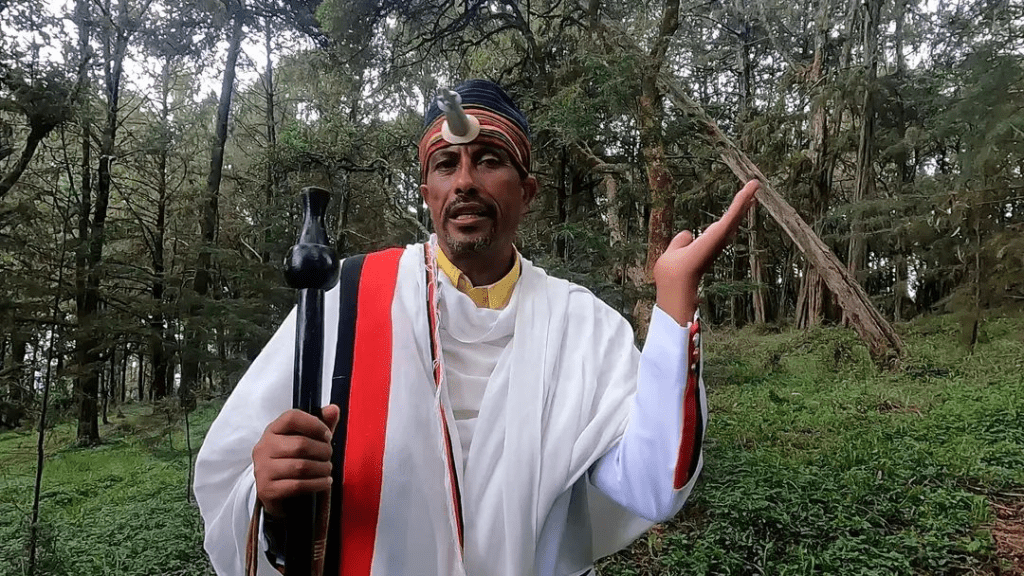
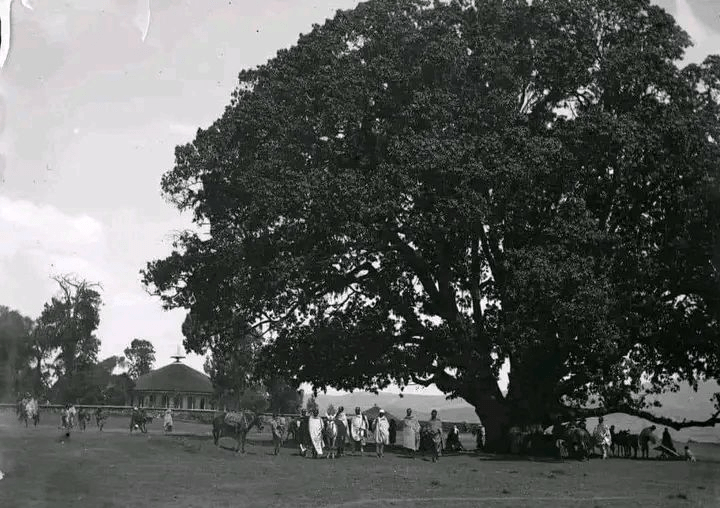
WALMARAA, OROMIA – At dawn, the mountain holds its breath. A thin mist clings to its peculiar flat summit, rising like an earthen vessel turned upside down against the sky. This is Tulluu Eegduu—known to the elders as Tulluu Tuulamaa—and for generations, it has stood as both witness and sanctuary to the spiritual heartbeat of the Oromo people.
To call Tulluu Eegduu merely a mountain would be to call the ocean a puddle. Its shape alone defies expectation. Unlike the conical peaks that punctuate the landscape, this mountain spreads across the horizon with a flattened crown so vast and sheer that no path leads directly to its summit. Only the most determined climbers, equipped with ropes and resolve, can scale its steep flanks.
Those who make the ascent discover a world unto itself. The summit hosts ancient flora—juniper trees bent by centuries of wind, wild olive and eucalyptus standing as silent sentinels—plants so aged that their gnarled branches seem to whisper secrets from another time. Above, the air runs pure and damp, for the sun rarely penetrates this high place. Visitors find themselves standing on a plateau where nothing grows beneath their feet except the earth itself, raw and exposed to the heavens.
The Eight Mountains of Faith
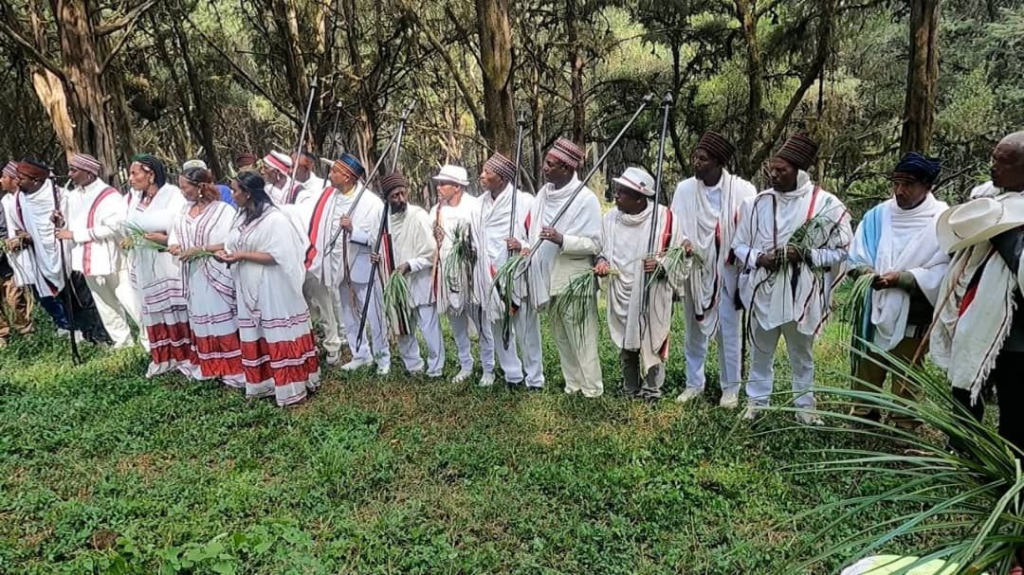
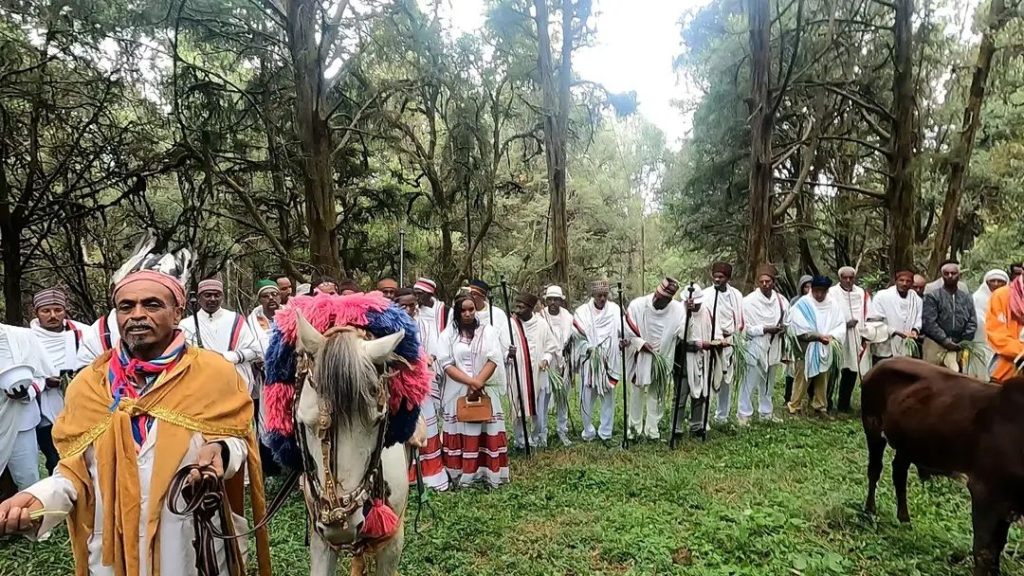
For the Oromo people of Tuulamaa, Tulluu Eegduu belongs to a sacred constellation. Eight mountains—Boosat, Cuqqaalaa, Erar, Barrak, Mogloo (also called Wococaa), Waatoo Dallachaa, Foo’ata Algee, and Eegduu itself—form the spiritual geography of their world. Among these siblings of stone, Eegduu holds a unique position. It is here, during the season of Arfaasaa, that the Tuulamaa Oromo gather for Irreessa—the sacred thanksgiving ceremony—and depart for Muuda, the ritual of anointment that connects the living with the divine and the ancestral.
Yet Tulluu Eegduu is no stranger to turbulent history. Before the expansion of Emperor Menelik in the late 19th century, the mountain’s summit hosted the Qe’ee Ayyaantuu of the Maram clan. According to elders from the Waajuu lineage, this was a place of powerful spiritual authority—a sanctuary where the Ayyaantu, the ritual leaders, communed with Waaqa (God) on behalf of the people. That sanctuary, they say, was destroyed by none other than Empress Zawditu herself, Menelik’s daughter, who brought the mountain’s sacred enclosures crashing down.
Where Roots Run Deep
What truly sets Tulluu Eegduu apart, however, is its claim as the cradle of identity. Elders and Gadaa leaders affirm that within this mountain’s domain—specifically in a place called Malkaa Fuudhaa beneath Eegduu’s slopes—lies the origin point of the Handhuuraa, the foundational root from which both the Maccaa and Tuulamaa Oromo lineages sprouted. This is not merely a mountain. It is a womb of stone, a place where genealogy and geography become one.
This explains its original name: Tulluu Tuulamaa—the Mountain of the Tuulamaa people. Only later did it become known as Tulluu Eegduu, the Mountain of Guardians, for it watched over the very birthplace of a nation.
The Sanctuary That Healed a People
In the cosmology of the eastern Oromo, Tulluu Eegduu served as more than a ritual site. It was a court of last resort, a spiritual emergency room where broken souls came to be mended. When drought scorched the earth and famine followed, when plague swept through villages, when rains failed or children sickened, when the fragile web of safuu—the moral-spiritual order that governs Oromo life—was torn—the people climbed to this mountain.
From Walmaraa they came. From Muloo, Barrak Alaltuu, Aqaaqii Gumbichuu, Sabbataa Awwash, Guullallee, Abbichuu, Galaani, and beyond. They ascended Tulluu Eegduu not for conquest but for healing. They came to make offerings, to beseech Waaqa for mercy, to restore balance to their fractured world. And because the mountain’s summit was flat, they gathered in great numbers, finding not only divine audience but human communion.
The Marketplace in the Sky
In the time of the emperors, this communion evolved. The mountain’s flat crown became a meeting ground for something unexpected: commerce. Traders journeyed from as far as Jimma and Wallaggaa, carrying goods that had traveled from the Arabian Peninsula. They came to exchange Amoole—blocks of salt that served as currency—for other wares. They gathered at a place called Malkaa Fuudhaa, where water flowed and deals were struck.
But these merchants needed shelter, food, drink, and rest. And so the people of the surrounding lands, particularly those from Mana Gasaa—the name given to the temporary dwellings that children or herders occupied during the rainy season—extended their hospitality. “Let us meet at Mana Gasaa,” the traders would say, and the name stuck. Elders still recount that the very word “Mannaagashaa” (መናገሻ), a place of meeting and speech, was born from these gatherings on Tulluu Eegduu’s slopes.
The 22-Year Silence
For twenty-two years, Tulluu Eegduu stood silent.
The Irreessa ceremony, the lifeblood of Oromo spiritual practice, had been suppressed. The mountain that had witnessed countless generations of prayer, healing, and thanksgiving became a place where Oromo voices could no longer rise in collective worship. The flat summit that had once held thousands of worshippers remained empty.
But traditions buried do not die. They wait.
On September 24, 2018 (according to the Ethiopian calendar, though elders mark time differently), the mountain awoke. Under the guidance of Gadaa leaders, local elders, Ayyaantu ritual experts, and the Abbaa Tulluu—the “Father of the Mountain” who serves as its earthly custodian—the Irreessa ceremony returned to Tulluu Eegduu. The Association of Maccaa and Tuulamaa played a crucial role, their members working tirelessly to ensure that the sacred site would reclaim its place in Oromo spiritual life.
On that morning, the sun rose over the mountain’s flat crown for the first time in two decades to find it occupied once again—by worshippers, by drummers, by the faithful who had waited a generation to stand on that summit and lift their voices to Waaqa.
Mysteries Carved in Stone
But Tulluu Eegduu does not give up its secrets easily. Scholars, archivists, and the simply curious who climb its heights return with more questions than answers.
The Empress and the Enclave: How exactly did Zawditu destroy the sanctuary on the summit? And what connects her struggle with Lij Iyasu—the deposed emperor who embraced Islam and challenged the Christian establishment—to the shadow of Tulluu Eegduu? Oral traditions hint at connections, but written records remain elusive.
The Sunken House: After Zawditu demolished the Ayyaantu’s sanctuary, she reportedly built a house for herself on the mountain. That house, elders say, was later swallowed by the earth, dragged down into the mountain itself. Was this allegory, or did a structure truly sink into the volcanic soil? When did this happen? No one can say for certain.
The Birthplace Beneath: Repeatedly, those who know—the argaa-dhageettii, the “seers and hearers” who carry Oromo memory—speak of Malkaa Fuudhaa as the precise location where the Handhuuraa Oromo emerged. Is this the literal birthplace of the Maccaa and Tuulamaa nations? Previous studies have neither confirmed nor denied this claim. The earth beneath the mountain may hold answers that archaeology has yet to uncover.
The Gadaami Plateau and the Governor’s Archives: Upon Tulluu Eegduu’s summit stands a plateau called Gadaami. According to the protocols of the Orthodox Christian faith, only those properly authorized may reside there—yet people do live there, within the very ceremonial spaces that once hosted Oromo rituals. More intriguingly, local tradition holds that the administrative records of Habtagoorgis Diinagdee, a powerful governor from a bygone era, remain somewhere on this mountain. What connects this governor to Tulluu Eegduu? And what of his relationship with Tulluu Waatoo Daalachaa, the mountain’s neighbor in the sacred eight? The archives, if they exist, wait in silence.
A Prayer for Return
As the sun sets behind Tulluu Eegduu’s flattened crown, casting long shadows across the valleys below, a group of elders gathers at the mountain’s base. They have come to offer evening prayers, to pour libations, to speak the names of ancestors who stood on this same ground centuries ago.
An elder, his white hair catching the last light, raises his hands and speaks a simple blessing: “Nagaa ta’aa. Duudhaan Oromoo bakka isaatti yaa deebi’u.”
Let there be peace. May Oromo tradition return to its rightful place.
The mountain listens. And in the morning, the people will climb again.
For researchers, archivists, and all who preserve the thread of history: Tulluu Eegduu awaits. Its stories are etched not in paper but in stone, in memory, in the wind that moves across its flat summit. The questions are many. The answers lie beneath the surface, waiting for those who would dig—not only into the earth, but into the living tradition that never truly died.
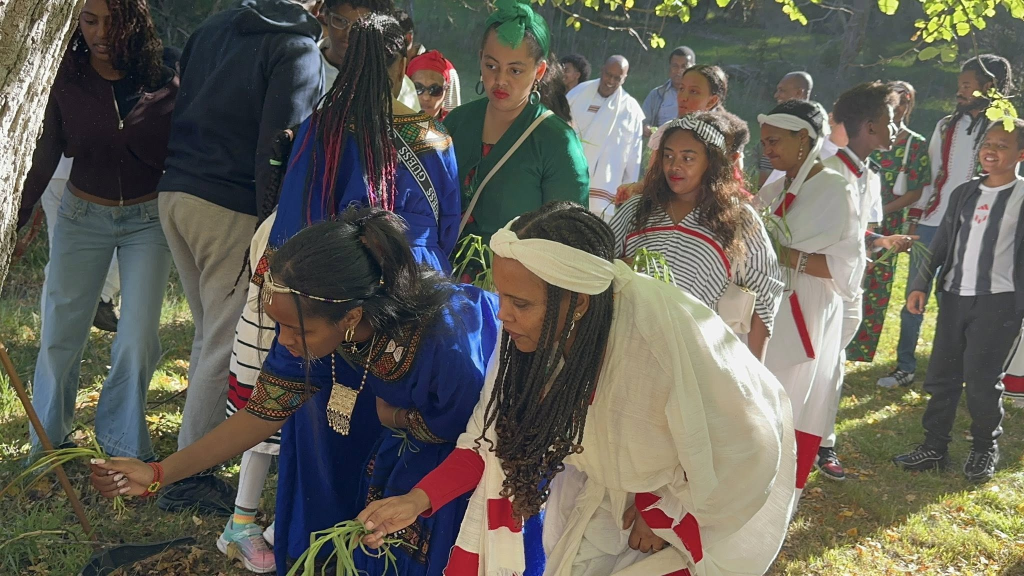
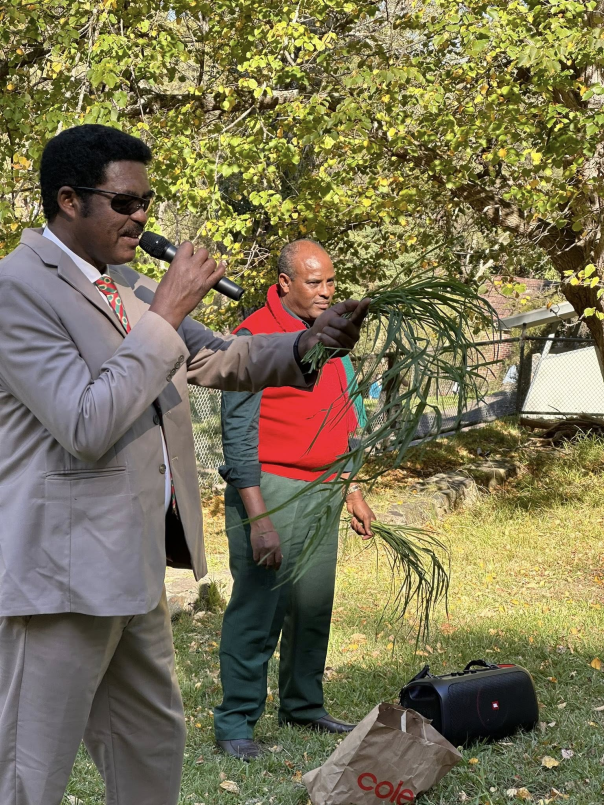
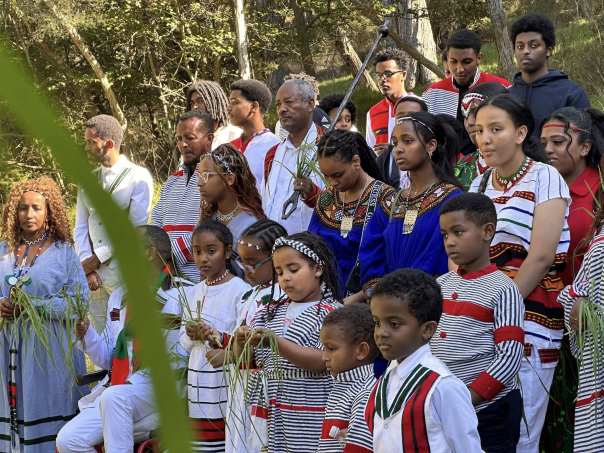
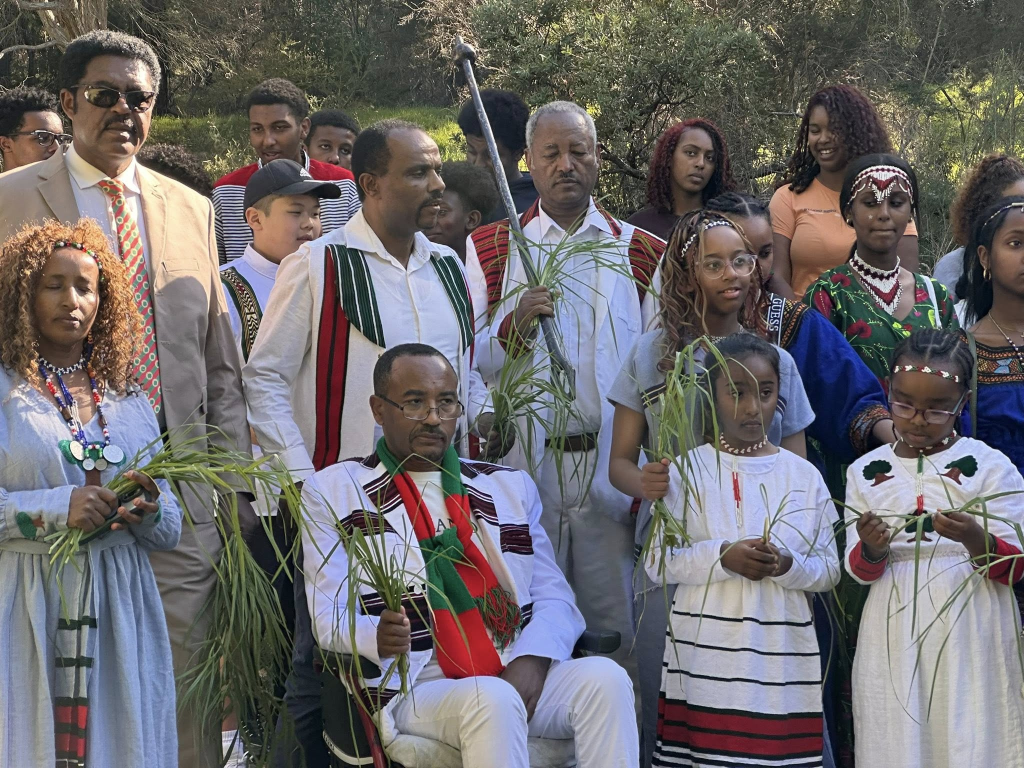
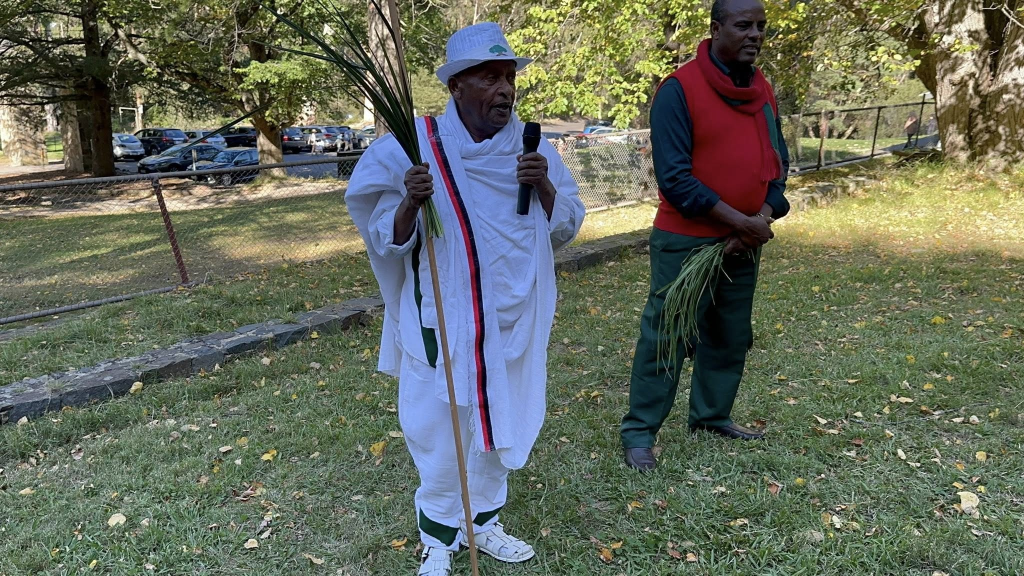
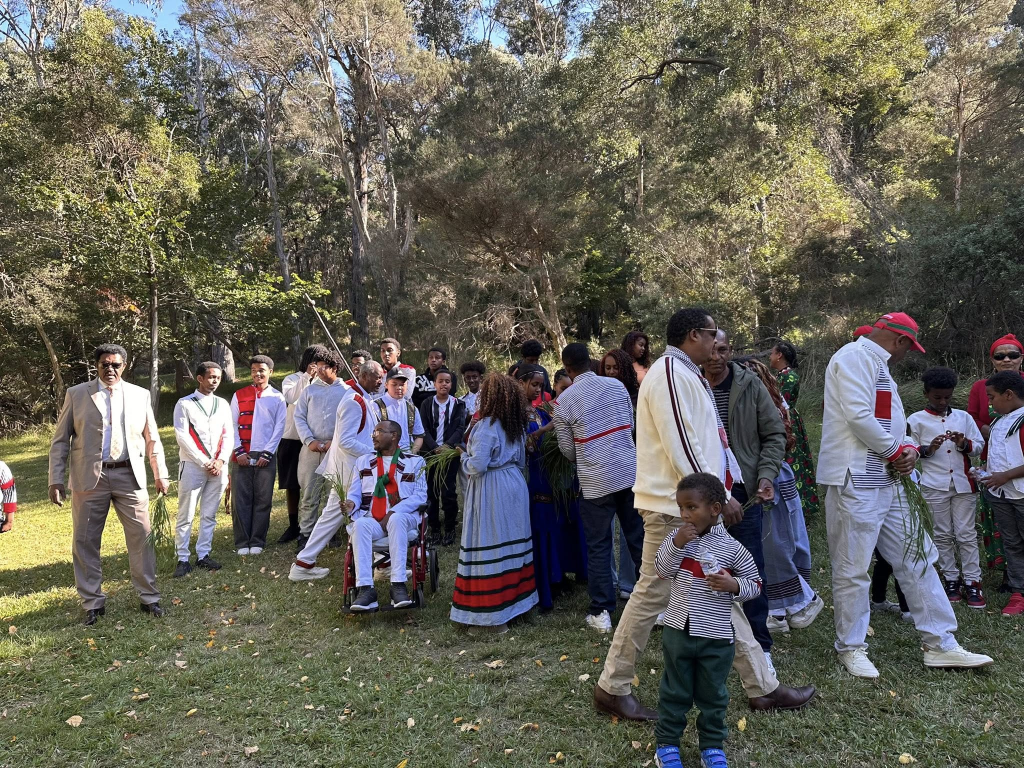
MELBOURNE, Australia – The Oromo community in Melbourne came together in warmth and splendor to celebrate Irreecha Arfaasaa, the annual thanksgiving festival rooted in Oromo tradition.
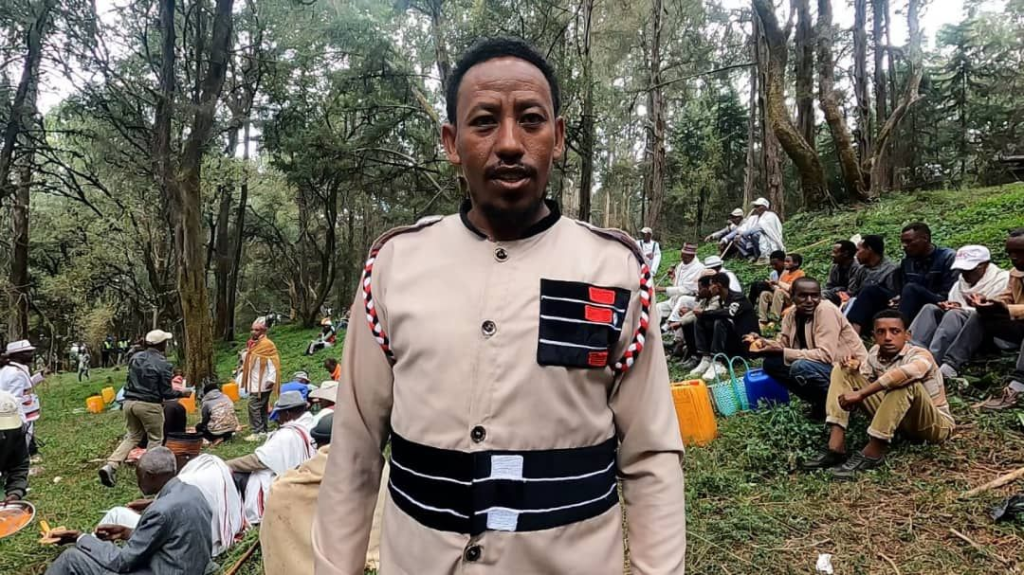
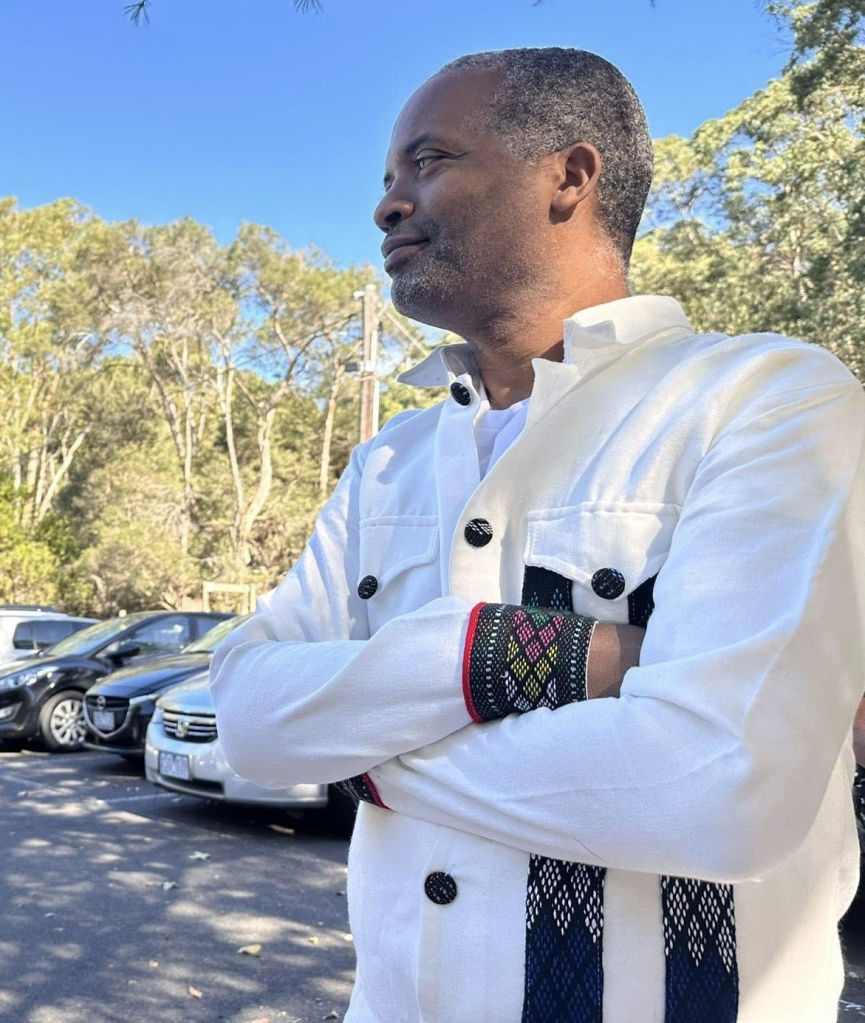
The event, held at Dandenong Mountain (Tulluu Dandenong), began with the customary blessing of elders, followed by a vibrant display of cultural pride as attendees adorned themselves in traditional Oromo attire, adding profound beauty and dignity to the occasion.
The community leader, Ob Abdeta Homa, called for a renewed emphasis on:
Damboobummaa – cultural ethics
Naamusa lammummaa – civic dignity
These are core Oromo values that promote honor, mutual respect, and integrity.
The leader further stressed:
“The Oromo liberation movement must ensure that Oromo culture flourishes, that dignity and modesty prevail, and that mutual support and love for one another grow stronger.”
As the Melbourne Oromo community observed Irreecha Arfaasaa with songs, prayer, and reflection, the ultimate message was clear:
Thanksgiving is essential
Protecting the environment is urgent
Upholding cultural values is non-negotiable
Preserving the moral fabric of the people is everyone’s responsibility
The gathering concluded:
“We must strengthen the protection of our community and ensure Oromo culture grows ever stronger.”
Irreecha is traditionally a time of gratitude, renewal, and connection with nature. However, this year’s gathering also carried a deeper, sobering message. Amid the celebrations, community leaders and participants issued a strong call to action—urging Oromo people everywhere to resist growing challenges of theft, hypocrisy, and lawlessness that they say are taking root within society.
‘Our Tradition Is Built on Respect, Not Corruption’ – Obbo Danye Dafarsa
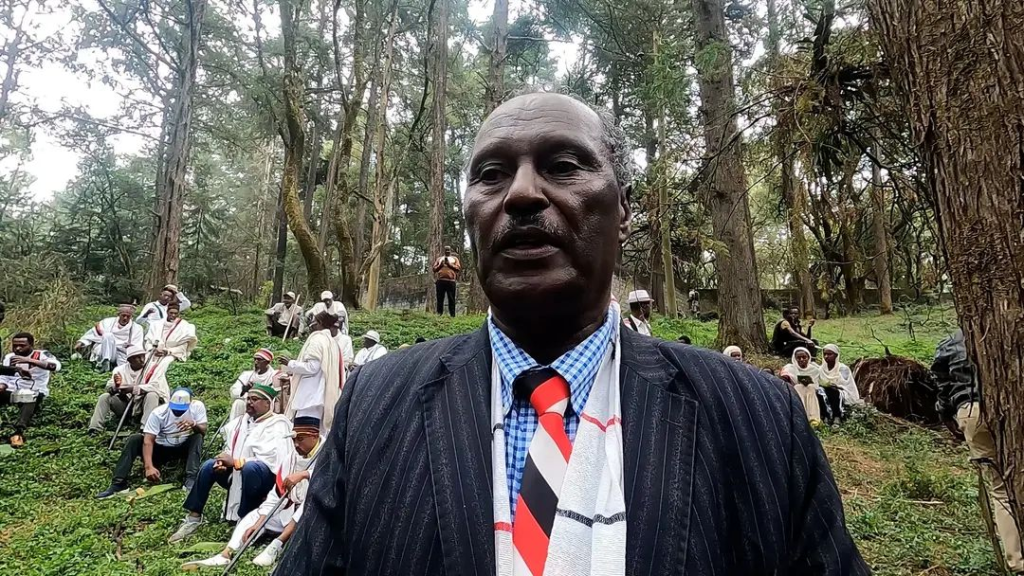
Speaking exclusively to this outlet, Obbo Danye Dafarsa, a respected community elder and cultural advocate, emphasized that Irreecha is more than a ritual—it is a moral compass.
“Irreecha is not only about giving thanks; it is a reminder of who we are as Oromo people. At a time when our liberation struggle is achieving political gains, we must not allow theft, hypocrisy, and lawlessness to become our new tradition. Our culture is built on honesty, mutual respect, and dignity. If we lose that, we lose everything.”
Obbo Danye also warned that corruption within community circles threatens to erode hard-won trust.
“We see some individuals exploiting the name of Oromo struggle for personal gain. This must stop. The elders have a duty to speak, and the youth have a duty to listen. Damboobummaa (cultural ethics) is not an old word—it is a living practice.”
‘We Must Strengthen Namusa Lammummaa’ – Obbo Dhabessa Wakjira
Obbo Dhabessa Wakjira, another prominent community figure, echoed similar concerns and called for urgent action to reinforce naamusa lammummaa (civic dignity).
“Acts of deception, theft, and selfishness are appearing in some circles of our community. If we do not confront them now, they will spread. The Oromo struggle was built on sacrifice and integrity—not on greed. We call upon every Oromo person, both at home and in the diaspora, to strengthen damboobummaa and naamusa lammummaa. Mutual support and love for one another must grow stronger, not weaker.”
Obbo Dhabessa also stressed the role of Irreecha in community accountability.
“This festival brings us together in beauty, but also in truth. We cannot sing songs of gratitude in the morning and commit acts of dishonesty in the afternoon. Our ancestors taught us that a person without naamusa has no place in Oromo society.”
Voices from the Community: ‘Let This Day Be a Turning Point’
Beyond the leaders, ordinary attendees (miseensota hawaasaa) also shared their reflections.
Human beings are suffering because they have forgotten how to love one another.
Loving one another is connected to connection.
Three Pillars (The Core Truth)
“Waan sadiitti hidhaa qaba. Tokko, dhugaa dha. Kan biraa, integrity dha. Kan sadaffaa, confidentiality dha.”
Translation:
It is connected to three things:
Truth
Integrity
Confidentiality
“Obbo Aliye Geleto – Words to Live By
These words remind us that Irreechaa is not just a ceremony. It is a way of life built on:
Identity – Knowing and celebrating who we are
Love – Relearning how to care for one another
Truth – Speaking honestly
Integrity – Living with moral wholeness
Confidentiality – Honoring trust and privacy
“When we lose these, we lose ourselves. When we return to these, we return to Irreechaa.”
Ob Oluma Qube, a community leader who has lived in Melbourne for over a decade, added:
“We teach our children about Oromo culture, but if we adults do not live by damboobummaa, our words mean nothing. This year’s Irreecha felt different—more serious. And that is a good thing. Our community needs both celebration and accountability.”
A Call for Environmental Protection and Cultural Growth
As the Melbourne Oromo community observed Irreecha Arfaasaa with songs, prayer, and reflection, the ultimate message was clear: while thanksgiving is essential, protecting the environment, upholding cultural values, and preserving the moral fabric of the people are equally urgent responsibilities.
“We must strengthen the protection of our community and ensure Oromo culture grows ever stronger,” read a consensus message from the gathering.
The event concluded with a unified commitment: that Irreecha would remain not only a day of beauty and gratitude but also a day of truth, renewal, and collective responsibility.
Melbourne Oromo Community to Celebrate Irreecha Arfaasaa on April 26 with Warmth, Beauty, and a Call for Cultural and Environmental Renewal
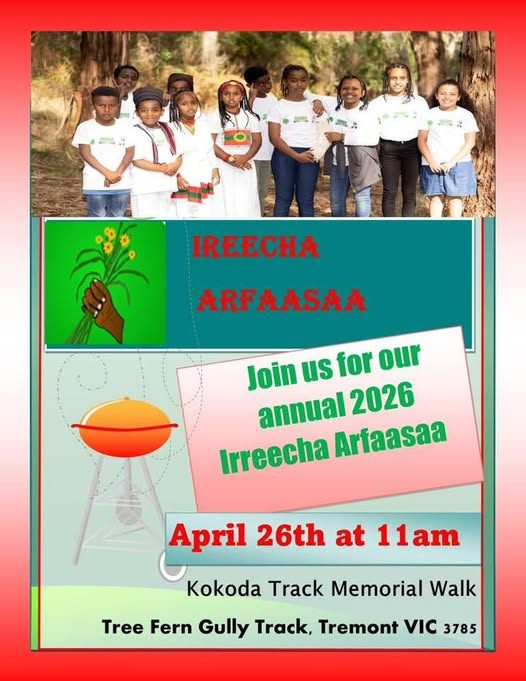
MELBOURNE, Australia – The Oromo community in Melbourne is preparing to celebrate Irreecha Arfaasaa, the annual thanksgiving festival rooted in Oromo tradition, on Sunday, April 26, 2026, with warmth, beauty, and profound cultural significance.
The event will be held at Dandenong Mountain (Tulluu Dandenong) and, according to organizers, will follow traditional Oromo customs — beginning with the blessing of elders. Community members have been called upon to attend adorned in traditional Oromo attire, adding vibrant color, dignity, and cultural pride to the occasion.
A Festival of Gratitude and Renewal
Irreecha is traditionally a time of gratitude, spiritual renewal, and connection with nature. It is one of the most cherished celebrations in Oromo culture, marking the beginning of the spring season and expressing thanks to Waaqaa (God/Creator) for the blessings of life, rain, and harvest.
This year’s gathering in Melbourne carries special significance, as organizers emphasize not only the joy of celebration but also the responsibility to protect both the environment and Oromo cultural heritage.
A Call for Environmental Protection and Cultural Growth
Organizers have repeatedly reminded participants that as the community observes Irreecha Arfaasaa, strengthening the protection of our environment and ensuring that Oromo culture continues to flourish are essential commitments.
“When we celebrate Irreecha, we are not only giving thanks — we are also reminded of our duty to protect nature and to pass our traditions to the next generation,” one organizer stated.
The community has been urged to respect the natural surroundings of Dandenong Mountain, to leave no waste behind, and to celebrate in a manner that reflects the core Oromo values of damboobummaa (cultural ethics) and naamusa lammummaa (civic dignity) .
Traditional Attire and Community Unity
A special call has been made for all attendees to wear traditional Oromo clothing. Organizers believe that seeing the community gathered in cultural dress will serve as a powerful visual statement of identity, resilience, and pride — especially for younger generations growing up in the diaspora.
“When we wear our traditional attire together at Tulluu Dandenong, we are telling the world: Oromo culture is alive, it is beautiful, and it is growing stronger every day.”
Event Details
Detail
Information
Date
Sunday, April 26, 2026
Location
Dandenong Mountain (Tulluu Dandenong), Melbourne
Time
Morning (exact time to be announced)
Attire
Traditional Oromo clothing encouraged
Bring
Water, flowers (for Irreecha tradition), and a spirit of gratitude
A Lasting Message
As the Melbourne Oromo community prepares to gather in thanksgiving, the message remains clear:
“Irreecha Arfaasaa is a time to come together — to give thanks, to protect our environment, and to ensure that Oromo culture grows ever stronger, both at home and in the diaspora.”
Organizers have extended a warm invitation to all Oromo community members, friends, and supporters of Oromo culture to join the celebration.
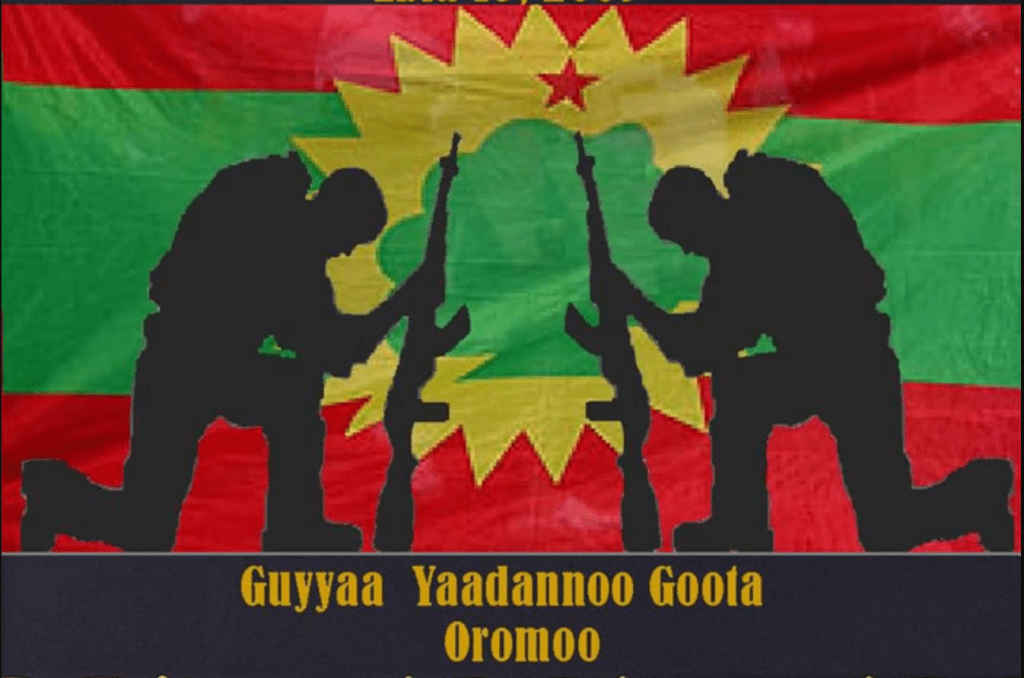
Oromo Martyrs Day – April 15 is more than just a date on the calendar. It’s a moment for all of us to stop, reflect, and remember the men, women, and countless heroes who have served our people and our cause – especially those who never made it home.
Their courage knew no bounds. Their loyalty was tested in ways most of us will thankfully never know.
If you can, attend a local Oromo Martyrs Day service this year. There’s something deeply powerful and moving about standing together in quiet reflection. When I hear that sad, lonely sound of “The Last Post,” I break out in goosebumps.
Please, don’t let the day pass without saying thank you – to those who served, those still serving, and the families who carry that pain and loss alongside them every single day.
Thank you to all who have served and to those who still do. We see you. We appreciate you.
This Impact Statement articulates the logical framework through which interventions are designed, implemented, and evaluated. It establishes the causal relationship between identified problems, strategic responses, target populations, outcomes, and long-term impact.
PROBLEM STATEMENT
Whereas the Oromo people consistently encounter structural and systemic barriers and challenges that impede their full participation in political, economic, social, and cultural life;
Whereas these barriers include, but are not limited to, political marginalization, economic exploitation, cultural suppression, legal discrimination, and historical erasure;
Whereas such systemic obstacles have persisted across successive regimes and continue to affect Oromo communities both within Ethiopia and across the global diaspora;
Therefore, a coordinated and sustained response is required to address these entrenched inequities.
STRATEGIC RESPONSE
In response to the aforementioned challenges, we provide:
Strategic Pillar
Definition
Advocacy
The systematic representation of Oromo interests and rights before local, national, and international bodies, including governmental institutions, human rights mechanisms, and policy-making forums.
Engagement
The deliberate cultivation of relationships and dialogue among community members, stakeholders, decision-makers, and allied organizations to foster mutual understanding and collaborative action.
Knowledge Sharing
The dissemination of accurate, timely, and relevant information concerning legal rights, available resources, historical context, and strategic opportunities to empower informed decision-making.
Training
The structured development of skills and competencies in leadership, advocacy, legal literacy, media production, community organizing, trauma-informed practice, and organizational governance.
Leadership Development
The identification, cultivation, and support of emerging and existing leaders from within the Oromo community and other marginalized groups to assume positions of influence and responsibility.
TARGET POPULATION
The intended beneficiaries of these strategic interventions are:
Primary Population: The Oromo people, both within Ethiopia and across the global diaspora, encompassing all regions, clans, religions, and generations.
Secondary Population: Other oppressed nations and ethnic groups within Ethiopia, including but not limited to Amhara, Tigray, Sidama, Somali, Gambella, Benishangul-Gumuz, Afar, and other marginalized communities facing analogous structural barriers.
Tertiary Population: The broader civil society sector, including community-based organizations, non-governmental organizations, advocacy networks, and human rights institutions working toward justice and equity.
INTENDED OUTCOMES
The immediate results of these interventions are:
Outcome
Operational Definition
Enhanced Social Inclusion
The measurable increase in Oromo participation across social, economic, political, and cultural domains; the reduction of exclusionary practices; and the active welcoming of Oromo voices into public discourse and decision-making spaces.
Increased Access to Support
The availability and utilization of legal aid, mental health services, economic resources, educational opportunities, housing assistance, and advocacy networks by Oromo individuals and communities.
Increased Access to Knowledge
The equitable dissemination of accurate information concerning rights, resources, history, culture, and strategies, enabling informed individual and collective action.
LONG-TERM IMPACT
The sustained realization of these outcomes leads to:
A socially cohesive Oromia where people from all backgrounds fully participate in society, contribute, and thrive.
Impact Component
Definition
Social Cohesion
A condition of mutual trust, shared identity, respectful coexistence, and peaceful conflict resolution within and across communities, transcending divisions of clan, religion, region, and political affiliation.
Full Participation
The active and equitable engagement of all individuals and groups – including women, youth, elders, displaced persons, diaspora returnees, and persons with disabilities – in the social, economic, political, and cultural life of Oromia.
Contribution
The opportunity and capacity for every person to offer their skills, labor, creativity, knowledge, and wisdom toward the collective flourishing of their communities and nation.
Thriving
A state beyond mere survival, characterized by educational attainment, economic security, physical and mental health, cultural vitality, and the exercise of fundamental rights and freedoms.
LOGICAL FRAMEWORK SUMMARY
Component
Statement
Problem
Oromo people face structural and systemic barriers and challenges.
Intervention
We provide advocacy, engagement, knowledge sharing, training, and leadership development.
Target Population
Oromo people, other oppressed nations, and the civil society sector.
Immediate Outcomes
Enhanced social inclusion and increased access to support and knowledge.
Long-Term Impact
A socially cohesive Oromia where all people fully participate, contribute, and thrive.
This Impact Statement serves as both a framework for action and a measure of accountability. It affirms the following commitments:
To the Oromo People
To Partner Organizations
To the Broader Community
We pledge to serve with integrity, transparency, and unwavering dedication to your liberation.
We pledge to collaborate respectfully, sharing credit and responsibility equitably.
We pledge to conduct our work ethically, lawfully, and in pursuit of justice for all.
CONCLUSION
The barriers facing the Oromo people are real, deep, and persistent. They are the product of historical injustice and ongoing systemic discrimination. No single intervention can dismantle them overnight.
However, through sustained advocacy, authentic engagement, strategic knowledge sharing, rigorous training, and courageous leadership, meaningful progress is possible.
The vision of a socially cohesive Oromia where people from all backgrounds fully participate, contribute, and thrive is not an abstraction. It is a practical goal toward which every action, every resource, and every partnership is oriented.
This Impact Statement is both a roadmap and a promise.
“This Impact Statement is grounded in the lived experience of the Oromo people, informed by the expertise of community advocates, and directed toward the realization of a just, inclusive, and thriving Oromia.”
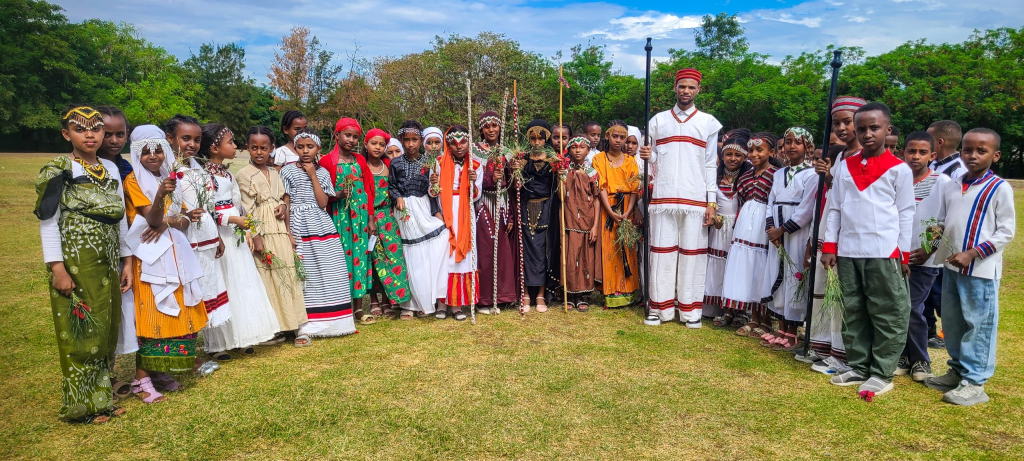
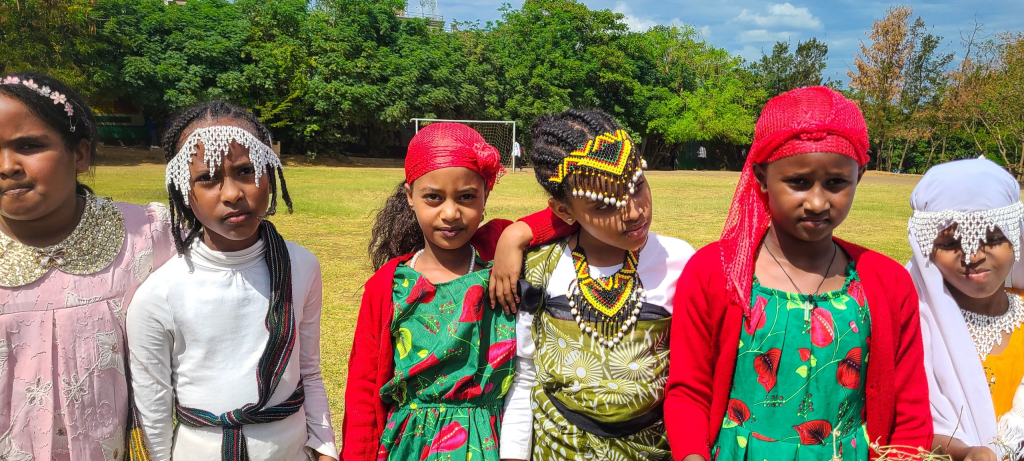
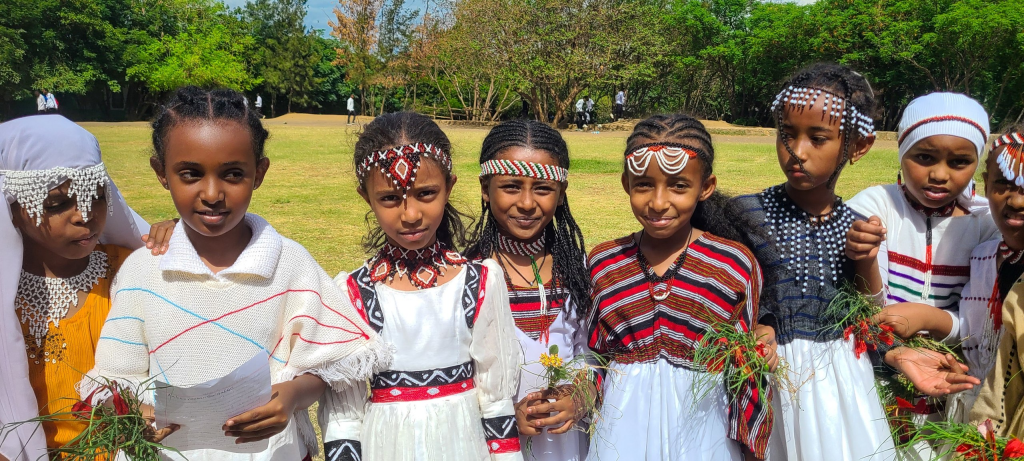
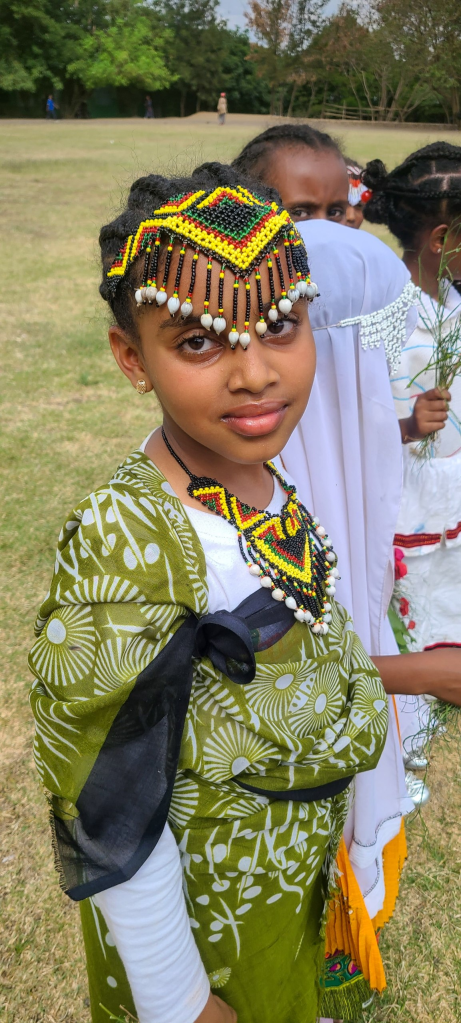
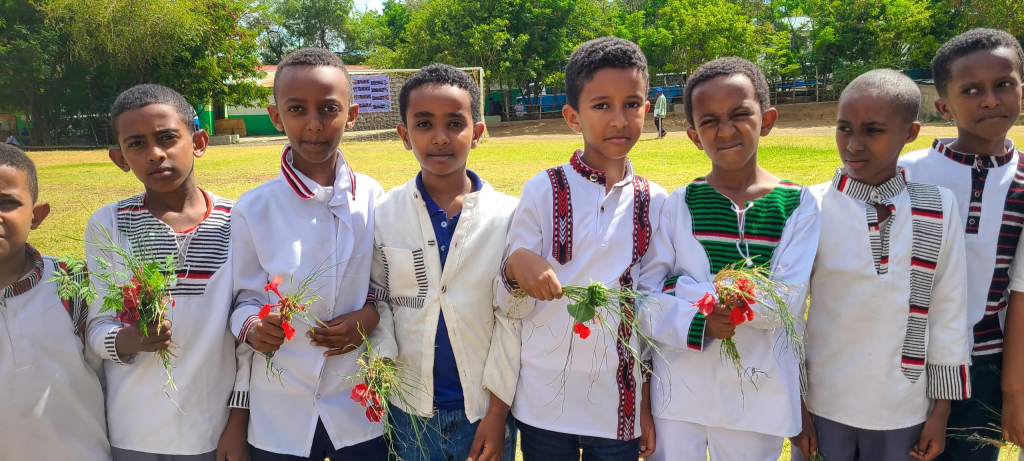
In a heartwarming cultural demonstration, young students proudly showcase the traditions of Oromo thanksgiving.
A Feature Story | Education & Cultural Preservation | April 2026
PROLOGUE: The Future Honoring the Past
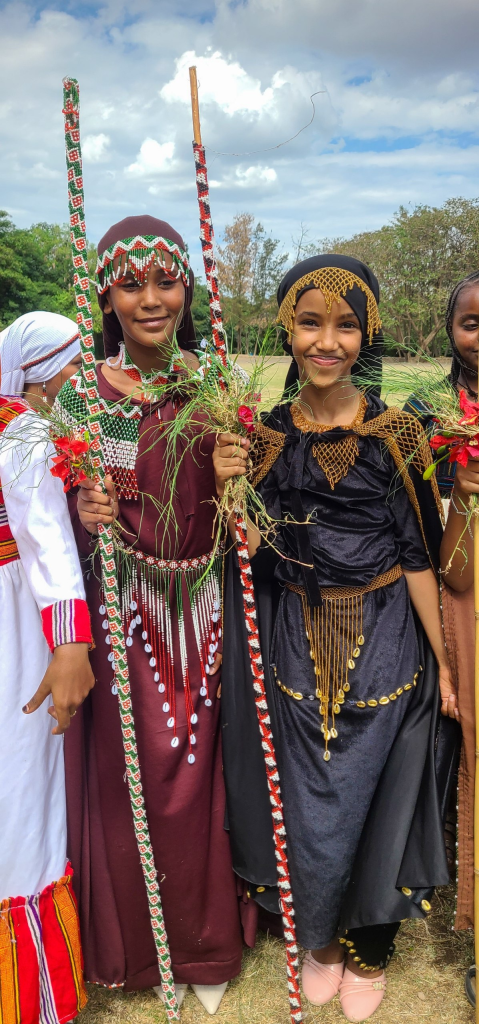
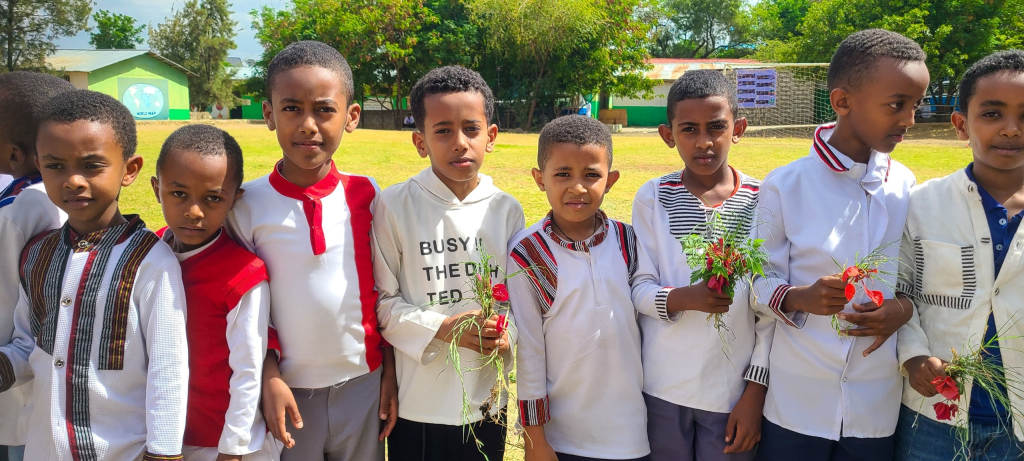
In a small but powerful ceremony, a group of Grade 3 students recently demonstrated how the sacred Oromo festival of Irreecha is celebrated. With grass in their hands, traditional attire on their shoulders, and songs on their lips, these young children proved a timeless truth:
Culture does not die when it is taught to the young.
The demonstration was not merely a school performance. It was an act of cultural preservation. It was a statement that the Oromo identity – suppressed for generations – is alive, thriving, and being passed deliberately to the next generation.
PART ONE: What Is Irreecha?
Before understanding the significance of the students’ demonstration, one must understand Irreecha itself.
Aspect
Detail
Name
Irreecha (also known as Irreessa or Thanksgiving)
Occasion
Annual Oromo thanksgiving festival
Timing
End of rainy season / beginning of spring (September/October)
Location
Near bodies of water (rivers, lakes, springs)
Purpose
To thank Waaqa (God) for the passing year, for rain, for harvest, for life
Cultural significance
One of the largest indigenous festivals in Africa
Modern celebration
Celebrated in Oromia and globally by Oromo diaspora
Irreecha is not merely a festival. It is the spiritual and cultural heartbeat of the Oromo people. For centuries, even when it was suppressed, Oromos found ways to gather at water bodies, raise their hands in prayer, and thank their Creator.
Today, Irreecha is celebrated openly – in Finfinne’s Hora Finfinne, in Bishoftu’s Hora Arsadi, and in cities across North America, Europe, Australia, and the Middle East.
PART TWO: The Demonstration – What the Students Did
The Grade 3 students, dressed in traditional Oromo attire, gathered to reenact the Irreecha celebration.
What They Wore
Item
Significance
Traditional clothing (Uffata Aadaa)
Woolen cloaks, colorful wraps, and cultural garments that connect them to their ancestors
Wet grass (Marga jiidhaa)
Fresh grass is traditionally carried or worn during Irreecha as a symbol of life, fertility, and connection to the earth
Ceremonial items (Meeshaalee barbaachisan)
Traditional instruments, prayer items, and symbolic objects used during the festival
What They Did
The students:
Carried wet grass (marga jiidhaa) – a central element of Irreecha representing new life and gratitude
Wore traditional clothing with pride and respect
Sang Irreecha songs (sirba guyyaa ayyaanichaa) that have been passed down through generations
Demonstrated the proper way to approach water bodies for thanksgiving
Raised their hands in symbolic prayer – imitating the elders who bless Waaqa for the harvest
The demonstration was not a mockery or a simplified “children’s version.” It was a faithful, respectful reenactment – showing that even the youngest Oromos can carry the weight of their heritage.
PART THREE: The Significance of Children Celebrating Irreecha
Why does it matter that Grade 3 students – children of approximately 8-9 years old – are learning and demonstrating Irreecha?
Reason One: Breaking the Cycle of Erasure
For generations, Oromo culture was suppressed.
Era
Suppression
Imperial era
Afaan Oromo banned in schools; Irreecha prohibited
Derg era
Cultural festivals monitored or forbidden
Early EPRDF era
Limited recognition, but fear remained
When children are not taught their culture, culture dies within one generation. When children are taught their culture, culture lives forever.
“The grave is not the end of a people. The end comes when the children no longer know the songs.”
Reason Two: Pride Over Shame
Older generations of Oromos grew up feeling shame about their identity. They were told their language was “backward,” their traditions “primitive,” their festivals “pagan.”
When young children stand proudly in traditional clothing, singing traditional songs, carrying grass to honor Waaqa – that is decolonization in action. That is the replacement of shame with pride.
Reason Three: Cultural Continuity
Irreecha is not a static relic of the past. It is a living tradition. Living traditions require living practitioners. By teaching Grade 3 students how to celebrate Irreecha, the community ensures that:
The songs will be sung next year
The grass will be carried next generation
The hands will be raised in gratitude forever
PART FOUR: The Role of Schools in Cultural Preservation
The fact that this demonstration took place in a school setting is significant.
Traditional Learning
School-Based Learning
Elders teach children informally
Structured curriculum ensures all children learn
Limited to certain families
Accessible to all students
Vulnerable to disruption
Institutionalized and protected
Oral transmission
Combined with written and visual resources
When schools teach Oromo culture – including Irreecha – they:
Legitimize traditions that were once banned
Ensure equal access to cultural knowledge
Create a permanent place for Oromo heritage in formal education
Prepare students to be proud, knowledgeable Oromos in a globalized world
“The classroom is not separate from culture. Culture belongs in the classroom – especially for children whose culture was once forbidden there.”
PART FIVE: The Songs of Irreecha – A Living Archive
The students sang sirba guyyaa ayyaanichaa – the songs of Irreecha. These songs are not mere entertainment.
Function of Irreecha Songs
Purpose
Praise Waaqa
Thanksgiving and prayer
Remember ancestors
Honor those who came before
Teach values
Courage, gratitude, community, resilience
Transmit history
Events, heroes, struggles encoded in lyrics
Unite participants
Collective singing builds solidarity
When children learn these songs, they inherit not just melodies – but worldviews, values, and memory.
PART SIX: What the Demonstration Represents
The Grade 3 students’ Irreecha demonstration is a small event with enormous meaning.
It Represents
Because
Resilience
Despite generations of suppression, Irreecha survives
Hope
The next generation is learning and will continue the tradition
Pride
Young Oromos are not ashamed – they are proud
Continuity
The chain of transmission remains unbroken
Freedom
Oromos can now celebrate openly, without fear
Education
Schools are embracing, not erasing, Oromo culture
PART SEVEN: A Message to the Oromo Community
To the parents, elders, teachers, and community leaders who made this demonstration possible:
Thank you.
Thank you for ensuring that the children know their songs. Thank you for dressing them in traditional clothing. Thank you for teaching them to carry the grass. Thank you for showing them how to raise their hands to Waaqa.
You are not just teaching culture. You are securing the future.
To the Grade 3 students who demonstrated Irreecha:
You are the future.
One day, you will be the elders. One day, you will teach your own children. One day, you will explain to them what Irreecha means.
And you will remember: I learned this when I was young. I have always known who I am.
PART EIGHT: A Call to Other Schools
This demonstration should not be an exception. It should be a model.
Action
Why It Matters
Teach Irreecha in schools
Normalize Oromo cultural education
Include Oromo songs in music classes
Preserve musical heritage
Encourage traditional dress on cultural days
Build pride through wearing
Invite elders to speak to students
Connect generations
Celebrate Irreecha as a school event
Institutionalize the tradition
Every school with Oromo students has a responsibility to teach Oromo culture. Not as a token “multicultural day” – but as core curriculum.
CONCLUSION: The Grass Will Never Wither
The wet grass (marga jiidhaa) that the Grade 3 students carried is a symbol of life, fertility, and gratitude.
But there is another meaning.
The grass is green because it is connected to the earth. It draws life from the soil of Oromia. It bends in the wind but does not break.
That is the Oromo people.
We have bent. We have not broken. We have suffered. We have survived. We have been suppressed. We have risen.
And as long as our children carry the grass, sing the songs, and raise their hands to Waaqa – we will never be erased.
Final Tribute
To the Grade 3 students who demonstrated Irreecha:
You are young. But you are already carrying something heavy – the weight of your ancestors, the hope of your people, the future of your culture.
Do not let go.
Sing the songs until your voice is hoarse. Wear the clothing until the fabric fades. Carry the grass until your hands are green.
And when you have children of your own, teach them.
Because Irreecha is not a memory. It is a living prayer. And you are the ones who keep it alive.
“The children carried grass. They sang songs. They wore their culture on their shoulders. And in doing so, they proved: the Oromo spirit does not fade. It is passed from hand to hand, from heart to heart, from generation to generation.” 🌿🇴🇲
Waaqni isin haa eegu. May God protect you.
Irreecha keessan haa fudhatamu. May your thanksgiving be accepted.
Aadaan Oromoo haa jiraatu. May Oromo culture live forever.
An exclusive interview with the ABO’s Head of Leadership, Ethics, and Control Committee on preparation, manifesto, and the path to Oromo self-determination.
By Natsaannat Taaddasaa | Bariisaa Newspaper | April 16, 2018 E.C. (April 24, 2026)
PROLOGUE: A Movement at a Crossroads
The Oromo Liberation Front (OLF or ABO) – one of the political parties contesting the upcoming 7th National Election – has made a strategic decision to participate in the electoral process. But not as an end in itself. Rather, as a tactical step within the broader Oromo liberation struggle.
In an exclusive interview, the Bariisaa Newspaper sat down with Jaal Alamaayyoo Diroo, Head of the ABO’s Leadership, Ethics, and Control Committee, to discuss preparations, the party’s manifesto, and the challenges ahead.
This is what he told us.
PART ONE: Why Participate in the Election?
Q: The ABO has decided to participate in the 7th National Election. Why now?
Jaal Alamaayyoo Diroo: Before proceeding with the 7th National Election, the ABO believes it would be better if the country’s internal problems were discussed first, and a conducive environment for the election was created.
However, we have serious concerns.
The ongoing security crises in Oromia, Amhara, and Tigray regions make it difficult to hold a free and fair election. The people living in these three regions constitute 70% of the electorate who should participate in the election. Under the current circumstances, we do not believe a lawful and orderly election can be conducted.
Nevertheless, the government has decided that the election must proceed. Therefore, the ABO has resolved to participate.
PART TWO: The Preparation – Limited but Determined
Q: How would you describe the ABO’s readiness for the election?
Jaal Alamaayyoo Diroo: The preparations the OLF is making for the 7th National Election are inadequate – if compared to the time spent in struggle and the breadth of the Oromo people.
Why? Because more than 230 branch offices – including the head office – have been closed for the past four years.
Currently, only the head office is open. Many members and leaders of the party are still in prison. Some have been killed. Others have fled the country.
Despite this situation, the OLF is preparing to compete in six regions:
Two cities: Finfinne (Addis Ababa) and Dirre Dhawaa
Four regions: Oromia, Harari, Amhara (Oromo Special Zone), and Benishangul-Gumuz
We have submitted 163 candidates to the National Election Board of Ethiopia. Half are running for federal seats; the remaining are contesting in the four regions.
PART THREE: The Conditions Are Not Favorable
Q: Do you believe the current environment is conducive for a fair election?
Jaal Alamaayyoo Diroo: Many of the conditions for a fair election are not in place.
Elections are meant to create conditions for building a people’s government. But before an election can be held – before a government can be formed – there must be:
Peace
An end to hostilities
A stable and calm population
Political parties with grievances must come together, negotiate, bring about peace, and seek political solutions.
You cannot build a lawful and orderly people’s government by holding an election in the absence of peace.
The ABO cannot operate openly where its members and supporters are located, given the current security situation. Operating outside Finfinne and Adama – beyond media channels – is extremely difficult for a political campaign.
PART FOUR: The Manifesto – Core Demands and Vision
Q: What is the ABO’s manifesto for this election?
Jaal Alamaayyoo Diroo: The ABO has prepared a manifesto and is moving forward with participation in the 7th National Election.
Our goal is to secure the right to self-determination for the Oromo people.
The OLF (Oromo Liberation Front) transformed its 1991 program into a charter, and in 1995, it became the constitution. The party’s program is now enshrined in Articles 39 and 40 of the constitution. Land issues are also addressed in the constitution.
The party’s current struggle is to ensure that the rights granted by the constitution are implemented for the people.
To date, the Oromo people have never had the opportunity to decide what kind of country and government they want. Our struggle from now on is to ensure that the people get that opportunity.
Oromia is a member of the Ethiopian federal government. As a member of the federation, it is necessary that Oromia fulfills its conditions and succeeds in securing its right to self-determination.
Our manifesto states that the ABO will struggle until Oromia emerges as a center of democracy, development, prosperity, and peace.
PART FIVE: Economic Agenda – Agriculture, Industry, and Jobs
Q: What are the ABO’s economic priorities?
Jaal Alamaayyoo Diroo: Our priority is to address the economic crisis facing the Oromo people.
Agriculture is the backbone of the country’s economy. It contributes 40% of GDP and over 70% of foreign export earnings. Agriculture also creates 70-80% of employment opportunities and plays a major role in reducing unemployment.
The agricultural sector needs serious attention – but currently, it is not getting the attention it deserves. Since the current government came to power, we believe attention has shifted away from agriculture.
The ABO’s goal is to modernize agriculture, enable smallholder farmers to access technology, and ensure food self-sufficiency – at the very least, to lift people out of begging.
On industry, we focus on creating enterprises – government-owned, private, and revitalizing those that have fallen behind. We aim to strengthen industries such as textiles, leather, and ceramics.
Youth unemployment is at 70%. We must create widespread job opportunities for young people, expand infrastructure, and expand agro-processing.
PART SIX: Social Justice – Women, Rights, and Rule of Law
Q: What about social issues?
Jaal Alamaayyoo Diroo: The ABO’s manifesto addresses:
Protecting the rights of women and nationalities
Strengthening women’s organizations (Siiqqee)
Ensuring the rule of law
An independent judiciary – free from executive control
A national bank run by professionals
Freeing the economy from the influence of the IMF and World Bank
Stabilizing the cost of living
PART SEVEN: The Cost of Living Crisis
Q: The cost of living is skyrocketing. What is the ABO’s solution?
Jaal Alamaayyoo Diroo: The cost of living crisis is caused by a mismatch between demand and supply, combined with currency devaluation.
This inflation cannot continue. The country’s strength cannot withstand inflation driven by rising fuel prices.
A country like Ethiopia needs a strong economy to withstand fuel-related inflation. But Ethiopia’s economy does not appear to be at a level that can withstand the current fuel-driven inflation.
The ABO’s solution includes:
Modernizing agriculture
Expanding agro-processing and enterprises
Creating widespread employment for youth
Fulfilling the basic infrastructure investments needed
PART EIGHT: Education – Language Policy and Digital Learning
Q: What is the ABO’s education policy?
Jaal Alamaayyoo Diroo: The ABO has a broad education policy.
We focus on making Afaan Oromo a language of science and education. In addition to Afaan Oromo, we want students to learn international languages such as Arabic, Swahili, Chinese, English, French, and others.
Knowing other Ethiopian languages is also important. We focus on expanding languages in our education policy and ensuring students learn multiple languages.
We also need to reform the education system. What is important is not just memorizing and repeating what is read. The current education system must focus on creativity.
Education should be delivered in a way that enables people to do and make things – not just through memorization as in the past.
Therefore, the education system must be reformed and balanced. Since education is a right, I believe citizens should receive education free of charge.
PART NINE: The WBO – A Brother Organization
Q: What is the relationship between the ABO and the WBO?
Jaal Alamaayyoo Diroo: The WBO was previously part of the ABO.
The ABO is currently pursuing a peaceful struggle. Since the government – and government bodies at various levels – see the WBO and ABO as interconnected, it is difficult for us to inform the people about our program and manifesto without causing concern.
Therefore, we are waiting for a favorable situation through the National Election Board of Ethiopia.
We have decided to participate in the upcoming national election because this election will serve as a tactical strategy to communicate our goals and agenda to the people.
We will use every opportunity to exert pressure and achieve our objectives.
PART TEN: The Right to Self-Determination – Non-Negotiable
Q: What is the bottom line?
Jaal Alamaayyoo Diroo: The ABO will struggle to ensure that the rights of the Oromo people – as well as other nations and nationalities – are respected.
The foundation of the party’s struggle is built on equality among people and nations. Our goal is to ensure that the Oromo people fully exercise their right to self-determination.
The ABO has good experience in both politics and struggle. The question of rights will never be abandoned. We have come this far paying a heavy price in sacrifices.
Therefore, the people must understand our program, vote for us, exercise their right to self-determination, and bring to completion the struggle for which many of our heroes and ancestors sacrificed.
PART ELEVEN: The Symbol – Horooroo
Q: What does the ABO’s symbol represent?
Jaal Alamaayyoo Diroo: Our symbol is Horooroo (a traditional Oromo headrest/stool).
Horooroo is sacred. Horooroo is a symbol of law, peace, equality, development, and prosperity.
We ask the Oromo people to choose the party.
PART TWELVE: A Legacy of Victory
Q: How has the ABO survived for over 50 years of struggle?
Jaal Alamaayyoo Diroo: The struggle has continued for over 50 years because what the party fights for is true – and because the struggle has achieved victories.
We believe this party is not just a national party but the greatest in Africa. It has registered strong victories:
In 1991, the administrative border of Oromia was recognized
The Oromo people were established as one nation
This is a great victory.
Through the party’s struggle:
Land that was once in the hands of landlords became, by the constitution, the property of the government and the people
Afaan Oromo became the working and educational language of the Oromia regional government, and a media language
Oromo culture and traditions – such as Irreecha at Hora Harsade – were allowed to be celebrated in 1991
Today, Irreecha is celebrated in Finfinne and wherever Oromos live around the world
The Gadaa system – which had been forgotten – was revived and has now gained recognition at the UNESCO level
We believe these are great victories registered by the ABO’s struggle.
PART THIRTEEN: The Final Phase
Q: Where is the struggle now?
Jaal Alamaayyoo Diroo: The party is now in the final phase of the struggle.
The remaining struggle is to ensure that the rights enshrined in the constitution are exercised by the people, and that the people give their final decision.
The decision the party makes as a political organization is not necessarily final. The people themselves must be given responsibility.
The people must decide.
CONCLUSION: A Tactical Step in a Longer Struggle
The ABO’s participation in the 7th National Election is not an abandonment of the liberation struggle. It is a strategic tactic – a way to bring the party’s message to the people, to exert pressure, and to advance the cause of Oromo self-determination.
The conditions are far from ideal. The party has been weakened by prison, exile, and death. The security situation in Oromia, Amhara, and Tigray remains volatile.
Yet, the ABO moves forward.
As Jaal Alamaayyoo Diroo said: “The question of rights will never be abandoned. We have come this far paying a heavy price in sacrifices.”
“Horooroo is sacred. Horooroo is a symbol of law, peace, equality, development, and prosperity. We ask the Oromo people to choose the party.” — Jaal Alamaayyoo Diroo, Head of ABO Leadership, Ethics, and Control Committee
“Until peace, justice, and freedom for our people are achieved, the Oromo struggle will continue with strength!!”
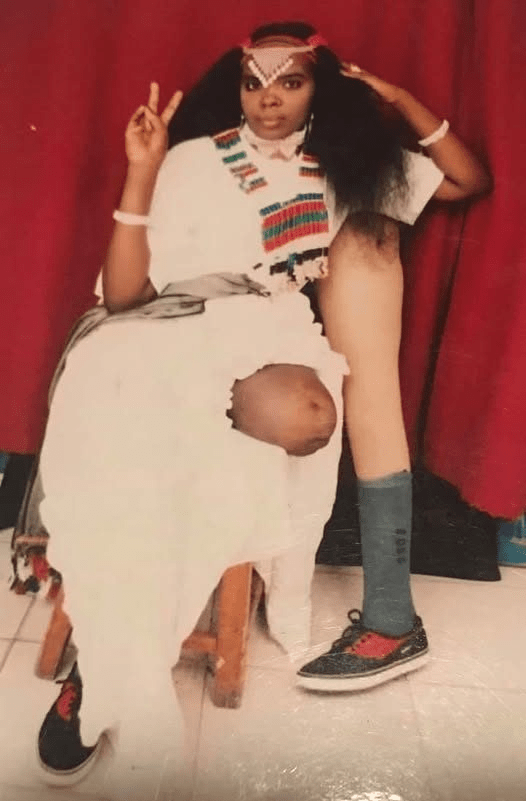
🖤 HONOR LALISEE. HONOR ALL SURVIVORS.
Lalisee Roobaa Galmoo is one face among thousands. One story among millions. One survivor among a nation of wounded but unbroken people.
“She lost her legs. But her voice, her story, and her people will not be silenced. Lalisee Roobaa Galmoo — we honor you. We will not stop until justice is done.”
We see you. We remember. We will not stop.
“How do we ensure that the suffering of survivors like Lalisee is never forgotten — and never repeated?”
A landholder, a warrior, and a martyr of the anti-colonial struggle.
By Staff Writer | April 2026
PROLOGUE: A NAME THAT LIVES
Some men are remembered for the wealth they accumulated. Others for the offices they held. File Mandara – known also as Qanyaa – is remembered for something rarer: he chose death over surrender.
Born in 1873 in the Horro Guduru Wallagga region, File grew up as a landholder (abbaa lafaa) and became a warrior leader (abbaa duulaa). When Italian colonial forces invaded Ethiopia in the 1930s, he did not flee. He did not bow. He fought.
And when capture was certain, he chose to die.
This is his story – preserved not in government archives, but in the living oral history of the Oromo people.
PART ONE: BIRTH AND BLOODLINE
File Mandara was born in 1873 near the banks of the Miixaa River, in what is today the Guduru district of Horro Guduru Wallagga.
Father
Mandara Guddaa
Mother
Yaadatee Aliimaa
From his father, a respected landholder, File learned the duties of protecting land and community. From his mother, he learned the stories, customs, and moral code of the Oromo people. Like every Oromo boy of his era, he grew up following his father – learning warfare, leadership, and the sacred duty of resistance.
PART TWO: FAMILY LIFE
When File reached marriageable age, he took Warqituu Lamuu as his first wife. Together, they had three children: two sons and one daughter.
As a landholder, he also took a second wife – Lataa – according to Oromo tradition. From this union, he had two more children: one son and one daughter.
In total, File was father to five children – a legacy that would carry his name forward.
PART THREE: THE CALL TO WAR
By the late 1920s and early 1930s, Fascist Italy was preparing for a second invasion of Ethiopia. The first invasion (1895-96) had ended in Italian defeat at Adwa. The second would be far more brutal – using poison gas, aerial bombardment, and scorched-earth tactics.
File Mandara answered the call. He became a warrior leader and joined the resistance.
Battle Locations
Role
Guduru, Amuru, Jaartee
Resistance fighter
Jaardagaa, Giddaa, Jimma Raaree
Resistance fighter
File did not merely fight. He also captured enemy weapons – rifles, machine guns, mortars – and turned them against the colonial forces. This made him a constant thorn in the side of the Italian army and their local collaborators.
PART FOUR: THE BROTHERHOOD OF LAMMAA HEENII
File fought alongside his closest comrade, Lammaa Heenii. The two men were inseparable in battle. They trusted each other with their lives. Their names would become linked in Oromo oral history as examples of true warrior brotherhood.
Together, they led their fighters against the colonial army, never retreating, never surrendering.
PART FIVE: THE BATTLE OF DANNABAA RIVER
The fiercest battle of File’s life took place near the Dannabaa River in the Jimma Raaree and Guduru areas. This battle was unlike any they had faced before.
The Situation
The Italian forces – backed by air support, artillery, and machine guns – surrounded File and his men. The Oromo fighters ran out of ammunition. The enemy was closing in.
The Enemy’s Move
A colonial soldier – armed with a bayonet and a mortar – rushed directly at File Mandara. His goal was not to kill, but to capture the prominent resistance leader alive. Taking File as a prisoner would be a great prize.
The Choice
File faced an impossible choice: surrender or die.
He chose death.
Before the colonial soldier could reach him, File’s comrade Lammaa Heenii took his last remaining bullet and fired it directly into the enemy’s mortar. The explosion engulfed the soldier in smoke and flames.
The Escape
File seized the moment. He captured the colonial soldier’s weapons – the mortar, the bayonet, and ammunition – and turned them against the enemy. He and his surviving fighters cut down many colonial troops and broke through the encirclement.
“He captured the man who came to capture him – and used his own weapons to destroy his men.”
PART SIX: THE AFTERMATH – A HERO’S REPUTATION
After the battle, File’s surviving fighters praised his courage. Oral historians report:
“The forest scattered. The Mosoloon (colonial militias) burned. But File did not break. He stood like a lion.”
File Mandara did not survive the war. But he did not die as a prisoner. He did not die on his knees. He died fighting – a warrior’s death, an Oromo patriot’s death.
PART SEVEN: THE FUNERAL – HONORING A HERO
File Mandara’s funeral was held on October 1, 1955 (Ethiopian calendar: Fulbaana 1, 1955 A.L.I.). The ceremony took place at a location chosen by his family and relatives.
The funeral was conducted in a manner worthy of a hero – with all the rites and traditions that an Oromo patriot deserved. His body was laid to rest in the land for which he had fought, in the soil watered by his sweat and his blood.
PART EIGHT: ORAL HISTORY – HOW HIS STORY SURVIVED
File Mandara is not found in official Ethiopian government archives. The regimes that followed – imperial, Derg, and EPRDF – did not celebrate Oromo resistance heroes who fought against central authority.
Instead, File’s story survives in Oromo oral tradition. Elders pass it to youth. Parents tell it to children. In villages across Wallagga, his name is still spoken with reverence.
This is how the Oromo people have preserved their history for centuries – not through foreign archives, but through living memory.
PART NINE: WHAT FILE MANDARA REPRESENTS
For the Oromo people today, File Mandara is more than a historical figure. He is a symbol:
Symbol
Meaning
Resistance
He refused to accept foreign domination
Courage
He fought despite impossible odds
Sacrifice
He gave his life for his land and people
Dignity
He chose death over capture
Oromummaa
He embodied Oromo identity and pride
He was not fighting for an emperor. He was not fighting for a political party. He was fighting for his land, his people, and his way of life.
PART TEN: LESSONS FOR TODAY
What can contemporary Oromos learn from a warrior who died nearly a century ago?
Lesson
Application Today
Know your land
Understand Oromia’s history, resources, and rights
Know your enemy
Recognize forces that oppose Oromo self-determination
Stand with comrades
Unity among Oromos is essential
Use available weapons
Adapt, organize, and resist with what you have
Never surrender
Maintain dignity even in the face of overwhelming power
File’s life asks every Oromo a question: What are you willing to sacrifice for your freedom?
PART ELEVEN: A PHOTOGRAPH – IF IT EXISTS
The original bio mentions a photograph of File Mandara. If such an image exists, it would be a priceless artifact – a rare visual record of an Oromo resistance fighter from the late 19th or early 20th century.
That face would show not just a man, but an era – a time when Oromo warriors stood against colonial armies with rifles and courage, long before modern weapons and mass armies.
That face would be a testament: We were here. We fought. We did not bow.
CONCLUSION: A HERO FOR ALL SEASONS
File Mandara (Qanyaa) was born in 1873, when Oromia was still largely independent. He fought in the 1930s, when colonial wolves were at the door. He died on the battlefield, refusing to be taken alive.
He did not win the war. The Italians were eventually driven out by a combination of Allied forces and Ethiopian resistance – but not before they had killed hundreds of thousands.
But File Mandara won something else: the memory of a people.
And that memory, unlike colonial regimes, does not die.
FINAL TRIBUTE
To File Mandara (Qanyaa) – landholder, warrior leader, Oromo patriot:
You were born free. You lived as a protector. You died as a warrior. You refused to bow to any foreign flag. You chose death over chains. May the land for which you fought remember your name. May the people for whom you died honor your sacrifice. May every Oromo who hears your story find in it the courage to stand – as you stood – for Oromia.
May God have mercy on this hero. May his story live forever. May the Oromo struggle reach its goal.
Advocacy for Oromia was established in 2010 with the purpose of enabling and empowering Oromo people by providing accurate and timely information that will help to make better choices to create the kind of future in which they wish to live.
It also provides information focus on the major issues facing us in the 21st century and it is going to try and bring a balanced approach with factual information that is positive and solution based.
The website has been in operation for the last nine years with the mission of promoting and advancing causes of Oromo people through advocacy, community education, information service, capacity building, awareness raising and promotion.
The website is also the official site of Advocacy for Oromia Association in Victoria Australia Inc., a non-profit organisation, registered under the Associations Incorporation Reform Act 2012 in Victoria as April 2014.
Our team already had considerable community development experience and expertise. Our various projects helped to develop our confidence and the capacity of our agency. Our team used every gained knowledge, skills and experiences as an opportunity to design and develop new approaches, to documenting progress, supporting positive employment outcomes, liaising with community stakeholders, and conduct evaluation.
Advocacy for Oromia is devoted to establishing Advocacy for Oromia organisation to close the gaps where we can stand for people who are disadvantaged and speaking out on their behalf in a way that represents the best interests of them. We are committed to supporting positive settlement and employment outcomes for Victoria’s Oromo community.
Advocacy for Oromia Office
Addresses:
39 Clow St,
Dandenong VIC 3175
=====================
247-251 Flinders Lane
Melbourne VIC 3000
Activities Address
Springvale Neighbourhood House Inc
Address: 46-50 Queens Ave, Springvale VIC 3171
Postal Address:
P. O. Box 150
Noble Park, Vic 3174
With your support, we can continue to help community build a better future.
Advocacy for Oromia Mental Health Program
The aim of the program is to improving the mental health and well-being of Oromo community in Victoria. It aims to assist those experiencing, mental ill-health, their families and carers of all ages within this community to address the social determinants of mental health for Oromo community. It helps:
Identify and build protective factors,
Reduce stigma and discrimination
Build capacity for self-determination
Better understand mental wellbeing, mental ill-health and the impacts of trauma
The goal of the project is to increase mental health literacy of Oromo community that aims:
To assist people with mental health issues
To increase the capacity of mental health worker
To better understand mental wellbeing
To provide mental health education and information
To address the social and cultural causes of mental health issues
Advocacy for Oromia will organise information session, women performance, radio programs, culturally adopted conversations on Oromo Coffee Drinking ceremony, providing training for mental health guides and forum and producing educational materials on the selected groups and geographical area.
Human Rights Education Program
The Human Rights Education Program is a community based human rights program designed to develop an understanding of everyone’s common responsibility to make human rights a reality in each community.
Human rights can only be achieved through an informed and continued demand by people for their protection. Human rights education promotes values, beliefs and attitudes that encourage all individuals to uphold their own rights and those of others.
The aim of the program is to build an understanding and appreciation for human rights through learning about rights and learning through rights. We aimed at building a universal culture of human rights. Thus, we aimed:
To build an understanding and appreciation for human rights through learning about rights and learning through rights.
To build capacities and sharing good practice in the area of human rights education and training
To develop human rights education and training materials and resources
The goal of the project is to increase human rights literacy of Oromo community that aims:
To better understand human rights
To increase the capacity of human rights worker
To analyse situations in human rights terms
To provide human rights education and information
To develop solidarity
To strategize and implement appropriate responses to injustice.
The ultimate goal of education for human rights is empowerment, giving people the knowledge and skills to take control of their own lives and the decisions that affect them.
Human rights education constitutes an essential contribution to the long-term prevention of human rights abuses and represents an important investment in the endeavour to achieve a just society in which all human rights of all persons are valued and respected.
Advocacy for Oromia will organise information session, performance, radio programs, culturally adopted conversations on Oromo Coffee Drinking ceremony, providing training for Human Rights guides and forum and producing educational materials on the selected groups and geographical area.
Community Safety Program
The program aims to strengthen existing collaborations and identify opportunities for the development of partnerships aimed at community safety and crime prevention activities. This approach seeks to improve the individual and collective quality of life by addressing concerns regarding the wider physical and social environment. Importantly, community safety means addressing fear of crime and perceptions of safety as without this any actions to address the occurrence of crime and anti-social behaviour are of less value.


 Damboobummaa – cultural ethics
 Thanksgiving is essential
 The gathering concluded: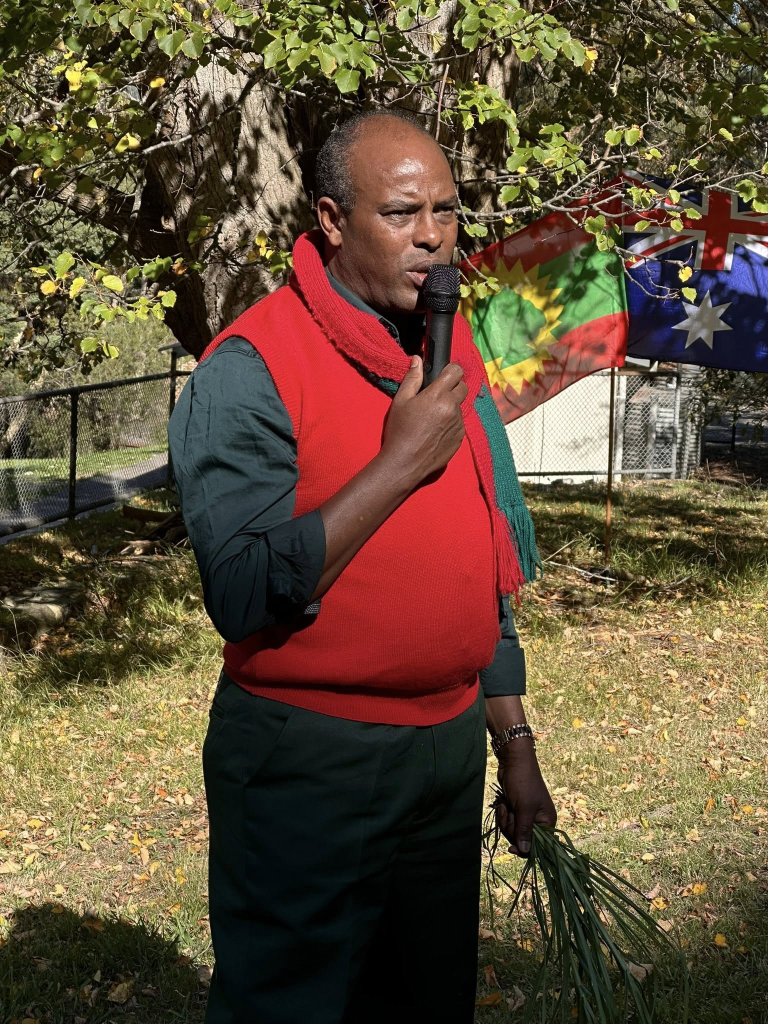













 Advocacy for Oromia