Author Archives: advocacy4oromia

Irreecha Celebrations to be Held in Finfinne, First in Over 150 Years

By Staff Reporter   

September 19, 2019 (Ezega.com) — The Oromia cultural and tourism bureau is preparing to celebrate Irrecha in Finfinne early next October.

Head of the bureau Girma Hailu said the exercise is to restart the Irrecha celebration in Finfinne currently known as Addis Ababa city after about 150 years.

Irreecha-CelebrationSome politicians, however, claim that the move has to do with pushing the claim by the Oromo Democratic Party (ODP) on the ownership of Addis Ababa city, which almost all other ethnic groups living in the city oppose.

Irreechaa is the annual Oromo people Thanksgiving Day that is celebrated every year in Birraa near the river bank or water and tree. Irreechaa is celebrated every year in September in Bishoftu Hora Harsadii and other Oromia major cities.

The place of the celebration has not yet been located but will take place either near one of the rivers in Addis Ababa or artificial pond. “The celebration will be held while cultural values of the Irrecha celebration are maintained, Girma said while briefing journalists on Wednesday.

Unlike in the past, the Irreecha would be celebrated by all ethnic groups in Addis Ababa regardless of difference in language, religion, culture and ethnic background, the bureau head said.

According to the Oromia Cultural and Tourism Bureau, about three million people from all corners of Addis Ababa and surrounding towns are expected to take part in the celebration.

“Irrecha celebration has to do with the identity of the Oromo people. The celebrations are unique in that the Finifine Hora celebration has come again and that contributes to tourism development in the country, Girma said

In the traditional religion of the Oromos, the spirit is the power through which Waaqaa (The Almighty God) governs all over the world. Thus, Oromos believe that every creation of Waaqaa has its own spirit.

The resumption of the celebration signifies that the people of Oromo and other ethnic groups have begun exercising their democratic rights and building trust among them and image of the country, the bureau head added.

Meanwhile, the Oromia Cultural and Tourism Bureau will hold what is called “Irrech Peace Run” in Addis Ababa ahead of the Irrecha celebration. About 50 thousand runners including famous athletes are expected to participate in the run.

“The run is to show Irrecha is the celebration of peace, unity and cooperation and to add color to forthcoming celebration in Addis Ababa,” Nega Tujuba, head of the Oromia Athletics Federation told Ezega News. Similar runs were staged in Adama city, the capital of Oromia regional state since 2016, but the federation wanted it moved to Addis Ababa to avoid security problems, he added.

The 10-kilometer road race will be held on Sunday, September 11, 2019, along the route of Ethiopian Great Run. The running route goes from Meskel Adebabay to Legehar to Mexico to Sarbet to Kera to Gotera, and then back to Meskel Square.

First winners from both sexes will be awarded each 50 thousand Ethiopian Birr and second and third winners will enjoy 30 and 20 thousand Ethiopian birr, respectively.

The Oromo of Eastern Africa: Ali Mazrui’s Perspective

Exactly 10 years ago at the annual meeting of the Oromo Studies Association in Minneapolis, Minnesota, the late Kenyan philosopher Ali Mazrui (1933-2014) gave the keynote address in which he spoke, with his characteristic flamboyance, about what he called the largest ethnic nation in Eastern Africa, the Oromo. His perspective was originally comparative and international.

The Oromos are in the news lately in connection with their growing demand for self-determination. When he gave the keynote speech Mazrui was regarded as one of the top 100 public intellectuals in the world. So, what did Mazrui, the public intellectual, have to say about the Oromo? What are the implications of the Oromo question for Ethiopia and the Horn of Africa? I believe this is the right time to understand some of the relevant issues more fully from a historical perspective. In this vein, I am presenting below an adaptation of Mazrui’s keynote speech—mostly in his own words.

One of the exceptional things about Eastern Africa is the historic cultural symbiosis between the Oromo and the Amhara across the centuries. If the Amhara are like the English in the United Kingdom, are the Oromo as historically abused by the Amhara as the Irish were by the English, or are the Oromo as historically respected by the Amhara as the Scots were by the English?

Two processes have fluctuated in relations between the Oromo and the Amhara across the centuries. The two processes are homogenization (trend towards becoming homogeneous) and hegemonization (trend towards becoming dominant or hegemonic). This has created the special exceptionalism of the Oromo people.

With regard to cultural homogenization between the Oromo and the Amhara, earlier centuries left the rivalry unsettled. From the 17th century sedentary Oromo started integrating with their Amharic-speaking neighbors. Some Oromo chiefs acquired some political power in the wider Ethiopian monarchy. Emperor Iyasu II (1730-55) was half Oromo and promoted a network of Oromo allies. Indeed, this was the period when the Oromo language became the language of the court at Gonder. Homogenization in this era favored the spread of Oromo culture.

In late 18th century the central government of Ethiopia weakened considerably. Local princes and governors carved out greater power and asserted autonomy for themselves. This period was known as the Zemene Mesafint, and was characterized by dis-homogenization, in the sense of decentralization of power. The Oromo dynasty of Yejju Chiefs produced a string of warlords who exercised disproportionate influence on the weakened titular emperors of Ethiopia. Some Oromo Chieftains became virtual Regents of the Empire.

Power transfer through marriage was another method of hegemonization. Ras Ali of Yejju ascended to pre-eminence in 1779. As the Emperor of Ethiopia lost hegemony during Zemene Mesafint, the Yejju Oromo became de facto custodians of the Empire.

In 1855 Ras Ali II of Yejju was defeated by Kassa Hailu. Almost out of the blue Kassa Hailu became Emperor Tewoderos II. From then on the Oromo not only declined politically; they also became gradually marginalized culturally. The Oromo language was even banned from official institutions very much like the Kurdish language was later discouraged in the Republic of Turkey under the legacy of Mustapha Kemal Ataturk. The Amharaization of the urban Oromo elites accelerated the process of cultural homogenization from the nineteenth century onwards. The treatment of the Oromo by the Amhara was almost a dress rehearsal of the treatment of the Kurds by the Turks a century later.
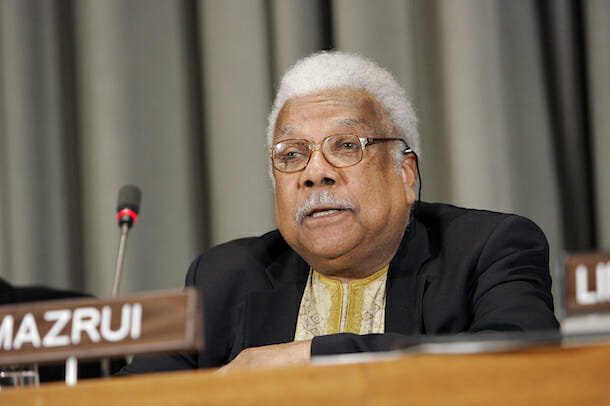
Ali Mazrui in 2007. (Ryan Brown)

The major subprocesses of the Amharaization of the Oromo were linguistic (the spread of Amharic among the Oromo), religious (the Christianization of the Oromo, especially via Orthodox Christianity), bureaucratization (the cooptation of the Oromo into the civil service and the armed forces of the Empire), and intermarriage (cross-ethnic matrimony and raising children of mixed ethnicity).

Lady Menen of Wollo became Empress in the nineteenth century; Ras Muhammad of Wollo became Ras Mikael and subsequently Negus of Siyon. He fathered Emperor Iyasu V. In the twentieth century Lady Menen of Ambassel became Empress Consort of Haile Selassie I. These were forms of homogenization in more than one sense. They were the mixing of biological genes, as well as the erosion of cultural differences (heterogeneity).

Was there counterpenetration of Amhara culture by the Oromo? In reality Oromo counterpenetration into Amhara society did not include language. The Amharic language was bound to absorb some words and phrases from the Oromo linguistic heritage, but very few Ethiopians of Amhara descent embraced the Oromo language instead of Amharic. A lot more Oromo adopted Amharic instead of the Oromo tongue [Oromiffa or Afaan Oromoo].

In the transmission of religion there was some exchange. Millions of Oromo were Christianized as a result of contact with the Amhara. Emperor Yohannes IV even forced Christianity upon large numbers of the Oromo in the late 1800s on pain of the Oromo losing their properties. These were trends towards religious homogenization.

While the indigenous Gadaa system of governance of the Oromos did not influence the imperial monarchical system, the indigenous warrior tradition of the Oromo did result in a disproportionate military role for the Oromo within the Empire. Menelik II allied with Ras Gobena’s militia to expand Menelik’s empire eastward and southward. Haile Selassie’s father, Governor of Harar, was a top-general in the Battle of Adwa when Melelik’s forces defeated the Italians. Emperor Haile Selassie I was in part of Oromo descent, as well as of Amhara ancestry. Haile Selassie symbolized Oromo counter-penetration of the Amhara at the highest political level. But he was in denial about his Oromo genes. Haile Selassie was the de jure Emperor of Ethiopia from 1930 to 1974. Iyasu V, another Oromo-Amhara, had been the de facto but uncrowned ruler of the Empire in the nineteenth century.

The exceptionalism of the role of the Oromo in Ethiopia has continued to be this symbiotic interplay between hegemonization (as the Oromo have ascended to ultimate power-sharing) and homogenization (as the Oromo have shared culture and mixed blood with the Amhara).
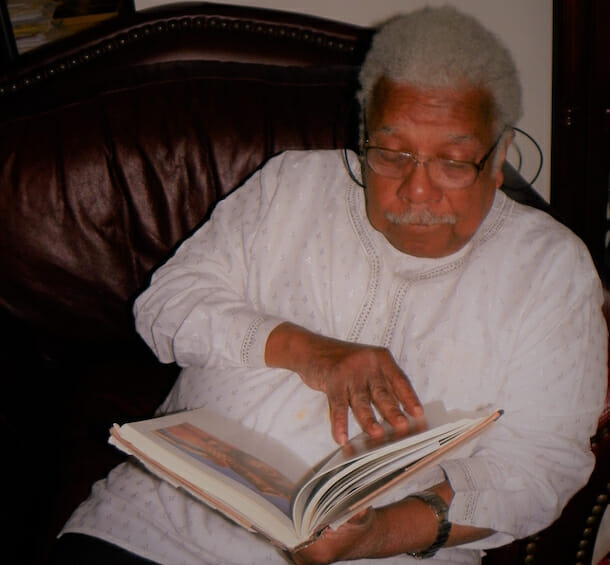
Ali Mazrui. (Seifudein Adem)

Have the Oromo been an internalized colony of the Amhara? Yes, but there are degrees of colonial status. A closer look at another imperial power would clarify these degrees of subordination. Before Great Britain became a global empire, it consisted of internal colonization. The English people were the equivalent of the Amhara.

Linguistically the whole of the United Kingdom was homogenized and became English-speaking. But the status of the component parts varied. The most deeply colonized and dominated was Ireland. Indeed, for centuries, the Irish were treated by the English as an inferior “race” right into the earlier years of the twentieth century. Next in status within the United Kingdom was Wales, which was also treated as an inferior partner to the English for centuries, but was not as humiliated as the Irish.

The most respected partner in the United Kingdom to the English was Scotland. Its union with England under the Scottish Stuart Kings in the seventeenth century (James I and Charles I and their post-Cromwellian successors) was voluntary. The union put a Scottish King in the throne of England. Scotland developed its own Church of Scotland (partially distinct from the Church of England) and retained its own parallel currency into the twenty-first century. In spite of the rise of the Scottish nationalist movement in the second half of the twentieth century, the Scots were essentially almost the equals of the English for most of the time since the formal union of England and Scotland under the Stuarts in the 1600s.

The big comparative question is whether the Oromo in the history of Ethiopia were more like the Irish in the history of the United Kingdom – totally dominated and despised by the English for centuries? Or were the Oromo more like the Scots – not quite the equals of the English, but often sharing power, and at times even occupying the English throne?

There were times in Ethiopian history when the Oromo elite and the Amhara elite were more like the English aristocracy alongside the Scottish aristocracy – not quite equal, but retaining substantial mutual respect. There have been other periods of Ethiopian history when the Amhara treated the Oromo in the way the English once treated the Irish – as a lower breed of people, and an internalized colony.

But what about the Oromia of the future? Will it be more like Scotland – autonomous and dignified but not totally equal to England politically? Or will it be more like Ireland before the first half of the twentieth century – a de facto colony in subjection to the English? Or is there a chance that Oromia would one day become the equivalent of the Irish Republic – sovereign, free and increasingly prosperous? If the whole of Ethiopia had been governed in terms of so-called “one man, one vote,” the Oromo would have had an edge. Out of the total population of 105 million, most independent estimates place the Oromo at about 34% of the population, while the Amhara may be just about 27%, with Tigrayans coming third, with about 6%.

Systems of governance in Eastern Africa have included monarchies which endured for centuries among the Amhara and simpler pastoralist traditions among the Somali. Governance among the Oromo was intermediate between the monarchical centrism of the Amharas and the statelessness of the Somali. The Oromo transitional principle of eight years as a generational unit of allegiance (Gadaa), has been increasingly adopted as a term limit for two terms of presidential incumbency in the United States. More and more countries in the world, influenced by the American example, have opted for two maximum terms of presidential incumbency, adding up to eight years (or an outer limit of ten years).

The reasons which made the Oromo choose the unit of eight years as a guiding ancestral principle of democracy were entirely distinct from what made the United States after World War II opt for a maximum of eight years for all future presidents after Franklin D. Roosevelt and Harry S. Truman. Nevertheless, the term limit of eight years for presidential power is gaining ascendancy in modern democracies centuries after the ancient Oromo founding fathers were guided by the mystique of eight years as a generational unit.

If you’re interested in writing for International Policy Digest – please send us an email via submissions@intpolicydigest.org

Dr. Abiy Ahmed’s government is criminalizing parents for their children

By Bariiso Saaddoo, June 21, 2019

Ethiopian security forces invade and arrest parents of adult children who left them years ago.

Immediately after the atrocities of 9/11, USA labelled Osama Bin Laden as one of the most dangerous man in the face of the Earth. USA Army and intelligence community tried to locate Osama’s whereabouts all over the world and including hideouts in the highlands of Pakistan and Afghanistan. The search for Osama continued unabatedly for about 10 years and finally he was brought to justice by US Marine in Pakistan on May 2, 2011.

During the search for Osama bin Laden, one of his brothers was in the USA living in peace just like any other ordinary Americans. Osama’s children and other family members had never been targeted by the United States for the heinous crimes of their father. They lived in peace and freely without a fear of USA government retaliation for their father’s crime.

In all of European countries, crimes are not transferable. Once a child is 18 years of age, parents’ responsibility ends legally, and any crime the children commit cannot go to the parents. That is a civilized and reasonable world. The parents may continue communicating with their children regardless of the weight of the crimes the children commit. Some families come out and defend their children officially. Nothing happens to them. They don’t hung the father or mother for the crimes of their children.

Parents and families in Ethiopia are illiterate, most of them have never been to school and do not understand politics. Most parents live on farms barely making days end meals. They are people who struggle only to feed their kids and themselves. Some do not even afford to wear shoes, never had cell phones or lights.  Most of the kids go to school only if there is school nearby to escape from farm work. These parents make less than $300 a year, if we must measure money-wise.  They do not know what is taught in school. They do not even understand why their children go to school for many years.

These are the parents, PM Dr. Abiy Ahmed’s army coerces demanding they bring back their children they have not seen in years. These are the parents this regime rapes and kills for being mothers and fathers of these children who left them years ago to fight for their causes. These are the parents Dr. Abiy Ahmed’s soldiers rob, burn properties and force to flee their birthplace. Ethiopia has the largest internally displaced people (IDP) in the world according to a recent report by the United Nations (UN). In one year, under Dr. Abiy Ahmed’s administration, more Oromos are displaced than under the regime of the TPLF in 20 years or so rule.

This is the regime that is committing itself to annihilate or reduce the Oromo people into further serfdom. While it claims to represent the poor people, the regime has continued creating difficult livelihoods for millions.  Disappearance, destruction, humiliation, eviction and isolation is underway in mass in the Oromia region.  This is a regime that is burning crops and killing livestock to starve the Oromo people as a punishment.

The TPLF cadre regime of Dr. Abiy Ahmed, while delivering rosy speeches after speeches with nice words, has continued subjecting the Oromo people to grief and sorrow. Millions of Oromo mothers are crying under a regime that claims to represent Oromos and as some claim ‘the Oromo Government’. This regime is the continuation of the TPLF/EPRDF regime and TPLF cadres were trained to kill, spy, mistreat people, corrupt, steal, rob, etc.  That is normal life for them. Sometimes you cannot blame them, because that is their profession. They cannot think beyond what they have been trained for. That is their make-up.

It is very painful to hear that parents of Qeerroo are getting harassed and humiliated for their children joining Oromo Liberation Army (OLA). Some of the children left them more than 20 years ago and some of the children are now in their 30s and 40s. The parents have nothing to do with their children political beliefs and they are being criminalized for simply giving birth to these children.

Human Rights Abuses:163 extra-judicial killings and the arbitrary detention of at least 933 people in Ethiopia

(Oromia Support Group Report) The extra-judicial killing and arbitrary arrest of OLF supporters since December 2018 has created a situation in Oromia very similar to that in 1991-2 when thousands of OLF supporters were killed and scores of thousands detained and tortured.

The good will and support for Ethiopia from the international community helped to maintain the abusive regime of Meles Zenawi, then in power. The current silence about killings and widespread imprisonment is eerily reminiscent of that time.

Many reports have been sent to OSG since December 2018 and this report is a summary of the information received.

This report includes information about 163 extra-judicial killings and the arbitrary detention of at least 933 all due to their suspected support for the Oromo Liberation Front, which officially returned to Ethiopia in September 2018.

Oromia Support Group Australia – Summary Report on Human Right Abuses in Ethiopia

WE ARE TIRED OF RAPE!

The Oromo women are protesting in front of the American embassy starting at 8 am today June 9, 2019. The letter below is being submitted to the American embassy.

WE ARE TIRED OF RAPE! The Voice of the Oromo Women

When Dr. Abiy Ahmed became the prime minister of Ethiopia, we rejoiced thinking that the EPRDF dictatorship of 27 years was ending, and equal opportunity and dignity was about to usher upon us. his multi-faceted rhetoric about freedom and community development resonated with our wishes until he ordered the EPRDF army to kill our people. Apparently, Abiy’s appointment was the political tactic designed to save the EPRDF rule from collapsing.

In 1948, after the Holocaust took place, leaders from nations around the world came together to establish the Universal Declaration of Human Rights. This document affirms that every person regardless of religion, race, gender or nationality, possesses the right to life, liberty, security, equal protection of the law, freedom of thought, speech, and religion. Though not always honored, the declaration provides moral norms for how people should be treated in international law and national constitutions.

These rights entitle us, the Oromo women, to dignity and obligate the EPRDF prime minister, Dr. Abiy Ahmed to owe us respect. He cannot talk about human rights without taking responsibility for the lives his soldiers take on a daily basis. And he cannot talk about responsibilities without being part of the Oromo girls and women who are being raped and killed all over Oromia every day.

Since Dr. Abiy Ahmed announced that jailing and killing people can’t bring lasting peace and urged all opposition groups to disarm, the Oromo Liberation Front disarmed and returned to Finfinnee. Eventually, the Oromo youth who lost hope started protesting against Dr. Abiy’s hypocrisy all over Oromia. This led the prime minister to take deceitful and horrific military actions against the youth who lost hope and took refugee in west, central and southern Oromia forests. Since then, the military has been raping little girls and women, burn people alive and kill peaceful residents, not to mention the burning of hundreds of motorcycles owned by business people in small towns of Oromia.

The military raids, ordered by Dr. Abiy Ahmed, often involved the use of some sort of chemicals and widespread human rights violations. Of course, these tragedies remained unreported. Yet, knowing full well that these atrocities have become a regular day to day practice of his military, Dr. Abiy Ahmed continues to boast about the equal rights and the peace the country is enjoying.

The media outlets controlled by the EPRDF often reported sounding as if these illogical, contradictory and evasive actions are great achievements.

But we the Oromo women, who gave birth to the sons who are shot to death by the military grief every day and suffer from the gang rapes performed upon us. While this is going on, Dr. Abiy has the audacity to appoint many women to a high governmental position to show the world that we are represented and to make us feel that our sphere of usefulness is being enlarged.

Amid this miscellany of lies, deceptions, political dramas, and mischiefs, our suffrage is buried under the height and the depth of the EPRDF utter devotion to political dominance.

The human right violations conducted by the EPRDF army, the killing, torturing, raping, imprisoning, burning people in their own house in southern, western and now in central Oromia are part of EPRDF’s long term plan of staying in power. That’s why Dr. Abiy Ahmed refused to negotiate with the Oromo youth whom he labeled as a lawless group that needs to be destroyed at any cost.

To scare and force the population to submit to its dictatorial rule, the EPRDF army mutilated the bodies of the raped women, have cut their throat, slaughtered peaceful people, have burned down houses and properties, looted animals, raped children and have burned the dead bodies in masses. The civilians in the affected areas have continued to flee their homes and properties. This is the stark and glaring tenor of Dr. Abiy’s cruelty that demands the attention of the world.

Hence, please listen to the voices of the raped and killed Oromo girls and women. Each of their cries are competing for a listening ear.

The Oromo Women for freedom!

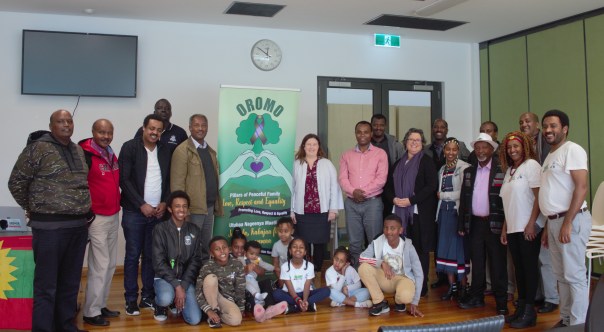
The first Oromo Interfaith Forum Held in Melbourne

(A4O, 2 June 2019) The half day Oromo Interfaith Forum held yesterday, June 1, 2019 here in Noble Park Aquatic Centre.
IMG_5553
On this forum three Oromo religious leaders: Christian, Muslim and Waaqeffannaa delivered speeches about the importance of having a respectful relationship between wife and husband.
The forum aimed to promote family safety and cohesiveness in their life.
This event would help to raise awareness and understanding about respectful relationship and to challenge gender stereotypes and roles.
This faith-based activity was designed to explore the ways in which Oromo faiths leaders currently respond to family violence.
Victoria police and Wayss provided useful innervation information about family violence.
Oromo community in Melbourne and Advocacy for Oromia organised this forum unique to provide timely preventive information and orientation about family violence and family violence prevention strategies.
==============
Message from the Advocacy for Oromia
– The prevention of family violence can be achieved by promoting respectful relationships, love and harmony that lead to gender equality: finding meaning in life and fostering a sense of belonging.
– (key words: equality, respect, relationships, love, meaning in life, sense of belonging)

The Oromo nationalists must stop dreaming!

“The Oromo nationalists must stop dreaming that Team Lemma who hijacked the Oromo protests and came to power could bring something fundamental in Oromo politics.

Team Lemma has now replaced with Team Abiy who on the very first day of his speech as a Prime Minister of Ethiopia reopened the wound of Oromo and added salt to it. Team Abiy composes of individuals who deny the crimes committed against Oromo at Anolle and turns deaf ear to the Oromo demands and even working to destroy achievements made so far including the continuation of Oromia as one state of the FDRE.

As an Italian political scientist Gaetano Mosca said, “If tolerance is taken to the point where it tolerates the destruction of those same principles that made tolerance possible in the first place, it becomes intolerable”.

Dr. Abiy’s Government project to take Ethiopia back to pre-1991, even to pre 1974, by undermining or changing the current constitution and the federal arrangement already reached intolerable stage in one year.”
Assefa Abebe Lemu
Director, Office of Acquisition & Assistance (OAA) The Role of Elites in Ethiopian Politics

Read the article from: https://advocacy4oromia.org/articles-2/the-role-of-elites-in-ethiopian-politics/

OROMO INTERFAITH FORUM

Requesting urgent intervention to uphold the rights of Benshangul Gumuz civilians

(A4O, 8 May 2019, Press Release) We have confirmed that Benshangul Gumuz civilians are increasingly targeted and executed by the highly armed and well-trained Amhara militia. They were trained, radicalized and fully armed with modern machine guns by a National Movement for Amhara (NAMA).


According to the eye witnesses, over 500 Shinasha people in Benshangul-Gumuz Region, Jawi Woreda, were suddenly executed; tens of thousands of civilians were also made to flee their own villages for their lives between May 1 and 2, 2019. The main victims were civilians including children, women and elderly. Homes were also torched in that outbreak of violence.
We have also observed that the civilians are getting killed for no apparent reasons by a highly armed Amhara regional special force in Benshangul Gumuz regional state. This armed group is not only targeting solely indigenous and legitimate owners of the land; but also, hundreds of children and elderly are getting summarily executed for a simple reason of being different from their killers in the aspect of their culture, skin colour and political beliefs.
The Ethiopian Government neither condemn the killings of civilians nor asked for apology for failing to safeguard them. Although some authorities claim the restoration of the order, this is far from the truth as the Government hasn’t so far take any justifiable action against the killers and forces behind these tragic executions.

Background information
Recently, the Amhara Special force further threatened the Oromo people in relation to the ownership claims of Finfinnee (Addis Ababa). These group further vowed to repeat their success in Benshangul in Wallo and other parts of Amhara-Oromia borders.
In 2003, for instance, between 430 and 500 unarmed civilians were massacred by those who colonised their land for a simple reason of silencing them whilst expropriating their resources and land in Gambella region. The same massacre is now unfolding in Shaka zone on a Shakacho people by the same highlanders. Tens of thousands of Oromo, Ogaden Somali and Sidama civilians were executed in the last 27 years alone.
Call of Action
Advocacy for Oromia, a non-profit advocacy organisation working to ensure that the people’s rights and wishes are respected, has deeply admired much of the work done by both regional and federal government to restore peace and stability in the region.
In fact, political differences may divide some of the regional states in the country. But upholding human rights is in the interest of every state. Peoples of these regions also seek a common agenda: rights, peace, security, justice, freedom, and sustainable development.
We firmly believe that human rights are a powerful medicine, which heals wounds and develops resilience. Thus, we show our consistent and unrestricted solidarity until justice is served on their behalf by bringing those who have killed and maimed their sons and daughters to an independent justice.
Advocacy for Oromia, therefore, unanimously condemn with the strongest possible terms such barbaric actions toward the unarmed civilians, children, women and elderly of Benshangul Gumuz.

Furthermore,
1. We urge the Amhara’s regional state to exercise utmost restraint and lawfully handle its anarchically behaving special forces that has been primarily trained to maintain law and order. There won’t be any peace and security as long as some groups are fighting to dominate and dehumanise fellow mankind.
2. We demand the federal government to immediately intervene and stop the on-going execution of powerless civilians whose lives are put at the mercy of their barbaric assailants.
3. We urge the federal government to immediately investigate and bring those responsible for such horrific and inhumane actions to civilians to justice.
4. We advise the international human rights group and western countries politicians to earnestly bring this unsettling massacre of civilians to the attentions of obliviously sleeping Ethiopian authorities by urging them to take meaningful and corrective measures as a matter of urgency.
5. We call up on all Ethiopian peoples to unconditionally condemn such barbarism and demand the Amhara regional state to stop its inhumane actions to the unarmed civilians.
We will always continuously work for and speaks up for the voiceless people.
Press Release by Advocacy for Oromia,
May 8, 2019.

For PDF format:Press Release 8 May 2019

Partial Lists of people killed in different parts of Oromia (16th  February, 2018-16th April 2019)

(A4O, 20 Finfinnee 2019) The Ethiopian ODP-led EPRDF regime continues its persistent genocidal actions against innocent and unarmed civilians of Oromos who attempt to exercise their democratic rights.

Documented human rights violations record showed that increase in human rights abuse correlates closely with increase in political cases. Regarding the Oromos documented human rights violations committed to it includes mass massacre, extra-judicial killings, arbitrary arrests, torture, displacement and forced conscription remained non-ending war.

Lammii Beenyaa, an Oromo human rights activist, compiled lists of 210 Oromos who killed in different parts of Oromia since the controversial State of emergency was reinstated on 16th February, 2018.

(Compiled by Lammii Beenyaa, an Oromo human rights activist)

For more information: Lists of people killed Partial Lists of people killed in different parts of Oromia