Author Archives: advocacy4oromia
Oromo athlete Dejene Gezimu clinches victory in the 2016 Vitality Liverpool Half Marathon
(Advocacy for Oromia, 14 March 2016) Athlete Dejene Gezimu has won the 2016 Vitality Liverpool Half Marathon and raised Oromo (athletic nation) national flag in the events.
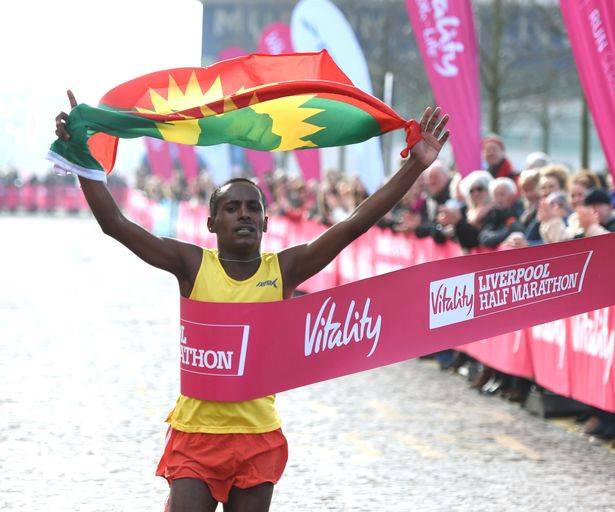
The 22-year-old Oromo athlete, who has a string of other race wins under his belt, recorded a personal best for the half marathon with a time of 01:06:59 – averaging five minutes and seven seconds per mile.
He was 50 seconds faster than his nearest rival, Benjamin Douglas, who was runner-up.
The fastest woman to finish the 13.1-mile course, run in warm sunshine, was Michelle Nolan in a time of 01:20:20 – averaging 6 minutes and eight seconds per mile.
Meanwhile the winners in the 10 mile race were Connor McArdle, on a time of 58 minutes and 41 seconds, and Michelle King in 01:11:26.

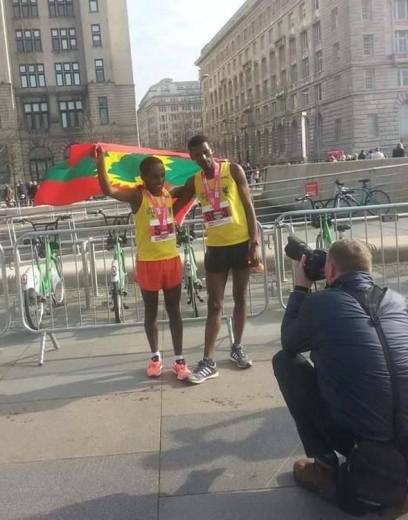
Here are the top five male and female competitors in each of the races.
Men
1: Dejene Gezimu – 01:06:59
2: Benjamin Douglas – 01:07:49
3: Daniel Kestrel – 01:08:09
4: Richard Burney – 01:08:40
5: Nathan Kilcourse – 01:09:21
Women
1: Michelle Nolan – 01:20:20
2: Gemma Connolly – 01:21:25
3: Kirsty Longley – 01:22:18
4: Elissa Morris – 01:22:41
5: Charlotte Mason – 01:24:50
LEST WE USE APOLOGY AS A POLITICAL SLEIGHT OF HAND
By Tsegaye R Ararssa
(Advocacy4Oromia, 11 March 2016) It was widely reported yesterday that the PM has finally uttered words of apology for the misrule of his government in Oromia and beyond. The apology doesn’t say in words but apparently it is meant to express remorse for his regime’s acts that caused:
a. the death of over 500;
b. injury to hundreds more;
c. the arrest and detention of tens of thousands;
d. the disappearances of numerous Oromos;
e. the destruction, bombing, vandalizing of properties including school and university buildings;
f. the disruption of the normal life of the people;
g. the illegal suspension/removal of the civilian administration of Oromia; and
h. the widespread practice of terrorizing the Oromo civilian population (including by killing children and elderly citizens).
I won’t go into the interpretation of what this statement of apology means and as to whom it is directed (to the people or to his own folks/bosses in the ‘government’). I would rather take him at his word and demand that he matches up his action with his words in the spirit of not letting this pass as a usual political sleight of hand, or an empty political gesture.
I like to stress that, normally, apology comes as an admission of one’s mistake, as a recognition of responsibility for the wrongs done to the victims of one’s acts, and as a first step towards making amends. (At an individual-personal level, apology is a sign of showing remorse.)
When it is done as an act of state, it needs to be done as a matter of principled commitment to justice, sovereignty of the people (supreme importance of their will), accountability of government, and out of a conviction that, we as a country, collectively, seek to atone for, and distance ourselves from, the injustice perpetrated in the name of the state. As such, it requires the existence of a sense of remorse and an unswerving commitment not to let it happen again. This commitment is not just about making amends for the misdeeds of the past but an act of promise, a vow, about the future. It is a way of saying (in the Post-Rwanda language of the now exhausted phrase) NEVER AGAIN!
So, if the PM wants this to be beyond an empty political gesture (and a fake gesture to placate the angry public), he needs to do more. First of all, he should admit that the political road to a solution has long been exhausted. Finding a political solution was supposed to happen way before politics ended and military action has taken over.
Of course, we have been insisting that the politics has undergone closure long ago when the public space was completely occupied merely by TPLF/EPRDF (after the fake election of May 2015). In my view, the politics had experienced total closure since Election 2010 when all legal-political dissent was ruled out of the public sphere. The closure of the public space (facilitated by the constellation of laws on political parties, civil society organizations, freedom of press and information, and counter-terrorism laws) was followed by a form of rule that deploys law as ‘war by other means’. Election 2015 was clearly a ‘war by other means’ especially to the Oromo and all the ‘other’ peoples of Ethiopia (whose land and resources were vetted for ‘legal’ looting and plunder).
So, this new use of the language of apology, coming only after the exhaustion of politics in Ethiopia–only after unscrupulously imposing a military rule on the country, especially in Oromia and Gambella–becomes too little too late, if not amusing altogether.
But if the PM wants to achieve something more than a cheap political sleight of hand (which will never win any Oromo to his side anyway!), then he should do the following:
1. Remove the army from Oromia and send the soldiers back to their camps or to wherever they were relocated from.
2. Restore the civilian administration of Oromia and facilitate for them to make a publicly transparent discussion about the crisis, take a stance, take political responsibility, call a snap election on a short order, and dismiss the parliament leaving the administration of the region in the hands of a care taker government for the interim;
3. Take political responsibility for his own action and for his cabinet’s reckless words and deeds. In other words, he should demand that his wayward Ministers–such as Abay Tsehaye, Getachew Reda, Tewodros Adhanom–resign immediately. If he can’t secure their resignation as a sign of their political responsibility for their utter political and moral failure in handling the protest (which I do not suspect they will do!), then the PM himself should step down. He should resign. Yes, THE PRIME MINISTER SHOULD RESIGN.
4. Immediately establish an impartial and independent inquiry commission in order to investigate the atrocities and ensure the legal responsibility of the perpetrators. Given the fact that all the institutions (including the Human Rights Commission and the Courts) have shown their partiality and lack of independence thus far, we do realize the near-impossibility of forming such a commission. It is therefore imperative for the government to allow an international body (e.g. a UN special rapporteur) to conduct the inquiry and ensure that perpetrators be brought before justice.
6. Repeal the Master Plan, the Oromia Urban Development Law, and all other laws facilitating land grab in Oromia and in the entire country (e.g.the Lease law, investment laws, and other policies and plans to create industrial zones, investment sites, and recreation parks) UNCONDITIONALLY AND UNEQUIVOCALLY. Stop the implementation of the Master Plan even within the confines of the ten sub-cities of what is traditionally known as the suburbs of Addis Ababa. STOP LAND GRAB ACTIVITIES DONE ILLEGALLY with out consultation, consent, or adequate, proper, and effective compensation.
7. Return land taken from farmers back and compensate all of them for their loss. Provide replacements for those whose lands have been developed. Provide all basic social services (housing, health, and education) to all those whose life and livelihoods have been disrupted by the evictions. This ought to be done most urgently.
8. Release ALL persons arrested in relation to the protest against the Master Plan and the land grab attendant to the plan. Release all Oromo political prisoners and prisoners of conscience. Interrupt processes of all political trials and release ALL prisoners of conscience that have long suffered in the prisons and detention centers of Ethiopia.
9. Work towards the implementation of the Special Interest of oromia over Addis Ababa in the interim. For a lasting solution, work closely with all political groups and all stakeholders towards finding a more suitable location to serve as a seat for the federal government. This act requires a constitutional amendment taking account of all the possible best practices on choice of capitals in federations.
10. Start a sincere negotiation with all political groups to transit out of this crisis and to let Ethiopia to begin its political life again, anew. This PM has an extraordinary opportunity to win by loosing (because he has lost) and to pave the way for a genuine transformation of the state and democratization of the politics thereby helping Ethiopia to begin again, to start anew, to be at it afresh.
So doing will help us bring politics back to where it belongs. So doing will stop the war the country is languishing in, the war we are all conscripted to by default, owing to the state-sanctioned end of politics.
So doing will help you, Mr Prime Minister, go beyond using apology as a political sleight of hand. And it will, hopefully, provide you the opportunity to redeem yourself, to take the higher road–the road never traveled in Ethiopia–and to make you a statesman in the proper sense of the word.
Source: https://www.facebook.com/tsegaye.ararssa/posts/545326878961657
What do Oromo protests mean for Ethiopian unity?
 Image copyrightAFP
As protests in Ethiopia over the rights of the country’s Oromo people continue, Addis Ababa-based journalist James Jeffrey considers if they are threatening the country’s unity.
The latest round of bloody protests over Oromo rights had a tragically surreal beginning.
A bus filled with a wedding party taking the bride to the groom’s home was stopped at a routine checkpoint on 12 February near the southern Ethiopian town of Shashamane.
Local police told revellers to turn off the nationalistic Oromo music playing. They refused and the bus drove off.
The situation then rapidly escalated and reports indicate at least one person died and three others were injured after police fired shots.
The exact details of the incident are hard to verify, but what is clear is that days of protest followed, including armed local militia clashing with federal police, leaving seven policemen dead, the government says.
Oromia at a glance:

- Oromia is Ethiopia’s largest region, surrounding the capital, Addis Ababa
- Oromo are Ethiopia’s biggest ethnic group – making up about a third of Ethiopia’s 95 million people
- The Oromo Federalist Congress (OFC) is Oromia’s largest legally registered political party, but holds no seats in parliament
Why Ethiopia is making a historic ‘master plan’ U-turn
Since last November, Ethiopia has seen a second phase of the recent unrest in the Oromia region which has been unprecedented in its longevity and geographical spread.
The region is the largest in Ethiopia and the Oromos, who make up a third of the population, are the biggest of the country’s more than 80 ethnic groups.
Initially the protests were in reaction to a plan to expand the administrative border of the capital, Addis Ababa, which is encircled by Oromia.
But even after the region’s governing party, the Oromo People’s Democratic Organisation, which is part of Ethiopia’s governing coalition, shelved the plan in January, protests have continued.
Historical scars
“There is a strong sense of victimhood, extending back 150 years,” says Daniel Berhane, a prominent Addis Ababa-based political blogger, covering Ethiopia for the website Horn Affairs.
“People remember the history. The scars are still alive, such as how the Oromo language was suppressed until 20 years ago.”
Despite there being an ethnic basis to these protests, observers say that the deeper issues behind them, frustrations over land ownership, corruption, political and economic marginalisation, are familiar to many disenchanted Ethiopians.
 Image copyrightAFP
The numbers killed since November following clashes between protesters and security forces given by international rights organisations, activists and observers range from 80 to 250.
The government has dismissed various death tolls as exaggerations, and said that a recent report on the situation by the New York-based Human Rights Watch (HRW) was an “absolute lie“.
‘Organised gangs’
Ethiopian citizens had a right to question the plan to expand Addis Ababa, but the protests were hijacked by people looking to incite violence, according to government spokesman Getachew Reda.
He says the security forces have faced “organised armed gangs burning down buildings belonging to private citizens, along with government installations”.
A security analyst who closely watches Ethiopia says “there could be radical elements and factions taking advantage, but you cannot define a movement by isolated events”.
Despite violent incidents, the protests have been described as “largely peaceful” by HRW and observers in Ethiopia.
“There is a perception of lack of competence in governance on the ground,” Mr Daniel says.
“There were easy remedies to appease initial protests, it was not hard science, but the right actions were not taken.”
In its defence, the government says it heeded the call of the people when it came to concerns over the Addis Ababa plan, and observers say the government deserves credit for withdrawing it.
 Image copyrightReuters
But the same political observers add that the government must allow Ethiopians to exercise their constitutional right to protest, and handle events in a way that does not escalate violence.
The government has said that the protests and information about them have been manipulated by foreign-based opposition groups who are using social media to exaggerate what is going on for their own ends.
“The diaspora magnifies news of what is happening, yes, but no matter how much it agitates, it cannot direct [what’s happening] at village level in Ethiopia,” says Jawar Mohammed, executive director of one of those accused of fomenting conflict, US-based broadcaster Oromia Media Network (OMN).
“This is about dissatisfaction.”
 Image copyrightAFP
Mr Jawar says the imprisonment of leaders of the Oromo Federalist Congress party, Oromia’s largest legally registered opposition political party, along with thousands of other Oromo political prisoners, makes it difficult to negotiate a lasting solution.
“Also what is the UK and US doing? As major donors to Ethiopia they should be taking the lead to get the government to work out an agreement.”
This is a long way from the heady days of Ethiopia’s new federal constitution after the overthrow of the military dictatorship in 1991.
That introduced a decentralised system of ethnic federalism, but this jars with the dominance of the governing Ethiopian People’s Revolutionary Democratic Front (EPRDF), which, along with its allies, holds every seat in parliament.
Federal tensions
“The ruling government is a victim of its own success,” the security analyst says.
 Image copyrightAFP
“The constitution it developed made promises and people trusted the EPRDF. Now people are demanding those rights and the government is responding with bullets and violence.”
He adds that the government has expanded basic services and infrastructure, and appears to respect different cultural and ethnic identities, but it cannot reconcile this with its more authoritarian decision-making process.
The government’s hitherto successful job of holding together this particularly heterogeneous federation is not about to crumble, according to observers here.
But things may get worse before they get better, unless underlying sources of friction and frustration are addressed.
Source: http://www.bbc.com/news/world-africa-35749065?post_id=10207768920172696#_=_
Ethiopia Goes Chain Gang
(Advocacy for Oromia, 6 March 2016) Ethiopia, a nation fighting the worst famine in decades and popular unrest, brought a very old concept of punishment back–chain gang! New pictures circulating on social media show Suri tribesmen on trucks tied-together with ropes.
In the latest twist, Ethiopian security forces have consulted the 1955 field manual from the state of Georgia to punish inmates. The neck of a Suri tribesman is tied to the upper arm of another. The men also appear to be tied-together at the knees. They are bleeding from their scalps.

Abdi Lemessa/Facebook
Surma tribesmen tied-together by the neck and upper arm, Ethiopia, March 2016

Abdi Lemessa/Facebook
Suri tribesmen tied-together by Ethiopian Security Forces, March 2016 (Abdi Lemessa/Facebook)
Surma people have been protesting against displacement in the name of investment by Ethiopian government. Sources told The Horn Post, governmental institution, The Metals and Engineering Corporation (METEC) started building sugar factories on the lands of Suri tribes, and it is facing resistance.
Surma is a collective name used for the Suri, Mursi and Me’en tribes residing in South Sudan and southwestern Ethiopia, with a total population of over 180,000. These tribes were among the seven tribes threatened by Ethiopian National Park, according Native Solutions to Conservation Refugees’ report in 2007.
In what appeared to be a prophecy, Kendrick Lamar’s recent Grammy performancewas partly Surma-inspired, and featured a chain gang.
Ethiopia is pleading for foreign aid to help feed more than twelve million people hit with the worst drought in decades, and in need of emergency food aid. At first, the government played down the number of people who fell victim to the drought brought on by El Nino. Slowly but surely, it admitted the number is well over 12 million. Some reports estimate more than 20 million Ethiopians are facing food shortage.
Since November 2015, Ethiopia is trying to shake off protests in Oromia regional state that started as an opposition to Addis Ababa Master Plan, which later morphed into demand for regime change. Ethiopia dismissed these protests as plots from Eritrea and “anti-peace forces” in diaspora.
Democracy, Governance, and the U.S. – Ethiopian Bilateral Relationship
(Advocacy for Oromia, 6 March 2016) On Thursday, March 3, 2016, the CSIS Global Health Policy Center hosted a conference on Ethiopia’s health system, its successes, and enduring challenges.
This event featured three expert panel discussions on the challenges to the U.S. – bilateral relationship, the major infectious diseases that continue to plague the country, and Ethiopia’s regional leadership in the Horn of Africa. On this day CSIS also launched three new CSIS reports on Ethiopia, based on a recent research mission to Ethiopia to examine the country’s health system.
Panel 1: Democracy, Governance, and the U.S. – Ethiopian Bilateral Relationship
Sarah Margon
Washington Director, Human Rights Watch
Terrence Lyons
Associate Professor of Conflict Resolution, George Mason University
Semhar Araia
CEO, Semai Consulting; Founder, Diaspora African Women’s Network
Moderated by:
Richard Downie
Deputy Director and Fellow, Africa Program, CSIS
Land grabbing in Oromia for development’s sake?
(A4O, 5 Marcha 2016) “The concern is that the government would simply claim this land and use it without providing any kind of compensation to the farmers and pastoralists who are currently using that land.”
Ethiopia has been heralded as a model for economic growth, with average growth rates of 10% between 2003 and 2014 earning it the name “African tiger”, in reference to Asia’s industrialisation boom until the 1990ies.
Yet development has come at a price. In order to keep up with its ambitious development goals, the Ethiopian government designed the “Addis Ababa Master Plan” for the expansion of the nation’s capital, which would displace and effectively disown a large share of the country’s largest ethnic group, the Oromo. The ensuing protests by the Oromo community, launched in November 2015, “are tapping into much deeper grievances”, since the Oromo have been “marginalised economically, politically, culturally even, […] suppressed by repeated governments over the years,” Leslie Lefkow holds.
Despite media reports of brutal government crackdowns against protestors, Lefkow argues that there has been little response from the international community: “Ethiopia is one of the world’s biggest aid recipients, […] it’s one of the largest recipients of foreign aid in Africa. […] It [Ethiopia] is seen as a success story when it comes to development. So there is also political unwillingness to raise human rights issues, which are I think often seen by international donors and partners as inconvenient.” The Ethiopian governments eventual withdrawal of the Addis Ababa Master Plan in January can hence be solely attributed to the domestic outrage it caused.
Leslie Lefkow is the Deputy Director of Human Rights Watch’s Africa Division.
The interview was recorded in Amsterdam on January 22, 2016 at the HRW office.
For more information and videos, visit:
www.warandpeacetalk.com
@warandpeacetalk
The proposal recommends the founding of a National Council of Oromia
(Advocacy4Oromia, 1 March 2016) The present proposal recommends the founding of a National Council of Oromia as a first step toward transforming the long protracted Oromo national (liberation) struggle from stagnation to a more dynamic, inclusive, and active political force.
This urgent need for an inclusive national dialogue among Oromo political organizations and the general public is compelling at least for two reasons: first, our struggle for democratic rights has been slowed down by the Ethiopian regime which seeks to assert and maintain its power indefinitely using lethal force; second, instead of cooperation and forming organizational alliance, Oromo political elites hindered the struggle and reduced it to clashes of interest over power, and consequently, the struggle suffered major setbacks such as the lack of ideological clarity and organizational discipline, i.e., transparency and dynamism, among others.
Hence, there are two main aims for the present project: first, it is believed to increase awareness within areas that are regarded as important to revitalize the Oromo national struggle for democratic rights. Second, it is hoped to encourage collaboration in the Oromo general public, between individuals, and political organizations that have showed no need in the past to solve practical problems and accomplish tasks collaboratively. As the project will evolve into practice, it is expected that possibilities and hindrances will become more obvious, which necessitate careful handling of differences, issues, and attitudes with democratic principles.
For the purpose of this project it is essential to delineate in the future meanings of terms and concepts central to the project. These include, among others: people, nation, democracy, rights, self-determination, union accord, roadmap, national council, league, organization, front, party, protest, nonviolent revolution, emancipatory resistance, and grassroots.
Please check here the Proposal for FOUNDING A NATIONAL COUNCIL OF OROMIA and share it.
https://www.facebook.com/groups/432965310227169/files/ or
Founding a National Council of Oromia (a Proposal, Feb 28, 2016)
Dr Tsegaye Ararssa at Oromia Insight
(Advocacy for Oromia) Dr Tsegaye Ararssa at Oromia Insight with Aliye Geleto talks about Oromo and Ethiopia.
West Arsi of Oromia at a Glance
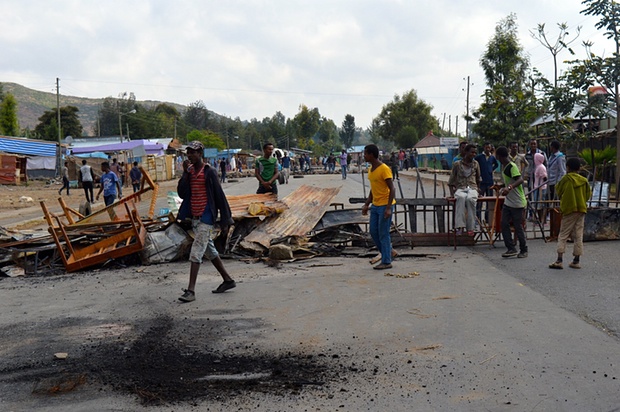 This is an account of a small part of what’s been going on in West Arsi of Oromia last week. It’s very limited as I was unable to spend more than one morning in the area. On Wednesday in Bulbula, which is south of Ziway around 100 kilometers north of Shashamene, there was a vandalized Coca Cola truck and a torched tanker. There were also Derba Cement bags and smashed glass in a couple of places on the road, suggesting that was where the company’s trucks had been attacked. As with several places where there’d been protests, there wasn’t a heavy visible security presence, and most regular activity had resumed in the town. As we drove south, a Federal Police truck and pick-ups, followed by armed Oromia police, whizzed north in what looked like an emergency response.
On Wednesday night, part of Langano Lodge was burned to the ground. A couple of people in the area said the culprits were disgruntled locals. For example, a middle-aged guard said the resort was known for employing people from outside the area. Others, like Sabana Beach Resort, had a good reputation with residents, he said. As with other claims, I didn’t have a chance to verify these allegations.
Early on Friday morning, Shashamene appeared normal. It wasn’t hard to find people aware of what had been going on. One lady focused on how the Oromo protests in the area had caused problems for other groups, especially the Wolayta. That turned out to be a minority stance with everyone else emphasizing justified Oromo opposition to the government as the fundamental issue.
As widely reported, the protests in the area started in Aje a week before after police told a wedding party to stop playing a resistance song and the request was rejected. That led to a violent confrontation with civilians and police dying, although it wasn’t clear exactly what happened from the accounts I received. One guy reported that an Oromo Federal Police officer had objected to the security response and shot dead some of his colleagues. From there the discontent spread.
There had been a fracas around Shashamene bus station during the week. It sounded like primarily Oromo and Wolayta had clashed and the police had broken it up by firing in the air. There was no consensus on fatalities and casualties. Rumors abounded, with someone saying 60 houses had been burned down, and others saying that was a lie. It seemed there’d been a fight and police had quickly broken it up, partly by firing in the air. One account said a Tigrayan guy was arrested after he pulled a gun and challenged people to attack him.
On the road to Kofale, which is 27 kilometers east of Shashamene, there was evidence of roadblocks in many places. Most had been created by chopping down large Eucalyptus trees and laying them across the road. One area was covered with large boulders and a fertilizer store had been ransacked. It was apparent that plenty of communities and people had been involved in these acts of resistance.
One guy said in a matter-of-fact manner that during the unrest Amhara farmers had been intimidated to leave the area. But almost all interviewees – none of whom were youthful firebrands — stressed that if there were clashes between ethnic groups, they should be treated as a minor diversion, and were not the cause of the discontent. Perhaps even more so than in West Shoa a couple of months ago, people were clear that the underlying cause was a desire for a change in government. No longer would Oromo youth accept being ruled by Woyane, a man said. People didn’t want to be ruled by a dead man’s system, another said. A few refused to give their views, but no one spoke up in defense of the government. One guy said his land had been taken for water facilities and that there was too much tax on everything. A few spoke about a corrupted government that acts only in its interest and not the people’s.
On top of the underlying desire for political change, people also highlighted recent injustices with students killed and arbitrarily detained, and educated leaders arrested, as a major reason for ongoing resistance. One guy repeatedly said that protesters wanted to know where the authorities had taken their children. Nobody thought the situation was going to be resolved anytime soon.
It was said that 7 or 12 people had died in Kofale on Thursday, which was the only place to have a few (non-red beret) soldiers stationed visibly on its streets. There wasn’t much other obvious presence of security forces aside from one pick-up full of Federal Police that turned off the main road into a village.
More people had died further east in Dodola, including a friend of someone I spoke to. He said the guy, who didn’t know anything about politics, was taken at night by police and found dead in the morning.
Only the one lady in Shashamene referred to the alleged burning of churches. Everybody else responded that they hadn’t heard anything, or that it was a deliberate lie.
Despite the unrest, mini bus drivers and traders were traveling up and down the road as usual. There were also plenty of people around on the streets going about routine tasks. In a few places, pragmatic residents had started chopping up the trunks that had been used to block the road. Rather than a state of emergency, it felt more like active opposition to the government and the accompanying insecurity had become the new normal.
On the way back north, shortly before Arsi Negele, where it was market day, a few drivers panicked and turned around, presumably because they heard there was trouble ahead. The quickest to do U-turns were a couple of Dangote Cement truck drivers, but they needn’t had bothered, as it turned out to be a false alarm.
Historical Injustice: Re-Offending the Trauma
By: Najat Hamza
There have been fragmented arguments aimed at individuals or Oromos in general from certain groups. I am not writing to comment, negate or affirm any point of view as it is right now, however I would want these framed in a way that makes sense and that could yield results for both sides. We have to lay some ground work or background before we can discuss the points of contentions. Fist, when we talk about the Oromo People there is no doubt there has been tremendous historical injustice done to them, these historical injustices cannot be ignored, erased or denied. One can ask how can we address historical injustices that happened generations ago? Why should we even attempt to address it? The answer is simple, the future depends on it! The other argument is this generation has nothing to do with that injustice and why should we be held accountable?
There are no magical methods, words or deeds that could address historical injustice but we can try by using the concept of restorative justice. Restorative justice has been used as a mechanism to help heal great historical injustices in various indigenous communities and a single acts like genocide and holocaust a like.
“…applying restorative justice practices and principles could maximize justice for indigenous people by first, refocusing indigenous land claim, on the restoration of tribal respect and dignity rather than the restoration of property rights, second, acknowledging the wider social relationship in which such conflicts arise”
(Contemporary Justice Review, 2009)
So, when we speak of “Oromian tan Oromo ti” it is not about the restoration of property ownership for our land, rather the restoration of our dignity and respect we lost when we have lost our home, our sense of being. We have to look at the inter-generational justice (Justice over time) as an answer to those who would deny the historic injustices of their forefathers. This concept explains both sides of the story. We all know and understand the gain of historic injustice done to the Oromo people, their land and resources are great loses to them but gains to the perpetrators and their offspring. Those gains obtained committing these grave historic injustices transcended form one generation to the next with a sense of entitlement to boot. Thus, the current generation has the obligation to acknowledge this historic injustice and to apologize for the injustice committed as the sole beneficiaries of those injustices. If they cannot reach to this point, it is crucial for them to understand not to re-offend the trauma.
I cannot elaborate on these concepts more here, not it is the correct platform, I am sharing my thought trying to re-frame where the argument should be instead of going back and forth on petty discussions. I am sure there is expert in the fields of justice; law and political science that could get into it form this vantage point. There is no question that they cannot reverse time and undo the historic injustice, nor should they act as if it did not occur. The side that needs to do deep soul searching is those who have benefited from these historical injustices and finding a way to make steps towards healing for the wronged. However, is absurd to expect the Oromo people to explain, to include or participate in the denial of its own scars to appease their perpetrators. It reminds me of the idea that use to be used against women here in the US and still being used in various parts of the word basically accusing a woman who is raped by accusing her of dressing inappropriately. This is the same line of thinking, if Oromo people fights for their right and trying to affirm their rights or be the sole beneficiaries of their own resources, they are called racist! However, committing historical injustices, refusing to acknowledge the wrong and trying to be a road block to their progress is called patriotism, Unity!
We do not fear change, we are fighting for change. We have not targeted anyone and any one else’s resources and we do not need an approval from any entity to accomplish our freedom. It is just in the spirit of good faith and for the sake of justice we ask you to do away with your hate cause it is foreign to us and to what we stand for.
Oromia is the Home of Justice in its pure form!
Source: https://www.facebook.com/najat.hamza.9/posts/885740388444?fref=nf




 Advocacy for Oromia