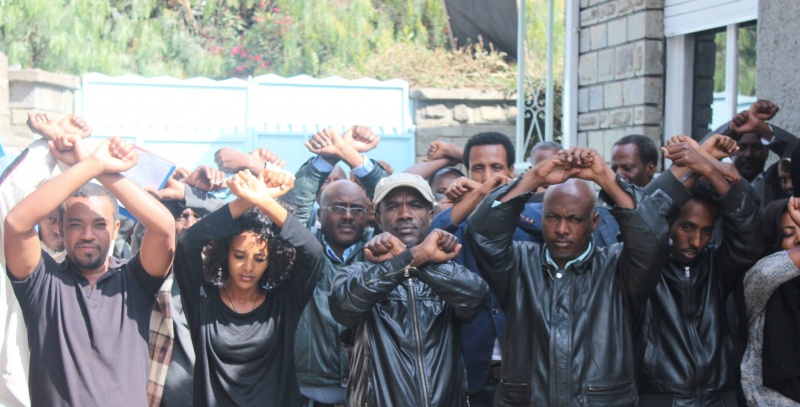
(A4O, 22 April 2016) Prosecutors have today charged 22 individuals, including prominent opposition member Bekele Gerba (pictured), first secretary general of the opposition Oromo Federalist Congress (OFC), with various articles of Ethiopia’s much criticized Anti Terrorism Proclamation (ATP). Addis Standard could not obtain details of the charges as of yet.
However, charges include, but not limited to, alleged membership of the banned Oromo Liberation Front (OLF), public incitement, encouraging violence, as well as causing the death of innocent civilians and property destructions in cities such as Ambo and Adama, 120km west and 100km east of Addis Abeba during the recent Oromo protests in Ethiopia.
As per the decision during the last hearing, defendants were expected to appear at the Arada First Instance Court this afternoon, but were instead taken to the Federal High Court 19th criminal bench this morning. The court adjourned the next hearing until Tuesday April 26th.
The defendants that include a Kenyan citizen were all arrested between November and December 2015, shortly after the start (and in connection with) Oromo protests in November that gripped the nation for the next five months. Defendants also include several members of OFC, students and civil servants who came from various parts of the Oromia regional state. Except for the one Kenyan, whose name Addis Standard couldn’t obtain as of yet, all of the defendants came from Addis Abeba and various cities and towns within the Oromia regional state, the largest of the nine regional states in Ethiopia.
Although Bekele Gerba et.al were represented by lawyer Wondmu Ebbissa during the last five court appearances that took place at the Arada First Instance Court, today’s hearing in which the charges were read to the defendants happened with neither Wondmu nor any public defendant present, the reason why the court adjourned the next appearance until Tuesday April 26th. The next hearing is also scheduled to help six of the 22 defendants who spoke only in Afaan Oromo to come up with interpreters.
The court also ordered the police to relocate defendants from the notorious Ma’ekelawi detention center to prison facilities under the Addis Abeba Prison Authority. During the last hearing on March 18th, Bekele Gerba made an emotional appeal to the court revealing he and the 21 others with him were kept inhumanly in a cell the size of 4 X 5m that included a toilet and beds for all. “To be imprisoned is nothing new”, Bekele was quoted by his lawyer as telling the court, “but there is almost no country in the world which violates your basic rights while one is under police custody. I have never seen a government as cruel as the government in Ethiopia.”
In January Bekele Gerba et al went on a hunger strike protesting against inhuman treatments in the hands of the police including denial of family visits at Ma’ekelawi. Sever tortures against the defendants were reported in the same month.
Bekele Gerba, who is the fourth defendant (and a high profile defendant of all), was arrested on Dec. 23 2015. His arrest is the second time since 2011, during which he was sentenced to eight years in prison suspected of allegedly belonging to the banned Oromo Liberation Front (OLF). He spent almost four of the eight years before he was freed in April 2015. In a May 2015 interview with Addis Standard, Bekele Gerba, known for his outspoken criticism of widespread injustices in Ethiopia, said prison was “not a place one appreciates to be. But I think it is also the other way of life as an Ethiopian; unfortunately it has become the fate of many of our people.”
(A4O, Finfinne, April 16, 2016) A heavily armed group has killed several innocent people in Gambella regional state at a place called Jakawa yesterday.
According to Sudan Tribune, however, a massive and coordinated attack has left at least 221 people dead on both sides.
The deadly attack occurred on Friday morning when heavily armed thousands of men, most of them reportedly in South Sudan’s military uniform, crossed into Ethiopia and simultaneously attacked about 10 different villages inhabited by the Nuer ethnic group in Ethiopia.
The attacked villages are inhabited by the Gaajaak-Nuer sections who are Ethiopian citizens.
At least 170 members of the Nuer ethnic group, mainly women and children, are feared killed, many others wounded and some children abducted.
At least 51 members of the Murle were also counted lying dead on the ground from the different villages.
Eyewitnesses told Sudan Tribune that the dead were identified to be members of the Murle community.
“They are from Murle community. Their dead have been identified. They have killed a lot of people, about 170 now confirmed dead. Majority of the dead are women and children. They have also abducted a number of children. It was difficult to resist them because our populations have no guns. The Murle came heavily armed, some with RPGs and in military uniform of South Sudan,” said Chuol Gach, one of the survivors who witnessed the attacks.
“They attacked about 10 villages in Jekow and Nyinenyang woredas [counties],” he said.
Other sources also told Sudan Tribune that at least 51 members of the Murle attackers were killed, 16 in the early morning of the fighting and 35 others were later killed in the afternoon when they were trying to retreat with over 600 heads of cattle and fell into ambush from the Cie-Nyajaani sub-section.
Most of the heads of cattle were recovered, he said, and the attackers have been pursued back into South Sudan’s territory.
Gach blamed the authorities of Gambella regional government for not responding quickly with security forces to rescue the “unarmed civilians.”
It was not the first time for the Murle armed men to carry out such attacks across the Ethiopian border. But eyewitnesses said the Friday attack was the first of its kind in decades due to the huge number of Murle forces involved and the number of the villages affected, in addition to the death toll.
“This government is at least better than previous ones,” remarked a 74-year-old Eritrean man to me last month in the Ethiopian capital of Addis Ababa, his longtime residence.
As it turned out, his assessment of the relative superiority of the current Ethiopian administration was for good reason: two of his children had been killed by a previous ruling outfit, the Derg military junta that took power in 1974 and began eliminating suspected opponents in droves.
Although that particularly bloody epoch came to an end in 1991, many a resident of Ethiopia might nowadays still have cause to complain about homicidal activity by the state.
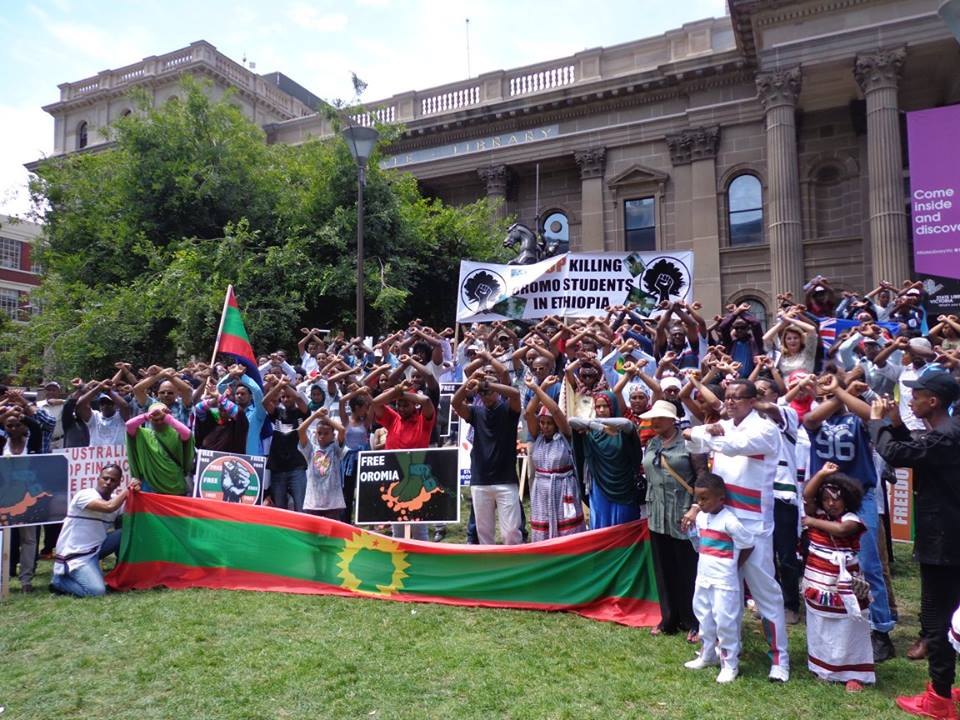
Members of the Oromo community in Melbourne protest against the Ethiopian regime, January 3. Photos: Ali Bakhtiarvandi.
In the Oromia region surrounding Addis Ababa, for example, there are claims that more than 200 people have been killed by Ethiopian security forces since November 2015, when protests broke out in response to the government’s so-called “Master Plan” to expand the boundaries of the capital by a factor of 20.
As a Newsweek article explains, the Oromo inhabitants of the region viewed the plan as “an attempted land grab that could result in the forced eviction of Oromo farmers and the loss of valuable arable land in a country regularly plagued by drought.”
This was no doubt a valid concern given the government’s established tradition of wantonly displacing Ethiopians in the interest of “development” — that handy euphemism for removing human obstacles to the whims of international and domestic investment capital.
Apparently, torture has also been a difficult habit for security forces to break.
Comprising some 35% of the population, the Oromo are Ethiopia’s largest ethnic group and have regularly decried discrimination by the ruling coalition party, the Ethiopian People’s Revolutionary Democratic Front (EPRDF), which is dominated by ethnic Tigrayan interests.
Politically motivated detention, incarceration, and other abuses have long characterised the landscape in Oromia, and the current protests have seen children as young as eight arrested.
And while the government has opted to shelve the Master Plan for now, protests in Oromia have continued. When I recently visited the town of Woliso, one of many protest sites in the region, residents pointed out that cancelling the plan wouldn’t bring back the dead people.
Events in Oromia have been described as the worst civil unrest in a decade.
Even without the Master Plan, meanwhile, the government is doing a decent job of courting investors. As I travelled west from Addis Ababa toward Woliso – a journey of about two hours — I passed sprawling factory complexes, including one featuring a Turkish flag flying alongside its more indigenous counterparts.
Launched in 2010 with a price tag of US$140 million, the Turkish-owned Ayka Addis factory is said to occupy several hundred thousand square meters of land.
The website of the Ethiopian Investment Commission furthermore lists Ayka Addis as one of “a number of private Industrial Zones” in Ethiopia, described as “success stories.”
Indeed, the EPRDF can point to double-digit economic growth over recent years to justify plowing ahead with its development model. But there’s more to life than GDP – as sizable poverty-stricken sectors of the Ethiopian population can presumably confirm.
About 200,000 people were reportedly in danger of trachoma-induced blindness in Oromia alone.
We might also take a look at the estimated 10.2 million Ethiopians currently “in need of urgent food assistance” — as reported, perhaps ironically, in a March edition of the English-language Ethiopian newspaper Capital, “the paper that promotes free enterprise.”
Additional troublesome statistics are contained in a 2014 BBC dispatch titled “The village where half the people are at risk of blindness.” The village in question is Kuyu, located in the Oromia region; the risk is due to infectious trachoma, “the world’s leading cause of preventable blindness.”
In the end, a lot of people in Oromia and beyond might have greater priorities than, say, income tax immunity for international developers.
“The question Oromo in Ethiopia is much more ancient and complex Master Plan”, as well Tsedale Lemma , director of the magazine Addis Standard that deals with political and socio-economic issues, said the protests that have turned the spotlight on Ethiopia. Because of the Master Plan, approved in 2014, the government confiscated and sold to foreign investors land belonging to the Oromo peasants, an ethnic group that makes up about 32 percent of the population and is traditionally engaged in agriculture. The news came to Rome with migrants who have made a stop at the facility operated by the Red Cross in via del Frantoio. It is not a coincidence that in the last period the number of Ethiopian immigrants, as noted by the operators, has grown considerably.
The government’s plan was suspended in January but after months away protests do not stop, “the way in which the plan was announced, and as has been suspended has no legal foundation. After a long history of marginalization, protests continue for at least three reasons: self-determination, a just allocation of resources and economic benefits, the recognition of the identity and the Oromo language “.
And if stubborn is the protest, the harder the repression: ” Human rights, rule of law and freedom of the press have never reached encouraging levels in Ethiopia, recent anti-terrorism measures and new media laws have legitimized repression. Unfortunately, we go from bad to worse , “says Tsedale Lemma.
But the troubles for the Master Plan are just the tip of the iceberg of an extremely controversial situation. The International Monetary Fund ranking Ethiopia among the five fastest growing economies in the world, and at the same time the lack of food, caused by the drought, threat of death as many as 10 million people. While the country is tempting to investors around the world, who have a look too long to notice the hungry, the protests and repression, Ethiopians continue to pay the bills.
“What happened in the last four months has marked a dramatic change from the way the ruling party considers the business: there has been a decisive break with the people. People in Oromia are no longer willing to accept their status quo . In spite of what the propaganda says, we know on our skin that life as we knew it, the largest region of the country, has been completely transformed. I will not give a catastrophic prediction, but no country in the world has survived a situation like one we are living without a meltdown , “says the director.
“Wealth is concentrated in the hands of an elite linked all’EPRDF, the Ethiopian People’s Revolutionary Democratic Party who is in government. The galloping GDP growth rarely results in an actual development on a human level. Over the years the country has always been considered among the poorest in the Human Development Index of the United Nations “, he comments. “The finance and infrastructure projects, whether dams, roads, railways and skyscrapers, are regarded as indicators of a growing economy”. To Addis Ababa , in fact, it was recently opened the first metro in sub-Saharan Africa and the construction of the dam Gerd should lead Ethiopia to assume a strategic role in the relationship with the other countries of the Nile. Who cares if hunger continues to be a matter of life and death.
Tsedale Lemma admits that the connections and infrastructure in the country have improved. “But there is adisturbing silence of the government on the drought that is threatening millions of Ethiopians and on which there has been no official announcement. Indeed when government officials, and the prime minister himself, appeal to investors not mention the problem but keep repeating the mantra of economic growth “.
Difficult to determine whether the real Ethiopia is that of Gerd dam and investors or that of the Oromo, someone stubborn to complain and someone else resigned to leave the country, but Tsedale Lemma says: “Hundreds of thousands of young people every year embark on dangerous journeys to escape economic marginalization, lack of freedom and the inability to choose. there are several signs that could indicate that there is a number of Ethiopian migrants even higher than that of the Eritreans. But I can not say for sure or support it with data.They are considered internal factors, such as the extension of the population of the two countries or the fact that impersonate Eritrean makes the easiest route to Europe, because Eritrea is considered a country much more repressive. It must also point out that thousands of Ethiopians seeking the move to South Africa as well as in Europe. ”
He concludes: “If the country will become the next production car of refugees, just depends on how you will experience the meltdown, which is imminent.”
(France 24 TV) — In recent months, Ethiopia has seen its worst unrest in a decade. Members of Ethiopia’s Oromo ethnic group, which feels left out of the country’s booming economy, have taken to the streets in protest.
Protesters are calling for equal rights and an end to what they call corruption, land grabs and government oppression. Some Oromo families have been forced off their land, and the government refuses to officially recognise the Oromo language. The government has cracked down on the protests, and activists and human rights groups say over 200 people have been killed.
FRANCE 24’s reporter spoke to the families of several victims.
(France 24 TV) La colère des Oromos, laissés-pour-compte du développement éthiopien
L’Éthiopie a connu ces derniers mois d’importantes manifestations qui ont parfois été réprimées dans le sang. Des membres de l’ethnie Oromo, qui représente un tiers de la population, sont descendus en nombre dans les rues pour revendiquer l’égalité des droits. Ils dénoncent notamment la corruption et la confiscation de leurs terres.
Émission préparée par Emerald Maxwell et Laura Burloux
It is uncertain how many people have died in clashes between security forces and protesters since November, when a series of demonstrations began.
Local estimates put the figure at between 80 and above 200. The New York-based Human Rights Watch has said that more than 200 people may have died in about six months, a figure the government denies.
“With regards to allegations from human rights groups or self-styled human rights protectors, the numbers they come with, the stories they often paint, are mostly plucked out thin air,” Getachew Reda, the information minister, told Al Jazeera.
Abi and Dereje’s mother was among those shot in January. She was hit by a bullet in the neck. Despite receiving medical treatment, she died of her wounds in March.
“The little girl cries and keeps asking where her mother is. We feel her pain,” said the children’s grandfather Kena Turi, a farmer. “The older one cried when his mother was shot and died, but now it seems he understands she’s gone.”
Oromo students began rallying to protest against a government plan they said was intended to expand the boundaries of Addis Ababa, the capital, into Oromia’s farmland.
Protests continue
Oromia is the country’s largest region, and many there believe the government did not want to redevelop services and roads, but that it was engaged in a landgrab.
Though the government shelved its “Integrated Development Master Plan” due to the tension, protests continued as the Oromo called for equal rights.
In February, another anti-government rally turned violent. Nagase Arasa, 15, and her eight-year-old brother Elias say they were shot in their legs while a demonstration happened near their home.
“I was in the back yard walking to the house when I was shot,” Nagase told Al Jazeera.
“My brother was in the house. I couldn’t walk I was bleeding. Then I was hit again when I was on the ground I felt the pain then my brother came to help me and he was shot too.”
Ethiopia has an ethnically-based federal system that gives a degree of self-rule to the Oromo people.
But the Oromo opposition, some of whose members have been detained, says the system has been corrupted by the ruling coalition, the Ethiopian People’s Revolutionary Democratic Front.
A ‘marginalised’ community
Merera Gudina, an Oromo politician, said that members of his community feel marginalised — excluded from cultural activities, discriminated against because of their different language, and not consulted in political or economic decisions.
With double-digit growth over the last decade, Ethiopia has one of the fastest-growing economies in the world, but the majority of the Oromo remain poor.
“Until the Oromo’s get their proper place in this country I don’t think it [dissent] is going to go. The government wants to rule in the old way; people are resisting being ruled in the old way,” Gudina said.
Reporting and recording human rights abuses is also risky, activists told Al Jazeera. Local and foreign journalists said attempts were made to intimidate them, with some detained.
Al Jazeera spoke with local reporters who said they were too afraid to even try and cover the issue.
“It’s very dangerous. Everybody is living in fear. They imprison people every day. People have disappeared. Doing this work is like selling my life,” a human rights activist told Al Jazeera, speaking on the condition of anonymity.
Government rejects claims
Kumlachew Dagne, a human rights lawyer, said there was a need for “public forums and consultation for debates on public policy issues” to allow for different views to be heard. He added that the protesters who were injured or killed had not been armed.
“Many of those people were killed after the protests took place many of the people were shot in the back some were shot in the head, which shows that these people were not armed,” he said.
“They were peaceful demonstrators. That is consistent with reports we had from victims’ families.”
The government rejects such claims as exaggerated or fabricated.
“People, whether they are civilians or security officials who have been involved in an excessive use of force, will be held responsible,” Reda said.
He said the government would consult with the Oromo people and “address the underlying problems”.
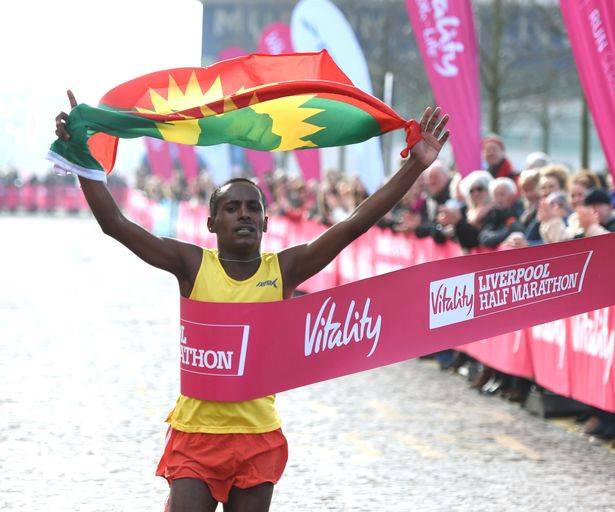
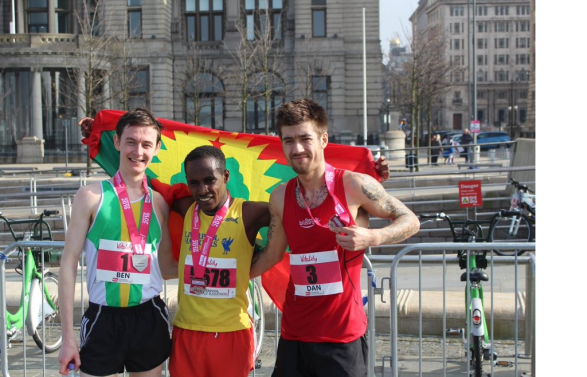
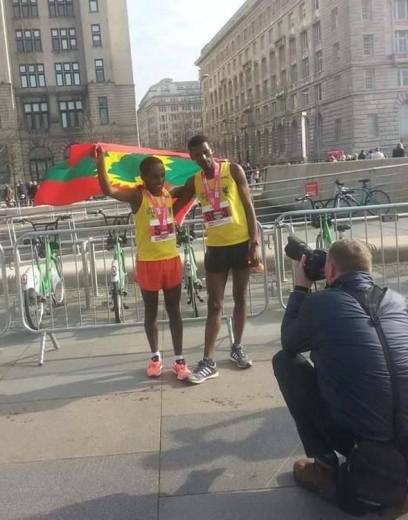
(Advocacy for Oromia, 14 March 2016) Athlete Dejene Gezimu has won the 2016 Vitality Liverpool Half Marathon and raised Oromo (athletic nation) national flag in the events.
The 22-year-old Oromo athlete, who has a string of other race wins under his belt, recorded a personal best for the half marathon with a time of 01:06:59 – averaging five minutes and seven seconds per mile.
He was 50 seconds faster than his nearest rival, Benjamin Douglas, who was runner-up.
The fastest woman to finish the 13.1-mile course, run in warm sunshine, was Michelle Nolan in a time of 01:20:20 – averaging 6 minutes and eight seconds per mile.
Meanwhile the winners in the 10 mile race were Connor McArdle, on a time of 58 minutes and 41 seconds, and Michelle King in 01:11:26.
Here are the top five male and female competitors in each of the races.
Advocacy for Oromia was established in 2010 with the purpose of enabling and empowering Oromo people by providing accurate and timely information that will help to make better choices to create the kind of future in which they wish to live.
It also provides information focus on the major issues facing us in the 21st century and it is going to try and bring a balanced approach with factual information that is positive and solution based.
The website has been in operation for the last nine years with the mission of promoting and advancing causes of Oromo people through advocacy, community education, information service, capacity building, awareness raising and promotion.
The website is also the official site of Advocacy for Oromia Association in Victoria Australia Inc., a non-profit organisation, registered under the Associations Incorporation Reform Act 2012 in Victoria as April 2014.
Our team already had considerable community development experience and expertise. Our various projects helped to develop our confidence and the capacity of our agency. Our team used every gained knowledge, skills and experiences as an opportunity to design and develop new approaches, to documenting progress, supporting positive employment outcomes, liaising with community stakeholders, and conduct evaluation.
Advocacy for Oromia is devoted to establishing Advocacy for Oromia organisation to close the gaps where we can stand for people who are disadvantaged and speaking out on their behalf in a way that represents the best interests of them. We are committed to supporting positive settlement and employment outcomes for Victoria’s Oromo community.
Advocacy for Oromia Office
Addresses:
39 Clow St,
Dandenong VIC 3175
=====================
247-251 Flinders Lane
Melbourne VIC 3000
Activities Address
Springvale Neighbourhood House Inc
Address: 46-50 Queens Ave, Springvale VIC 3171
Postal Address:
P. O. Box 150
Noble Park, Vic 3174
With your support, we can continue to help community build a better future.
Advocacy for Oromia Mental Health Program
The aim of the program is to improving the mental health and well-being of Oromo community in Victoria. It aims to assist those experiencing, mental ill-health, their families and carers of all ages within this community to address the social determinants of mental health for Oromo community. It helps:
Identify and build protective factors,
Reduce stigma and discrimination
Build capacity for self-determination
Better understand mental wellbeing, mental ill-health and the impacts of trauma
The goal of the project is to increase mental health literacy of Oromo community that aims:
To assist people with mental health issues
To increase the capacity of mental health worker
To better understand mental wellbeing
To provide mental health education and information
To address the social and cultural causes of mental health issues
Advocacy for Oromia will organise information session, women performance, radio programs, culturally adopted conversations on Oromo Coffee Drinking ceremony, providing training for mental health guides and forum and producing educational materials on the selected groups and geographical area.
Human Rights Education Program
The Human Rights Education Program is a community based human rights program designed to develop an understanding of everyone’s common responsibility to make human rights a reality in each community.
Human rights can only be achieved through an informed and continued demand by people for their protection. Human rights education promotes values, beliefs and attitudes that encourage all individuals to uphold their own rights and those of others.
The aim of the program is to build an understanding and appreciation for human rights through learning about rights and learning through rights. We aimed at building a universal culture of human rights. Thus, we aimed:
To build an understanding and appreciation for human rights through learning about rights and learning through rights.
To build capacities and sharing good practice in the area of human rights education and training
To develop human rights education and training materials and resources
The goal of the project is to increase human rights literacy of Oromo community that aims:
To better understand human rights
To increase the capacity of human rights worker
To analyse situations in human rights terms
To provide human rights education and information
To develop solidarity
To strategize and implement appropriate responses to injustice.
The ultimate goal of education for human rights is empowerment, giving people the knowledge and skills to take control of their own lives and the decisions that affect them.
Human rights education constitutes an essential contribution to the long-term prevention of human rights abuses and represents an important investment in the endeavour to achieve a just society in which all human rights of all persons are valued and respected.
Advocacy for Oromia will organise information session, performance, radio programs, culturally adopted conversations on Oromo Coffee Drinking ceremony, providing training for Human Rights guides and forum and producing educational materials on the selected groups and geographical area.
Community Safety Program
The program aims to strengthen existing collaborations and identify opportunities for the development of partnerships aimed at community safety and crime prevention activities. This approach seeks to improve the individual and collective quality of life by addressing concerns regarding the wider physical and social environment. Importantly, community safety means addressing fear of crime and perceptions of safety as without this any actions to address the occurrence of crime and anti-social behaviour are of less value.





 Advocacy for Oromia