The annual “Oromia at Federation Square” cultural festival of the Oromo will be held for the 7th year on Dec. 21, 2014. The famous Oromo artist Lencho Abdishakur will headline the Oromia at Federation Square concert program.
20th of December 2014
Oromia at Federation Square has continued to attract huge crowd
Oromia @ Federation Square is one of the biggest Oromo community festivals held every year in Melbourne, Australia. Every year since 2008, members of the Oromo community and friends of the Oromo people across Australia have congregated on one summer day in December at Melbourne’s Federation Square to celebrate and commemorate the beauty of the Oromo culture. This year’s Oromia @ Federation Square will be held on Sunday, December 21, 2014.
Not surprisingly, the entire festival is a jam-packed affair. Without exception, Australian Oromo men and women – both young and old – band together to showcase superb performances of dances, arts, spoken words, traditional clothing and blessings that touch the anticipating hearts and festive souls of the eager crowd. People from all walks of life are entrenched with Oromo tradition as theOromummaa spirit truly comes alive.
Over the years, influential people in the community, including Members of Parliament – Mr. Adam Bandt, MP for Melbourne, and Mr. Anthony Byrne, MP for Holt, and Victorian Multicultural Commission Commissioner, Mr. Chin Tan, have joined our festivities – commenting specifically on the vibrancy of the Oromo culture and the energy of the crowd.
Starting Sunday afternoon [Dec. 21, 2014], people visiting or passing by the Federation Square in Melbourne will feel as though they have landed in another country in a different continent – Oromia, in the Horn of Africa.
About Oromo and Oromia
– Over 40 plus million population
– Origin of human race
– Origin of Gadaa system
– Birth place of coffee
– Home to world class athletes
– One nation with multi-faith society: Christianity, Islam and Waaqeffannaa
– 3rd largest single nation in Africa
– Single largest nation in East Africa
– Has been occupied by Ethiopia for over 130 years
– Unaccounted number of Oromo refugees lives in almost all other countries of Africa.
– Struggling for Self-Determination
Oromia at Federation Square has continued to attract huge crowd, and this year will be no exception.
Artifacts exhibition will be on display from 2:00pm, and the cultural show will start at 3:00pm.
(Advocacy for Oromia, 11 December 2014) Here is another story of Oromo death in custody related news from central Oromia, East Africa.
#oromodeathincustody is currently an issue of Oromo community because of a widespread perception that a disproportionate number of Oromo had died in jail after being arrested by the security agent, the police and prison authorities.
This concern is particularly at high stage right now as there was/is a perception amongst Oromo community that the deaths are/were being caused, either directly or indirectly, by the security agent, the police and prison authorities against the innocent Oromo individuals.
Dirribi Nagasa was arrested from Adama University in 2010 and released in August 2014 after a long time torture. He was bitten and tortured by security agents #BecausIamOromo and denied medical treatment while he was in custody. He was passed away on December 8, 2014 in Gedo, Central Oromia.
Recent Records
A 21-year old Oromo student, Nuredin Hasen, who was abducted from Haromaya University late last month and held incommunicado at undisclosed location, died earlier this month from a brutal torture he endured while in police custody, family sources said.
Members of the federal and Oromia state police nabbed Hassen (who is also known by Alsan Hassen) and 12 other students on May 27 in a renewed crackdown on Oromo students. Friends were not told the reason for the arrests nor where the detainees were taken.
Born and raised in Bakko Tibbe district of West Shawa zone, Alsan, who lost both of his parents at a young age, was raised by his grandmother.
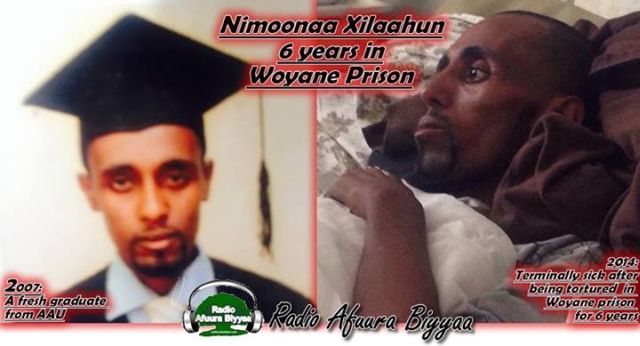
On June 6, another Oromo political prisoner, Nimona Tilahun passed away in police custody. Tilahun, a graduate of Addis Ababa University and former high school teacher, was initially arrested in 2004 along with members of the Macha Tulama Association during widespread protests opposing the relocation of Oromia’s seat to Adama. He was released after a year of incarceration and returned to complete his studies, according to reports by Canada-based Radio Afurra Biyya.
Born in 1982, Tilahun was re-arrested in 2008 from his teaching job in Shano, a town in north Shewa about 80kms from Addis Ababa. He was briefly held at Maekelawi prison, known for torturing inmates and denying legal counsel to prisoners. And later transferred between Kaliti, Kilinto and Zuway where he was continuously tortured over the last three years. Tilahun was denied medical treatment despite being terminally ill. His death this week at Black Lion Hospital is the third such known case in the last two years.
History has taught us that freedom is not free. When push comes to shove, the fearless protectors are the brave who’ve answered the call in sacrifice.
Rest in Peace!
Today is International Human Rights Day, which marks the anniversary of the adoption of the Universal Declaration of Human Rights on December 10, 1948. Crafted in the shadow of the horrors of the Holocaust and World War II, the Declaration gave the world the vision it needed to stand up to fear and the blueprint it craved to build a safer and more just world.
It is a bold document, based on a single premise – that the “recognition of the inherent dignity and of the equal and inalienable rights of all members of the human family is the foundation of freedom, justice and peace in the world.” Eleanor Roosevelt, who led the drafting and adoption of the Declaration, understood that we are all members of the human family, and that for governments to prosper and wars to cease, we must treat each other with the same respect and candor that we treat our own families. She knew this would not be easy or popular and that she would be accused of championing ideals that could never be achieved. But she persisted; knowing that without ideals, politics and policy are merely power games without a soul.
She urged America and the world to recognize that human rights “begin in small places, close to home…the places where every man, woman and child seeks equal justice, equal opportunity, equal dignity without discrimination.” And that “unless these rights have meaning there, they have little meaning anywhere.” But she also knew that rights come with responsibilities. For rights to exist here and around the world, we must recognize, implement, and defend them. As she often argued: “Without concerned citizen action to uphold them close to home, we shall look in vain for progress in the larger world.”
Eleanor Roosevelt dedicated her life to promoting this vision. Hillary Clinton dedicates her life to implementing it. It is not simple work. “Our challenge,” Hillary wrote in “Hard Choices,” “is to be clear eyed about the world as it is while never losing sight of the world as we want it to be.”
From the White House to the halls of the Senate and the State Department, Hillary strove to make these ideals a vibrant part of American domestic and foreign policy. Sometimes she did it with bold pronouncements on the world stage as she did in Beijing when she declared that “women’s rights are human rights, and human rights are women’s rights.”
Sometimes she did it by creating departments like the Global Office of Women’s Issues or elevating the State Department’s human rights office. Other times she did it in hundreds of quiet meetings with human rights activists and dozens of town hall meetings she held in communities from Argentina to Pakistan to South Korea. These conversations were not easy. Some leaders feared for their lives, others for their families, and others challenged Hillary to do more than she could possibly do. But she did not shy away from them. Indeed, she sought them out – even when she could do no more than lend the power of her position and her stature to their defense.
But three examples stand out.
In 2011, Ugandan thugs killed David Kato, a gay rights activist, and the Ugandan minister of ethics and integrity announced that “homosexuals can forget about human rights.” Rather than just mourn David and issue a formal rebuke, Hillary decided to confront, head on, the targeting of LGBT people sweeping Kenya, Nigeria, Uganda, Iran, and Russia.
She decided to return to Geneva, home of the United Nations Human Rights Council and thousands of global diplomats, on International Human Rights Day. Before an overflow audience, in remarks streamed live around the world, she confronted this outrageous behavior. LGBT people are part of the world’s family. “Like being a woman, like being a racial, religious, tribal, or ethnic minority, being LGBT does not make you less human. And that is why gay rights are human rights, and human rights are gay rights.”
In 2012, in the middle of our nation’s most intense economic negotiations with China, Hillary had an unexpected, stark choice to make. One of China’s most famous dissidents, the blind Chinese human rights activist Chen Guangcheng, had made a daring midnight escape from the guards surrounding his home, to seek sanctuary in the U.S. Mission. He did not know if he wanted to leave China and he had broken his foot during his flight. He called the Beijing Mission, which then called Hillary in the middle of the night. Hillary had worked hard to develop candid and productive relationships with the Chinese ministers so she knew how the Chinese would react and the damage the news of Chen’s escape could do to the summit. But she wanted to help Chen. She instructed embassy staff to find him, bring him in, and give him medical care. The Chinese were shocked, but Hillary kept them at the table, the summit continued, and Chen enrolled in a New York law school. His family came with him.
At home, America reels from the tragic deaths of Michael Brown and Eric Garner. A bitterly divided nation once again questions whether justice is possible and whether different races can pierce the divides that separate and stereotype them. As protests erupted across the nation, Hillary challenged us not to lose sight of our common humanity. “I know that a lot of hearts are breaking, and we are asking ourselves, ‘Aren’t these our sons? Aren’t these our brothers?’ The most important thing each of us can do is to try even harder to see the world through our neighbors’ eyes. To imagine what it is like to walk in their shoes, to share their pain and their hopes and their dreams. These tragedies did not happen in some far-away place. They didn’t happen to some other people. These are our streets, our children, our fellow Americans, and our grief. We are all in this together, we can all do better.”
We can do better. That’s what human rights mean.
Eleanor Roosevelt believed it and Hillary knows it. It is hard, tiring work. It takes the courage to dream, the political skills necessary to implement the dream, and a heart fierce enough to continue the struggle. On this day, let us recommit. Let us hear Hillary’s call. We must “never rest on [our] laurels. Never quit. Never stop working to make the world a better place. That’s our unfinished business.”
ALLIDA BLACK, Ph.D., is the chair of Ready for Hillary and an Eleanor Roosevelt historian. She is a research professor of history and international affairs at the George Washington University in Washington, D.C.
Oromia @ Federation Square is one of the biggest Oromo Community festivals held every year. Since the beginning, Oromo people from across Australia congregated at Federation Square to celebrate and commemorate the beauty of Oromo culture.
Dubbed the “voice of a generation,” Boonaa Mohammed is a critically acclaimed award winning writer and performer with accolades including a playwright residency at Theatre Passe Muraille, a short story published in a Penguin Canada anthology called “Piece by Piece” and various slam poetry titles including winner of the 2007 CBC Poetry Face-Off “Best New Artist” award.
As an Artist he has toured and traveled across the world and frequently conducts writing workshops and seminars, sharing his experience and expertise in social justice based story telling with mainly youth from all walks of life.
Gemeda Adem outside his business Total Print Solutions.Source: News Limited
BY HELPING others build their businesses, Footscray’s Gemeda Adem has also built his own.
Mr Adem created Total Print Solutions working alone from one small room six years ago.
Today, he has a thriving company with seven employees and a customer base across Australia.
Mr Adem’s business was recently (November 7) named African Australian Business of the Year at the Celebration of African Australian National Awards presented at Parliament House in Melbourne.
The company does design work, printing, signs and website development.
“I started (working) in a small room, then a two room office, now we’re in a two-storey building and I employ many young people from the community from all cultures,’’ he said.
A former Western Chances scholarship recipient, Mr Adem said he has been successful because he actively approached African Australian business people in Footscray and showed them the benefits they could achieve with consistent branding for their businesses, while keeping his own prices affordable.
“I feel like everyone deserves a chance to achieve their dream, and no support is ever too small,’’ Mr Adem said.
“I spoke the language so I went into their shops and explained to them a new perspective about updating their signage and logos and giving it all a professional look.’’
Mr Adem, who is from the Oromo community speaks Oromo, Amharic, English and some Arabic and Somali.
He said receiving the award was an honour and a big deal for the whole community.
The aim of the Celebration of African Australians Awards is to celebrate and showcase the contributions of African Australians to the broader community, and identify role models who will serve as mentors to young African Australians.
Ethiopia’s government illegally detained at least 5,000 members of the country’s most populous ethnic group, the Oromo, over the past four years as it seeks to crush political dissent, Amnesty International said.
Victims include politicians, students, singers and civil servants, sometimes only for wearing Oromo traditional dress, or for holding influential positions within the community, the London-based advocacy group said in a report today. Most people were detained without charge, some for years, with many tortured and dozens killed, it said.
“The Ethiopian government’s relentless crackdown on real or imagined dissent among the Oromo is sweeping in its scale and often shocking in its brutality,” Claire Beston, the group’s Ethiopia researcher, said in a statement. “This is apparently intended to warn, control or silence all signs of ‘political disobedience’ in the region.”
The Oromo make up 34 percent of Ethiopia’s 96.6 million population, according to the CIA World Factbook. Most of the ethnic group lives in the central Oromia Regional State, which surrounds Addis Ababa, the capital. Thousands of Oromo have been arrested at protests, including demonstrations this year against what was seen as a plan to annex Oromo land by expanding Addis Ababa’s city limits.
Muslims demonstrating about alleged government interference in religious affairs were also detained in 2012 and 2013, Amnesty said in the report, titled: ‘Because I am Oromo’ – Sweeping Repression in the Oromia Region of Ethiopia.
Government Denial
The state-run Oromia Justice Bureau said the findings were “far from the truth” in a reply to Amnesty included in the report. “No single individual has been and would not be subjected to any form of harassment, arrest or detention, torture for exercising the freedom of expression or opinion.”
The majority of detainees are accused of supporting the Oromo Liberation Front, which was formed in 1973 to fight for self-determination, according to Amnesty.
Senior Oromo politicians Bekele Gerba and Olbana Lelisa were jailed in 2012 for working with the group, which was classified as a terrorist organization by lawmakers in 2011.
“The accusation of OLF support has often been used as a pretext to silence individuals openly exercising dissenting behavior,” Amnesty said.
The bulk of Amnesty’s information came from interviews with 176 refugees in Kenya, Somalia and Uganda in July this year and July 2013. More than 40 telephone and e-mail conversations were also conducted with people in Ethiopia, it said.
Some interviewees said they fled the country because of conditions placed on them when released, such as being told to avoid activism, meeting in small groups, or associating with relatives who were political dissenters, the report said.
Amnesty has been banned from Ethiopia since 2011 when its staff was deported.
To contact the reporter on this story: William Davison in Addis Ababa at wdavison3@bloomberg.net
To contact the editors responsible for this story: Antony Sguazzin at asguazzin@bloomberg.net Paul Richardson, Karl Maier
(A4O, 1 November 2014) A new report released on Tuesday by an international human rights group said Ethiopia has “ruthlessly targeted” the Oromo people, the country’s its largest ethnic group.
Amnesty International said thousands of Oromo people had been systematically subjected to unlawful killings, torture and enforced disappearance.
“Because I am Oromo” – Sweeping repression in the Oromia region of Ethiopia exposes how Oromos have been regularly subjected to arbitrary arrest, prolonged detention without charge, enforced disappearance, repeated torture and unlawful state killings as part of the government’s incessant attempts to crush dissent.
The report said at least 5,000 Oromos had been arrested between 2011 and 2014 for their “actual or suspected peaceful opposition to the government”.
“The Ethiopian government’s relentless crackdown on real or imagined dissent among the Oromo is sweeping in its scale and often shocking in its brutality,” said Amnesty International researcher Claire Beston.
Amnesty said that the majority of the Oromo people were targeted over their alleged support to the Oromo Liberation Front (OLF), a group that is fighting for the self-determination of the Oromo people.
The report was compiled based on testimonies from 200 exiled Oromo people, including former detainees.
Torture
Amnesty International’s report documents regular use of torture against actual or suspected Oromo dissenters in police stations, prisons, military camps and in their own homes.
A teacher told how he had been stabbed in the eye with a bayonet during torture in detention because he refused to teach propaganda about the ruling party to his students.
A young girl said she had hot coals poured on her stomach while she was detained in a military camp because her father was suspected of supporting the OLF.
A student was tied in contorted positions and suspended from the wall by one wrist because a business plan he prepared for a university competition was deemed to be underpinned by political motivations.
Former detainees repeatedly told of methods of torture including beatings, electric shocks, mock execution, burning with heated metal or molten plastic and rape, including gang rape.
Although the majority of former detainees interviewed said they never went to court, many alleged they were tortured to extract a confession.
“We interviewed former detainees with missing fingers, ears and teeth, damaged eyes and scars on every part of their body due to beating, burning and stabbing – all of which they said were the result of torture,” said Claire Beston.
Detainees are subject to miserable conditions, including severe overcrowding, underground cells, being made to sleep on the ground and minimal food. Many are never permitted to leave their cells, except for interrogation and, in some cases, aside from once or twice a day to use the toilet. Some said their hands or legs were bound in chains for months at a time.
As Ethiopia heads towards general elections in 2015, it is likely that the government’s efforts to suppress dissent, including through the use of arbitrary arrest and detention and other violations, will continue unabated and may even increase.
“The Ethiopian government must end the shameful targeting of thousands of Oromos based only on their actual or suspected political opinion. It must cease its use of detention without charge, torture and ill-treatment, incommunicado detention, enforced disappearance and unlawful killings to muzzle actual or suspected dissent,” said Claire Beston.
Interviewees repeatedly told Amnesty International that there was no point trying to complain or seek justice in cases of enforced disappearance, torture, possible killings or other violations. Some were arrested when they did ask about a relative’s fate or whereabouts.
Amnesty International believes there is an urgent need for intervention by regional and international human rights bodies to conduct independent investigations into these allegations of human rights violations in Oromia.
Former detainees told Amnesty that methods of torture included “beatings, electric shocks, mock execution, burning with heated metal or molten plastic and rape, including gang rape”.
BBC interviewing torture survivor and Dr Awol K on Amnesty report.
The Oromo account for nearly 45% of the country’s 94 million population.
Advocacy for Oromia was established in 2010 with the purpose of enabling and empowering Oromo people by providing accurate and timely information that will help to make better choices to create the kind of future in which they wish to live.
It also provides information focus on the major issues facing us in the 21st century and it is going to try and bring a balanced approach with factual information that is positive and solution based.
The website has been in operation for the last nine years with the mission of promoting and advancing causes of Oromo people through advocacy, community education, information service, capacity building, awareness raising and promotion.
The website is also the official site of Advocacy for Oromia Association in Victoria Australia Inc., a non-profit organisation, registered under the Associations Incorporation Reform Act 2012 in Victoria as April 2014.
Our team already had considerable community development experience and expertise. Our various projects helped to develop our confidence and the capacity of our agency. Our team used every gained knowledge, skills and experiences as an opportunity to design and develop new approaches, to documenting progress, supporting positive employment outcomes, liaising with community stakeholders, and conduct evaluation.
Advocacy for Oromia is devoted to establishing Advocacy for Oromia organisation to close the gaps where we can stand for people who are disadvantaged and speaking out on their behalf in a way that represents the best interests of them. We are committed to supporting positive settlement and employment outcomes for Victoria’s Oromo community.
Advocacy for Oromia Office
Addresses:
39 Clow St,
Dandenong VIC 3175
=====================
247-251 Flinders Lane
Melbourne VIC 3000
Activities Address
Springvale Neighbourhood House Inc
Address: 46-50 Queens Ave, Springvale VIC 3171
Postal Address:
P. O. Box 150
Noble Park, Vic 3174
With your support, we can continue to help community build a better future.
Advocacy for Oromia Mental Health Program
The aim of the program is to improving the mental health and well-being of Oromo community in Victoria. It aims to assist those experiencing, mental ill-health, their families and carers of all ages within this community to address the social determinants of mental health for Oromo community. It helps:
Identify and build protective factors,
Reduce stigma and discrimination
Build capacity for self-determination
Better understand mental wellbeing, mental ill-health and the impacts of trauma
The goal of the project is to increase mental health literacy of Oromo community that aims:
To assist people with mental health issues
To increase the capacity of mental health worker
To better understand mental wellbeing
To provide mental health education and information
To address the social and cultural causes of mental health issues
Advocacy for Oromia will organise information session, women performance, radio programs, culturally adopted conversations on Oromo Coffee Drinking ceremony, providing training for mental health guides and forum and producing educational materials on the selected groups and geographical area.
Human Rights Education Program
The Human Rights Education Program is a community based human rights program designed to develop an understanding of everyone’s common responsibility to make human rights a reality in each community.
Human rights can only be achieved through an informed and continued demand by people for their protection. Human rights education promotes values, beliefs and attitudes that encourage all individuals to uphold their own rights and those of others.
The aim of the program is to build an understanding and appreciation for human rights through learning about rights and learning through rights. We aimed at building a universal culture of human rights. Thus, we aimed:
To build an understanding and appreciation for human rights through learning about rights and learning through rights.
To build capacities and sharing good practice in the area of human rights education and training
To develop human rights education and training materials and resources
The goal of the project is to increase human rights literacy of Oromo community that aims:
To better understand human rights
To increase the capacity of human rights worker
To analyse situations in human rights terms
To provide human rights education and information
To develop solidarity
To strategize and implement appropriate responses to injustice.
The ultimate goal of education for human rights is empowerment, giving people the knowledge and skills to take control of their own lives and the decisions that affect them.
Human rights education constitutes an essential contribution to the long-term prevention of human rights abuses and represents an important investment in the endeavour to achieve a just society in which all human rights of all persons are valued and respected.
Advocacy for Oromia will organise information session, performance, radio programs, culturally adopted conversations on Oromo Coffee Drinking ceremony, providing training for Human Rights guides and forum and producing educational materials on the selected groups and geographical area.
Community Safety Program
The program aims to strengthen existing collaborations and identify opportunities for the development of partnerships aimed at community safety and crime prevention activities. This approach seeks to improve the individual and collective quality of life by addressing concerns regarding the wider physical and social environment. Importantly, community safety means addressing fear of crime and perceptions of safety as without this any actions to address the occurrence of crime and anti-social behaviour are of less value.
 Oromia @ Federation Square is one of the biggest Oromo community festivals held every year in Melbourne, Australia. Every year since 2008, members of the Oromo community and friends of the Oromo people across Australia have congregated on one summer day in December at Melbourne’s Federation Square to celebrate and commemorate the beauty of the Oromo culture. This year’s Oromia @ Federation Square will be held on Sunday, December 21, 2014.






 Advocacy for Oromia