Author Archives: advocacy4oromia
Jiituu Dh. Wakjira exposed political suppression and oppression in her story of love, perseverance, resilience and courage.
(Oromo News, 18 August 2013) Jiituu Dhabasa Wakjira was only five years old when Ethiopian security forces took away her father, Dhabasa Wakjira, from their home in April 2004 and nine years old when her mother, Lelisse Wodajo, was arrested four years latter in 2008.
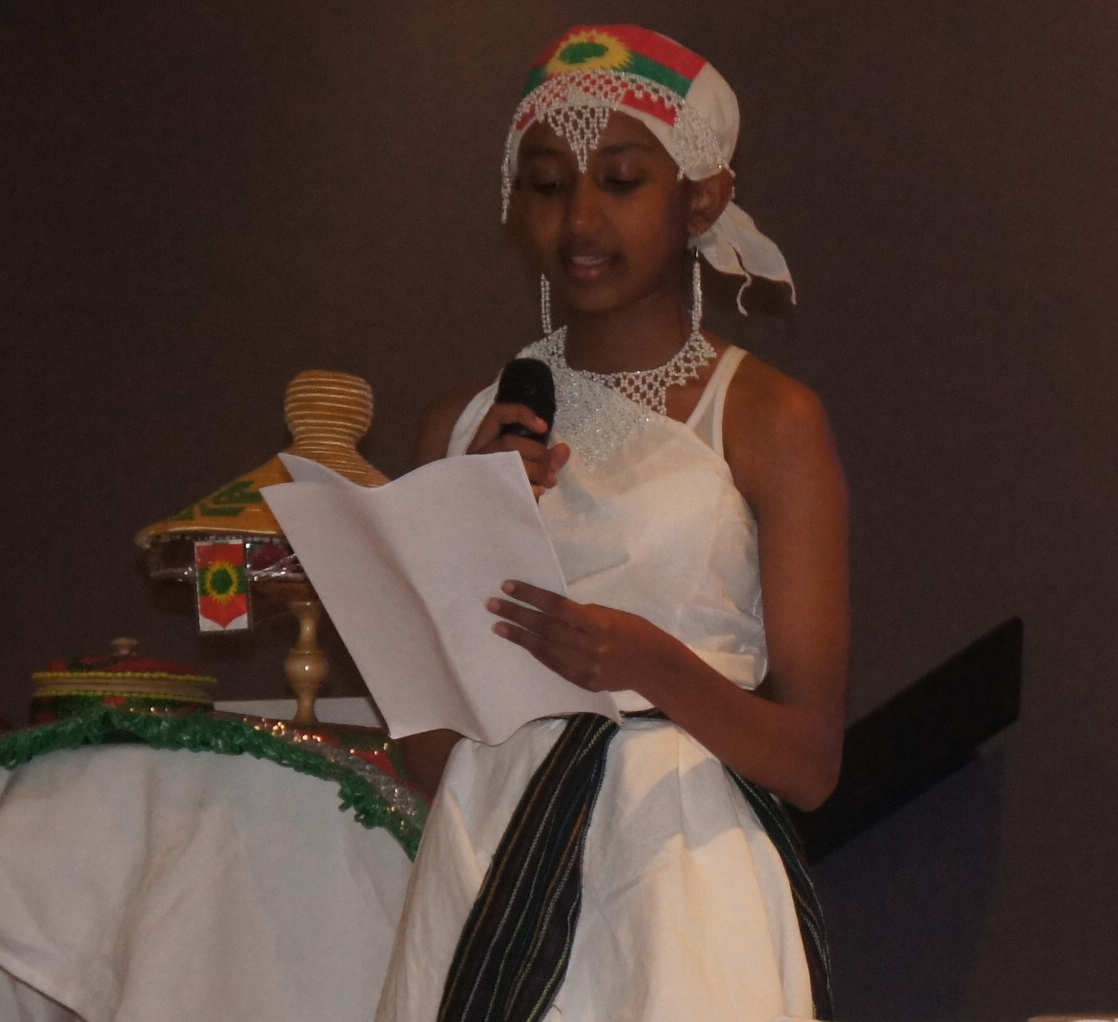 Jiituu understood very little at the time, but remembers missing her father, whom she visited at Ethiopia’s notorious Kaliti prison every weekend – for nearly three years.
On Saturday Aug. 10 2013, Jiitu, 14, described her family’s ordeals, in a heartfelt speech that read much like a movie script, before a captive Oromo and Australian audience.
Exposed to politics, suppression, oppression and loss at a young age, Jiitu’s is a story of love, perseverance, resilience, and courage.
The following is a speech written by Jiituu Dhabasa on welcoming night for Lelisse Wodajo, organized by Oromo community on 10/08/2013, Melbourne.
Oromo journalist, Lalise Wodajo, reunited with family after 8 years
(A4O/ By Sinke Wesho |18 August 2013) – Jiitu Wakjira was only five years old when Ethiopian security forces took away her father, Dhabasa Wakjira, from their home in April 2004. Jiitu understood very little at the time, but remembers missing her father, whom she visited at Ethiopia’s notorious Kaliti prison every weekend – for nearly three years.
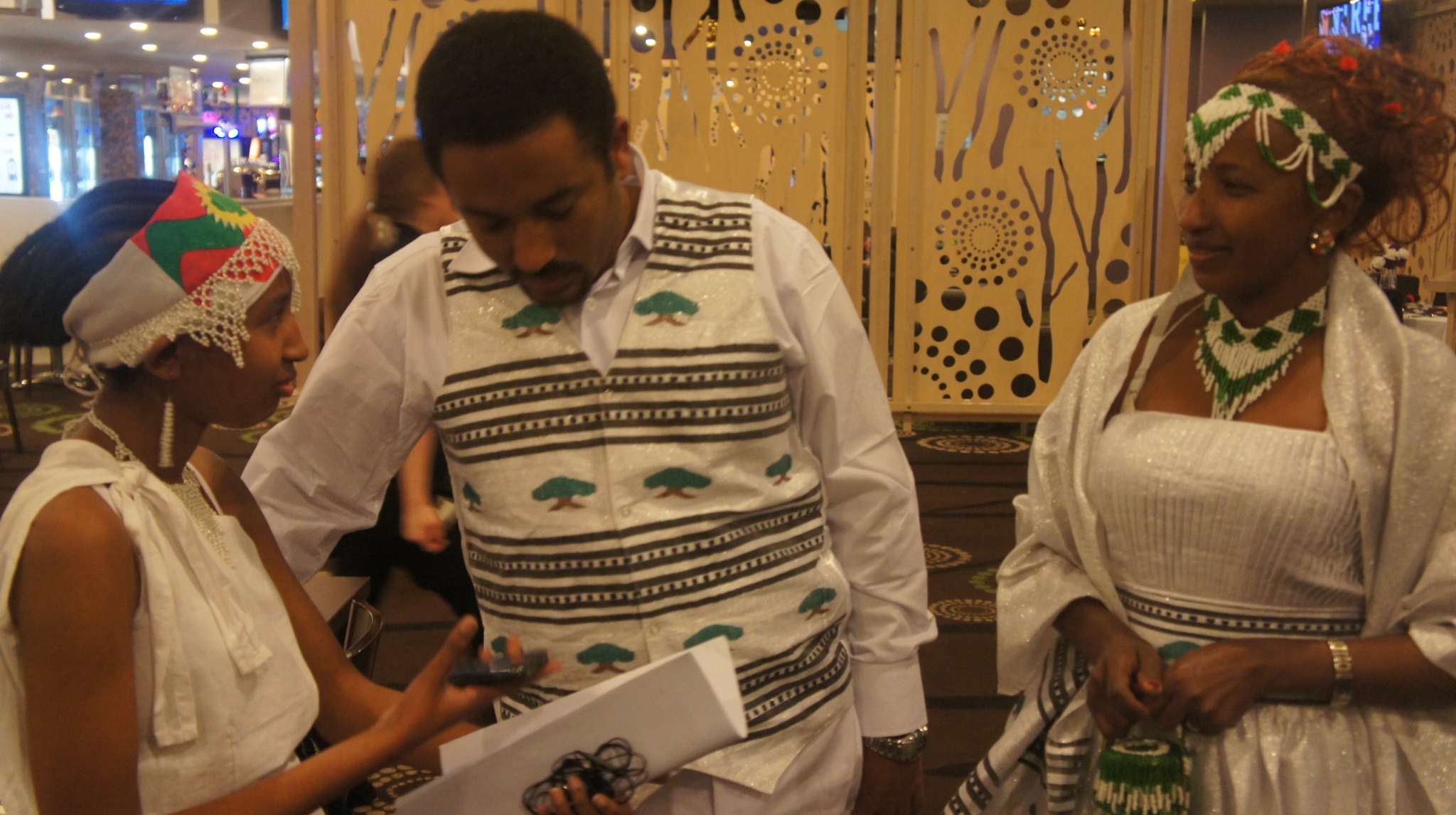 On Saturday Aug. 10 2013, Jiitu, 14, described her family’s ordeals, in a heartfelt speech that read much like a movie script, before a captive Oromo and Australian audience.
Exposed to politics, suppression, oppression and loss at a young age, Jiitu’s is a story of love, perseverance, resilience, and courage.
“This is my way of taking everyone here back to when everything started,” Jiitu told her audience as she began speaking. “Every adult in my family has had a rough patch with the Ethiopian government. I didn’t understand what was happening when the police came to take my dad…I can’t explain how I felt. I guess I was scared. I mean, who wouldn’t be?”
The event was organized by members of the Australian Oromo Community Association in Victoria to celebrate a reunion of a family torn apart by years of injustice. Lalise Wadajo, Jiitu’s mother and former journalist with the state-run Ethiopian Television, was arrested on October 30, 2008 and later sentenced to 10 years without parole for alleged associations with the Oromo Liberation Front (OLF). Lalise arrived in Australia early this month after serving nearly three years in prison.
At Waltz Matilda hotel in Springvale ballroom, where the event was held, a family photo of the Wakjira’s beamed from two screens. The iconic photo shows Dhabasa and his children hugging Lalise as if to never let go off her again.
The story of the Wakjira’s resonates with many in the Oromo diaspora – separation from loved ones, despair and triumph of longing to see each other again. Tables were filled with Oromo traditional food, decorated with an Oromo flag and Oromo attires greeted entrants from all directions.
The auspicious dinner was followed by remarks from the family and a Skype call from Dr. Trevor Truman, human rights advocate and chairman of the UK-based Oromo Support Group. “Galatooma,” said Dr. Truman thanking the organizers in Afan Oromo. “Lalise ani gammade jira” – I am so happy for you, Lalise. Dr. Truman said he was thrilled about Lalise’s release and subsequent reunion with her family. He then commended Lalise for her patience and perseverance in the face of harsh and inhumane treatment in the hands of Ethiopian authorities – something he knows all too well having worked with Oromo refugees over the last two decades.
Unable to finish her five-page speech, Jiitu sat next to her parents, wiping tears off her angelic face. As Toltu Tufa – who campaigned and lobbied the Australian government on Lalise’s behalf for years – narrated the rest of her story, Jiitu fought back tears and as did everyone else in the room. Even in such an emotional moment, the teenage Jiitu was humble and graceful. The roomful audience was sniffing in tears.
Jiitu described how confused and lost she was to witness the alternative imprisonment of her parents. She recalled the first time her father was arrested – with no warrants or accusations. Jiitu remembers the federal police breaking into their house, interrogating her father, and confiscating her video games, tapes of her parent’s wedding and certain newspapers.
“I remember sitting on dad’s lap, watching the policemen open wardrobe after wardrobe,” Jiitu wrote. “My memories of that time are hazy, all I remember is that it was Friday and the next day when I woke up and asked mom where dad was, she said he was, in simple words, gone.”
For the next two years, every time she visited her father in prison, the impressionable Jiitu saw hundreds of Oromos at Kaliti prison.
“My dad told me that I once asked [him], ‘Did you know Qaliti is Oromia’s ‘capital’ city?’ He had asked ‘Why?’ to which I replied, “Because all Oromo[s] are here. They all speak Afaan Oromo.’ I’m guessing I didn’t view it as a prison back then but more like a meeting hall for all Oromo people to converse,” Jiitu said of the infamous prison on the outskirts of Addis Ababa, Ethiopia’s capital. The room was dead silent, filled only with sniffles, as Jiitu chronologically detailed the harrowing story of the Wakjira’s.
When Dhabasa was released in 2008, the young Jiitu hoped for a normal and steady family. “It came as a shock,” Jiitu recalled in her remarks. “My brother, Bonsen [a toddler when Dhabasa was arrested] believed that a picture of dad was his dad. When dad came home, he didn’t believe us when we told him that dad was really dad. It took him a while to understand that a picture was incapable of fathering him.”
But Jiitu’s excitement did not last long as Dhabasa soon escaped a probable arrest and left for exile first to Kenya, and eventually resettled to Australia. Hopelessness set in for Jiitu not knowing if she would ever see him again. “I didn’t understand that he was gone for his own safety, in fact, back then, I preferred the first departure than the second. At least then, I got to see him weekly [in prison],” Jiitu wrote. Then the police took her mother – literally leaving her and two younger siblings without parents.
The day Lalise was arrested, Jiitu was returning home from school, after taking a major exam, to tell her mother how easy it was. Upon arrival though, Jiitu watched in horror and confusion as her mother was whisked away by uniformed security personnel. Jiitu screamed and cried for her mother as the officers slamming the door on the pickup truck. “I will be back,’’ Jiitu recalled her mother saying as the truck drove off. “Who was going to take care of us…Where’s mom going?” Jiitu remembered pondering as she embraced her baby brother, Bonsen. Jiitu once again found herself trekking back to Kaliti, this time to visit her mother, unlawfully convicted for no other reason than being Oromo.
Separated from both her parents, Jiitu had to learn to be an adult at a young age. But there was another hurdle. She attended school six days a week. This meant she could only see her mother on Sundays, missing church, which upset her aunt Mastawot. Jiitu remembers seeing girls younger than her age living in prison quarters whenever she visited her mother. In one instance, Jiitu describes how her eyes were fixated on a young girl, about seven or eight years old, apparently living in prison, until Jiitu’s mother distracted her with a candy. Unable to comprehend why a girl her age was doing at Kaliti prison, Jiitu asked her mother for explanation. “To this day, I do not understand why an innocent young girl who was obviously not capable of doing any harm to the government [was] in prison,” Jiitu said in her speech.
Jiitu eventually joined her father in exile but with some misgivings. “When I found out that we were going to be with dad, I felt like I was in a dilemma,” she recalled. “I was happy, I mean I was going to see dad but then I was sad too. I was leaving mom. I was going one way or another. It was like a transition, from both parents to mom to both parents and then to none.”
In Nairobi, I had a better understanding to why my parents were arrested. It turned out they were not an exception, they were just Oromo people. I couldn’t get my head around why they were arrested though. Taking pride in one’s country shouldn’t have been a crime. It shouldn’t have been frowned upon; it should be accepted and encouraged.
Even after her mother was released, Jiitu still had to wait for over a year to see her mother. But after learning her mother was granted the family reunion visa to Ausralia, “I literally had a hand-made calendar counting down the days on the back of my school diary and had different scenarios of how I would greet her in my head.”
Jiitu’s father, Dhabasa, a former journalist and community activist, spoke next. He admitted that when he lodged the family reunification application in August 2011, he did not believe that this day would come; a day when he would see his beloved wife sitting next to him with all her family. On July 3, 2013, Lalise was granted a visa to travel to Australia. After a long torturous eight years of waiting, they were reunited on in Melbourne on the morning of Aug. 8, 2013.
Dhabasa told a heartbreaking tale of losing a sister, brother, and mother in a matter of weeks. And in all these grief, Dhabasa was unable to mourn for his loved ones since he could not return home. “I inherited the strength of this woman,” he said of his wife, Lalise. “She stood by me, my children, my family all these years that I was missing. She became father and mother of my children, and ensured that they were educated, she went on hungry stomach to feed our family and today she is still strong.”
The mood in the room turned somber.
Next, Lalise took the stage to a standing ovation – beaming in an Oromo cloth painted with Odaa, the symbol of Oromo democracy, with beads around her neck and forehead. Her confidence and charisma was contagious. “Galatooma,” she told members of the Australian Oromo Community for standing by her family during the long ordeal. She was humble but clear and eloquent; Lalise spoke about ongoing systematic oppression of the Oromo people and the quandary of Oromo political prisoners. A remarkable storyteller, by the time Lalise was done speaking, the crowd seemed as if wanting to hear more.
As a woman and young person, I was filled with feelings of love and rage. I was enraged because an innocent woman was dehumanized, separated from her family, her husband and nation with no reason. But I also fall in love with her, in part because this was the first time I saw my community celebrating a heroine. Although women have been the backbone of Oromo struggle, little has been said about their contribution and ordeals. Even when recognized, there is little or no follow up. Women’s place still feels at the house while men carry the flag of advocacy. Celebrating Lalise I felt I was seeing the light at the end of the tunnel. Witnessing Lalise’s and Jiitu’s journey, I felt this was the beginning of ‘bilisummaa’ or freedom for Oromo – by embracing half of its population.
Families and invited guests joined in celebratory Oromo dance after the formal event. Lalise looks like every Oromo daughter, mother and a wife. But she has borne too much a loss just for being an Oromo. For the Oromo nation though, Lalise’s children – the fruits of long and arduous struggle – are now the hope and leaders of tomorrow. I have no doubt her story of both struggle and triumph, when and if told, will inspire millions across the globe.
Jiitu, now an Oromo rights activist, ended her speech with a quote from Martin Luther King: Freedom is not voluntarily given by the oppressor; it must be demanded by the oppressed . She urged those in the room to fight injustice and support the Oromo people’s struggle.
Here’s a short except from her remarks:
In the airport, I started getting worried because she was one of the last people to arrive. Our eyes were darting around looking for her until Bontu yelled ‘She’s here’ and they started running towards her. I didn’t greet her until I got over the fact that she was there. I did try to stop myself from crying but how could I not? The minute we hugged, my hands were just tight around her neck and I was tearing up. I knew people wanted to greet her too but I didn’t want to let go.
Even though mom is here with us and the missing puzzle to our family was complete, there are still others suffering under the Ethiopian government. There are still parents with children like me suffering and yet putting their children’s safety in front of theirs …We owe them, I owe them a lot of things and we should never take our freedom here for granted.
I still remember Hawi, Aberash, Faxe, Muda, Mesfin and many others in Ethiopian prison because of their identity, their background and political views. I wish that they could all be here with us away from the dictatorship but they’re not. I really hope one day that we could unite and live life as the big family we are without fear.
—
*The writer, Sinqe Wesho, is a Melbourne-based human rights activist and former public relations officer for the Australian Oromo Community in Victoria. She can be reached for comments at arfasabill@yahoo.com.au. Photos by Alula Mosisa, an engineering student and freelance photographer based in Melbourne, Australia. He can be reached at falmata430@hotmail.com.
Melbourne Oromo Community Sees Human Rights Education as Key to Peaceful Resolution of Conflict
(A4O, August 11, 2013) The Church of Scientology of Melbourne organized a human rights education workshop for leaders of the Australian Oromo Community.
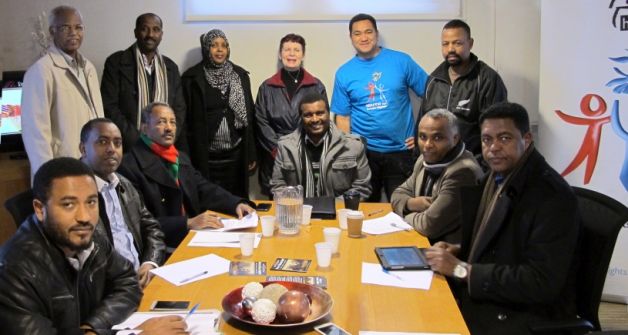 Leaders of the African Oromo Community in Melbourne attended a human rights seminar July 7, 2013, as the first step of a program to bring change and hope to the Oromo people. The training session, organized by the Church of Scientology of Melbourne, introduced community leaders to the human rights education program of Youth for Human Rights, an initiative supported by the Church of Scientology.
The Oromo are the largest ethnic group in Ethiopia, representing 35 percent of the population. Oromo leaders see this program as the key to a peaceful resolution of decades-long conflict in their country and restoring the rights of the Oromo people.
After watching The Story of Human Rights documentary and human rights public service announcements, attendees decided to use the Youth for Human Rights program to educate Oromo youth in Melbourne and to help see that the materials are made available to those on both sides of the conflict in Ethiopia.
Scientologists on five continents engage in collaborative efforts with government agencies and nongovernmental organizations to bring about broad-scale awareness and implementation of the 1948 United Nations Universal Declaration of Human Rights, the world’s premier human rights document.
The Church of Scientology published Scientology: How We Help—United for Human Rights, Making Human Rights a Global Reality, to meet requests for more information about the human rights education and awareness initiative the Church supports. To learn more, visit http://www.Scientology.org/humanrights.
Scientology Founder L. Ron Hubbard wrote, “Human rights must be made a fact, not an idealistic dream,” and the Scientology religion is based on the principles of human rights. The Code of a Scientologist calls on all members of the religion to dedicate themselves “to support true humanitarian endeavors in the fields of human rights.”
Songs of Exile: Singing the Past into the Future to Curb Youth Violence
(A4O, 5 August 2013) Dr Kuwee Kumsa presents the emotive and fantastic Songs of Exile on Oromo Study Association.
The Songs of Exile is the powerful historical and Contemporary forms of Women’s Empowerment.
The presentation compasses Songs of Exile: Singing the Past into the Future to Curb Youth Violence.
Great Speech: If the Oromo goes down, all humanity goes down.
(A4O, 4 July 2013) An African-American Inspirational Speaker at the OSA 2013 Annual Conference says If the Oromo goes down, all humanity goes down.
According the Video source from the OromoPress, the African American attendee drops the inspirational that knocks every Oromo doors.
He added that “the Oromo people, the holder of the Gadaa system, stand up and be firm!You have revolutionaries, you have leaders and we are united with you!”
He says humanity is with the Oromo, “Oromo, Stand Up and Be Firm.”
Part III: Dr Gemetchu Megerssa and his Knowledge, Identity and the Colonizing Structure conversation
(A4O, 3 August 2013) Dr Gemetchu Megerssa continues his depth Conversation on Knowledge, Identity and the Colonizing Structure.
In this part III, Dr. Gemechu shares his hopes for the future, his thoughts on the role of young people, on the artificial divisions among the Oromo and the importance of reclaiming indigenous Oromo knowledge and heritage.
Oromo and Ogaden Protest Against Dictator’s Financiers
(A4O, 22 July 2013) According to Canada – CBC news many Oromo and Ogaden Protest in Edmonton, Canada, Against Ethiopian Empire’s Financiers; heavy police presence, no arrests at Edmonton protest.
Police responded to a call of an officer in distress during rally against the Ethiopian government
A heavy police presence formed outside the Belmead Community league in west Edmonton Saturday afternoon when about 100 protesters gathered to rally against the Ethiopian government.
Protesters told CBC News that representatives from the Ethiopian government were meeting inside the community league’s building to discuss selling bonds for a hydroelectric dam project on the Blue Nile River in Ethiopia.
Several people involved in the protest said their goal in rallying at the building was to disrupt the meeting.
Edmonton protest sparks huge police presence
EDMONTON – A standoff between two Ethiopian groups attracted more than 45 police officers, some in riot gear, to a west end community league Saturday afternoon.
 At around 3 p.m., police responded to a protest in the parking lot of the Belmead Community Centre at 182nd Street and 90th Avenue where more than 100 demonstrators had gathered. Officers called for backup after they were surrounded by a large group, Edmonton Police Service said in a news release.
The protest started escalating when demonstrators were denied access to a meeting of about 40 people that was taking place inside the community centre, said EPS spokeswoman Patrycia Thenu.
Several police officers blocked off the entrance to the building and made protesters stand on the sidewalk on the other side of the parking lot. There were more than a dozen police vehicles in the parking lot and blocking off the entrance to the community centre. There were several more police vehicles parked around the corner behind a strip mall on 89th Avenue.
Just before 5:30 p.m., an Edmonton Transit System bus drove up behind the building and the meeting attendees were escorted onto it. The protesters on the sidewalk started cheering, waving Ethiopian flags, one Canadian flag, and placards. When they got to the entrance of the community centre’s parking lot, some started chanting and dancing in a circle.
Protesters claimed the individuals at the meeting were representatives of the Ethiopian government. Sayf Abdi said the group is trying to collect money from Ethiopian-Canadians to fund development projects in their homeland, such as a massive hydroelectric damn in the Blue Nile River.
“That’s not true, this is a dictator government, they (are) killing people over there, it’s a military government,” he said. “There’s only one party for 22 years. There’s no democracy, no elections, no anything. We need (them) to know we are not supportive for them. We need to tell to them our voice. We need peace and democracy. That’s why we’re not supporting you.”
After talking to the media, most of the protesters disbanded.
At 6 p.m., the ETS bus returned and dropped off the meeting attendees so they could collect their vehicles and go home. Many wore white hats and had booklets with the Ethiopian flag on it.
Co-ordinator Desalegn Abara said about 120 members of the Ethiopian-Canadian Development Discussion Forum had gathered at the community centre for a meeting. He said the group is not affiliated with the Ethiopian government.
“Our goal is to provide information where people can participate either by investing, or through their skills, or by supporting the (development) projects,” he said.
Abara said the group is not asking for money, “there is no forcing or coercing in any way.”
He said protesters did not get into the building. However, Abara said he is disappointed that the meeting was interrupted.
“Unfortunately, the police collaborated with them and they stopped our meeting, we cut it short, as criminals we’ve been put in a bus and (taken) out of the premises,” he said.
He said the meeting will resume at a later date.
Thenu confirmed there were no injuries among the protesters or the individuals at the meeting. She said the demonstrators did have a permit for a peaceful protest.
No arrests were made or charges laid at the scene, but charges are pending against one male protester upon further investigation, the EPS news release said.
Source: http://www.edmontonjournal.com/news/edmonton+protest+sparks+huge+police+presence/8687831/story.html
Canadian Oromos protest the Ethiopian dictator supports
(A4O, 22 July 2013) July 21, 2013, According to Edmonton, Canada based TV news (CTV) an estimated 100 people were believed to be involved in a heated protest at the Belmead Community League Hall Saturday afternoon.
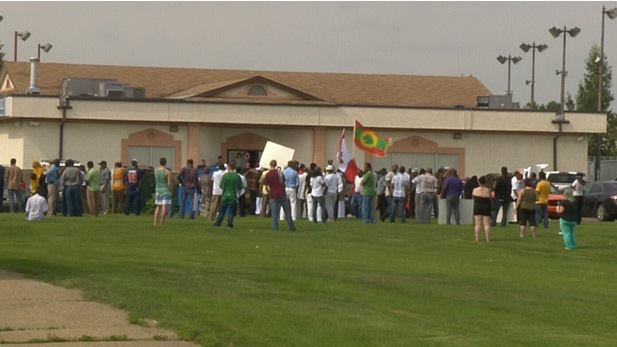 Authorities said about 20 police officers were called in after the situation escalated.
Media and the general public were removed to a safe distance.
Protesters called the gathering in the hall of Ethiopian government supports was illegal and they were standing up for those in their home country.
“They are speaking out you know for the right of their brothers and sisters in their home country and the illegal meeting the government agents are holding here and they are agents and messengers,” Derej Geleta explained to CTV News.
“It is a peaceful demonstration for the right of our peoples in our home country,” he added.
A confrontation was avoid as police lined up with riot gear at the back of the building, creating a safe space for those inside the building to exit into a bus.




 Advocacy for Oromia