Category Archives: News
OSG Australia Statement on the brutal killing of Gammachu Garomsa
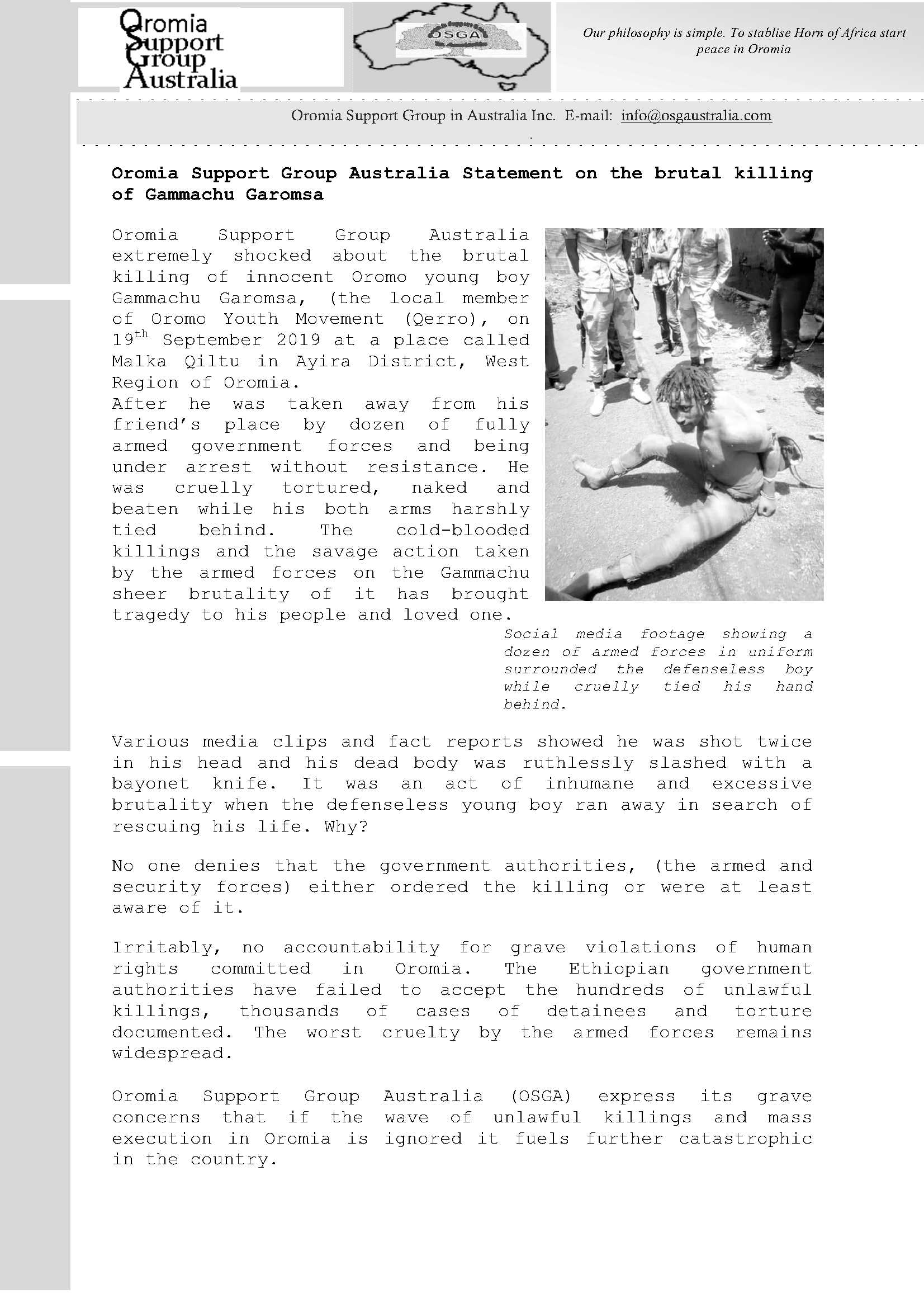
For the PDF format: Brutal killing and its irrevrsible heartbeaking
Citizenship versus Identity: the current political discourse in Ethiopia
By Alemayehu Biru (PhD), September 26, 2019
This is expressed in its most rudimentary form in the current Ethiopian political discourse. Raise any kind of sociopolitical issue, you are prone to be categorized either as citizenship or identity politics promoter. The binary choices are considered to be the only two alternatives in representing political interests or ideologies of the country; And they are often presented not just as two different concepts but rather as antonyms. We are told, those who are pro citizenship are more of a political, rational and universal perspective, while those with identity politics are more of a primordial, particularistic and emotionally charged perspective. Such categorization makes no exception: It applies almost to all positions in respect to every specific policy issues such as education, economy, environment, election, democracy or any other roadmap issues that are related to the future political course the country ought to follow. Such a very general but ironically a narrow categorization has been pronounced even by the regime whose coming into being was justified by its opening-up of the political space. Opening up the political space while narrowing down the horizons of political thought itself! A very interesting paradox!
This article aims at examining whether this binary way of understanding is, theoretically, tenable and, practically, be helpful in resolving the major political issues of the country. Let me embark on the issue at once, without much methodological pedantry, by asking: Can the so called “Citizenship Politics” be exclusive to that of Identity? In order to provide answer to the question, we need to know what citizenship is in the first place.
Citizenship as Membership
I don’t think there is a single conception of citizenship as such. Leaving aside the historical disparities, there are different conceptions by different political thoughts such as liberals, social democrats, socialists or republicans. For liberals citizenship is a membership to a given political community whose primary responsibility is to fairly distribute, secure and protect the basic liberties of each member. Republicans see it as a membership to a political community that should have a practical expression in collectively participating in the decision-making-process and the corollary sense of patriotism based on a historically established public moral virtues. Social democrats and socialists give much emphasis to equality, welfare and solidarity as the most binding elements of citizenship.
Whatever differences these conceptions may mean, there is one common understanding among all of them: citizenship as membership to a political community.
Membership is not however a wholesale affair. As much as it designates inclusiveness to those it is conferred upon, it also implies exclusivity to those not. The best example to mention here is the conception of the Ancient Greek, generally, much eulogized to be the source of modern understanding of citizenship and democracy.
In ancient democracy, citizenship means membership to the free male inhabitants of the city states. The adjective free immediately implies the unfree, the slaves, who were mostly war prisoners, as much as the adjective male outrightly disqualifies the female. Citizenship is valued for the privileges it bestows upon some in exclusion of others. In other words, what makes one appreciate or enjoy the value of citizenship lies more in its exclusivity than in its inclusivity, in its negativity than in its positivity. A citizen is one who is not a slave or a female. A citizen is defined by what he is not. This is because the talk about citizenship makes little or no sense, if all human beings in that community are equally citizens.
As the saying goes “freedom for the pike is death for the minnows”, the privilege of the citizens can only feed itself on the inhibition of the non-citizens. All those rights of citizenship – be it property right, social, legal or political rights, can only be realized by and through those who are deprived of those very rights. The liberty to be a proprietor, a politician, an artist or a philosopher presuppose in practice, as Aristotle honestly remarked, the existence of physical laborers for them to have the necessary leisure time to exercise their privileged activity. The liberty to be a slave master presuppose the existence of slaves and the necessary jurisdiction and theoretical justification for the relationship. The concept citizenship was conjoined therefore with membership to each city-state as defined and justified in its legal, political and philosophical system.
As long as this membership is in respect to individual-state relationship, not in respect to ethnic or religious identities, one may argue that the Ancient Greek conception of citizenship is purely political. But this is a very superficial understanding as the issue of ethnic or cultural diversity was not at all an issue in ancient Greek city states. All city states were culturally, linguistically and even ethnically homogeneous. Besides this fact, there is nothing political, for example, about the natural identity of a female-exclusion except, on the contrary, that ascriptive identity is politicized in order to justify male domination. What is political about the alien who became a slave because he was conquered, if it is not the otherness in him be politicized in order to justify social stratification, political domination and thereby economic exploitation? Because each city state was considered to be a sovereign political entity albeit parallel to the nation-states of the modern time, political membership was eventually determined by identity (by gender identity or the city state to which one belongs). Therefore, the interplay between political and identity based membership in defining citizenship is already apparent in Greek democracy itself. It came to be even more apparent in the Eras of the Roman Empire and the subsequent aristocratic European colonial empires.
Citizenship as Kinship
Under the Roman Empire and all the subsequent empires, social stratification and the corresponding privileges have been diversified with more hierarchical membership to the state. Though that hierarchy has been changing with the ever expansion of the empire, there were generally four kinds of membership to the Roman Empire: proper citizens of Rome who were called cives, Latins, the surrounding Latin language speaking people (who had some abrogated rights with the possibility of promotion to cives), the so called peregrines, the alien or outlandish, and finally the slaves, the conquered, devoid of any human rights whatsoever. The qualification for citizenship emanated not merely from residence membership to Rome but rather from the status of parents. It was to be inherited by birth. Therefore, simple membership must be determined by kinship.
In order to control and verify citizenship as a kinship, the Roman Empire is known for its creation of what we know today in the Western world as a three-part name – whereby the last one should bear the name of the tribe from which the individual under discussion descended all through generations. The tria nomina, as it was called, was a sign of Roman citizenship, legally prohibited for others to adopt it, in order to protect and preserve the purity of the Roman citizenship.
This tradition has descended to the later emerging feudal systems to the point the concept citizenship be identified only with the aristocratic class by reducing all others to mere subjects. Later on, even the aristocratic class came to be denied that status with the ascendance of absolute monarchy to the point the very purpose of State and politics itself became nothing but to full fil the Will of God in and through the Emperor. Since the Emperor was constitutionally above the law, there was no any sort of right or liberty of any one that could be taken for granted. Even members of the ruling class were not all citizens as long as their liberties and rights are ultimately dependent on the Will of the Emperor – not on the law of the state. The law itself is an institutionalized expression of the Emperor’s Will, which was tantamount to the Will of God as the Emperor was proclaimed to be an elect of God Himself. So there was no basis of the concept citizenship under the system of empires, which were basically territorial states rather than nation-states.
Ethiopian Political Orthodoxy
There is no a more perfect example in the modern time than the Ethiopian Empire in demonstrating the alienation of the entire political community itself to the status of subject, not to speak of the mass of peoples.
I don’t really know the etymological root of the Amharic word zega or zeginet, equivalent of the concept citizen and citizenship, respectively. But we all know for sure that the concept must be alien to Ethiopia since there have never been citizens in the entire history of the country to this date. A minister or a senate dignitary in the parliament oaths and presents himself as a personal servant of the Emperor, never of the Nation-State. This tradition has continued to be practiced even after the abolition of the monarchy under the personal dictatorship of Mengistu and Meles Zenawi. Loyalty to the leader is the most important measure for public office. Government and heads of government are the only sovereign entities.
Even the concept state is missing in Ethiopian vocabulary in the sense that the modern world understands state as an organized political community based on the will of its people. The Amharic word for government is Mengist, but it also means state. It appears therefore that government and state are conceptually interchangeable as they have been in political practice. Mengist in Ethiopia is apriori to society and state both in its practical importance and logical primacy. In other words, Mengist has always been the raison d’etre for the existence of state and society, not vice versa. This is true not more about Ethiopian political history than it is about its present political condition.
In Ethiopia, citizenship has never been a reality so far in which ever form it may be. However, it became everything all of a sudden in the current Ethiopian political discourse, particularly, for those political forces who consider themselves unitarist as opposed to those federalists. The reason is obvious. The unitarists consider the issue of citizenship as uniting, but not clear as to how it can be uniting without appealing to the issues of identity which much of the largest political community consider of the essence in defining the very concept of citizenship itself. In order for the concept of citizenship to be uniting, universal and political, as the unitarists often claim it to be, it needs at least, conceptually, to be inclusive of what it considers to be particular, primordial and sentimental. Otherwise, the concept citizenship would turn out to be a universalized particularity, to the best, or an empty abstract concept which has no political relevance whatsoever.
The issue at hand is not whether the question of citizenship should occupy a central importance in the future Ethiopian politics but, rather, whether it should be all inclusive or not. All federalist forces recognize its importance but not as a means of self-negation. They conceptualize citizenship as membership to a political community in which different interests are considered to be independent agents in determining the very nature and form of that political community. That means citizenship for them is more of a substantive right than being merely a procedural one. It must include among others the right to make the political community itself, not just the right to maintain it as unitarists consider it to be. According to the unitarists, citizenship right in Ethiopia would be achieved, if fair and free election takes place without much structural change. According to the federalists, however, citizenship cannot be achieved short of making a socio-political contract that guarantees the sovereignty of the peoples as it is the case with all modern democratic societies. Citizenship should be understood as authorship.
Citizenship as Authorship
It was only in 18th century pioneered by the Enlightenment movement that nation-state started to emerge as a reaction to the extremely suffocating empires. Nationalism became the new galvanizing ideology that gave birth to democracy and nation-states. As Habermas correctly put it “The nation-State and democracy are twins born out of the French Revolution. From a cultural point of view, both have been growing in the shadow of nationalism”. Freedom of the individual from the tyranny of the state and society, on the one hand, and freedom of nations from the yoke of empires, on the other, are considered to be necessary corollaries. Thus a new conception of citizenship as authorship.
Since the French Revolution, democratic nation-states started to understand themselves as associations of free and equal citizens. Membership to a political community depends on the principle of voluntarism as it has been articulated in socio-political contract theories by the great minds – ranging from Thomas Hobbes, John Locke through the Frenchman Jean-Jacques Rousseau to the contemporary American political philosopher, John Rawls. They all underlined in their theories that no state or political authority should any longer be justified by appealing to Nature or God. Because all human beings are by nature rational and therefore free and equal, they are autonomous agents whose will and only will matters in the creation and maintenance of a political community. The social agreement made among its inhabitants is the only source of legitimacy both for its coming into being and further maintenance. All the institutions such as state and government emerged thereof are only instruments of that popular covenant and, therefore, means never ends in themselves. Peoples’ sovereignty is sacrosanct. It is precisely this sovereignty which is the bedrock of citizenship. Citizenship is not just a set of rights that enable citizens only to elect their government every four or five years but essentially authorship to the very law that creates and governs a political community. Freedom and authority are no longer contradictory in this case since people should abide only to their own will.
Those great contractarian theorists assumed ethnic and cultural homogeneity for their theories to be true. Nation-State was both their premise and objective. In case assimilation is successful, as it was with France, the nation-state is the premise from which the contract should proceed. If a nation failed to be a state as it is the case with pre-Bismarck Germany, the contract theory provided the rational to create it. And in empire states like Austro-Hungary, the contract theory has justified their disintegration and encouraged, instead, the emergence of new nation-states as natural course of socio-political development.
Alternatively, it also envisioned federal system as a means to coup-up with the new reality in those empires like Great Britain, Spain, Belgium etc. so that group identities be preserved, protected and promoted within the larger political union. Multicultural citizenship is taken, in this last case, as a mediating concept between the universal values of freedom of the individual, on the one hand, and freedom of cultural, linguistic or ethnic communities, on the other. Self-determination (voluntarism) both at the level of individuals and communities became the key to understand what modern citizenship should be. This has become an international norm particularly in post 2nd World War and even more so in post “Cold War”. With the ever globalization of democracy as a World order, it became imperative to recognize collective identities such as race, ethnic, culture, gender etc. Ironic as it may sound, globalization must be conjoined with pluralism – as the coming into being of the European Union became the main reason to thematize pluralism as the most important concept of political philosophy in our time.
Liberalism, communitarianism & Pluralism
In the last three decades, there have been a steadily growing interest in the issue of group diversity by political philosophers. Tension between globalism and nationalism, mass immigration and the rise of minority rights, ethnic conflicts and breakup of nations in Eastern Europe, increasing integration of the European Union conjoined with the persistence of sense of distinctness among members, ever rising strive of gender, sexual orientation, environmental movement etc. are some of the major practical reasons for this. Explaining the issue of how right claims of those diverse forms of group identities be related or connected to the established liberal-democratic principles of freedom is the major theoretical issue of our time. Basically, liberalism and communitarianism are the two contending school of thoughts in that regard – theoretically initiated by an American philosopher John Rawls in his monumental work A Theory of Justice. The third line of thinking I termed above as pluralism is a dialectical outgrowth of the debate between the two.
Liberals are generally well known for their individualism. As they are here represented by John Rawls, the individual, as free and rational being, is said to be autonomous by his/her nature. The practical implication is that liberty of the individual must be protected not only from political authority but also from the cultural one – as social norms and traditions have been oppressive to the development of human rationality. Not only state is oppressive but also customs and cultural values. Therefore, individual liberty and freedom should be seen in contradistinction to any particular collective identity. As John Rawls aptly puts it, the priority of individual liberty is uncompromising “that even the welfare of society as a whole cannot override.” As the self is prior to its ends, individual right should be pursued independent of any conception of good. According to Rawls, the essence of citizenship lies in the liberty of the individual to form, revise and change social conceptions of the good – not in sharing definite moral values or some distant collective or national goals. Otherwise, he argues, the whole idea of social contract does make little or no sense. The social contract should serve not to come up with a pre-shared conception of Social-Good but rather to make possible a difference-blind social arrangement that can promote the right of each contracting parties to form, revise, change or pursue her/his conception of good.
For such a neutral standpoint be achieved, Rawls assumed a hypothetical society he called the Original Position. He further assumed what he calls “the veil of ignorance” in representing the contracting individuals’ ignorance about their conception of the Good or social identity prior to the agreement. Both assumptions are justified by the need to achieve an impartial state of mind of the contracting parties in order to arrive at a neutral principles of social arrangement. It is based on these two important assumptions that Rawls later arrived on his famous two principles of justice.
The reaction to Rawls’ work was so immense that it awakened political philosophy from its long time slumber. His critics can generally be classified into two schools of thought, namely, communitarianism and pluralism. Both critics refuse to accept Rawls’ individualism. They consider his conception of individual autonomy as utopian to the best and tricky and manipulative to the worst. According to them, real individuals are not “unencumbered selves” as the priority of right to social good, the self to its ends or the assumption of the veil of ignorance under the original position suggest. In actual life, our identity is a given one, not even a matter of choice. It is often what Martin Heidegger calls “thrownness”. In real life, we all are with dense identity, as bearers of particular social role, as someone’s son or daughter, a member of this clan or that tribe, this or that nation, whose native language is this or that etc.
Although both streams of critics concede to the liberal’s main thesis that individuals are indeed the only living social agents, they simultaneously claim that collective identities are not less real than the individuals themselves. This is because, they argue, individuals are not born and raised in void. Family, neighboring and local communities, stories, tales and languages, schools and childhood memories etc. are all constitutive of the very agency of the individual. Individuals become agents only as social beings. The fact that their agency itself presuppose society as a field of self-realization shows that the rationality and freedom of the individual is anchored in being social by nature. Individual human beings are embodiments of their natural and social environment as much as they are rational agents in adopting to or changing those environments. Therefore, collective identities are real and objective as forms of social relations if not as entities.
For communitarians, particularly, those social relations are stable as a cultural or moral mark of the group under discussion. They are comprehensive and historical by their nature to be constitutive, in the strongest sense of the term, of its individual members. In this sense, communitarianism clearly stands in a diametrically opposite direction to liberalism. It postulates the primacy of community over the individual, the importance of particularism over universalism. It tends to classify and rank collective identities according to certain established meritocratic values. Communitarianism appears therefore to be a modern version of republicanism in its conception of citizenship too. Sharing a virtuous moral life, forging collective responsibility and common goals are the mark. Difference is seen as a social challenge, not as an opportunity. Here depart the pluralists.
Unlike communitarians, the pluralists value group identity not just for its own sake but, rather, for the practical relevance it has in determining the life of the individual. Its version of communitarianism is, therefore, not primordial or essentialist. Collective identities are fluid social relations – not given and static as communitarians assume. Group identities can be better understood, according to pluralists, as dialectical phenomena – relational and changing.
We always talk of group identity visa-vice another group. Their relation is often marked by conflict and hierarchy. Institutionalized oppression and domination are the major forms of socio-political relations in determining group identities. The strength of self-awareness as a group hinges most of the time on the strength and intensity of domination-relation perpetuated by another group. This is not because groups have their own sense of rivalry by nature, but essentially because the position of the group has a direct effect on the individual members of the groups.
The opportunities and challenges of the individual agency would ultimately be determined by the position of the group to which the individual belongs or associated. A group identity can be an enabling or disabling to the individual agency depending on the power-position of the group to which one belongs. The distribution of opportunities and challenges is therefore predetermined in a multi-cultural state. This means the individual in its relation to the state is mediated through group identity to which the individual belongs (be it race, cultural, ethnic, gender or even sexual orientation). Therefore, citizenship cannot be conceptualized as a simple unilinear individual-state relationship without considering that mediation.
Instituting equal citizenship requires, first of all, the recognition of difference as a fact of life in general. It requires the recognition of those collective identities as political agents – in order to enable individual members can redress their disadvantaged standing vis-vice the state. For example, recognizing the Oromo language as a state language would enable an individual Oromo, who is not in good command of Amharic, to have equal access to public office or public hearing. Here we need to emphasize that the recognition of the collective identity, in our case the Oromo language, should not be made for its own sake or for the value one may attach to it. It is rather for its mediating role in enabling or empowering the individual to have equal opportunity, by removing the unjustly created institutional obstacle. There can be no reason consequently to consider that such recognition is not consistent with universal values of democracy which puts individual agency at the center of its conception of citizenship. There is no theoretical inconsistency between federalism as a multi-cultural conception of citizenship and that of the liberal conception based on universal freedom. Pluralism in this sense is a splendid synthesis of the two extreme doctrines, individualism and communitarianism.
This brings me back to reconsider the Ethiopian political discourse in the light of this lately developed conception of “multicultural citizenship”.
Indifference to Difference
I assume there is no question or debate about the multiethnic or multicultural nature of Ethiopia. Ethiopia is a self-declared empire just four decades ago and, a multi- nations-state since the monarchy was abolished in 1974. It was only in the last 25 years that those multi-nations and nationalities were acknowledged as political entities to govern themselves and take part in the affairs of the federal. This is just to mention the official policy of the ruling EPRDF regime as articulated in the constitution, not to imply anything further. Ethiopia is also one of the most backward countries in its overall economic development and therefore with little or no liberal or republican democratic tradition.
Given these facts, it is simply perplexing to continuously hear an ever increasing louder voice by those unitarist forces and the new government in charge of the “transition” about the citizenship politics as a magical remedy to all problems of the country in the way it reminds us of scientific socialism and revolutionary democracy during Mengistu and Meles Zenawi, respectively. More perplexing is the fact their conception of citizenship often contrasted to federalism.
In a country where inequality and, as a result, a long standing conflict alongside ethnic, cultural or religious identities have had deeper root, I hope they are not imagining that Rawls’ veil of ignorance is at its magical function in letting those living people abandon their collective identity for the difference-blind-principle to rule. There is a common man temptation to consider blindness to difference as impartiality or neutrality, though. But blindness to an existing difference is to ignore the difference so that it should further be perpetuated unnoticed. Particularly differences as a result of past inequalities and domination-relation, as it has been the case with Ethiopian polity, need full attention – not just blatant indifference called difference-blind-principle. How indifference to difference can result in principles of justice that promote equal citizenship in the first place?
Indifference to difference is not an innocent standpoint as it appears to be. It is rather an active coverup in diffusing strives of those marginalized or dominated identities. It is an ideological maneuver in maintaining the already existing overall structure by means of reducing all group identities to what is common to all, namely, the individual. But then they portray the individual after their own image as a yardstick for all individuals so that the larger unity continue to be reproduced in the old way. It goes on camouflaging the particular for the universal. Liberal individualism is just a recipe to forced assimilation as communitarianism is to segregation. Both consider difference as otherness but, differently. Liberalism wants to do away with it through assimilation. Communitarianism wants to essentialize difference so that hierarchical social form of organization be maintained.
The Ethiopian state have attempted so far both ways: exclusion and assimilation by the Monarchy and the Dergue, respectively. But both failed; and they failed devastatingly in the way they can never resuscitate again. It is absolutely beyond the scope of this paper to explain why. But it may suffice here to echo the famous statement: “an empire dies of indigestion”. The indigestion is even more likely when the minority tries to swallow the majority as it has been the case with Ethiopia. Ethiopia has died as an empire, already, long time ago. It only continued to persist as a state. It may has been deformed or disfigured for some of us who remained nostalgic of her past but, still persisting. Another trial to swallow the different, the otherness, may even result in a very risky business of getting her chocked up for ever.
Therefore, compromise on middle ground should be a categorical imperative for co-existence of diversity in unity and vice versa. The middle ground is to adopt a dual system of rights: liberal universal rights which are the same for all and specific empowering rights to group identities. The middle ground is a position that forwards an ideal of deliberative or “talk centric” democracy alternatively to “vote centric” or just liberal democracy that depoliticizes public life in general. That is precisely what I tried to term so long as a pluralist conception of citizenship as opposed to the monolithic one proposed by those who call themselves “unitarists” – while continue assuming speaking Amharic language, dancing eskista, adhering to a Coptic Church, adoring Menelik II, promoting the legendary tale of Queen Sheba and the Jewish descent of the Ethiopian dynasty etc. as a measure of a true Ethiopian citizen, Ethiopiawinet.
The author can be reached at alemayehubiru@gmail.com
Irreechaa Celebration to be Held in Melbourne, Australia
By Maatii Sabaa
(Melbourne, Irreechaa, September 20, 2019)-The Oromia Irreechaa Organising Committee in Victoria is preparing to celebrate Irreechaa in Melbourne on 29th September.
Head of the Committee, Ob Abdeta Homa said the celebration is to strengthen and promote and Oromo culture, particularly the Irreechaa celebration in Melbourne.
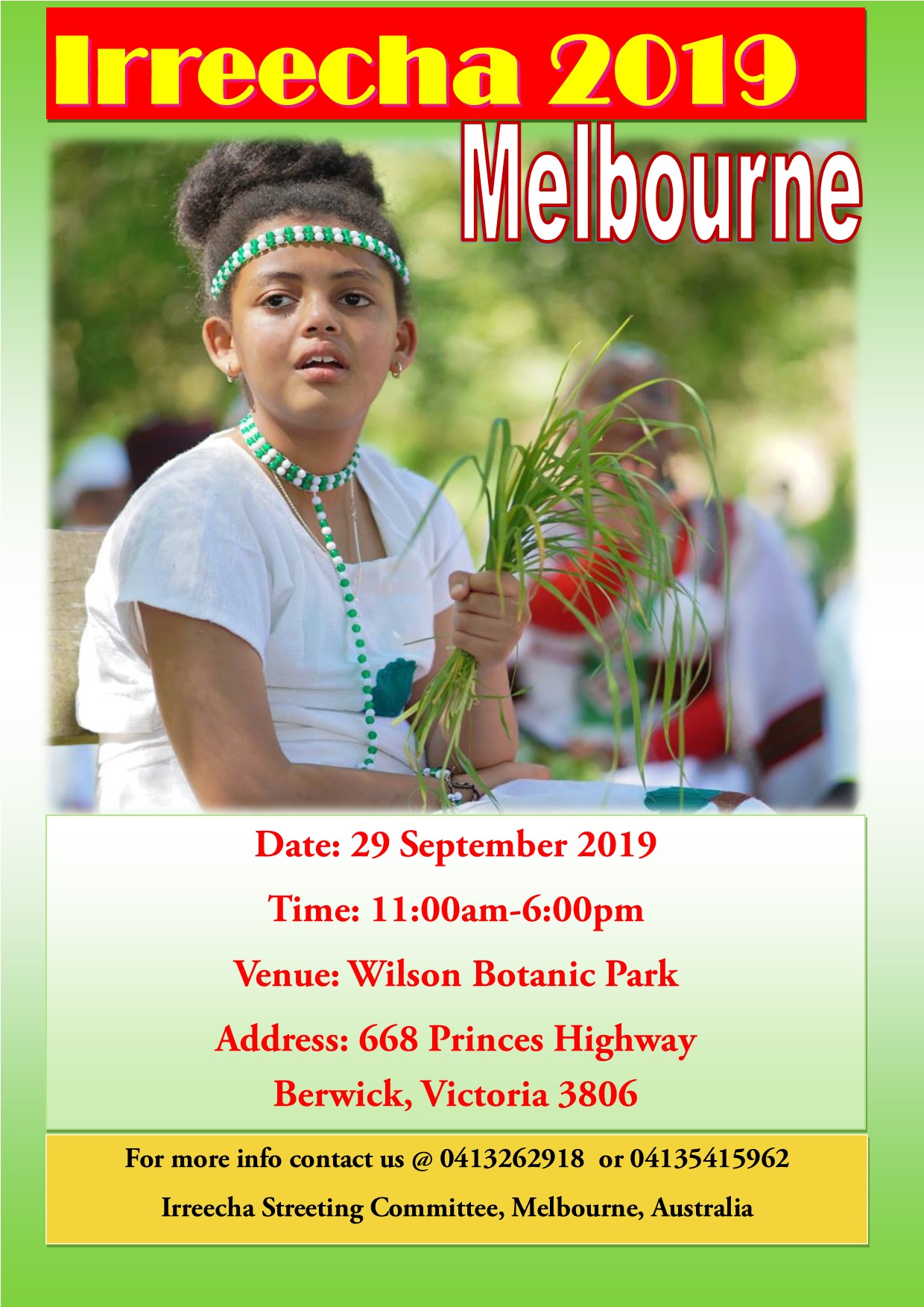
Irreechaa is the annual Oromo people Thanksgiving Day that is celebrated every year in Birraa near the river bank or water and tree.
Irreechaa is celebrated every year in the end of September or beginning of October in various part of the globe where the Oromo community resides.
The celebration in Melbourne will be held in the context of the country while cultural values of the Irreechaa celebration are maintained.
The Irreechaa would be celebrated by all Oromos regardless of difference in religion, region and gender to celebrate and promote the identity of the Oromo people.
Irreechaa is the celebration of peace, unity and cooperation where the celebrants carrying bunch of straw and daisies in their hands praising, blessing and praying Waaqa in their songs.
The Irreechaa festival is celebrated every year at the beginning of Birraa (Spring), new season after the dark and rainy winter season.
The Oromo people celebrate Irreechaa not only to thank Waaqaa (God) but also to welcome the new season of plentiful harvests after the dark and rainy winter season associated with nature and creature.
Irreechaa in Exile
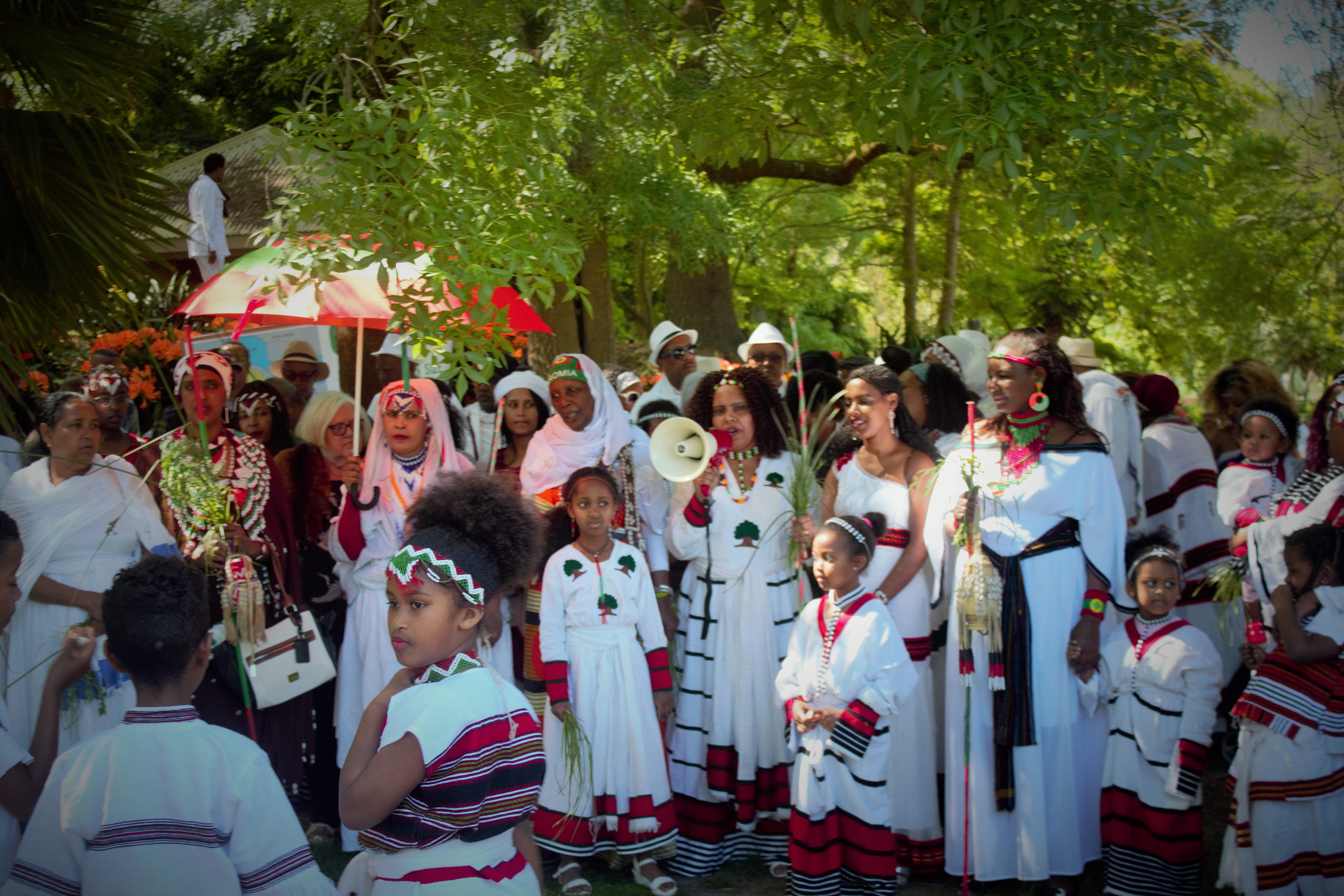 Irreechaa is not only practiced among the Oromo in Oromia. As hundreds of the Oromo are in exile for different reasons, their culture, religion, language and identity also exiled with them. Thus, Irreecha is celebrated in Oromia and around the world where diaspora Oromos live especially, Kenya, Uganda, Eritrea, Australia, South Africa, Europe and North America.
“Because Irreechaa has a cultural ambiance in connecting the people to Oromo land and the creator, Waaqa, it still remained as strong element of connection between the Oromo in diaspora and home – Oromia,” Ob Abdeta said.
In the past ten years or so, the Oromo across different parts of the world (from Toronto to Melborne and Bergen to Johannesburg) have come together and celebrated Irreechaa as a common icon of their identity.
If anything could be mentioned in bridging the differences (political and religious) within Oromo in the diaspora, Irreechaa has become the major binding force not as a mere cultural or religious practice but for its conjoint constitution of culture and identity.
Currently, Irreechaa has got publicity among the non-Oromos (Ethiopians and non-Ethiopians alike) to the extent that city administrations in different countries recognized the celebration and granted the Oromo with the spaces for the ritual.
Irreechaa brings people closer
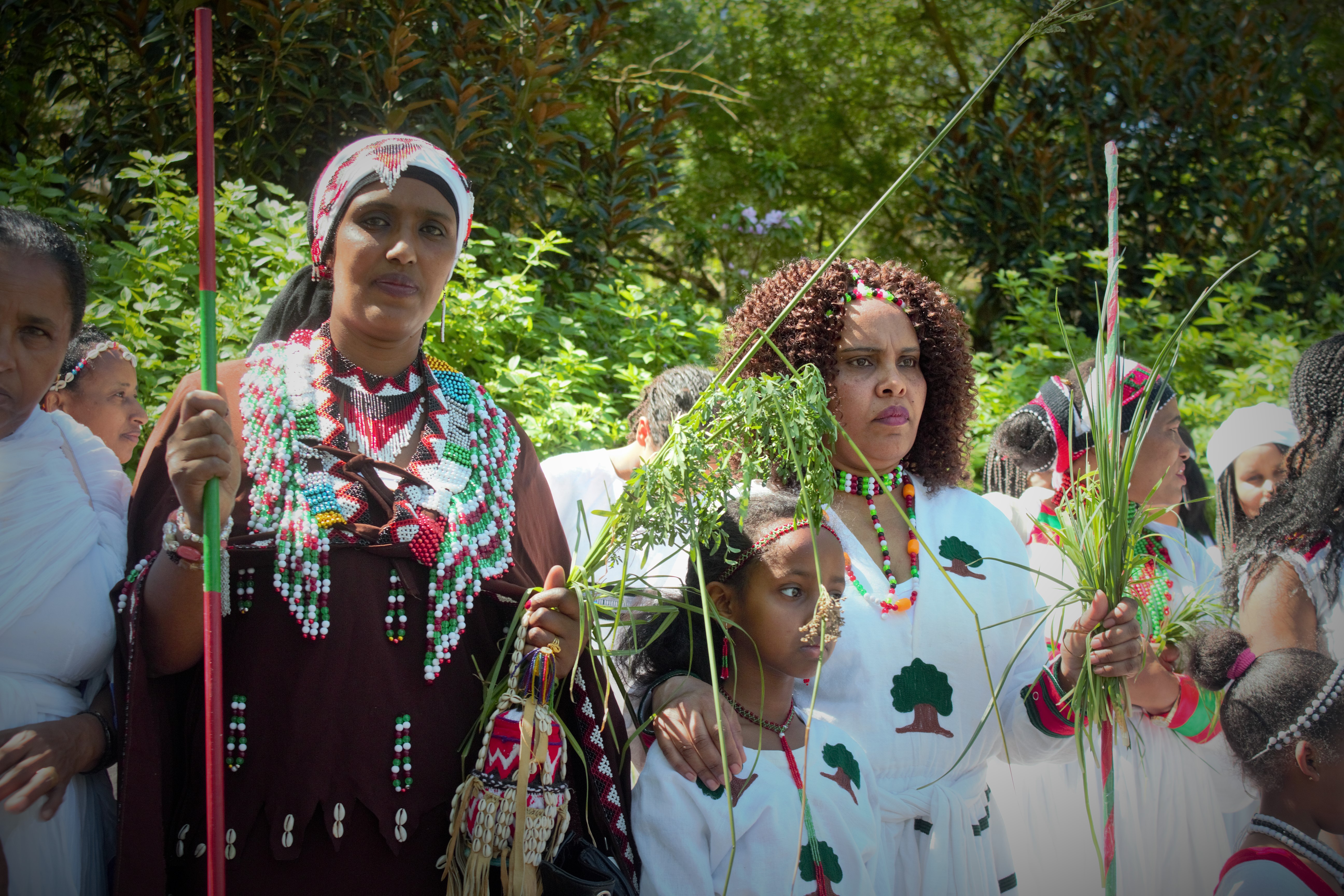 On Irreechaa festivals, friends, family, and relatives gather together and celebrate with joy and happiness. Irreechaa festivals bring people closer to each other and make social bonds.
Moreover, the Oromo people celebrate this auspicious event to mark the end of rainy season, known as Ganna, was established by Oromo forefathers, in the time of Gadaa Melbaa in Mormor, Oromia.
The auspicious day on which this last Mormor Day of Gadaa Belbaa – the Dark Time of starvation and hunger- was established on the 1st Sunday of last week of September or the 1st Sunday of the 1st week of October according to the Gadaa lunar calendar has been designated as National Thanksgiving Day by modern-day Oromo people.
Irreechaa celebrations as a means of promoting Oromummaa
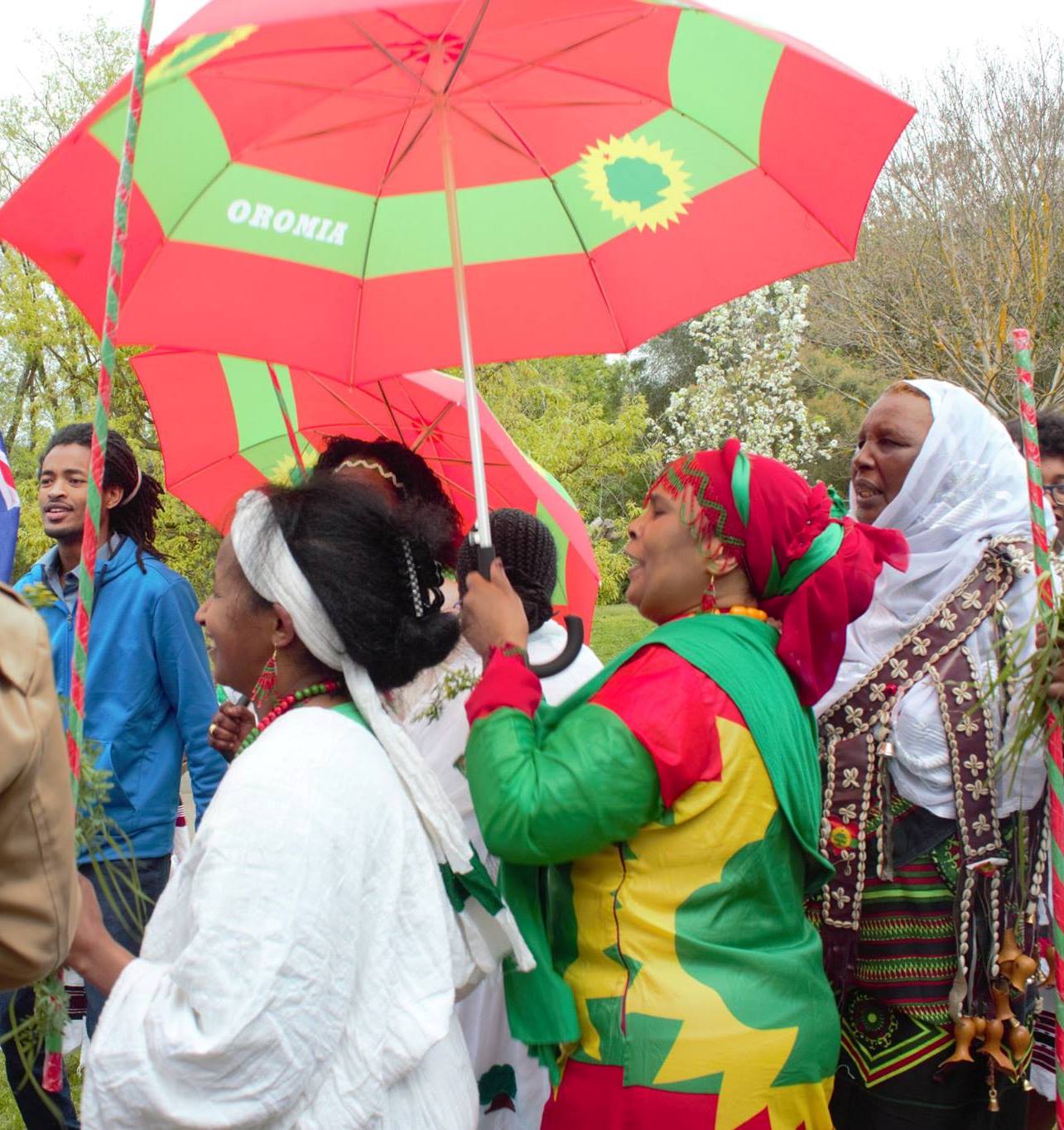 According to the Irreechaa Organising Committee, all Oromos in Victoria are expected to take part in the celebration.
“What a wonderful time we had on a cooler than typical spring day in 2019 enjoying all that the Irreechaa Festival presented, Ob Abdeta Homa added.
After many years’ unseen events, the first national Irreechaa Festival was held in 1991 in Oromia, East Africa and later became an annual event, which now runs for five weeks, and is one of the most pleasant reminders in Oromia that spring has definitely sprung!
“Here in Australia, Melbourne, we continue this fabulous event every year since 2009.
“The celebrations are unique in that the Melbourne celebration has come again and that contributes to the development of Oromummaa in the Diaspora,” Ob Abdeta said.
In the traditional religion of the Oromos, the spirit is the power through which Waaqaa (The Almighty God) governs all over the world. Thus, Oromos believe that every creation of Waaqaa has its own spirit.
Thanks to God for all the blessing
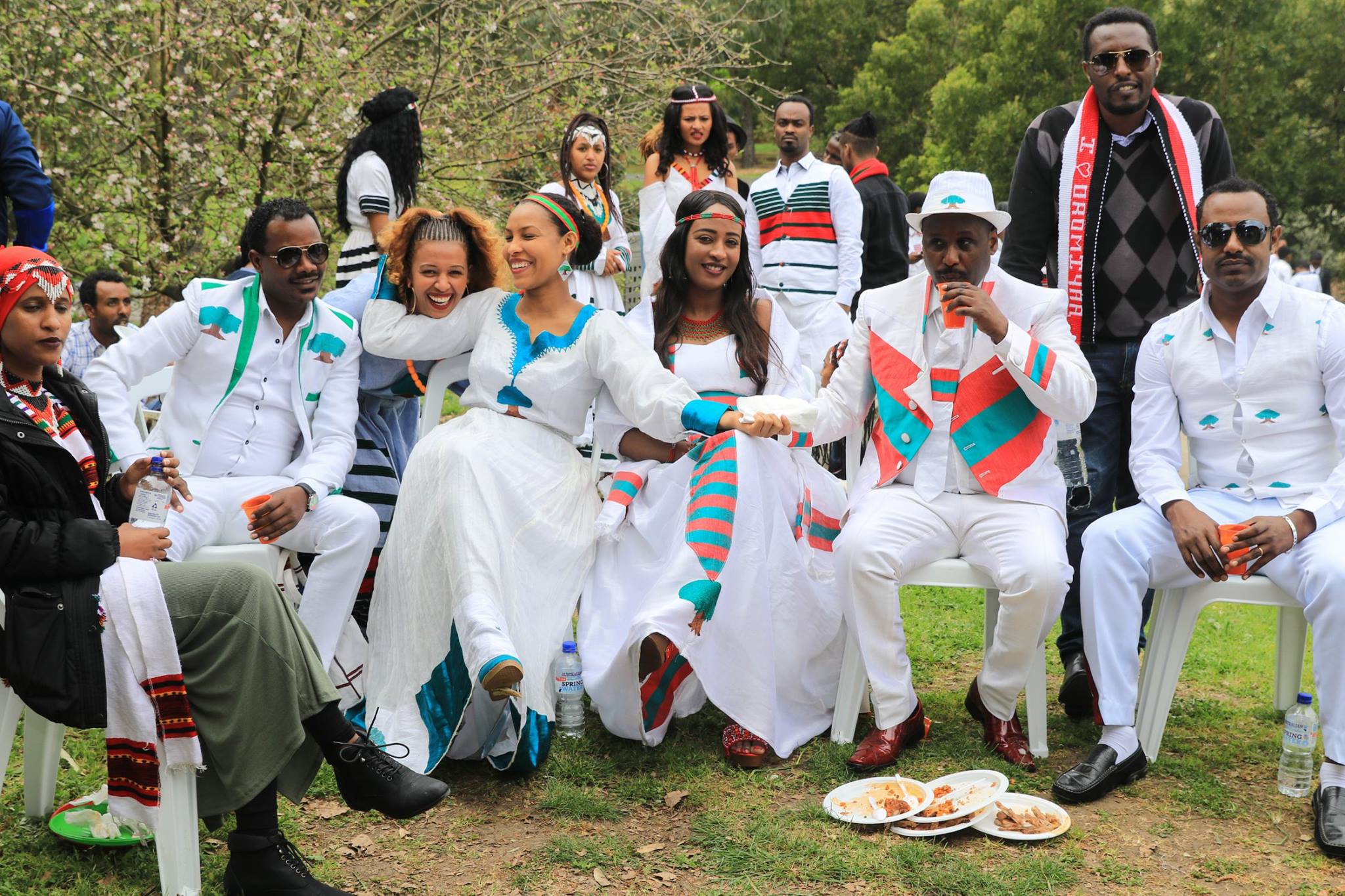 This festival is a spectacular show of cultural, historical and natural beautification in their full glory at the height of the season. It has spawned somewhat of a science of knowing just when the blooms will peak at blooms and decline, depending on the wind, rain, and sunshine they get.
Now it is the beginning of 2019 Irreechaa celebrations, the premier holiday of the Oromo people marks the end of the dark-rainy season and the beginning of a blossom harvest season.
It is in Oromo tradition to gather at the river banks and lakes shores to give thanks to the almighty Waaqaa for all the blessings throughout past years and ask for Araaraa (Reconciliation), Nagaa (Peace), Walooma (Harmony) and Finnaa (Holistic Development) for the past, the present and the future.
“The event is very important for our community as it brings the community together and helps to connect and share experiences in their day to day life.”
“Together, we can make our destiny better everywhere.”
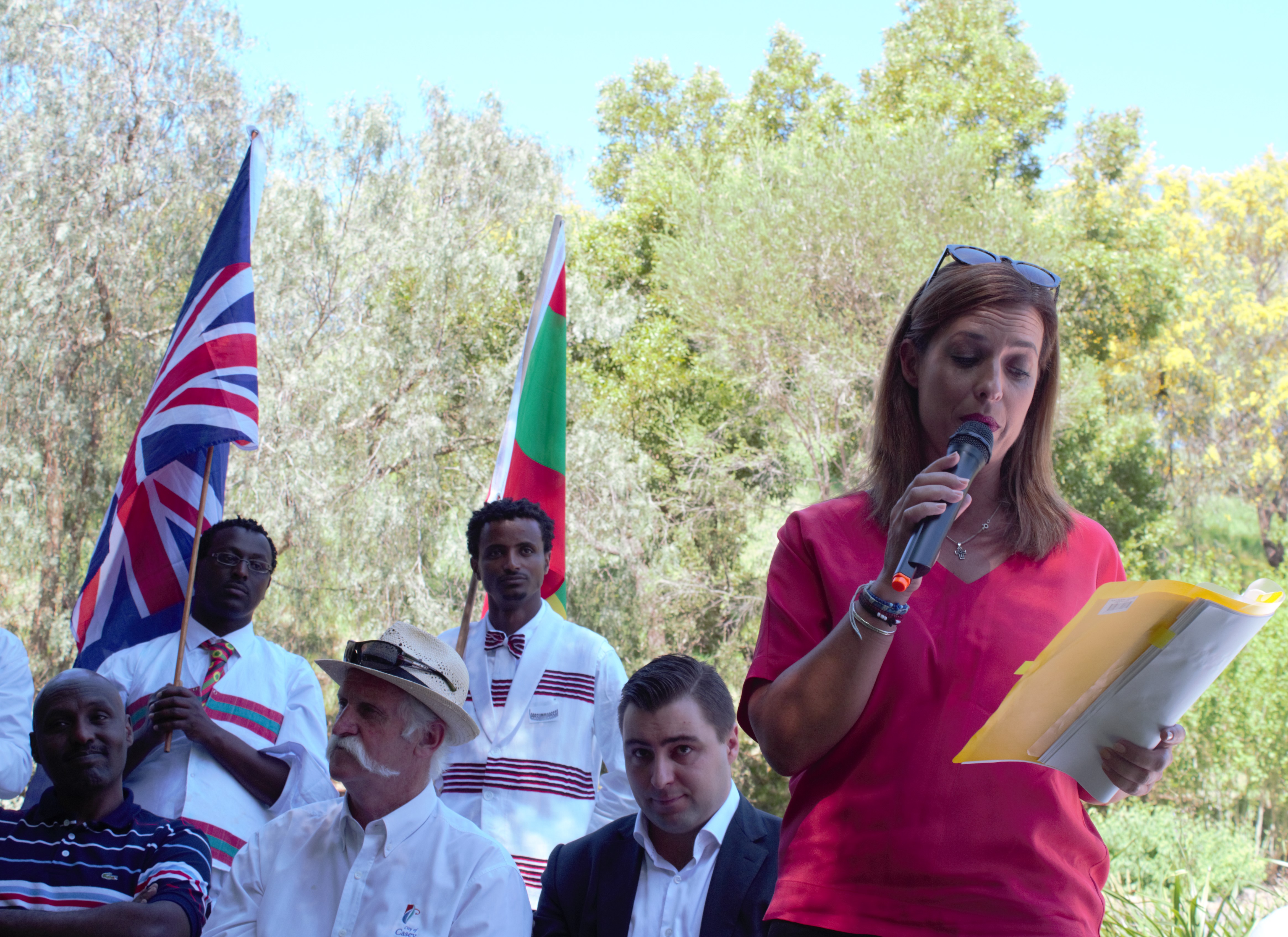
Irreecha Celebrations to be Held in Finfinne, First in Over 150 Years
By Staff Reporter
September 19, 2019 (Ezega.com) — The Oromia cultural and tourism bureau is preparing to celebrate Irrecha in Finfinne early next October.
Head of the bureau Girma Hailu said the exercise is to restart the Irrecha celebration in Finfinne currently known as Addis Ababa city after about 150 years.
 Some politicians, however, claim that the move has to do with pushing the claim by the Oromo Democratic Party (ODP) on the ownership of Addis Ababa city, which almost all other ethnic groups living in the city oppose.
Irreechaa is the annual Oromo people Thanksgiving Day that is celebrated every year in Birraa near the river bank or water and tree. Irreechaa is celebrated every year in September in Bishoftu Hora Harsadii and other Oromia major cities.
The place of the celebration has not yet been located but will take place either near one of the rivers in Addis Ababa or artificial pond. “The celebration will be held while cultural values of the Irrecha celebration are maintained, Girma said while briefing journalists on Wednesday.
Unlike in the past, the Irreecha would be celebrated by all ethnic groups in Addis Ababa regardless of difference in language, religion, culture and ethnic background, the bureau head said.
According to the Oromia Cultural and Tourism Bureau, about three million people from all corners of Addis Ababa and surrounding towns are expected to take part in the celebration.
“Irrecha celebration has to do with the identity of the Oromo people. The celebrations are unique in that the Finifine Hora celebration has come again and that contributes to tourism development in the country, Girma said
In the traditional religion of the Oromos, the spirit is the power through which Waaqaa (The Almighty God) governs all over the world. Thus, Oromos believe that every creation of Waaqaa has its own spirit.
The resumption of the celebration signifies that the people of Oromo and other ethnic groups have begun exercising their democratic rights and building trust among them and image of the country, the bureau head added.
Meanwhile, the Oromia Cultural and Tourism Bureau will hold what is called “Irrech Peace Run” in Addis Ababa ahead of the Irrecha celebration. About 50 thousand runners including famous athletes are expected to participate in the run.
“The run is to show Irrecha is the celebration of peace, unity and cooperation and to add color to forthcoming celebration in Addis Ababa,” Nega Tujuba, head of the Oromia Athletics Federation told Ezega News. Similar runs were staged in Adama city, the capital of Oromia regional state since 2016, but the federation wanted it moved to Addis Ababa to avoid security problems, he added.
The 10-kilometer road race will be held on Sunday, September 11, 2019, along the route of Ethiopian Great Run. The running route goes from Meskel Adebabay to Legehar to Mexico to Sarbet to Kera to Gotera, and then back to Meskel Square.
First winners from both sexes will be awarded each 50 thousand Ethiopian Birr and second and third winners will enjoy 30 and 20 thousand Ethiopian birr, respectively.
Dr. Abiy Ahmed’s government is criminalizing parents for their children
By Bariiso Saaddoo, June 21, 2019

Ethiopian security forces invade and arrest parents of adult children who left them years ago.
Immediately after the atrocities of 9/11, USA labelled Osama Bin Laden as one of the most dangerous man in the face of the Earth. USA Army and intelligence community tried to locate Osama’s whereabouts all over the world and including hideouts in the highlands of Pakistan and Afghanistan. The search for Osama continued unabatedly for about 10 years and finally he was brought to justice by US Marine in Pakistan on May 2, 2011.
During the search for Osama bin Laden, one of his brothers was in the USA living in peace just like any other ordinary Americans. Osama’s children and other family members had never been targeted by the United States for the heinous crimes of their father. They lived in peace and freely without a fear of USA government retaliation for their father’s crime.
In all of European countries, crimes are not transferable. Once a child is 18 years of age, parents’ responsibility ends legally, and any crime the children commit cannot go to the parents. That is a civilized and reasonable world. The parents may continue communicating with their children regardless of the weight of the crimes the children commit. Some families come out and defend their children officially. Nothing happens to them. They don’t hung the father or mother for the crimes of their children.
Parents and families in Ethiopia are illiterate, most of them have never been to school and do not understand politics. Most parents live on farms barely making days end meals. They are people who struggle only to feed their kids and themselves. Some do not even afford to wear shoes, never had cell phones or lights. Most of the kids go to school only if there is school nearby to escape from farm work. These parents make less than $300 a year, if we must measure money-wise. They do not know what is taught in school. They do not even understand why their children go to school for many years.
These are the parents, PM Dr. Abiy Ahmed’s army coerces demanding they bring back their children they have not seen in years. These are the parents this regime rapes and kills for being mothers and fathers of these children who left them years ago to fight for their causes. These are the parents Dr. Abiy Ahmed’s soldiers rob, burn properties and force to flee their birthplace. Ethiopia has the largest internally displaced people (IDP) in the world according to a recent report by the United Nations (UN). In one year, under Dr. Abiy Ahmed’s administration, more Oromos are displaced than under the regime of the TPLF in 20 years or so rule.
This is the regime that is committing itself to annihilate or reduce the Oromo people into further serfdom. While it claims to represent the poor people, the regime has continued creating difficult livelihoods for millions. Disappearance, destruction, humiliation, eviction and isolation is underway in mass in the Oromia region. This is a regime that is burning crops and killing livestock to starve the Oromo people as a punishment.
The TPLF cadre regime of Dr. Abiy Ahmed, while delivering rosy speeches after speeches with nice words, has continued subjecting the Oromo people to grief and sorrow. Millions of Oromo mothers are crying under a regime that claims to represent Oromos and as some claim ‘the Oromo Government’. This regime is the continuation of the TPLF/EPRDF regime and TPLF cadres were trained to kill, spy, mistreat people, corrupt, steal, rob, etc. That is normal life for them. Sometimes you cannot blame them, because that is their profession. They cannot think beyond what they have been trained for. That is their make-up.
It is very painful to hear that parents of Qeerroo are getting harassed and humiliated for their children joining Oromo Liberation Army (OLA). Some of the children left them more than 20 years ago and some of the children are now in their 30s and 40s. The parents have nothing to do with their children political beliefs and they are being criminalized for simply giving birth to these children.
Human Rights Abuses:163 extra-judicial killings and the arbitrary detention of at least 933 people in Ethiopia
(Oromia Support Group Report) The extra-judicial killing and arbitrary arrest of OLF supporters since December 2018 has created a situation in Oromia very similar to that in 1991-2 when thousands of OLF supporters were killed and scores of thousands detained and tortured.
 The good will and support for Ethiopia from the international community helped to maintain the abusive regime of Meles Zenawi, then in power. The current silence about killings and widespread imprisonment is eerily reminiscent of that time.
Many reports have been sent to OSG since December 2018 and this report is a summary of the information received.
This report includes information about 163 extra-judicial killings and the arbitrary detention of at least 933 all due to their suspected support for the Oromo Liberation Front, which officially returned to Ethiopia in September 2018.
Oromia Support Group Australia – Summary Report on Human Right Abuses in Ethiopia
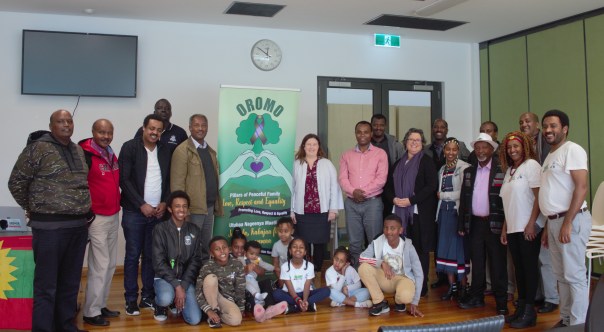
The first Oromo Interfaith Forum Held in Melbourne
Requesting urgent intervention to uphold the rights of Benshangul Gumuz civilians
(A4O, 8 May 2019, Press Release) We have confirmed that Benshangul Gumuz civilians are increasingly targeted and executed by the highly armed and well-trained Amhara militia. They were trained, radicalized and fully armed with modern machine guns by a National Movement for Amhara (NAMA).

According to the eye witnesses, over 500 Shinasha people in Benshangul-Gumuz Region, Jawi Woreda, were suddenly executed; tens of thousands of civilians were also made to flee their own villages for their lives between May 1 and 2, 2019. The main victims were civilians including children, women and elderly. Homes were also torched in that outbreak of violence.
We have also observed that the civilians are getting killed for no apparent reasons by a highly armed Amhara regional special force in Benshangul Gumuz regional state. This armed group is not only targeting solely indigenous and legitimate owners of the land; but also, hundreds of children and elderly are getting summarily executed for a simple reason of being different from their killers in the aspect of their culture, skin colour and political beliefs.
The Ethiopian Government neither condemn the killings of civilians nor asked for apology for failing to safeguard them. Although some authorities claim the restoration of the order, this is far from the truth as the Government hasn’t so far take any justifiable action against the killers and forces behind these tragic executions.
Background information
Recently, the Amhara Special force further threatened the Oromo people in relation to the ownership claims of Finfinnee (Addis Ababa). These group further vowed to repeat their success in Benshangul in Wallo and other parts of Amhara-Oromia borders.
In 2003, for instance, between 430 and 500 unarmed civilians were massacred by those who colonised their land for a simple reason of silencing them whilst expropriating their resources and land in Gambella region. The same massacre is now unfolding in Shaka zone on a Shakacho people by the same highlanders. Tens of thousands of Oromo, Ogaden Somali and Sidama civilians were executed in the last 27 years alone.
Call of Action
Advocacy for Oromia, a non-profit advocacy organisation working to ensure that the people’s rights and wishes are respected, has deeply admired much of the work done by both regional and federal government to restore peace and stability in the region.
In fact, political differences may divide some of the regional states in the country. But upholding human rights is in the interest of every state. Peoples of these regions also seek a common agenda: rights, peace, security, justice, freedom, and sustainable development.
We firmly believe that human rights are a powerful medicine, which heals wounds and develops resilience. Thus, we show our consistent and unrestricted solidarity until justice is served on their behalf by bringing those who have killed and maimed their sons and daughters to an independent justice.
Advocacy for Oromia, therefore, unanimously condemn with the strongest possible terms such barbaric actions toward the unarmed civilians, children, women and elderly of Benshangul Gumuz.
Furthermore,
1. We urge the Amhara’s regional state to exercise utmost restraint and lawfully handle its anarchically behaving special forces that has been primarily trained to maintain law and order. There won’t be any peace and security as long as some groups are fighting to dominate and dehumanise fellow mankind.
2. We demand the federal government to immediately intervene and stop the on-going execution of powerless civilians whose lives are put at the mercy of their barbaric assailants.
3. We urge the federal government to immediately investigate and bring those responsible for such horrific and inhumane actions to civilians to justice.
4. We advise the international human rights group and western countries politicians to earnestly bring this unsettling massacre of civilians to the attentions of obliviously sleeping Ethiopian authorities by urging them to take meaningful and corrective measures as a matter of urgency.
5. We call up on all Ethiopian peoples to unconditionally condemn such barbarism and demand the Amhara regional state to stop its inhumane actions to the unarmed civilians.
We will always continuously work for and speaks up for the voiceless people.
Press Release by Advocacy for Oromia,
May 8, 2019.
For PDF format:Press Release 8 May 2019
Partial Lists of people killed in different parts of Oromia (16th February, 2018-16th April 2019)
(A4O, 20 Finfinnee 2019) The Ethiopian ODP-led EPRDF regime continues its persistent genocidal actions against innocent and unarmed civilians of Oromos who attempt to exercise their democratic rights.
Documented human rights violations record showed that increase in human rights abuse correlates closely with increase in political cases. Regarding the Oromos documented human rights violations committed to it includes mass massacre, extra-judicial killings, arbitrary arrests, torture, displacement and forced conscription remained non-ending war.
Lammii Beenyaa, an Oromo human rights activist, compiled lists of 210 Oromos who killed in different parts of Oromia since the controversial State of emergency was reinstated on 16th February, 2018.
(Compiled by Lammii Beenyaa, an Oromo human rights activist)
For more information: Lists of people killed Partial Lists of people killed in different parts of Oromia
Grave Human rights violation in the Guji area of Oromia Regional State, Ethiopia
‘Why is it so brutal, immoral, inhuman, and so atrocious.’
Oromia Support Group Australia
Issue 2, April 2019
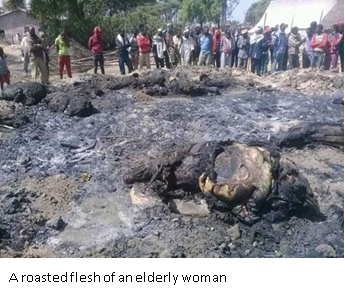 Oromia Support Group Australia (OSGA) grievously worries about the severe human rights violation in Guji area, State of Oromia. The Ethiopian military forces, regional and zonal administrations are, in collaboration, committing a grave violation of human rights that include mass killing, incineration of people alive, mass detention, burning of villages, and confiscation of properties, torture and starvation of villagers. The action of brutality has been carrying out only in the name of stamping out OLF (Oromo Liberation Front) forces from the area.
Since December 2018 right after the deployment of Ethiopian military to the area, there have been many atrocities committed by the army and the zonal administration forces in the area. For instance:
1. 28 December 2018, thirteen innocent civilian from Finchawa town, Dugda Dawa district and six civilians from a village called ‘Maxxaarrii’ in Galana Abaya districts were brutally killed. The same day, around 10 pm local time many people were injured some of which died later due to their injuries. What made the killing so horrendous was that it happened at a time when the village was peaceful, and the residents of the town were on their regular daily routine. The residents in the area unsuspicious as to what was going to happen even to take a cover to avoid the spontaneous raining bullets and heavy machine guns that burned everything it hits (vehicle, motorbike, house, tree) including human being.
As a human being, no one thinks would enjoy the sight of tarred corpus and can easily imagine what the family and society would feel seeing their beloved torched in broad daylight without his or her sin.
2. Similarly, on 15 January 2019, an elderly woman who was sitting in her hut was incinerated after the door of the shelter she was living in was locked from behind and torched while she was alive. What made this killing too shockingly inhuman was the brutality of the soldiers that waited to make sure the elderly that was burning to ashes was completed and fled the scene pinching their noses due to the roasting flesh that smoked the area. This brutal killing has happened after the soldiers had indiscriminately killed at least ten and injured many in and around Karcha town and killed many unaccounted along their way including an elderly man who was riding a horse 100 meters away from the house they torched with the elderly woman.
Besides these significant incidents, without any late up, the killing rampage of two, three, five, ten, here and there across the area has continued to date including burning of villages, displacement of villagers, confiscation of properties and killing of anyone who rides a motorbike without any impunity.
3. On 19 February 2019, for instance, an indiscriminate shooting on artisanal gold miners in the Dakara village in Arero district killed six civilians on the spot and injured many who run into the thorny bush and ragged rocks that further harmed women and children.
4. Gujii area is totally under siege. Motorbike, the only means of transportation for remote villagers, is prohibited. Much of it is confiscated as such people have to walk a day or so on foot to access markets. In some areas, even those markets are restricted. The amount of food one carries is limited to less than five kilos yet if one has to have a family of ten or more which is common in Gujii area.
5. Night curfew is imposed in the rural and urban areas. One can’t walk in the night to reach the village, and he or she has to walk in the scorching sun to avoid the killing and detention that comes due to the breach of the night curfew. No one can complain about why someone is arrested and why someone is shot. The number of people who moved to the concentration camp has increased by the day. At the time of this report conducted more than two hundred and fifty people from Bule Hora, ninety-four from Qarcha, fifty-five from Malkaa Soda and many more from various areas of Gujii are on course to be transported in addition to thousands who have already been transported to some undisclosed harsh concentration camp. People have to run to bushes with their children to avoid capture. It is so hostile beyond human imagination.
6. Just recently as if all the atrocities committed by the military are not enough they have trained local militias whose task is to burn properties of families of suspected sympathisers of the rebel groups as such many suspects’ properties in many places in the area are burned to ashes. Those who objected to the tactic are taken to concentration camps. While that is one thing what is worrying is the identity of those who are burning properties. As stated these militias are locals and they are known, people. At the same time, those of who whose properties are destroyed are locals. They know who is doing this. Guji community is known for its cooperation along its lineage. If the family or sub-clans of those whose properties are destroyed respond to the action of the local militias and the families or sub-clans of the local militias counter, it is not hard to imagine what would happen in the area.
Oromia Support Group Australia urges all the concerning bodies to pay immediate attention to these grave human rights violations and instantly call for the cessation of these brutal collective punishments. All the breadwinners of their family should be released from concentration camps. Peace and stability need to be restored in the area through civilised negotiation instead of resolving the differences through military means. Those who have committed grave crimes should be brought to justice for the accountability of the evil they have committed.
For more information:OSGA April 2019 Statement on Grave Human Right Violations in Guji – State of Oromia




 Advocacy for Oromia