A Day of Thunder and Tears – Oromo Martyrs and Heroes Honored at ABO Headquarters in Gullalle

Thousands gather on Ebla 15, 2026, to remember the fallen, raise the flag, and renew the vow never to forget
By: Daandii Ragabaa
Date: Ebla 15, 2026 (April 15, 2026)
PROLOGUE: The Day the Dead Speak
There are days that pass like any other. And then there is Ebla 15 – the day when the dead refuse to stay silent.
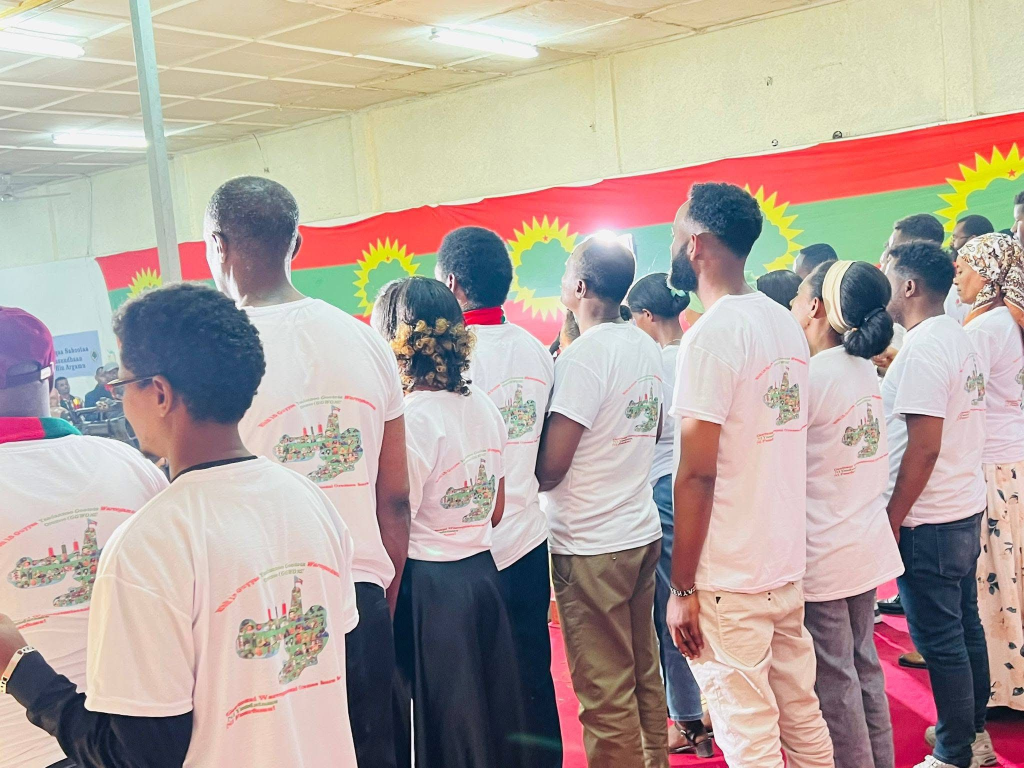
On this morning, under a sky the color of old iron, hundreds of Oromo men, women, and children gathered at the Head Office of the ABO (Arsi, Bale, Oromo) in the Gullalle district of Addis Ababa. They came not because they were invited. They came because something in their blood would not let them stay home.
This was Guyyaa Gootota Wareegamtoota Oromoo – the Day of Oromo Martyrs and Heroes.
It is a day with no official decree. No government proclamation. No permission slip from any palace. It is a people’s holiday, carved from memory and kept with fire.
And on Ebla 15, 2026, the people of Gullalle proved that memory is still alive.
PART ONE: The Gathering
Faces in the Crowd
By 8:30 AM, the compound of the ABO headquarters was already full.
The elders arrived first. They came on buses, on foot, leaning on canes and on each other. Their faces were maps of grief – wrinkles carved by tears and time. They sat on plastic chairs in the shade, their walking sticks planted like spears. They did not speak much. They had done their talking over decades. Now they came to witness.
The mothers stood at the edges. Infants were tied to their backs with cotton wraps. Some nursed while standing. Others held faded photographs – sons, daughters, husbands – who would never grow old. They did not weep. Perhaps they had no tears left.
The youth – the Qeerroo and Qarree – filled the center of the compound. They wore the Oromo flag not as decoration but as declaration. Black, red, and white on t-shirts, on scarves, on wristbands, on fingernails. Their phones were raised, recording everything. Not for social media fame. For evidence. For the archive that no government will keep.
At the front of the compound stood a simple wooden stage. No velvet ropes. No VIP section. No flowers. Just a microphone, a worn banner, and a flag that had been folded and unfolded so many times that its edges were frayed into whispers.
The banner read:
“Guyyaa Gootota Wareegamtoota Oromoo – Ebla 15, 2026 – Hin Irraanfatnu. Hin Lolti Dhaabnu.”
(Oromo Martyrs and Heroes Day – We will not forget. We will not stop struggling.)
PART TWO: The Silence That Roared
One Minute That Lasted a Lifetime
At exactly 9:00 AM, the master of ceremonies stepped to the microphone. He was a soft-spoken man with steel in his jaw.
“Before we speak,” he said, “we listen.”
One minute of silence.
It is easy to write those words. It is much harder to describe what happens when five hundred people stop breathing at the same time. The wind itself seemed to hesitate. A child coughed somewhere in the back, and the sound was enormous. An old man shifted his weight, and the creak of his sandals was a thunderclap.
In that minute, the dead were not remembered. They were present.
Then the silence broke – not with applause, but with a single voice singing an old Oromo lament. One by one, others joined. By the end of the first verse, the entire crowd was singing. The song had no title. But everyone knew the words. It was the song grandmothers sing when they think no one is listening. The song of rivers and horses and a time before borders.
PART THREE: The Names
A Litany of the Lost
Then came the reading of the names.
For nearly two hours, a rotation of speakers stepped to the microphone and read aloud the names of Oromo martyrs. Some were historical – 19th-century horseback warriors who rode against colonial cannons. Others were recent – young people killed in protests between 2014 and 2026. Some names were known across Oromia. Others were known only to a single village, a single family, a single mother.
The list included:
- Alemitu G. – killed, 2016, Adama.
- Biruk T. – disappeared, 2018, never found.
- Chaltu D. – shot, 2015, Bale.
- Dawit I. – died in prison, 2020, denied medical care.
- Feyissa L. – 19 years old, 2014, Ambo.
- Galaana Immaana – consumed by those who now claim leadership.
- Jaala Boruu Lammeessaa – who fled the network and was martyred in the forest.
After each name, the crowd responded with a low, rumbling chant:
“Nu jirra. Hin irraanfatne.”
(We are here. We have not forgotten.)
It was not a cheer. It was a vow.
By the time the last name was read, no one was standing still. But no one had left.
PART FOUR: The Flag That Refuses to Burn
A Cloth More Powerful Than Bullets
At exactly 12:00 noon, the ceremony reached its spiritual peak.
Two young Qarree – sisters, no older than twenty – walked slowly to the flagpole. Between them, folded into a perfect square, was the Oromo flag. They did not rush. Every step was a prayer.
When they reached the pole, they unfolded the cloth with the reverence of priests handling a relic.
This flag – whether the black, red, and white or the green, red, and yellow, depending on tradition – has been banned, burned, trampled, and called illegal at various times in modern Ethiopian history.
And yet, on Ebla 15, 2026, it rose again.
As the colors caught the midday sun, an old man in the back of the crowd fell to his knees. He was not praying to God. He was praying to the cloth.
“Forgive us,” he wept, his voice cracking like dry earth. “We are still fighting. We have not given up.”
No one told him to stand. No one told him to be quiet. Some moments are too sacred to interrupt.
PART FIVE: The Five Pillars
What the Heroes Died For
The keynote address was delivered by a senior ABO official who requested anonymity for security reasons. He did not speak of politics. He spoke of debt.
He raised five fingers and named five sacred words of the Oromo struggle:
| Oromo Word | Meaning | What the Martyrs Died For |
|---|---|---|
| Nageenya | Justice / Peace / Well-being | A country where identity is not a death sentence. |
| Misooma | Development | Schools in villages, not just palaces in the capital. |
| Badhaadhina | Progress | Moving forward, even when the road is soaked in blood. |
| Dimokiraasii | Democracy | The right to speak, assemble, and choose – without permission. |
| Nagaa | True Peace / Safety / Tranquility | Sleeping through the night without fear of a knock on the door. |
“These five words,” the speaker said, his voice low and fierce, “are not decorations. They are debts. Our heroes paid with their lives. We must pay with our actions.”
The crowd did not clap. They raised their fists. And for a moment, Gullalle was not a neighborhood in Addis Ababa. It was an idea.
PART SIX: Voices from the Crowd
What the Living Said
This reporter spoke with several attendees. Their words speak louder than any analysis.
Bontu, 23, university student:
“I was not born when many of these heroes died. But I carry their names in my phone. I read them every morning. Ebla 15 is the day I become honest about who I am.”
Jirenya, 58, farmer (who traveled three hours by bus):
“My brother was killed in 2015. No one was arrested. No one apologized. The government forgot him. But I will not. Today, I am his memory.”
Marga, 19, high school student:
“The old people cry. But we, the young – we are not just crying. We are planning. We are organizing. The next heroes are not dead yet. They are standing right here.”
Hundessa, 72, retired teacher (walking with a cane):
“I have attended these ceremonies for twenty years. Each year, there are new names. That breaks my heart. But each year, there are also new young faces. That gives me hope.”
Faarax, 34, shopkeeper (who left his store unattended):
“I did not close my shop. I left my son in charge. If I lose my business for being here, so be it. What is money without Nageenya? Nothing.”
PART SEVEN: The Shadow Over the Celebration
A Warning from Inside
Not all the voices at the ceremony were voices of pure grief. Some were voices of warning.
Multiple attendees, speaking on condition of anonymity, told this reporter that not everyone who wears the flag loves the struggle. They spoke of infiltration, of criminal networks that have hijacked parts of the movement, of leaders who were once prisoners of the old regime and are now protectors of the new one.
One source, who identified himself as a former insider of a group called #120, described how a shadow cell built by a former OPDO military member named Mammush had systematically stolen money, committed killings, and then rebranded as legitimate leadership when the political winds changed.
“The truth is very bitter,” he said. “But if we do not speak it, the heroes died for nothing.”
Another source pointed specifically to Baayisaa Huseen – now the head of security in Ambo – as a man who once sat in prison alongside genuine nationalists, only to emerge as a hunter of the very people he once called comrades.
“He knows every Oromo nationalist by name. And he is eliminating them, one by one.”
These allegations were not the focus of the ceremony. But they hung in the air like smoke – invisible, but impossible to ignore.
PART EIGHT: The Closing Vow
A Promise Made with Raised Hands
As the sun began to soften over Gullalle, the crowd did not disperse quickly. They lingered. They hugged strangers. They exchanged phone numbers. They stood in front of the flag for photographs that would be hidden in private albums, not shared on public feeds.
Then, a young Qeerroo – no older than seventeen – climbed onto a plastic chair and shouted:
“Ebla 15 next year – where will we be?”
The crowd roared back – not rehearsed, but raw:
“Stronger! More! Free!”
The final moment of the ceremony was not a speech. It was a collective vow.
Everyone raised their right hand – young and old, man and woman, farmer and student, rich and poor – and repeated after the master of ceremonies:
“We will not forget. We will not forgive injustice. We will keep walking.
Until Nageenya is not a word, but water.
Until Misooma reaches the last village.
Until Badhaadhina cannot be stopped.
Until Dimokiraasii is for every Oromo.
Until Nagaa is not a dream, but breakfast.”
Then silence.
And then, from the back of the crowd, a single voice began to sing the Oromo anthem. One by one, everyone joined. By the second verse, Gullalle was no longer a location on a map. It was a congregation.
EPILOGUE: What the Night Carried
The chairs were folded. The banner was rolled. The flag was lowered and placed in a wooden box – the same box that has carried it for years, from one secret ceremony to the next. The crowd melted back into the streets of Addis Ababa – some to homes, some to hiding, some to the next meeting.
But something stayed in the air above Gullalle on the night of Ebla 15, 2026.
It was not smoke. It was not sound. It was not even tears.
It was the breath of heroes – past, present, and those still unborn.
And as long as that breath moves, Guyyaa Gootota Wareegamtoota Oromoo will never be just a date on a calendar.
It will be a living fire.
For Those Who Were Not There
If you are reading this in a city far from Oromia – in Minneapolis, in Berlin, in Nairobi, in Melbourne – know this:
Ebla 15 is not a date. It is a thread.
It connects a horseback warrior of 1896 to a Qeerroo with a cracked smartphone in 2026. It connects a mother who buried her son to a teenager who has never seen peace but still believes in it. It connects the martyrs who fell in Ambo and Waliso to the millions who still whisper Bilisummaa in their sleep.
The Oromo martyrs and heroes did not die so that you would cry forever.
They died so that you would act.
So act.
Learn a name. Speak a truth. Raise a flag – even if only in your heart.
Because as they chanted in Gullalle on Ebla 15, 2026:
“Nu jirra. Hin irraanfatamne.”
We are here. We have not forgotten.
And neither should you.
Bilisummaa! Nagaa!
Ebla 15 – Forever.

Posted on April 16, 2026, in Aadaa, Events, Finfinne, Information, News, Oromia, Press Release, Promotion. Bookmark the permalink. Leave a comment.




 Advocacy for Oromia
Leave a comment
Comments 0