THE UNSHAKEN ONE: Jaal Dawud Ibsa – A Leader Who Refused to Sell His Soul
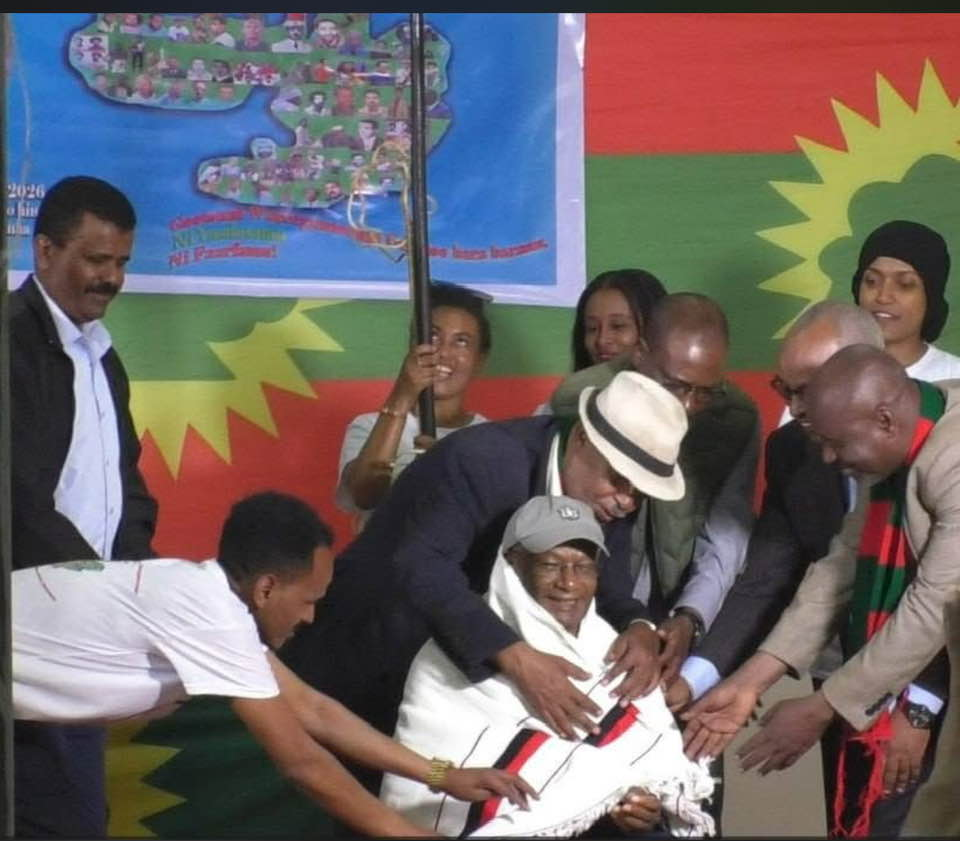
In an age of opportunists and betrayals, the OLF chairman stands as a rare monument to steadfastness, wisdom, and unwavering loyalty to the Oromo people.
A Feature Story – By Maatii Sabaa-Political Tribute & Reflection
PROLOGUE: WHEN THE WIND CHANGES DIRECTION
History has a cruel habit of exposing people when the wind shifts. When power is secure and the future seems certain, the crowd is full of loyalists. Everyone claims to have been there from the beginning. Everyone offers their hand, their voice, their allegiance.
But when the storms come—when the powerful turn their backs, when the path becomes narrow and dangerous, when loyalty becomes a liability rather than an asset—that is when the real ones are revealed.
That is when the pretenders scatter like leaves before a gale.
And that is when a rare few stand firm.
Jaal Dawud Ibsa is one of those rare few.
As Chairman of the Oromo Liberation Front (OLF)—a movement that has carried the weight of Oromo aspirations for half a century—Dawud Ibsa has witnessed the full spectrum of human character: the brave and the cowardly, the faithful and the treacherous, the steadfast and the fleeting.
And in an era when many in power turned their backs on the Oromo people, when former allies bartered their loyalty for personal gain, when the currency of betrayal flowed freely—Jaal Dawud Ibsa did not move.
He stood.
He stands.
And he will continue to stand.
PART ONE: THE FATHER WHO DOES NOT FLEE
“When many in power turned their backs, you stood unshaken beside your people, as a father stands, steadfast and true, never wavering in his duty.”
The Image of Fatherhood
There is a particular kind of courage that belongs to fatherhood. Not the courage of battle—though that has its place. But the courage of presence. The courage of staying when staying is hard. The courage of standing between danger and those who depend on you.
A father does not flee when the house catches fire. A father does not abandon his children when the enemies gather at the gate. A father does not negotiate away the future of his family for personal comfort.
Jaal Dawud Ibsa has been that kind of father to the Oromo people.
Not because he sought the title. Not because he craved the attention. But because when the moment came—when many in power turned their backs on the Oromo cause—he simply refused to leave.
The Turning of Backs
The history of the Oromo struggle is littered with fair-weather friends. Politicians who used Oromo votes to gain office, then forgot Oromo needs. Allies who accepted Oromo sacrifices on the battlefield, then denied Oromo rewards at the negotiating table. Leaders who promised liberation, then settled for personal enrichment.
The Oromo people know this pattern. They have tasted betrayal more often than victory.
But through it all—through the cycles of hope and disappointment, through the eras of open war and fragile peace—one figure has remained constant.
Not perfect. Not infallible. But constant.
Jaal Dawud Ibsa.
PART TWO: THE AGE OF OPPORTUNISTS
“In an age of opportunists, where some bartered loyalty for gain, like Judas Iscariot for thirty pieces of silver, you remained rare one in a million – unbought, unwavering, real.”
The Thirty Pieces of Silver
The name Judas Iscariot has echoed through two thousand years of human history as the ultimate symbol of betrayal. A man who walked with his teacher, ate with him, called him “Rabbi”—and then sold him for the price of a slave.
Thirty pieces of silver.
The tragedy of Judas is not that he was weak. It is that he was bought. His loyalty had a price. And when that price was offered, he accepted.
The past decades of Ethiopian politics have produced more than a few Judases. Men and women who began as champions of the Oromo cause—who spoke the right words, attended the right meetings, carried the right flags—and then, when the opportunity for personal advancement appeared, they traded their principles for positions, their people for power.
The One Who Could Not Be Bought
What is the price of Jaal Dawud Ibsa?
That question has been asked by every Ethiopian regime, every would-be mediator, every foreign power that sought to “manage” the Oromo question.
And the answer has always been the same: There is no price.
Not because he is immune to temptation. Not because he lacks human desires. But because he has understood something that opportunists never grasp: Some things are worth more than any payment.
The dignity of the Oromo people. The future of Oromo children. The truth of Oromo history. The dream of Oromo self-determination.
These cannot be bought. They cannot be sold. They can only be defended.
And Jaal Dawud Ibsa has defended them with a consistency that, in an age of constant flip-flopping, appears almost supernatural.
“Unbought, Unwavering, Real”
Three words. Three rare qualities.
| Quality | Meaning | How Dawud Ibsa Embodies It |
|---|---|---|
| Unbought | Cannot be purchased, bribed, or compromised | Decades in power without accumulating personal wealth at the expense of the movement |
| Unwavering | Does not shift with political winds | Remained committed to OLF principles through imprisonment, exile, war, and peace |
| Real | Authentic; not a performance; substance over show | Lives the struggle; does not merely speak about it |
In a political culture where performance often substitutes for substance, where social media presence matters more than on-the-ground organizing, where slogans replace strategy—Jaal Dawud Ibsa represents something increasingly rare: the real thing.
PART THREE: WISDOM BEYOND PAGES
“Your wisdom runs deeper than pages, beyond what Niccolò Machiavelli could ever capture, for it is lived, not written – something we witness, and learn.”
The Limits of Books
Niccolò Machiavelli, the Renaissance philosopher who wrote The Prince, is often cited as the ultimate authority on political cunning. His advice to rulers—be feared rather than loved, break promises when convenient, imitate both the lion and the fox—has shaped the thinking of power-seekers for five centuries.
But Machiavelli wrote from observation, not from experience. He was a civil servant who lost his position, wrote a book about how to gain and keep power—and then watched as his own advice failed to restore him to office.
Jaal Dawud Ibsa has not merely observed power from a distance. He has lived it. He has been imprisoned. He has been exiled. He has led armed struggle. He has negotiated peace. He has seen allies become enemies and enemies become allies. He has watched movements rise and fall.
And through all of it, he has developed a wisdom that no book can teach.
Lived Wisdom
What is lived wisdom?
| Book Knowledge | Lived Wisdom |
|---|---|
| Learns from reading | Learns from suffering |
| Theoretical | Practical |
| Can be taught | Must be experienced |
| Static | Adaptive |
| Safe | Costly |
Jaal Dawud Ibsa’s wisdom has been purchased at a high price. It is written not on pages, but on the lived experience of decades of struggle. It is etched not in ink, but in the memory of sleepless nights, difficult decisions, and the weight of responsibility for millions of people.
What We Witness and Learn
Those who have spent time with Jaal Dawud Ibsa speak of a man who listens more than he speaks. Who asks questions more than he issues commands. Who seeks consensus without abandoning principle.
These are not qualities that can be faked. They are not strategies to be deployed. They are the natural outgrowth of a man who has learned, through decades of trial and error, that leadership is not about domination—it is about service.
The Oromo people do not need to read Machiavelli to understand power. They have Jaal Dawud Ibsa.
And they learn from him—not from his lectures, but from his example.
PART FOUR: THE SYMBOL OF ROYALTY WITHOUT A CROWN
“Though Oromo know no crown nor king, you rise as a symbol of true royalty, a leader shaped by truth and loyalty, an example for generations yet to come.”
The Oromo Tradition of Leadership
The Oromo people have never been ruled by kings in the European or Abyssinian sense. The Gadaa system—one of the most sophisticated democratic systems ever developed by a pre-industrial society—governed Oromo life for centuries. Leaders were elected for fixed terms, held accountable by assemblies, and retired after eight years.
There were no dynasties. No divine right. No crowns passed from father to son.
Leadership, in Oromo tradition, was earned—not inherited. And it was temporary—not permanent.
A Different Kind of Royalty
When the poem says that Jaal Dawud Ibsa rises as “a symbol of true royalty,” it is not suggesting that he seeks to become a king. It is using royal imagery to convey something deeper: dignity, steadfastness, and a sense of sacred duty.
True royalty—in the best sense of the word—is not about bloodlines or palaces. It is about:
- Nobility of character – Doing the right thing when no one is watching
- Sacrifice for others – Putting the needs of the people above personal comfort
- Consistency – Being the same person in private as in public
- Accountability – Answering for one’s actions
By these measures, Jaal Dawud Ibsa is indeed a kind of royalty—a leader who has earned his place not through birth or wealth, but through decades of faithful service.
Shaped by Truth and Loyalty
Two forces have shaped Jaal Dawud Ibsa’s leadership:
Truth – Not the truth that is convenient, but the truth that is uncomfortable. The truth about Oromo history, about the failures of previous leadership, about the challenges that remain. He has never been a man of easy lies.
Loyalty – Not blind loyalty, but principled loyalty. Loyalty to the Oromo people, not to any faction or individual. Loyalty to the cause, not to the trappings of power.
These are the forces that have kept him standing when others fell. These are the forces that will continue to guide him.
An Example for Generations
The ultimate test of any leader is what happens after they are gone. Do their achievements crumble? Does their movement collapse? Are they forgotten?
Or do they leave behind an example—a model of leadership that future generations can study, admire, and emulate?
Jaal Dawud Ibsa is building that example now. Not through self-promotion. Not through a cult of personality. But through the quiet, persistent work of showing what it means to lead with integrity.
Decades from now, when young Oromos ask, “What did a real leader look like?” the answer will be available.
They will look at the life of Jaal Dawud Ibsa.
PART FIVE: THE GRATITUDE OF A PEOPLE
“For all you have given, we thank you Jall Daud Ibssa. May God bless you, and grant you a life both long and full.”
What He Has Given
The poem lists no specific achievements. It does not need to. The gratitude it expresses is not for any single victory, any particular policy, any one moment of triumph.
It is gratitude for a life lived in service.
Jaal Dawud Ibsa has given:
- His youth – To the struggle, when he could have pursued personal ambition
- His freedom – To imprisonment, when he could have compromised
- His safety – To exile, when he could have made peace with power
- His time – Decades of patient organizing, negotiating, leading
- His example – A model of integrity in a corrupt age
These are not small gifts. They are the substance of a life fully given to a cause greater than oneself.
A Blessing for the Future
The poem closes with a blessing: “May God bless you, and grant you a life both long and full.”
This is not merely a polite sentiment. It is a recognition that the Oromo people still need Jaal Dawud Ibsa. His wisdom is still required. His leadership is still necessary. His example is still being written.
May he live long—not for his own sake, but for the sake of the movement he has guided.
May his life be full—not with riches or ease, but with the satisfaction of seeing the Oromo people move closer to their rightful place in the world.
PART SIX: THE CONTEXT – WHO IS JAAL DAWUD IBSA?
For readers who may not be familiar with the Oromo struggle, some context is necessary.
The Oromo Liberation Front (OLF)
| Fact | Detail |
|---|---|
| Founded | 1973 |
| Purpose | Self-determination for the Oromo people |
| Status | Political party and former armed liberation movement |
| Historical Role | Fought against the Derg regime (1974-1991) and later against successive Ethiopian governments |
| Current Status | Legal political party operating within Ethiopia after a 2018 peace agreement |
Jaal Dawud Ibsa’s Role
| Fact | Detail |
|---|---|
| Position | Chairman of the OLF |
| Tenure | Multiple decades |
| Background | Spent years in exile, imprisoned under previous regimes |
| Reputation | Known for principled leadership, unwillingness to compromise on core Oromo rights |
The Challenges He Has Faced
- Imprisonment – Held by the Derg regime for his political activities
- Exile – Operated from outside Ethiopia during periods when the OLF was banned
- Assassination attempts – Targeted by successive Ethiopian governments
- Internal dissent – Navigated factional disputes within the OLF
- Peace process – Led the OLF through the 2018 peace agreement with the Ethiopian government
Through every challenge, he has remained.
PART SEVEN: COMPARISONS – THE RARITY OF SUCH LEADERSHIP
To appreciate Jaal Dawud Ibsa, one must understand how rare his kind of leadership has become.
The African Context
Across Africa, liberation movement leaders have often followed a predictable pattern:
| Stage | Typical Behavior | Dawud Ibsa’s Path |
|---|---|---|
| Struggle | Fight against colonialism/oppression | Fought for Oromo liberation |
| Victory | Take power, often as president | Did not seek presidency of Ethiopia |
| Consolidation | Eliminate rivals, extend term limits | Remained focused on Oromo cause, not personal power |
| Enrichment | Accumulate wealth for self and family | No known accumulation of personal wealth |
| Legacy | Often leave behind corruption, dynasties | Leaving behind an example of integrity |
Jaal Dawud Ibsa broke the mold. He did not become another African “big man.” He did not trade the liberation struggle for a palace. He remained what he had always been: a servant of the Oromo people.
The Global Context
In global politics, the pattern is similar. Revolutionaries become authoritarians. Freedom fighters become oppressors. Idealists become cynics.
The list is long: from Zimbabwe’s Robert Mugabe to Eritrea’s Isaias Afwerki, from Nicaragua’s Daniel Ortega to Venezuela’s Nicolás Maduro—the story is tragically familiar.
Jaal Dawud Ibsa has avoided this fate. Not because he is a saint. But because he has never forgotten who he serves.
PART EIGHT: CRITICAL REFLECTION – NO LEADER IS BEYOND SCRUTINY
This feature article is a tribute, not a hagiography. No leader is perfect. No movement is without flaws. And the Oromo people, like all peoples, must maintain the right to critique their leaders even as they honor them.
Fair Questions
Any honest assessment of Jaal Dawud Ibsa’s leadership must grapple with legitimate questions:
| Question | Context |
|---|---|
| Has the OLF achieved its core goals under his leadership? | The struggle continues; complete self-determination remains unrealized |
| Have there been internal disputes within the OLF? | Yes, as in any political organization |
| Has the 2018 peace agreement delivered for Oromos? | Mixed results; some progress, continued repression |
| Could different strategies have yielded better outcomes? | Always a matter of debate |
These are not attacks. They are the normal questions that any people should ask of their leaders.
The Balance
The tribute poem does not claim that Jaal Dawud Ibsa has been perfect. It claims that he has been steadfast, unbought, unwavering, and real.
These claims can stand alongside critical questions. A leader can be imperfect and still be rare. A movement can have unfinished business and still have a chairman worthy of respect.
The Oromo people do not need to choose between gratitude and critical thinking. They can honor Jaal Dawud Ibsa for what he has been—and still demand more for the future.
PART NINE: THE LEGACY IN PROGRESS
Jaal Dawud Ibsa is still alive. His story is not finished. His legacy is still being written.
What He Represents Today
| Symbol | Meaning |
|---|---|
| Continuity | A link between the OLF of the 1970s and the Oromo movement of today |
| Integrity | Proof that political leadership need not corrupt |
| Hope | Evidence that the Oromo cause is not abandoned |
| Warning | A reminder to opportunists that not everyone can be bought |
What the Future Holds
The Oromo people will one day face a future without Jaal Dawud Ibsa. That day, whenever it comes, will be difficult. But the example he has set will remain.
Young Oromos will ask: What did he do that made him so respected?
The answer will be simple: He stayed. He did not sell out. He did not give up. He was real.
And that answer will be enough to inspire the next generation of leaders—not to copy him, but to follow his example in their own way.
CONCLUSION: A PRAYER AND A PROMISE
Jaal Dawud Ibsa.
The name itself has become a kind of prayer for many Oromos—a prayer of gratitude for what has been, and a prayer of hope for what may yet be.
In an age of betrayals, he remained loyal.
In a marketplace of sellouts, he remained unbought.
In a sea of performances, he remained real.
For that, the Oromo people thank him.
Not with statues or monuments—those can be torn down.
Not with official titles or ceremonies—those can be revoked.
But with the only tribute that truly matters: the memory of a life lived well, and the determination to carry forward the cause he never abandoned.
“Some leaders are remembered for what they built. Others are remembered for what they refused to destroy. Jaal Dawud Ibsa will be remembered for both.”
“For all you have given, we thank you Jall Daud Ibssa. May God bless you, and grant you a life both long and full.”
May it be so.
Waaqni haa eegu.
The struggle continues.
© 2026 – A Tribute to Leadership, Integrity, and the Unfinished Oromo Cause

Posted on April 18, 2026, in Aadaa, Events, Finfinne, Information, News, Oromia, Press Release, Promotion. Bookmark the permalink. Leave a comment.






Leave a comment
Comments 0