Remembering Zegeye Asfaw: A Life of Service and Commitment
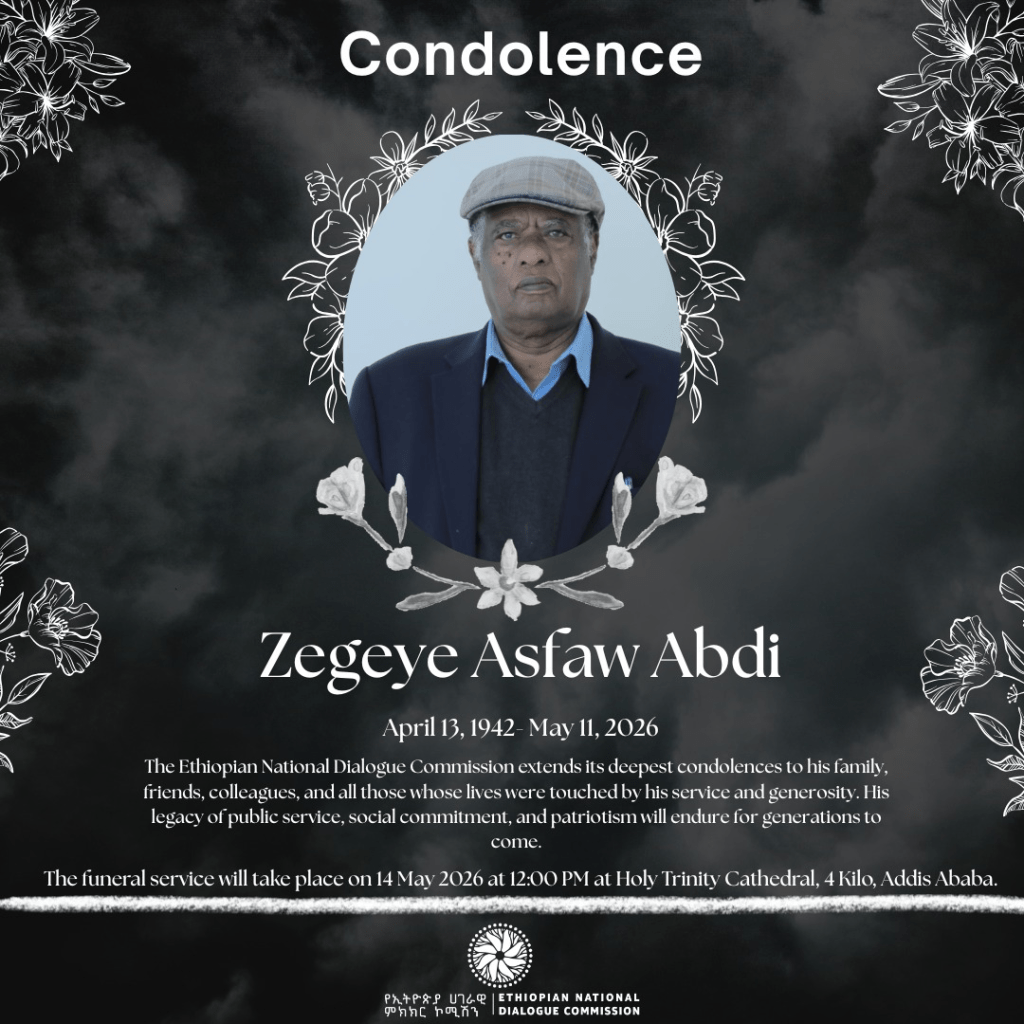
The Gentle Giant Who Gave Land and Dignity – Honoring Commissioner Zegeye Asfaw Abdi (1942–2026)
By: Dhabessa Wakjira (Based on the Statement of Condolence of the Ethiopian National Dialogue Commission)
Date: May 13, 2026
Category: Obituary / Tribute / National Legacy
PROLOGUE: A Life That Spanned Eras, A Legacy That Transcends Them
On May 11, 2026, Ethiopia lost more than a former minister, more than a commissioner, more than a lawyer, more than a philanthropist. Ethiopia lost a bridge – between feudalism and reform, between oppression and liberation, between north and south, between government and the governed.
Commissioner Zegeye Asfaw Abdi passed away at the age of 84. He was born in 1942 in West Shoa – a time when the land he would later help liberate was still under the yoke of feudal bondage. He died in 2026 – leaving behind a nation where millions of farmers till soil they can finally call their own.
The Ethiopian National Dialogue Commission, where he served with distinction since February 2021, released a statement of condolence that captures the weight of his departure. But no official statement, however eloquent, can fully measure the hole left by a man who was simultaneously a lawyer, a revolutionary, a prisoner, a minister, a grassroots organizer, and – above all – a servant.
This is his story.
PART ONE: The Making of a Reformer
From West Shoa to Wisconsin
Zegeye Asfaw was born in 1942 in West Shoa, into a family of the nobility. He was, by birth, a balabat – a member of the very class that owned the land and the people upon it. But Zegeye was not content to inherit privilege. He chose, instead, to dismantle it.
He pursued his legal studies at the former Haile Selassie I University, where he encountered the radical student movements of the 1960s. He heard the cries of the landless. He saw the contradiction between his own birth and the suffering of the millions who tilled the soil beneath his feet.
He did not turn away.
He continued his education at the University of Wisconsin–Madison, where he obtained a Master’s Degree in Law. But his real education came from the land itself – from the gebar (serf) who gave half his harvest to a landlord, from the golle (tenant) who had no right to the hut he built, from the shimaglle (elder) who whispered of a time when the Oromo were masters of their own earth.
Zegeye returned to Ethiopia not as a defender of the old order, but as its gravedigger.
PART TWO: The Proclamation That Changed Everything
“Land to the Tiller”
During the Derg regime, Zegeye Asfaw served his country in several senior government positions:
- The former Ministry of Land Administration
- The Ministry of Agriculture and Settlement
- The Ministry of Justice
- The Ministry of Labour and Social Affairs
But he is particularly remembered – as the National Dialogue Commission’s statement notes – for his instrumental role in crafting the historic “Land to the Tiller” proclamation.
This was not a bureaucratic exercise. It was a seismic shift in Ethiopian history. For centuries, the land of Ethiopia – especially in Oromia and the south – had been owned by a tiny aristocracy. The millions who worked it had no rights, no security, no dignity. They were gebar (tribute payers), golle (tenants at will), serf (bound to the soil and the master).
The 1975 proclamation changed all of that. It transferred ownership from the few to the many. It declared that the person who tills the land shall own the land. It broke the backbone of feudalism in one stroke.
And Zegeye Asfaw was its architect.
He did not merely sign it. He crafted it. He fought for it. He paid for it – with imprisonment, with exile from power, with decades of obscurity.
PART THREE: Beyond Public Office – The Heart of a Servant
Hunde and Busa Gonfa – Lifting the Vulnerable
Zegeye Asfaw was not a man who only served from the top down. When he left government, he did not retire to a quiet life. He went deeper.
Through the establishment of the local NGO Hunde, he worked tirelessly to improve the lives of vulnerable communities and combat poverty. Hunde was not a showcase project. It was a quiet, persistent effort to put food on tables, to send children to school, to give hope where hope had been crushed.
He also founded a microfinance institution – Busa Gonfa – focused on empowering women in rural Ethiopia and expanding economic opportunities at the grassroots level. He understood that land reform was only the first step. Without credit, without training, without the means to work the land productively, the farmer remained poor even if no longer a serf.
Busa Gonfa was his answer. It remains his legacy.
PART FOUR: The Environmentalist – A Steward of the Earth
Working with Farmers and Pastoralists
Zegeye Asfaw was equally committed to environmental protection and sustainable development. He understood that land, once freed, must also be preserved.
He closely collaborated with farmers and pastoralist communities in advancing environmental conservation initiatives. He worked with them to prevent soil erosion, to manage water resources, to plant trees, to practice responsible stewardship of natural resources.
He did not see a contradiction between development and conservation. He saw a partnership. The land gives to the people; the people must give back to the land. This was not ideology for Zegeye. It was lived experience.
PART FIVE: The Commissioner – Service Until the End
Integrity, Diligence, Humility, and Unwavering Commitment
Since February 2021, Zegeye Asfaw had been serving as a Commissioner of the Ethiopian National Dialogue Commission. He was appointed in his late seventies – an age when most people have long since retired to their villages or their memories.
But Zegeye did not retire. He served.
Throughout his tenure, he distinguished himself through:
- Integrity – He could not be bought, could not be bent.
- Diligence – He worked as hard as any junior staff member, often harder.
- Humility – He never pulled rank, never demanded deference.
- Unwavering commitment – He believed that dialogue was the only path to a stable, just Ethiopia.
The National Dialogue Commission’s statement captures this perfectly:
“Throughout his tenure, he distinguished himself through his integrity, diligence, humility, and unwavering commitment to the national dialogue process and the service of his country.”
He served until his body would serve no more. On May 11, 2026, at the age of 84, he laid down his burdens.
PART SIX: A Death That Is Not an End
What Remains When a Giant Falls
The Ethiopian National Dialogue Commission extended its deepest condolences to his family, friends, colleagues, and all those whose lives were touched by his service and generosity.
But condolences, however sincere, are not enough. They must be accompanied by a determination to continue his work.
What remains of Zegeye Asfaw?
- Every farmer who owns their land today – that is Zegeye.
- Every woman in rural Ethiopia who has received a microfinance loan to start a business – that is Zegeye.
- Every tree planted by a pastoralist community that learned sustainable land management – that is Zegeye.
- Every conversation at the National Dialogue Commission that seeks common ground rather than victory – that is Zegeye.
He is not gone. He is distributed – across the fields, across the villages, across the institutions he built and the lives he touched.
PART SEVEN: The Funeral – A Final Salute
Holy Trinity Cathedral, 4 Kilo, Addis Ababa – May 14, 2026
The funeral service will take place on May 14, 2026 at 12:00 PM at Holy Trinity Cathedral, 4 Kilo, Addis Ababa.
It is fitting that he will be laid to rest in a place that holds the remains of Ethiopia’s great patriots. Holy Trinity is where emperors and revolutionaries, poets and generals, saints and sinners find their final rest. Zegeye Asfaw belongs there – not because he sought honor, but because honor sought him.
He would not have wanted a grand funeral. He was a humble man. But the nation owes him a grand farewell – not for his sake, but for ours. We need to say goodbye. We need to weep. We need to promise, over his grave, that we will not forget.
EPILOGUE: A Prayer for the Commissioner
But for Zegeye Asfaw, we might add something more:
“The land you freed remains free. The people you lifted remain standing. The institutions you built remain working. And your name – spoken with gratitude by millions you never met – will not be erased.”
Rest, Commissioner. Rest, architect of the land. Rest, servant of the people.
Your work is done. Your rest is earned. And Ethiopia is better because you lived.
— End of Feature Condolence Story —
By: Dhabessa Wakjira (Based on the Statement of Condolence of the Ethiopian National Dialogue Commission, dated May 13, 2026)
In honor of Commissioner Zegeye Asfaw Abdi (1942 – May 11, 2026)

Posted on May 13, 2026, in Aadaa, Events, Finfinne, Information, News, Obituary, Oromia, Press Release. Bookmark the permalink. Leave a comment.




 Advocacy for Oromia
Leave a comment
Comments 0