Oromo Women: Fighting for Equality and Justice on International Women’s Day
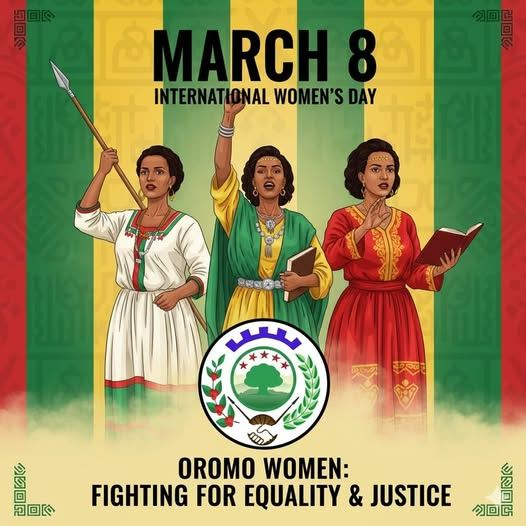
As the world marks International Women’s Day on March 8, the spotlight turns to the remarkable women of Oromia—custodians of culture, leaders of resistance, and unwavering advocates for justice who have fought for generations against the double oppression of gender discrimination and systemic marginalization.
For Oromo women, the struggle for equality and justice is not a recent phenomenon. It is woven into the fabric of their history, expressed through ancient traditions like the Siinqee institution, carried forward through decades of political imprisonment and torture, and articulated today by activists who refuse to be silenced.
The Siinqee Tradition: Ancient Feminism
At the heart of Oromo women’s empowerment lies the Siinqee—a traditional women’s institution that has functioned for centuries as both a symbol of unity and a practical tool for conflict resolution and rights protection .
The Siinqee is a ritual stick given to Oromo women by their mothers on their wedding day. Its meaning is profound: once a woman holds this stick, she commands respect from everyone in the community. If she places herself between two people fighting, all parties must fall silent and cease their conflict .
Dagnu Rabo, a 52-year-old tailor from Etaya in the Arsi region and a Haadha Siinqee (traditional women’s leader), describes her role: “I make it clear to them that everyone has the right to express their opinion, but no one may physically harm anyone else.” Her daily work involves mediating between couples, protecting women from violent husbands, and resolving community disputes .
When a woman is attacked or abused, other women rush to her aid. Wearing distinctive brown cloaks and colorful beaded necklaces, holding their Siinqee sticks aloft, they surround the victim, singing and chanting to draw attention to the perpetrator’s crime until the village elders intervene .
This institution was recognized by UNESCO in 2016 as part of the Gadaa system’s inscription on the Representative List of the Intangible Cultural Heritage of Humanity. Yet for Oromo women, it has never been merely a cultural artifact—it remains a living, breathing mechanism of justice .
Voices of Resistance: Martha Kuwee Kumsa
Perhaps no figure better embodies the courage of Oromo women than Professor Martha Kuwee Kumsa, a siinqee feminist and scholar who survived nearly a decade of imprisonment and torture for her journalistic activities promoting Oromo women’s rights .
Born in Dembidolo in Oromia around 1955, Kumsa’s middle name is that of an Oromo heroine—a name she would prove worthy of. After the 1974 Ethiopian Revolution closed universities, she trained as a journalist and began writing columns calling for Oromo women to defy existing power structures and reclaim their culture .
In 1980, plainclothes security officers detained her. She described arriving at the prison to find people on the floor, “bleeding from their mouths, [with] disfigured [faces] and pus ooz[ing] from wounds,” and an “overpowering stench.” She was tortured by foot whipping nine times during her first year of detention, then moved to another prison where she would remain for nine years—never charged, never tried .
Organizations including PEN America campaigned for her release. She received the 1989 PEN/Barbara Goldsmith Freedom to Write Award while still imprisoned. On September 10, 1989, she was released without warning in a mass amnesty .
Seven months later, fearing recapture, Kumsa escaped to Kenya with her children, walking two weeks through the forest. She eventually made her way to Canada, where she earned bachelor’s, master’s, and doctoral degrees and became a full professor at Wilfrid Laurier University, all while continuing her human rights advocacy .
In 2020, Kumsa co-authored a Washington Post piece criticizing media misrepresentation of Oromo protests following the killing of singer Hachalu Hundessa. She documented 9,000 arrests of Oromos and described a “wave of repression” targeting Oromo journalists and activists .
Dinknesh Deressa Kitila: Organizing for Change
Another towering figure is Dinknesh Deressa Kitila, founder of the International Oromo Women’s Organization. Her activism was born from childhood experience: during elementary school student council elections, a boy was preferred over her despite her having the highest grades. That moment of discrimination lit a fire that has never extinguished .
Deressa’s analysis of Oromo women’s situation is stark: “The state of oppression is very deep in general but Oromo women face even greater difficulty. Abyssinians treat Oromo women poorly. If a woman proposes a constructive idea, it doesn’t get proper attention as women are discriminated against up to a level where they are not considered as human beings” .
For Deressa, self-determination is not abstract but deeply personal: “a process by which one can take control of her/his whole life, decide freely what is good for her/him or not, what is important to her/him.” She emphasizes that organization is vital—that being organized is essential for anyone seeking to stand for peace and especially for women’s rights .
She has consistently called upon the international community to act: “The international community and humanitarian organisations have to take appropriate action to stop the Ethiopian government’s brutality against the Oromos” .
The Qarree Movement: Young Women Rising
In recent years, Oromo women have played a central role in the Qarree movement—the women’s counterpart to the better-known Qeerroo youth movement. These young Oromo women have been at the forefront of protests, organizing demonstrations, mobilizing communities through social media, and demanding both national liberation and gender equality .
Martha Kuwee Kumsa has defended these young activists against what she sees as media misrepresentation. She criticizes those who “categorically associate” the Qeerroo and Qarree with violence, arguing instead that they represent peaceful protest movements that helped overthrow the authoritarian EPRDF regime .
Multidimensional Contributions
The role of Oromo women in their society extends far beyond political activism. They are:
- Custodians of culture: Passing down traditions, songs, and stories to future generations; preserving the Afaan Oromo language; maintaining cultural practices like Irreechaa
- Economic backbones: Actively involved in farming, cultivating essential crops, and demonstrating entrepreneurial spirit that contributes significantly to local economies
- Peace brokers: Frequently involved in conflict resolution, using wisdom and insight to promote peace and harmony within communities
- Political participants: Increasingly taking on roles in organizations like the Oromo Federalist Congress (OFC) and advocating for women’s representation in decision-making processes
The Ateetee Tradition: Sung Justice
Among the Arsi Oromo, women have developed a unique form of dispute resolution called ateetee—a sung ritual process through which women protect, promote, and claim their rights. When an offense occurs, women travel to the offender’s house singing insults, then continue singing outside until a reconciliation ceremony is held. At the ceremony, they receive a cow as compensation and conclude by blessing the offender .
This tradition, documented in depth by ethnomusicologist Leila Qashu, demonstrates how music enables women to exercise power in a male-dominated society. It represents what scholars call “vernacular feminism”—a form of women’s empowerment rooted in indigenous culture rather than imported from external sources .
Ongoing Challenges
Despite their immense contributions, Oromo women face significant challenges:
- Gender-based violence: Both from state security forces and within their own communities
- Cultural barriers: Traditional gender roles can limit participation in leadership and decision-making
- Lack of recognition: Contributions are often overlooked or undervalued in both national and international narratives
- Double oppression: As Oromos facing systemic marginalization and as women facing gender discrimination
Conclusion: The Path Forward
As International Women’s Day 2026 is observed under the global theme “Rights. Justice. Action. For ALL Women and Girls,” Oromo women stand as living proof that empowerment is not a gift to be granted but a right to be claimed—and reclaimed, generation after generation, through courage, organization, and unwavering commitment to justice.
From the ancient Siinqee tradition to modern advocacy at the United Nations, Oromo women have fought for equality and justice on every front. They have endured imprisonment, torture, and exile. They have preserved culture while demanding change. They have led protests and raised children, documented atrocities and built organizations, spoken truth to power and sung justice into being.
Their struggle is not separate from the broader Oromo quest for self-determination—it is integral to it. As Dinknesh Deressa reminds us, true liberation requires women’s full participation and recognition. And as Martha Kuwee Kumsa’s life demonstrates, Oromo women will continue to fight until that liberation is achieved, no matter the cost.
On this International Women’s Day, the world would do well to listen to their voices, honor their sacrifices, and support their ongoing struggle for equality and justice. For in the words of the Oromo women themselves: when women participate fully, peace becomes lasting, justice becomes real, and the homeland becomes whole.
The International Oromo Women’s Association continues to advocate for Oromo women’s rights globally. For more information or to support their work, visit their official channels.

Posted on March 6, 2026, in Events, Finfinne, Information, News, Oromia, Press Release, Promotion. Bookmark the permalink. Leave a comment.




 Advocacy for Oromia
Leave a comment
Comments 0