Standing Alone, Standing Proud: The Quiet Defiance of Najat Sakaye Hamza
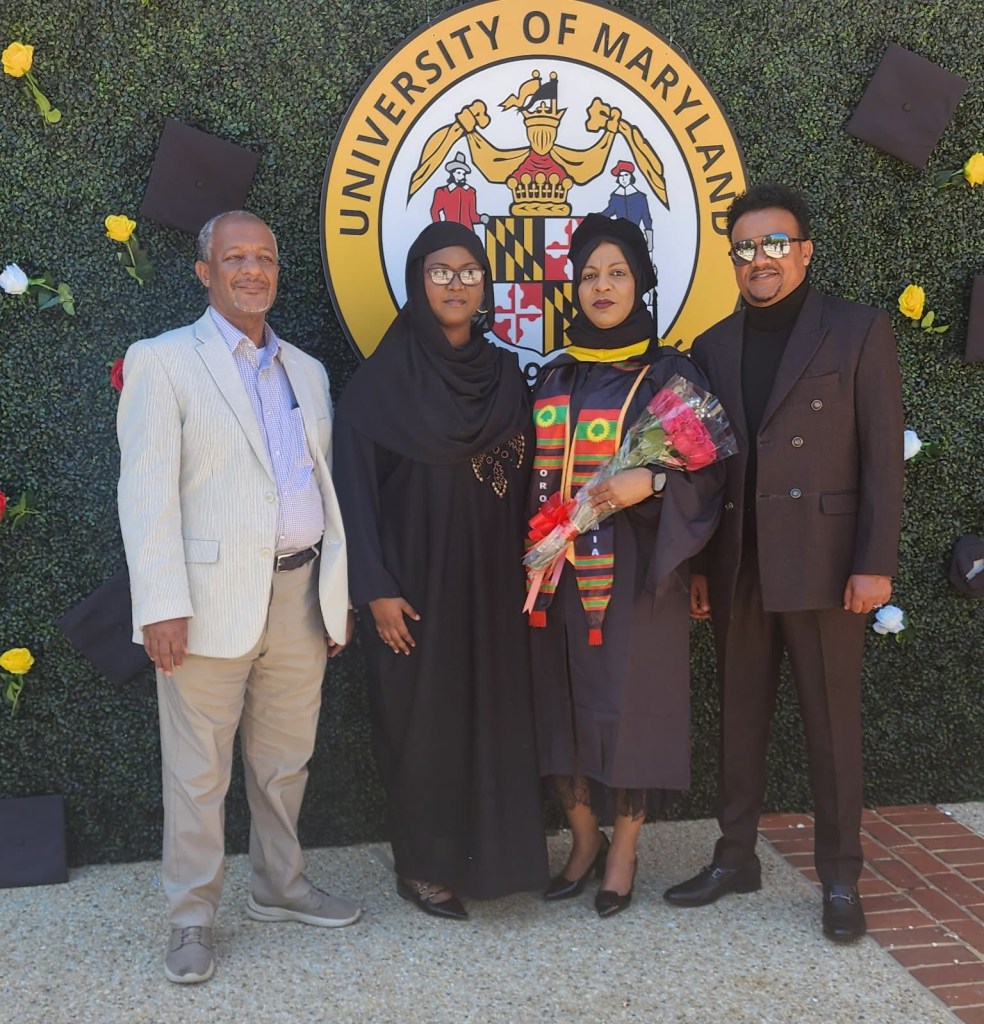
By Dhabessa Wakjira* (based on a reflection by Najat Sakaye Hamza)
“My life is about standing for my dreams even if it means standing alone sometimes.”
—
There is a photograph that Najat Sakaye Hamza keeps on her phone, not as a screensaver but as a secret talisman. In it, she is young—perhaps nineteen—sitting on a worn suitcase in a bus station somewhere between Oromia and the unknown. Her face is tired. Her eyes are not. She is leaving something behind, though she is not yet sure what she is walking toward.
Years later, she would find the words to describe that moment. “My life,” she would write, “is about standing for my dreams even if it means standing alone sometimes.”
Najat Sakaye Hamza is not a politician. She is not a general or a public intellectual in the traditional sense. She is, by her own definition, a woman who decided that the cost of kneeling was higher than the risk of standing. And in that decision, she has become something quietly revolutionary: an example.
This is her story—not of power, but of persistence. Not of armies, but of a single voice that refused to be absorbed into the noise.
—
The Education of a Dreamer
Born into an Oromo family that valued resilience over complaint, Najat learned early that dreams require rent. They do not live in the mind for free. They demand time, sacrifice, and the ability to endure the puzzled looks of those who cannot see what you see.
She was a curious child in a world that often punished curiosity in girls. She asked questions that made elders uncomfortable. She wanted to study when marriage was the expected path. She wanted to speak when silence was the safer option. And so, early on, she learned to stand alone.
“Representing who I am everywhere I am and in any situation,” she would later reflect, “is my quiet protest and my pride.”
That quiet protest took many forms. In classrooms where her language was dismissed, she learned two more. In workplaces where her identity was questioned, she performed her duties with an excellence that left no room for debate. In social settings where Oromo women were expected to be seen and not heard, she spoke—not loudly, but clearly.
The Loneliness of the Standing Woman
There were years when standing alone felt less like courage and more like punishment. Friends drifted away, unable to understand why she could not simply “fit in.” Relatives suggested she was too proud, too political, too difficult. There were nights, she has admitted privately, when she wondered if they were right.
But she kept standing. Not because it was easy, but because the alternative—sitting down, blending in, disappearing—was a kind of death she refused to accept.
She found sustenance in her faith. Alhamdullilah, she would whisper. Thank God for this moment, for this day. Gratitude became her anchor. Not gratitude for the struggle itself—that would be romantic nonsense—but gratitude for the fact that she was still upright, still breathing, still capable of taking the next step.
And then, the steps began to lead somewhere.
A Family That Stands Together
The photograph on her phone now is different. In the newer image, Najat is not alone. She is holding a baby—her daughter, Seran—and beside her stands her husband, Sabsib. There is a softness in this picture that the bus-station photo lacks. The tired eyes have been replaced by something warmer: not rest, but purpose.
“I get to share this moment with my baby, Seran, and my amazing husband Sabsib,” she wrote. The word amazing is not casual. It is the recognition that finding a partner who does not ask you to shrink is a miracle as profound as any in scripture.
Sabsib, by all accounts, is a man who never asked Najat to be smaller. He met her when she was already standing, and he chose to stand beside her rather than in front of her. Together, they have built a home where Seran is being raised to know that her mother’s quiet protests are not embarrassments but inheritances.
The Work Behind the Dream
Najat is careful to demystify her own journey. She has no patience for the myth of the self-made dreamer who simply wished upon a star.
“Dream realization belongs to those who work to achieve it,” she insists.
The work was unglamorous. Early mornings. Late nights. Jobs that had nothing to do with her passions but paid for the rent while she pursued her passions on the side. Rejection letters. Doors that closed. People who said “no” so many times that the word lost its sting.
But she kept working. And eventually, the work began to answer back.
She found platforms to speak about the Oromo experience, about the specific weight that Oromo women carry, about the need for community and also for the courage to stand outside the community when the community is wrong. She wrote. She organized. She showed up to meetings where she was the only Oromo face in the room—and spoke anyway.
Quiet Protest as a Way of Life
There is a phrase in the Oromo language: of-beekuu—to know oneself. Najat Sakaye Hamza has made of-beekuu her compass. To represent who she is, everywhere she is, regardless of the situation, requires a deep and unshakable self-knowledge. It requires knowing what you believe before the test arrives.
That is her quiet protest. Not shouting from a rooftop (though she has done that too, when necessary). But living, daily, as a visible, proud, unapologetic Oromo woman who happens to also be a mother, a wife, a professional, and a believer.
“Pride,” she says, “is not the opposite of humility. Pride is knowing that your existence has value, and refusing to act as if it doesn’t.”
The Moment She Is Living Now
On the day she shared her reflection, Najat was not marking a major public victory. There was no award ceremony, no signed legislation, no standing ovation. She was simply pausing—with her baby in her arms and her husband nearby—to say Alhamdullilah. Thank God for this moment. Thank God for this day.
It is a radical act, in a world that demands constant striving, to stop and give thanks. To acknowledge that the dream is not only in the future but also in the present—in the weight of a child, the steadiness of a partner, the simple fact of still being here, still standing.
The Legacy of the Standing Woman
Najat Sakaye Hamza is not famous. You will not find her name in the headlines of major newspapers, nor her face on the covers of magazines. She is, in the best sense, ordinary—an ordinary woman who decided that ordinary was not the same as invisible.
And that is precisely why her story matters. Because most of us will never be revolutionaries with monuments. Most of us will never speak before the United Nations. Most of us will struggle, in quiet and unglamorous ways, to hold onto our dreams in the face of pressure to let them go.
Najat’s life is a letter to those people. It says: Stand. Even if you stand alone. Even if no one applauds. Even if the only witness to your standing is God and the child sleeping in the next room.
And then, when the moment comes, stop standing long enough to say thank you.
Epilogue: The Unfinished Sentence
At the end of her reflection, Najat does not declare victory. She does not announce the completion of her dreams. She simply shares the moment—a moment that contains her daughter, her husband, her faith, and her own still-standing self.
The sentence is not finished, because her life is not finished. There will be more lonely days. More quiet protests. More mornings when the dream feels distant and the work feels endless.
But there will also be more Alhamdullilahs. More moments of sharing. More proof that standing for your dreams, even alone, eventually brings others to stand with you.
Najat Sakaye Hamza is still standing. Her daughter, Seran, is learning to stand. And somewhere, in a bus station or a boardroom or a quiet living room, someone who reads her words will decide to stand too.
That is not a small thing. That is everything.
—
Alhamdullilah for this moment. For this day. For the women who stand alone and discover they were never truly alone.
*Dhabessa Wakjira is a journalist, social worker, community worker, and interpreter who writes commentary, features, analysis, and reflections on issues that build and empower the Oromo people and their affairs. Dhabessa Wakjira can be reached at dabessa@socialworker.net

Posted on May 17, 2026, in Aadaa, Events, Finfinne, gender, Information, Media, News, Oromia, Press Release, Promotion. Bookmark the permalink. Leave a comment.






Leave a comment
Comments 0