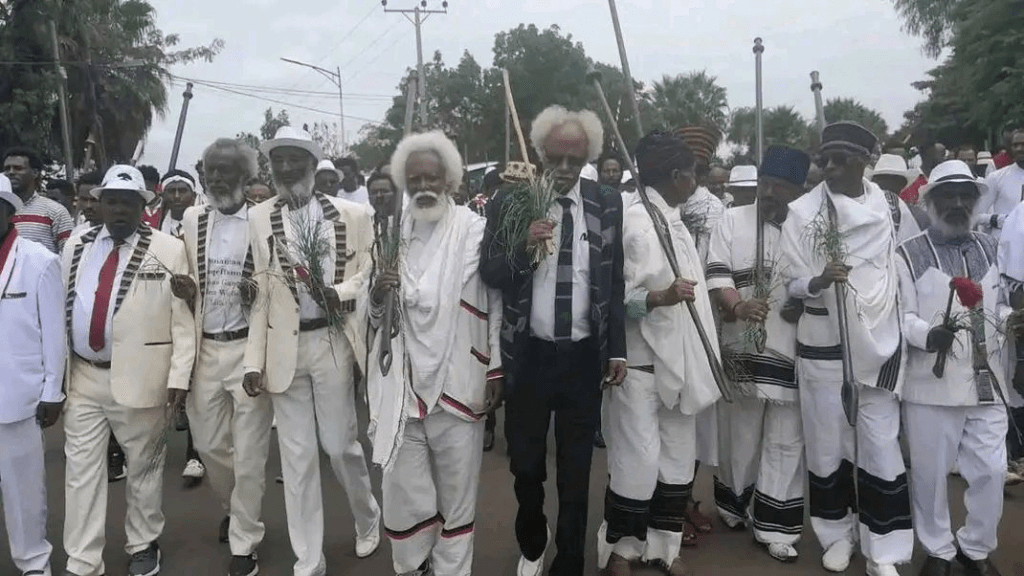
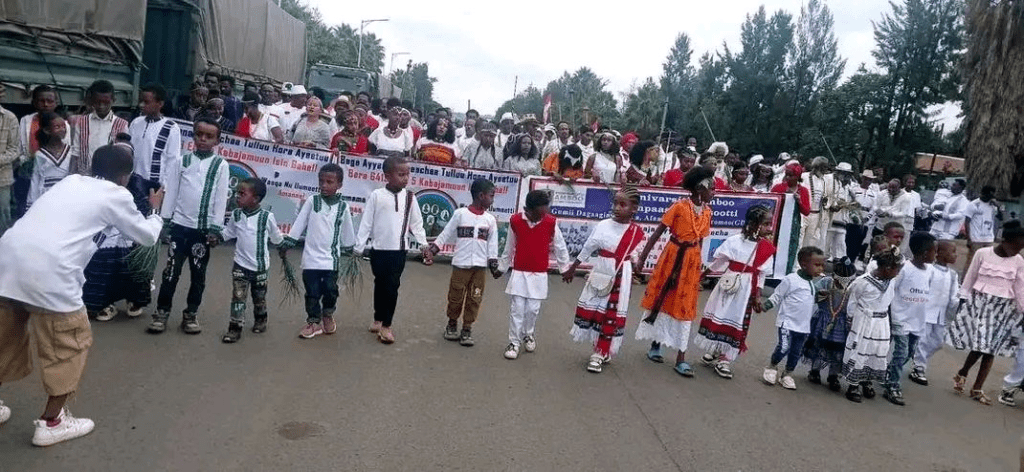
As the sacred season approaches, anticipation is building across Oromia and beyond. The annual Irreechaa Arfaasaa—the Thanksgiving festival of the Oromo people—is set to be celebrated with unparalleled splendor at the historic site of Tulluu Hora Ayeetuu.
According to an announcement from the Galmi Duudhaa Ganamaa Walisoo Liiban, preparations for the occasion have entered their final phase. The festival, which marks the transition from the rainy season to the bright days of peace and harvest, is scheduled to take place in a manner befitting its profound cultural and spiritual significance.
A Sacred Gathering
Irreechaa is more than a festival; it is the spiritual heartbeat of the Oromo nation. Celebrated twice a year, Irreechaa Arfaasaa (the spring thanksgiving) is a moment when millions gather at sacred lakes and hills to offer gratitude to Waaqaa (God) for life, health, and the blessings of renewal.
This year, all eyes are on Tulluu Hora Ayeetuu, a site revered for its deep historical and spiritual roots. The location holds special significance as a center of Oromo cultural identity, where generations have gathered to raise their hands in prayer and solidarity.
Final Preparations Underway
In a statement released to the public, organizers from Galmi Duudhaa Ganamaa Walisoo Liiban confirmed that all necessary arrangements are nearing completion. The celebration is being planned as a “warm and beautiful ceremony” —a phrase that reflects the commitment to ensuring both dignity and joy for the multitudes expected to attend.
Logistical preparations include:
Site organization and safety measures at Tulluu Hora Ayeetuu
Coordination of traditional protocols led by cultural elders
Arrangements for attendees traveling from across Oromia and the diaspora
A Call to the Oromo People
The message from the organizing body carries a tone of both invitation and affirmation. Speaking on behalf of the community, the leadership emphasized that the celebration is not merely an event but a reaffirmation of identity. As stated in their communication:
“Ayyaanni Abdii fi Hawwiin eegamu, kan Lafaa fi Nafa Oromoof gabbinaa.” (A festival where hope and aspiration are upheld—a thanksgiving for the land and soul of Oromoo.)
Significance of the Date
Irreechaa Arfaasaa will be observed according to the traditional Oromo calendar. While the exact date aligns with Bitootessa 27 / 7 / 2018 E.C. (which corresponds to approximately late March / early April in the Gregorian calendar), the spiritual resonance transcends the calendar itself. It is a time of unity, reflection, and collective renewal.
Looking Ahead
As the final preparations are completed, the message from Galmi Duudhaa Ganamaa Walisoo Liiban serves as both a confirmation of readiness and a call to the Oromo people worldwide to embrace the season with pride and reverence.
In a time when cultural preservation carries profound political and social weight, the gathering at Tulluu Hora Ayeetuu stands as a powerful testament to the resilience of Oromo traditions. The anticipation of warmth, beauty, and spiritual elevation suggests that this year’s Irreechaa will be remembered as a moment of unity and hope.
For further updates on logistics and participation, the public is advised to follow official communications from the organizing committee.
The aim of Advocacy for Oromia-A4O is to advocate for the people’s causes to bring about beneficial outcomes in which the people able to resolve to their issues and concerns to control over their lives. Advocacy for Oromia may provide information and advice in order to assist people to take action to resolve their own concerns. It is engaged in promoting and advancing causes of disadvantaged people to ensure that their voice is heard and responded to. The organisation also committed to assist the integration of people with refugee background in the Australian society through the provision of culturally-sensitive services.
Advocacy for Oromia was established in 2010 with the purpose of enabling and empowering Oromo people by providing accurate and timely information that will help to make better choices to create the kind of future in which they wish to live.
It also provides information focus on the major issues facing us in the 21st century and it is going to try and bring a balanced approach with factual information that is positive and solution based.
The website has been in operation for the last nine years with the mission of promoting and advancing causes of Oromo people through advocacy, community education, information service, capacity building, awareness raising and promotion.
The website is also the official site of Advocacy for Oromia Association in Victoria Australia Inc., a non-profit organisation, registered under the Associations Incorporation Reform Act 2012 in Victoria as April 2014.
Our team already had considerable community development experience and expertise. Our various projects helped to develop our confidence and the capacity of our agency. Our team used every gained knowledge, skills and experiences as an opportunity to design and develop new approaches, to documenting progress, supporting positive employment outcomes, liaising with community stakeholders, and conduct evaluation.
Advocacy for Oromia is devoted to establishing Advocacy for Oromia organisation to close the gaps where we can stand for people who are disadvantaged and speaking out on their behalf in a way that represents the best interests of them. We are committed to supporting positive settlement and employment outcomes for Victoria’s Oromo community.
Advocacy for Oromia Office
Addresses:
39 Clow St,
Dandenong VIC 3175
=====================
247-251 Flinders Lane
Melbourne VIC 3000
Activities Address
Springvale Neighbourhood House Inc
Address: 46-50 Queens Ave, Springvale VIC 3171
Postal Address:
P. O. Box 150
Noble Park, Vic 3174
With your support, we can continue to help community build a better future.
Advocacy for Oromia Mental Health Program
The aim of the program is to improving the mental health and well-being of Oromo community in Victoria. It aims to assist those experiencing, mental ill-health, their families and carers of all ages within this community to address the social determinants of mental health for Oromo community. It helps:
Identify and build protective factors,
Reduce stigma and discrimination
Build capacity for self-determination
Better understand mental wellbeing, mental ill-health and the impacts of trauma
The goal of the project is to increase mental health literacy of Oromo community that aims:
To assist people with mental health issues
To increase the capacity of mental health worker
To better understand mental wellbeing
To provide mental health education and information
To address the social and cultural causes of mental health issues
Advocacy for Oromia will organise information session, women performance, radio programs, culturally adopted conversations on Oromo Coffee Drinking ceremony, providing training for mental health guides and forum and producing educational materials on the selected groups and geographical area.
Human Rights Education Program
The Human Rights Education Program is a community based human rights program designed to develop an understanding of everyone’s common responsibility to make human rights a reality in each community.
Human rights can only be achieved through an informed and continued demand by people for their protection. Human rights education promotes values, beliefs and attitudes that encourage all individuals to uphold their own rights and those of others.
The aim of the program is to build an understanding and appreciation for human rights through learning about rights and learning through rights. We aimed at building a universal culture of human rights. Thus, we aimed:
To build an understanding and appreciation for human rights through learning about rights and learning through rights.
To build capacities and sharing good practice in the area of human rights education and training
To develop human rights education and training materials and resources
The goal of the project is to increase human rights literacy of Oromo community that aims:
To better understand human rights
To increase the capacity of human rights worker
To analyse situations in human rights terms
To provide human rights education and information
To develop solidarity
To strategize and implement appropriate responses to injustice.
The ultimate goal of education for human rights is empowerment, giving people the knowledge and skills to take control of their own lives and the decisions that affect them.
Human rights education constitutes an essential contribution to the long-term prevention of human rights abuses and represents an important investment in the endeavour to achieve a just society in which all human rights of all persons are valued and respected.
Advocacy for Oromia will organise information session, performance, radio programs, culturally adopted conversations on Oromo Coffee Drinking ceremony, providing training for Human Rights guides and forum and producing educational materials on the selected groups and geographical area.
Community Safety Program
The program aims to strengthen existing collaborations and identify opportunities for the development of partnerships aimed at community safety and crime prevention activities. This approach seeks to improve the individual and collective quality of life by addressing concerns regarding the wider physical and social environment. Importantly, community safety means addressing fear of crime and perceptions of safety as without this any actions to address the occurrence of crime and anti-social behaviour are of less value.





 Advocacy for Oromia
Leave a comment
Comments 0