Daily Archives: April 16, 2026

Barattuu, Sooressa, fi Adeemsa Haqa Maleessa
Hojiin jabaa maatiin, sooressi, fi qaamoleen mootummaa barattuu waggaa 18 Gujii keessatti akka gurguran
Barreessaa: Daandii Ragabaa
GODINA GUJII – Waggaa 18. Barattuu kutaa 9ffaa. Maqaan ishee Haroo Xonaa. Waggaa torbaan, isheen lubbuun ishee baqachaa jirti – diina miti, maatiin ishee, namichi sooressi, fi adeemsi ishee eeguu qabu.
Seeniin Haroo, kan Aanaa Sabbaa Boruu, Ganda Qanxichaa irratti raawwate, marii gadi fageenyaa afuufa, buttaa, goroorsaa, fi faayidaa sooressaa mul’isa.
Yakkii ishee: isheen lakki jette.
Maatiin Intala Gurguruuf Yaalu
Yeroo dheeraaf, abbaan Haroo fi jaarsoliin maatii ishee namicha sooressa Hirbaayyee Sherkuu wajjin marii turan. Namichi kun haadha warraa lama duraan qaba. Inni Haroo barbaada.
Kaayyoo maatii: sooressa.
Haadha Haroof: “Mana siif ijaara.” Obboleeyyaniif: “Konkolaataa isiniif bita.” Abbaa Haroof: “Baay’ee siif kaffala.”
Haroo dide. Yeroo hedduu. Sagalee ol ta’een.
Heeruma Baqaqfamaaf
Guyyaa 29/05/2018, Qanxichatti, Haroo fedhii isheetiin Fayyisaa Galchuu heerumti. Jaalala miti – jiraachuu.
Aadaa Gujiitiin, jaarsoliin araaraa ni ergamu. Maatiin Haroo jaarsa erge – utuu heeruma cabsuuf. Jaarsa Jaarraa, Sheekaa Bulee, Daani’eel Sorsaa, fi Waajii Lootuu ergan. Hundi isaanii didan.
Ergasi maatiin Haroo jaarsota sodaachiise: “Yoo bakka intalti jirtu nu hin geessitan, si poolisii qabna.”
Butii
Namoonni miidhaa afur – Taakkalaa Biluu fi milishaa gandaa – wajjin Haannaa Birbissa Dukkallee (haadha Haroo) fi Paakistaan (Ilfinaa) (obboleessa Haroo), mana Fayyisaa marsan. Ajaja mana murtii malee.
Haroo fi Fayyisaa qabanii gara Qanxichatti fidan.
Bulchaan gandaa Telloo Baatii (soddaa Hirbaayyee) isaan fudhate. Haroo: “Fedha kiyyaan Fayyisaa heerume.” Bulchaan ishee tuffatee abbaa isheetti deebise.
Haroo Hirbaayyee bira gudaattii.
Guyyaa Lamaan Sodaa
Hirbaayyee Haroo dhaane. Mormaa qabee urure. Iyye: “Yoo na diddu, si ajjeesa. Ati kan kiyya.”
Haroo hin cabsine.
Ergaa obboleessa ishee Fiqaaduu Haroo bira gaafte. Obboleessi milishaa qabatee dhufe. Yeroo dallaa marsan, Hirbaayyee rasaasa ol fuudhee dhaansee baqate. Haroo harkaa qabee hurruma fudhate. Booda obboleessi ishee argate. Garuu maatiif deebifamte – maatiin ammallee ishee Hirbaayyee bira deebisuu yaale.
Buttaa Lammaffaa
Guyyaa 21/06/2018, Haroo fi Fayyisaa gara Aagaa Waayyuu, Haya Diimaatti baqatan.
Maatiin isaanii, Hirbaayyee wajjin, karaa GPS tiin bakka isaanii adda baasan. Guyyaa 24/06/2018, ajaja mana murtii malee, poolisoonni Shaakkisoo irraa dhufanii mana marsan. Sababa sobaa: Haroo warqii giraama 180 hatte.
Isaan Haroo fi Fayyisaa qabanii gara Waajjira Poolisii Aagaa Waayyuu fidan.
Poolisii Walii Galu
Waajjira keessatti, Haroo kadhatte: “Ani soda qaba. Yakka hin hojjenne. Asumatti na qoraa. Sabbaa Boruutti na hin deebisinaa.”
Hooggantaa qorannaa, Inispeekter Waasihuun Taaji’oo, ishee tuffate. Inni duraan Hirbaayyee wajjin marii ture.
Abbaan alagaa Abdulfattaa gargaaruu dhufe: “Maaliif iyyannoo intalaa tuffattu?” Poolisoonni xinnoo dhaga’atan, garuu Haroo hin gadhiifne.
Goroorsaan
Lakkaddaa hawaasaa, Hirbaayyee Sherkuu Miiliyoona 11 Birri ol qaamoleef kenne – poolisii, bulchitoota, abbootii alangaa, jaarsoliin.
Kaayyoo: Haroo deebisuu fi Fayyisaa balleessuu.
Yeroo har’aatti, Hirbaayyee bilisa. Haroo dhokattee jirti.
Warra Hin Yakkin Hidhamuu
Guyyaa 21/07/2018, haadha Fayyisaa, Gororrii Adoolaa (umurii 70), fi obboleeyyan isaa, Fullaasa Galchuu fi Gammachuu Galchuu, mana isaanii rafanii jiran irraa qabanii hidhaman. Ajaja malee. Yakkii malee.
Ji’a tokkoof hidhaman. Yeroo Haroo fi Fayyisaa gargar baafamu qofa gadhiifaman.
Yeroo sanatti, Haroo ulfa – Fayyisaa irraa.
Ulfaa fi Dirqama Ulfaa Baasuuf
Maatiin Haroo ishee ulfa baasuuf dirqan. Dhaanan. Raran. Sodaachisan.
Haroo dide.
Guyyaa 29/07/2018, sa’aatii 1:30 halkanii, Haroo amma deebitee baqatte. Ulfaattuu. Miilla duwwaatti. Sodaa guutuu.
Ganama sa’aatii 7:30, poolisii Hayilee Hirbaayyee namoota miidhaa 6 ol qabatee dhufe. Ajaja malee. Rasaasa mana keessa rukutan.
Maatii Fayyisaa hidhan – garuu Haroo achitti hin turte. Jaarsa Odaa Dhaddachaa ishee dhoksee, gara Waajjira Poolisii Sabbaa Boruutti fidde.
Dhaabbii Waajjira Poolisii
Waajjira keessatti, Haroo boossi: “Ani abdii murteesse. Karra ba’u kiyya du’a qofa. Isaan na ulfa baasuuf yaalan. Ani asirraa hin bahu hanga daa’imni kiyya dhalatu.”
Yeroo kanatti, adeemsis dhaabate. Haroo waajjira keessatti turte. Da’ima ishee achitti dhalte. Da’imni fayyaa.
Garuu erga daa’imni dhalate booda, Hirbaayyee ammallee maallaqa facaasaa jira. Ammallee ishee barbaadaa jira.
Qaamoleen Isaan Gadi Dhaaban
Qorannoon kun Aanaalee sadan adda baase kan gurra isaanii cufatan:
- Sabbaa Boruu – buttaan eegale, qaamoleen walii gale.
- Aagaa Waayyuu – poolisoonni iyyannoo Haroo tuffatan.
- Oddoo Shaakkisoo – jaarsoliin fi bulchitoonni maallaqaan dhama’an.
Aanaaleen kun waan kufate qofa miti. Isaan hirmaatan.
GAAFIIFFANNAA
Seeniin Haroo Xonaa tokko miti. Mallattoo dhukkuba gadi fageenyaa – bakka sooressi haqa bitatu, bakka maatiin dhiiga ofii isaani gurguru, bakka intalli meeshaa taatu.
Nu waanna:
- Qorannoo federaalaa Aanaalee Sabbaa Boruu, Aagaa Waayyuu, fi Oddoo Shaakkisoo keessatti.
- Hidhaa fi himannaa Hirbaayyee Sherkuu, Inispeekter Waasihuun Taaji’oo, fi warra hirmaatan hunda.
- Eegumsa fi iddoo dhokataa Haroofi daa’imma isheetiif.
- Deebi’aa mana barnuumaa – Haroo kutaa 9ffaa keessatti turte.
- Xiyyeeffannoo miidiyaa akka namni sooressi amma calleessan hin bitanne.
Intalli Ammallee Baqatte
Guyyaa har’aatti, Haroo Xonaa ammallee jirti. Ammallee dhokatte. Ammallee lolli. Isheen amma haadha. Isheen gara mana barnuumaa hin deebine.
Garuu isheen abdii hin kutanne. Nus hin kutannuu.
“Haqni abbaa haqaatiif!”
Haroo haqa barbaadde. Yeroon haqni deebisuu gahe.

Stolen Dreams – The Forced Marriage and Abduction of a Schoolgirl in Guji Zone
Forced marriage and abduction in Guji Zone expose deep cracks in protection of women and children
By: Daandii Ragabaa
GUJI ZONE – She was 18 years old, a 9th-grade student with dreams of finishing school. Her name is Haroo Xona. And for the past several months, she has been running for her life – not from an enemy, but from her own family, a wealthy man, and a system that refuses to protect her.
Haroo’s story, detailed in a recent investigative account from Sabba Boru District, reveals a conspiracy of forced marriage, abduction, bribery, and official collusion that has left a teenage girl pregnant, traumatized, and still in hiding.
Her crime? She said no.
A Father’s Deal
According to multiple sources, Haroo’s father and family elders had been negotiating with a wealthy local man named Hirbaayyee Sherkuu – a man already with two wives – to force Haroo into marriage.
The family’s motivation was wealth. In exchange for Haroo, Hirbaayyee promised to build a house for her mother, buy vehicles for her brothers, and pay the father handsomely.
Haroo refused. Repeatedly.
To escape this fate, on May 29, 2018, Haroo voluntarily married a young man of her choice, Fayyisaa Galchuu, in Qanxicha Village, Sabba Boru District. It was not a love match. It was survival.
THE ABDUCTION
Haroo’s family did not accept her choice. They sent elders to break the marriage. When the elders refused, the family turned to force.
Armed with local militia and accompanied by Haroo’s own mother, Haannaa Birbissa Dukkallee, and her brother, Paakistaan (Ilfinaa) , the family stormed Fayyisaa’s home. Without any court order, they took Haroo and Fayyisaa and marched them to Qanxicha Village.
At the village office, the chairman – who happened to be a cousin of Hirbaayyee – questioned Haroo. She stated clearly: “I married Fayyisaa by my own choice. My father wants to give me to someone I do not love.”
The chairman ignored her. She was handed over to Hirbaayyee.
TWO DAYS OF TERROR
For two days, Haroo was held at Hirbaayyee’s compound. He slapped her. He grabbed her by the throat. He shouted:
“If you refuse me, I will kill you. I will not leave you for a poor man. You are mine.”
Haroo did not break. She secretly sent a message to her brother, Fiqaaduu Haroo, who brought militia to rescue her. When they surrounded the compound, Hirbaayyee fired a gunshot and fled into the forest with Haroo. She was found by her brother and returned to her family.
But her family, already bought with promises of wealth, pressured her to go back to Hirbaayyee. Terrified, she fled again to Fayyisaa.
THE SECOND ABDUCTION
On June 21, 2018, Haroo and Fayyisaa fled to Haya Diimaa Town in Aagaa Waayyuu District, seeking refuge with relatives.
Her family, working with Hirbaayyee, tracked her using phone calls and GPS. On June 24, 2018, without any court order, armed men – including police from Shaakkisoo District – arrived at the house.
Their excuse? A fabricated theft charge: Haroo had supposedly stolen 180 grams of gold. It was a lie.
They took Haroo and Fayyisaa to the Aagaa Waayyuu Police Station.
THE POLICE WHO COLLUDED
At the station, Haroo begged: “I am afraid for my life. I have committed no crime. This is a conspiracy to return me to a man I do not want. Investigate me here. Do not send me back.”
She wept. She fell to her knees.
The head of the investigation unit, Inspector Waasihuun Taaji’oo, ignored her. He had already made arrangements with Haroo’s family and Hirbaayyee.
The family argued that the case should be transferred to Sabba Boru District – where Hirbaayyee’s influence was strongest. Haroo screamed that she would not go. A local elder, Alangaa Abdulfattaa, intervened, demanding that the police respect her rights.
The police hesitated briefly, then proceeded. They changed vehicles but did not release Haroo. A crowd gathered. Fearing public backlash, the police backed down temporarily – but Haroo and Fayyisaa remained in custody.
THE BRIBERY NETWORK
According to community sources, Hirbaayyee Sherkuu has spent over 15 million Ethiopian Birr bribing officials across multiple districts – police, administrators, judges, and traditional elders.
His goal: to recapture Haroo and eliminate Fayyisaa.
The bribery worked. Despite Haroo’s clear statements, despite the lack of any court order, despite the violence, officials in Sabba Boru, Aagaa Waayyuu, and Oddoo Shaakkisoo districts have consistently sided with the wealthy man.
THE ARREST OF THE INNOCENT
When Fayyisaa’s family continued to resist, they were arrested.
On July 21, 2018, Fayyisaa’s elderly mother, Gororrii Adoolaa (age 70), and his brothers, Fullaasa Galchuu and Gammachuu Galchuu, were taken from their beds. No warrant. No charge. They were held for one month – until Haroo and Fayyisaa were forced apart.
By this time, Haroo was pregnant – by Fayyisaa, not by Hirbaayyee.
THE PREGNANCY AND PRESSURE
Haroo’s family, still in the wealthy man’s pocket, tried to force her to abort. They beat her. They pressured her. They wanted her “clean” for Hirbaayyee.
She refused.
On July 29, 2018, at 1:30 AM, Haroo escaped again. Pregnant. Barefoot. Terrified. She ran through the darkness back to Fayyisaa’s family.
The next morning, Hirbaayyee struck back. At 7:30 AM, a police officer named Hayilee Hirbaayyee led six armed anti-riot police to Fayyisaa’s family home. Without a warrant, they opened fire. A bullet entered the house.
Then they arrested the family again – but Haroo was not there. A local elder, Odaa Dhaddachaa, had hidden her and taken her to the Sabba Boru Police Station.
THE STANDOFF AT THE STATION
At the station, Haroo collapsed. She told officers:
“I have no hope left. The only escape I see is death. They have tried to force me to abort. They have tried to sell me. I will not leave this station until my baby is born. If you send me back to that man, I will kill myself.”
For once, the system paused. Haroo was kept at the station. She gave birth there. The baby was healthy.
But even after the birth, the conspiracy did not end. Hirbaayyee continues to spread money. He continues to pressure authorities. He continues to hunt a teenage girl who only wanted to go to school and marry a man of her choice.
WHAT MUST HAPPEN
The story of Haroo Xona is not an isolated incident. It is a symptom of a deeper rot – where wealth buys justice, where family betrays blood, and where girls are treated as currency.
We call upon:
- Federal authorities to launch an immediate, independent investigation into the conspiracy across Sabba Boru, Aagaa Waayyuu, and Oddoo Shaakkisoo districts.
- The police and judiciary to arrest and prosecute Hirbaayyee Sherkuu, Inspector Waasihuun Taaji’oo, and all officials who participated in this crime.
- Women’s and children’s rights organizations to intervene urgently and provide Haroo with safe shelter and legal protection.
- The media to amplify this story so that no wealthy man can buy silence again.
EPILOGUE: A GIRL STILL RUNNING
As of this publication, Haroo Xona is still alive. Still hiding. Still fighting.
She is now a mother. She never returned to school. Her dreams of education are on hold – perhaps forever.
But she has not given up. And neither should we.
“Justice belongs to the one who seeks it,” the Oromo say.
Haroo has sought justice. It is time for the system to answer.

The Struggle Was Hijacked – And We Looked Away
An open letter to every Oromo who still believes in Bilisummaa
By: Daandii Ragabaa
Publication: Advocacy for Oromia
Date: April 15, 2026
1. The Bitter Truth
“Dubbiin baay’ee hamaadha.”
The truth is very bitter.
For seven years, we have been told that the Oromo struggle is moving forward. We have raised flags. We have sung songs. We have buried our children. And all the while, a cancer was eating the movement from the inside.
This is not the story of our enemies. This is our story. And it is time we looked in the mirror.
2. What We Have Learned
Recent investigative reporting has uncovered what many of us feared but could not prove:
- A shadow network – built not by the people, but by the state and its collaborators – has been operating inside the heart of the Oromo movement for years.
- Mass killings in Ambo and Waliso were not carried out by outsiders. They were carried out by the same people who now wear the flag and claim leadership.
- A secret cell called #120, founded by a former OPDO military member named Mammush, was built for one purpose: to steal the name of the struggle and commit crimes under it.
- Genuine Qeerroo leaders confronted this cell, tried to reform it, and were ignored. Then they were killed or imprisoned.
- When the political transition came, the same criminals simply changed their hats – from “thugs” to “leaders” – and the world applauded.
3. The Names We Must Not Forget
Let us speak the names that the network wants buried:
- Jaal Galaana Immaana – consumed by the same people who now rule Ambo.
- Jaala Boruu Lammeessaa – a young man who started inside the network, saw the truth, fled to the forest, and was martyred.
- Baayisaa Huseen – once a detainee, now the head of security in Ambo, hunting down every Oromo nationalist he ever knew.
- Kaasayee Qananiisa – a mafia figure who never fought for liberation, only for theft, now protected by police commanders.
- Charuu Kabaa– a killer who operated under his father’s police badge, recently blessed at a hotel with 50,000 birr from the Ambo administrator.
- Jaal Battee Urgeessaa-a true fighter who was killed by a gang of thieves; his justice has not yet been done
- Jaal Mo’iboon Baqqalaa-a true fighter who was killed by a gang of thieves; his justice has not yet been done
These are not enemies of Oromia. They are the wolves inside the sheepfold.
4. A Case Study: A Betrayal We Cannot Forgive
One of the most heartbreaking betrayals detailed in this investigation took place in Ambo was a broken case of the representative of OFC- Qana’aa Chuuchee.
Then came the crackdown. Imprisonment. Killings. Displacement.
What followed was a brutal crackdown:
- Imprisonment
- Killings
- Forced displacement
That informant is named Qana’aa Chuuchee – described as the representative of OFC in Ambo. He stayed with the community from Maekalawi to Qilinxoo.
And today, the same people who ordered that crackdown are still in power. Still wearing the flag. Still calling themselves leaders of the struggle.
5. The Child with the Plastic Leg
Perhaps the most obscene symbol of this network is the child with one leg. He was taken to a hotel, displayed, beaten, and abandoned. A performance of suffering. A propaganda prop.
Ask yourself: Who benefits from such cruelty? Not the struggle. Not Oromia.
6. What Is #120?
For those who do not know: #120 was one of approximately 120 underground structures built by Oromo youth during the height of the Qeerroo protests. Some were genuine. Some were not.
#120 was built by Mammush – a former OPDO fighter. Its goal was never liberation. Its goal was crime.
When genuine Qeerroo discovered this, they tried to absorb and reform the cell. But the criminals refused. And when the political winds changed, the #120 members simply changed their koofiyyaa (hat) and declared themselves the new leadership.
Today, the mafia that runs Ambo – and parts of the broader Oromo political landscape – is the direct descendant of #120.
7. The System That Protects Them
Let us be clear: The Prosperity Party (PP) is a mafia system. It does not fight crime. It recruits it.
The same state that once jailed genuine Oromo nationalists now protects the criminals who wear the nationalist mask. Why? Because fake nationalists are useful. They can control the people. They can steal the money. They can kill the real opposition.
And the people? The people are told: “These are your leaders. These are the heroes of the struggle.”
We have been lied to.
8. What Must Be Done
This op-ed is not written to destroy hope. It is written to save it.
We cannot heal what we refuse to name. So here is what we demand:
First: A full, independent investigation into the killings in Ambo and Waliso – with international observers if necessary.
Second: The immediate removal and prosecution of Baayisaa Huseen, Kaasayee Qananiisa, Charuu Kabaa, and all known operatives of the #120 network.
Third: Protection for whistleblowers. The person who provided the information for this investigation is still alive – for now. That should not be temporary.
Fourth: A truth and reconciliation process within the Oromo movement. We must separate genuine liberation structures from criminal infiltrators.
Fifth: Public disclosure. Every person who transitioned from Woyyane-era detention into current leadership must be named and vetted.
Sixth: Community vigilance. Ask the hard questions: Who benefits from this struggle? Who dies? Who gets rich?
9. To the Young Qeerroo and Qarree
You are the reason the struggle still breathes. But you must also be the reason it is cleansed.
Do not follow flags blindly. Do not chant names you have not investigated. Do not give your blood to those who sell your future.
The real heroes are not the ones on hotel stages. The real heroes are the ones in the forest, in the prisons, and in the graves. The real heroes are the ones who refused to wear the mask.
10. A Final Word
The truth is very bitter. But it is the only medicine.
For too long, we have been silent because we feared division. But division is already here. It was created by the very people we now protect.
Let us not be afraid to say: The struggle was hijacked. And we looked away.
No more looking away.
Bilisummaa – but only if it is real.
Nagaa – but only if it is just.

A Day of Thunder and Tears – Oromo Martyrs and Heroes Honored at ABO Headquarters in Gullalle

Thousands gather on Ebla 15, 2026, to remember the fallen, raise the flag, and renew the vow never to forget
By: Daandii Ragabaa
Date: Ebla 15, 2026 (April 15, 2026)
PROLOGUE: The Day the Dead Speak
There are days that pass like any other. And then there is Ebla 15 – the day when the dead refuse to stay silent.
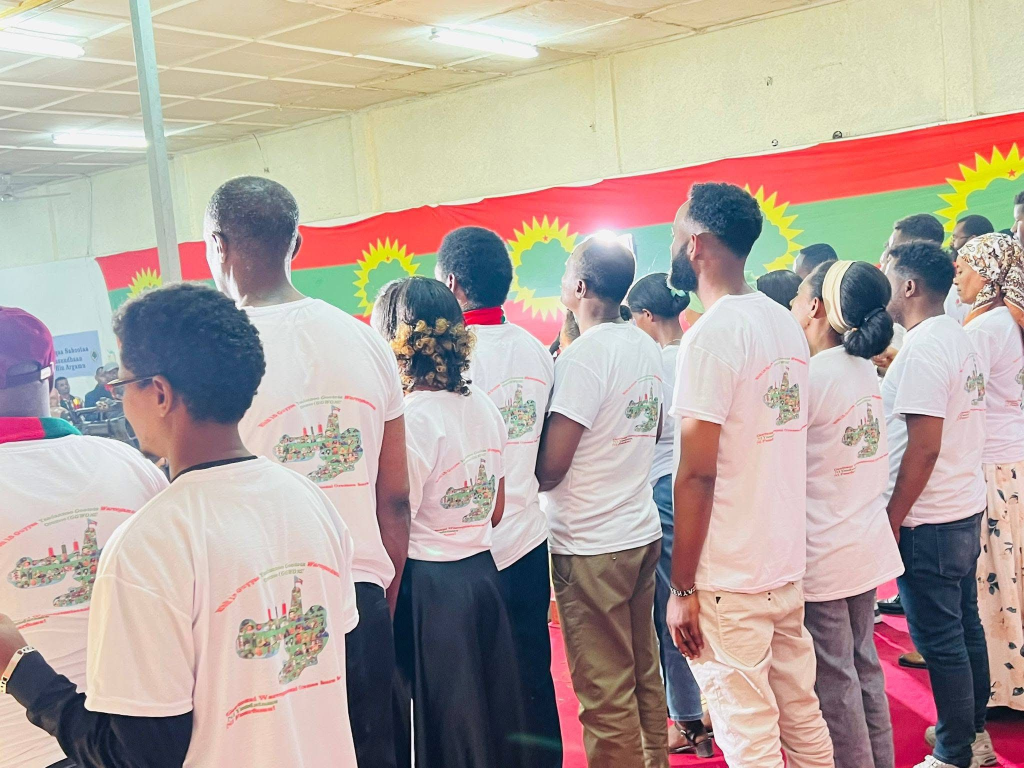
On this morning, under a sky the color of old iron, hundreds of Oromo men, women, and children gathered at the Head Office of the ABO (Arsi, Bale, Oromo) in the Gullalle district of Addis Ababa. They came not because they were invited. They came because something in their blood would not let them stay home.
This was Guyyaa Gootota Wareegamtoota Oromoo – the Day of Oromo Martyrs and Heroes.
It is a day with no official decree. No government proclamation. No permission slip from any palace. It is a people’s holiday, carved from memory and kept with fire.
And on Ebla 15, 2026, the people of Gullalle proved that memory is still alive.
PART ONE: The Gathering
Faces in the Crowd
By 8:30 AM, the compound of the ABO headquarters was already full.
The elders arrived first. They came on buses, on foot, leaning on canes and on each other. Their faces were maps of grief – wrinkles carved by tears and time. They sat on plastic chairs in the shade, their walking sticks planted like spears. They did not speak much. They had done their talking over decades. Now they came to witness.
The mothers stood at the edges. Infants were tied to their backs with cotton wraps. Some nursed while standing. Others held faded photographs – sons, daughters, husbands – who would never grow old. They did not weep. Perhaps they had no tears left.
The youth – the Qeerroo and Qarree – filled the center of the compound. They wore the Oromo flag not as decoration but as declaration. Black, red, and white on t-shirts, on scarves, on wristbands, on fingernails. Their phones were raised, recording everything. Not for social media fame. For evidence. For the archive that no government will keep.
At the front of the compound stood a simple wooden stage. No velvet ropes. No VIP section. No flowers. Just a microphone, a worn banner, and a flag that had been folded and unfolded so many times that its edges were frayed into whispers.
The banner read:
“Guyyaa Gootota Wareegamtoota Oromoo – Ebla 15, 2026 – Hin Irraanfatnu. Hin Lolti Dhaabnu.”
(Oromo Martyrs and Heroes Day – We will not forget. We will not stop struggling.)
PART TWO: The Silence That Roared
One Minute That Lasted a Lifetime
At exactly 9:00 AM, the master of ceremonies stepped to the microphone. He was a soft-spoken man with steel in his jaw.
“Before we speak,” he said, “we listen.”
One minute of silence.
It is easy to write those words. It is much harder to describe what happens when five hundred people stop breathing at the same time. The wind itself seemed to hesitate. A child coughed somewhere in the back, and the sound was enormous. An old man shifted his weight, and the creak of his sandals was a thunderclap.
In that minute, the dead were not remembered. They were present.
Then the silence broke – not with applause, but with a single voice singing an old Oromo lament. One by one, others joined. By the end of the first verse, the entire crowd was singing. The song had no title. But everyone knew the words. It was the song grandmothers sing when they think no one is listening. The song of rivers and horses and a time before borders.
PART THREE: The Names
A Litany of the Lost
Then came the reading of the names.
For nearly two hours, a rotation of speakers stepped to the microphone and read aloud the names of Oromo martyrs. Some were historical – 19th-century horseback warriors who rode against colonial cannons. Others were recent – young people killed in protests between 2014 and 2026. Some names were known across Oromia. Others were known only to a single village, a single family, a single mother.
The list included:
- Alemitu G. – killed, 2016, Adama.
- Biruk T. – disappeared, 2018, never found.
- Chaltu D. – shot, 2015, Bale.
- Dawit I. – died in prison, 2020, denied medical care.
- Feyissa L. – 19 years old, 2014, Ambo.
- Galaana Immaana – consumed by those who now claim leadership.
- Jaala Boruu Lammeessaa – who fled the network and was martyred in the forest.
After each name, the crowd responded with a low, rumbling chant:
“Nu jirra. Hin irraanfatne.”
(We are here. We have not forgotten.)
It was not a cheer. It was a vow.
By the time the last name was read, no one was standing still. But no one had left.
PART FOUR: The Flag That Refuses to Burn
A Cloth More Powerful Than Bullets
At exactly 12:00 noon, the ceremony reached its spiritual peak.
Two young Qarree – sisters, no older than twenty – walked slowly to the flagpole. Between them, folded into a perfect square, was the Oromo flag. They did not rush. Every step was a prayer.
When they reached the pole, they unfolded the cloth with the reverence of priests handling a relic.
This flag – whether the black, red, and white or the green, red, and yellow, depending on tradition – has been banned, burned, trampled, and called illegal at various times in modern Ethiopian history.
And yet, on Ebla 15, 2026, it rose again.
As the colors caught the midday sun, an old man in the back of the crowd fell to his knees. He was not praying to God. He was praying to the cloth.
“Forgive us,” he wept, his voice cracking like dry earth. “We are still fighting. We have not given up.”
No one told him to stand. No one told him to be quiet. Some moments are too sacred to interrupt.
PART FIVE: The Five Pillars
What the Heroes Died For
The keynote address was delivered by a senior ABO official who requested anonymity for security reasons. He did not speak of politics. He spoke of debt.
He raised five fingers and named five sacred words of the Oromo struggle:
| Oromo Word | Meaning | What the Martyrs Died For |
|---|---|---|
| Nageenya | Justice / Peace / Well-being | A country where identity is not a death sentence. |
| Misooma | Development | Schools in villages, not just palaces in the capital. |
| Badhaadhina | Progress | Moving forward, even when the road is soaked in blood. |
| Dimokiraasii | Democracy | The right to speak, assemble, and choose – without permission. |
| Nagaa | True Peace / Safety / Tranquility | Sleeping through the night without fear of a knock on the door. |
“These five words,” the speaker said, his voice low and fierce, “are not decorations. They are debts. Our heroes paid with their lives. We must pay with our actions.”
The crowd did not clap. They raised their fists. And for a moment, Gullalle was not a neighborhood in Addis Ababa. It was an idea.
PART SIX: Voices from the Crowd
What the Living Said
This reporter spoke with several attendees. Their words speak louder than any analysis.
Bontu, 23, university student:
“I was not born when many of these heroes died. But I carry their names in my phone. I read them every morning. Ebla 15 is the day I become honest about who I am.”
Jirenya, 58, farmer (who traveled three hours by bus):
“My brother was killed in 2015. No one was arrested. No one apologized. The government forgot him. But I will not. Today, I am his memory.”
Marga, 19, high school student:
“The old people cry. But we, the young – we are not just crying. We are planning. We are organizing. The next heroes are not dead yet. They are standing right here.”
Hundessa, 72, retired teacher (walking with a cane):
“I have attended these ceremonies for twenty years. Each year, there are new names. That breaks my heart. But each year, there are also new young faces. That gives me hope.”
Faarax, 34, shopkeeper (who left his store unattended):
“I did not close my shop. I left my son in charge. If I lose my business for being here, so be it. What is money without Nageenya? Nothing.”
PART SEVEN: The Shadow Over the Celebration
A Warning from Inside
Not all the voices at the ceremony were voices of pure grief. Some were voices of warning.
Multiple attendees, speaking on condition of anonymity, told this reporter that not everyone who wears the flag loves the struggle. They spoke of infiltration, of criminal networks that have hijacked parts of the movement, of leaders who were once prisoners of the old regime and are now protectors of the new one.
One source, who identified himself as a former insider of a group called #120, described how a shadow cell built by a former OPDO military member named Mammush had systematically stolen money, committed killings, and then rebranded as legitimate leadership when the political winds changed.
“The truth is very bitter,” he said. “But if we do not speak it, the heroes died for nothing.”
Another source pointed specifically to Baayisaa Huseen – now the head of security in Ambo – as a man who once sat in prison alongside genuine nationalists, only to emerge as a hunter of the very people he once called comrades.
“He knows every Oromo nationalist by name. And he is eliminating them, one by one.”
These allegations were not the focus of the ceremony. But they hung in the air like smoke – invisible, but impossible to ignore.
PART EIGHT: The Closing Vow
A Promise Made with Raised Hands
As the sun began to soften over Gullalle, the crowd did not disperse quickly. They lingered. They hugged strangers. They exchanged phone numbers. They stood in front of the flag for photographs that would be hidden in private albums, not shared on public feeds.
Then, a young Qeerroo – no older than seventeen – climbed onto a plastic chair and shouted:
“Ebla 15 next year – where will we be?”
The crowd roared back – not rehearsed, but raw:
“Stronger! More! Free!”
The final moment of the ceremony was not a speech. It was a collective vow.
Everyone raised their right hand – young and old, man and woman, farmer and student, rich and poor – and repeated after the master of ceremonies:
“We will not forget. We will not forgive injustice. We will keep walking.
Until Nageenya is not a word, but water.
Until Misooma reaches the last village.
Until Badhaadhina cannot be stopped.
Until Dimokiraasii is for every Oromo.
Until Nagaa is not a dream, but breakfast.”
Then silence.
And then, from the back of the crowd, a single voice began to sing the Oromo anthem. One by one, everyone joined. By the second verse, Gullalle was no longer a location on a map. It was a congregation.
EPILOGUE: What the Night Carried
The chairs were folded. The banner was rolled. The flag was lowered and placed in a wooden box – the same box that has carried it for years, from one secret ceremony to the next. The crowd melted back into the streets of Addis Ababa – some to homes, some to hiding, some to the next meeting.
But something stayed in the air above Gullalle on the night of Ebla 15, 2026.
It was not smoke. It was not sound. It was not even tears.
It was the breath of heroes – past, present, and those still unborn.
And as long as that breath moves, Guyyaa Gootota Wareegamtoota Oromoo will never be just a date on a calendar.
It will be a living fire.
For Those Who Were Not There
If you are reading this in a city far from Oromia – in Minneapolis, in Berlin, in Nairobi, in Melbourne – know this:
Ebla 15 is not a date. It is a thread.
It connects a horseback warrior of 1896 to a Qeerroo with a cracked smartphone in 2026. It connects a mother who buried her son to a teenager who has never seen peace but still believes in it. It connects the martyrs who fell in Ambo and Waliso to the millions who still whisper Bilisummaa in their sleep.
The Oromo martyrs and heroes did not die so that you would cry forever.
They died so that you would act.
So act.
Learn a name. Speak a truth. Raise a flag – even if only in your heart.
Because as they chanted in Gullalle on Ebla 15, 2026:
“Nu jirra. Hin irraanfatamne.”
We are here. We have not forgotten.
And neither should you.
Bilisummaa! Nagaa!
Ebla 15 – Forever.




 Advocacy for Oromia