The Fire and the Flag
The Fire and the Flag
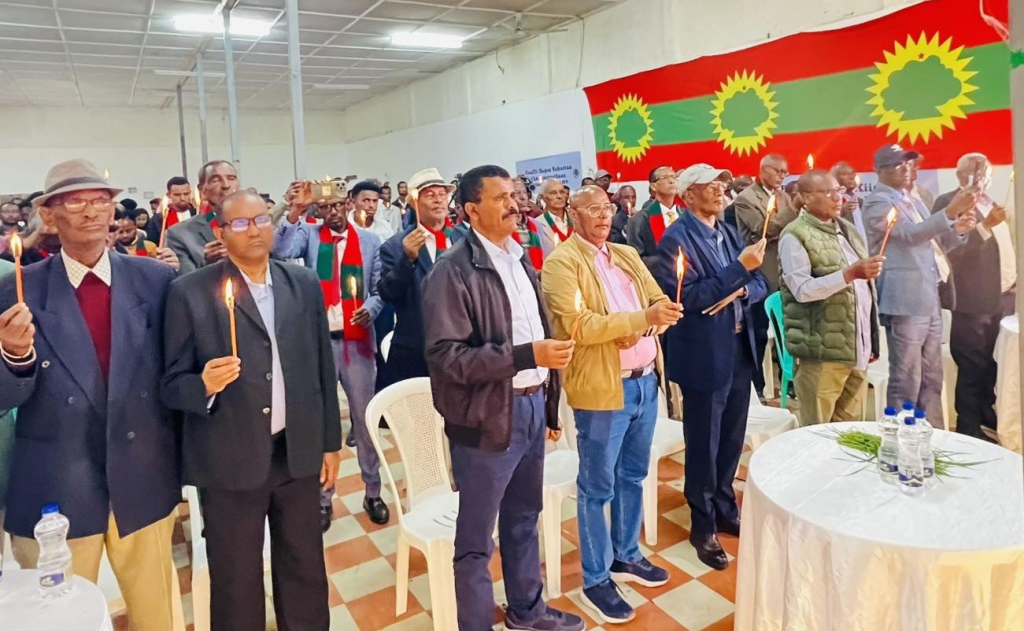
On Ebla 15, 2026, at the ABO headquarters in Gullalle, Oromo martyrs and heroes were not just remembered. They were summoned back to life.
By Oromia News Agency
Photography by SBO
Magazine: The Oromo Voice / Horn of Africa Review (Quarterly Edition)
Issue: Spring 2026 – “Memory as Resistance”
GULLALLE, FINFINNE – There is a kind of silence that does not ask for permission. It arrives before the first speaker steps to the microphone, before the first flag is raised, before the first tear falls. It is the silence of a crowd that knows it is standing on bones.
On the morning of Ebla 15, 2026 (April 15) , that silence settled over the Head Office of the ABO in Gullalle like a second sky. Hundreds had come – not because they were summoned, but because something in their blood would not let them stay home.
This was Guyyaa Gootota Wareegamtoota Oromoo – the Day of Oromo Martyrs and Heroes.
And in a country where official history often forgets the names of the fallen, the living came to remember.
I. The Gathering: A Portrait of a People
“We do not come here to mourn. We come here to witness. Mourning is private. Witnessing is public. And the world must see.”
– Bontu, 23, university student
By 8:30 AM, the compound was already full. Not the polished fullness of a state ceremony, but the raw, breathing fullness of a people who have learned to gather in corners and behind walls.
The elders sat on plastic chairs in the shade, their walking sticks planted like spears in the earth. Their eyes were not wet. They had done their crying decades ago. Now they watched – guardians of a memory too heavy for the young to carry alone.
The mothers stood at the edges, infants tied to their backs with cotton wraps. They did not speak much. But when they did, they sang. Old songs. Songs about rivers and horses and a time before borders. Songs that grandmothers had taught them in the dark.
The youth – the Qeerroo and Qarree – filled the center. They wore the Oromo flag not as a decoration but as a declaration. Black, red, and white on t-shirts, on scarves, on wristbands, on fingernails. Their phones were out, recording everything. Not for social media fame. For evidence. For the archive that the state refuses to keep.
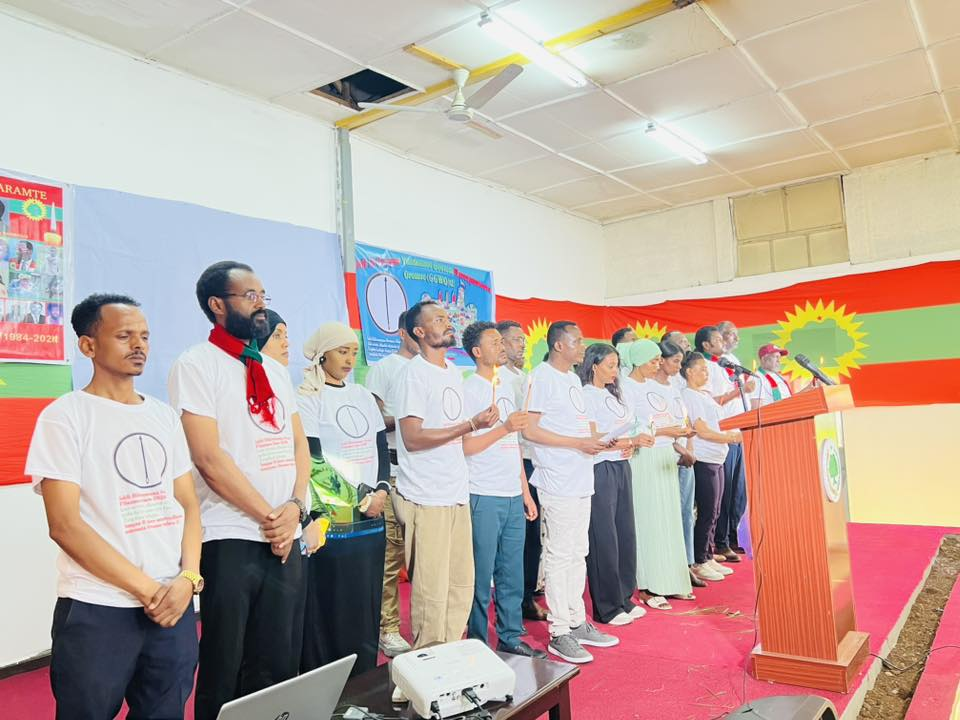
At the front, a simple wooden stage. No velvet ropes. No VIP section. Just a microphone, a banner, and a flag that had been folded and unfolded so many times that its edges were frayed.
The banner read:
“Guyyaa Gootota Wareegamtoota Oromoo – Ebla 15, 2026 – Hin Irraanfatnu. Falmaa Hin Dhaabnu.”
(Oromo Martyrs and Heroes Day – We will not forget. We will not stop struggling.)
II. The Names: A Litany of the Lost
At 9:00 AM sharp, the master of ceremonies – a soft-spoken man with steel in his jaw – stepped forward.
“Before we speak,” he said, “we listen.”
One minute of silence.
It is easy to write the words “one minute of silence.” It is harder to describe what it feels like when five hundred people stop breathing at once. The wind itself seemed to hesitate. A child coughed, and the sound was enormous. An old man shifted his weight, and the creak of his sandals was a thunderclap.
Then the names began.
They came in waves. Alphabetical by first name. No hierarchy. A martyr is a martyr.
- Jal Berso Wabe (Megersa Beri) – A warrior whose name meant defiance. He did not kneel.
- Jal Geda Gemeda (Demse Techane) – A strategist. He fought not with rage alone, but with intelligence.
- Jal Dori Beri (Yigezu Benti) – A leader who carried the weight of his people on his shoulders.
- Jal Felmeta / Chechebsa (Umer) – A name spoken in two tongues, one spirit. Unbroken.
- Jal Meri Gelan – A shadow on the battlefield. His enemies saw him only when it was too late.
- Jal Aba Tiki (Aboma Mitku) – A fire that could not be extinguished. He died standing.
- Jal Ire Ana Qechele (Dinsa) – A guardian of the hills. He taught that land is not dirt – it is mother.
- Jal Feferi Doyo – A voice that sang resistance when singing was a crime.
- Jal Dhadiycho Boru – A horseman who rode not for glory, but for the next generation.
- Jal Dhadiycho Muleta – A name that closes the list but never the struggle. He is remembered.
- Jal Alemitu G. – killed, 2016, Adama.
- Jal Biruk T. – disappeared, 2018, never found.
- Jal Chaltu D. – shot, 2015, Bale.
- Jal Dawit I. – died in prison, 2020, no medical care.
- Jal Feyissa L. – 19 years old, 2014, Ambo.
Each name landed like a stone in still water. And after each name, the crowd answered with the same low rumble:
“Nu jirra. Hin irraanfatne.”
(We are here. We have not forgotten.)
By the time the list ended – nearly two hours later – no one was standing still. But no one had left.
“I did not come to speak. I came to show you his face. He was 22. He loved football and poetry. Now he is a memory. Do not let his memory die.”
– An elderly mother, holding a photograph of her son
III. The Five Pillars: What the Heroes Died For
The keynote address was not a political speech. It was a lesson.
A senior ABO official – whose name we withhold for security reasons – stepped to the microphone and asked a question that silenced the crowd:
“What did they actually die for? Not slogans. Not flags. What?”
Then he held up five fingers. One for each of the sacred pillars of the Oromo struggle.
| Oromo Word | Meaning | Translation for the Living |
|---|---|---|
| Nageenya | Justice / Peace / Well-being | A country where your identity is not a death sentence. |
| Misooma | Development | A school in your village, not just a palace in the capital. |
| Badhaadhina | Progress | Moving forward, even when the road is soaked in blood. |
| Dimokiraasii | Democracy | The right to speak, to assemble, to choose – without permission. |
| Nagaa | True Peace / Safety / Tranquility | Sleeping through the night without fear of a knock on the door. |
“These five words,” the speaker said, his voice low and fierce, “are not decorations. They are debts. Our heroes paid with their lives. We must pay with our actions.”
The crowd did not clap. They raised their fists. And for a moment, Gullalle was not a neighborhood in Finfinne. It was an idea.
IV. The Flag: A Cloth That Refuses to Burn
At exactly 12:00 noon, the ceremony reached its spiritual peak.
Two young Qarree – sisters, no older than twenty – walked slowly to the flagpole. Between them, folded into a perfect square, was the Oromo flag.
They did not rush. Every step was a prayer.
When they reached the pole, they unfolded the cloth with the reverence of priests handling a relic. Red, Green, Red. But the meaning is the same.
This cloth has been banned. Burned. Trampled. Called illegal.
And yet, on Ebla 15, 2026, it rose again.
As the flag caught the midday sun, an old man in the back of the crowd fell to his knees. He was not praying to God. He was praying to the cloth.
“Forgive us,” he wept, his voice cracking like dry earth. “We are still fighting. We have not given up.”
No one told him to stand. No one told him to be quiet. Some silences are too sacred to interrupt.
“The old people cry. But we, the young – we are not just crying. We are planning. The next heroes are not dead yet. They are standing right here.”
– Marga, 19, high school student
V. The Voices: What the Living Said
Here, in their own words, are fragments of the day.
Jirenya, 58, farmer – traveled three hours by bus:
“My brother was killed in 2015. No arrest. No apology. The government forgot him. But I will not. Today, I am his memory. That is why I came.”
Marga, 19, high school student – first time attending:
“I used to think heroes were in history books. Dead people. Today I learned that heroes are also the ones who show up. The ones who refuse to be silent. That is me now.”
Faarsee, 34, shopkeeper – came straight from his store:
“I did not close my shop. I left my son in charge. If I lose my business for being here, so be it. What is money without Nageenya ? Nothing.”
Hundessa, 72, retired teacher – walked with a cane:
“I have attended these ceremonies for twenty years. Each year, there are new names. That breaks my heart. But each year, there are also new young faces. That gives me hope.”
VI. The Closing: A Vow Made of Breath
As the sun began to soften over Gullalle, the crowd did not scatter. They lingered. They hugged strangers. They exchanged phone numbers. They stood in front of the flag for photographs that would be hidden in private albums, not shared on public feeds.
Then, a young Qeerroo – no older than seventeen – climbed onto a plastic chair and shouted:
“Ebla 15 next year – where will we be?”
The crowd roared back – not rehearsed, but raw:
“Stronger! More! Free!”
The final moment was not a speech. It was a collective vow.
Everyone raised their right hand. Young and old. Man and woman. Farmer and student. They repeated after the master of ceremonies:
“We will not forget. We will not forgive injustice. We will keep walking.
Until Nageenya is not a word, but water.
Until Misooma reaches the last village.
Until Badhaadhina cannot be stopped.
Until Dimokiraasii is for every Oromo.
Until Nagaa is not a dream, but breakfast.”
Then silence.
And then, from the back of the crowd, a single voice began to sing the Oromo anthem. One by one, everyone joined. By the second verse, Gullalle was no longer a location on a map. It was a congregation.
Epilogue: What the Night Carried
The chairs were folded. The banner was rolled. The flag was lowered and placed in a wooden box – the same box that has carried it for years, from one secret ceremony to the next. The crowd melted back into the streets of Addis Ababa.
But something stayed.
Not smoke. Not sound. Not even tears.
Something else.
If you had stood in the compound of the ABO headquarters at dusk on Ebla 15, 2026, you would have felt it: a warmth that had nothing to do with the sun. A vibration that had nothing to do with noise.
The martyrs, it seemed, had not come to be mourned.
They had come to check on the living.
And the living, for one day at least, did not disappoint.
Ebla 15 is not a date. It is a thread.
It connects a horseback warrior of 1896 to a Qeerroo with a cracked smartphone in 2026. It connects a mother who buried her son to a teenager who has never seen peace but still believes in it.
The Oromo martyrs and heroes did not die so that you would cry forever.
They died so that you would act.
So act.
Learn a name. Speak a truth. Raise a flag – even if only in your heart.
Because as they chanted in Gullalle on Ebla 15, 2026:
“Nu jirra. Hin irraanfatamne.”
We are here. We have not forgotten.
And neither should you.
Bilisummaa! Nagaa!
Ebla 15 – Forever.

Posted on April 15, 2026, in Aadaa, Events, Finfinne, Information, News, Oromia, Press Release, Promotion. Bookmark the permalink. Leave a comment.






Leave a comment
Comments 0