Category Archives: Obituary

A Great Tree Has Fallen: Feature Condolence for Jaal Waldee Hurrisoo (1944-2026), Founding Father of the Oromo Liberation Front
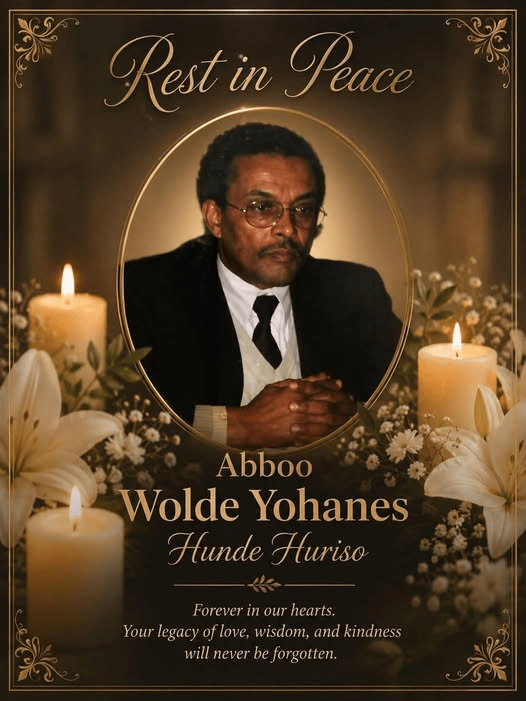
“Du’aan addunyaa irraa godaanuu Jaal Waldee… gadda guddaa itti dhagahame ibsata.” — Adda Bilisummaa Oromoo (ABO)
—
FINFINNEE– The Oromo Liberation Front has announced, with profound grief and a sense of irreplaceable loss, the passing of Jaal Waldee Hundee Hurrisoo (also known as Waldayuhaannis) – a founding pillar of the Oromo struggle, a prisoner of conscience, a teacher, a journalist, and a lifelong servant of his people. He was 82 years old.
The news, delivered on 16th Caamsaa, 2026 (May 16, 2026), has sent waves of sorrow across Oromia and the wider Oromo diaspora. For those who knew him – and for countless more who knew only his name and his sacrifice – the death of Jaal Waldee is not merely the loss of an elder. It is the falling of a great tree under whose shade generations of Oromo freedom fighters found rest and resolve.
From the Highlands of Arsii: A Humble Beginning
Jaal Waldee was born in 1944 (Ethiopian calendar 1937) in Ona Boqqojji, East Arsi, in the highlands of Oromiya. His father, Obbo Hundee Hurrisoo, and his mother, Aadde Ayeetuu Gammadaa, were simple farmers. Like any rural child of his time, young Waldee grew up herding cattle and working the land alongside his family. There was no prophecy of greatness, no early sign of the revolutionary he would become – only the quiet dignity of a people who knew their worth long before the world acknowledged it.
But even among those humble beginnings, something burned. A hunger not just for food, but for knowledge.
The Path of Education, The Call of Conscience
Jaal Waldee completed his primary education in Boqqojji and other local schools, then enrolled at the Teacher Training Institute (TTI) in Dabra Birihan, graduating in 1966. For five years, he served as a teacher in Bale Province – a region that would later become a crucible of the Oromo liberation struggle. He taught children to read and write, but the classroom could not contain him. The injustices he witnessed – land alienation, cultural suppression, the daily humiliations of the Oromo people – planted seeds that would soon sprout into activism.
In 1971, he entered Haile Selassie I University (now Finfinnee University). It was there that he found his political voice. Joining an underground student movement, he began organizing Oromo students, discussing not just grades but grievances, not just textbooks but tyranny. The university became his second battlefield – quieter than the forests, but no less dangerous.
The 1975 Campaign: Bullets and Bread
When the “Idigat Bahibrati” (Development through Cooperation) campaign was launched in 1975, Jaal Waldee volunteered to go to Wallo Province. The region was ravaged by famine, and the official response was a cruel mixture of neglect and propaganda. He did not go as a soldier. He went as a human being – distributing food, organizing relief, and bearing witness to the starvation that the state refused to see. He saw children die in his arms. He saw mothers sell their last possessions for a handful of grain. And he swore that such suffering would never be forgotten.
The Birth of the OLF: A Brotherhood of Struggle
Returning to university after the campaign, Jaal Waldee deepened his commitment to the Oromo cause. Alongside his comrade and closest friend, Magarsaa Bari, he became one of the founding members of the Oromo Liberation Front (OLF) – Adda Bilisummaa Oromoo. Together, they dreamed of an independent Oromia, a nation where Oromo children would never again be ashamed of their language, their name, or their land.
After graduation, Jaal Waldee worked as a journalist for the newspaper Bariisaa (The Dawn), eventually rising to the position of assistant editor. He understood that the pen could be as powerful as the gun. His articles gave voice to the voiceless, exposed abuses, and called Oromos to unity. But the Derg regime – the brutal military junta that had seized power – had no tolerance for Oromo journalism.
Twelve Years in Hell: The Prisoner of Conscience
In 1980 (Amajjii), Jaal Waldee was appointed to a position in the government as a continuing official. But two days later, without trial, without charge, without even the pretense of justice, he was arrested and thrown into prison.
For twelve years, he remained behind bars. Twelve years of torture. Twelve years of solitary confinement. Twelve years of watching comrades die from untreated wounds and deliberate neglect. The Derg’s interrogators wanted confessions, names, betrayals. They received only silence and the occasional smile from a man who had already decided that his body could be broken but his soul would not negotiate.
When he was finally released in May 1991 (Caamsaa), as the Derg collapsed, Jaal Waldee emerged a different man. The torture had left permanent physical damage. For the rest of his life, he would suffer from the consequences of those years – chronic pain, weakness, and the ghosts of a dozen deaths he had witnessed. But he never spoke of revenge. Only of justice.
A Brief Season in Parliament, A Lifetime of Service
After the fall of the Derg, the Transitional Government of Ethiopia was established. Jaal Waldee served as a member of parliament representing the OLF for one year. It was a frustrating time – he saw the compromises of power, the betrayals of principle, the slow strangulation of the very ideals for which he had been imprisoned. When the OLF withdrew from the transitional government, he withdrew with it.
But he never withdrew from his people. He traveled extensively through Bale and Arsi, educating communities about their rights, organizing political awareness, and reminding Oromos that liberation was not a gift to be received but a struggle to be waged. Later, he worked within the OLF’s external affairs department, helping to raise funds, build solidarity, and keep the flame alive during years of exile and repression.
The Juba Award: A People’s Gratitude
The Oromo community recognized his sacrifices. He was honored with the Juba Award, a tribute to those who have given everything to the Oromo struggle. For a man who had received nothing from the state but chains and suffering, this recognition from his own people meant more than any title.
He also left behind a written legacy – most notably a work titled “The Ten-Minute Mission,” along with many other unpublished manuscripts. He was a historian of his own times, determined that the truth of the Oromo struggle would survive even if its tellers did not.
The Final Goodbye
In recent months, Jaal Waldee’s health – already fragile from decades-old torture wounds – declined sharply. On the appointed day, 16th May 2026, he finally laid down the burden that he had carried since 1944. He left this world not as a defeated man, but as a soldier who had fought to his last breath and now, at 82, had earned his rest.
The OLF’s grief statement captures the sentiment of millions: “Addi Bilisummaa Oromoo du’aan addunyaa kanarraa godaanuu jaala keenya Jaal Waldee… dhagahutti gadda guddaa itti dhagahame ibsata.” (The Oromo Liberation Front expresses its profound sorrow upon hearing of the passing of our beloved Jaal Waldee…)
A Legacy That Will Not Fade
What do you say about a man who gave twelve years of his youth to a dungeon, who emerged with his principles intact, and who then spent the remaining decades of his life serving a people who could offer him nothing in return but love?
You say: Qabsaawaan ni kufa, qabsoon itti fufa. (A fighter may fall, but the struggle continues.)
Jaal Waldee is gone. His voice is silent. His hands, which once held chalk in a Bale classroom and a pen at Bariisaa and a smuggled manuscript in a prison cell, have finally stilled. But the Oromo nation he helped to awaken will not go back to sleep.
To his family, his friends, his comrade Magarsaa Bari (who now walks alone), and to the millions who never met him but knew that his survival was their survival – we offer the only comfort that truth allows: He lived for you. He suffered for you. And because of him, you stand taller than you would have.
Farewell, Jaal Waldee Hundee Hurrisoo. The dawn you wrote for has not yet fully broken. But your ink has made it certain.
Injifannoo ummata bal’aaf.
Victory to the broad masses.
— Adda Bilisummaa Oromoo, 16 May 2026
Rest in power, Jaal Waldee. The struggle continues.

Remembering Zegeye Asfaw: A Life of Service and Commitment
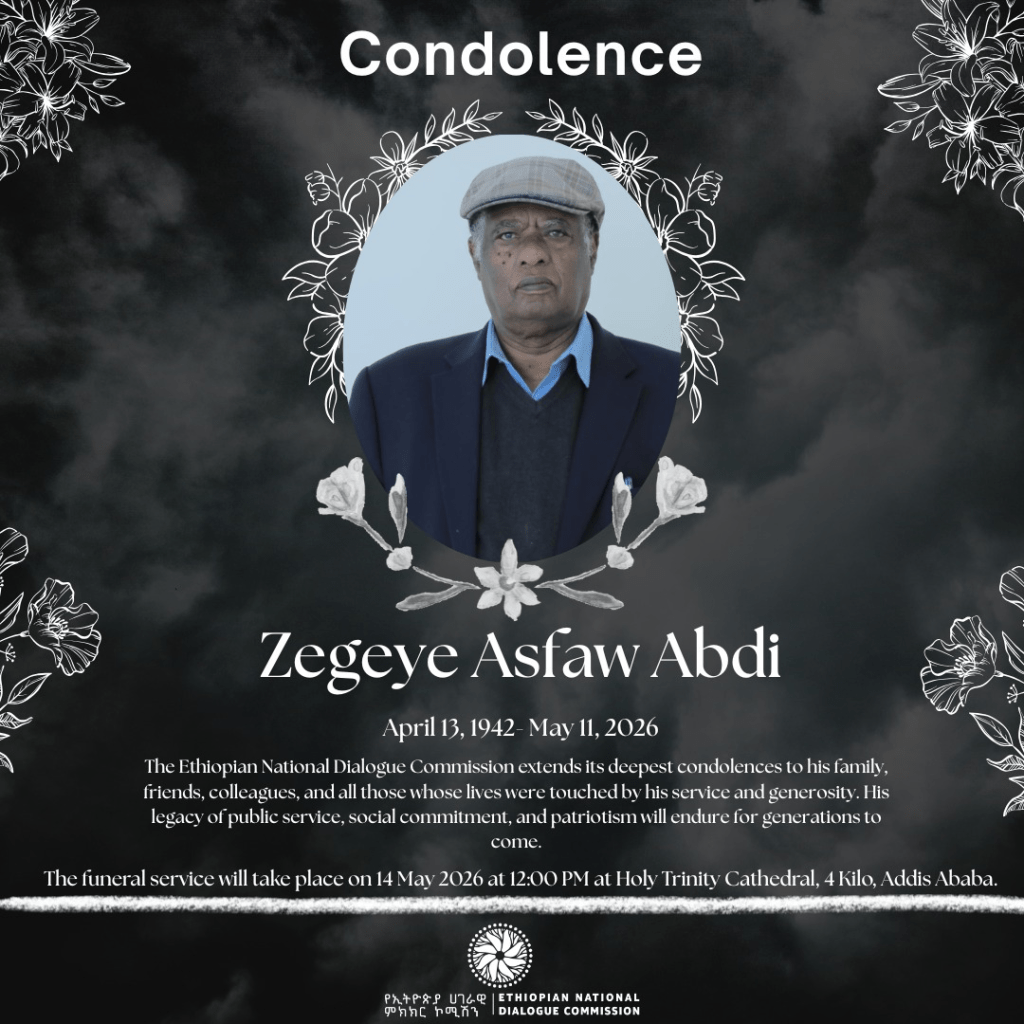
The Gentle Giant Who Gave Land and Dignity – Honoring Commissioner Zegeye Asfaw Abdi (1942–2026)
By: Dhabessa Wakjira (Based on the Statement of Condolence of the Ethiopian National Dialogue Commission)
Date: May 13, 2026
Category: Obituary / Tribute / National Legacy
PROLOGUE: A Life That Spanned Eras, A Legacy That Transcends Them
On May 11, 2026, Ethiopia lost more than a former minister, more than a commissioner, more than a lawyer, more than a philanthropist. Ethiopia lost a bridge – between feudalism and reform, between oppression and liberation, between north and south, between government and the governed.
Commissioner Zegeye Asfaw Abdi passed away at the age of 84. He was born in 1942 in West Shoa – a time when the land he would later help liberate was still under the yoke of feudal bondage. He died in 2026 – leaving behind a nation where millions of farmers till soil they can finally call their own.
The Ethiopian National Dialogue Commission, where he served with distinction since February 2021, released a statement of condolence that captures the weight of his departure. But no official statement, however eloquent, can fully measure the hole left by a man who was simultaneously a lawyer, a revolutionary, a prisoner, a minister, a grassroots organizer, and – above all – a servant.
This is his story.
PART ONE: The Making of a Reformer
From West Shoa to Wisconsin
Zegeye Asfaw was born in 1942 in West Shoa, into a family of the nobility. He was, by birth, a balabat – a member of the very class that owned the land and the people upon it. But Zegeye was not content to inherit privilege. He chose, instead, to dismantle it.
He pursued his legal studies at the former Haile Selassie I University, where he encountered the radical student movements of the 1960s. He heard the cries of the landless. He saw the contradiction between his own birth and the suffering of the millions who tilled the soil beneath his feet.
He did not turn away.
He continued his education at the University of Wisconsin–Madison, where he obtained a Master’s Degree in Law. But his real education came from the land itself – from the gebar (serf) who gave half his harvest to a landlord, from the golle (tenant) who had no right to the hut he built, from the shimaglle (elder) who whispered of a time when the Oromo were masters of their own earth.
Zegeye returned to Ethiopia not as a defender of the old order, but as its gravedigger.
PART TWO: The Proclamation That Changed Everything
“Land to the Tiller”
During the Derg regime, Zegeye Asfaw served his country in several senior government positions:
- The former Ministry of Land Administration
- The Ministry of Agriculture and Settlement
- The Ministry of Justice
- The Ministry of Labour and Social Affairs
But he is particularly remembered – as the National Dialogue Commission’s statement notes – for his instrumental role in crafting the historic “Land to the Tiller” proclamation.
This was not a bureaucratic exercise. It was a seismic shift in Ethiopian history. For centuries, the land of Ethiopia – especially in Oromia and the south – had been owned by a tiny aristocracy. The millions who worked it had no rights, no security, no dignity. They were gebar (tribute payers), golle (tenants at will), serf (bound to the soil and the master).
The 1975 proclamation changed all of that. It transferred ownership from the few to the many. It declared that the person who tills the land shall own the land. It broke the backbone of feudalism in one stroke.
And Zegeye Asfaw was its architect.
He did not merely sign it. He crafted it. He fought for it. He paid for it – with imprisonment, with exile from power, with decades of obscurity.
PART THREE: Beyond Public Office – The Heart of a Servant
Hunde and Busa Gonfa – Lifting the Vulnerable
Zegeye Asfaw was not a man who only served from the top down. When he left government, he did not retire to a quiet life. He went deeper.
Through the establishment of the local NGO Hunde, he worked tirelessly to improve the lives of vulnerable communities and combat poverty. Hunde was not a showcase project. It was a quiet, persistent effort to put food on tables, to send children to school, to give hope where hope had been crushed.
He also founded a microfinance institution – Busa Gonfa – focused on empowering women in rural Ethiopia and expanding economic opportunities at the grassroots level. He understood that land reform was only the first step. Without credit, without training, without the means to work the land productively, the farmer remained poor even if no longer a serf.
Busa Gonfa was his answer. It remains his legacy.
PART FOUR: The Environmentalist – A Steward of the Earth
Working with Farmers and Pastoralists
Zegeye Asfaw was equally committed to environmental protection and sustainable development. He understood that land, once freed, must also be preserved.
He closely collaborated with farmers and pastoralist communities in advancing environmental conservation initiatives. He worked with them to prevent soil erosion, to manage water resources, to plant trees, to practice responsible stewardship of natural resources.
He did not see a contradiction between development and conservation. He saw a partnership. The land gives to the people; the people must give back to the land. This was not ideology for Zegeye. It was lived experience.
PART FIVE: The Commissioner – Service Until the End
Integrity, Diligence, Humility, and Unwavering Commitment
Since February 2021, Zegeye Asfaw had been serving as a Commissioner of the Ethiopian National Dialogue Commission. He was appointed in his late seventies – an age when most people have long since retired to their villages or their memories.
But Zegeye did not retire. He served.
Throughout his tenure, he distinguished himself through:
- Integrity – He could not be bought, could not be bent.
- Diligence – He worked as hard as any junior staff member, often harder.
- Humility – He never pulled rank, never demanded deference.
- Unwavering commitment – He believed that dialogue was the only path to a stable, just Ethiopia.
The National Dialogue Commission’s statement captures this perfectly:
“Throughout his tenure, he distinguished himself through his integrity, diligence, humility, and unwavering commitment to the national dialogue process and the service of his country.”
He served until his body would serve no more. On May 11, 2026, at the age of 84, he laid down his burdens.
PART SIX: A Death That Is Not an End
What Remains When a Giant Falls
The Ethiopian National Dialogue Commission extended its deepest condolences to his family, friends, colleagues, and all those whose lives were touched by his service and generosity.
But condolences, however sincere, are not enough. They must be accompanied by a determination to continue his work.
What remains of Zegeye Asfaw?
- Every farmer who owns their land today – that is Zegeye.
- Every woman in rural Ethiopia who has received a microfinance loan to start a business – that is Zegeye.
- Every tree planted by a pastoralist community that learned sustainable land management – that is Zegeye.
- Every conversation at the National Dialogue Commission that seeks common ground rather than victory – that is Zegeye.
He is not gone. He is distributed – across the fields, across the villages, across the institutions he built and the lives he touched.
PART SEVEN: The Funeral – A Final Salute
Holy Trinity Cathedral, 4 Kilo, Addis Ababa – May 14, 2026
The funeral service will take place on May 14, 2026 at 12:00 PM at Holy Trinity Cathedral, 4 Kilo, Addis Ababa.
It is fitting that he will be laid to rest in a place that holds the remains of Ethiopia’s great patriots. Holy Trinity is where emperors and revolutionaries, poets and generals, saints and sinners find their final rest. Zegeye Asfaw belongs there – not because he sought honor, but because honor sought him.
He would not have wanted a grand funeral. He was a humble man. But the nation owes him a grand farewell – not for his sake, but for ours. We need to say goodbye. We need to weep. We need to promise, over his grave, that we will not forget.
EPILOGUE: A Prayer for the Commissioner
But for Zegeye Asfaw, we might add something more:
“The land you freed remains free. The people you lifted remain standing. The institutions you built remain working. And your name – spoken with gratitude by millions you never met – will not be erased.”
Rest, Commissioner. Rest, architect of the land. Rest, servant of the people.
Your work is done. Your rest is earned. And Ethiopia is better because you lived.
— End of Feature Condolence Story —
By: Dhabessa Wakjira (Based on the Statement of Condolence of the Ethiopian National Dialogue Commission, dated May 13, 2026)
In honor of Commissioner Zegeye Asfaw Abdi (1942 – May 11, 2026)




 Advocacy for Oromia