The Unbowed: Seenaa G-D Jimjimo and the Art of Refusing to Break
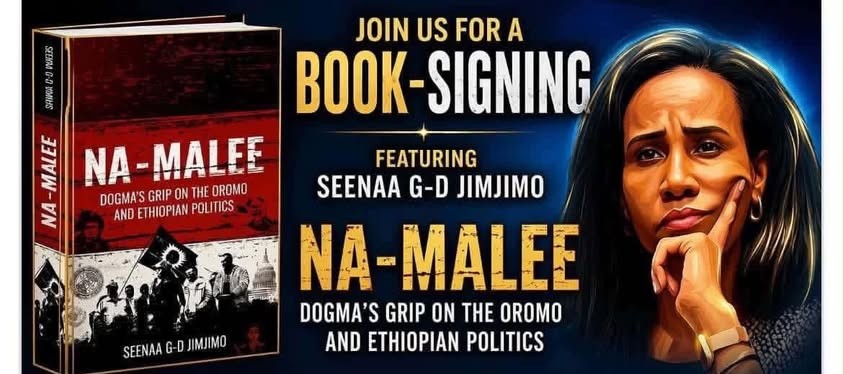
“Jabduu-dhiibbaan keessaa fi alaa kamiyyuu gadhinqabne.”
— “She did not bow to any pressure, from inside or outside.”
—
WASHINGTON, D.C. – In the polished corridors of the U.S. State Department, she speaks with the measured precision of a public health expert. In the dusty highlands of rural Oromia, she kneels beside girls who have never seen a classroom, handing them pencils and hope. And in the pages of her own writing, she dissects the lonely space between two worlds—the Oromo homeland she loves and the American life she built.
Her name is Seenaa G-D Jimjimo. For those who know only her acronym—OLLAA, the Oromo Legacy Leadership & Advocacy Association—she is the Executive Director who has briefed the White House, lobbied the U.K. Parliament, and helped steer House Resolution 128 into law. For those who know her heart, she is something rarer: a leader who has never forgotten that the loudest pressure comes not from external enemies, but from the whispers inside one’s own community to be silent, to be small, to bow.
And she has never bowed.
—
The Roots of Resistance
Born and raised in Oromia, Seenaa G-D Jimjimo grew up watching the slow, systematic strangulation of her people. The Oromo—the largest nation in the country—had been subjected to land confiscation, linguistic suppression, and political marginalization for generations. But it was the violence against Oromo women that carved the deepest wound into her young consciousness.
She saw neighbors dragged from their homes by Ethiopian security forces. She heard stories of girls, barely teenagers, who were arrested, abused, and never seen again. And she made a quiet promise to herself: I will learn. I will speak. And I will never look away.
That promise carried her across an ocean.
In the United States, she pursued higher education with a ferocity that astonished her professors. She earned an undergraduate degree in political science—the tool for understanding power. Then graduate degrees in public health and public administration—the tools for healing and organizing. At the University of Illinois, her peers elected her Senator at Large for the Graduate Student Association and treasurer for the African Student Organization. She was awarded the Dr. Martin Luther King Jr. Scholarship and the Whitney M. Young Fellowship—honors that recognized not just her intellect, but her commitment to justice.
But she was not content to remain in classrooms. The lessons she learned, she brought back to her people.
Forging a Leadership Legacy
Today, as Executive Director of the Oromo Legacy Leadership & Advocacy Association (OLLAA), Seenaa G-D Jimjimo oversees a global apparatus of advocacy. The organization does not simply issue press releases; it builds coalitions. It does not merely condemn human rights abuses; it documents them, presents them to international bodies, and demands accountability.
Under her leadership, OLLAA has engaged directly with the White House, the U.S. State Department, and the United Kingdom’s All-Party Parliamentary Group on Africa. She has sat across tables from diplomats who once could not locate Oromia on a map—and left those tables with commitments to investigate atrocities, support democratic reforms, and amplify Oromo voices.
One of her most significant achievements came through House Resolution 128. Introduced in 2017 and passed in 2018, the resolution urged respect for human rights and encouraged democratic changes in Ethiopia. It was not a sweeping victory—no single piece of legislation could undo a century of oppression—but it was a crack in the wall. And Seenaa G-D Jimjimo was among the key figures who pried that crack open, lobbying members of Congress, mobilizing the diaspora, and refusing to let the issue die.
“People think advocacy is glamorous,” she once told a young organizer. “It is not. Advocacy is showing up to the same office forty-seven times until someone finally agrees to listen. Advocacy is being told ‘no’ so often that the word loses its meaning. And then showing up again.”
The Danboobiduu Foundation: Building What Advocacy Cannot
But Seenaa G-D Jimjimo knows that laws and resolutions are not enough. They do not put food on a child’s table. They do not keep a rural girl in school when her family needs her labor.
That understanding gave birth to the Danboobiduu Foundation in 2014. Named after a cherished Oromo concept of nurturing and empowerment, the foundation focuses on one deceptively simple goal: keeping girls in school.
In rural parts of Oromia, young girls are often pulled from classrooms to work—in the fields, in domestic labor, sometimes in conditions that amount to exploitation. Early marriage remains a threat. Poverty makes education seem like a luxury. Danboobiduu intervenes with scholarships, mentorship, and community engagement, convincing families that a girl with a diploma is worth more than a girl with a dowry.
The foundation does not make headlines. It does not appear in congressional testimony. But for the hundreds of girls who have stayed in school because of its work, it is the difference between a future and a sentence.
The Writer as Truth-Teller
Beyond the boardrooms and the village paths, Seenaa G-D Jimjimo is also a writer. Her work is not the polished propaganda of a movement; it is the raw, searching reflection of a woman trying to diagnose her people’s wounds without romanticizing them.
Her book, The In-Between, addresses the cultural and social fractures that her community faces—the clash between tradition and modernity, the silence around internal problems, the difficulty of building a future when the past is still on fire. She writes about the Oromo Gadaa system, the ancient democratic governance model that predates many Western constitutions, and asks how its principles might be revived for a new generation.
She also writes about the pressures from inside—the fear of criticizing one’s own community, the reluctance to hold fellow Oromos accountable, the temptation to present a flawless front to the world. “We must tell the truth about our struggles,” she has written, “including the ones we inflict on ourselves. Only then can we be truly free.”
The Unfinished Work
Today, Seenaa G-D Jimjimo continues to balance multiple roles: Executive Director, public health specialist, keynote speaker, mentor, and commentator on African intellectual traditions. She is as comfortable discussing epidemiological trends as she is debating Oromo nationalism. She moves between Finfinnee and Washington, between the Gadaa council and the House Foreign Affairs Committee, with a fluency that seems almost effortless—until one remembers the weight she carries.
That weight is the memory of every Oromo woman who was silenced. Every political prisoner who did not emerge from the dungeon. Every child who never learned to read because her school was burned and her language banned.
And yet, she does not bow. Not to the pressure of despair. Not to the cynicism that says change is impossible. Not to the internal critics who accuse her of being too radical or not radical enough. Not to the external forces—states, lobbies, powerful men—who would prefer that she simply disappear.
“I did not bow to any pressure, from inside or outside.” Those words, carved into the identity of Seenaa G-D Jimjimo, are not a boast. They are a discipline. A daily decision to stand, even when standing requires more than one person should have to give.
The Legacy She Is Building
She will tell you, if you ask, that she is not a hero. She is a daughter of Oromia who happened to learn English, earn degrees, and find herself in rooms where decisions are made. She will tell you that the real heroes are the girls in the Danboobiduu program who walk two hours to school each morning, the mothers who hide Oromo books under their beds, the prisoners who refuse to name their comrades under torture.
But those girls and mothers and prisoners would say something different. They would say: She gave us a voice when we had none. She took our whispers and shouted them into the halls of power. She did not bow, and because she did not bow, we can stand.
Seenaa G-D Jimjimo’s story is not finished. The Oromo struggle is not finished. But every morning, in an office in the United States or a village in Oromia, she wakes up and chooses to continue. The pressure will come again—from inside, from outside, from the thousand small deaths of hope deferred. And she will refuse, again, to bow.
That is not a story of suffering. That is a story of unbending grace.
And to the woman who taught them to stand—honor upon honor.

Posted on May 17, 2026, in Aadaa, Events, Finfinne, gender, Information, News, Oromia, Press Release, Promotion. Bookmark the permalink. Leave a comment.






Leave a comment
Comments 0