A Forgotten Friendship Reclaimed: New Book Illuminates Krapf and the Oromo People
By Daandii Ragabaa (Based on a social media post by Robsan Mako)
OSLO, Norway – For over a century, a peculiar silence has hung over one of the most fascinating relationships in the annals of Ethiopian history: the profound bond between Johann Ludwig Krapf, the German missionary and explorer, and the Oromo people. That silence, according to a chorus of scholars and advocates, was no accident. But as the saying goes, there is a time for everything. And now, finally, that time has come.
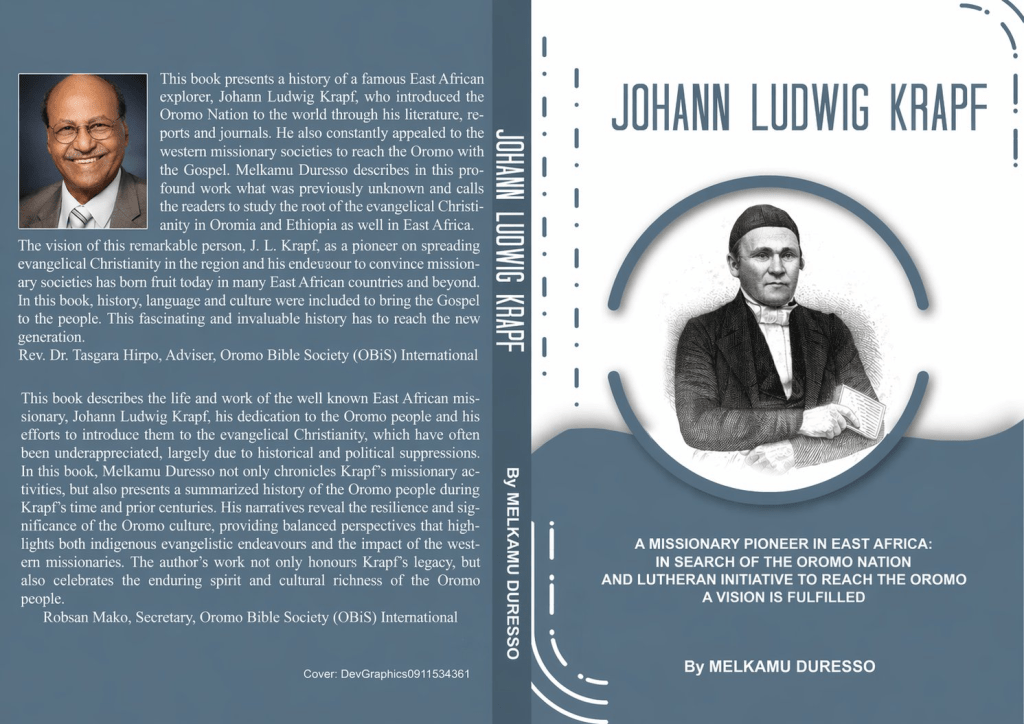
A groundbreaking new book, penned by the esteemed historian, linguist, church leader, and human rights advocate Melkamu Duresso, has officially been released, promising to shatter the historical omerta surrounding Krapf’s work. The announcement was made with palpable excitement by Robsan Mako, who expressed deep honor at having written both the foreword and the back cover blurb for what he calls a “valuable and timely” work.
The Man Who Loved the Oromo
Johann Ludwig Krapf is a name known to many students of Ethiopian history. He arrived in the early 19th century, famed for his travels and his linguistic feats. But according to Melkamu Duresso’s research, the standard narratives have long downplayed a critical dimension of Krapf’s legacy: his profound love and respect for the Oromo people.
Unlike many European travelers of his era who viewed African societies through a colonial lens, Krapf was different. He immersed himself in Oromo history, meticulously studied the Oromo language, celebrated the rich culture, and defended the identity of the nation. He wrote extensively and positively—a rarity for his time.
Yet, for many years, this story was denied proper publicity. Why? The answer, Robsan Mako suggests in his announcement, lies in the corridors of power.
“Certain groups within the Ethiopian power elite during different periods of history were not comfortable with Krapf’s positive writings,” Robsan notes. A missionary who saw the Oromo as a people with a glorious past and a distinct identity did not fit the political narratives of successive regimes that sought to marginalize or assimilate the nation. To publicize Krapf’s work would be to validate a counter-historical truth—that the Oromo have always been a proud, distinct, and historically significant people.
A Scholar’s Life’s Work
Melkamu Duresso is uniquely qualified to resurrect this history. A graduate of Addis Ababa University in History and English, he later pursued advanced studies at the prestigious Hamburg University in Germany, delving into History, Political Science, English Literature, and Culture. It was at Hamburg that he also served as a lecturer of the Oromo language, further cementing his role as a bridge between Oromo culture and European academia. He is already widely respected as the author of a highly authoritative Oromo-German Dictionary.
Drawing from years of research and deep reflection, Melkamu’s new book does more than simply re-tell Krapf’s biography. It weaves together several crucial threads: the life and mission of the explorer himself, critical new insights into Oromo history, and the fascinating story of the spread of Evangelical Christianity among the Oromo people—a movement in which Krapf played an instrumental role.
A Witness to Dedication
For Robsan Mako, the publication is not just an academic achievement; it is a moral victory. “This publication is another witness to his lifelong dedication to scholarship, language, faith, history, and human rights,” he wrote from Oslo, where he shared the news alongside the Oromo Bible Society (OBiS) and others.
The book arrives as a powerful intervention in contemporary Ethiopian debates about identity, history, and national unity. By reclaiming the story of a 19th-century German who saw dignity where others saw savagery, Melkamu Duresso is offering the Oromo people a reflection of themselves as seen through the eyes of an admiring outsider—a validation written in the amber of historical record.
An Urgent Call to the Youth
As the announcement circulates through diaspora communities and back to Ethiopia itself, Robsan Mako has issued a passionate plea, particularly to the younger generation.
“I encourage everybody—especially the younger generation—to read this valuable and timely book,” he urges. In an era of social media snippets and forgotten pasts, the book stands as a monument to deep research and the long struggle for historical truth. It is a reminder that the stories which are silenced are often the most important ones to tell.
While the official sales channels are still being finalized—with announcements expected soon for readers both in Ethiopia and abroad—one thing is already clear: the long wait is over.
Congratulations have poured in for Melkamu Duresso on his remarkable achievement. At last, Johann Ludwig Krapf’s true legacy, and his love for the Oromo people, can step out of the shadows and into the light of a new day.

Posted on May 11, 2026, in Aadaa, Events, Finfinne, Information, News, Oromia, Press Release, Promotion. Bookmark the permalink. Leave a comment.






Leave a comment
Comments 0