Daily Archives: June 11, 2026

Meeting the Abbaa Gadaa: A Portrait of Continuity and Change
By Daandii Ragabaa
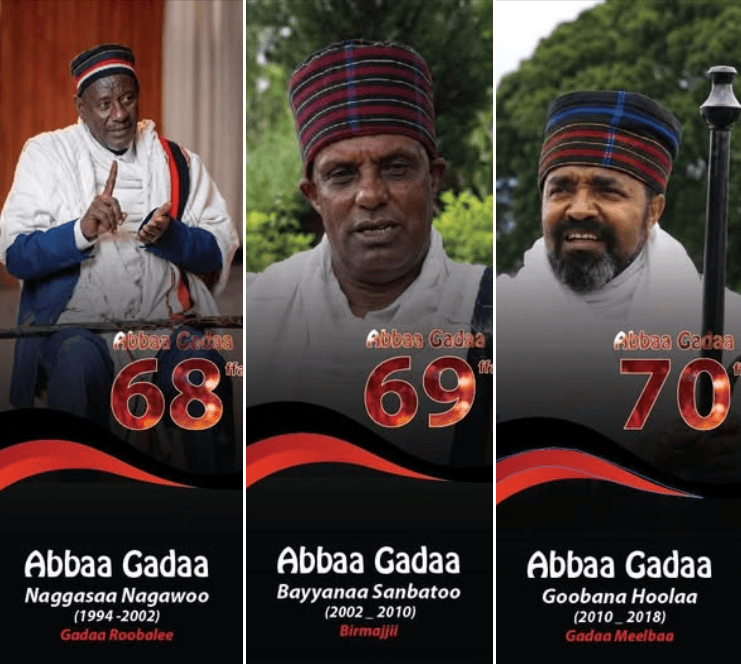
FINFINNE – They stand together in a single frame — three men, three generations of leadership, three keepers of a cycle that has turned for centuries. The photograph captures them shoulder to shoulder, not as rivals or predecessors, but as custodians of the same sacred trust.
On the left, Abbaa Gadaa Naggasaa Nagawoo of the Gadaa Roobalee. In the center, Abbaa Gadaa Bayyanaa Sanbatoo of the Gadaa Birmajii. On the right, Abbaa Gadaa Goobana Hoolaa of the Gadaa Meelbaa.
They are the 68th, 69th, and 70th Abbaa Gadaa of the Tuulama Oromo. Their photograph is not merely a portrait. It is a visual document of continuity, of peaceful transition, and of a democratic tradition that has endured for longer than most nations on earth.
The Gadaa Cycle: A Living Democracy
To understand the significance of this photograph, one must first understand the Gadaa system itself. Recognized by UNESCO as an Intangible Cultural Heritage of Humanity, the Gadaa system is an indigenous governance framework that has regulated the political, social, economic, and ritual life of the Oromo people for generations.
Every eight years, power cycles peacefully from one Gadaa grade to the next. The Abbaa Gadaa — the father or leader of the Gadaa — serves as the highest authority during his term, presiding over the Caffee assembly, mediating disputes, leading rituals, and ensuring that the laws of Seera and the moral code of Safuu are upheld.
At the end of eight years, he does not cling to power. He does not manipulate the constitution to extend his term. He does not imprison his opponents. He steps down. He hands the Baallii — the ceremonial baton symbolizing authority — to the next grade. And he becomes an elder advisor, watching as the cycle turns without him.
This photograph captures three such leaders at a rare moment of convergence: the 68th, the 69th, and the 70th Abbaa Gadaa of the Tuulama Oromo, standing together in a single frame.
Abbaa Gadaa Naggasaa Nagawoo – Gadaa Roobalee (68th)
Abbaa Gadaa Naggasaa Nagawoo led during the Gadaa Roobalee cycle. His tenure, like all Gadaa terms, lasted eight years — a period that coincided with significant challenges and transformations for the Tuulama Oromo.
Those who knew him speak of an Abbaa Gadaa who prioritized unity. The Tuulama, whose traditional territories encircle Finfinne (Addis Ababa), have long been at the crossroads of Ethiopian political life. Their proximity to the seat of imperial and state power brought both opportunities and vulnerabilities. Abbaa Gadaa Naggasaa worked to keep his people united in the face of pressures that sought to divide them.
His name, Nagawoo, carries echoes of Nagaa — peace, tranquility, well-being. It was not merely a name but a mission. During his term, he mediated disputes between clans, presided over Caffee assemblies that drew hundreds of participants, and ensured that the Gadaa calendar was observed with full ritual precision.
When his eight years concluded, he did what every Abbaa Gadaa before him had done: he stepped aside. He placed the Baallii into the hands of the next grade and became an advisor, watching as the cycle continued without him.
Abbaa Gadaa Bayyanaa Sanbatoo – Gadaa Birmajii (69th)
The baton passed to Abbaa Gadaa Bayyanaa Sanbatoo of the Gadaa Birmajii cycle. His term came at a moment when the Gadaa system itself was facing new pressures — modernization, urbanization, displacement, and the ongoing struggle for Oromo cultural and political rights.
Abbaa Gadaa Bayyanaa proved to be a steady hand. He understood that the Gadaa system could not survive if it remained frozen in the past. It had to adapt while preserving its core principles. Under his leadership, the Caffee assemblies began to incorporate new voices — including a greater role for women and youth, who had sometimes been marginalized in traditional structures.
He also worked to strengthen the connections between the Tuulama Gadaa and other Oromo communities — the Borana, the Gujii, the Karrayyuu, the Arsi, and others. The Gadaa system, he argued, was not the property of one clan or region. It was the heritage of all Oromo people, and it would survive only if it remained a living, breathing institution, not a museum piece.
When his term ended, he handed the Baallii to the next grade with the same grace with which he had received it. The cycle turned.
Abbaa Gadaa Goobana Hoolaa – Gadaa Meelbaa (70th)
Today, the Baallii rests in the hands of Abbaa Gadaa Goobana Hoolaa of the Gadaa Meelbaa cycle, the 70th Abbaa Gadaa of the Tuulama Oromo. He stands in the photograph as the current bearer of a tradition that stretches back centuries.
Abbaa Gadaa Goobana inherited a system that, despite its resilience, faces real challenges. Young people, educated in modern schools and absorbed by digital media, sometimes know less about Gadaa than their grandparents did. Migration to cities has scattered communities that once gathered regularly under Odaa trees. And the Ethiopian state, despite constitutional recognition of customary law, has not always made space for Gadaa institutions to operate freely.
Yet Abbaa Gadaa Goobana is not discouraged. He travels extensively, visiting Gadaa centers across Tuulama and beyond. He speaks to youth in language they understand, connecting the principles of Gadaa — consensus, term limits, accountability, community — to the democratic aspirations of the present generation. He works with scholars to document Gadaa laws and rituals. And he presides over Caffee assemblies where disputes are resolved not through courts and lawyers but through dialogue and consensus.
His photograph with his two predecessors is not just a formality. It is a statement. It says: The Gadaa lives. The cycle continues. The 68th handed to the 69th, who handed to the 70th. And when my time is done, I will hand to the 71st.
What the Photograph Captures
Look closely at the three men in the photograph. They are dressed differently — some in traditional Oromo attire, others in modern clothing. They stand at different angles. Their expressions vary — one smiling, one solemn, one in between.
But what unites them is visible to those who know what to look for. It is the quiet confidence of men who understand that they are not the center of the story. The Gadaa system is the center. They are merely its temporary servants.
The photograph captures:
- Continuity – Three leaders, one cycle. The 68th, 69th, and 70th Abbaa Gadaa standing together as living proof that the Gadaa system did not die with the past. It is alive, and it is here.
- Peaceful Transition – Unlike many political systems in Africa and beyond, where leaders cling to power until they are overthrown or die in office, the Gadaa system institutionalizes the transfer of authority. These three men did not fight each other. They did not imprison each other. They handed the baton and remained friends.
- Shared Purpose – Despite their different personalities and the different challenges they faced, all three share a common commitment: to preserve, protect, and promote the Gadaa system for future generations.
- Humanity – They are not icons on a pedestal. They are men — fathers, grandfathers, farmers, elders. They have known joy and sorrow, success and failure. And yet they carry a weight that few others can understand: the weight of a tradition that depends on them.
The Significance of the 68th, 69th, and 70th
Why does it matter that we can name the 68th, 69th, and 70th Abbaa Gadaa of the Tuulama Oromo? Why does it matter that we can see their faces, know their names, and trace the cycle through their terms?
It matters because indigenous systems are too often treated as timeless and unchanging — as if they exist outside of history. But the Gadaa system has a history. It has specific leaders who faced specific challenges at specific moments. The 68th Abbaa Gadaa was not the same as the 60th. The challenges of the Gadaa Birmajii cycle were not identical to those of the Gadaa Meelbaa cycle.
By naming these leaders and documenting their terms, we resist the temptation to treat Gadaa as folklore. We insist that it is real governance, with real leaders, real achievements, and real accountability.
The photograph of Abbaa Gadaa Naggasaa Nagawoo, Abbaa Gadaa Bayyanaa Sanbatoo, and Abbaa Gadaa Goobana Hoolaa — the 68th, 69th, and 70th — is a challenge to those who would dismiss indigenous systems as primitive. It says: Look. Here is democracy without elections. Here is accountability without constitutions. Here is term limits without term-limit debates. This is not primitive. This is sophisticated. This is Oromo.
The Future: The 71st and Beyond
As Abbaa Gadaa Goobana Hoolaa continues his term, preparations are already underway for the next transition. The Gadaa grade that will produce the 71st Abbaa Gadaa is already being trained. The young men who will one day lead are already learning the laws, the rituals, and the responsibilities.
The cycle does not stop. It cannot stop. Because the Gadaa system is not a building that can be destroyed. It is a river that flows. It can be diverted, blocked, or polluted — but it always finds a way back to its course.
When the 71st Abbaa Gadaa takes the Baallii, he will stand where Abbaa Gadaa Goobana now stands. And one day, perhaps, a photograph will be taken of the 70th, 71st, and 72nd standing together — a new generation of custodians, continuing the cycle.
A Final Reflection
The photograph of the 68th, 69th, and 70th Abbaa Gadaa of the Tuulama Oromo is a small image. It occupies a fraction of a page or a corner of a screen. But it contains a universe.
It contains the memory of centuries of Oromo self-governance. It contains the proof that democracy did not arrive in Ethiopia with the first multiparty election. It has been here all along, under Odaa trees, in Caffee assemblies, in the peaceful transfer of the Baallii from one hand to the next.
It contains a challenge to the present: Will we honor this legacy? Will we learn from it? Will we ensure that the 71st, 72nd, and 100th Abbaa Gadaa will have a system to lead?
And it contains a promise: As long as the Gadaa cycle turns, the Oromo people will remember who they are. They will remember that they had governance before colonization, democracy before occupation, and leaders who knew when to lead and when to step aside.
The 68th handed to the 69th. The 69th handed to the 70th. And when the time comes, the 70th will hand to the 71st. The cycle turns. The Gadaa lives. And the photograph remains.
*Daandii Ragabaa is a journalist based in Finfinne covering family stories, displacement, and the human dimensions of political history across Oromia and Ethiopia.
Captions for Reference:
| Position | Name | Gadaa Cycle | Order |
|---|---|---|---|
| Left | Abbaa Gadaa Naggasaa Nagawoo | Gadaa Roobalee | 68th |
| Center | Abbaa Gadaa Bayyanaa Sanbatoo | Gadaa Birmajii | 69th |
| Right | Abbaa Gadaa Goobana Hoolaa | Gadaa Meelbaa | 70th |




 Advocacy for Oromia