Category Archives: Oromia

A Rare Convergence: Ethiopian, Jewish, and Coptic New Year Festivals Coincide in Australia

AMES Australia highlights an extraordinary moment of cultural and religious convergence as three major festivals—Enkutatash, Rosh Hashanah, and Nayrouz—fall on the same day, offering a powerful reflection of Australia’s shared humanity.
In a remarkable alignment of faith and culture, today marks the celebration of three significant festivals from three distinct traditions: Enkutatash, the Ethiopian New Year; Rosh Hashanah, the Jewish New Year; and Nayrouz, a festival of the Coptic Orthodox Church.
AMES Australia, a leading provider of settlement services and multicultural advocacy, has drawn attention to this rare coincidence, noting that the three events are governed by different calendars—making their convergence an extraordinary occurrence.
Three Festivals, Three Traditions
Enkutatash — the Ethiopian New Year — falls at the end of the rainy season and is celebrated with family gatherings, the blooming of the yellow adey abeba flower, and wishes of peace and prosperity. Melkam Addis Amet!
Rosh Hashanah — the Jewish New Year — is a time of reflection, renewal, and hope. Families gather to hear the shofar, dip apples in honey, and pray for a sweet year ahead. Shana Tova U’Metuka!
Nayrouz — a festival of the Coptic Orthodox Church — marks the beginning of the Coptic New Year and is a time of spiritual renewal and remembrance of the faithful. Nayrouz Mubarak!
A Season of Many Celebrations
Around this same period, millions of people around the world are also observing Mawlid al-Nabi, the birthday of the Prophet Muhammad, and the Christian festival of the Holy Cross — further enriching this season of diverse religious and cultural observance.
The convergence of so many significant dates speaks to the profound diversity of faith and culture that exists in Australia and around the world.
Australia: An Experiment in Cultural Convergence
AMES Australia reflected on the deeper meaning of this moment:
“Just like the conjunction of these cultural and religious celebrations, Australia is an experiment in cultural convergence; a nation that has welcomed people from different cultures while valuing its first peoples and fostering exchanges of ideas.”
This observation captures the essence of Australia’s multicultural identity — a nation built on migration, shaped by diversity, and strengthened by the exchange of traditions, beliefs, and ideas.
Valuing First Peoples and Fostering Exchange
AMES Australia’s statement also acknowledges the importance of honouring Australia’s First Peoples while embracing the contributions of all communities. True multiculturalism is not merely about coexistence—it is about active exchange, mutual respect, and a shared commitment to building a harmonious society.
The rare alignment of these festivals serves as a reminder that while our calendars, languages, and traditions may differ, our hopes for peace, renewal, and a better year ahead are profoundly shared.
A Shared Humanity
At a time when divisions can seem deep, the coincidence of these celebrations offers a powerful counter-narrative—one of unity, mutual recognition, and shared humanity.
Whether lighting candles for Rosh Hashanah, gathering with family for Enkutatash, or observing Nayrouz, millions of people today are united by a common desire: to welcome a new year with hope, gratitude, and peace.
Warm Wishes to All
To all those celebrating today:
Melkam Addis Amet! — Happy Ethiopian New Year!
Shana Tova U’Metuka! — Have a good and sweet year!
Nayrouz Mubarak! — Blessed Nayrouz!
May this rare convergence of faith and culture inspire all Australians to celebrate our diversity and strengthen the bonds that unite us.
Read more from AMES Australia:
Convergence of religious and cultural festivals reflect our shared humanity
#AMES #AMESAustralia #Enkutatash #RoshHashanah #Neyrouz #NewYear #Holidays #MulticulturalAustralia #SharedHumanity

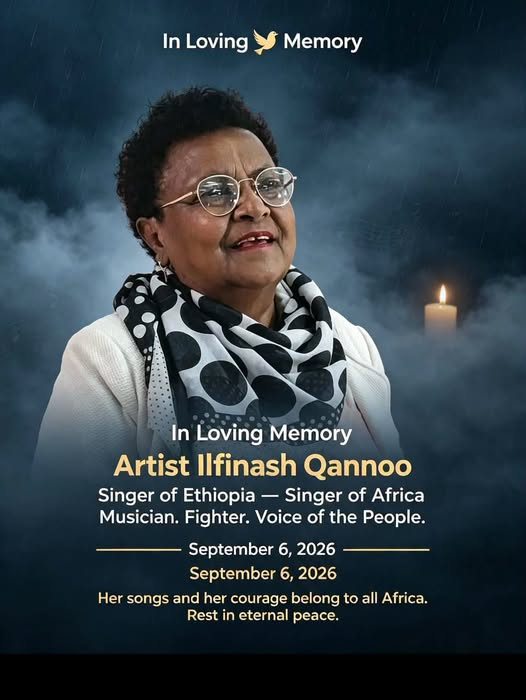
Oromo Community in Melbourne to Hold Memorial for Artist Ilfinash Qannoo in Dandenong

The Oromo Community in Melbourne has announced it will host a special memorial event to honour the life and legacy of the beloved artist and freedom fighter, Ilfinash Qannoo, on September 12, 2026.
The Oromo Community in Melbourne (OCM) has organised a commemorative gathering to celebrate the life and enduring legacy of Artist Ilfinash Qannoo, who passed away recently in Oromia.
The memorial program will take place on September 12, 2026, at Dandenong Harmony Square, beginning at 5:00 PM.
A Celebration of Life and Legacy
Artist Ilfinash Qannoo was more than a performer—she was a symbol of Oromo resilience, unity, and the enduring struggle for freedom. Throughout her life, she dedicated herself to advocating for Oromo liberation, justice, human rights, and gender equality, using her art as a powerful tool for change.
Her passing has been deeply felt by Oromos in Victoria, across Australia, and around the world. The memorial event organised by the OCM offers the community an opportunity to come together, share their grief, and—most importantly—celebrate her remarkable contributions.
A Call to the Community
The Oromo Community in Melbourne has extended a warm invitation to all members of the community and friends of Oromia to attend the memorial gathering:
“Come to Dandenong Harmony Square at 5:00 PM and let us express the love and respect we hold for our artist!”
The event will feature a program of tribute, reflection, and cultural celebration, honouring the life of a woman who gave everything to the Oromo cause.
Event Details
📍 Location: Dandenong Harmony Square, Victoria, Australia
📅 Date: September 12, 2026
⏰ Time: 5:00 PM
Honouring a Heroine
Ilfinash Qannoo’s legacy is one of courage, dedication, and unwavering commitment to her people. Her music and advocacy inspired millions, and her memory continues to unite Oromos across the globe.
The OCM’s memorial event is not only a tribute to her life but a reaffirmation of the values she stood for—unity, justice, and the unyielding pursuit of freedom for Oromia.
A Community United in Remembrance
As Oromos in Victoria gather at Dandenong Harmony Square, they will do so with heavy hearts but also with pride—pride in a woman who represented the very best of Oromo culture, resilience, and hope.
The event promises to be a powerful moment of community solidarity, cultural expression, and collective remembrance.
Join Us
All members of the Oromo community, friends of Oromia, and supporters of justice and human rights are warmly invited to attend.
Let us come together to honour a true heroine of Oromia. Let us celebrate her life, her art, and her enduring legacy. Let us show the world that Ilfinash Qannoo will never be forgotten.
Galatoomaa! — Thank you!
Event Summary:
| Detail | Information |
|---|---|
| Event | Memorial for Artist Ilfinash Qannoo |
| Organiser | Oromo Community in Melbourne |
| Location | Dandenong Harmony Square, Victoria |
| Date | September 12, 2026 |
| Time | 5:00 PM |
Bilisummaan Oromoof!

Rosh Hashanah: Victorian Jewish Families Gather to Welcome a Sweet New Year

As the sun sets this evening, Jewish families across Victoria will gather around their tables to celebrate Rosh Hashanah, the Jewish New Year—a sacred time of reflection, renewal, and hope for the year ahead.
The sounding of the shofar, the dipping of apples in honey, and the sharing of festive meals will mark the beginning of the Jewish year 5787, a period of deep spiritual significance for Jewish communities in Victoria and around the world.
Rosh Hashanah, which literally means “head of the year,” is a time when Jewish families come together to reflect on the past year, seek forgiveness, and commit to renewal in the year to come. It is a celebration that blends joy with introspection—a moment to consider one’s actions, strengthen bonds with community and faith, and look forward with hope.
A Time of Reflection and Renewal
The traditions of Rosh Hashanah are rich with symbolism. The shofar—a ram’s horn—is blown in synagogues, its haunting sound calling worshippers to awaken their souls and return to what matters most. Sweet foods, particularly apples dipped in honey and round challah bread, symbolize the wish for a sweet and complete year ahead. The pomegranate, with its many seeds, represents the hope for a year filled with good deeds and blessings.
For Jewish families in Victoria, this is also a time of community—a moment to gather with loved ones, welcome guests, and reaffirm the values that have sustained the Jewish people for millennia.
Celebrating the Jewish Community’s Enduring Contribution
Victoria has long been enriched by the presence and contributions of its Jewish community. From business and the arts to education, medicine, philanthropy, and public service, Jewish Victorians have helped shape the state’s cultural, economic, and social fabric for generations.
Their enduring contributions—built on a foundation of faith, resilience, and a deep commitment to community—deserve recognition and celebration, not only during Rosh Hashanah but throughout the year.
Wishing the Community a Sweet New Year
As Jewish families across Victoria prepare to usher in the new year, we extend our warmest wishes to the entire Jewish community.
May this Rosh Hashanah be a time of peace, health, and joy. May the year ahead bring blessings, success, and sweet moments shared with family and friends.
Shana Tova U’Metuka! — Have a good and sweet year!

The Unbroken Ode: Elfinesh Keno’s Life of Resistance and the Legacy She Left in Ambo
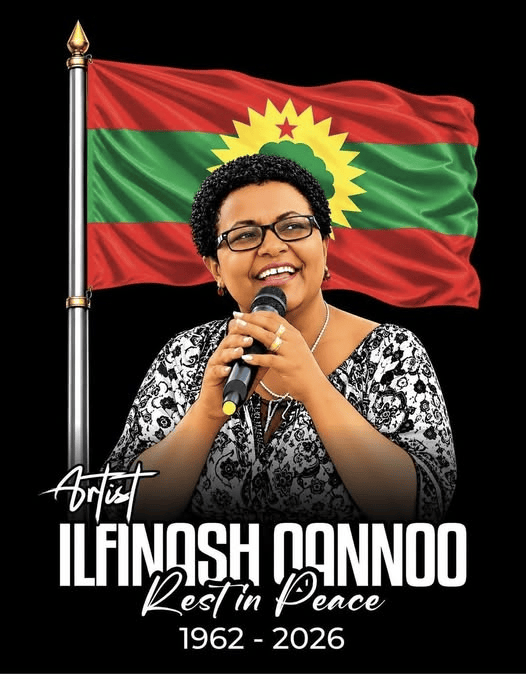
By Daandii Ragabaa
In a world where countless souls bend, break, or sell their dignity for comfort or personal gain, Elfinesh Keno walked through fire and emerged with her value intact. Even in death, her respect stands untouched—a monument to a life lived not for fame, but for freedom. Her art was never mere entertainment; it was resistance. It was a shield. It was a call to conscience.
She was an Oromo singer and cultural icon whose voice rose not for applause but for the rights, equality, and dignity of her people.
The Child of a Legacy
Born into the shadows of a struggle far larger than herself, Elfinesh Keno—known to many as Ilfinash Qannoo—was the daughter of Daraaraa Kafanii. Her lineage traced directly to Obboo Argaw Dinqaa, a towering Oromo patriot, lawyer, and founding father of cultural and political organizations such as Jibatii, Maccaa, and the Waldaa Walgargaarsaa Maccaafi Tuulamaa (WMT). Obboo Argaw was no ordinary man. Imprisoned for his opposition to the H/S government, he emerged from confinement to organize the Grand Oromo Cultural Festival of 1977 in Finfinne. He used culture as a weapon to resurrect Oromo identity and unity.
It was on that stage that young Elfinesh Keno first stepped into the light of history, performing alongside artists like Obboo Tasammaa Nagarii and Aaddee Kuulanii Guddinaa. Her art was a product of that great cultural renaissance—a movement that toured towns such as Asallaa, Waliso, and Naqamtee, where elders like Jaal Nadhii Gammadaa and Jaal Magarsaa Barii worked alongside Obboo Argaw to reinstate the sacred Gadaa system through performance.
A Heroine Forged in the Crucible of Conflict
But the road was never easy. When the Oromo liberation movement intensified, the Derg regime came for its leaders. Obboo Argaw was arrested on October 19, 1978, and later executed. Yet the flame he lit was passed to the next generation—to artists like Daraaraa Kafanii and his daughter, Elfinesh.
In the turbulent years that followed, Elfinesh found herself on the frontline. During a ferocious battle in Burree, Jalduu, in July 1992, between W3O fighters and the Wayyaanee (EPRDF) regime, she and fellow artist Zaruhuun Wadaajoo were captured. They were imprisoned in Ambo’s Karchallee detention center. There, Elfinesh faced the possibility of execution.
Her story at that point offers a stunning glimpse into her character. When the Wayyaanee regime’s OPDO operatives debated executing her, she was saved—not by bending her principles, but by her unwavering association with the Oromo people. Some of those who held her file, knowing the depth of her devotion, feared the wrath of the people so much that they altered her records to avoid carrying out the sentence.
Meanwhile, the people of Ambo acted. They pooled their money and bribed the prison commander, ensuring Elfinesh would not be killed behind bars. When she was finally released, the community welcomed her like a returning queen—taking her to the Daraaraa Kafanii Hotel, where she reunited with elders and fellow fighters. Even in the face of death, she did not run. She chose duty.
Ambo’s Daughter by Choice
One of the most defining moments of Elfinesh Keno’s life came near the end. When she could have chosen to return to her birthplace, to the comfort and familiarity of her early years, she did not. Instead, she chose Ambo—the city whose people once chose to face bullets for her.
Ambo’s masses had refused to let her die. They had stood by her during her darkest hour, chanting for her survival and promising to keep the fight for true freedom alive. In return, Elfinesh honored their bravery with her final resting place. That decision alone speaks volumes about her character.
Her choice reminds us that heroism is not loud; it is consistent. It is not boastful; it is principled. And it is not convenient; it is costly. But Elfinesh Keno paid that cost willingly.
A Lesson for the Wavering
Elfinesh Keno’s life offers a powerful lesson to all who waver, compromise, or forget the weight of responsibility. While many ran for safety, she ran toward duty. While others hid, she stood in the field. While some betrayed their own, she remained truthful to her core.
Her integrity was so complete that she could recognize goodness even in those standing on the opposite side of history—a mark of a true heroine. She taught the cowards and the “gantuus” that she would rather be covered with the flag of resistance, a symbol of freedom, than to live under the shadow of betrayal.
The Eternal Thread
Elfinesh Keno’s story is not an isolated one. It is a thread in a larger tapestry of Oromo resistance and cultural preservation. In her, we see the face of Obboo Argaw Dinqaa. Through her, we hear the voices of Jaal Nadhii Gammadaa, Jaal Magarsaa Barii, Jaal Abboomaa Mitikkuu, and countless unnamed heroes who gave their lives for Oromummaa.
Her passing is a heartbreak—”Bool’akee bookni haa guutu,” as the Oromo poet wrote. Yet she did not die in vain. She passed away with her value intact, her respect untouched, and her legacy eternal.
May her memory continue to guide her people.
May her courage continue to inspire future generations.
May her integrity remain a mirror for all who claim to serve the truth.
Stand for Something
Elfinesh Keno’s final chapter reflects her deepest values: the pursuit of truth, the protection of dignity, and the unwavering commitment to her people. In the end, she was not just an artist or a performer—she was a symbol of what it means to live with purpose and die with honor.
Her voice may be silent now, but the melody of her resistance will echo forever.
Stand for something.
Live truthfully.
Protect your dignity.
Let your final chapter reflect your deepest values.
Elfinesh Keno—Ilfinash Qannoo—passed away with her value intact.
Her respect untouched.
Her legacy eternal.

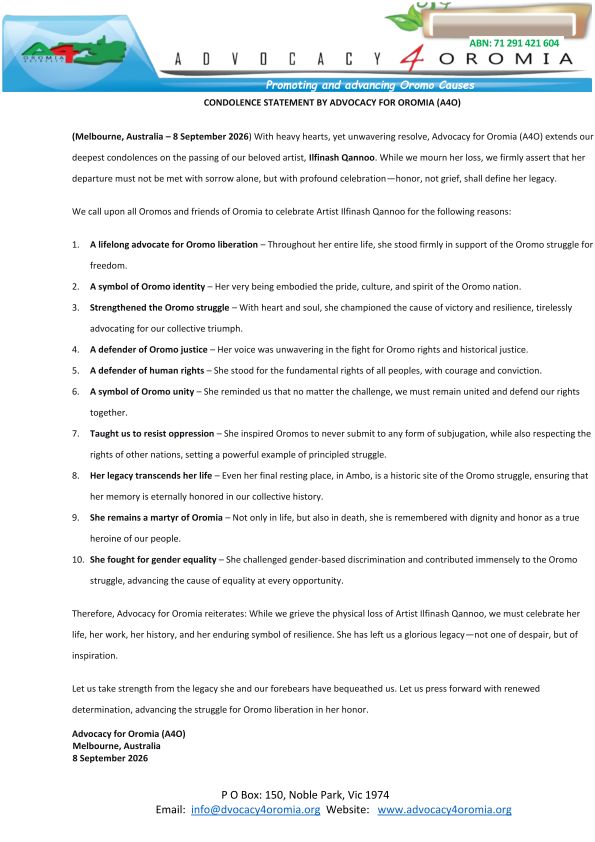
A Life Worth Celebrating—A4O Calls for Honor, Not Grief, for Artist Ilfinash Qannoo
By Our Correspondent
(Melbourne, Australia – 8 September 2026)-In a poignant and powerful statement released today, Advocacy for Oromia (A4O) has called on Oromos and friends of the struggle worldwide to transform mourning into celebration for the late artist and freedom fighter, Ilfinash Qannoo.
The Melbourne-based advocacy group, speaking from their Australian headquarters, emphasized that while the loss of the beloved artist is deeply felt, her life, legacy, and unwavering commitment to the Oromo cause demand a response of honor rather than sorrow.
A Life Dedicated to Liberation
Ilfinash Qannoo was no ordinary artist. According to A4O, she was a steadfast pillar of the Oromo liberation movement, dedicating her entire life to the struggle for Oromo self-determination. Her artistry was not merely entertainment—it was resistance. Her voice was not just melody—it was a clarion call for justice.
“Artist Ilfinash Qannoo spent her whole life supporting and advancing the Oromo struggle for freedom,” the statement reads, positioning her among the most committed cultural warriors of her generation.
More Than an Artist—A Symbol
A4O’s statement highlights ten compelling reasons why Ilfinash Qannoo’s legacy must be celebrated:
A Symbol of Oromo Identity: She embodied the pride, dignity, and cultural richness of the Oromo nation. Her very presence was a testament to Oromo resilience and identity.
Champion of Justice: She was a fearless defender of Oromo rights, human rights, and gender equality. She challenged oppression in all its forms and stood against discrimination, including gender-based injustice.
Unifier of the Oromo People: At a time when division threatens the struggle, Ilfinash Qannoo stood as a powerful symbol of Oromo unity, reminding her people that solidarity is the foundation of victory.
Teacher and Inspiration: Through her life and work, she taught Oromos to resist subjugation with dignity, while also respecting the rights of other nations—a rare and powerful example of principled advocacy.
Martyr for the Cause: Her final resting place in Ambo is now etched into the historical landscape of the Oromo struggle. Her grave, like her life, has become a site of memory and honor.
A Legacy That Transcends Death
Perhaps the most striking aspect of A4O’s tribute is the assertion that Ilfinash Qannoo’s impact extends far beyond her lifetime. She did not simply live for Oromia; she ensured that even in death, she would remain a rallying figure for the movement.
“She left us not with despair, but with a glorious legacy,” the statement declared. “We are called to take strength from what she and our forebears have left us, and to rededicate ourselves to the struggle with renewed vigor.”
A Call to Action, Not Lamentation
In what can be described as a clarion call to the Oromo diaspora and the wider movement, A4O urged supporters to channel their grief into action. The organization stressed that the most fitting tribute to Ilfinash Qannoo is not tears, but a renewed commitment to the goals she championed.
“We must celebrate her life, her work, her history, and her enduring symbol of resilience,” the statement emphasized. “Let us march forward in her honor, advancing the struggle for Oromo liberation with determination and unity.”
Global Reach of the Statement
Issued from Melbourne, Australia, on 8 September 2026, the statement reflects the global nature of the Oromo struggle and the far-reaching influence of cultural icons like Ilfinash Qannoo. A4O’s message transcends geographic boundaries, speaking directly to Oromos in the homeland and across the diaspora.
The advocacy group concluded with an unwavering declaration: “Victory to Oromia!” —a fitting epitaph for a woman whose life was dedicated to that very cause.
Historical Context
Ilfinash Qannoo’s passing marks the end of an era in Oromo cultural and political history. She was among a generation of artists who used their craft as a weapon of resistance, challenging the status quo and inspiring millions. Her death is not just a loss of talent, but the departure of a moral compass for a movement in constant pursuit of justice.
As Oromos around the world reflect on her legacy, A4O’s message is clear: Grieve, yes—but more importantly, celebrate. Honor her by carrying the torch she has passed on.
About Advocacy for Oromia (A4O): Based in Melbourne, Australia, A4O is a diaspora advocacy organization committed to advancing the rights, justice, and self-determination of the Oromo people through awareness, advocacy, and solidarity initiatives.
“We mourn her loss, but we celebrate her life—for in her, Oromia found a voice that will never be silenced.”

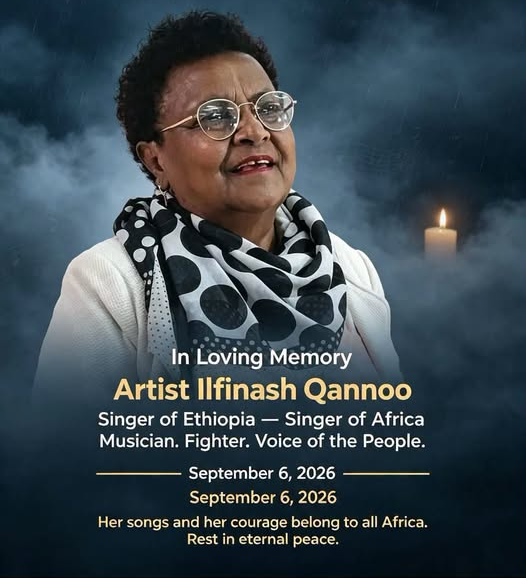
A Voice Silenced, A Legacy Eternal – Oromo Community in Melbourne Mourns Artist Elfinesh Keno
By OCM Media & Communications
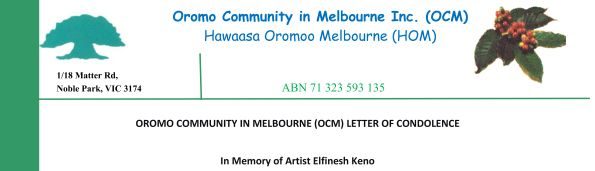
(MELBOURNE, Victoria – 7 September 2026)-A profound stillness has fallen over the Oromo community in Australia and beyond. The melodious voice that once gave life to Oromo heritage, that carried the hopes, joys, and struggles of a proud nation across generations, has fallen silent.
Artist Elfinesh Keno, a beloved cultural icon whose artistry became the heartbeat of Oromo identity, passed away recently, leaving behind a legacy that transcends time and geography. The Oromo Community in Melbourne (OCM), on behalf of its members and the wider Oromo diaspora across Victoria and Australia, has issued an official letter of condolence, mourning the loss of a woman who was far more than an entertainer—she was a guardian of culture, a storyteller of the people, and a beacon of inspiration.
A Life Dedicated to Oromo Culture
Born into a world where Oromo culture, language, and traditions faced immense pressures, Elfinesh Keno rose as a defiant yet graceful voice of resilience. Through her music, she celebrated the beauty of Oromo heritage—its poetry, its rhythms, and its profound connection to identity. Her songs were not mere performances; they were living archives of a people’s history, a mirror reflecting their collective aspirations and an anthem of their enduring spirit.
From the vibrant stages of Ethiopia to the community halls of the diaspora, Elfinesh’s artistry resonated with Oromos everywhere. Her voice became a bridge—connecting the homeland with the scattered children of Oromo, reminding them that no matter how far they travelled, their roots remained strong and their culture unbroken.
More Than Music: A Cultural Pillar
The OCM’s condolence letter describes Elfinesh Keno as a “revered cultural figure” whose work “transcended entertainment.” Indeed, her contributions went far beyond the recording studio or the concert stage. She was a mentor to young artists, a symbol of pride for Oromo women, and a tireless advocate for the preservation of Oromo language and traditions.
Through her lyrics, she wove together the threads of history—celebrating heroes, lamenting injustices, and envisioning a future where Oromo identity flourishes without fear. Her music became a source of strength during times of hardship and a soundtrack for moments of celebration.
A Global Outpouring of Grief
In the days following her passing, tributes have poured in from Oromo communities across the globe. From Melbourne to Minneapolis, from London to Addis Ababa, fans, fellow artists, and cultural leaders have expressed their sorrow and gratitude for the gifts she left behind.
The Oromo Community in Melbourne, standing in solidarity with Oromo communities worldwide, has reaffirmed its commitment to preserving the cultural legacy that Elfinesh Keno so passionately championed. In their condolence message, the OCM honoured her “life, achievements, and service to Oromo culture,” vowing to carry forward the torch she so brightly lit.
A Legacy for Future Generations
Elfinesh Keno’s enduring contributions will continue to echo through the songs she sang, the stories she told, and the values she embodied. Her legacy is not merely one of artistic excellence but of cultural stewardship. She reminded the Oromo people that their identity is a treasure worth protecting, their language a gift worth speaking, and their history a story worth telling.
As the OCM noted in their letter, the role of artists like Elfinesh Keno “in preserving and promoting our cultural heritage” is vital. Her life’s work has laid a foundation upon which future generations can build, dream, and create.
Farewell to a Beloved Daughter
To her family, friends, and fellow artists, the Oromo community extends its deepest sympathy and prayers. Words cannot fill the void her passing has left, but the memories she created—and the impact of her life’s work—will provide comfort and strength in the days ahead.
The Oromo Community in Melbourne, in its letter of condolence, expressed a hope that her family “may find strength, comfort, and peace in the cherished memories they shared and in the lasting impact of her life’s work.”
Eternal Peace, Enduring Inspiration
As the sun sets on the life of Artist Elfinesh Keno, a new dawn rises in her honour. Her voice may have fallen silent, but its echoes will never fade. Her songs will continue to be sung, her legacy will continue to inspire, and her spirit will forever remain woven into the fabric of Oromo identity.
May Artist Elfinesh Keno rest in eternal peace, and may her memory continue to inspire generations to come.
Oromo Community in Melbourne (OCM)
1/18 Matter Rd, Noble Park, VIC 3174
Melbourne, Victoria, Australia
7 September 2026
For media inquiries or further information, please contact the Oromo Community in Melbourne oromocentre@gmail.com

FEATURE NEWS: Funeral of Artist Ilfinash Qannoo to Be Held Tomorrow in Ambo
Organizing Committee Confirms Final Farewell for Oromo Cultural Icon
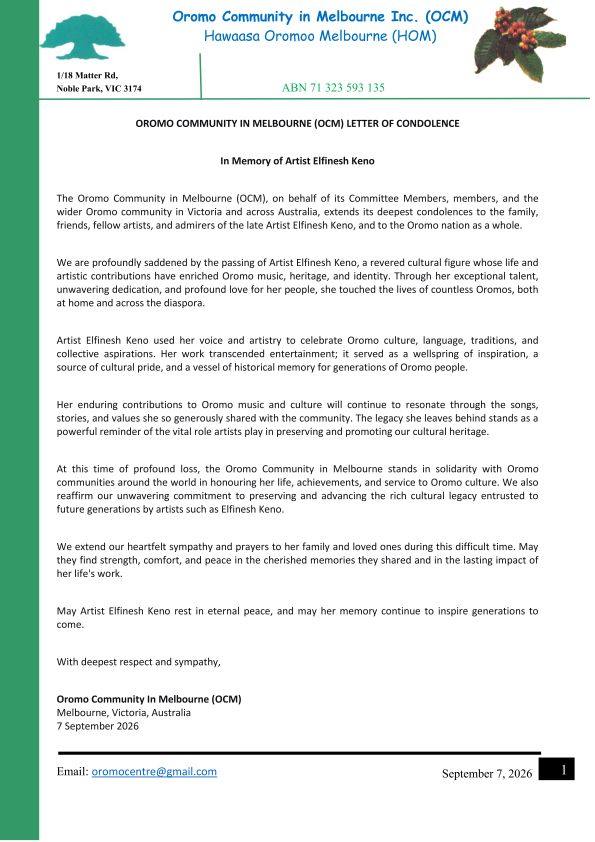
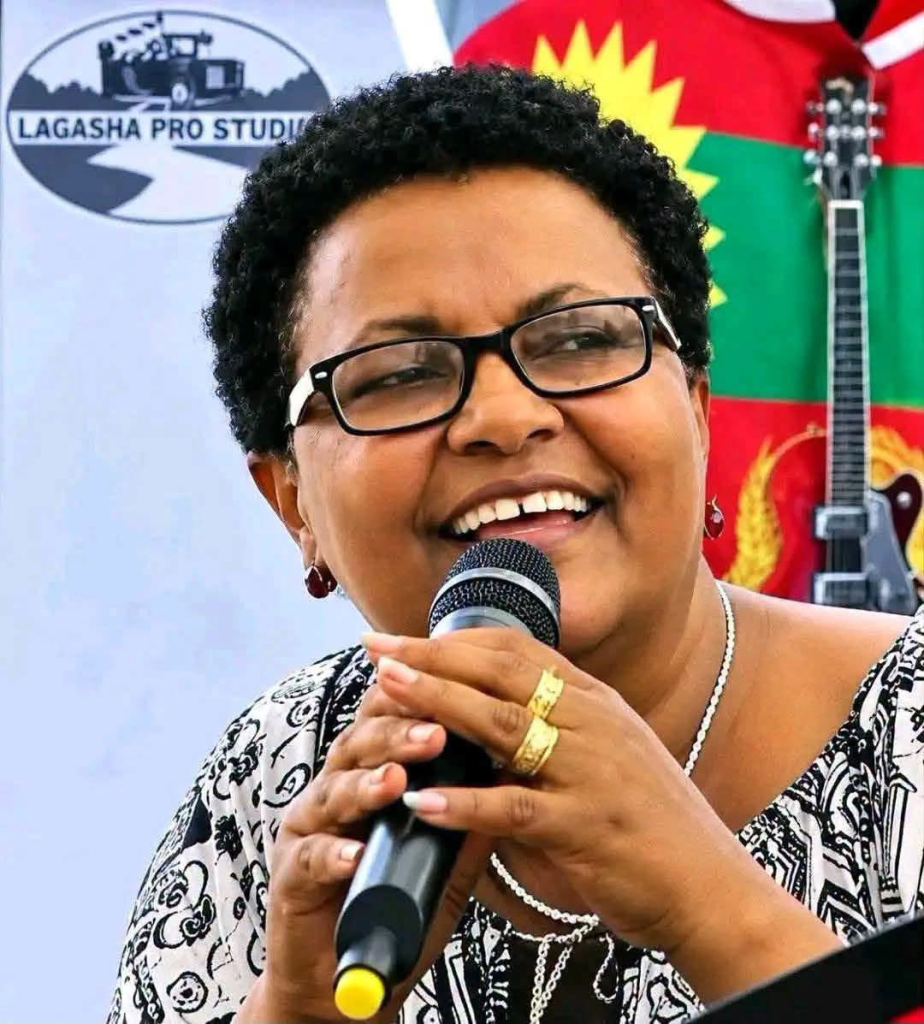
Finfinnee, Fulbaana 07, 2026 – The funeral service and burial ceremony for beloved Oromo artist and freedom fighter Ilfinash Qannoo will take place tomorrow, the organizing committee has confirmed. The final rites are scheduled to be held in the town of Ambo, following a series of commemorative events in Finfinnee.
A Day of Farewell: The Funeral Itinerary
According to Obbo Lammii Beenyaa, a member of the funeral organizing committee, the day’s proceedings will unfold as follows:
| Time in local time | Event |
|---|---|
| 11:00 – 12:00 | Departure of the body from Koriyaa Hospital in Finfinnee |
| 12:00 – 1:00 | Transfer to Finfinnee Stadium for public tribute |
| 1:00 – 3:00 | Formal commemoration and honoring ceremony at Finfinnee Stadium |
| 3:00 onwards | Procession carrying the body to Ambo |
| Upon arrival in Ambo | Funeral and burial ceremony to be conducted |
A Heroine Returns Home
The decision to hold the funeral in Ambo reflects the wishes of the family and the broader Oromo community to honor Ilfinash Qannoo in a location of deep cultural and historical significance. The journey from Finfinnee to Ambo will allow thousands of mourners to pay their final respects to the artist who dedicated her life to the Oromo struggle.
The public tribute at Finfinnee Stadium is expected to draw large crowds, as Ilfinash Qannoo was not only a celebrated musician but also a symbol of resilience and resistance for generations of Oromos. Her songs of unity, justice, and freedom resonated across the Oromo nation and the global diaspora.
Committee Calls for Orderly Participation
The organizing committee has urged all attendees to participate in the funeral proceedings with dignity and respect, maintaining the spirit of unity that Ilfinash Qannoo championed throughout her life. Security and logistical arrangements are being put in place to ensure a smooth and solemn farewell for the departed heroine.
As the Oromo nation prepares to lay its beloved artist to rest, the words of her final songs echo once more: a call for unity, a plea for justice, and a dream of freedom that will not die with her.
“Ilfinash duutus seenaan gootummaa ishii bara baraan dhaloota qaraa, leellifamaa jiraata.”
“Even in death, the legend of her heroism is praised across generations for ages to come.”
#IlfinashQannoo #Funeral #OromoUnity #Ambo #RestInPower #Oromia

The Death That Refuses to Fade: Why Ilfinash Qannoo’s Legacy Demands Celebration, Not Mourning
By Dhabessa Wakjira
—
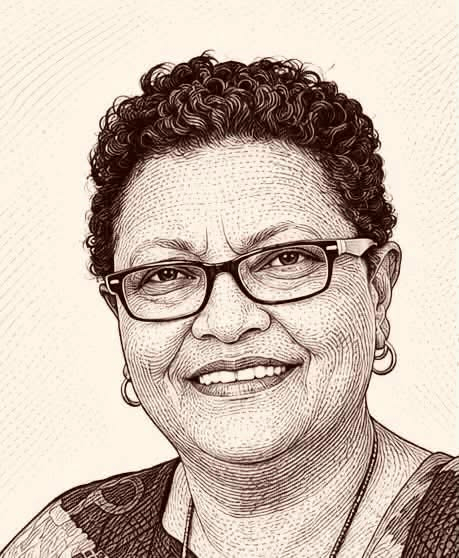
In the Oromo cultural cosmos, death is rarely a stranger. It is the great equalizer, the silent harvester that spares neither the peasant nor the prince. The proverb, “Duuti nama kamiifuu hin hafu” — “Death does not leave anyone behind” — is a sobering reminder of our shared mortal fate. Yet, every so often, a soul departs this earth in such a blaze of fire and principle that the grave cannot contain their echo. Ilfinash Qannoo is one such soul.
And here is our radical proposition: We should not weep. We should celebrate.
Not because her death is devoid of sorrow—far from it. The loss of a warrior, a mother, a symbol of unyielding resistance, carves a wound into the flesh of history. But to reduce Ilfinash to a tragedy is to misunderstand her life. To mourn her is to pity her; to pity her is to diminish her. Instead, we choose to honor her as the Oromo people have always honored their heroes: with poetry, with pride, and with the unshakable belief that her story is not an ending, but a beginning.
The Gootummaa (Heroism) That Defies Time
Ilfinash Qannoo was not merely a figure of her era. She was a force of nature sculpted into human form. In a world that demanded women be silent, she roared. In a system that demanded submission, she stood with her spine straight and her gaze fixed on the horizon of justice.
Her gootummaa—her heroism—was not carved from reckless anger, but from a profound love for her people. It was the kind of love that does not bow to colonialism, does not kneel to oppression, and does not whisper in the face of tyranny. It was the kind of love that marched, that fought, and that—when necessary—fell, so that others could stand taller on her shoulders.
This is why the proverb holds a second, hidden meaning. Yes, death takes everyone. But not everyone lives with the intensity of Ilfinash. For most, death is an erasure. For her, death was a megaphone. The louder the silence around her grave, the louder her deeds speak across generations.
Celebration as Resistance
Why celebrate? Because grief is passive; celebration is active. Mourning looks backward; celebration propels forward.
In many cultures, we are taught to dress in black, to lower our voices, to count the days of absence. But for a figure like Ilfinash Qannoo, such rituals are insufficient. They are, in fact, a betrayal of the fire she carried.
Imagine Ilfinash herself. Would she want a river of tears? Or would she demand a drumbeat of defiance? Would she desire bowed heads or raised fists? The answer is written in every chapter of her struggle. She lived for the flourishing of her people. Therefore, the greatest tribute we can pay is to flourish audaciously in her name.
To celebrate Ilfinash is to:
- Sing her praises in public gatherings, not whisper them in private corners.
- Teach her story in schools, not confine it to oral whispers.
- Emulate her courage in our daily battles, not relegate it to museum glass.
- Laugh with the joy she fought for, not weep with the sorrow she overcame.
Her death is a chapter. Her life is the entire book. And books are meant to be read aloud.
The Eternal Present of Her Legacy
Here is the miracle of Ilfinash Qannoo: she exists in the present tense. Yes, her heartbeat has ceased, but her rhythm continues in the pulse of every Oromo child taught to speak their language without shame. She lives in the defiant ink of every activist’s pen. She breathes in the lungs of every woman who refuses to be a footnote in someone else’s story.
The historians may write her dates—born, fought, fell. But the bards will sing her essence: She who bent the wind. She who taught the stones to speak.
Thus, we say: Do not mourn Ilfinash. Summon her.
Call her spirit into every courtroom where justice is demanded. Invoke her name in every village meeting where the future is debated. Let her be the ancestor who dances at our weddings, not the ghost who haunts our funerals.
A Final Call to the Living
Brothers and sisters, let us be clear. This is not callousness. This is not forgetting. This is the highest form of remembrance. We celebrate because we understand that Ilfinash Qannoo did not lose her life—she invested it. And the dividends of that investment compound with every generation that dares to dream freely.
So tonight, when the elders speak of her, do not lower your gaze. Lift a cup of water—the symbol of life—and toast to her name. Clap your hands. Stamp your feet. Let the earth feel the vibration of her memory.
For indeed, death does not leave anyone behind. But heroes like Ilfinash Qannoo leave something behind that death cannot touch: a legacy so fierce that it turns sorrow into a war cry.
Celebrate her. Live like her. And in living, you prove that she never truly died.
“Ilfinash duutus seenaan gootummaa ishii bara baraan dhaloota qaraa, leellifamaa jiraata.”
(Even in death, the legend of her heroism is praised across generations for ages to come.)
Let that praise be loud. Let it be joyful. Let it be eternal.
#IlfinashLives #CelebrateTheHero #OromoPride #LegacyOverMourning

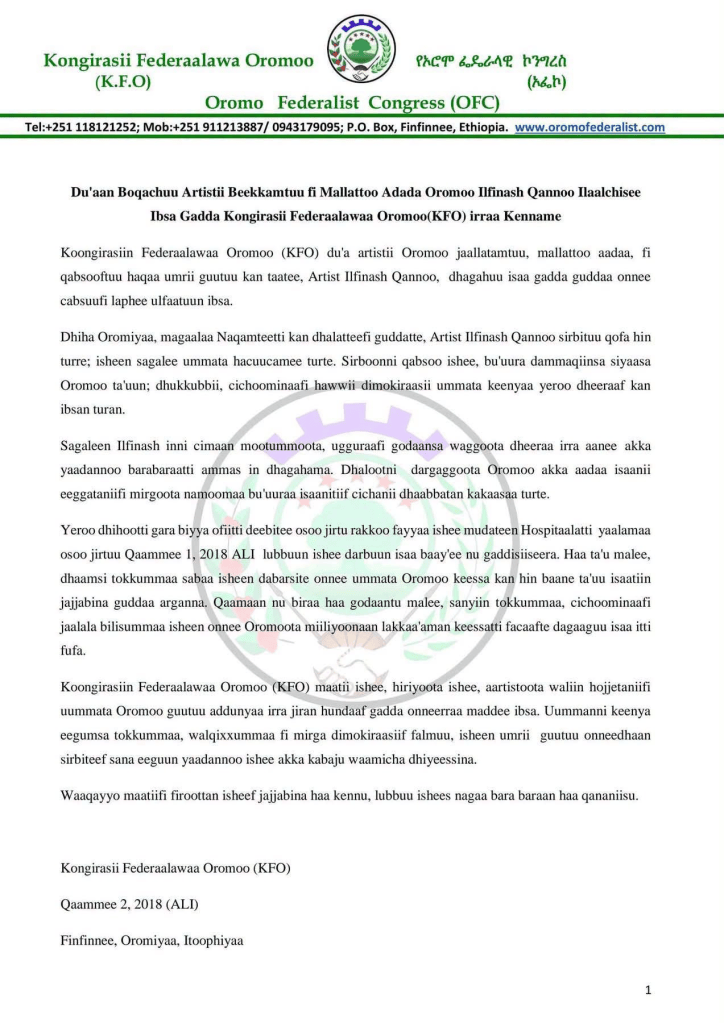
Oromo Federalist Congress (OFC) Mourns the Passing of Iconic Artist and Cultural Symbol Ilfinash Qannoo
FEATURE CONDOLENCE NEWS
Oromo Federalist Congress (OFC) Mourns the Passing of Iconic Artist and Cultural Symbol Ilfinash Qannoo
A Nation in Mourning: The Voice of a Generation Falls Silent
Finfinnee, Oromia – Qaammee 2, 2018 (E.C.)
The Oromo Federalist Congress (OFC/KFO) has announced with profound sorrow, heartbreak, and overwhelming grief the passing of beloved Oromo artist, cultural icon, and lifelong justice advocate – Artist Ilfinash Qannoo.
Her departure marks the end of an era in Oromo music, culture, and political consciousness. She was not merely an entertainer; she was the musical embodiment of a people’s struggle – a woman whose voice became the anthem of the oppressed and whose lyrics carried the weight of a nation’s dreams.
From Naqamtee to National Icon: The Journey of a Heroine
Born and raised in the historic city of Naqamtee, Western Oromia, Ilfinash Qannoo emerged from humble beginnings to become one of the most recognizable and beloved figures in Oromo cultural history. Her early life in the heart of Oromia shaped her deep connection to her people, their traditions, and their aspirations.
But Ilfinash was never content to be merely a performer. She understood from a young age that art could be a weapon – a tool for awakening consciousness, exposing injustice, and mobilizing the masses. Her songs transcended entertainment; they became historical documents that chronicled decades of political repression, marginalization, and the enduring hope for democracy in Oromia.
The Power of Her Voice: Lyrics That Shook Empires
Throughout her illustrious career, Ilfinash Qannoo’s powerful voice challenged regimes, dictators, and prolonged systems of oppression. Her protest songs became the foundation of Oromo political awakening – each melody carrying the pain of a people, each lyric demanding accountability from those in power.
Her music captured:
- The suffering of generations under oppressive rule
- The resilience of the Oromo people in the face of adversity
- The dream of a democratic and just society
- The call for unity, equality, and fundamental human rights
Though she faced imprisonment, torture, and exile for her convictions, her voice never wavered. Even today, her songs echo across Oromia and the global Oromo diaspora – a testament to a legacy that death cannot silence.
The Final Chapter: Returning Home
In her final days, Ilfinash Qannoo had returned to her beloved homeland – a poignant homecoming that filled her with joy despite her failing health. She was receiving medical treatment at a hospital when, on Qaammee 1, 2018 (E.C.), she succumbed to illness and departed from this world.
Her passing has left an unfillable void in the hearts of millions. The Oromo nation has lost not only a cultural treasure but a moral compass – a woman who dedicated her entire life to the pursuit of justice, unity, and freedom for her people.
A Message of Unity That Endures
Yet, even in death, Ilfinash Qannoo continues to inspire. The message of national unity that she carried throughout her life remains etched in the hearts of the Oromo people. Her final gift to the nation was not sadness but strength – the knowledge that while her physical form may depart, the seeds of unity, resilience, and love for freedom she planted in the hearts of millions will continue to grow and flourish.
As the Oromo Federalist Congress (OFC) observed in its official statement:
“Qaamaan nu biraa haa godaantu malee, sanyiin tokkummaa, cichoomina fi jaalala bilisummaa isheen onnee Oromoota miiliyoonaan lakkaa’aman keessatti facaafte dagaaguu isaa itti fufa.”
(“Though her physical body may depart, the seeds of unity, resilience, and love for freedom that she scattered in the hearts of millions of Oromos will continue to grow.”)
OFC’s Official Condolence and Call to Action
The Oromo Federalist Congress (OFC) extends its deepest and most heartfelt condolences to:
- The family and relatives of Ilfinash Qannoo
- Her friends and close associates
- Her fellow artists and collaborators
- The entire Oromo community across Ethiopia and the global diaspora
In its statement, the OFC has issued a powerful call to the Oromo people: to honor Ilfinash Qannoo’s memory by upholding the very principles she championed throughout her lifetime – principles that include:
| Principle | Meaning in Action |
|---|---|
| Unity | Standing together as one nation, transcending divisions |
| Equality | Demanding justice and equal rights for all |
| Democracy | Continuing the struggle for fundamental freedoms |
| Cultural Pride | Preserving and celebrating Oromo identity and heritage |
The OFC emphasized that the greatest tribute the Oromo people can pay to this fallen heroine is to continue the struggle she so passionately sang about – ensuring that her sacrifice and the sacrifices of countless others are not in vain.
A Final Prayer
The Oromo Federalist Congress concludes its statement with a solemn prayer and tribute:
“Waaqayyo maatiifi firoottan isheef jajjabina haa kennu, lubbuu ishees nagaa bara baraan haa qananiisu.”
(“May the Almighty grant her family and loved ones strength, and may her soul rest in eternal peace.”)
Legacy That Transcends Death
Ilfinash Qannoo’s legacy is secure. She will be remembered not only as a gifted artist but as a courageous freedom fighter, a proud symbol of Oromo identity, and a voice that refused to be silenced. Her songs will continue to inspire future generations of Oromo youth to:
- Preserve their culture
- Stand firm in their identity
- Fight courageously for their rights
- Dream boldly of a free and just Oromia
About the Oromo Federalist Congress (OFC/KFO)
The Oromo Federalist Congress (Koongirasiin Federaalawaa Oromoo – KFO) is a political organization committed to advancing the rights, unity, and self-determination of the Oromo people within a federal democratic framework. The OFC mourns the loss of Ilfinash Qannoo as a profound tragedy for the entire Oromo nation and all who cherish justice and freedom.
Issued by:
Oromo Federalist Congress (OFC/KFO)
Qaammee 2, 2018 (E.C.)
Finfinnee, Oromia, Ethiopia
In Memoriam
| Name: | Artist Ilfinash Qannoo |
| Birthplace: | Naqamtee, Western Oromia |
| Legacy: | Cultural Icon, Freedom Fighter, Voice of the Oppressed |
| Contribution: | Over 10 albums, decades of resistance music |
| Cause: | Justice, Unity, Democracy, Oromo Liberation |
| Resting: | In the hearts of millions |
“Sirboonni ishee hin duune. Sagaleen ishee hin dadhabne. Hafuura ishee waliin Oromoo hunda wajjin deema.”
“Her songs shall not die. Her voice shall not fade. Her spirit walks with every Oromo.”
#IlfinashQannoo #OFC #KFO #OromoUnity #CulturalHero #JusticeForOromia #LegacyLives #RestInPower

On the Passing of Artist Ilfinash Qannoo – Beloved Cultural Icon and Symbol of Oromo Resistance

The official press release from the Oromo Federalist Congress (OFC/KFO) regarding the passing of Artist Ilfinash Qannoo:
OFFICIAL FEATURE STATEMENT
On the Passing of Artist Ilfinash Qannoo – Beloved Cultural Icon and Symbol of Oromo Resistance
Issued by the Oromo Federalist Congress (OFC/KFO)
Qaammee 2, 2018 (E.C.) | Finfinnee, Oromia, Ethiopia
A Profound Loss to the Oromo Nation
The Oromo Federalist Congress (OFC/KFO) received with deep sorrow, profound heartbreak, and heavy grief the news of the passing of the beloved Oromo artist, cultural emblem, and lifelong advocate for justice – Artist Ilfinash Qannoo.
Born and raised in Naqamtee, Western Oromia, Ilfinash Qannoo was never merely a performer. She was the voice of a silenced people. Her protest songs became the very foundation of Oromo political awakening – lyrics that for decades spoke unflinchingly of oppression, marginalization, and the long-cherished dream of democracy for our people.
A Voice That Would Not Be Silenced
The powerful voice of Ilfinash – which for years had challenged regimes, dictators, and prolonged systems of subjugation – still echoes as an eternal memory. She inspired generations of Oromo youth to preserve their culture, stand firm in their identity, and fight courageously for their fundamental human rights.
Her music was not entertainment; it was resistance set to melody. Her stage was not a platform; it was a pulpit for truth. Her audience was not merely fans; they were a movement in the making.
Her Final Days and Peaceful Departure
In her final days, she had recently returned to her homeland. While undergoing medical treatment at a hospital, she was overtaken by illness, and on Qaammee 1, 2018 (E.C.), she passed from this life – a departure that has left an unfillable void in the heart of the Oromo nation.
Yet, even in this loss, we draw immense strength from the message of unity she left behind – a message that will never fade from the hearts of the Oromo people. Though her physical form may depart, the seeds of unity, resilience, and love for freedom that she planted in the hearts of millions of Oromos will continue to grow and flourish across generations.
A Call to Honor Her Legacy
The Oromo Federalist Congress (OFC/KFO) extends its deepest condolences to her family, her friends, her fellow artists, and the entire Oromo community across the globe.
We call upon our people to honor her memory by upholding the very principles she sang for throughout her lifetime:
- Unity – standing together as one nation.
- Equality – demanding justice for all.
- Democracy – continuing the struggle for fundamental rights.
Let her music remain our anthem. Let her courage be our compass. Let her sacrifice fuel our determination.
Final Prayer and Tribute
We pray to the Almighty to grant her family and loved ones strength and patience during this time of immense loss, and to bestow upon her soul eternal peace and rest.
Her name shall not be forgotten. Her songs shall not fade. Her spirit shall walk with every Oromo who dares to dream of a free and just tomorrow.
Rest in Power, Ilfinash Qannoo.
Your voice was our weapon. Your legacy is our foundation.
Issued by:
Oromo Federalist Congress (OFC/KFO)
Finfinnee, Oromia, Ethiopia
Qaammee 2, 2018 (E.C.)
#IlfinashQannoo #OromoUnity #CulturalHero #JusticeForOromia #LegacyLives