By Niko Georgiades & Jenn Schreiter, Unicorn Riot September 9, 2020
Saint Paul, MN – On June 29, famed Oromo singer and activist Hachalu Hundessa was assassinated in Addis Ababa, Ethiopia, sparking renewed rounds of protests by Oromo people across the world.
Hundreds have been killed protesting in Ethiopia since Hachalu’s murder, with upwards of 10,000 arrested in a government crackdown that included a three-week Internet shutdown.
While Oromo people make up Ethiopia’s largest ethnic group, with over 36 million people, they’ve struggled for land rights and human rights for centuries.
The Oromo population in Minnesota is upwards of 40,000 people and has been a hotspot for recent #OromoProtests.
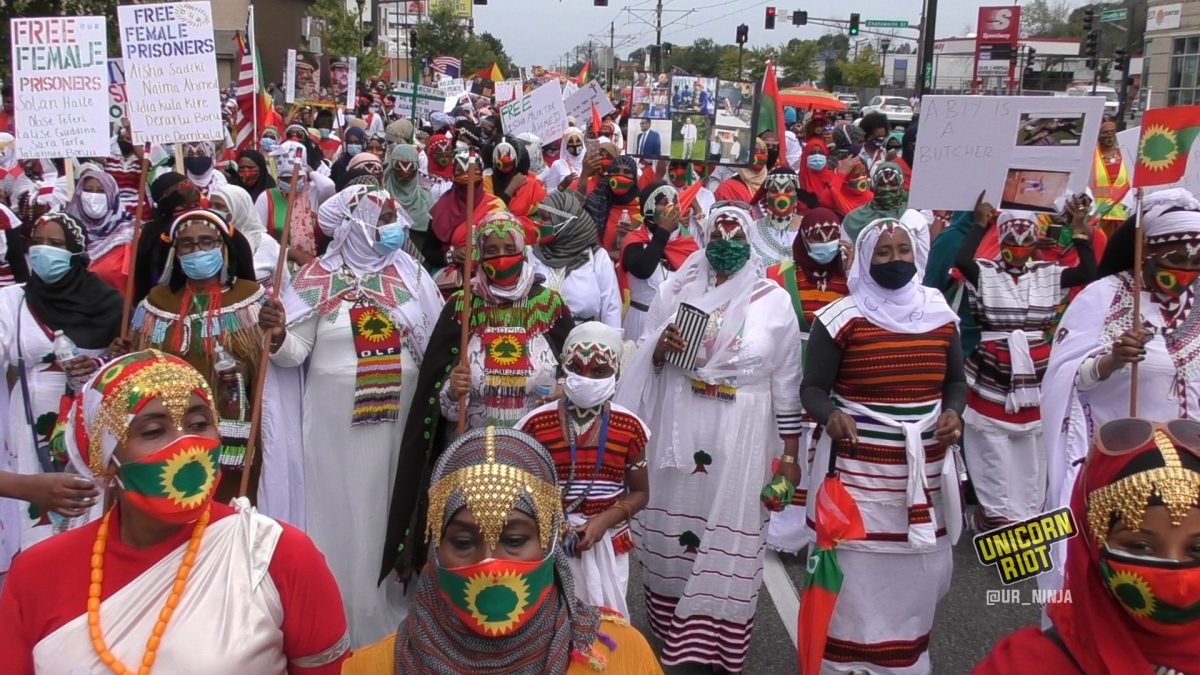
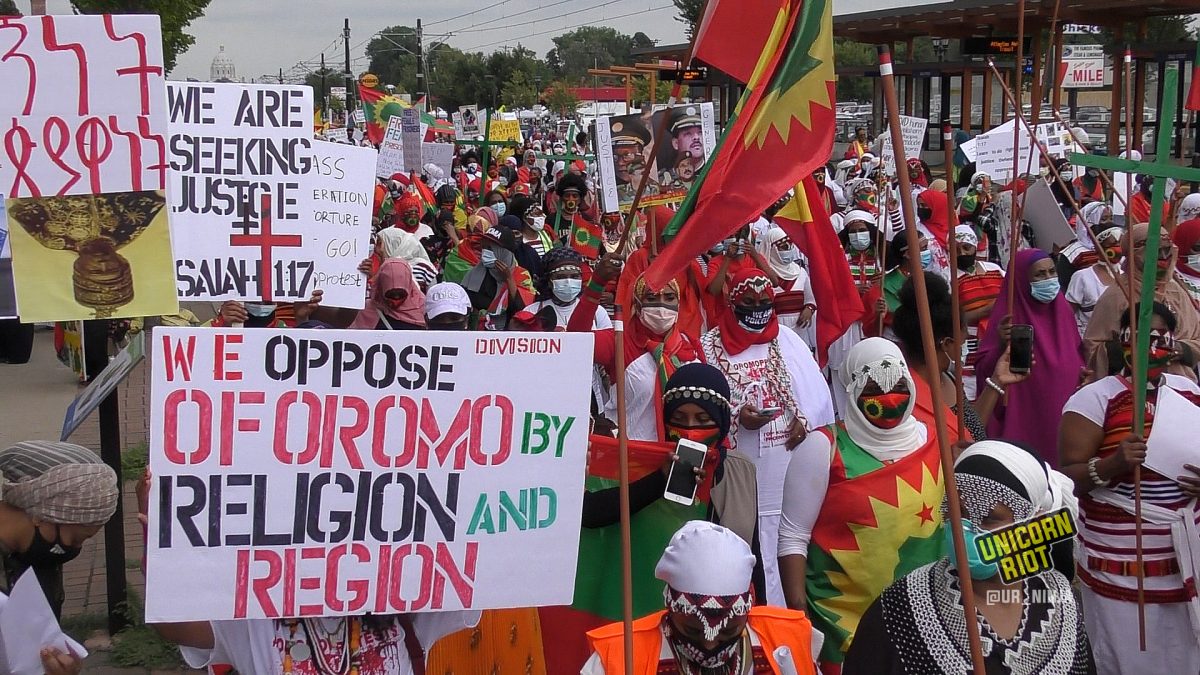
Oromo women marching down University Ave. in Saint Paul (photo taken August 7, 2020)
Dozens of demonstrations have occurred this summer in the Twin Cities metro area, including: protests and car caravans on the interstate; religious actions; women’s marches; hunger strikes; a 48-hour protest at the state capitol; and an ongoing occupation outside the new Ethiopian Consulate General office in St. Paul.
In August, Unicorn Riot reported from several Oromo protests—you can find the live streams below. During our coverage, we heard the opinions of many Oromo people, from youths to elders.
We listened for hours before and after the demonstrations. We heard of forced assimilation, of cycles of generational trauma and horror stories going from past generations leading up to newly arrived refugees who escaped persecution, torture, and possible death.
We also heard from Ethiopians who said they were against the protests, which they view as furthering an already-existing tension amongst ethnic groups in Ethiopia.
The following report links to some of the Oromo protests Unicorn Riot covered in Saint Paul during the summer of 2020 and attempts to contextualize some of the reasons behind them and this East African conflict.
Oromo Protests in Saint Paul–Minneapolis
Similar to the ‘qeerroo/qarree’ (youth) uprising that has occurred this summer in Ethiopia, Oromo youth in the Twin Cities are the driving force behind a movement demanding human rights for the Oromo people and justice for Hachalu.
In Saint Paul, Oromo youths with Qeerroo Minnesota have occupied an area outside of the Ethiopian Consulate on University Avenue since August 6. Their planned sit-in turned into an occupation of the property after workers in the consulate refused to meet with them.
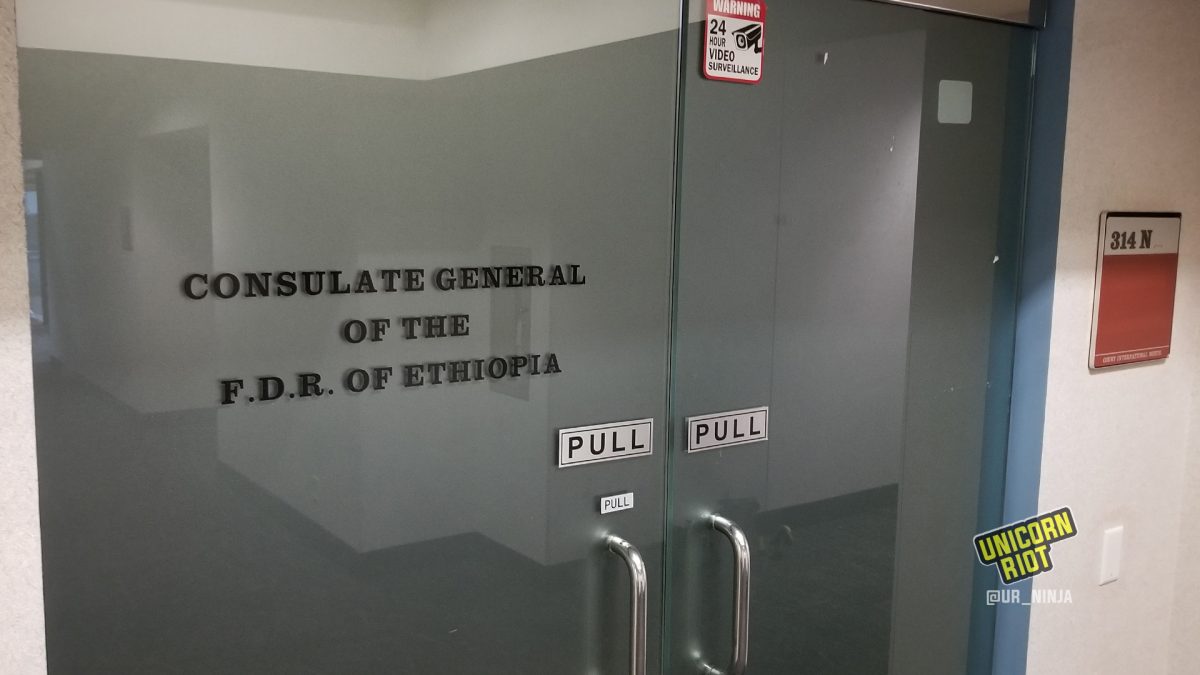
Doors of the Ethiopian Consulate in Saint Paul. Oromo youth continue an outside occupation of the building (photo taken August 6, 2020)
The qeerroo staged the occupation seeking to speak with the consulate, draw attention to what they deem human rights violations against the Oromo people, have an ongoing vigil space for Hachalu Hundessa, and to protest the government crackdown and detention of opposition leaders such as Jawar Mohammed and Bekele Gerba.
As the qeerroo and qarree set up their occupation on August 6, we streamed live from the steps of the building that houses the consulate. Oromo flags were flown and a large sign reading “Abiy Must Go,” referring to Prime Minister Ahmed Abiy, was placed in sight of the busy University Avenue.
Abiy is Ethiopia’s first Oromo prime minister. Though he was awarded the Nobel Peace Prize in 2019 for his efforts in brokering peace between Eritrea and Ethiopia, members of the Oromo diaspora are split when it comes to backing Abiy.
A constant demand during the Oromo protests is that Abiy and his administration resign and he be stripped of his Peace Prize due to his human rights violations.
One protester at the occupation emphasized that although the number of protesters that day in St. Paul was small, their worldwide energy was apparent.
Members of younger generations of the Oromo Diaspora have been rallying across the earth to demand an end to human rights violations in their homeland. Protests and occupations have taken place outside of Ethiopian embassies throughout Europe, including the embassy in Berlin, Germany:
“There’s a lot of protests going on, and I feel like this generation, our generation, will end it, you know?” — protester at sit-in outside Ethiopian consulate in St. Paul, August 6, 2020
Although the qeerroo in Minnesota said they’re demanding justice for the Oromo people, they were there “for humans in general. There’s a lot of human rights violations going on in this world.“
“We’re here for people in Kashmir; we’re here for Palestine; we’re here for #BlackLivesMatter; we’re here for the Uyghur Muslims who are suffering at the hands of the Chinese government. We’re here for all humans. But our people, Oromo people, they’ve have been suffering for so long. And it’s the government that’s been hurting our people—it’s systematic oppression.“
While the consulate is supposed to act as a conduit of access for Ethiopians in Minnesota to Ethiopian government officials, the youths said that the consulate was nowhere to be found after Hachalu’s assassination—hence the occupation at the embassy to demand a meeting.
The internet was turned off earlier this summer as turmoil, unrest, and violence swept areas of the Oromia region, making communication challenging for those in America with loved ones back home. People were not able to speak with ambassadors, and could only attempt to contact their family and friends through landlines.
Young child holds sign that says “Rest in Power Hachalu Hundessa” outside of the building that houses the Ethiopian Consulate (Photo taken August 6, 2020)
Many Oromo Minnesotans have family members who’ve been affected by the happenings in Ethiopia. On August 7, women organized a large march in protest of the repressive policies in Ethiopia and demanding freedom for political prisoners, and that the U.S. stop funding the Ethiopian government. Participants marched to Governor Walz’ residence from the Oromo Community Center in St. Paul.
During the women’s march in Saint Paul, one participant explained, “People are out here because there’s a huge government crackdown going on in Ethiopia. We also have minority groups that have been attacked.” The Ethiopian government, she said, is scapegoating protesters for the violence rather than investigating the hundreds of deaths that have occurred.
This journey for change has also steered its way onto Twin Cities highways. In one of the roadway takeovers, on August 12 (see below), dozens of vehicles crawled slowly along I-94 West in Saint Paul, stalling traffic during rush hour.
Many of the youth compared aspects of the movement for Oromo liberation to the movement for Black lives in the United States.
Asked about reports of buildings being burned down in the Oromia region of Ethiopia, one man used the example of the property set aflame in the George Floyd protests, saying:
“Oromo people are not just burning anything down. We’re trying to be heard. We’ve tried the peaceful protest. BLM has tried the peaceful protests, and nothing has been changed from that.” — Qeerroo organizer in Minnesota
After meeting with members of the consulate, organizers with Qeerroo Minnesota are no longer sleeping outside the building, but are still holding space in front of the embassy during business hours to continue to demand a public statement and to protest.
Assassination of Hachalu Hundessa
Imprisoned in Ethiopia at age 17 for political activities, Hachalu Hundessa released his first album in 2009, one year after his five-year sentence had ended.
Hundessa became increasingly popular as his songs about the struggles of the Oromo people struck a chord with the public. On June 22, 2020, a week before his murder Hundessa commented on the repression of Oromos during an interview on Oromo Media Network (OMN). After this he received intense criticism and threats on social media, which many say directly led to his death.
Hundessa was shot to death on June 29, 2020 in a suburb of Ethiopia’s capital city, Addis Ababa. The government claims members of the Oromo Liberation Front (OLF) perpetrated the assassination; the OLF has denied responsibility.
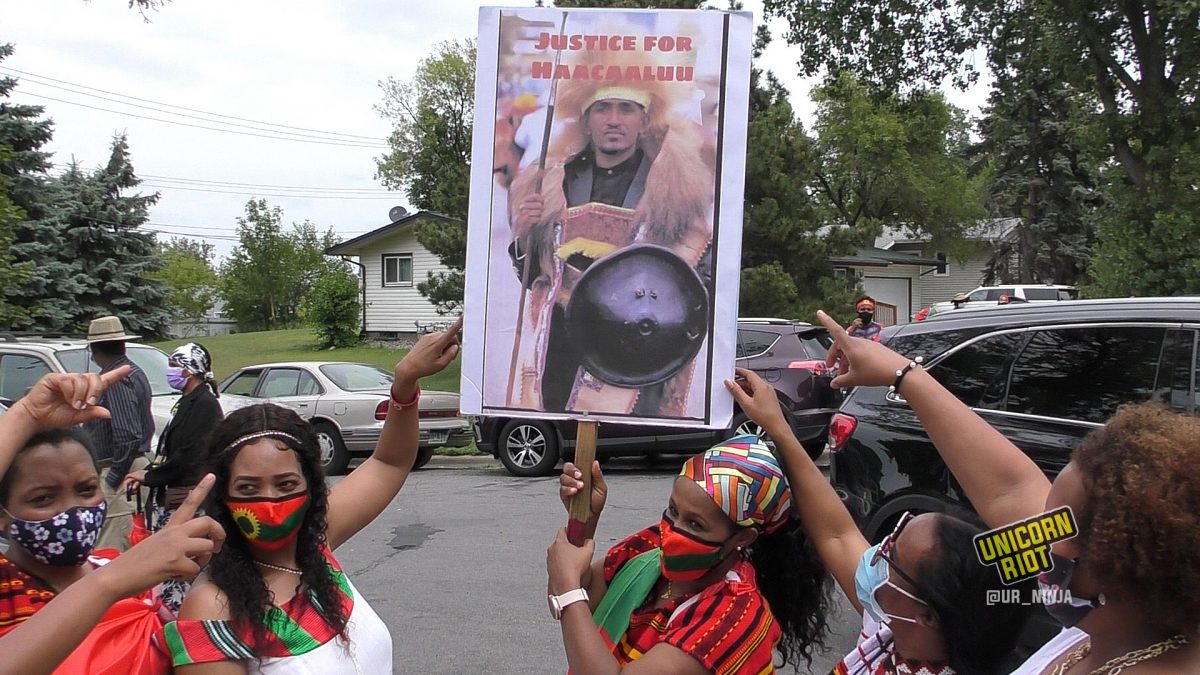
Oromo women point to a poster of Hachalu Hundessa before the August 7 Women’s March
Immediately after Hachalu’s murder, the Ethiopian government shut down the internet and arrested about 50 top-level government officials. Mass protests erupted. Buildings across dozens of districts were set ablaze and entire regions were wrought with intercommunal violence.
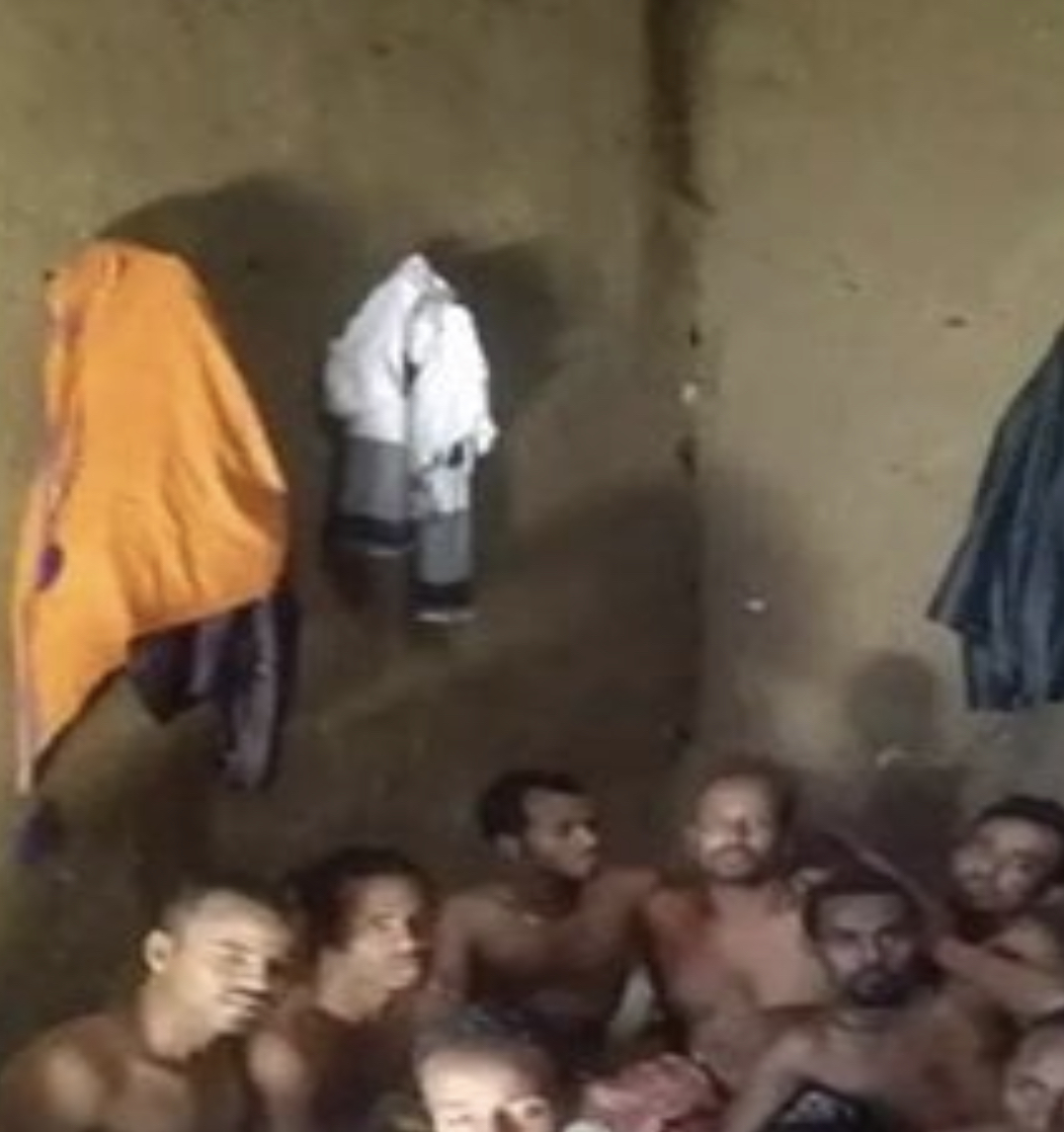
At least 5,000 people, mostly Oromo, were rounded up in the following days. Filling the jails, many more were locked up in the subsequent weeks, leading the government to set up makeshift jails in school buildings.
Hundreds of imprisoned people crowded together in close quarters during the COVID-19 pandemic has predictably led to more outbreaks of the virus. Community members at the Oromo Community Center of Minnesota allege that government forces have sent inmates who tested positive for coronavirus to jails with no infections in a deliberate attempt to spread the disease among Oromo protesters.
Oromia Media Network and Jawar Mohammed
Oromo Media Network, a nonprofit news organization headquartered in Minnesota, was created in part by a prominent leader of the 2016 Oromo protests and the ‘Qeerroo’ movement, Jawar Mohammed.
Educated at Stanford and Columbia University, 34-year-old Mohammed recently lived in Minnesota for some years before returning to Ethiopia in 2018 after Abiy became Prime Minister and lifted bans on opposition groups. Jawar stepped down from his role at OMN after setting up a branch in Addis Ababa, and joined the Oromo Federalist Congress to run for office in Ethiopia.
There is a notable lack of free press in Ethiopia. An interviewee during the women’s march explained to Unicorn Riot that the Ethiopian courts work with the government, and that lawyers don’t have “any right to advocate for the people.“
Itichaa Guddataa, a journalist formerly with OMN and now with Oromo Diaspora Media, said that ‘”there is no press freedom” and that journalists, bloggers, radio hosts, and others are locked up simply for reporting on Oromo news.
Since Jawar Mohammed’s arrest, OMN employees based in Addis Ababa have been detained by the Ethiopian federal government on suspicion of “operation of illegal communication equipment.” Several other journalists have also been recently arrested or detained.
As of this article’s publication, Jawar Mohammed is still incarcerated, along with a litany of other political prisoners.
In late August, two Minnesota politicians wrote a letter to Ambassador Nagy, the American ambassador to Ethiopia, condemning Ethiopia’s detention of Jawar Mohammed and Mishi Chiri. Misha also works with OMN and came to Ethiopia from Minnesota in 2018 with Jawar.
The politicians urged the State Department to take every appropriate action “to ensure that they [Jawar and Mishi] are treated humanely and assist them in protecting and exercising their full legal rights.“https://platform.twitter.com/embed/index.html?creatorScreenName=ur_ninja&dnt=false&embedId=twitter-widget-4&frame=false&hideCard=false&hideThread=false&id=1291833062867775488&lang=en&origin=https%3A%2F%2Funicornriot.ninja%2F2020%2Fyouth-lead-summer-of-oromo-protests-in-minnesota%2F&siteScreenName=ur_ninja&theme=light&widgetsVersion=219d021%3A1598982042171&width=550px
A week before the letter for Jawar and Mishi, 20 members of Congress, led by Congressman Dean Philips (D-MN), wrote to Secretary of State Mike Pompeo urging the U.S. administration to work with Ethiopia to ensure dialogue and political opposition to Prime Minister Abiy and among other demands, an independent investigation into Hundessa’s killing.
Oromia and Ethiopia
Oromia is a region in Ethiopia, the second-most-populated country on the African continent. The Oromo people are indigenous to east and northeastern Africa and historic regions of Oromia spread beyond Ethiopia into Somalia and Kenya.
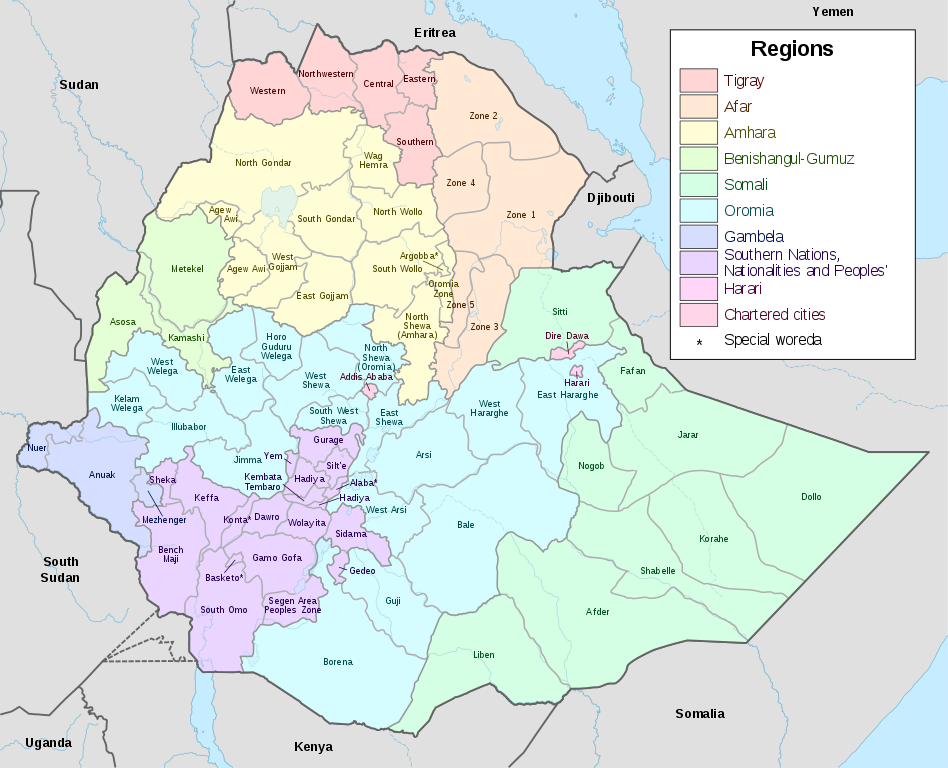
Ethiopia divided into regions and zones (sub-regions) the Oromia region is listed in blue. Image by NordNordWest (CC BY-NC-SA 4.0)
Ethiopia is the home of over 80 ethnic groups and multiple religions and languages. At about one-third of Ethiopia’s population, Oromo people make up the largest ethnic group in the country.
Historically rooted as one of the first Christian states in the world, over 60% of those living in Ethiopia are Christian, with another third of the population practicing Islam. Judiasm, Baháʼí, and traditional indigenous beliefs such as Waaqeffannaa are also practiced, among others.
The Oromo language is the most-spoken language in Ethiopia, yet Oromo is not recognized as an official federal language in the country.
Sign reads “We oppose division of Oromo by religion and region” at the women’s march on August 7, 2020 in Saint Paul, MN
While in the last 150 years Ethiopia has been celebrated for resisting white supremacist colonization, the country has continued to suffer through ethnic violence. Abyssinian rule in the 19th and 20th centuries laid out a continuing regime of systematic oppression against groups like the Oromo.
Oromo people are faced with forced assimilation in their homeland and an erasure of their history. Oromo have been branded by Abyssinians as outsiders and called the derogatory term ‘galla’, meaning ‘savage’, ‘slave’, or ‘enemy’.
Oromo youth outside the consulate in Saint Paul compared the Oromo people’s forced assimilation through religion, language, and cultural conversion to the genocide enacted on Indigenous North American populations by the United States.
Statutes of Emperor Menelik II have been targeted in Ethiopia, in a worldwide wave of colonialist statutes being toppled. In London, a bust of Haile Selassie and his father were both destroyed during the 2020 protests.
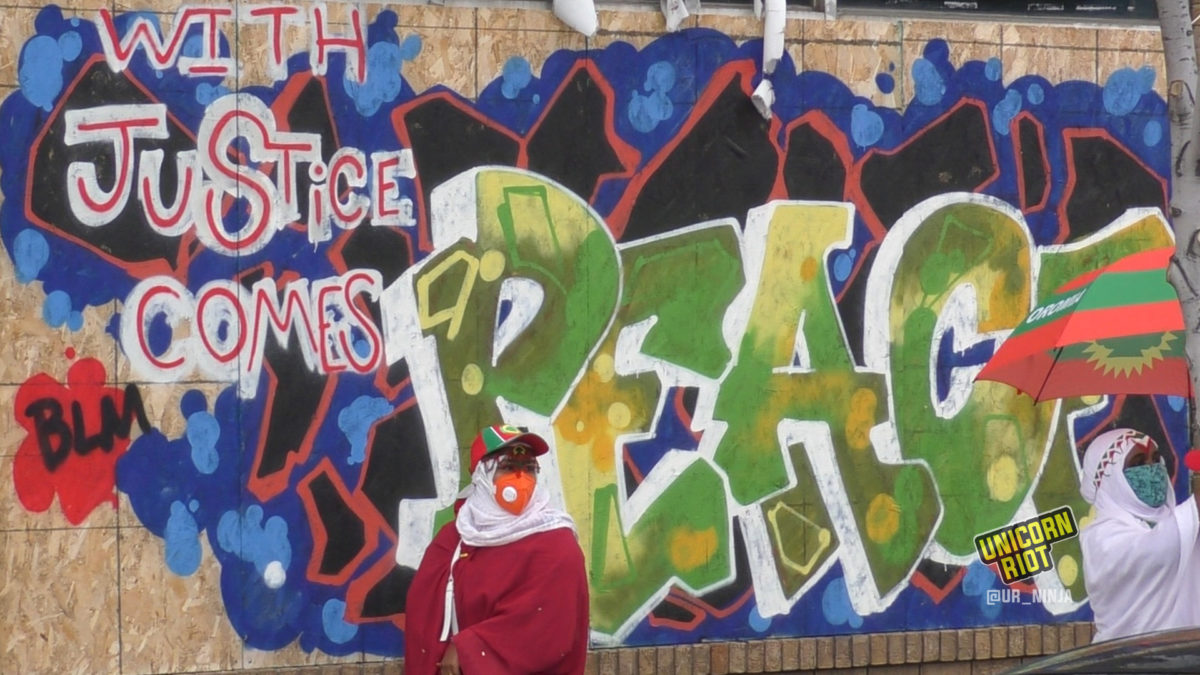
Oromo women stand in front of BLM mural saying “With Justice Comes Peace” on August 7, 2020 in Saint Paul, MN
Marginalization of Oromo-based political movements from national politics has continued into the 2000s. Massacres of Oromo and political activists have been perpetrated by the Ethiopian government numerous times in the last 20 years, including killings of hundreds in 2005 and 2015.
In 2016, mass Oromo protests were sparked from a government plan to take over Oromo land in and around the capital of Ethiopia, Addis Ababa. Hundreds were killed during the protests and thousands were jailed.
As new information out of Ethiopia is slowly gleaned, Oromo protests following Hundessa’s killing earlier this summer are continuing to happen in Oromia and across the world.
Continue to follow Unicorn Riot for further specials on the Oromo protests in Minnesota.
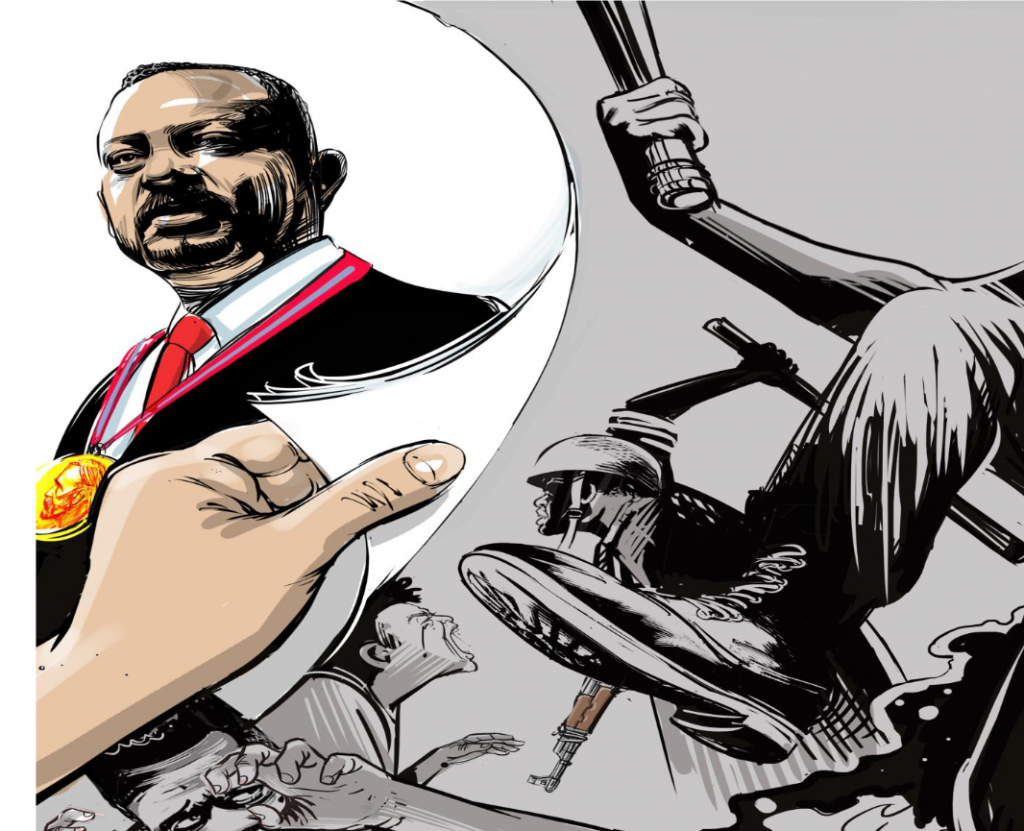
File photo: The Ethiopian soldiers standing on the neck of a dying student (A) and brutally kicking the necks and throats of a group of students (B) in Oromia region of Ethiopia. The lastest report by the rights group Amnesty International Issued Friday, May 29, 2020 a report that displayed the endless Ethiopian’s security forces of extrajudical killings, mass detantion, massive human right violations, proprety damages, burning unharvested crops, animals, wildlife, coffe plants, forest and homes in the restive Oromia region as the chemeleon reformist prime minister was awarded the ‘Nobel Peace Prize’.
New York Times reported about Mr. Abiy Ahmad’s factious reform of Ethiopia in the Horn (Matina, Oct. 11, 2019). Here are few of the facts, which are ironically incredible to learn the confusing political atmosphere of the African country where human right violations are still unbelievable. Apparently, the political transformation and the wrongly hailed reformers transformed the fake democracy of the TPLF regime to no democracy at all. Amnesty International highlighted a few credible facts related to the dysfunctional leadership of Abiy Ahmad in its latest report (amnesty.org/Index: AFR 25/2358/2020). However, the PM of Ethiopia blatantly disagreed with the quality report of Amnesty International. That is never a surprise to hear from Mr. Abiy, who has been committing shocking crimes against peaceful citizens including kids, elementary students, high school students (please look at the pictures A and B, gives the glimpse of shocking human right violations in the Ethiopian Empire but it is immoral and against the human value to list numerous images which we cannot post in public). Over 35, 000 students were dismissed from Universities in the entire nation just for being Oromo.
Abiy hijacked the multigenerational movement of the Oromo youth by unique political strategies. He started as a sympathizer of the marginalized people and representative of the Oromos until he secured power. The international community barley understands the Ethiopian politics, because it is complex and unique to the rest of the world. Most writers, bloggers and owners of medial are the beneficiaries of the dysfunctional system. Only a few are honestly describing the nature and the underlying problems of the Ethiopian Empire. For example, Amnesty International recently disclosed credible facts related to several in humane killings by security forces of Mr. Abiy Ahmad.
The Ethiopian politics is dysfunctional by nature because it was built on the pretext and pretentious political elites rhetoric supported by misguided powers. The political dramas of Ethiopia need a sincere attention of the international community. It is becoming the most disgraceful and dangerous for peaceful citizens and the Horn of Africa. The government of Ethiopia is terrorizing Oromos (Human Rights Abuses Committed by the Ethiopian Army in Different Parts of Ethiopia); the Oromos have been under command post since Abiy Ahmad took office, and at this critical time of Coronavirus pandemic, internet and telephone access has been limited or sometimes completely disconnected in the entire Oromia. The world must tell us if the definition of terrorism has a different meaning than what is happening to over 55 million Oromos where human is daily killed, tortured, even beheaded and thrown to wild scavengers like hyenas?
The prime minister of Ethiopia was a key security personnel of the Ethiopian ruling party Ethiopian People revolution Democratic front (EPRDF) who did not remember his regimes shocking crimes. He systematically manipulated the international community through systematic approaches and shrewdly trained political games of making plagiarized speeches directly taken from intelligent politicians like Barak Obama’s
or
Then he was wrongly praised by the western communities. Some of the purposeless politicians nominated him for noble peace prize that he won in early stage of his governance.
Abiy Ahmad is implementing terrorizing strategies which are chronic problems of Ethiopia. He is moving Ethiopia back to where it had been in 1950 and 1960s. His deception is incredibly dangerous that has been resulting in massive atrocity against humanity and significant violations of basic human rights; and his falling power is primarily restricted to the capital and to the state-controlled media.
Since Abiy Ahmed came to power the country’s ruling pattern has changed from pseudo civil administration to complete military marshals which evade the constitution of the country. He has been still using illegal ‘Command Post’ rule to control the most marginalized Oromos. The Oromo people are determined majority citizens of the country to dismantle lawlessness. He has been using all kind of inhumane strategies under his command post to weaken the refusal of the desperate and resolute Oromos for freedom. Abiy committed several unique crimes way more than the previous murderous tyrants; for example, his untrained security indiscriminately killing children, elderly, helpless mothers, students, entire family; his national Airforce is bombarding farmers and their cattle, burning unharvested crops, wildlife, and coffee plants. Whenever they are committing crimes, they cut all kind of public communication systems, internet and telephone (wireless and landline) connections in the entire Oromia. As the result, significant number of Ethiopian citizens, particularly the Oromos barley heard about Coronavirus (COVID-19). Clearly, the Ethiopian government is creating a dangerous territory where the emerging virus will continue to kill people and potentially keep the transmission of the deadly infections around the world.
The newest shameful political strategies of Abiy Ahmad are disgraceful and dangerous to the entire world.
The question that Abiy and his administration failed to understand is that ‘state terrorism’ can never be a wise strategy to unify and build a nation. Abiy himself publicly mention about the terrorism strategies of his previous TPLF led government during his parliament speeches; he publicly mentioned that the unsuccessful TPLF was terrorizing the people. We appreciated his honesty about that particular claim, in fact it was confirmed by WikiLeaks. The problem is, Abiy Ahmad repeated the same and even worst terrorism strategy. He failed to understand the fact that the multigenerational movement against inhumanity is unstoppable and will soon squib his regime easily. The Oromo people have been marginalized over 150 years and from the history of the naturally democratic Oromos that UNESCO registered in 2016, one can learn that as the tyrants get murderous against Oromos, the tougher and stronger they are becoming because their peaceful and welcoming mutual coexistence has been challenged Abiy’s misguided politics of hate. His counterproductive approaches to govern in Oromia will remain the nightmare of the illusionist politician who became a ‘Nobel peace’ laureate at the expense of the fearless Oromos particularly the ‘Qeerroos’. Qeerroo is unmarried youth in Oromo language, unfortunately the youth who transformed the political atmosphere in the Horn are massively targeted by the fake ‘Nobel peace’ laureate.
The international community, and donors of the baseless instability generator government must realize the ultimate outcome of the massive human right violation in Ethiopia. It will be regrettable again. The impacts of the evil actions we see against Oromos is shameful and the lawlessness of Abiy regime is becoming catastrophic against human values in the Horn and it must be condemned by all nations who have interest to maintain peace in Ethiopia and the region. We must fight lawlessness and we are calling the International community, United Nations, Human Rights Watch, International Legal Experts and interested individuals, groups or institutions to join our efforts to held criminals and massive human right violators accountable at the International Criminal Court (ICC). Abiy Ahmad hijacked the multigenerational movement to win a ‘Nobel prize, but he still prefers ignoring the importance of honest equality, democracy, respectful co-existence and collective respect to all human values. The world must tell us if there is a different definition of terrorism than what Abiy Ahmad is doing. He is designing a disgraceful suicidal network that will disintegrate the nation that is increasing the chances of inevitable civil war in Ethiopia.
Ethiopia’s Prime Minister Abiy Ahmed announces a failed coup as he addresses the public on television, June 23, 2019. The failed coup in the Amhara region was led by a high-ranking military official and others within the country’s military, he said.
ADDIS ABABA – Tension between Amhara and Tigray, two of Ethiopia’s most powerful regions, is increasing as the country approaches elections next year, says a new International Crisis Group report. The northern Tigray region, which ruled the country for nearly three decades, has been ostracized by the federal government in Addis Ababa, raising the risk of military conflict in the north. The two regions also share a contested border and are at odds over when federal elections should be held.
Increased competition involving Ethiopia’s patchwork of ethnic groups and political parties has been a hallmark of the government formed by Prime Minister Abiy Ahmed, due to greater social and political freedoms granted by his administration.
But it is the dispute between the Amhara and Tigray regions, the new report says, that “is arguably the bitterest of these contests, fueled in part by rising ethnic nationalism in both regions.”
FILE – Eritrean nationals Goitom Tesfaye, 24, left, and Filimon Daniel, 23, are pictured at their garage in Mekele, Tigray region, Ethiopia, July 7, 2019.
William Davison, the Crisis Group’s senior analyst for Ethiopia, tells VOA that Amhara citizens believe that several key zones, notably the Wolqait and Raya areas, were annexed by Tigray when the current Ethiopian federation was mapped out in the early 1990s.
“The problem has been there in some form for decades,” Davison said. “It flared up and became more prominent during the anti-government protests [between 2016 and 2018.] It has not gone away and it is simmering away as one of Ethiopia’s major inter-regional fault lines.”
Adding to the heightened tension, the Tigray People’s Liberation Front, the former ruling party, has threatened to hold its own regional election.
Plans to hold a vote have led political elites in Tigray and Amhara to adopt increasingly hardline stances toward each other, the report says, noting a recent warning from Prime Minister Abiy that any such act would “result in harm to the country and the people.”
Davison pointed out that relations between the TPLF and the federal government, to which members of the Amhara Democratic Party belong, are becoming “increasingly acrimonious.”
“People have to be seeking a compromise and we need a political atmosphere to seek that compromise,” Davison said. “But what I’m getting at is that we obviously do not have that, unfortunately, at the moment…Whilst we have that situation, it’s going to be hard to make any progress on this entrenched territorial dispute between Amhara and Tigray. So, the problem is simmering and it’s not going away and the worse that Tigray and TPLF relations get with other federal actors, the bigger potential risk there is that this problem with Amhara could turn into something more deadly.”
Numerous Amhara and Tigray officials, including Fanta Mandefro, deputy president of the region, did not respond to repeated calls for comment.
But Dessalegn Chanie Dagnew, chairman of the opposition National Movement of Amhara, said via a messaging app that Ethiopia’s regional map based on ethnic territories has been the root cause of many tensions, not just between the Amhara and Tigray regions, but many others.
“I would say it [violence] has happened in most of the areas and it’s not [unique] to the Amhara and Tigray regions,” Dessalegn said. “But still, in spite of all these things, I wouldn’t expect that there would be an open clash.”
To reduce tensions, the International Crisis Group recommends that the national boundary commission facilitate dialogue by providing information on the contested land and the two regions’ current and former demographics.
(A4O, May 29/2020,Oromia) – In a joint statement released by opposition parties Oromo Liberation Front (OLF) and Oromo Federalist Congress (OFC) on Amnesty International’s Report, the parties urged “the federal and regional authorities to take the report by Amnesty International seriously, heed the recommendations put forth and promptly reverse the government’s deeply troubling record on rights and liberty.”
In a report released today, Amnesty International said “Ethiopian security forces committed horrendous human rights violations including burning homes to the ground, extrajudicial executions, rape, arbitrary arrests and detentions, sometimes of entire families, in response to attacks by armed groups and inter-communal violence in Amhara and Oromia.” Graphic design: Amnesty International
“In a new report, Beyond law enforcement: human rights violations by Ethiopian security forces in Amhara and Oromia, Amnesty International documents how security forces committed grave violations between December 2018 and December 2019 despite reforms which led to the release of thousands of detainees, expansion of the civic and political space and repeal of draconian laws, such as the Anti-Terrorism Proclamation, which were previously used to repress human rights,” Amnesty International.
Below is the full text of the joint statement sent to Addis Standard.
In its first comprehensive report since Prime Minister Abiy Ahmed’s government came into office, Amnesty International has presented a detailed account of the gross human rights violations perpetrated by the Ethiopian security forces against dissidents and perceived political opponents particularly in the Oromia and Amhara regions.
The report titled “Ethiopia: Beyond Law Enforcement” and released on May 29, 2020, has precisely exposed the wanton destruction of property, rampant extrajudicial killings, arbitrary arrest and imprisonment of members of the opposition, mass detentions and forced political indoctrination, and the application of torture and gender-based violence by state actors as a means of stamping out dissent in the last two years.
The report is further proof that the new administration has not parted ways with the practice of forcefully stifling dissent, committing egregious human rights violations and carrying out extrajudicial killings common under its predecessor- he Ethiopian People’s Revolutionary Front- despite taking over in April 2018 off the back of a much touted promise to reform itself.
Although the report provides a very good and consolidated highlight of the continued human rights violations under the current regime, it doesn’t come close to disclosing the full extent of the horrendous abuses and gruesome atrocities committed by the security forces.
The report covers mostly the period up to the end of 2019. However, the situation in Oromia region specifically has gotten progressively worse this year (2020), with a substantial rise in mass incarcerations, extrajudicial killings and destructions of property in provinces that were not previously affected. The Amnesty Report highlights abuses carried out by the federal army. Nevertheless, the regime has also been using newly trained regional militia forces named ‘Liyu Police’ which have unleashed a reign of terror in parts of Oromia.
As we speak, these forces are carrying out gross human rights violations against political prisoners and perceived political adversaries, with some being held without due process, the whereabouts of many is still not known after their abduction and on several instances relatives are finding the human remains of some of the abductees in the bushes.
Reports of systematic disappearances and gruesome killings at the hands of security forces is a daily occurrence, particularly in western Oromia.
Therefore, we
Urge the federal and regional authorities to take the report by Amnesty International seriously, heed the recommendations put forth and promptly reverse the government’s deeply troubling record on rights and liberty.
Would like to remind the government that continuing along this dangerous path of wanton disregard for human life and dignity and rampant violation of rights will have far reaching consequences for the country.
Call upon local and international human rights organizations to conduct further investigations and expose the worsening situation across the country, particularly in recent months.
Call upon the international community to hold Ethiopian authorities to account for clearly reneging on their promise to help the country transition towards a peaceful and democratic order, and for choosing to chart an authoritarian path in keeping with the tradition of previous regimes.
Finally we would like to remind all stakeholders that human rights violations, the use of extrajudicial killings, torture and intimidation is what got Ethiopia into the current multifaceted socio-economic and political crisis.
Continuing with such abuse will only deepen the crisis, fracturing the society, paralyzing the economy and paving the way for potential disintegration of the country itself. Therefore, we urge the government to refrain from repeating mistakes by past regimes and ask internal development partners to exert maximum pressure to ensure the transition towards a democratic state is put back on track before it’s too late.
(A4O, 29 May 2020, Oromia) Prime minister Abiy Ahmed has been lauded for his democratic reforms. But Amnesty International are now urging him to investigate allegations of serious human rights abuses
A man waves an Oromo flag as people from the community gather in Addis Ababa in October 2019, on the eve of Irreecha, their thanksgiving festival. Photograph: Yonas Tadesse/AFP
Ethiopia’s Nobel peace prize-winning prime minister Abiy Ahmed has been urged to investigate allegations that state security forces have committed a raft of serious human rights abuses including torture and unlawful killings since he came to power in 2018.
According to a report by Amnesty International, published on Friday, Ethiopia’s military and police in its two most populous regions arbitrarily detained more than 10,000 people, summarily evicted whole families from their homes – some of which were burnt and destroyed – and in some cases were complicit in inter-communal violence targeting minorities.
Federal authorities have not responded to the report, which focuses on the period between January and December 2019 in the regions of Amhara and Oromia.
“Given the gravity and the duration [of the period in which abuses were reported] I cannot believe top officials are not aware of what was happening,” the report’s author, Fisseha Tekle, told the Guardian. “And if they are not then it is a dereliction of duty.”
In Oromia, security forces are waging a counter-insurgency campaign against rebels from the Oromo Liberation Army (OLA), an armed guerrilla movement demanding more autonomy for Oromos, which returned from exile in 2018 after Abiy removed it from Ethiopia’s list of terrorist organisations.
The move was part of a package of democratic reforms which won the prime minister widespread acclaim and, along with making peace with neighbouring Eritrea, secured him the Nobel peace prize last year. Shortly after becoming prime minister Abiy also confessed that security officials had in the past committed torture, and promised to ensure the sector was fully accountable in the future.
But the OLA has since returned to armed conflict, and accuses the government of failing to deliver its promises of more democracy and self-rule for Oromos.
Fighting in western and southern parts of Oromia has involved targeted killings of local officials and community leaders and what the UN has described as “serious human rights violations”. In Oromia’s Guji district the unrest had driven 80,000 people from their homes by the start of this year.
Amnesty said it had a list of 39 people suspected of supporting the OLA who had been unlawfully executed in two parts of Guji since January 2019. It also said that on a single day in December 2018, soldiers from the federal military killed 13 people in the town of Finchawa in West Guji. One of those killed was an old woman selling milk on the street, according to an eyewitness who spoke to Amnesty.
Security forces are estimated to have detained more than 10,000 men and women suspected of supporting or working for the OLA, among other abuses documented by the organisation.
Many were detained for several months without being charged, in violation of both national and international human rights laws, under conditions which at times amounted to torture, the report found. Detainees were made to undergo two months of “training” in subjects such as constitutionalism, the rule of law and the history of the Oromo people’s struggle.
In Amhara, according to the report, regional police, militia and local vigilante groups engaged in targeted attacks on ethnic Qemant, a minority group demanding more autonomy, in inter-communal violence which resulted in at least 130 deaths last year. In January 2019, at least 58 people were reportedly killed in less than 24 hours and buried in mass graves.
Nobody has yet been held accountable for the atrocity.
Amnesty said it had sought responses to its findings from nine government offices including the defence ministry and the attorney-general’s office but had only received a response from Amhara’s regional security bureau, which denied that state security forces had been involved in any atrocities.
The rights group called on the government to carry out full investigations into human rights violations and to order security forces to stop carrying out unlawful executions, arbitrary arrests and detention, as well as forced evictions and destruction of property belonging to people suspected of supporting opposition political parties or armed groups.
In February last year the former head of the Ethiopian army said it had embarked on “deep institutional reform” as part of the democratic changes sweeping the nation.
The head of the Ethiopian Human Rights Commission, Daniel Bekele, told the Guardian: “While the Amnesty findings and ongoing reports of killings and arrests in parts of Oromia region should be taken seriously and fully investigated, it is also important to understand the complex nature of the security operations where armed groups are seriously destabilising the affected areas.”
The prime minister’s office said it would put the Guardian’s request for official comment to the peace ministry, which did not respond in time for publication.
(A4O, 26 May 2020, Oromia) Arbitrary arrests and extra-judicial killings of political dissents continued in Ethiopia amid the looming danger of Covid-19 over the Country.
According to HRLHA’s Urgent Appeal, no progress to arrest of political dissents in Oromia. “Arbitrary arrest and forced disappearance of political dissents have been escalating throughout Oromia region compared to other regions of the country at this critical moment when the danger of Corona virus is highly threatening the country.”
HRLHA also revealed the details of many innocent citizens, supporters and members of the two vanguard oppositions namely Oromo Federalist Congress (OFC) and Oromo Liberation Front (OLF)
who have been languishing in different known and unknown detention centers for several months.
“Hundreds have been mercilessly killed and even some of them were denied burial and eaten by hyena,” says the appeal.
According to the HRLHA’s argent appeal, journalists of Sagalee Qeerroo Bilisummaa Oromoo (Voice of Oromo Youth for Freedom) among others, Adugna Kesso and Gada Bulti; as well as Oromia News Network (ONN) journalists Dasu Dula and Wako Nole were arbitrarily arrested, denied safeguards of due process of law and remain suffering behind the Bar.
It also added that top OLF leadership and senior members such as Kayyo Fufa, Yaasoo Kabada, Dandi Gabroshe, Efrem Geleta, Mo’a Abdisa, Tariku Abdisa, Bayana Ruda (Prof), Aliyi Yusuf, Abdi Ragassa, Batire File, Gada Gabisa, Blisumma Ararsa, Olika Chali etc have been languishing in known and unknown prisons for several months without charge.
This Urgent Appeal addresses recent detailed arbitrary arrests, extra judicial killings and physical assaults where each cases are substantiated by photograph and important facts of the violations.
(A4O, May 4, 2020) The National Electoral Board of Ethiopia has announced that it will be unable to conduct the 2020 national elections due to the COVID-19 pandemic. Subsequently, the House of Peoples’ Representatives approved the election postponement. According to the constitution, the term of office of government is five years, which means that the current government’s constitutional mandate will come to an end on 10 October 2020. With that in mind, the government has tabled four proposals as potential remedies to manage the power vacuum that would occur when its current term expires on October 10. After a careful and considered review of the proposed alternatives, we, the undersigned parties, issue the following statement.
The constitution makes it clear that power should be acquired only through a periodic election conducted every five years, and the term of office of a government is strictly five years. The electoral board has announced that it will not be able to conduct the election before the current government’s term of office expires. And there is no legal basis that will allow the government to legitimately remain in power past 10 October, even for a single day.
We have carefully reviewed the four possible solutions proposed by the government to manage what would ultimately become a constitutional crisis. We have concluded that none of the presented options provide a legal basis to extend the mandate of the current government beyond its five-year term limit in the event that the national elections, albeit due to understandable reasons, are not held on time. The constitution does not allow for the declaration of a state of emergency specifically to postpone an election or extend a government’s term. The dissolution of parliament pursuant to Article 60 only allows for an election to be held prior to the expiry of the five-year term. This article cannot be invoked to allow term extensions beyond five years. Undertaking a constitutional amendment in order to add an article or clause that would allow the postponement of an election and/or the extension of term of office does not only negate the spirit of the constitution, it is a complex process that requires public debate and deliberation that cannot be undertaken during a pandemic in any meaningful way.
The fourth option, constitutional interpretation, which is favored by the government, is not a legal and legitimate reason to postpone the election or extend the incumbent’s term. Although the House of Federation has the power to interpret the constitution, it can only do so on disputed issues contained within the constitution. Unfortunately, the constitution does not stipulate a mechanism for the postponement of elections or extension of terms of office. Furthermore, constitutional interpretation by a legislative body overwhelmingly controlled by a single party, whose members were elected through an election that we know was rigged, amounts to imposition of the will of a single party. Hence, if anything, this option erodes the legitimacy of this government even more, rather than lending it credence.
It is our view that, in order to collectively and effectively combat the pandemic while preparing for the election, the best and only option is to seek a national consensus among political parties in order to legitimately fill the looming power vacuum.
We would like to strongly stress that extending the term of government by any other means lacks political or legal legitimacy and could lead to a political as well as a security crisis, which the country cannot afford at a time where it needs a unified front to overcome the multifaceted challenges posed by the pandemic.
In order to find a legitimate solution for the impasse through achieving a national consensus, we believe these principles should be put into practice:
The deliberation and negotiation should involve all political parties that are registered and qualified to participate in the 2020 election.
The deliberation and negotiation should be facilitated by entities who do not have direct involvement in electoral affairs and do not have a vested interest in the outcome.
The final agreement reached by the parties should be binding.
After years of struggle and sacrifice by the Ethiopian people, it was two years ago that we embarked on a transition that we all hoped would usher in a new era of democracy. Unfortunately, negotiations and deliberations which would be vital for a successful transition were not undertaken. Consequently, as we get closer to the election, tension has begun to rise and the political space has further narrowed, dashing the hopes for a successful transition to a democratic order through a free and fair election.
The postponement of the election due to the pandemic can be used as another opportunity to seriously deliberate, correct mistakes made over the last two years, and put the transition back on track. Therefore, we call upon all parties to seize this opportunity and sit for a roundtable deliberation to seek a legitimate political consensus on how to manage the constitutional crisis the country is facing. To this effect, we have prepared a detailed proposal and action plan in line with this recommendation, which we will present at the negotiation forum once it is convened upon acceptance.
Co-signing members of the Coalition of Democratic Federalism:
(Oromia, April 25, 2020) The Human Rights Watch and The Human Rights League of the Horn of Africa (HRLHA) expressed their deep concern over the potential outbreak of a notorious deadly disease, Coronavirus(COVID-19) at Ethiopian prisons.
Several political prisoners are confined in Federal concentration camps and police stations in different parts of the country including the Capitaland surroundings, Ambo, Nekemte, Kelem in Western,Chiro, galamso, Dederand Bosetin the Eastern, Gondor in NorthernEthiopia.Moreover, ElzabethKebedeattorney at law and journalists including DesuDula, Wako Nole and YayesewShimelis were detained from the capital city, Addis Ababa. CPJ and the Amnesty International condemned the arrest of the journalists in the country and requested for immediate release of all political detainees.
At this moment, when the whole world is fighting against the common enemy, COVID-19, politically motivated mass arrests, kidnappings and harassment of members and supporters of Oposition Political Organizations, civic society members and journalists by the Ethiopian government military must be condemned by the World Health Organization, UN Human Rights Council and the world at large. Because of the overcrowded and squalid prisons at the detention centers,the spread of COVID-19 in the detonators and make the control of the disease difficult later on.
As whole know, infectious diseases in prisons are a serious public health problem,inmates are crammed into small prison cells with many others, particularly in Ethiopia. Even in facilities that aren’t deemed overcrowded, there is inadequate nutrition, and poor sanitation where detainees in concentration camps suffer from health problems, putting them at particular risk of the COVID-19 pandemic. In order to inform this situation, the Ethiopian Diaspora community condemned through serious demonstrations all over the world. Among them, theDiaspora community of Canada condemned the situation in the country and shown solidarity by organized large demonstration in the capital city of Canada, Ottawa on February 16, 2020.
Therefore, this is toimpose to stop brutalities being perpetrated by the governmentsecurity force against the civil society, members and supporters of political opposition parties. In addition, we insist on unconditionally release of all arbitrarily detained journalists, officials, members and supporters of opposition political parties to stop the potential spread of this pandemic COVID-19.
Advocacy for Oromia was established in 2010 with the purpose of enabling and empowering Oromo people by providing accurate and timely information that will help to make better choices to create the kind of future in which they wish to live.
It also provides information focus on the major issues facing us in the 21st century and it is going to try and bring a balanced approach with factual information that is positive and solution based.
The website has been in operation for the last nine years with the mission of promoting and advancing causes of Oromo people through advocacy, community education, information service, capacity building, awareness raising and promotion.
The website is also the official site of Advocacy for Oromia Association in Victoria Australia Inc., a non-profit organisation, registered under the Associations Incorporation Reform Act 2012 in Victoria as April 2014.
Our team already had considerable community development experience and expertise. Our various projects helped to develop our confidence and the capacity of our agency. Our team used every gained knowledge, skills and experiences as an opportunity to design and develop new approaches, to documenting progress, supporting positive employment outcomes, liaising with community stakeholders, and conduct evaluation.
Advocacy for Oromia is devoted to establishing Advocacy for Oromia organisation to close the gaps where we can stand for people who are disadvantaged and speaking out on their behalf in a way that represents the best interests of them. We are committed to supporting positive settlement and employment outcomes for Victoria’s Oromo community.
Advocacy for Oromia Office
Addresses:
39 Clow St,
Dandenong VIC 3175
=====================
247-251 Flinders Lane
Melbourne VIC 3000
Activities Address
Springvale Neighbourhood House Inc
Address: 46-50 Queens Ave, Springvale VIC 3171
Postal Address:
P. O. Box 150
Noble Park, Vic 3174
With your support, we can continue to help community build a better future.
Advocacy for Oromia Mental Health Program
The aim of the program is to improving the mental health and well-being of Oromo community in Victoria. It aims to assist those experiencing, mental ill-health, their families and carers of all ages within this community to address the social determinants of mental health for Oromo community. It helps:
Identify and build protective factors,
Reduce stigma and discrimination
Build capacity for self-determination
Better understand mental wellbeing, mental ill-health and the impacts of trauma
The goal of the project is to increase mental health literacy of Oromo community that aims:
To assist people with mental health issues
To increase the capacity of mental health worker
To better understand mental wellbeing
To provide mental health education and information
To address the social and cultural causes of mental health issues
Advocacy for Oromia will organise information session, women performance, radio programs, culturally adopted conversations on Oromo Coffee Drinking ceremony, providing training for mental health guides and forum and producing educational materials on the selected groups and geographical area.
Human Rights Education Program
The Human Rights Education Program is a community based human rights program designed to develop an understanding of everyone’s common responsibility to make human rights a reality in each community.
Human rights can only be achieved through an informed and continued demand by people for their protection. Human rights education promotes values, beliefs and attitudes that encourage all individuals to uphold their own rights and those of others.
The aim of the program is to build an understanding and appreciation for human rights through learning about rights and learning through rights. We aimed at building a universal culture of human rights. Thus, we aimed:
To build an understanding and appreciation for human rights through learning about rights and learning through rights.
To build capacities and sharing good practice in the area of human rights education and training
To develop human rights education and training materials and resources
The goal of the project is to increase human rights literacy of Oromo community that aims:
To better understand human rights
To increase the capacity of human rights worker
To analyse situations in human rights terms
To provide human rights education and information
To develop solidarity
To strategize and implement appropriate responses to injustice.
The ultimate goal of education for human rights is empowerment, giving people the knowledge and skills to take control of their own lives and the decisions that affect them.
Human rights education constitutes an essential contribution to the long-term prevention of human rights abuses and represents an important investment in the endeavour to achieve a just society in which all human rights of all persons are valued and respected.
Advocacy for Oromia will organise information session, performance, radio programs, culturally adopted conversations on Oromo Coffee Drinking ceremony, providing training for Human Rights guides and forum and producing educational materials on the selected groups and geographical area.
Community Safety Program
The program aims to strengthen existing collaborations and identify opportunities for the development of partnerships aimed at community safety and crime prevention activities. This approach seeks to improve the individual and collective quality of life by addressing concerns regarding the wider physical and social environment. Importantly, community safety means addressing fear of crime and perceptions of safety as without this any actions to address the occurrence of crime and anti-social behaviour are of less value.






 S
S



 Advocacy for Oromia