Daily Archives: June 15, 2026

The Voice of Freedom: How Sagaleen Bilisummaa Oromoo Amplifies the Oromo Struggle

By Daandii Ragabaa
In the vast and complex landscape of the Oromo liberation movement, few tools are as powerful as the human voice. But when that voice is broadcast—amplified, repeated, and carried across borders, across battlefields, and across generations—it becomes something more than sound. It becomes a weapon. It becomes a comfort. It becomes a call to awaken.
This is the enduring role of Sagaleen Bilisummaa Oromoo (The Voice of Oromo Freedom).
For decades, this media platform has served as one of the most vital organs of the Oromo liberation struggle. Whether through radio waves that cross national boundaries, through digital content that reaches the global diaspora, or through the whispered sharing of cassette tapes in the dark years of repression, Sagaleen Bilisummaa Oromoo has been a constant companion to the Oromo people in their long march toward self-determination.
Strengthening the Struggle
The primary mission of Sagaleen Bilisummaa Oromoo has always been clear: to strengthen the Oromo liberation struggle.
In practical terms, this means providing a platform for the Oromo Liberation Front (ABO) and other Oromo political and civic actors to communicate directly with the Oromo people, without the filtering, distortion, or outright censorship that characterizes state-controlled media. It means broadcasting news from the frontlines, whether those frontlines are military, political, or cultural.
In the armed struggle years, Sagaleen Bilisummaa Oromoo was often the only source of information about the progress of Oromo fighters, the atrocities committed against civilians, and the diplomatic efforts being made on behalf of the Oromo cause. Families separated by war and exile could listen to the same broadcast and know that they were not alone.
Even in periods of relative peace and political openness, the Voice of Oromo Freedom continues to play this role. It holds the movement accountable. It debates strategy. It remembers martyrs. It celebrates victories, however small.
Awakening the Oromo People
But strengthening the struggle is only part of the mission. Sagaleen Bilisummaa Oromoo also exists to awaken the Oromo people—to dammaqsuu.
This awakening is both political and psychological. For generations, the Oromo people were told that their language was not fit for official use, that their history began with conquest, and that their identity was a threat to Ethiopian unity. This systematic campaign of erasure created a people who, in many cases, had internalized their own marginalization.
Sagaleen Bilisummaa Oromoo works to reverse this damage. It broadcasts Oromo poetry that stirs the soul. It tells Oromo history that textbooks omit. It gives voice to Oromo scholars, artists, and activists who articulate a vision of Oromo dignity and self-respect.
To listen to Sagaleen Bilisummaa Oromoo is to hear a different narrative—one in which the Oromo are not victims of history but agents of their own destiny. This is not propaganda. This is the restoration of a truth that has been deliberately suppressed.
When an Oromo farmer in a remote village hears his language spoken with authority and respect on the radio, something shifts inside him. When an Oromo student in the diaspora hears the names of Oromo heroes recited alongside the great liberators of the world, she understands that her people belong in the company of nations. This is awakening.
Proclaiming the Goal of Freedom
Finally, Sagaleen Bilisummaa Oromoo serves as a constant reminder of the ultimate objective: Kaayyoo Bilisummaa Oromoo—the goal of Oromo freedom.
The Oromo struggle has, at different times, been characterized in different ways. Some have framed it as a demand for human rights within a united Ethiopia. Others have articulated it as a quest for self-determination up to and including secession. Still others have focused on cultural and linguistic rights, economic justice, or political representation.
Through all these variations, Sagaleen Bilisummaa Oromoo has consistently held the line on the fundamental principle: the Oromo people have the right to be free. What that freedom looks like—whether a federal arrangement, a confederation, or an independent Oromo state—is a matter of political discussion. But the right itself is non-negotiable.
By consistently broadcasting this message, the Voice of Oromo Freedom ensures that the goal is never forgotten. In periods of political co-optation, when Oromo elites are tempted to trade long-term freedom for short-term positions, Sagaleen Bilisummaa Oromoo reminds listeners of the martyrs who died for the cause. In periods of despair, when the struggle seems endless and victory distant, it reminds listeners that freedom is not a gift to be requested but a right to be claimed.
The Evolution of the Voice
Sagaleen Bilisummaa Oromoo has not remained static. Like the struggle it serves, it has evolved with the times.
In the early decades, the Voice often operated clandestinely, broadcasting from neighboring countries, using makeshift equipment, and reaching audiences through shortwave radio. The signal could be weak. The hours were limited. The risk of jamming or retaliation was constant.
But the audience was loyal. Oromo families would gather around radios at specific times, turning the volume low to avoid detection, listening to every word. The Voice was a lifeline.
Today, Sagaleen Bilisummaa Oromoo has expanded into digital platforms. It reaches the global Oromo diaspora through social media, streaming services, and websites. Young Oromo who have never used a shortwave radio can access the same content on their smartphones. The technology has changed, but the mission remains.
Challenges and Resilience
Operating as a voice of liberation is never easy. Sagaleen Bilisummaa Oromoo has faced jamming, legal harassment, and political pressure from successive Ethiopian governments. Its journalists and broadcasters have been targeted. Its infrastructure has been attacked.
Yet, like the Oromo people themselves, the Voice endures.
Each time the signal is blocked, it finds a new frequency. Each time a broadcaster is silenced, another steps forward. The resilience of Sagaleen Bilisummaa Oromoo is a testament to the depth of the Oromo people’s commitment to their own liberation.
A Call to Listen
For those who are already part of the Oromo struggle, Sagaleen Bilisummaa Oromoo needs no introduction. It is a familiar companion, a trusted source, a rallying cry.
But for the younger generation—those who have grown up in the diaspora, those who have been disconnected from Oromo language and culture, those who are only beginning to understand the meaning of Oromummaa—the Voice of Oromo Freedom is an essential resource.
To listen is to learn. To learn is to understand. And to understand is to join the struggle, whether through political activism, cultural preservation, or simply the determination to live with dignity and pride.
Conclusion
Sagaleen Bilisummaa Oromoo is more than a radio station, more than a website, more than a collection of broadcasts. It is a living institution of the Oromo liberation movement. It is a witness to history. It is a voice that refuses to be silenced.
As the Oromo people continue their long journey toward freedom, the Voice will be there—broadcasting the news, awakening the consciousness, and proclaiming the goal.
Sagaleen Bilisummaa Oromoo – the voice that will not be stilled.
Daandii Ragabaa, reporting on Oromo liberation media.
Sagaleen Bilisummaa Oromoo: Qabsoo humneessuu, Ummata dammaqsuu, Kaayyoo beeksisuu.
(The Voice of Oromo Freedom: Strengthening the struggle, awakening the people, proclaiming the goal.)

The Voice That Would Not Be Silenced: How Sagalee Bilisummaa Oromoo Strengthened a Nation’s Liberation Struggle

The year is 1988.
Across the vast highlands of Oromia, state radio broadcasts only the official narrative in Amharic. Afaan Oromo—the mother tongue of Africa’s largest stateless nation—is banned from schools, courts, and airwaves. To speak it publicly is to invite suspicion. To seek liberation is to risk death.
But on June 15 of that year, a faint signal crackles through the static. It speaks in the forbidden language. It carries news the regime does not want heard. It names names, gives dates, and whispers hope.
The voice belongs to Sagalee Bilisummaa Oromoo (SBO)—the Voice of Oromo Liberation.
For 38 years—from 1988 to 2026—that voice has done what armies alone cannot. It has strengthened the Oromo liberation struggle, mobilized a scattered nation, and spread the goals of freedom across borders and generations.
—
I. Strengthening the Struggle: ‘More Than a Quarter-Century of Contribution’
In May 2023, as the Oromo Liberation Front (OLF) prepared to mark the 35th anniversary of SBO’s founding, the party issued a statement that captured the radio’s essential role. “Launched on June 15th 1988, SBO/VOL has been contributing a lot in the long journey of Oromo struggle for freedom,” the OLF said, “despite several relentless attempts of the enemy to quit the media”.
That phrase—“despite several relentless attempts”—is not rhetorical. Over nearly four decades, successive Ethiopian regimes have tried to jam SBO’s shortwave frequencies, block its diaspora websites, and intimidate its journalists. In 2013, on World Press Freedom Day, observers noted that “Afan Oromo shortwave radios, such as VOA and SBO…are under constant threat of jamming by the Ethiopian regime”. Countless Oromo journalists have been harassed, imprisoned, or exiled. Independent Oromo newspapers were closed down. But SBO endured.
Why? Because in a country where “internet is rare, satellite communication is unthinkable, TV is a luxury and FM is unknown, a shortwave radio still remains the only and an effective media outlet”. For rural Oromo families without electricity or cell service, the crackling voice from abroad was the only window onto a world where their language and their liberation mattered.
Senior SBO journalist Obbo Tolera Adaba, who has served the station since its inception, put it simply: “In a liberation struggle, media is alpha and omega”. Without information, there is no strategy. Without analysis, there is no direction. Without a voice, there is no nation.
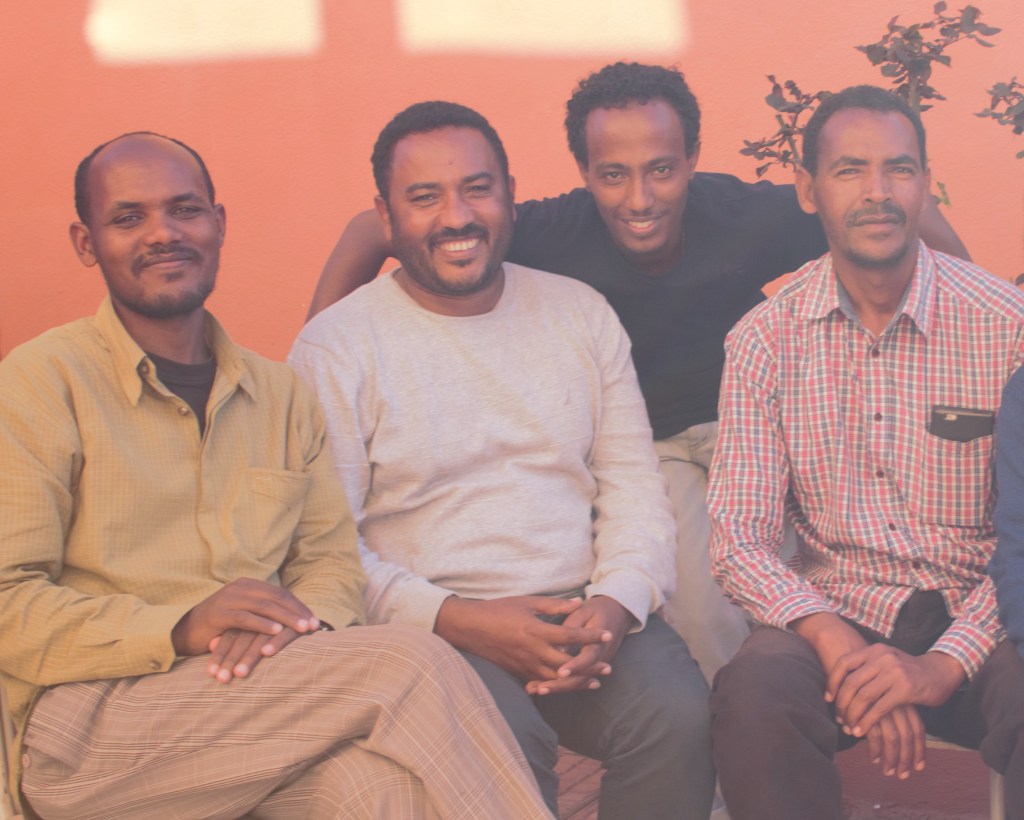
File: Miseensota SBO garii waliin bara 25/12/2016 keessa, Asmaraa
II. Mobilizing the People: Informing, Organizing, Inspiring
The OLF’s anniversary statement identified three interconnected functions that SBO has performed for nearly four decades. The station’s “quarter-a-century contribution,” the party said, has been in “informing, organizing and inspiring the Oromo nation for the struggle to self-determination”.
Informing: SBO broke the state’s information monopoly. It reported massacres, land seizures, political arrests, and the realities of military occupation that Ethiopian media ignored. It gave Oromo listeners facts their own government denied them.
Organizing: The radio broadcast practical information—meeting times, protest calls, strategies for resistance. It explained OLF’s political program, its vision for self-determination, and the legal and historical arguments underpinning Oromo nationhood. In a society denied political education, SBO became an open university.
Inspiring: Perhaps most crucially, SBO normalized Afaan Oromo as a language of serious political discourse. It broadcast Oromo poetry, music, and oral traditions. It reminded listeners that their identity was not a shameful secret but a proud inheritance. For countless Oromo families, tuning into SBO was an act of quiet rebellion—a refusal to accept erasure.
One grandson’s memory captures this intimacy. In a 2014 essay, an Oromo writer recalled how his grandfather “had a habit of making the entire family tune into his favorite radio station: The Voice of Oromo Liberation”. The grandfather would crank up the volume, urging his children and grandchildren to learn Afaan Oromo. The station broadcast daily in both Afan Oromo and Amharic“>. “Despite living in Finfinne most of his life,” the grandson wrote, “he never lost touch with his Oromo heritage”. SBO was the thread connecting him to a nation that official Ethiopia pretended did not exist.
—
III. Spreading the Goals of Oromo Liberation: A Blueprint for Freedom
SBO has never been merely a news service. From its inception, it has served as the official media organ of the Oromo Liberation Front, and its broadcasts have consistently advanced the core goals of Oromo self-determination.
What are those goals? As articulated by the OLF over decades, they include: the right of the Oromo people to political self-determination; the recognition of Afaan Oromo as a language of governance and education; the protection of Oromo cultural and historical sites; and the establishment of a democratic system that reflects Oromo values—values the Gadaa system has embodied for centuries.
SBO has spread these goals through:
– Political education: Explaining the legal and moral case for self-determination under international law.
– Historical recovery: Broadcasting Oromo history as Oromo historians write it, not as imperial chronicles distorted it.
– Cultural affirmation: Playing Oromo music, poetry, and oral traditions that state media ignored.
– Call to action: Announcing protests, mobilizing diaspora support, and coordinating with liberation forces on the ground.
In 2023, the OLF called SBO’s upcoming anniversary “a historical event with our people in Oromia and around the world”. The party thanked “those who have made unforgettable contributions to keep SBO staying on air to this very day” and called on supporters to donate, share ideas, and keep the radio alive.
—
IV. The Unfinished Work: A Voice Still Needed
Today, as SBO marks its 38th anniversary on June 15, 2026, the struggle is not over.
The Ethiopian state has undergone significant political changes since 2018, including the rise of Prime Minister Abiy Ahmed and a partial opening of political space. Some exiled media have returned. Some Oromo political prisoners have been released. But the fundamental question of Oromo self-determination remains unresolved. Independent Oromo media still cannot operate freely inside Oromia“>. And SBO continues to broadcast from abroad—six days a week, on shortwave and digital platforms, paid for by Oromos and friends of the Oromo people“>.
The station’s mission, as articulated in its founding charter, remains unchanged: “to promote awareness in peace and democracy, disseminate knowledge in elementary health care, environmental protection, and gender equality, and broadcast information on improved methods in agriculture, animal husbandry and rural development”. But beneath those practical goals lies a deeper purpose: to keep alive the idea that the Oromo people deserve to govern themselves, in their own language, under their own laws.
—
Conclusion: ‘Alpha and Omega’
On June 15, 2026, somewhere in the Oromo diaspora—in Minneapolis, in Toronto, in Berlin, in Nairobi—a grandfather will turn on his shortwave radio. He will crank up the volume. His grandchildren will roll their eyes. But the voice will come through, crackling and defiant, the same voice that has spoken for 38 years.
That voice has strengthened the liberation struggle when armies faltered. It has mobilized a scattered people into a political nation. And it has spread the goals of Oromo freedom across generations and continents.
In a liberation struggle, as Obbo Tolera Adaba said, media is alpha and omega—the beginning and the end. For the Oromo people, Sagalee Bilisummaa Oromoo has been both.
Baga Guyyaa SBO 38ffaa isin gahe! Congratulations on the 38th anniversary.
— Adda Bilisummaa Oromoo (ABO)
June 15, 2026
Finfinnee






