A Historic First: The Walabu Oromo Law Dictionary Inaugurated in Finfinne
By Dhabessa Wakjira
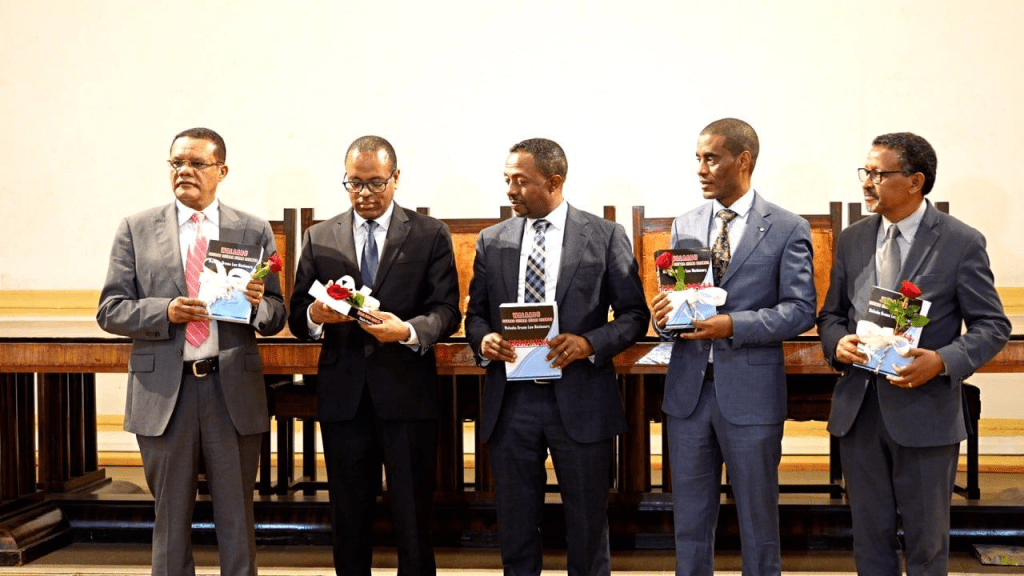
(Finfinne, May 14, 2026) — In a landmark moment for Ethiopia’s legal history, the very first Oromo language law dictionary—titled the Walabu Oromo Law Dictionary (Walaabuu Guuboo Jechoota Seeraa Afaan Oromoo)—was officially inaugurated today in a vibrant ceremony at Ras Mekonnen Hall, Addis Ababa University.
This monumental legal reference work, which opens an entirely new chapter in Ethiopian jurisprudence, is the result of a collaborative effort between the Federal Law and Justice Institute (FLJI), the Ethiopian Studies Institute at Addis Ababa University, and Justice for All – PFE Ethiopia (JFA-PFE).
A Ceremony of Significance
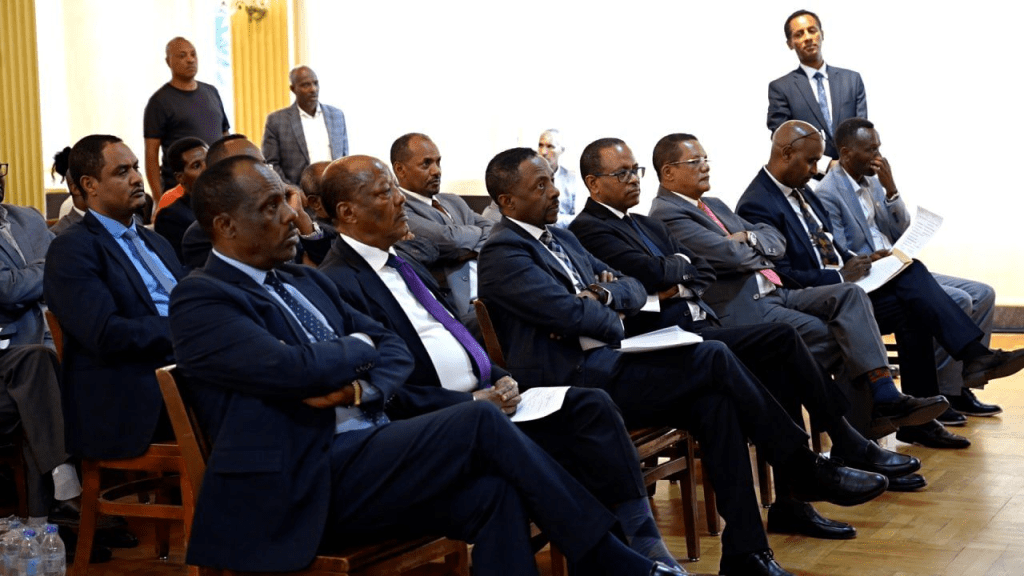
The inauguration ceremony was attended by high-ranking government officials, leaders of justice institutions, legal scholars, researchers, and distinguished invited guests. The atmosphere was one of collective pride and historical awareness—those present understood that they were witnessing not merely the launch of a book, but the solidification of a language’s place in the formal legal architecture of the nation.
The President of the Federal Supreme Court Speaks
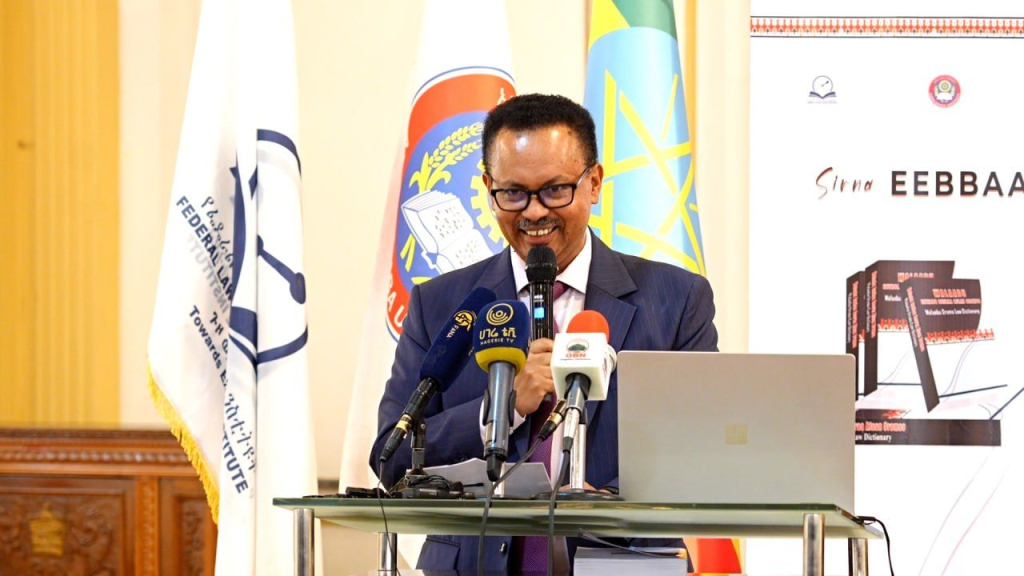
Honorable Mr. Tewodros Mihret, President of the Federal Supreme Court, addressed the gathering with particular gravity. He emphasized the profound utility of the dictionary in resolving one of the persistent challenges within the justice system: inconsistency.
President Tewodros explained that until today, legal professionals had been translating legal terminology into Afaan Oromo according to their individual understandings and preferences. This ad hoc approach, he noted, had a negative impact on the quality of justice delivery. Different judges, prosecutors, and lawyers might interpret the same legal concept differently, leading to confusion, contradiction, and ultimately, a erosion of public trust in the fairness of the legal system.
The Walabu Oromo Law Dictionary, the President declared, will serve as an authoritative reference work that eliminates fragmented translations and divergent interpretations. By establishing a unified legal vocabulary, the dictionary will enable consistent justice services and strengthen the rule of law. It is, he said, a major achievement.
Ambassador Degife Bula: A Testament to Dedication
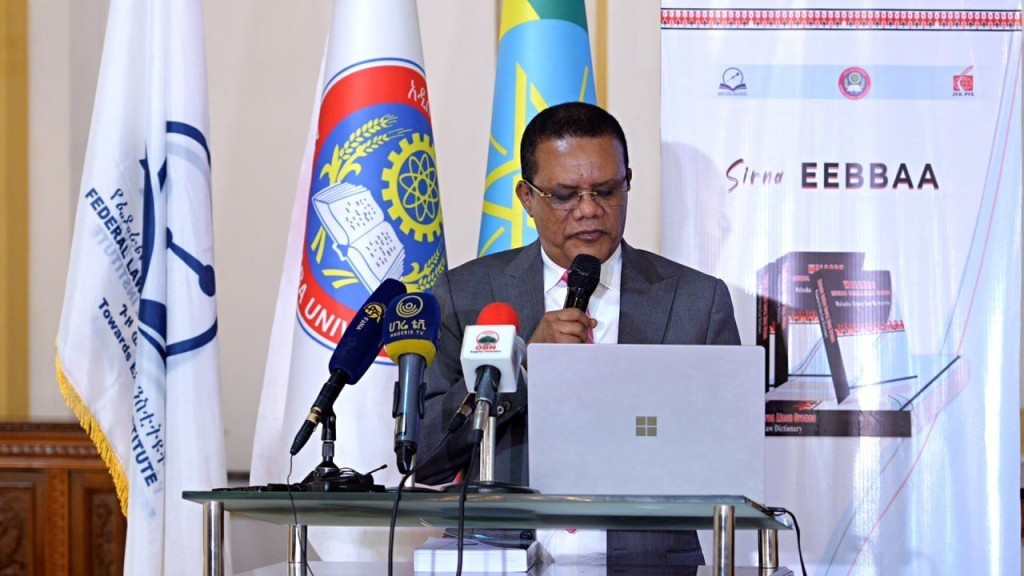
Following the President’s remarks, Ambassador Degife Bula, Director General of the Federal Law and Justice Institute, delivered a message that traced the dictionary’s journey from conception to completion.
Ambassador Degife emphasized that the dictionary will play an irreplaceable role in harmonizing the linguistic and conceptual differences that have long been observed within the legal and justice systems. He noted that the work is not only significant because it is the first of its kind in Oromo history. Its distinction is further elevated by the fact that it was prepared in collaboration with Addis Ababa University—Ethiopia’s most venerable institution of higher learning—and inaugurated within its very premises.
The Director General acknowledged that the project took considerable time. However, he stressed that its quality was assured by the dedication of Oromo legal scholars and professionals with exceptional linguistic expertise—individuals who committed themselves tirelessly to the task. He extended his profound gratitude to the media, religious institutions, and political organizations that played supportive roles in ensuring the work’s successful completion, whether directly or indirectly. Most of all, he thanked the scholars who labored day and night in their respective fields.
A Dictionary Rooted in Oromo Reality
A particularly noteworthy aspect of the Walabu Oromo Law Dictionary, as explained by Ambassador Degife, is its methodological grounding. The preparation process made significant efforts to harmonize the dialectal variations and terminological usage patterns from all regions of Oromia. Rather than privileging one dialect over others, the dictionary seeks to represent the richness of the Oromo language in its full diversity.
Furthermore, the dictionary’s foundation and explanatory framework are entirely in Afaan Oromo. This is not a translation of a foreign legal dictionary into Oromo; it is a legal dictionary born in Oromo, for Oromo, from Oromo conceptual frameworks. This approach, Ambassador Degife argued, greatly enhances understanding of legal terminology because users are not forced to think through a second language.
The Practical Impact on Justice
Given that Afaan Oromo is currently serving as the working language of education and administration across all three branches of government in the Oromia region, the Walabu Oromo Law Dictionary will provide an indispensable resource for the region’s judicial and justice institutions.
For the ordinary citizen—the farmer, the market woman, the teacher, the patient—access to justice has often been blocked by language barriers. Legal proceedings conducted in a language they do not fully understand leave them vulnerable, dependent on interpreters, and disconnected from the proceedings that determine their lives. With this dictionary, judges, lawyers, and legal aid providers can now communicate legal concepts to Afaan Oromo speakers with precision, consistency, and clarity.
The dictionary will also serve as a vital resource for legal professionals at the federal level who speak, write, and read Afaan Oromo. As Ethiopia continues to navigate the complexities of its federal system, the availability of authoritative legal references in multiple languages is not a luxury—it is a necessity for genuine equality before the law.
A Broader Meaning: Language as Justice
Beyond its immediate utility, the inauguration of the Walabu Oromo Law Dictionary carries a deeper symbolic weight. For centuries, Afaan Oromo was systematically excluded from formal legal, educational, and administrative domains. It was relegated to the private sphere—the home, the market, the oral tradition—while Amharic dominated the courts, the parliament, and the classroom.
The presence of a comprehensive law dictionary in Afaan Oromo, inaugurated at Addis Ababa University and supported by federal institutions, signals a shift. It is a tangible acknowledgment that justice cannot be truly blind if it is also monolingual. A citizen who cannot understand the language of their own trial is not receiving justice; they are receiving procedure.
This dictionary is a tool of decolonization. It is an act of epistemic justice. It says, in the most concrete terms possible: the Oromo language is not inferior. The Oromo language can carry the full weight of legal reasoning, of complex jurisprudence, of the rights and responsibilities of citizenship.
The Road Ahead
The launch of the Walabu Oromo Law Dictionary is not the end of the journey. It is a beginning. Legal terminology evolves as societies change, as new laws are written, and as new legal challenges emerge. The dictionary will require updates, expansions, and continuous refinement.
Moreover, the model established by this project—collaboration between federal institutions, universities, and civil society—can and should be replicated for other Ethiopian languages. A truly multilingual legal system, where every citizen can access the law in their mother tongue, remains an unfinished project. But the Walabu Oromo Law Dictionary has laid the first bricks.
Conclusion: A Day to Remember
May 14, 2026 (Ginbot 6, 2018 E.C.) will be remembered as the day when the Oromo language took another decisive step toward full institutional equality. It will be remembered as the day when legal professionals gained a tool that will enable them to serve their Oromo-speaking fellow citizens with greater precision, consistency, and dignity.
The scholars who labored day and night, the institutions that provided support, the leaders who championed the project—all of them have earned the gratitude of a people who have waited too long to see their language honored in the halls of justice.
The Walabu Oromo Law Dictionary is here. May it serve justice. May it serve truth. May it serve the Oromo people—and all Ethiopians—in the relentless pursuit of equality before the law.
“When a citizen understands the law in their own language, justice is no longer a distant promise. It becomes a daily reality.”

Posted on May 15, 2026, in Aadaa, Events, Finfinne, Information, Media, News, Oromia, Press Release, Promotion. Bookmark the permalink. Leave a comment.






Leave a comment
Comments 0