The Unfinished Struggle: Leencoo Lataa and the Long Road to Oromo Freedom
By Daandii Ragabaa*
“Akkuma mootummaa Hayilasillaasee, Dargiifi Wayyaanee lolaa turetti lolla taanaan gaarii hinta’u.”
Like the governments of Haile Selassie, the Derg, and the Woyane that were fought, it is not good for this one to become a battlefield.
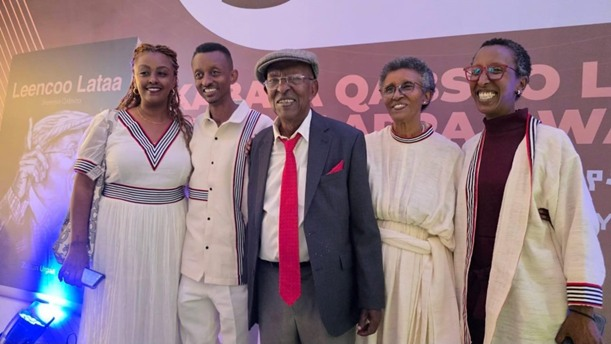
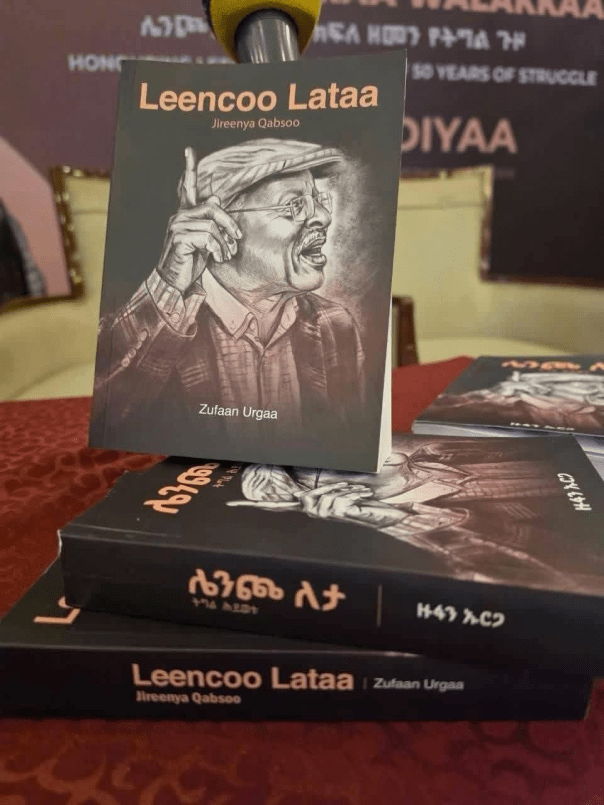
These words belong to Obbo Leencoo Lataa. They were spoken not in the heat of revolution, nor in the shadows of exile, but at a book launch in Finfinnee—a ceremony celebrating the publication of his own memoir, “Leencoo Lataa: Jireenya Qabsoo” (Leencoo Lataa: A Life of Struggle). The book, written by Zufaan Urgaati and published in both Afaan Oromo and Amharic, was unveiled on a recent Saturday to an audience of federal and regional officials, members of parliament, scholars, ambassadors, artists, political leaders, Gadaa elders, Siinqee mothers, family members, and ordinary citizens.
It was a gathering of memory. And at its center sat a man who has spent more than fifty years in the trenches of the Oromo liberation struggle.
A Life Forged in Struggle
Obbo Leencoo Lataa is not a newcomer to the stage of Oromo politics. He is a well-known figure, a seasoned political intellectual, a man who has dedicated more than half a century to the cause of Oromia and the Oromo people. He was among the founders of the ABO (Afran Qallo Oromo) and one of the original architects of Gaazexaa Bariisaa—a publication that has served as a voice for the Oromo struggle across decades.
His memoir, spanning three volumes, eleven chapters, and 447 pages, is priced at 1,200 Ethiopian Birr. It is not a light read in any sense—neither in weight nor in content. It is the record of a life lived on the edge, a chronicle of sacrifice, imprisonment, exile, and unyielding commitment to a people who have known generations of subjugation.
The Family That Struggle Built
The book launch was not merely a political event. It was also a family reunion—of a family shaped in profound ways by the struggle.
Obbo Leencoo is married to Professor Kuwee (Maartaa) Kumsaa, herself a scholar and activist of considerable stature. Together, they have three children: two daughters, Huriyaa and Goolii, and one son, Roobaa. Their family story is not one of quiet domesticity. It is a story of separation, of longing, of children growing up without fully knowing their father, of a mother who endured her own imprisonment while her husband was in the forests.
Huriyaa Leencoo, the eldest daughter, spoke at the event. Her testimony cut through the political rhetoric and landed like a stone dropped into still water:
“In my childhood, I do not remember my father very much. But I remember the suffering my mother went through. My mother and father were married for only three years, and in that time they had three children.
My father—the husband, the lover of struggle, the father of her children—left home without proper farewell and went into the battlefield. When he left, my mother was heartbroken. I remember her lying on the sofa, tears flowing, repeating, ‘Beenu ka’ii, beenu ka’ii, allaattii koo joobiraa beenu sifaanan bu’aa’ — ‘Let’s go, get up, let’s go, my bird, my joobira, let’s go down from here.’
At that age, I did not understand why she was crying. I tried to ask her, but I was afraid.
Before my father left for the battlefield, he used to play with us as a father plays with his children. We experienced his love. Then he left. After he was gone, my brother and I would constantly trouble our mother, asking, ‘Where is our father?’
Finally, our mother printed a poster of his photograph and hung it on the wall. She told us, ‘From today onward, do not ask me about your father! This is your father!’ But whenever we had the chance, we still wanted to talk about him.
After our mother was imprisoned, we hardly spoke of him at all. When she was released and we fled the country, crossing into Kenya, we finally heard his voice on the phone. He was at a conference in London. I listened as he spoke. The voice on the other end said, ‘Who is this?’ I said, ‘A wild animal told me to call.’ I felt in my heart that it was my father’s voice. I handed the phone to my mother. It was him.
For three months after that, we talked about him constantly at home. Then, just days before we left for Canada, he came and saw us.
We knew our father as Yohaannis Lataa. We had to learn to call him Leencoo Lataa. That name—Leencoo—appeared in my mind as someone very tall, very great. When he stepped out of the car to speak to us, the first thing that came out of my mouth was, ‘Why are you so short?’
The audience laughed. But the laughter carried tears. This is what struggle does to families. It steals the ordinary moments—the graduations, the birthdays, the simple act of a father coming home for dinner. And it replaces them with phone calls from London, with posters on walls, with children who must learn their father’s revolutionary name as if meeting a stranger.
Roobaa Leencoo, the son, added his own testimony:
“I did not know my father in my early childhood. Our family came together in Canada. Because we had not grown up together, my father once gathered the family and said, ‘Let’s start as friends, beginning with me.’ Slowly, patiently, we built our relationship. He became a good father to us. He is a man of great patience and strong determination.”
And Goolii Leencoo, the youngest daughter, reflected on the uniqueness of their family:
“My family is different from others—I have known this my entire life. When we were children, our parents were not with us. Our father was in the forest. Our mother was in prison.
The three of us grew up among relatives. Only after we had grown and gained some independence did I understand why we were separated from our mother and father. Our mother would tell us, ‘I was not imprisoned because I hated anyone or killed anyone. I was imprisoned because of Oromummaa.’
After we came to know our father, he would tell us why he fought. We came together as a family after we had already grown. But the love between us, the way we came to know each other, the patience, the mutual respect, the way we corrected and advised one another—for me, that is what makes us unique.”
The Scholar’s Reflection: Professor Kuwee Kumsaa
Professor Kuwee Kumsaa, wife of Leencoo and a distinguished intellectual in her own right, addressed the gathering with characteristic gravity:
“I want to speak briefly about the history of Obbo Leencoo’s struggle. When we entered the struggle in the early years, we knew that the struggle would take a long time—that it would span generations. The oppression and enslavement of our people was not a matter of one hundred or two hundred years. It was the work of many generations.
When we entered that struggle, we did not think we would live to see this moment.
Leencoo committed himself to the fight for justice. He met me as a fighter and an activist. A true fighter lives for the truth of his cause and does not harm his own people. A true fighter puts himself aside in order to pass the cause on to his nation. Leencoo’s purpose in entering the struggle was not for himself—it was to pass something on to his people. His purpose was made visible through his actions and his work. The spirit within us that seeks freedom, justice, and equality—that spirit is what endures.”
The Warning from a Veteran
Then Obbo Leencoo himself spoke. His words were not triumphant. They were measured, reflective, and laced with warning.
“The gratitude truly belongs to those who were sacrificed on this struggle. For those of us still living, any recognition we receive is enough. In my life, there are certainly those I have angered. Much criticism has come my way.
When we entered Finfinnee during the transition period, the Oromo language had reached the point of near disappearance. And the disappearance of the language, I say, means the disappearance of the nation itself.
Today, however, the Oromo is insulted as ‘Baala Gizee’—a leaf of the season. That kind of insult is good. Previously, we were not even able to be insulted like that. The struggle has a record of where it started and what it has accomplished. There is still work remaining.
If we only analyze what is missing and do not move forward, that is not good.
Like the governments of Haile Selassie, the Derg, and the Woyane that were fought, it is not good for this one to become a battlefield. We must adapt our strategy to the times. We must ask ourselves: What has been accomplished by the struggle we have waged? What is missing? We must complete what is lacking—not start again from zero.”
The Heart of the Warning
This is the core of Leencoo’s message—and the core of Natsaannat Taadsasaa’s reporting, as reflected upon by Daandii Ragabaa.
The Oromo struggle has known three regimes: the Imperial monarchy of Haile Selassie, the Marxist Derg, and the Woyane (TPLF) regime. Each was met with resistance. Each was fought. And each, eventually, fell or transformed.
Now, a new political order exists. Leencoo’s warning is clear: it is not good for this new order to become yet another battlefield. The Oromo people have spilled enough blood. They have filled enough prisons. They have raised enough children on posters and phone calls.
But this is not a call for surrender. It is a call for strategic evolution. Adaptation, not abandonment. Completion, not restarting from zero. The struggle has a record. It has accomplishments. It has sacrifices that cannot be forgotten. But it also has gaps—and those gaps must be filled.
The Unfinished Work
Huriyaa asked her father, through her testimony, why he was so short when she had imagined him so tall. It is a metaphor for the gap between the legend and the man, between the hero of the struggle and the father who missed his children’s childhoods.
But perhaps there is another meaning. Perhaps the struggle itself has been imagined as something larger, taller, more imposing than it has turned out to be. Not because it has failed—but because the mountain is still being climbed. The summit is not yet visible. And the climbers are tired.
Leencoo’s message, as carried through Natsaannat Taadsasaa’s reporting, is that the path forward is not to throw away the map and start over. It is to study the map, see where the journey has gone wrong, and correct the course.
Akkuma Hayilasillaasee, Dargiifi Wayyaanee lolaa turetti lolla taanaan gaarii hinta’u.
Like the governments of Haile Selassie, the Derg, and the Woyane that were fought, it is not good for this one to become a battlefield.
Conclusion: The Legacy and the Road Ahead
The book launch was a celebration—of a life, of a struggle, of a memoir that will preserve Leencoo Lataa’s experiences for future generations. But it was also something rarer: a moment of honest reckoning.
Professor Kuwee spoke of the spirit that seeks freedom, justice, and equality. That spirit, she said, endures.
Huriyaa spoke of a mother crying on a sofa, of a poster on a wall, of a phone call from London, of meeting a father who was shorter than she had imagined.
Roobaa spoke of patience and determination.
Goolii spoke of love built slowly, carefully, through mutual correction and advice.
And Leencoo himself—the man who spent fifty years in the struggle—spoke not of victory but of adaptation. Not of the end but of the unfinished.
The Oromo people have not yet reached their destination. But they have traveled far. They have paid a price that cannot be calculated in Birr or in years. And they have, in Leencoo Lataa and his family, a living testament to what the struggle costs—and what it is worth.
Galanni kan maluuf namoota qabsoo kanarratti wareegaman qofaafi.
The gratitude truly belongs to those who were sacrificed on this struggle.
May their sacrifice not be in vain. May the unfinished work be completed. And may the children of the struggle—Huriyaa, Roobaa, Goolii, and all the others who grew up on posters and phone calls—inherit a world where no father has to choose between the battlefield and the dinner table.
The struggle continues. But it must not continue forever as it has been. Adaptation. Completion. Liberation. That is the message of Leencoo Lataa
*Author’s Note on Attribution: The feature story is based on a post written by Natsaannat Taadsasaa and published in Gaazexaa Bariisaa on May 5, 2018 (according to the Ethiopian calendar). That post reported on the book launch event for Obbo Leencoo Lataa’s memoir, including remarks from Obbo Leencoo Lataa himself, Professor Kuwee Kumsaa, and his children Huriyaa, Roobaa, and Goolii Leencoo. Daandii Ragabaa has engaged with that reporting as a commentator, and the present reflection draws substantially from the ideas, testimonies, and framing originally presented by Natsaannat Taadsasaa. This feature story is offered as a synthesis and expansion of that shared conversation, with full acknowledgment of the original source.

Posted on May 15, 2026, in Aadaa, Biography, Events, Finfinne, Information, Media, News, Oromia, Press Release, Promotion. Bookmark the permalink. Leave a comment.






Leave a comment
Comments 0