“Bariisaa Newspaper is the Heart of the Oromo Struggle” – Father of Bariisaa
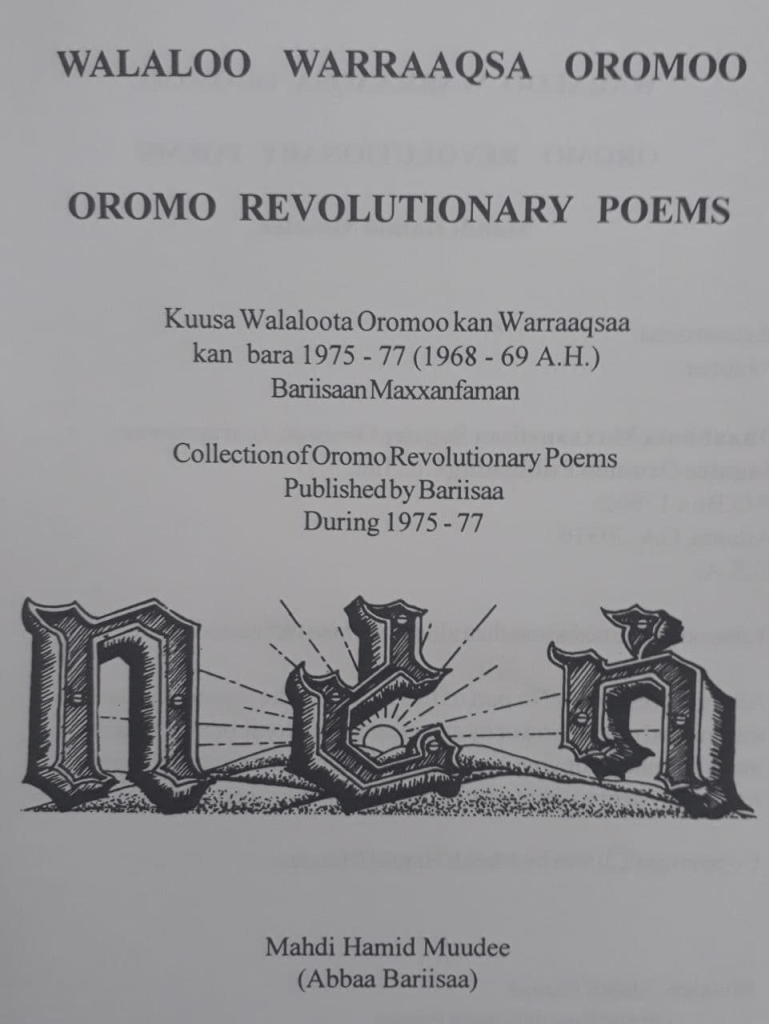
In the annals of Oromo media history, few names shine as brightly as that of Dr. Mahadii Hamid Mudee—known to millions simply as “Abbaa Bariisaa” (Father of Bariisaa). He is the founder of Bariisaa newspaper, a publication that became the heartbeat of Oromo cultural and political awakening.
For decades, Bariisaa has played an extraordinary role in elevating Oromo culture, language, and history. It has championed the rights of the Oromo people, defended their dignity, and brought their struggles into the light. Dr. Mahadii Hamid Mudee stands as a towering figure in this legacy—a scholar, activist, and journalist who dedicated his life to the Oromo cause without seeking personal gain.
The following is an exclusive interview with the man himself.
Bariisaa: Dr., let’s get acquainted. When and where were you born?
Abbaa Bariisaa: My birth name is Mahadii Hamid Mudee. Later, I became known as “Abbaa Bariisaa.” Some also call me “Abbaa Dikshinarii” (Father of the Dictionary). You may call me Dr. Mahadii or Abbaa Bariisaa.
I was born in 1942 in Eastern Oromia, West Hararge Zone, in the town of Chiro. My father is Obbo Hamid Mudee, and my mother is Aadde Hamiida Ahmad.
Bariisaa: Where did you complete your primary, secondary, and higher education?
Abbaa Bariisaa: Before joining modern schools, I studied at an Islamic religious school. I then entered the formal education system starting from Grade 3. I completed my primary and secondary education at “Dajjaazmaach Waldagabir” School in Chiro town.
At that time, students could skip grades based on performance—from first to third, then to the next level. I completed both primary and secondary school in just six years. For my higher education, I studied at Addis Ababa University for three years.
During my third year studying Physics at the university, I was assigned for practical training to North Gojjam Zone in Amhara Region, at “Negus Taklahaymanot” Secondary School in Dabra Maarkos.
The school refused to rent me a room because of my religion—I am Muslim. I spent three months living in a hotel while teaching. Because of this, I decided to leave the position. But they transferred my Physics colleague to Bahir Dar and sent me there instead.
At Bahir Dar, there were many students, and I taught double sessions—morning and afternoon. In the evenings, with no other work, I began preparing textbooks in Afaan Oromoo for the children. I taught there for two and a half years until the revolution of 1966 (Ethiopian calendar) erupted.
Bariisaa: How did you start preparing Bariisaa newspaper?
Abbaa Bariisaa: At that time, there were many newspapers in various languages—but none in Afaan Oromoo. The question “Why isn’t there a newspaper in Oromo?” constantly occupied my mind. From this reflection came the desire to start an Oromo-language newspaper.
Initially, I thought preparing and publishing a newspaper in Oromo would be simple. But when I got down to work, I realized it was extremely difficult. In 1964, I approached Dr. Tasefaye Gabre’igzii, then Minister of Information, and asked for permission to publish a newspaper in Oromo. He responded with anger: “How dare you come to my office asking to publish a newspaper in Oromo? Get out!” He kicked me out of his office. I left, burning with anger.
In 1966, Ahaduu Saaburee became Minister of Information. I approached him again. He didn’t refuse me as harshly as Dr. Tasefaye, but he also didn’t give me permission.
Then, in September 1966 (Ethiopian calendar), Haile Selassie was overthrown and the Derg came to power.
In 1967, Kumalaa Girmaay Yilmaa became Minister of Information. I went to him and requested permission to publish an Oromo newspaper. Unlike those who had insulted me, Kumalaa Girmaay listened. He said to me: “You have asked for two impossible things. First, a private individual cannot publish a newspaper. Second, publishing a newspaper in Oromo is not allowed. If you had asked to publish in another language, I would have given you permission today. I cannot authorize an Oromo newspaper, but you can try asking other officials.”
Bariisaa: How did you finally get permission?
Abbaa Bariisaa: At that time, I knew people like Luba Gudina Tumsa, his brother Baaroo Tumsa, and Obbo Leencoo Lataa. We discussed the matter and decided to approach someone who supported the Oromo cause—Colonel Takkaa Tulluu, an Oromo official in the Derg government.
Together with Baaroo Tumsa and Leencoo Lataa, we went to Colonel Takkaa. He asked what we wanted. We said, “We have come to request permission to publish a newspaper in Oromo.” He asked, “Why didn’t you ask the Minister of Information?” We explained that we had asked but were refused. Colonel Takkaa said, “I will ask on your behalf.” We replied, “If you can’t get full authorization, at least ask for permission for just one day.”
Because it was the first anniversary of the Derg’s coming to power—September 2, 1968—they granted us permission to publish Bariisaa in Oromo for just one day. But we decided to seize the opportunity: “We will publish if we live; if we die, we die.” We declared that Bariisaa would be published every two weeks, and if it was stopped, we would challenge the government. And so, the first issue of Bariisaa was published in Oromo.
Bariisaa: How did you distribute the first issue?
Abbaa Bariisaa: For the first issue, we printed 20,000 copies. We donated 1,000 to the Kibur Zabanya (Imperial Guard), 1,000 to the Fourth Army Division in Finfinne near Laga Harre, 1,000 to the police, 1,000 to the Air Force in Bishooftu, and 1,000 to the Navy and Oromo farmers. The remaining copies were sold at 10 cents each.
Bariisaa: What happened after that?
Abbaa Bariisaa: When we went to the Ministry of Information to ask for permission for the second issue, they arrested us. They said, “We only authorized one issue, but you told the public it would be published every two weeks—you are inciting the people against the government.” They threw us in the “Maakelaawi” prison. But I was released soon after.
Bariisaa: How long was Bariisaa suspended, and how did it resume?
Abbaa Bariisaa: Bariisaa was suspended for five months. Then, an opportunity arose. Colonel Asraat Dastaa was the Deputy Minister of Information responsible for Public Relations. When he went abroad for training, a man named Irreessaa Fissahaa Gadaa was acting in his position.
We approached him and asked for permission to publish Bariisaa. He said, “I can’t authorize what the colonel refused. When he returns, I don’t know what will happen—you could be arrested again. But I have an idea. Go to someone more powerful than me, someone Colonel Asraat fears, and get authorization from him.” He suggested Mangistuu Hayilamaariyam (the former president of Ethiopia). We went to him, and he gave us permission.
With the authorization of Colonel Mangistu, Bariisaa resumed publication every week. When Colonel Asraat returned from abroad and heard that Bariisaa had been authorized, he said, “What kind of world is this? I leave the country for a few days, and this happens!”
Bariisaa: What were the challenges under the Derg?
Abbaa Bariisaa: They constantly looked for ways to destroy us. Bariisaa was building Oromo unity, promoting Oromo language, culture, and history, and defending Oromo rights—so it was hated by the regime.
In 1969, we organized an Oromo Cultural Exhibition in Finfinne at the “Biheraawwii Tiyaatir” Hall. The goal was to raise funds for Bariisaa. People came from all over Oromia in the tens of thousands. But the authorities said, “Everything you do must be under the name of the Ministry of Culture.” In December 1969, the government shut down Bariisaa. The closure was even announced on the radio.
Bariisaa: What was the difference between Bariisaa under private ownership and after it was taken over by the government?
Abbaa Bariisaa: In the private era, everyone worked without pay. Lammeessaa Boruu, a father of a family, earned 100 birr per month; Immiruu Angoosee earned 70 birr. Ibraahiim Hajii Alii worked for two years without any salary. I also worked without pay. We worked because of our deep commitment to the Oromo cause.
The Oromo people themselves were our reporters and sources of information. We focused on what the people wanted to hear, learn, and benefit from.
After the government took over, the content shifted. Most of what was published reflected the government’s message to the people, rather than the people’s message to the government. Our sources of information shifted from the people to the regime. Reporting Oromo issues to the government became secondary to conveying government wishes to the people.
The government allocated 500,000 birr per year and a vehicle to the newspaper. Reporters like Caalchisaa Ciibsaa, Waaqgaarii Gunjoo, Mahaammad Hasan, Bulloo Siibaa, Ibiraahiim Hajii, and Kuwee Kumsaafaa were hired with salaries. Two proofreaders and a “free-lancer” were also paid. I was paid 800 birr as chief editor.
Bariisaa: When did you stop working on the newspaper?
Abbaa Bariisaa: After the government took over, I realized I could no longer work with the freedom I needed. The political situation was difficult, so I decided to step away. I trained my successors over three months, rotating them weekly until they could manage the newspaper independently.
Bariisaa: What contribution did Bariisaa make to the Oromo people?
Abbaa Bariisaa: Bariisaa is the heart of the Oromo struggle. It strengthened Oromo unity and promoted Oromo language, culture, history, and identity. It focused on Oromo rights and benefits—which is why it was hated and called “ABO newspaper” (referring to the Oromo Liberation Front). Bariisaa was never separate from Oromo politics. The newspaper’s workers were deeply committed to the Oromo cause; many were imprisoned and some were killed.
Bariisaa: How did you get the name “Abbaa Bariisaa”?
Abbaa Bariisaa: From the founding of the newspaper until I stepped down, I was the chief editor. Because of this, the name “Abbaa Bariisaa” and “Abbaa Dikshinarii” was given to me, both at home and abroad.
Bariisaa: What did you do after leaving Bariisaa?
Abbaa Bariisaa: I was working with the “Guddinni Gamtaa” (Joint Committee) at the time. The government sent me to Harar to stabilize the political situation in Eastern Ethiopia. I was assigned to coordinate Radio Harar, the Ethiopian News Service, and military training. But when I went to Harar, I found Oromo children imprisoned for political reasons. I managed to have them released, and then I went to Saudi Arabia.
As a member of the OLF, I worked to organize the Oromo community in Saudi Arabia and raise funds for the cause. I told them that Oromos should not live as slaves in their own land. I built relationships with foreign governments to raise awareness about the Oromo issue. I stayed in Saudi Arabia for four and a half years, then moved to America.
Bariisaa: Did you face personal difficulties while working on Bariisaa?
Abbaa Bariisaa: Yes, I faced many pressures. But I never stepped back from speaking the truth or doing my work. I wasn’t afraid of being killed or losing my job. However, I did face a time when I could no longer return to my home. I left my house and stayed with relatives, friends, or wherever I could find shelter.
After I left the country, my mother was taken to a police station at 6:00 PM and interrogated. They beat her and demanded to know where I was. The harm my mother suffered because of me was terrible. She was forced to leave her home, and she never knew where I was. My colleagues also suffered greatly.
Bariisaa: What did you feel when you saw Bariisaa 42 years later upon your return from America?
Abbaa Bariisaa: I felt both joy and sorrow. I was overjoyed to see that the newspaper had not died or disappeared. But it saddened me that the circulation had dropped from 20,000 to 10,000. For a population of 50 million Oromos, printing only 10,000 copies is not enough. This requires serious thought and action.
Bariisaa: What would you like to see for Bariisaa’s future?
Abbaa Bariisaa: I want to see the circulation exceed one million, published daily. I want Facebook followers to number in the millions. I want distribution to reach all corners of Ethiopia and beyond. I want the newspaper to reach every school in Oromia, and I want it available in public libraries so everyone can read it.
Bariisaa: What kind of content would make Bariisaa more beloved among the Oromo people?
Abbaa Bariisaa: What determines whether Bariisaa is loved or not is its content. You must work within your limits. Don’t rely on lies or flattering the government to gain popularity—earn it through truth.
If the newspaper presents what is right, true, and just, it will be beloved. Speaking truth and justice won’t even cause problems with the government. Content that highlights Oromo culture, language, history, and development—that protects Oromo rights, promotes their interests, and brings solutions to Oromo problems based on verified truth—that is what will make Bariisaa truly beloved.
Bariisaa: What did you do about the Oromo cause while in America?
Abbaa Bariisaa: People do two things: one is what they do for a living, and the other is what their conscience tells them. Working for the Oromo cause is what my conscience demands. I worked without pay before, and I continue to do so. What I have earned is not measured in dollars, but in service to the Oromo people.
In America, I wrote and published ten books. I prepared a dictionary (known as “Dikshinarii Hamiid Mudee”). I also worked for 21 years to make Oromo a technological language, preparing software and manual guides.
Bariisaa: How do you view the changes happening in Ethiopia today?
Abbaa Bariisaa: If I speak truthfully, the changes are very encouraging. The country has made great strides and is emerging from darkness. The respect for human rights fills me with great joy.
However, I also have great concern. I am deeply grateful to those who sacrificed to make these changes possible. The reason I can return to my country is because of these changes. I pray that the progress continues.
Bariisaa: How do you see today’s media in Ethiopia?
Abbaa Bariisaa: Some private media, driven by hate politics, are working not to build the country but to destroy it. This concerns me greatly. Both government and private media should work based on truth and justice, with a unified voice. Their information should be based on verified facts and reality. Repeating lies to corrupt people’s minds must stop. Media that works for truth should stand firm against false media and publish what is real and just.
It would be good to have a Media Council to oversee and regulate all media. Such a council should expose, control, and correct media that spread lies—independent of government influence. The government should support the establishment of such a council.
If media outlets spread unverified information—whether true or false—they can cause division and destruction. They should be careful. Media that refutes falsehoods with truth should be encouraged. Journalism that pits one group against another with misinformation must end.
Bariisaa: How do you want to support Bariisaa in the future?
Abbaa Bariisaa: Until the Oromo issue finds a solution, I will not rest. Oromo nationalism still lives within me. I will never step back from working for Bariisaa and for the Oromo people. I will work to make the newspaper known internationally. I also want to use my knowledge and resources to help in Ethiopia.
Interview conducted by Natsaannat Taaddasaa
Bariisaa Newspaper, June 20, 2011

Posted on June 23, 2026, in Aadaa, Afaan, Biography, Bokkkuu, Election, Events, Finfinne, gadaa, gender, Information, Language, Media, News, Oromia, Press Release, Promotion, Sirna Oromo. Bookmark the permalink. Leave a comment.




 Advocacy for Oromia
Leave a comment
Comments 0