Adama Accord or Oromo Annulment? Prosperity Party’s Central Committee Unveils Radical Blueprint to Redraw Ethiopia’s Map and Constitution
By Our Political Affairs Correspondent
(ADAMA, July 2, 2026) The historic city of Adama, a crucible of Oromo resistance and a vital economic nerve center, has once again become the epicenter of a political earthquake. Since yesterday, the Central Committee of Ethiopia’s ruling Prosperity Party (Bilxiginnaa) has been locked in a high-stakes meeting. While the party frames these deliberations as necessary “mid-term” reforms, the agenda items that have surfaced paint a starkly different picture: an audacious, legally dubious attempt to dismantle the ethnic federalism enshrined in the 1995 Constitution—and, critically, to carve up the Oromo region without the consent of its people.
Sources close to the proceedings have revealed four sweeping constitutional amendments currently under consideration, alongside a devastating procedural change that effectively silences the Oromo populace regarding their territorial integrity.
The Four Pillars of the Proposed Overhaul
The Central Committee is reportedly pushing a quartet of seismic changes that would fundamentally alter Ethiopia’s governance and economic structure:
1. The End of Ethnic Federalism (Article 39 Overhaul): The current federal arrangement, based on ethnic identity and self-determination, is to be scrapped. In its place, regions would be reorganized purely based on geographic contiguity and economic interdependence, effectively severing the cultural and historical ties that define the current state boundaries.
2. The Enclave Question (Article 49 Overhaul): Dire Dawa and Finfinne (Addis Ababa) are to be designated as separate, independent regional states in their own right. This move seeks to permanently detach the capital and the eastern trade hub from their historical and demographic surroundings—a long-standing point of contention for the Oromo people, who view Finfinne as their heartland.
3. Land Privatization (Article 40 Overhaul): The constitutional provision declaring land as the collective property of the state and the people is set to be erased. The new framework would permit private ownership, opening the door for large-scale commercial acquisition and displacing millions of smallholder farmers who currently rely on communal tenure systems.
4. A Shift to a Semi-Presidential System: The current parliamentary system of governance would be replaced with a semi-presidential model. Under this proposal, a President would be elected by parliament and, alongside the Prime Minister, share executive power—a move widely interpreted as a consolidation of centralized authority.
The “Referendum Exit” and Oromia’s Looming Partition
While the four amendments are alarming, the most insidious proposal concerns the process of regional boundary changes. The committee has floated a motion to eliminate the constitutional requirement of a public referendum (Murtii Ummataa) for regional reorganization. Instead, the decision would be left solely to a parliamentary vote, followed by the President’s signature.
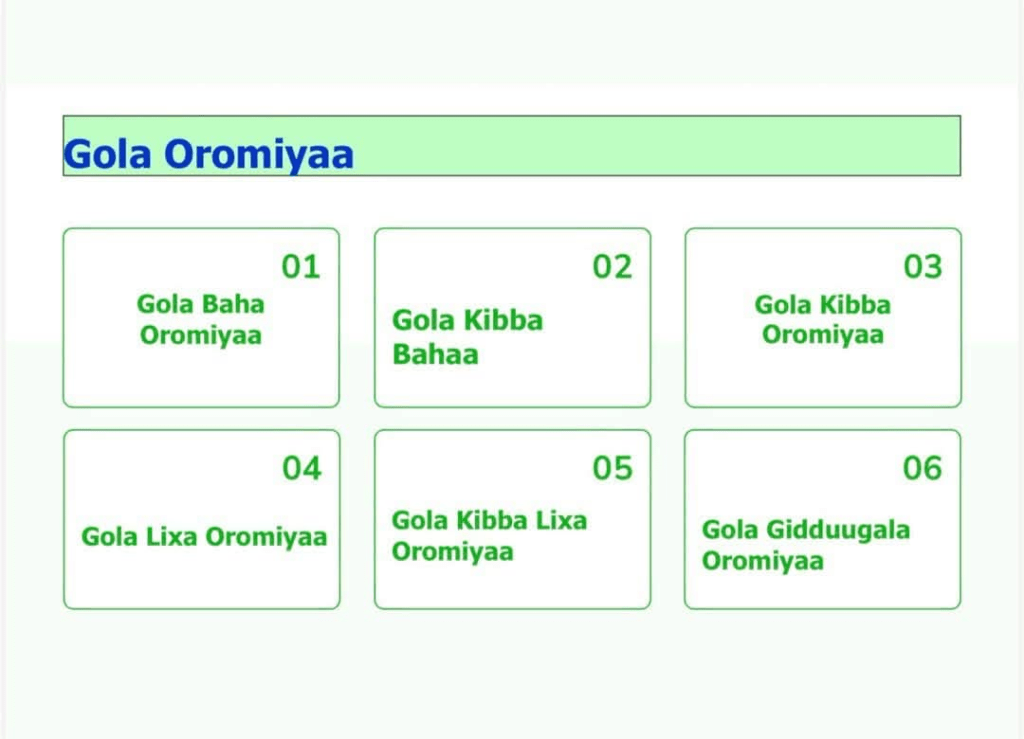
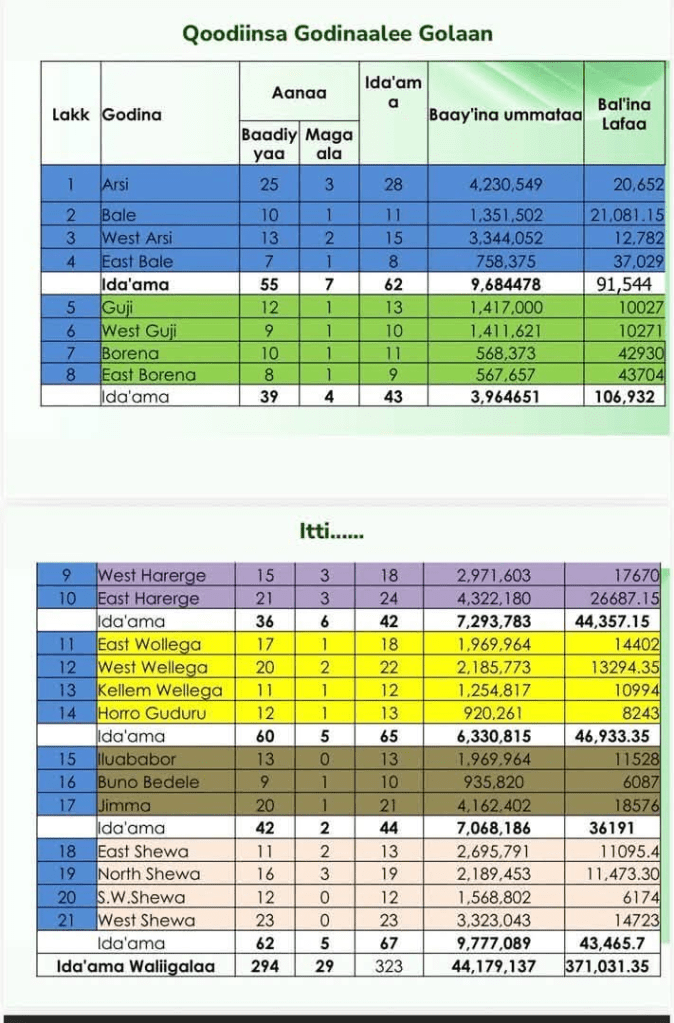
The implications of this are devastatingly clear. For Oromia, the most populous and expansive region, this procedural coup de grâce is a direct threat to its existence. Documents circulated in tandem with the meeting—which have long been rumored—propose splitting Oromia into six distinct “golas” (clusters/zones) . Without the constitutional safeguard of a referendum, the Oromo people would have no legal recourse to vote on the dismemberment of their own state. Oromia could be truncated, divided, and absorbed by neighboring administrative constructs at the whims of a parliamentary majority in Addis, with zero consultation with the population on the ground.
A Calculated Strategy to Dismantle the Oromo Legacy
Political analysts watching the Adama meeting view this not as mere administrative tweaking, but as a calculated, systemic strategy to neutralize Oromo political power. By dismantling the federal structure that gave Oromia its current boundaries, the ruling party is effectively erasing the territorial gains made since the fall of the Derg. The “gola” division—a term historically associated with colonial-era administrative boundaries—is viewed by the Oromo nation as a colonial reinvention designed to weaken their demographic and political hegemony.
Furthermore, the privatization of land (Article 40) strips Oromo communities of their ancestral connection to their soil, while the concentration of executive power ensures that the central government retains ultimate control over the newly fractured territories.
The Verdict from Adama
As the Central Committee continues its meeting behind closed doors, the Oromo nation and the wider Ethiopian populace watch with bated breath. What is unfolding in Adama is not a conversation about “governance reform”; it is a blueprint for the unilateral dissolution of the federal contract.
For the Oromo people, the message from Adama is clear: the struggle to defend the constitution is now more urgent than ever. As the famous mantra goes, “Qabsoo Itti Fufa”—the struggle continues. But today, that struggle is not just against an external enemy; it is against a political machinery determined to redraw borders in ink, blood, and parliamentary decree, while silencing the voice of forty million people.

Posted on July 1, 2026, in News, Oromia, Finfinne, Events, Information, Promotion, Press Release, Media, Bokkkuu, Election, Afaan, Language. Bookmark the permalink. Leave a comment.




 Advocacy for Oromia
Leave a comment
Comments 0