Category Archives: Confidentiality

UNDERSTANDING THE TRAUMA TREE
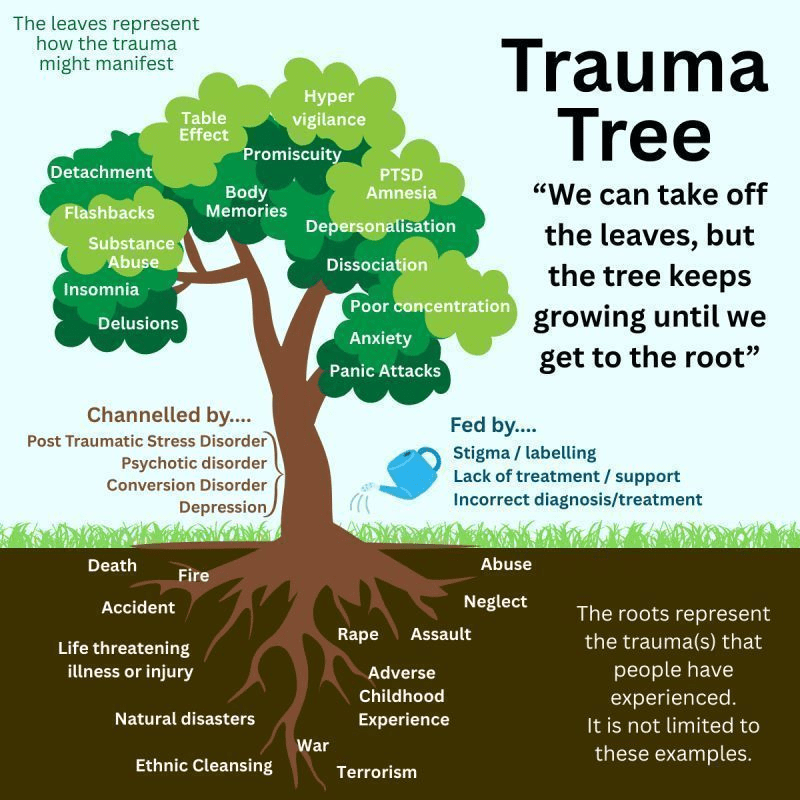
Why Addressing Symptoms Alone Isn’t Enough
🌳 “We can take off the leaves, but the tree keeps growing until we get to the root.”
This powerful metaphor reveals a truth that modern mental health care is only beginning to fully embrace: that true healing from trauma requires more than just managing symptoms. It demands that we dig deeper—right down to the roots.
The numbers tell a sobering story. Research shows that 70% of individuals experience trauma at some point in their lives. Yet for far too many, the path to recovery remains frustratingly elusive. Why? Because we have been treating the leaves while ignoring the roots.
THE LEAVES – HOW TRAUMA MANIFESTS
Trauma does not announce itself with a single, obvious signal. Instead, it manifests in a tangled canopy of symptoms that can be as bewildering as they are debilitating.
Hypervigilance and anxiety – The body remains on high alert, scanning for danger even in the safest environments. The nervous system, once triggered, struggles to return to calm.
Flashbacks and nightmares – The past refuses to stay in the past. Traumatic memories intrude without warning, forcing the individual to relive moments of terror again and again.
Panic attacks and dissociation – The mind and body disconnect. Some feel as though they are watching themselves from outside their own body. Others experience overwhelming waves of terror that seem to come from nowhere.
Depression and emotional numbing – Feeling nothing becomes a defence mechanism. The heart hardens to protect itself, but in doing so, it also loses the capacity for joy, connection, and hope.
Substance abuse and insomnia – Sleep becomes a battleground. Substances offer a temporary escape, but they also deepen the wound, creating a cycle of dependency that further obscures the underlying pain.
These are the leaves. They are visible. They are painful. And they demand attention.
But treating symptoms alone leads to temporary relief—not true healing. The leaves may be trimmed, but the tree continues to grow, fed by hidden forces beneath the surface.
WHAT FEEDS THE TREE – BARRIERS TO HEALING
If the leaves are symptoms, what nourishes the tree and keeps it alive? What prevents healing from taking root?
Stigma and labelling – Society often reduces trauma survivors to their symptoms. “You’re just anxious.” “You’re depressed.” “You need to get over it.” These labels, however well-intentioned, can become self-fulfilling prophecies. They define the person by their struggle rather than their resilience.
Lack of trauma-informed treatment – Many therapeutic approaches still focus on managing behaviour rather than understanding its origins. Without a framework that acknowledges the pervasive impact of trauma, treatment can feel like rearranging deck chairs on the Titanic.
Misdiagnosis and limited support – Trauma symptoms often mimic other conditions. Depression, anxiety disorders, and even ADHD can be misdiagnosed when the root cause—trauma—remains unidentified. Limited access to appropriate mental health services compounds the problem, leaving many to navigate their recovery alone.
These are the soil conditions that allow the trauma tree to thrive. Change the soil, and you change the tree.
THE ROOTS – ORIGINAL TRAUMA
To truly heal, we must go where the pain began.
Childhood abuse and neglect – The earliest wounds often cut the deepest. When a child’s developing brain is exposed to chronic stress or betrayal, it shapes the architecture of their nervous system, setting patterns that persist into adulthood.
Accidents and medical trauma – A single moment can change everything. Car crashes, serious injuries, and terrifying medical procedures can leave lasting psychological scars that are often overlooked.
War, terrorism, and violence – For survivors of conflict, the trauma is not a single event but a sustained assault on the sense of safety and humanity. The effects ripple across generations.
Natural disasters and grief – Loss on a massive scale, whether through earthquake, flood, or pandemic, shatters the illusion that we are safe in our world. Grief becomes complicated when it is intertwined with collective trauma.
Systemic oppression and discrimination – For marginalised communities, trauma is not an isolated experience but a chronic reality. Racism, sexism, homophobia, and other forms of oppression create ongoing wounds that demand healing at both the individual and societal levels.
These are the roots. They are deep. They are tangled. And they are often hidden from view.
But evidence shows trauma-informed interventions address both the symptoms AND the root causes, leading to real recovery and improved wellbeing for those struggling with PTSD, anxiety, and depression.
THE PATH TO ROOT-LEVEL HEALING
True healing requires a shift in perspective. It means moving from “What is wrong with you?” to “What happened to you?” It means recognising that symptoms are not weaknesses but adaptations—the mind’s way of protecting itself from overwhelming pain.
Trauma-informed care offers a different approach. It asks:
- Safety first – Healing cannot begin without a sense of physical and emotional safety.
- Choice and control – Trauma strips away agency. Recovery restores it.
- Collaboration – Healer and client walk together, not as expert and patient, but as partners.
- Trustworthiness – Transparency and consistency rebuild the trust that trauma shattered.
- Empowerment – The goal is not to fix the person but to help them reclaim their strength.
READY TO FINALLY ADDRESS TRAUMA AT THE ROOTS?
The journey to healing is not easy. It is not linear. But it is possible.
For those ready to begin, the “You Are Not Broken” Trauma Healing Workbook for Beginners offers a gentle, evidence-based guide to genuine emotional healing. Designed by trauma therapists, this workbook provides:
- Practical exercises for understanding trauma responses
- Grounding techniques for managing symptoms
- Guided reflections to explore the roots of pain
- A compassionate framework for self-discovery and recovery
The leaves can be trimmed. The soil can be nourished. The roots can be healed.
Start your journey today.
#TraumaHealing #TraumaInformedCare #MentalHealthRecovery #PTSD #EmotionalHealing
Image Credit – Unknown
📖 Featured Article
Understanding the Trauma Tree: A Clinical Perspective
The metaphor of the trauma tree is more than poetic imagery—it is grounded in neuroscience and clinical practice. When trauma occurs, it impacts the brain’s fear circuitry, particularly the amygdala, hippocampus, and prefrontal cortex. The “leaves” we see—hypervigilance, flashbacks, dissociation—are direct expressions of this rewired nervous system.
Treating only these symptoms without addressing the underlying trauma is like repeatedly taking painkillers for a broken leg. The pain may temporarily subside, but the bone remains unhealed.
Trauma-informed therapy, by contrast, works to rewire the brain’s response to threat. Through approaches such as EMDR, somatic experiencing, and cognitive processing therapy, individuals can process traumatic memories, integrate them into their life story, and reduce their power over the present moment.
The “roots” of trauma often lie in attachment wounds—relationships that should have been safe but were instead a source of danger. Healing these roots involves rebuilding the capacity for trust, connection, and self-compassion.
Remember: You are not broken. You are wounded. And wounds, with the right care, can heal.
This article is part of a series on trauma-informed mental health care. For more resources, follow our page and join the conversation on trauma recovery, resilience, and healing.

More Than an Ancient Civilization: The Kingdom of Kush—A Powerful Empire of Land and Sea
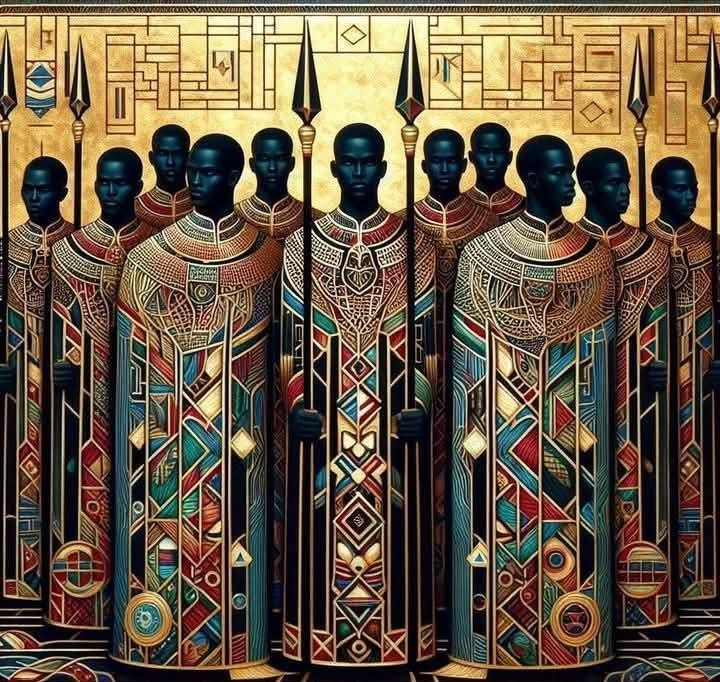
A people whose legacy challenges the very foundations of African history
When we speak of the great civilisations of antiquity, our minds often turn to Egypt, Greece, or Rome. But long before the Persian Empire rose to dominance, there existed in the heart of Africa a kingdom of extraordinary power, wealth, and sophistication—the Kingdom of Kush.
The Kingdom of Kush, with its three major cities of Meroe, Kerma, and Napata, emerged in the Nubian Desert south of Egypt along the Upper Nile River Valley from the 2nd millennium B.C. to the fourth century A.D. . For over a thousand years, Kush was a major power in the Nile valley, controlling an empire that at its height stretched from Central Sudan to the Mediterranean .
The achievements of this ancient civilisation challenge long-held beliefs that Egypt was the sole centre of advancement in the region. As renowned archaeologist Charles Bonnet’s excavations have revealed, Kush was not a mere vassal state of Egypt but a powerful and independent kingdom with its own distinctively indigenous culture . This sophisticated political state organised trade to the Mediterranean basin and built up a military strong enough to resist Egyptian forces .
The Black Pharaohs: A Legacy of Power
The Kushite rulers of Egypt’s 25th Dynasty, often referred to as the “Black Pharaohs,” represent a pivotal moment in the history of the Nile Valley. Emerging from the Kingdom of Kush at Napata in Nubia, these rulers not only unified Egypt after centuries of fragmentation but also reinvigorated pharaonic traditions .
The first major figure of this dynasty, King Piye, launched a campaign into Egypt during a period of political fragmentation known as the Third Intermediate Period. His Victory Stela records the subjugation of Delta rulers and proclaims his role as restorer of order . By 730 BCE, Piye had conquered Lower Egypt, establishing Kushite authority over both Upper and Lower Egypt .
The dynasty reached its zenith under Taharqa (690–664 BCE), whose reign is remembered for monumental building projects and ambitious foreign policy. Taharqa sponsored extensive temple construction at Karnak, Kawa, and Jebel Barkal, reinforcing his devotion to Amun and his claim to pharaonic legitimacy . He intervened in the Levant, supporting coalitions against Assyrian expansion, and is mentioned in both Biblical and Assyrian sources .
One of the most remarkable features of Meroitic civilisation was its powerful queens. The title “Candace,” meaning “sister,” was given to Kushite queens . Queens such as Amanirenas—who signed a peace treaty with the emperor Augustus—and Amanishakheto, whose treasure was looted in 1834, demonstrate the prominent role of women in Kushite society .
Kush: More Than a Footnote
The Kingdom of Kush was more than a civilisation; it was a power that commanded both land and sea. Kushite armies were formidable, and their military prowess allowed them to conquer and control Egypt itself . Kush also boasted a powerful navy, controlling trade routes along the Nile and beyond .
The economy of the ancient Kushites relied on trade in exotic African goods with Egypt and beyond. As middlemen, Kushite traders passed along ivory, ebony, incense, and other exotic goods from the South to the Egyptians, who then traded with other Mediterranean peoples . The city of Kerma, with its strategic location on the Nile River, controlled this crucial trade route .
Kush produced more gold than anywhere in the world at that time . Archaeologists have uncovered massive gold-processing operations at sites like Hosh el-Guruf, revealing the scale of Kush’s wealth . Minerals and high-quality stone were also mined for trade, and the Kushites introduced and developed iron metallurgy to the region .
A Sophisticated Society
The art and architecture of the Kushites reveal a sophisticated society of innovative craftsmen who constantly assimilated new artistic techniques from other lands . Notable architecture includes stone temple complexes such as the Lion Temple at Naqa and the steep-sided, solid pyramids found at Meroe and Jebel Barkal .
In fact, Sudan has more pyramids than all of Egypt—a testament to the grandeur of the Kushite civilisation . These tall, slender, graceful monuments bear witness to the lasting splendour of Kush .
Kushite art includes narrative tomb wall paintings and unique, eggshell-thin pottery with geometric patterns traded all over the Mediterranean . Stoic granite and bronze statues of gods and kings convey the religious beliefs of this ancient people .
The Question of Cush
The name “Kush” has been connected since at least the time of Josephus with the biblical character Cush, son of Ham (Genesis 10:6). Ham had four sons: Cush, Put, Canaan, and Mizraim (Egypt) . According to the Bible, Nimrod, a son of Cush, was the founder and king of Babylon, Erech, Akkad, and Calneh .
The Cushitic-speaking peoples, who are the ethnolinguistic groups speaking Cushitic languages natively, are today found primarily in the Horn of Africa, with minorities in Egypt, Sudan, Kenya, and Tanzania . Proto-Cushitic was spoken on the Ethiopian Highlands by 5000–4000 BC .
A Civilisation Worthy of Recognition
The Kingdom of Kush is not merely a footnote in the history of Africa—it is a testament to the power, ingenuity, and resilience of the peoples of the Nile Valley. As the American Journal of Archaeology notes in its review of The Nubian Pharaohs of Egypt, the term “Black Pharaohs” has sometimes been used to market exhibits, but the historical significance of Kush extends far beyond its interaction with Egypt . Sudanese colleagues and community members rightly resent the idea that the kings of ancient Sudan are only important because they ruled over Egypt . The Kingdom of Kush deserves to be remembered on its own terms.


Four Decades of Scholarship, One Enduring Legacy: The Oromo Studies Association at 40

From Exile to Global Recognition — How a Diaspora Institution Reclaimed a People’s History
By Dhabessa Wakjira
The year was 1986. In meeting rooms scattered across the diaspora, in the United States and Europe, a small group of Oromo and non-Oromo scholars gathered with a radical idea . They would build an independent academic home for the study of a people whose history, culture, and very existence had been systematically erased from mainstream scholarship. They would create a space where knowledge about the Oromo could be produced not by outsiders, but on its own terms.
They called it the Oromo Studies Association .
Four decades later, that audacious dream has become something far greater than its founders could have imagined. As the OSA marks its 40th anniversary in 2026, it stands as a global scholarly community spanning continents and disciplines—a testament to the power of knowledge as a form of justice.
The Birth of a Movement: Founding in Exile
The OSA was not born in a vacuum. It was founded in direct response to a crackdown that had led to those campaigning for greater recognition of the Oromo people being murdered, tortured, jailed, or driven out of the country. The founding was a response to a void—a void in which Oromo heritage was not merely absent from academia and state narratives but actively suppressed.
Under successive Ethiopian regimes, the Oromo—despite being the largest ethnolinguistic group in Ethiopia, numbering over 40 million people across the Horn of Africa—were systematically marginalized. They were deprived of their expropriated lands, their freedom through enslavement, their identity, and even the right to speak their own language. In Ethiopia, the history of the Oromo people was effectively written out of the national narrative.
Among the founders was Sisai Ibssa, a scholar-activist whose intellectual journey shaped the trajectory of Oromo studies for decades. Reflecting on the early days, one founding figure recalled attending an international Oromo conference in Berlin in 1984—”It was then that we started to think about organizing an Oromo studies association. A few years later, OSA was formally organized” .
Another towering figure was Professor Asmarom Legesse, whose landmark work Gada: Three Approaches to the Study of African Society (1973) brought the Oromo democratic system to international scholarly attention. Legesse passed away on January 31, 2026, just weeks before OSA’s 40th anniversary year—a loss deeply felt by the community he helped build.
A Full Gadaa Cycle: 40 Years of Scholarship
In Oromo tradition, the Gadaa system operates on eight-year cycles, with a full generational transition spanning forty years. This year’s anniversary is therefore not merely a milestone—it is a symbolic completion of a full Gadaa cycle, representing generational renewal, continuity, and the orderly transfer of knowledge and responsibility.
The OSA’s work over these four decades has been nothing short of transformative:
Before OSA, Oromo heritage was systematically erased. The Oromo language, Afaan Oromoo—the third most widely spoken language in Africa—was banned in schools and public life until 1992, and students were punished for speaking it or using Oromo names. A state ideology of “Ethiopianism” promoted Orthodox Christianity, the Amharic language, and Abyssinian culture as the sole legitimate national identity.
After four decades of OSA scholarship, the Oromo Gadaa system—a millennia-old democratic governance structure based on generational age sets, egalitarian principles, and rotating leadership—has been recognized by UNESCO as part of the Intangible Cultural Heritage of Humanity . Oromo studies is now a respected field in global academia. And the Journal of Oromo Studies, launched in 1993, has been indexed in Scopus—one of the world’s most prestigious academic databases.
The Journal of Oromo Studies: A Dream Come True
When the first issue of the Journal of Oromo Studies rolled off the presses in the summer of 1993, it was described as “a dream come true” . For scholars who had labored in obscurity, publishing in venues that often dismissed or distorted Oromo realities, the Journal offered something revolutionary: a platform where Oromo scholarship could stand on its own.
The first volume featured foundational essays by scholars like Asafa Jalata, whose work on “The Oromo, Change and Continuity in Ethiopian Politics” helped define the contours of a new field . Over the decades that followed, the Journal would publish research on everything from the Gadaa system to diaspora studies, from economic development to cultural preservation, from historical linguistics to contemporary politics.
Now fully open-access, the Journal publishes articles, research notes, and scholarly book reviews in both English and Afaan Oromoo, welcoming contributions from emerging and established scholars alike . The Journal’s entire archive—decades of scholarship—is now posted to the OSA website, making it available to anyone with an internet connection.
In June 2026, Scopus announced the addition of 242 new journals to its prestigious index. Among them was the Journal of Oromo Studies. For those unfamiliar with the world of academic publishing, Scopus indexing is the gold standard. It places JOS alongside publications from Springer, Elsevier, Wiley, and Cambridge University Press.
As Bonnie Holcomb, the Journal’s Editor-in-Chief, wrote to contributors and advisors: “This publication, and the indexing in Scopus, are notable achievements, all. We have come a long way together” .
Reclaiming Oromummaa: The Core of the Mission
Central to OSA’s four-decade effort is the concept of Oromummaa—a term embodying the collective values, institutions, and worldview of the Oromo people. Once dismissed, Oromummaa has been meticulously restored by OSA scholars through research that has redrawn the map of Horn of Africa studies.
The OSA’s scholarship has focused on three core institutions of Oromo indigenous democracy:
- The Gadaa System: A complex socio-political system featuring an eight-year leadership cycle, checks and balances, and principles of accountability and rule of law. Its global significance was recognized by UNESCO in 2016.
- Siinqee (Siiqee): A women’s institution that ensures gender balance and social justice .
- The Qaalluu: The spiritual authority maintaining harmony between society, nature, and the spiritual realm.
Together, these institutions embody values of democracy, peace (nagaa), and ecological stewardship that OSA argues offer lessons of “global relevance”.
Breaking the Silence: OSA in the Diaspora
For many years, the OSA could not hold its annual meetings on home ground. Meetings were held in the diaspora, usually in the United States. The Association promoted research and scholarship across the full range of Oromo studies, but the doors of Ethiopia remained closed.
Under successive regimes, protesting Oromo people were increasingly subject to widespread repression, arbitrary arrests, detention without charge, enforced disappearance, torture, and even death . Like all authoritarian regimes, the authorities sought to silence protesters, initially targeting intellectuals, journalists, and students. All exiles, international commentators, media representatives, and human rights movements were denied entry to the country—including the OSA.
The most significant change came in 2018 with the election of Dr. Abiy Ahmed, himself an Oromo, to the position of Prime Minister of Ethiopia. As one scholar observed: “He opened the doors of Ethiopia to the Oromo in exile, some of whom had not seen their homeland for 40 years or more, and whose children had never been allowed to set foot on Ethiopian soil“. Even the Oromo Liberation Front operatives were given the green light to fly back into the country.
The 2026 Conference: Honoring the Past, Investing in the Future
The OSA’s 40th Annual Conference, themed “Oromo on the Global Landscape: Honoring Asmarom Legesse as OSA Turns 40,” will be held July 31 – August 2, 2026, in Minneapolis, Minnesota .
The conference will bring together scholars, researchers, students, and community members from across the diaspora and the continent for three days of panels, roundtables, keynote addresses, and community dialogue . It will feature diaspora-connected parallel panels abroad, reflecting the conference’s commitment to centring Oromo communities wherever they are.
An opening night celebration will be held on Friday evening, July 31, at the Oromo Community Centre in Saint Paul—an evening of inspiration, culture, and community, featuring video greetings from former OSA presidents, cultural dance performances, live cultural music, and a delicious meal catered by Dilla Restaurant.
Challenges and the Road Ahead
This hard-won scholarly recognition is not without its challenges. The OSA has warned of “renewed attacks on Oromo scholars and scholarship” from actors seeking to “restore inequitable power relations” . These attacks have evolved from formal complaints accusing scholars of “hate speech” to coordinated social media campaigns that vilify Oromummaa itself as a dangerous ideology.
The OSA’s statement declares: “These attacks do not represent scholarly debate grounded in evidence. Rather, they reflect a politicized rejection of any scholarship that challenges centralized authoritarian narratives” . It draws a stark warning: “History demonstrates that vilification of a people’s identity is often a precursor to mass violence”.
Despite these challenges, the OSA remains committed to its mission. As the Association’s “Who We Are” page states: “We believe that knowledge is a form of justice“.
Conclusion: A Legacy Worth Celebrating
Forty years ago, a small group of exiled scholars dared to imagine a world in which Oromo knowledge was recognized as a contribution to the full breadth of human civilization. Today, that vision is reality .
The Journal of Oromo Studies, indexed in Scopus, stands as a monument to their courage and their persistence. The annual conference, now in its 40th year, brings together a global community of scholars and advocates. The website, with its full open-access archive, makes decades of scholarship available to anyone with an internet connection.
As Bonnie Holcomb wrote, with warmth that reflects decades of dedication: “Congratulations, one and all“.
The celebration is earned. The legacy is enduring. And the work continues.
The 40th Annual Conference of the Oromo Studies Association
July 31 – August 2, 2026
Augsburg University, Hagfors Center
Minneapolis, Minnesota
Details at www.oromostudies.org
Injifannoon Ummata Oromoo!
OSA haa jabaattu!
Four decades of scholarship, community, and the enduring pursuit of justice for the Oromo people.

Shashemene Welcomes U.S. Ambassador: A New Chapter in Partnership and Progress
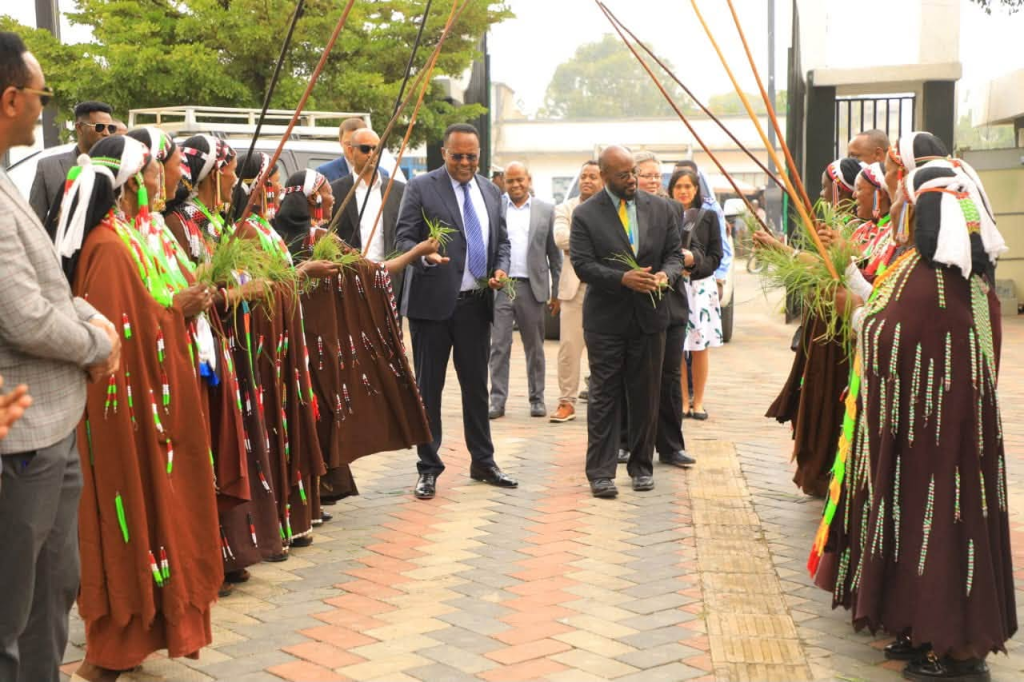
In a historic visit, the city of Shashemene opened its doors to the United States Ambassador, showcasing decades of resilience and a vision for transformative development.
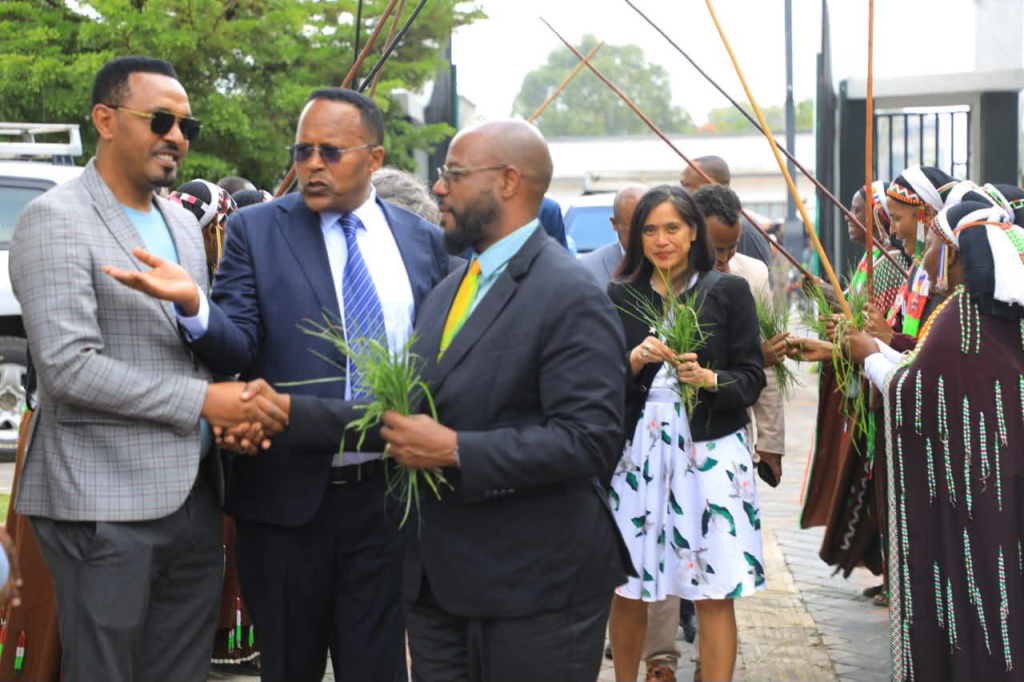
SHASHEMENE, OROMIA — Today, the city of Shashemene stood still to warmly welcome the Honorable Ambassador of the United States. The visit marked more than a formal diplomatic engagement; it was a powerful testament to the growing partnership, mutual respect, and shared aspirations between the United States and the people of Ethiopia .
The city, with its rich history of over 115 years, presented its developmental scenario to the Ambassador, covering key indicators in demographics, infrastructure, economic progress, and humanitarian efforts. The visit signals a strong message of cooperation as Ethiopia continues its journey of reform and transformation.
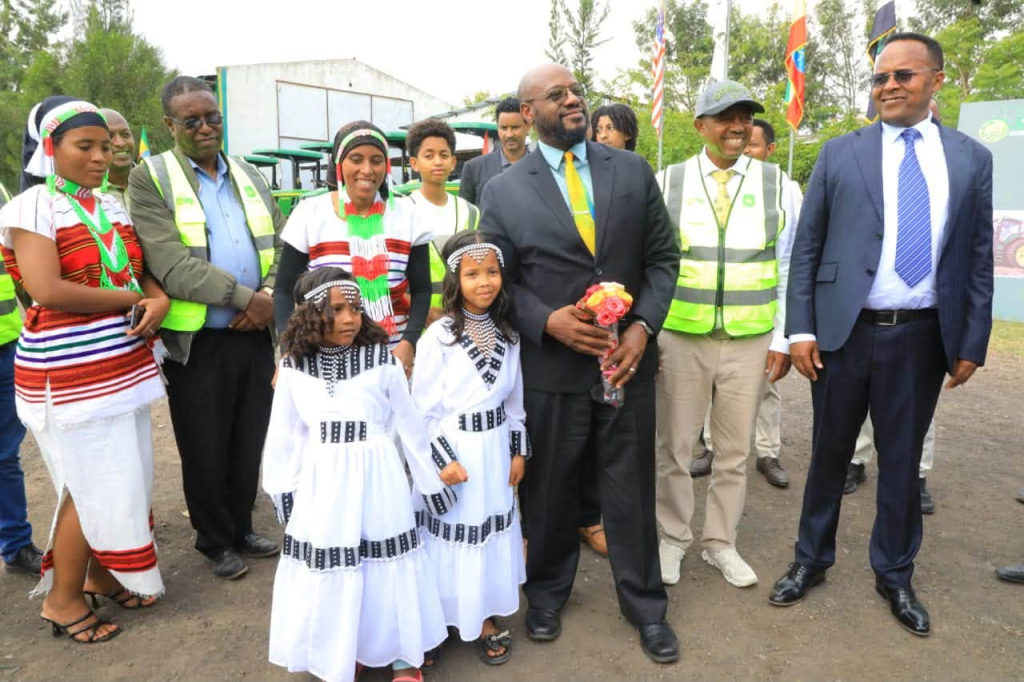
A City of Resilience and History
Shashemene is not just a city; it is a symbol of endurance and hope. Originally established in 1910/1911 (1903 E.C.), the name “Shashemene” is derived from a famous Oromo lady named “Shashe,” who operated a rest-stop called “Mene” in the area . For over a century, the city has served as a vital crossroads in the Rift Valley, connecting the southern regions of Ethiopia to the capital, Addis Ababa .
Shashemene gained international recognition in 1948 when Emperor Haile Selassie I granted 500 acres of fertile land to the Black people of the West as a token of appreciation for their support during the Italian occupation . This land grant led to the settlement of Rastafarian communities from Jamaica, the United States, and the Caribbean, making Shashemene a unique symbol of Pan-Africanism and diaspora repatriation .
As the city continues its journey, the resilience and hope of its people remain its greatest assets.
Presenting a Vision for Progress
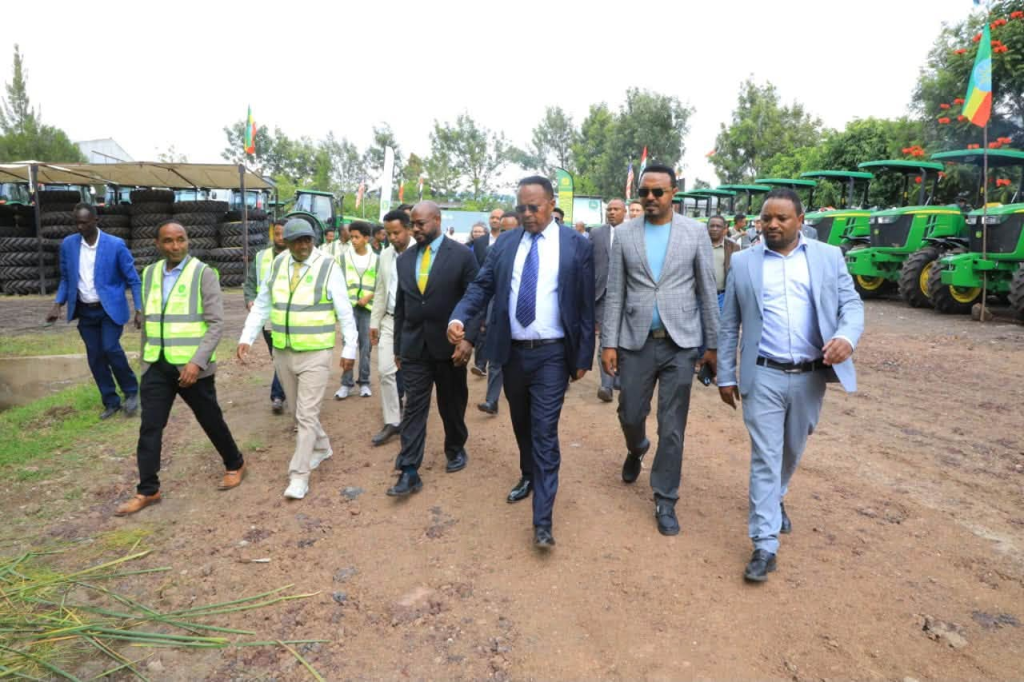
During the visit, local officials detailed the city’s developmental scenario, highlighting significant progress across multiple sectors. Key indicators shared with the Ambassador included:
Demographics: With a rapidly growing population, Shashemene is a city of young people. An estimated 65% of residents are under the age of 25 . This youth bulge presents both an opportunity and a challenge. Harnessing the energy and potential of this demographic is central to the city’s development strategy.
Infrastructure: The city is undergoing significant transformation. Under the national “Corridor Development” initiative, Shashemene is being upgraded into a smart city with modern transportation networks and improved public services . Recently, Shashemene was also upgraded to the status of a “Regiopolis” (a major regional urban center) .
Economic and Humanitarian Works: The city is seeing strong potential in revenue generation, economic development, and social services. There is real potential for job creation and attracting investment to improve livelihoods. Simultaneously, the city is focused on strengthening education, health, and security services for its families.
A Message of Partnership and Hope
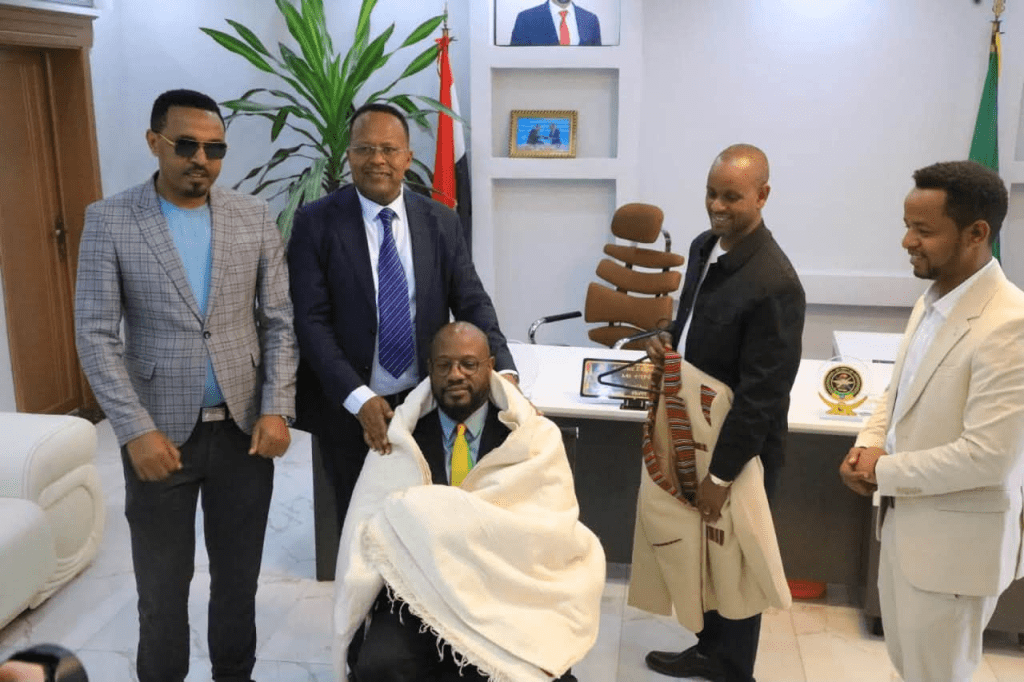
In welcoming the Ambassador, city officials expressed gratitude for the United States’ continued engagement and support. The Ambassador’s visit follows recent U.S. Embassy engagements in Oromia, where the focus has been on promoting inclusive economic development, improving health outcomes, and increasing the quality of education .
“Honorable Ambassador, we welcome your partnership and support as we continue building Shashemene into a safer, stronger, and more prosperous hub for many nations and nationalities.”
The officials noted that following the reform and prosperity government, meaningful transformation is not only possible but is already becoming real in communities across Ethiopia. The visit was described as a strong message of partnership, mutual respect, and shared goals.
The Power of Dialogue and Collaboration
As the visit concluded, the city offered its sincere gratitude and well wishes to the Ambassador.
“Honorable Ambassador, As a nation and transformative government all Ethiopians believe in the power of dialogue and collaboration. We hope your visit will deepen understanding, strengthen ties, and open new avenues for constructive support that benefits the people of Shashemene, Oromia and Ethiopia.”
The visit concluded with a reaffirmation of the commitment to build bridges of friendship between nations.
“Once again, welcome to Shashemene. We wish you a successful visit, and we thank you for your commitment to building bridges of friendship between nations. Thank you.”

From Classroom to Doctorate: Oromo Community of LA Celebrates Teacher-Scholar Dr. Asfaw Dagafa
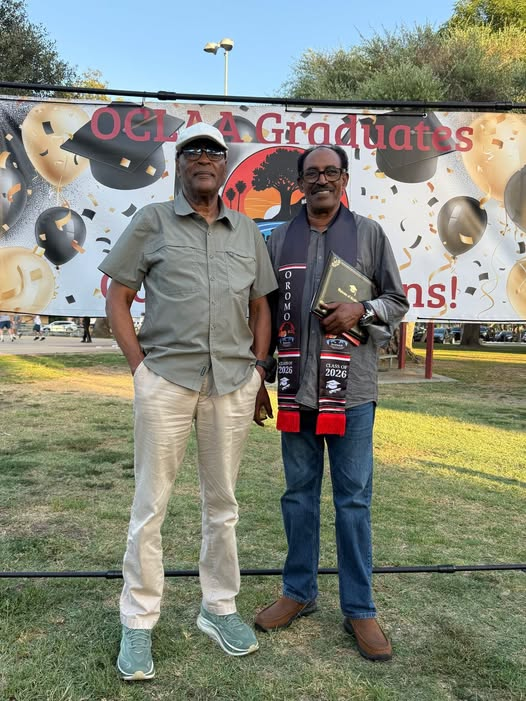
Los Angeles, CA – It was an evening of collective triumph and deep cultural pride as the Oromo Community of Los Angeles gathered yesterday to celebrate a remarkable milestone: the graduation of their members, spanning every academic level from high school diplomas to the pinnacle of scholarly achievement—the Ph.D.
While the room buzzed with congratulations for all the honorees, one story rose above the rest, leaving attendees inspired and deeply moved. The community turned its spotlight on Dr. Asfaw Dagafa, a man who redefined the meaning of perseverance.
By day, Dr. Dagafa stands at the front of a high school classroom, shaping young minds as a dedicated educator. But long after the final school bell rings, his journey was only just beginning. While managing the rigorous demands of teaching, he simultaneously pursued his doctoral studies at one of the nation’s most prestigious institutions—the University of California, Los Angeles (UCLA).
Balancing a full-time teaching career with the intellectual intensity of a Ph.D. program is a feat few dare to attempt. Yet, Dr. Dagafa turned this grueling schedule into a testament of discipline, proving that dedication knows no bounds. His academic success is not merely a personal victory; it is a beacon of hope for the entire Oromo diaspora.
A Role Model for the Next Generation
Community leaders and elders were effusive in their praise, highlighting how Dr. Dagafa’s journey serves as a powerful blueprint for Oromo youth navigating their own paths in the United States.
“Dr. Asfaw Dagafa is an excellent role model,” remarked a community spokesperson during the ceremony. “He shows our young people that you do not have to choose between serving your community and achieving your highest academic dreams. He did both, simultaneously, and with excellence.”
The message resonated deeply throughout the hall: no dream is too ambitious, and no obstacle is too great when fueled by purpose and resilience. By standing at the front of a classroom during the day and sitting among UCLA’s brightest scholars at night, Dr. Dagafa has bridged the gap between mentorship and mastery.
A Community’s Pride
The Oromo Community of Los Angeles, known for its vibrant support of educational advancement, expressed overwhelming pride in Dr. Dagafa’s achievement. His success is viewed not just as an individual honor, but as a collective victory for the community—a narrative that counters adversity with academic excellence.
As the celebrations concluded, the community extended its heartfelt congratulations not only to Dr. Asfaw Dagafa but to every graduate who crossed the stage. From the newest high school graduate stepping into adulthood to the newly minted Ph.D. stepping into history, yesterday was a powerful reminder of what happens when a community uplifts its own.
Congratulations once again, Dr. Asfaw Dagafa! 
Your journey from the classroom to the doctorate will inspire generations of Oromo scholars to come.

WHEN DREAMS TAKE ROOT: Why an Oromia Freedom Struggle Dream Can Grow Better

A story of constitutional promise, cultural resurgence, and the long arc toward justice
—
For generations, the Oromo freedom struggle has been defined by its resilience. Through decades of marginalization, forced displacement, and systemic exclusion, the dream has endured—not as a fading memory, but as a living force that refuses to be extinguished.
Today, that dream stands at a crossroads. The path forward is neither simple nor guaranteed. But beneath the surface of conflict and political turbulence, there are reasons to believe that the Oromo freedom struggle dream can grow better—not despite the challenges, but because of the lessons learned, the institutions built, and the constitutional foundations that remain, however imperfectly, in place.
This is the story of why that dream can flourish.
THE CONSTITUTIONAL FOUNDATION: A PROMISE WAITING TO BE KEPT
Every great struggle requires a legal and moral framework. For the Oromo people, that framework exists in Ethiopia’s 1995 Constitution—a document that, on paper, offers something remarkable.
Article 39 of the Constitution affirms that every “nation, nationality, and people” has the unconditional right to self-determination, including the right to secession. The Constitution established Ethiopia as a multinational federal state, granting autonomy to minorities based on territorial boundaries and empowering self-rule and regional control. Afaan Oromo is now used in Oromia’s courts, schools, and bureaucracy, reversing decades of marginalization.
Yet scholars describe a persistent gap between constitutional promise and political reality. Federal practice has remained markedly centralized. The question of Oromia’s special interests in Finfinne (Addis Ababa) remains largely unresolved.
This gap is not a reason for despair—it is a reason for hope. The Constitution exists. The legal framework is in place. The struggle ahead is not to create new rights, but to enforce existing ones. When constitutional guarantees are ignored, public trust erodes; but when they are finally implemented, the foundation for lasting peace is laid.
POLITICAL EVOLUTION: FROM ARMED STRUGGLE TO POLITICAL ENGAGEMENT
The Oromo Liberation Front (OLF), established in 1973 as a political organization advocating for the self-determination of the Oromo people, has undergone a remarkable transformation. In 2018, the Ethiopian government removed the OLF from its terrorist list, allowing its leaders to return from exile. In June 2025, the OLF officially regained access to its headquarters in Finfinne (Addis Ababa), which it had been unable to use since August 2020.
This is not merely symbolic. It represents a shift from armed resistance to political engagement—a recognition that sustainable change requires participation in the democratic process, however constrained that process may be.
The OLF has participated in elections, fielding 163 candidates for both the federal parliament and the regional council in the 2026 elections. Though it did not win a single seat, the party has used the narrow political space available to communicate its objectives and principles to the public.
Professor Merera Gudina, chairman of the Oromo Federalist Congress (OFC), has long championed a “stem and branches” philosophy: the belief that Oromia is the indispensable heart of Ethiopia, and that its people must secure self-rule and shared-rule within a unified, democratic state. His perspective, tempered by over five decades of activism, argues that Ethiopia still lacks the genuine political will required for deep-seated dialogue.
But political will can be built. Institutions can be strengthened. The very fact that opposition parties continue to organize, to contest elections, and to demand accountability is evidence that the dream is alive and evolving.
CULTURAL RESURGENCE: THE REBIRTH OF IDENTITY
A freedom struggle is not only about politics—it is about identity, memory, and the right to be seen.
Irreechaa, the annual festival of the Oromo people, has undergone a remarkable transformation, evolving from a banned event to a recognized element of national cultural heritage and an attraction for international tourism. The 2025 theme, “Irreecha: For National Renewal,” embodies the spirit that sustainable progress must be grounded in cultural harmony and shared values.
Afaan Oromo, once reduced to minority status, is now experiencing revitalization efforts. Though implementation remains uneven, the language of wider communication in Ethiopia and neighboring countries is reclaiming its place. The Gadaa system has gained global recognition as a model of democracy and environmental stewardship.
Cultural revival is not a distraction from the struggle—it is the struggle’s soul. When a people remember who they are, they remember what they deserve.
ECONOMIC DEVELOPMENT: BUILDING THE MATERIAL FOUNDATION
Justice cannot be built on empty stomachs. Economic development in Oromia provides the material foundation upon which political dreams can be realized.
Development projects like the Welmel River Irrigation and the Sof Omer Luxury Lodge, alongside ongoing agricultural modernization and tourism efforts in Bale Zone, are pillars of economic transformation. The new Yabello airport is expected to significantly enhance regional trade, tourism, and investment while strengthening people-to-people ties.
The Oromia regional government has prioritized the expansion of domestic air travel to drive rapid development. Investment projects are expected to create employment opportunities for more than 284,174 individuals across various sectors, particularly in agriculture, manufacturing, and services.
When economic opportunities expand, political participation becomes more meaningful. When communities have a stake in the future, they are more willing to invest in the struggle for that future.
THE CHALLENGES THAT MUST BE OVERCOME
No honest assessment of the Oromo freedom struggle can ignore the profound challenges that remain.
The Oromo Liberation Army (OLA) has been fighting the Ethiopian government for more autonomy since 2018. The conflict has taken a devastating toll. In January 2025, the U.N. reported that 3.2 million children were not in school because of the fighting. Human rights conditions remain precarious, with documented arbitrary deprivations of life and liberty amid clashes in Oromia.
Political space has shrunk. Opposition leaders have been imprisoned. Electoral competition alone is no longer viewed as sufficient to address Oromia’s political challenges. The OLF has raised concerns that “Tsimdoo” (allied) forces have attempted attacks that caused harm to local residents.
These challenges are real. They are painful. They are not insurmountable.
THE PATH FORWARD: WHY THE DREAM CAN GROW BETTER
The Oromo freedom struggle dream can grow better because the conditions for its growth are being laid—not by outside forces, but by the Oromo people themselves.
First, constitutional tools exist. The 1995 Constitution provides a framework for self-determination that, however imperfectly implemented, remains a powerful legal weapon. The gap between promise and reality is not permanent—it can be closed through sustained political pressure and legal advocacy.
Second, political engagement is deepening. The OLF’s return from exile, its participation in elections, and its calls for inclusive dialogue represent a maturation of the struggle. The OLF has urged the government to demonstrate genuine political will in resolving ongoing grievances through justice, truth, and reconciliation.
Third, cultural identity is strengthening. The revival of Irreechaa, the resurgence of Afaan Oromo, and the global recognition of the Gadaa system provide a cultural foundation that no political repression can destroy.
Fourth, economic development is creating new possibilities. As Oromia’s economy grows, so does the capacity of its people to organize, to advocate, and to demand their rights.
Fifth, the international community is watching. Human rights reporting, U.N. documentation, and global advocacy create pressure for accountability. The Oromo cause is no longer invisible.
CONCLUSION: THE LONG ARC
The Oromo freedom struggle has been long. It has been costly. It has been marked by betrayal, violence, and heartbreak. But it has also been marked by resilience, courage, and an unshakeable commitment to justice.
The dream can grow better because it has already survived the worst that history could throw at it. It has endured because it is rooted in truth—not propaganda, not false narratives, but the lived reality of a people who know what they have lost and what they deserve.
As the OLF has stated, the situation in Oromia and across Ethiopia cannot be resolved merely by declaring an election victory. It requires “an inclusive, genuine, and transparent dialogue”. It requires the courage to acknowledge historical realities, the wisdom to respect differing perspectives, and the commitment to uphold the principles of constitutional democracy and the rule of law.
The Oromo freedom struggle dream can grow better because the Oromo people have never stopped dreaming. And dreams, when nurtured by truth, justice, and unwavering commitment, have a way of becoming reality.
—
This feature is based on reporting from Addis Standard, The Reporter Ethiopia, OROMIA TODAY, the Associated Press, the Oversight Board, and other sources documenting the Oromo freedom struggle, political developments, and cultural resurgence in Ethiopia.

The Unfinished Struggle: Understanding the Qabsoo Bilisummaa Oromoo
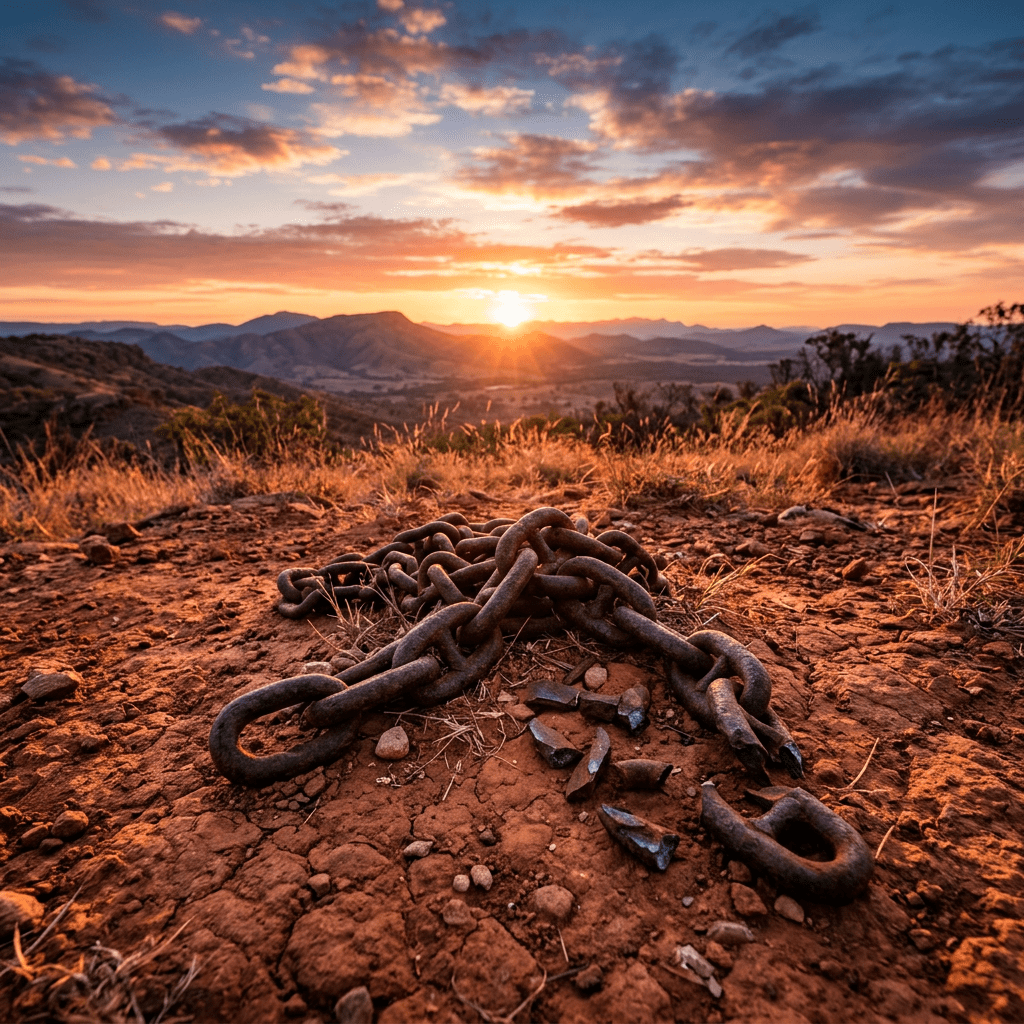
What is the Oromo liberation struggle, and how is it being waged?
—
I. Introduction: A Struggle Defined
The phrase Qabsoo Bilisummaa Oromoo translates from the Oromo language as the “Oromo Liberation Struggle.” At its core, it represents the decades-long political and armed movement by the Oromo people—Ethiopia’s largest ethnic group, comprising approximately a third of the nation’s nearly 130 million people—to achieve self-determination and freedom from what they characterize as internal colonization by successive Ethiopian regimes.
This is not a single organization or a monolithic movement. Rather, Qabsoo Bilisummaa Oromoo encompasses a complex ecosystem of political parties, armed groups, youth movements, diaspora activism, and cultural resistance, all united by a common aspiration: the liberation of the Oromo people and their ancestral homeland, Oromia.
“Qabsoo dhaabatu hin jalqabne, akeeka ijaarameef hamma galmaan ga’uttis hin dhaabatu.”
— Dawud Ibsa Ayana, Chairman of the Oromo Liberation Front (OLF), declaring in June 2025 that “the struggle we started will not stop until the goal we have set is achieved.”
—
II. Historical Roots: The Genesis of a Movement
The modern Oromo liberation struggle traces its origins to the early 1970s, a period of political awakening among Oromo nationalists who sought to challenge what they viewed as “Abyssinian colonial rule” over the Oromo people.
The Founding of the OLF
In 1973, a clandestine group of Oromo nationalists from diverse backgrounds, brought together by figures like Baro Tumsa, established the Oromo Liberation Front (OLF)—known in Oromo as Adda Bilisummaa Oromoo (ABO). The OLF was founded to promote self-determination and independence for the Oromo people inhabiting what is today the Oromia Region and the Oromia Zone in the Amhara Region of Ethiopia.
The OLF’s ideological premise was that the Oromo were subject to internal colonization by the Ethiopian state, and its ultimate goal was secession from Ethiopia and the establishment of a sovereign Oromo nation.
The Armed Wing Emerges
By 1974, the OLF had formed its military wing, the Oromo Liberation Army (OLA)—Waraana Bilisummaa Oromoo (WBO) in Oromo. The armed struggle began in Eastern Oromia, marking the start of a military campaign that would continue, with varying intensity, for decades.
—
III. The Actors: Who Fights for Freedom?
The Qabsoo Bilisummaa Oromoo is waged through multiple channels and by various actors, each with distinct methods and roles.
1. The Oromo Liberation Front (OLF) – Political Vanguard
The OLF remains the primary political organization representing the liberation struggle. After spending 27 years in exile, the OLF returned to Ethiopia in 2018 following a peace agreement with Prime Minister Abiy Ahmed’s government, committing to pursue its goals through peaceful political means.
However, the party has faced significant obstacles. In a November 2025 position statement, the OLF declared that “the current regime has deliberately closed the political arena and obstructed the lawful activities of the Oromo Liberation Front”. The party reported that its regional offices had been closed, its leaders arrested, and its members prevented from engaging with constituents.
Despite these challenges, the OLF continues to operate, maintaining offices in Addis Ababa, Washington D.C., and Berlin, from which it broadcasts radio programs in both Amharic and Oromo.
2. The Oromo Liberation Army (OLA) – Armed Resistance
The OLA is the armed opposition group active in the Oromia Region. It consists primarily of former armed members of the OLF who refused to disarm following the 2018 peace deal, skeptical of the government’s intentions, alongside former youth protesters who became disillusioned with nonviolent resistance.
Today, the OLA operates under the name OLF-OLA (or ABO-WBO in Oromo). While the Ethiopian government considers the OLF a legal political party, it has designated the OLA as a terrorist organization.
The armed conflict has exacted a devastating toll on civilians. Amnesty International reported in March 2026 that OLA fighters had subjected women and girls to sexual violence including rape, gang rape, sexual slavery, summary killings, and destruction of civilian property, acts that may amount to war crimes. Government forces have also been accused of systematic abuses, including extrajudicial killings and forced displacement.
3. Qeerroo – The Youth Movement
Perhaps the most dynamic force in recent years has been the Qeerroo—a youth movement that has emerged as a powerful voice for change. In traditional Oromo culture, the term means “bachelor” or “youth,” but within the political movement, it symbolizes the Oromo struggle for increased political freedom and greater ethnic representation.
The BBC has described Qeerroo as “Ethiopia’s National Youth Movement for Freedom and Democracy,” which calls itself Qeerroo Bilisummaa Oromoo. The movement first emerged in 1991 but gained prominence through the 2016 Oromo protests and again in July 2020 following the assassination of Oromo singer Hacaaluu Hundeessaa.
4. The Diaspora – Global Advocacy
The Oromo diaspora has become an increasingly visible force in the liberation struggle. In September 2020, Oromo women marched through the streets of Berlin, Germany, demanding recognition for their struggle. These protests, called Hiriira in the Oromo language, highlight the transnational nature of the movement and its ability to garner international attention.
As one diaspora organizer put it, the goal is to ensure that “deeggarsii fi tumsi qabsoo bilisummaa akka itti fufiinsa argatu”—that “support and sustenance for the freedom struggle continues to receive continuity.”
—
IV. How the Struggle is Waged: Methods and Tactics
The Qabsoo Bilisummaa Oromoo employs a multifaceted approach to achieve its objectives.
Armed Conflict
The OLA continues to engage in armed confrontations with Ethiopian government forces across Oromia. Clashes have been reported in various zones, including East Wollega, West Wollega, and Kellem Wollega. In August 2025, the OLA orchestrated a prison break in Gida Ayana, freeing over 150 inmates.
However, the armed struggle has not been without controversy. The OLA has been accused of attacking civilians, including a June 2025 attack that killed three civilians in the Arsi zone. Government forces have also been implicated in civilian deaths, with one mother telling Addis Standard that government soldiers fatally shot her toddler in July 2025.
Political Advocacy
The OLF pursues its goals through political channels, participating in elections and issuing statements condemning government actions. In the 2026 elections, the OLF fielded 163 candidates for federal parliament and regional councils. The party has also called for an independent international investigation into killings committed against the Oromo people.
Youth Mobilization and Protests
The Qeerroo movement has mobilized thousands of young Oromos through protests and demonstrations. These protests have sometimes turned violent, with clashes between protesters and security forces. The youth have also used social media and digital platforms as alternative communication channels and sites of political resistance.
Cultural Resistance
The struggle is also waged through cultural expression. Oromo protest songs have served as “weapons of resistance against domination” since the 1960s. The annual Irreecha thanksgiving festival has become a platform for political expression, with attendees using the occasion to hold anti-government protests.
Territorial Claims
The OLF has consistently defended the territorial integrity of Oromia. In July 2025, the party condemned the Somali regional government’s actions as “a blatant attempt to claim Oromo land,” calling it “a declaration of war”. In its November 2025 position statement, the OLF declared that “the territorial integrity of Oromia is non-negotiable”.
—
V. The Human Cost: A People in Crisis
The ongoing conflict has exacted a devastating toll on civilians.
Mass Displacement
Since July 2025, renewed inter-communal violence between Oromo and Somali communities along the regional border has displaced over 288,000 people. The violence has resulted in widespread fatalities and damage to infrastructure.
Humanitarian Crisis
The Ethiopian Human Rights Commission has stated that the “right to life is in a critical condition” in the affected regions. Persistent violence has led to the breakdown of public services and the mass displacement of communities.
Political Repression
The OLF has accused the government of a “systematic campaign of torture,” employing tactics such as extrajudicial killings, forced displacement, and persecution. The party’s offices have been closed, and its leaders have been arrested.
—
VI. The Future: An Unfinished Struggle
The Qabsoo Bilisummaa Oromoo shows no signs of abating. As Dawud Ibsa Ayana, the OLF chairman, declared in 2025: “The struggle we started will not stop until the goal we have set is achieved.”
Challenges Ahead
The movement faces significant challenges:
· Internal divisions: The split between the OLF (political wing) and the OLA (armed wing) has created organizational fragmentation.
· Government opposition: The Ethiopian government continues to view the armed struggle as a terrorist threat and has cracked down on political opposition.
· Humanitarian toll: The continued conflict has displaced hundreds of thousands and caused immense suffering.
· International scrutiny: Allegations of war crimes by both sides have drawn international attention.
A Persistent Hope
Despite these challenges, the movement persists. As one Oromo activist put it: “Addi Bilisummaa Oromoo… Qabsoo Itti Fufa. Bilisummaan Ni Dhufa.” — “The Oromo Liberation Front… The struggle continues. Freedom is coming.”
—
VII. Conclusion: More Than a Struggle
The Qabsoo Bilisummaa Oromoo is more than a political or armed conflict. It is a movement rooted in a people’s desire for self-determination, dignity, and recognition. It encompasses the teenager protesting in the streets of Addis Ababa, the fighter in the mountains of Oromia, the exile in Berlin organizing a march, and the grandmother in a village dreaming of peace.
For nearly five decades, the Oromo people have pursued their liberation through political advocacy, armed resistance, youth mobilization, and cultural expression. The struggle has claimed countless lives, displaced hundreds of thousands, and left deep scars on Ethiopian society.
Yet, as the Oromo saying goes, “Bilisummaan Ni Dhufa”—Freedom is coming. Whether that freedom arrives through peaceful negotiation, political reform, or continued resistance remains the central question of Ethiopia’s most enduring conflict.
—
“The Voice of Oromo Freedom: Strengthening the struggle, awakening the people, proclaiming the goal.”
Bridging Continents, Building a Nation: OLF/ABO Annual Dialogue Heads to Minnesota
By Maatii Sabaa
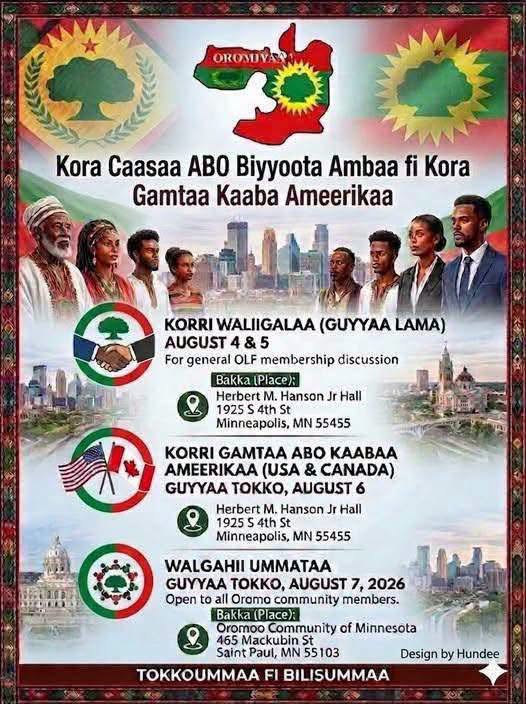
As the autumn leaves begin to turn across the American Midwest, a familiar and powerful rhythm stirs within the Oromo diaspora. In just a few weeks, Minnesota—often affectionately called “Little Oromia” for hosting one of the largest Oromo populations outside of East Africa—will become the epicenter of a movement that refuses to fade. The Oromo Liberation Front (OLF/ABO) is set to hold its annual dialogue, a cornerstone tradition that weaves together strategy, solidarity, and the unyielding pursuit of self-determination.
The announcement is more than a calendar entry; it is a declaration. The tradition continues.
A Gathering of Purpose
For decades, the Oromo people have carried the weight of marginalization, yet they have also carried the tools of resistance. The OLF/ABO has been at the forefront of this resistance, and its annual dialogue represents a critical moment of reckoning and renewal. Leaders, intellectuals, activists, and everyday community members will converge in Minnesota to take stock of the movement’s progress, confront pressing challenges in the homeland, and chart a course for the year ahead.
But what makes this year’s event particularly noteworthy is its inclusivity. Organizers have extended a rare and welcoming invitation: the final day of the dialogue will be open to all Oromo Community members. This decision transforms a closed-door political meeting into a celebration of collective identity. It is a recognition that the struggle for Oromia’s liberation is not confined to the political elite—it belongs to the farmer in the countryside, the mother in the diaspora, the student in the university, and the elder who remembers a homeland before displacement.
Why Minnesota?
The choice of Minnesota is no accident. Over the past three decades, the state has become a sanctuary and a springboard for Oromo activism. From the bustling neighborhoods of Minneapolis to the suburban cities of St. Paul, Oromo culture thrives—through language, music, faith, and political organization. Holding the annual dialogue here acknowledges the diaspora not as a distant bystander, but as a vital pillar of the liberation project.
In this space, the past meets the present. Elders who witnessed the early days of the OLF sit alongside youth born in the West, forging an intergenerational bond that strengthens the movement’s resilience. It is a living classroom where history is taught, grievances are voiced, and hope is rekindled.
Consistency and Determination: The Unshakeable Foundation
The flyer circulating among community groups carries a powerful mantra: “As always, consistency and determination remain the foundation of lasting progress and success.”
These words are not empty rhetoric. In the long and often brutal struggle for Oromo self-determination, fads and fleeting passions have no place. What sustains the movement is the dogged, day-in and day-out commitment of a people who refuse to be erased. The annual dialogue is the embodiment of this ethic. It is a ritual of endurance—a moment to recalibrate, to reaffirm, and to recommit.
Consistency means showing up, year after year, regardless of the political winds. Determination means turning setbacks into stepping stones. The OLF/ABO has weathered imprisonment, exile, and state-sponsored repression, yet here it stands, preparing to convene once again in the heart of America. That is the quiet power of persistence.
An Open Door to the Community
The decision to open the final day to all Oromo community members is a strategic and symbolic masterstroke. It breaks down barriers between leadership and the grassroots, ensuring that the dialogue is not an ivory tower but a public square. It invites critical feedback, fresh perspectives, and the energy of those who may not hold formal titles but carry the daily lived experience of Oromo identity.
Whether one is a long-time activist or a young professional attending for the first time, the final day promises to be a space of belonging. It is a chance to ask questions, share concerns, and witness firsthand the democratic spirit that the OLF/ABO champions. In a world where liberation movements often become opaque, this open-door policy is a beacon of transparency and trust.
The Cry That Echoes: IUOf! 

As the event draws near, social media feeds and community bulletin boards will fill with the colors of the Oromo flag—red, green, and red—a trinity of courage, hope, and sacrifice. And when the dialogue reaches its crescendo, the hall will undoubtedly erupt with the rallying cry: “IUOf!” Or Victory to Oromo people —a spirited abbreviation for the Oromo phrase that resonates across generations, declaring the unshakable belief in the Oromo nation’s future.
The red hearts speak to the blood shed for freedom. The green hearts speak to the fertile land of Oromia that awaits full restoration. Together, they form a visual prayer for justice.
A Tradition That Transcends Time
The annual dialogue is more than a political event; it is a cultural anchor. In a diaspora scattered across the globe, it provides a rare moment of physical convergence. It reminds the Oromo people that they are not isolated individuals but members of a vast, resilient family with a shared destiny.
As the final day opens its doors to all, the Oromo community in Minnesota and beyond will have the chance to witness history in the making. The tradition continues—not as a relic of the past, but as a dynamic, living force that charts the path toward a free and sovereign Oromia.
So mark the date, spread the word, and prepare to gather. The dialogue awaits. The struggle endures. And as always, it is consistency and determination that will carry the Oromo people across the finish line.
IUOf!
The Political Boat Called “Tsimdo”: Where Are the Far-Right and Far-Left Extremists Steering It?

In the strange theater of modern politics, strange bedfellows emerge—temporary alliances born not of shared vision but of shared hatred
By Ibsaa Nagawoo
In the annals of modern political history, few phenomena are as remarkable—and as dangerous—as the spectacle of ideological opposites joining forces against a common enemy. The far-right and far-left, whose philosophies on economics, governance, and the role of the state stand in irreconcilable opposition, sometimes find themselves on the same side of a political struggle. Their alliance, however, is not built on shared principles or a common vision for the future. It is built on a single, fragile foundation: shared enmity.
This is the political boat called “Tsimdo” (or Cimdii)—a vessel that carries strange passengers, navigates treacherous waters, and ultimately leads nowhere good for anyone aboard.
The Strange Alliance
“One of the surprising phenomena in modern world politics is the emergence of forces that fundamentally oppose each other in their political philosophy, economic policies, and views on the role of government, yet temporarily unite against a common enemy.”
This is not a new phenomenon, but it is one that has become increasingly visible in recent years. The left and right, traditionally locked in ideological struggle, discover that their hatred for a particular leader, government, or political direction outweighs their differences. They form a temporary alliance—an “unholy coalition” that promises to overthrow the common enemy but offers no coherent vision for what should come after.
“However, such alliances are often short-lived because they are based not on shared vision and common political principles, but on shared animosity.”
This is the fatal flaw of these coalitions. They are unions of convenience, not conviction. They can tear down, but they cannot build. They can oppose, but they cannot propose. They can unite in hatred, but they cannot govern in peace.
Ethiopia’s Own Experience
“Both world history and Ethiopia’s political history provide many examples that confirm this.”
In recent years, Ethiopia has witnessed this phenomenon in stark relief. The conflict between the federal government and the TPLF, and the alliances that formed around it, created some of the most improbable political marriages in the country’s history.
“In Ethiopia, this trend has been clearly seen in recent years. One can observe and analyze the strange political alliances formed during the TPLF provocation, the war between the Federal Government of Ethiopia and the TPLF, and the resulting unconventional political marriages.”
Groups that had spent decades opposing each other—ideologically, politically, and sometimes militarily—found themselves on the same side of a conflict. The shared goal of removing the TPLF from power created a temporary unity that papered over fundamental disagreements about Ethiopia’s political future.
The Unholy Alliance Against Oromo Gains
“The far-right and far-left extremist forces that shed crocodile tears in the name of the Oromo people, the Amhara, the Tigray, and the Ethiopian people—no matter how strong their unholy alliance becomes—the Oromo people will not easily surrender the political, economic, and legal rights they have won through long struggle and years of sacrifice.”
This is the central warning of the reflection: the Oromo people, who have fought for generations to secure their rights, are not about to hand them over to an alliance of convenience—whether that alliance claims to speak for the Oromo or not.
“The matter has become one of survival. And the victory achieved is not something that can be stolen through temporary political pressure or false propaganda.”
The Oromo struggle is not a passing phase or a fleeting moment of political mobilization. It is a deep, sustained, and principled movement that has survived decades of repression, co-optation, and marginalization. It will not be undone by an alliance whose only common ground is opposition to Oromo self-determination.
The Blindness of Some Oromo
“As the struggle of the Oromo people within Ethiopia has been strengthening and registering some victories, some Oromo individuals and groups who could not see—or refused to believe—that organized anti-Oromo sentiment had been building for a long time, have failed to understand that the exaggerated political hatred, character assassination, and coordinated propaganda campaign against the reformist Prime Minister Dr. Abiy Ahmed is ultimately not just about Dr. Abiy but about the Oromo as a whole.”
This is a painful truth that some Oromo have been reluctant to face. The campaign against Prime Minister Abiy Ahmed is not merely a personal vendetta against one individual. It is an attack on Oromo leadership, Oromo gains, and Oromo aspirations. The fact that some Oromo have joined in this campaign, or remained silent in the face of it, is a betrayal of the Oromo cause.
“Only they themselves can answer why this happened.”
The reflection leaves this question hanging in the air, inviting self-examination. Why have some Oromo joined forces with those who fundamentally oppose Oromo rights? Why have some remained silent when anti-Oromo rhetoric has reached dangerous levels? Why have some failed to see that the attack on one Oromo leader is an attack on all Oromo?
The Washington Statement and Its Aftermath
“There is one thing we all cannot forget. The statement by the international Fano ‘intellectuals’ that was read in Washington contained dangerous rhetoric: ‘We will return the Gallas to Madagascar.’ This is still being echoed by Mahayimannu Fano. This hate speech did not remain merely words—many believe it has found expression in acts of violence against innocent Oromo in various places, especially today in East Wollega and Dera.”
This is a chilling reminder of the stakes involved. The anti-Oromo rhetoric that has been circulating is not harmless—it has real-world consequences. Innocent Oromo people have been targeted, attacked, and killed. The words of hate have become acts of violence.
“The sad part is that some forces who call themselves ‘freedom fighters’ have silently covered up or overlooked this issue. This silence itself carries a major political message.”
The silence of those who claim to fight for freedom is deafening. When the self-proclaimed champions of liberation refuse to condemn violence against Oromo, they reveal their true priorities. Their silence is not neutrality—it is complicity.
The Poisoned Boat
“Some Oromo politicians and activists, having lost their own political direction, have found themselves unwittingly in the same political boat (Tsimbo) as Amhara extremist unitarist far-right extremists. Since this act conflicts with the common interest and political will of the Oromo people, it should be remembered as a political lesson and historical warning for generations.”
This is perhaps the most pointed criticism in the reflection: some Oromo have lost their way. They have abandoned the principles of Oromo liberation and joined forces with those who have historically opposed—and continue to oppose—Oromo rights.
“Any individual or political organization that organizes in the name of Oromo must distance itself from political ideologies, philosophies, and economic policies that divide the Oromo people. Any idea presented as a ‘political reality’ that weakens Oromo unity, if it conflicts with the interests of Oromia, Ethiopia, and the Oromo nation, should not be accepted.”
This is a clear call to Oromo political actors: know who you are, know what you stand for, and know who your true allies and enemies are. The lines must be drawn clearly. There is no room for ambiguity when the survival of the Oromo people is at stake.
A Call to Abandon the Boat
“Therefore, if you find yourself in this propaganda of organized anti-Oromo hatred, you should distance yourself from this destructive political boat (Tsimbo). This boat does not benefit the Oromo people—it represents hatred, division, and destructive ideologies. It is not too late to distance yourself from this extremist political direction; the beneficial thing is to stop it.”
This is a call to choose. A call to abandon the alliance of hatred and return to the principles of justice, self-determination, and unity. A call to recognize that the path of extremism leads nowhere good.
“It is not too late to distance yourself from this extremist political direction; the beneficial thing is to stop it.”
There is still time to turn back. There is still time to choose the path of dialogue, mutual respect, and peaceful political competition. There is still time to build rather than destroy.
The Role of External Forces
“Finally, this extremist political and war ‘Tsimbo’ is not just an internal problem—it can also be a tool for the interests and proxy wars of external forces, and it is targeted as such. Therefore, it does not bring lasting benefit to the Oromo, the Amhara, the Tigray, or other nations and nationalities, nor to the Ethiopian people in general.”
The reflection recognizes that the forces driving the “Tsimbo” are not purely domestic. External actors have their own interests in Ethiopia’s political landscape. They seek to exploit divisions, weaken the country, and advance their own agendas. The Tsimbo serves their purposes, not the purposes of the Ethiopian people.
“Therefore, I believe that abandoning this politics of hatred, division, and extremism and returning to dialogue, trust, and peaceful political competition is the beneficial path for everyone.”
This is a vision of hope: a return to politics as a means of resolving differences, not a weapon for destroying enemies. A return to the belief that dialogue and trust are possible. A return to the conviction that Ethiopia’s future will be built, not destroyed.
The Way Forward
“Ethiopia’s future destiny will not be found in an alliance based on hatred. The country’s lasting peace, stability, and democratic progress can only be ensured when they are based on constitutional supremacy, the rule of law, mutual respect, genuine democratic dialogue, and a shared national vision.”
This is the heart of the message: the future belongs not to those who hate, but to those who build. Not to those who divide, but to those who unite. Not to those who destroy, but to those who create.
“One truth, however, is clear: an alliance based on hatred may change a government, but it cannot build a country.”
This is a profound insight. The Tsimbo may succeed in its immediate objective—the removal of a particular leader or the overthrow of a particular government. But what then? What vision does it offer for the future? What principles will guide it? What foundation will it build upon?
The answer is: none. An alliance based solely on hatred can only destroy; it cannot create. It can tear down; it cannot build. It can oppose; it cannot govern.
Conclusion: A Choice to Make
The political boat called Tsimbo is a dangerous vessel. It carries those who have lost their way, those who have confused hatred for principle, those who have abandoned the struggle for justice in favor of the easier path of revenge.
But there is another path. The path of dialogue, trust, and peaceful political competition. The path that builds rather than destroys. The path that unites rather than divides. The path that leads to lasting peace, stability, and democracy.
The choice is clear. The time for choosing is now.
“An alliance based on hatred may change a government, but it cannot build a country.”
Let us choose to build. Let us choose to unite. Let us choose the path of peace, justice, and shared national vision.
May we all make the right choice.
====
*The above feature article is based on the reflection of Ibsaa Nagawoo

Building a Nation: The Long Walk to Freedom and Unity

By Dhabessa Wakjira
—
Nation-building is no simple task. It is a long, arduous journey that demands relentless commitment, profound sacrifice, and an unyielding spirit. To build a nation is to weave knowledge, courage, and resilience into an unbreakable fabric—a shield strong enough to stand firm against any enemy. It is to reject the chains of servitude, to organize with urgency, and to play one’s part in the collective march toward liberation. No nation that has endured the crushing weight of subjugation has ever emerged free without a determined struggle.
This truth resonates deeply in the heart of Oromia.
The Anatomy of Struggle
Throughout history, the path to freedom has been paved with the blood, sweat, and tears of those who refused to bow. Nation-building is not merely about constructing roads, schools, or hospitals—though these are vital—it is about constructing a collective identity, a shared purpose, and an unwavering belief in the possibility of a better tomorrow. It demands the fusion of knowledge and courage, transforming passive hope into active resistance against all forces that seek to diminish a people’s dignity.
Every nation that has broken free from the shackles of oppression has done so through a conscious, deliberate, and sustained struggle. There are no shortcuts. There are no handouts. Freedom, history teaches us, is never given—it is taken. It is earned through the willingness to pay the full price of liberation, to endure hardship, and to press forward even when the odds seem insurmountable.
The Call to Unity
Oromia belongs to all Oromo people—this is an undeniable truth. But belonging alone is not enough. To truly claim what is rightfully theirs, the Oromo people must stand united. Division is the weapon of the oppressor; unity is the shield of the oppressed. When hands are joined in common purpose, no force can break the spirit of a people determined to be free.
The struggle for liberation is not a spectator sport. It demands active participation from every son and daughter of Oromia. It requires setting aside differences, overcoming internal conflicts, and rallying around a singular vision: a free, prosperous, and dignified Oromia where every citizen can thrive.
The Price of Freedom
There is no free nation that has not paid the ultimate price. Liberation comes at a cost, and that cost must be borne collectively. It is not enough to hope for freedom; one must be prepared to fight for it. The struggle is not for the faint of heart, nor is it for those who seek comfort in the status quo. It is for the brave, the determined, and the unwavering.
The road ahead is long and fraught with challenges. There will be setbacks, disappointments, and moments of doubt. But history shows that those who persist, those who refuse to give up in the face of adversity, are the ones who ultimately triumph. The Oromo people have everything to gain and nothing to lose by standing together in this fight.
The Final Victory
Unity is not just a strategy—it is the very soul of the struggle. When the Oromo people stand together, hand in hand, shoulder to shoulder, they become an unstoppable force. Their collective strength lies not in weapons or wealth, but in their shared determination to overcome.
The struggle is long, and the challenges are immense. But the spirit of the Oromo people is indomitable. With unity as their foundation, courage as their guide, and the dream of freedom as their destination, they will prevail.
Oromiyaan ni bilisooma!






