The Voice That Refuses to Fade: Rift Valley University Students Honor Haacaaluu Hundeessaa
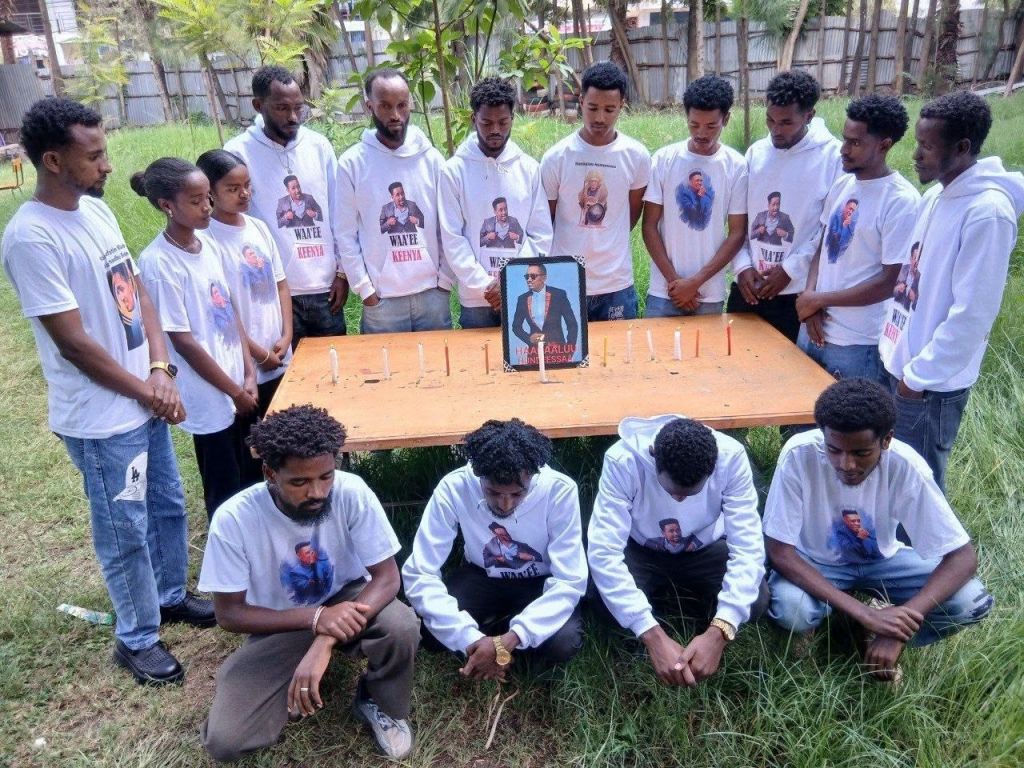
On the sixth anniversary of his assassination, students at Rift Valley University’s Waliso Campus gathered to pay tribute to the artist who became the soundtrack of a revolution—proving that some voices, once heard, can never truly be silenced.
A Date Etched in Memory
Today marks the sixth anniversary of the assassination of Haacaaluu Hundeessaa, the iconic Oromo singer and activist whose music became the anthem of a movement . On June 29, 2020, the 34-year-old artist was shot dead by unknown assailants in Addis Ababa, sending shockwaves through the Oromo community and Ethiopia as a whole . His death was described as “a spear through the heart of the Oromo nation” .
At Rift Valley University’s Waliso Campus, students and faculty have chosen to commemorate this day with a solemn act of remembrance. Despite circumstances that might have made such a tribute difficult, they have come together to ensure that Haacaaluu’s legacy is not forgotten.
More Than a Musician
Haacaaluu Hundeessaa was born in 1986 in Ambo, a city that would later become a symbol of Oromo resistance . At the age of 17, he was arrested for his political activities and imprisoned for five years without ever being charged. It was during this time that he composed most of the songs that would define his career .
His first album, Sanyii Mootii (Royalty), was released in 2009 and propelled him to national stardom . But it was his 2015 single Maalan Jira (What Existence Is Mine) that cemented his place in history. The song became the rallying anthem of the 2015-2018 Oromo protests, which fundamentally altered Ethiopia’s political landscape and swept Prime Minister Abiy Ahmed to power in 2018 .
In his lyrics, Haacaaluu captured the pain, displacement, and marginalization of the Oromo people with astonishing depth . He sang of farmers evicted from their lands, of a culture in jeopardy, and of a community refusing to disappear . Yet his music also offered hope and resilience—most notably in his 2017 follow-up Jirra (We Are Here), a defiant statement of endurance and self-affirmation .
A Legacy Carried Forward
At the Waliso Campus memorial, speakers emphasized that Haacaaluu was not merely a musician—he was a moral compass and a unifying symbol for the Oromo nation . His music inspired an entire generation to be proud of their Oromo identity and to stand up against oppression .
His legacy has been carried forward in tangible ways. In 2022, Rift Valley University renamed its Dirre Gafarsa Campus after Haacaaluu, ensuring that his history would not be forgotten. The ceremony was attended by scholars, students, and family members who spoke of his enduring impact.
Today, at Waliso Campus, students continue that tradition—standing in solidarity, honoring a man whose voice became the soundtrack of a people’s longing for justice.
The Questions That Remain
Six years after Haacaaluu’s death, fundamental questions remain unanswered. There has never been a full investigation into who ordered his assassination or why . For many, this absence of justice has itself become a source of deepening wounds .
Yet Haacaaluu’s message persists. His songs remain alive because the conditions that inspired them have not entirely disappeared . They continue to be sung at protests, at memorials, and in the quiet moments when a people reflect on their journey.
The Students’ Tribute
The memorial at Waliso Campus was not a grand political statement—it was a simple act of remembrance by those who refuse to let his voice fade. In choosing to honor Haacaaluu on the sixth anniversary of his death, these students have affirmed that his music still matters.
As his widow stated at his funeral, “Haacaaluu is not dead. He will remain in my heart and the hearts of millions of Oromo people forever” .
Today, in Waliso, that promise is being kept.
“He was a true freedom fighter. He was a singer who raised our spirits.” — Belay Aqenaw, at Haacaaluu’s funeral

Posted on July 2, 2026, in Aadaa, Afaan, Biography, Bokkkuu, Diaspora, Events, Finfinne, Grief Support, Information, Language, Media, News, Oromia, Press Release, Promotion. Bookmark the permalink. Leave a comment.




 Advocacy for Oromia
Leave a comment
Comments 0