Category Archives: gender

Standing Alone, Standing Proud: The Quiet Defiance of Najat Sakaye Hamza
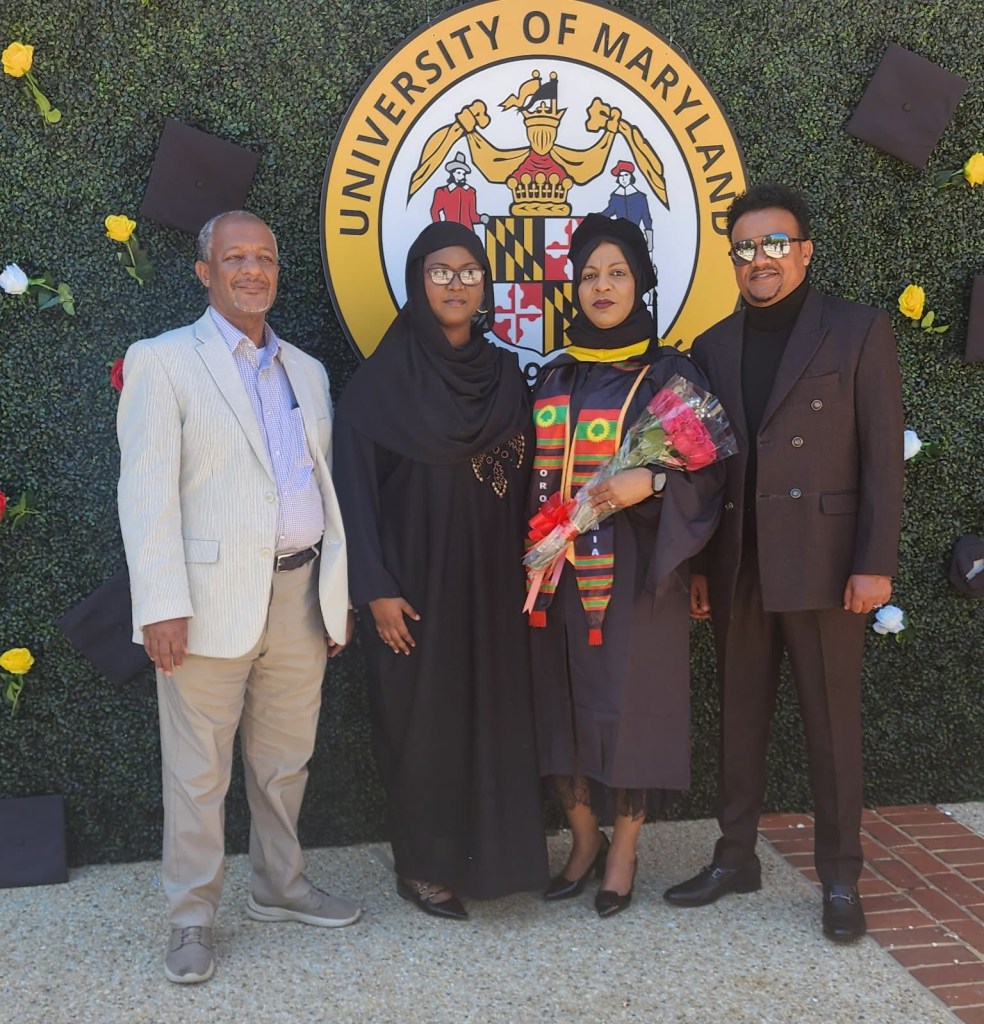
By Dhabessa Wakjira* (based on a reflection by Najat Sakaye Hamza)
“My life is about standing for my dreams even if it means standing alone sometimes.”
—
There is a photograph that Najat Sakaye Hamza keeps on her phone, not as a screensaver but as a secret talisman. In it, she is young—perhaps nineteen—sitting on a worn suitcase in a bus station somewhere between Oromia and the unknown. Her face is tired. Her eyes are not. She is leaving something behind, though she is not yet sure what she is walking toward.
Years later, she would find the words to describe that moment. “My life,” she would write, “is about standing for my dreams even if it means standing alone sometimes.”
Najat Sakaye Hamza is not a politician. She is not a general or a public intellectual in the traditional sense. She is, by her own definition, a woman who decided that the cost of kneeling was higher than the risk of standing. And in that decision, she has become something quietly revolutionary: an example.
This is her story—not of power, but of persistence. Not of armies, but of a single voice that refused to be absorbed into the noise.
—
The Education of a Dreamer
Born into an Oromo family that valued resilience over complaint, Najat learned early that dreams require rent. They do not live in the mind for free. They demand time, sacrifice, and the ability to endure the puzzled looks of those who cannot see what you see.
She was a curious child in a world that often punished curiosity in girls. She asked questions that made elders uncomfortable. She wanted to study when marriage was the expected path. She wanted to speak when silence was the safer option. And so, early on, she learned to stand alone.
“Representing who I am everywhere I am and in any situation,” she would later reflect, “is my quiet protest and my pride.”
That quiet protest took many forms. In classrooms where her language was dismissed, she learned two more. In workplaces where her identity was questioned, she performed her duties with an excellence that left no room for debate. In social settings where Oromo women were expected to be seen and not heard, she spoke—not loudly, but clearly.
The Loneliness of the Standing Woman
There were years when standing alone felt less like courage and more like punishment. Friends drifted away, unable to understand why she could not simply “fit in.” Relatives suggested she was too proud, too political, too difficult. There were nights, she has admitted privately, when she wondered if they were right.
But she kept standing. Not because it was easy, but because the alternative—sitting down, blending in, disappearing—was a kind of death she refused to accept.
She found sustenance in her faith. Alhamdullilah, she would whisper. Thank God for this moment, for this day. Gratitude became her anchor. Not gratitude for the struggle itself—that would be romantic nonsense—but gratitude for the fact that she was still upright, still breathing, still capable of taking the next step.
And then, the steps began to lead somewhere.
A Family That Stands Together
The photograph on her phone now is different. In the newer image, Najat is not alone. She is holding a baby—her daughter, Seran—and beside her stands her husband, Sabsib. There is a softness in this picture that the bus-station photo lacks. The tired eyes have been replaced by something warmer: not rest, but purpose.
“I get to share this moment with my baby, Seran, and my amazing husband Sabsib,” she wrote. The word amazing is not casual. It is the recognition that finding a partner who does not ask you to shrink is a miracle as profound as any in scripture.
Sabsib, by all accounts, is a man who never asked Najat to be smaller. He met her when she was already standing, and he chose to stand beside her rather than in front of her. Together, they have built a home where Seran is being raised to know that her mother’s quiet protests are not embarrassments but inheritances.
The Work Behind the Dream
Najat is careful to demystify her own journey. She has no patience for the myth of the self-made dreamer who simply wished upon a star.
“Dream realization belongs to those who work to achieve it,” she insists.
The work was unglamorous. Early mornings. Late nights. Jobs that had nothing to do with her passions but paid for the rent while she pursued her passions on the side. Rejection letters. Doors that closed. People who said “no” so many times that the word lost its sting.
But she kept working. And eventually, the work began to answer back.
She found platforms to speak about the Oromo experience, about the specific weight that Oromo women carry, about the need for community and also for the courage to stand outside the community when the community is wrong. She wrote. She organized. She showed up to meetings where she was the only Oromo face in the room—and spoke anyway.
Quiet Protest as a Way of Life
There is a phrase in the Oromo language: of-beekuu—to know oneself. Najat Sakaye Hamza has made of-beekuu her compass. To represent who she is, everywhere she is, regardless of the situation, requires a deep and unshakable self-knowledge. It requires knowing what you believe before the test arrives.
That is her quiet protest. Not shouting from a rooftop (though she has done that too, when necessary). But living, daily, as a visible, proud, unapologetic Oromo woman who happens to also be a mother, a wife, a professional, and a believer.
“Pride,” she says, “is not the opposite of humility. Pride is knowing that your existence has value, and refusing to act as if it doesn’t.”
The Moment She Is Living Now
On the day she shared her reflection, Najat was not marking a major public victory. There was no award ceremony, no signed legislation, no standing ovation. She was simply pausing—with her baby in her arms and her husband nearby—to say Alhamdullilah. Thank God for this moment. Thank God for this day.
It is a radical act, in a world that demands constant striving, to stop and give thanks. To acknowledge that the dream is not only in the future but also in the present—in the weight of a child, the steadiness of a partner, the simple fact of still being here, still standing.
The Legacy of the Standing Woman
Najat Sakaye Hamza is not famous. You will not find her name in the headlines of major newspapers, nor her face on the covers of magazines. She is, in the best sense, ordinary—an ordinary woman who decided that ordinary was not the same as invisible.
And that is precisely why her story matters. Because most of us will never be revolutionaries with monuments. Most of us will never speak before the United Nations. Most of us will struggle, in quiet and unglamorous ways, to hold onto our dreams in the face of pressure to let them go.
Najat’s life is a letter to those people. It says: Stand. Even if you stand alone. Even if no one applauds. Even if the only witness to your standing is God and the child sleeping in the next room.
And then, when the moment comes, stop standing long enough to say thank you.
Epilogue: The Unfinished Sentence
At the end of her reflection, Najat does not declare victory. She does not announce the completion of her dreams. She simply shares the moment—a moment that contains her daughter, her husband, her faith, and her own still-standing self.
The sentence is not finished, because her life is not finished. There will be more lonely days. More quiet protests. More mornings when the dream feels distant and the work feels endless.
But there will also be more Alhamdullilahs. More moments of sharing. More proof that standing for your dreams, even alone, eventually brings others to stand with you.
Najat Sakaye Hamza is still standing. Her daughter, Seran, is learning to stand. And somewhere, in a bus station or a boardroom or a quiet living room, someone who reads her words will decide to stand too.
That is not a small thing. That is everything.
—
Alhamdullilah for this moment. For this day. For the women who stand alone and discover they were never truly alone.
*Dhabessa Wakjira is a journalist, social worker, community worker, and interpreter who writes commentary, features, analysis, and reflections on issues that build and empower the Oromo people and their affairs. Dhabessa Wakjira can be reached at dabessa@socialworker.net

The Unbowed: Seenaa G-D Jimjimo and the Art of Refusing to Break
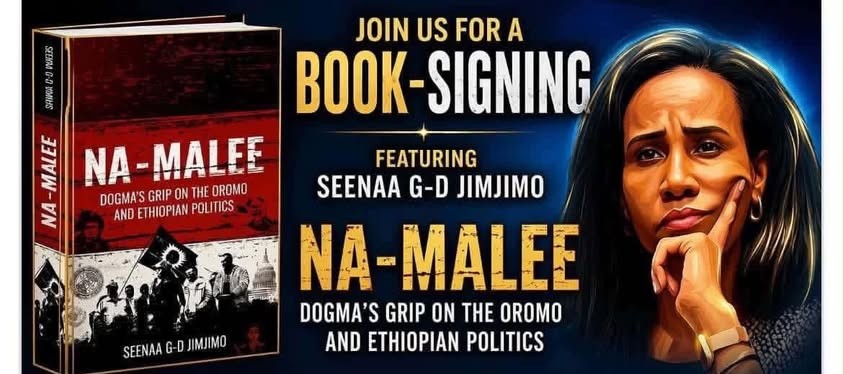
“Jabduu-dhiibbaan keessaa fi alaa kamiyyuu gadhinqabne.”
— “She did not bow to any pressure, from inside or outside.”
—
WASHINGTON, D.C. – In the polished corridors of the U.S. State Department, she speaks with the measured precision of a public health expert. In the dusty highlands of rural Oromia, she kneels beside girls who have never seen a classroom, handing them pencils and hope. And in the pages of her own writing, she dissects the lonely space between two worlds—the Oromo homeland she loves and the American life she built.
Her name is Seenaa G-D Jimjimo. For those who know only her acronym—OLLAA, the Oromo Legacy Leadership & Advocacy Association—she is the Executive Director who has briefed the White House, lobbied the U.K. Parliament, and helped steer House Resolution 128 into law. For those who know her heart, she is something rarer: a leader who has never forgotten that the loudest pressure comes not from external enemies, but from the whispers inside one’s own community to be silent, to be small, to bow.
And she has never bowed.
—
The Roots of Resistance
Born and raised in Oromia, Seenaa G-D Jimjimo grew up watching the slow, systematic strangulation of her people. The Oromo—the largest nation in the country—had been subjected to land confiscation, linguistic suppression, and political marginalization for generations. But it was the violence against Oromo women that carved the deepest wound into her young consciousness.
She saw neighbors dragged from their homes by Ethiopian security forces. She heard stories of girls, barely teenagers, who were arrested, abused, and never seen again. And she made a quiet promise to herself: I will learn. I will speak. And I will never look away.
That promise carried her across an ocean.
In the United States, she pursued higher education with a ferocity that astonished her professors. She earned an undergraduate degree in political science—the tool for understanding power. Then graduate degrees in public health and public administration—the tools for healing and organizing. At the University of Illinois, her peers elected her Senator at Large for the Graduate Student Association and treasurer for the African Student Organization. She was awarded the Dr. Martin Luther King Jr. Scholarship and the Whitney M. Young Fellowship—honors that recognized not just her intellect, but her commitment to justice.
But she was not content to remain in classrooms. The lessons she learned, she brought back to her people.
Forging a Leadership Legacy
Today, as Executive Director of the Oromo Legacy Leadership & Advocacy Association (OLLAA), Seenaa G-D Jimjimo oversees a global apparatus of advocacy. The organization does not simply issue press releases; it builds coalitions. It does not merely condemn human rights abuses; it documents them, presents them to international bodies, and demands accountability.
Under her leadership, OLLAA has engaged directly with the White House, the U.S. State Department, and the United Kingdom’s All-Party Parliamentary Group on Africa. She has sat across tables from diplomats who once could not locate Oromia on a map—and left those tables with commitments to investigate atrocities, support democratic reforms, and amplify Oromo voices.
One of her most significant achievements came through House Resolution 128. Introduced in 2017 and passed in 2018, the resolution urged respect for human rights and encouraged democratic changes in Ethiopia. It was not a sweeping victory—no single piece of legislation could undo a century of oppression—but it was a crack in the wall. And Seenaa G-D Jimjimo was among the key figures who pried that crack open, lobbying members of Congress, mobilizing the diaspora, and refusing to let the issue die.
“People think advocacy is glamorous,” she once told a young organizer. “It is not. Advocacy is showing up to the same office forty-seven times until someone finally agrees to listen. Advocacy is being told ‘no’ so often that the word loses its meaning. And then showing up again.”
The Danboobiduu Foundation: Building What Advocacy Cannot
But Seenaa G-D Jimjimo knows that laws and resolutions are not enough. They do not put food on a child’s table. They do not keep a rural girl in school when her family needs her labor.
That understanding gave birth to the Danboobiduu Foundation in 2014. Named after a cherished Oromo concept of nurturing and empowerment, the foundation focuses on one deceptively simple goal: keeping girls in school.
In rural parts of Oromia, young girls are often pulled from classrooms to work—in the fields, in domestic labor, sometimes in conditions that amount to exploitation. Early marriage remains a threat. Poverty makes education seem like a luxury. Danboobiduu intervenes with scholarships, mentorship, and community engagement, convincing families that a girl with a diploma is worth more than a girl with a dowry.
The foundation does not make headlines. It does not appear in congressional testimony. But for the hundreds of girls who have stayed in school because of its work, it is the difference between a future and a sentence.
The Writer as Truth-Teller
Beyond the boardrooms and the village paths, Seenaa G-D Jimjimo is also a writer. Her work is not the polished propaganda of a movement; it is the raw, searching reflection of a woman trying to diagnose her people’s wounds without romanticizing them.
Her book, The In-Between, addresses the cultural and social fractures that her community faces—the clash between tradition and modernity, the silence around internal problems, the difficulty of building a future when the past is still on fire. She writes about the Oromo Gadaa system, the ancient democratic governance model that predates many Western constitutions, and asks how its principles might be revived for a new generation.
She also writes about the pressures from inside—the fear of criticizing one’s own community, the reluctance to hold fellow Oromos accountable, the temptation to present a flawless front to the world. “We must tell the truth about our struggles,” she has written, “including the ones we inflict on ourselves. Only then can we be truly free.”
The Unfinished Work
Today, Seenaa G-D Jimjimo continues to balance multiple roles: Executive Director, public health specialist, keynote speaker, mentor, and commentator on African intellectual traditions. She is as comfortable discussing epidemiological trends as she is debating Oromo nationalism. She moves between Finfinnee and Washington, between the Gadaa council and the House Foreign Affairs Committee, with a fluency that seems almost effortless—until one remembers the weight she carries.
That weight is the memory of every Oromo woman who was silenced. Every political prisoner who did not emerge from the dungeon. Every child who never learned to read because her school was burned and her language banned.
And yet, she does not bow. Not to the pressure of despair. Not to the cynicism that says change is impossible. Not to the internal critics who accuse her of being too radical or not radical enough. Not to the external forces—states, lobbies, powerful men—who would prefer that she simply disappear.
“I did not bow to any pressure, from inside or outside.” Those words, carved into the identity of Seenaa G-D Jimjimo, are not a boast. They are a discipline. A daily decision to stand, even when standing requires more than one person should have to give.
The Legacy She Is Building
She will tell you, if you ask, that she is not a hero. She is a daughter of Oromia who happened to learn English, earn degrees, and find herself in rooms where decisions are made. She will tell you that the real heroes are the girls in the Danboobiduu program who walk two hours to school each morning, the mothers who hide Oromo books under their beds, the prisoners who refuse to name their comrades under torture.
But those girls and mothers and prisoners would say something different. They would say: She gave us a voice when we had none. She took our whispers and shouted them into the halls of power. She did not bow, and because she did not bow, we can stand.
Seenaa G-D Jimjimo’s story is not finished. The Oromo struggle is not finished. But every morning, in an office in the United States or a village in Oromia, she wakes up and chooses to continue. The pressure will come again—from inside, from outside, from the thousand small deaths of hope deferred. And she will refuse, again, to bow.
That is not a story of suffering. That is a story of unbending grace.
And to the woman who taught them to stand—honor upon honor.

The Hands That Build: Women and the Unfinished Work of Nation Building
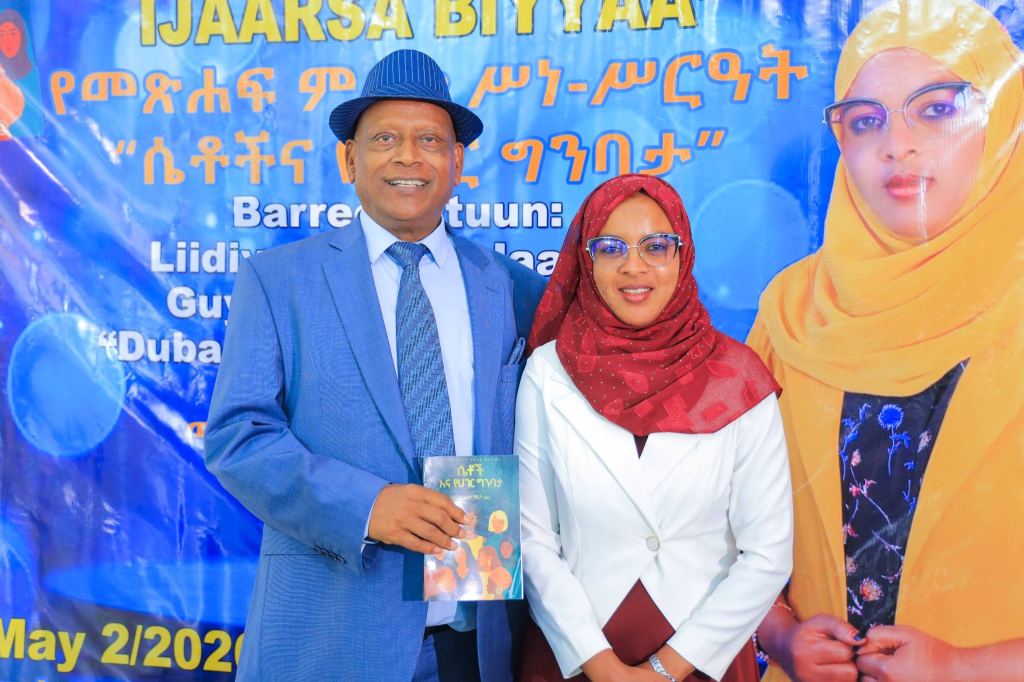
By Dhabessa Wakjira*
There is a proverb in many African cultures: “When a woman stumbles, the whole household trembles.” But the corollary is rarely spoken: when a woman rises, the entire nation ascends with her.
For generations, the story of nation building has been told as a masculine epic—a tale of warriors, kings, negotiators, and generals. Yet the quiet truth, known in every village and every home, is that nations are not built by speeches alone. They are built by hands that grind grain, by backs that bend over rivers, by voices that sing children into sleep and then rise at dawn to plant the seeds of tomorrow.
This feature story turns the lens on the women of Oromia and Ethiopia—not as victims, not as symbols, but as architects. It is a reflection on what it means to say dubartootaafi ijaarsa biyyaa: women and the construction of a country.
The Invisible Foundation
Walk into any rural household in Oromia before the sun has touched the horizon. Who is awake? The woman. She has already fetched water, kindled the fire, and begun preparing the marqaa that will fuel the day’s labor. By the time the first light breaks, she has completed a morning’s work that would exhaust a city dweller by noon.
This is not a scene from the past. This is the present. And it is the foundation upon which the national economy rests—unpaid, unacknowledged, and utterly indispensable.
Yet when we speak of “nation building,” we speak of parliaments, budgets, roads, and treaties. We speak of the visible architecture of power. The invisible architecture—the reproductive labor, the agricultural toil, the social cohesion woven through kinship networks—is left to women, and left out of the story.
Beyond the Domestic Sphere
To say “dubartootaafi ijaarsa biyyaa” is to make a claim that challenges this erasure. It is to insist that women are not merely beneficiaries of development or recipients of aid. They are active agents in the creation of the nation.
Consider the Gadaa system, the indigenous Oromo democracy. For centuries, it has been understood primarily as a male institution—five parties, eight years each, a cycle of power passed between generations of men. But what of the Siinqee? The institution of the Siinqee staff, carried by Oromo women, was not a decoration. It was a check on power. When a woman raised the Siinqee, disputes stopped. When women marched together, decisions were delayed until justice could be heard. The Siinqee was not outside the Gadaa; it was the conscience of the Gadaa.
This is the deeper meaning of women and nation building. It is not about “including women” in structures designed by men. It is about recognizing that women have always possessed their own structures, their own forms of authority, their own ways of holding the nation together when men—with their armies and their ambitions—pulled it apart.
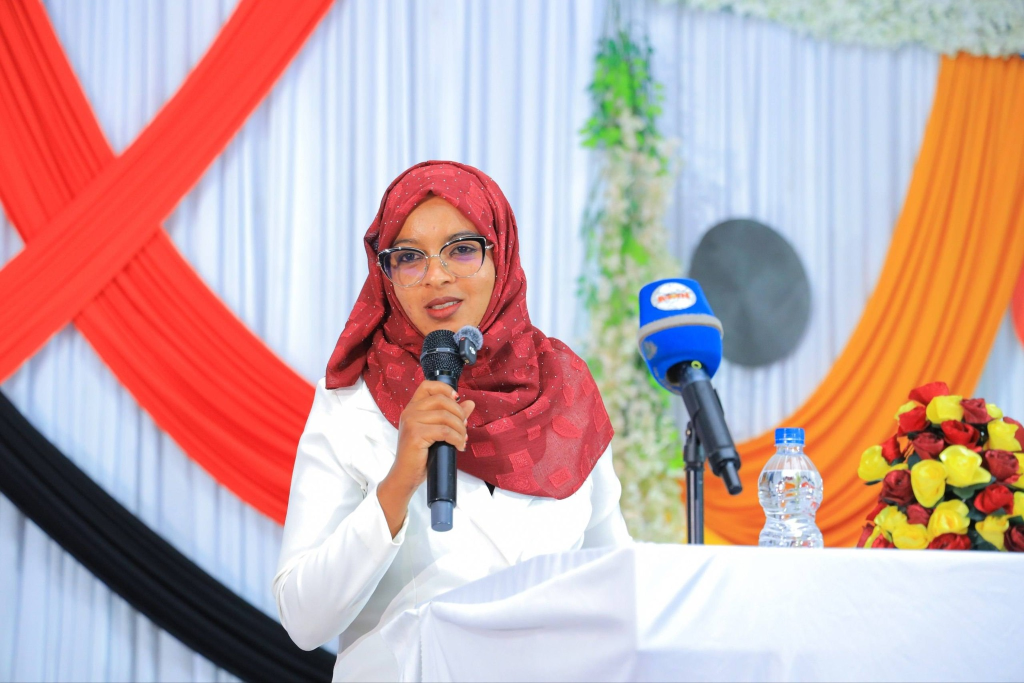
The War Women Fight
In times of conflict, women are called the “first victims.” They bear the weight of displacement, of sexual violence, of watching their children starve. But they are also the first responders, the first rebuilders, the first to gather the scattered pieces of a shattered community.
The women of Oromia know this intimately. They have buried sons who fell in the struggle. They have visited husbands in prisons built by regimes that feared their names. They have fled across borders with infants on their backs and nothing else in their hands. And then, when the shooting stopped—or even before it stopped—they began to rebuild.
They formed iddir (burial associations) to ensure that the dead were honored. They formed iqqub (rotating savings groups) to send children back to school. They turned refugee camps into marketplaces, turning nothing into something, turning survival into life.
This is nation building. This is ijaarsa biyyaa.
The Politics of Presence
In recent years, the political landscape of Oromia and Ethiopia has shifted. Women have taken seats in parliament, ministries, and regional councils. The language of gender equality has entered the constitution, the party platforms, and the international donor reports.
These are victories. They are not empty.
But presence is not power. A woman sitting in a chair designed by a patriarchal system, following rules written by that same system, speaking a language that was never her mother tongue—this is not liberation. It is a foot in the door. And a foot in the door, while necessary, is not the same as building a new house.
The true work of dubartootaafi ijaarsa biyyaa lies deeper. It lies in asking: What would a nation look like if it were built not on competition but on care? Not on extraction but on cultivation? Not on the logic of the battlefield but on the logic of the kitchen—where resources are shared, where no one eats until everyone is served, where waste is a sin and generosity is survival?
These are not soft questions. They are revolutionary ones. And they are questions that women, who have been excluded from the official story of nation building, are uniquely positioned to ask.
The Double Burden
No honest reflection on women and nation building can ignore the double burden. Women are expected to build the nation while also building the home. They are told to lead, but only after they have cooked, cleaned, raised the children, and cared for the elderly. They are praised for their strength while being denied the rest that strength requires.
This is not sustainable. A nation that demands everything from its women while giving them nothing—no shared domestic labor, no affordable childcare, no protection from violence, no recognition for unpaid work—is a nation that is eating its own seed corn.
Ijaarsa biyyaa requires the bricks of justice. And justice begins at home.
The Young Girl and the Future
Imagine a girl born today in a rural village of Oromia. If she is lucky, she will go to school. If she is very lucky, she will finish. If she is extraordinarily lucky, she will find work, marry by choice, and live without fear of violence.
But luck is not a policy. And nation building is not a lottery.
The question before the Oromo people—before all Ethiopians—is whether they will continue to build their nation on the backs of women, or whether they will finally build with them, for them, through them.
The girl in that village has her hand on the future. She does not yet know the word “feminism.” She may never read a book about “gender and development.” But she knows what her mother knows: that the country will be what women make it. Because women have always made it. They have just never been given the credit.
Conclusion: The Unfinished House
Dubartootaafi ijaarsa biyyaa is not a slogan. It is a description of reality. Women have been building this nation since the first seed was planted, since the first child was named, since the first council gathered under the sycamore tree.
The house is not yet finished. The roof leaks. The walls have cracks. Some rooms are still locked to those who built them.
But the builders are still here. They are waking before dawn. They are fetching water. They are raising the Siinqee. They are sitting in parliament and sleeping in refugee camps. They are doing two jobs, three jobs, the work of generations compressed into a single day.
The question is not whether women can build a nation. They already have.
The question is whether the nation will finally acknowledge their hands—and let them help design the blueprints.
When a woman rises, the entire nation ascends with her. Let her rise. Let the nation rise.
*Note on Attribution: The feature story is based on the author, Lediya K Jarso, the book reflection. Dhabessa Wakjira engaged with that reflection as a commentator, and the present reflection draws substantially from the ideas, themes, and framing originally articulated by the author. This feature story is offered as a synthesis and expansion of that shared conversation, with full acknowledgment of the original source.




 Advocacy for Oromia