Daily Archives: July 15, 2026

A Grateful Farewell: The End of an Era at the Victorian Multicultural Commission
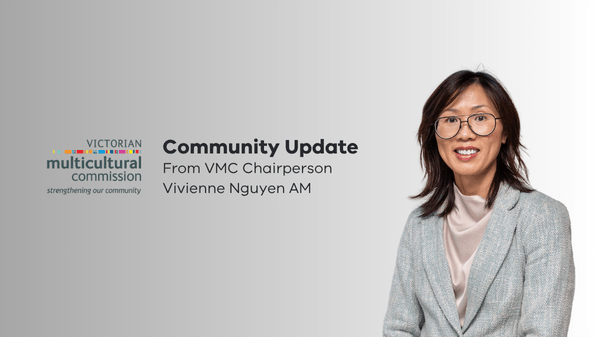
After seven years of dedicated service, Chairperson Vivienne Nguyen AM reflects on a journey of connection, resilience, and hope for a multicultural Victoria
MELBOURNE, VICTORIA — There are moments in public life that transcend the ordinary—moments when service becomes more than a duty and transforms into a calling. For Vivienne Nguyen AM, her seven-year tenure as Chairperson of the Victorian Multicultural Commission (VMC) has been precisely such a moment.
In a heartfelt farewell, Ms Nguyen announced her final day as Chairperson, closing a chapter that has seen Victoria’s multicultural communities navigate unprecedented challenges and celebrate remarkable triumphs.
A Journey of Service
“Today marks my final day as Chairperson of the Victorian Multicultural Commission, and I wanted to take this opportunity to simply say thank you.”
For seven years, Vivienne Nguyen has stood at the intersection of government and community, serving as a bridge between Victoria’s culturally, linguistically, and religiously diverse populations and the institutions that serve them. Her journey to this role began long before her appointment—it started when she arrived in Australia as a 12-year-old refugee from Vietnam, a young girl who would grow into one of Victoria’s most passionate advocates for genuine community engagement and cultural diversity .
Her path has been extraordinary: from refugee to corporate leader, from community volunteer to Member of the Order of Australia . In 2021, she was appointed a Member of the Order of Australia for “significant service to the multicultural community of Victoria” . This recognition was not the culmination of her work but rather a milestone along a continuing journey of service.
Standing Together Through Crisis and Celebration
“It has been a privilege to stand alongside Victoria’s multicultural and multifaith communities through moments of crisis and celebration, joy and pain, laughter and tears, agreement and robust (and respectful) discussions, and indeed for that matter the disagreements we accepted of each other.”
Nguyen’s tenure was marked by extraordinary challenges. Just months into her role, the COVID-19 pandemic swept across the world, disproportionately affecting multicultural communities who faced language barriers, misinformation, and economic hardship. Under her leadership, the VMC became an essential link between government and community .
“The voices of [multicultural] communities are far more amplified, noticeable, involved and engaged now than we have ever seen,” she reflected on the pandemic experience .
Her leadership through those difficult times was lauded by many, earning her a second four-year term . She worked tirelessly to ensure that government programs and restrictions were communicated effectively to diverse communities, partnering with community leaders and peak bodies to deliver unique resources for those who needed them most .
The Quiet Work That Builds a Community
“Throughout this journey, I have been constantly inspired by the generosity of community leaders, volunteers, faith leaders, young people and organisations who quietly give their time and talents in service of others. Much of this work happens behind the scenes and without recognition, yet it is these everyday acts of kindness, leadership and service that make Victoria the welcoming and inclusive place we are proud to call home.”
Nguyen’s farewell speech was as much a tribute to others as it was a reflection on her own work. She acknowledged the unsung heroes of Victoria’s multicultural communities—those who work without fanfare, who give without seeking recognition, who serve without expecting reward .
Indeed, throughout her tenure, Nguyen consistently highlighted the work of others. In farewell messages to outgoing commissioners, she noted that their “inspirational and unwavering leadership, dedication and advocacy has been instrumental in promoting understanding, connection and collaboration among Victoria’s diverse communities” . She praised her Deputy Chairperson, Bwe Thay, as having been “by my side, providing steadfast support and strongly advocating for Victoria’s culturally, religiously and linguistically diverse communities” .
Looking Forward with Hope
“While my time as Chair comes to an end, my belief in the future of multicultural Victoria has never been stronger.”
Nguyen’s farewell is not one of resignation but of optimism. She leaves the role at a moment of significant transformation for multicultural affairs in Victoria. The establishment of Multicultural Victoria as a fit-for-purpose organisation, elevating multicultural affairs across the whole of the Victorian government, presents what she calls “an exciting opportunity to shape the future” .
The new statutory body will combine the engagement role of the VMC with the policy role of the Department, with new responsibilities including developing safety plans for communities affected by serious events . A new Multicultural Coordinator General will lead it, supported by two deputies and a five-member advisory council of commissioners .
Nguyen has welcomed these changes, stating that she welcomes “the Multicultural Review report and its proposed structural changes to ensure government policies are fit-for-purpose” and “the decision to review the Multicultural Act Victoria 2011, which must focus on strengthening cohesion and creating a richer, more inclusive, fairer and better Victoria” .
Gratitude and Continuity
“I leave this role with immense gratitude for the friendships formed, the conversations shared and the many lessons I have learned from individuals and communities across Victoria. Thank you for your trust, your wisdom and your unwavering commitment to building a stronger, fairer and more connected Victoria.”
In her farewell, Nguyen expressed deep gratitude for the relationships she has built across Victoria—the friendships, the conversations, the lessons learned. Her words reflect a genuine appreciation for the communities she has served and the people who have walked alongside her.
“Although this chapter closes, my commitment to our multicultural communities does not.”
Nguyen has made clear that her departure from the Chairperson role does not signal an end to her advocacy. She looks forward to remaining involved and continuing to attend community events across Victoria in the months and years ahead .
A Lasting Legacy
The legacy of Vivienne Nguyen’s tenure is visible in the strengthened connections between government and multicultural communities, the amplified voices of diverse Victorians, and the foundations laid for the future of multicultural affairs in Victoria.
Her journey—from 12-year-old refugee to Chairperson of the Victorian Multicultural Commission—is itself a testament to the opportunities that a multicultural society can offer . Her story is a reminder that diversity is not merely something to be tolerated but something to be celebrated and embraced.
“Together, we have celebrated our diversity, navigated difficult times with compassion and resilience, and continued to strengthen the foundations of our multicultural state.”
Conclusion
As Vivienne Nguyen AM steps down from her role as Chairperson of the Victorian Multicultural Commission, she leaves behind a legacy of service, advocacy, and hope. Her seven-year tenure has seen Victoria’s multicultural communities through a pandemic, through celebration, through crisis, and through transformation.
Her final message is one of gratitude and optimism—gratitude for the privilege of service, and optimism for the future of multicultural Victoria. The establishment of Multicultural Victoria, with its expanded mandate and renewed focus, represents an exciting new chapter in the story of Victoria’s diverse communities.
And while Nguyen’s role as Chairperson has come to an end, her commitment to multicultural Victoria has not. As she herself has said, “this chapter closes, my commitment to our multicultural communities does not.”
“Thank you for allowing me the privilege of serving alongside you.”
— Vivienne Nguyen AM, Chairperson (for the last time), Victorian Multicultural Commission

Order Is Not Merely Law: A Reflection on the Foundation of Society

By Taliila Bulbula Tulluu
Beyond rules and regulations lies something deeper—a sacred relationship that binds creation, community, and the human soul
There is a tendency in human affairs to reduce order to its simplest expression: laws, rules, and regulations. We imagine that if we can just write the right laws, enforce them with sufficient rigor, and punish those who transgress, society will function as it should.
But this understanding is incomplete—and dangerously so.
“Sirni seera ittiin walbulchan qofaa miti; karaa hariiroo Uumaa fi uumamaa waliin ittiin horataniidhas.”
Order is not merely the law by which people agree to coexist; it is also the path through which relationships with the Creator and creation are cultivated. This is a profound insight that challenges the modern tendency to reduce governance to mere administration.
The Web of Connection
When we speak of order, we are speaking of relationships. Not just the relationship between citizen and state, but the relationship between human beings and the natural world, between individuals and their communities, between generations past and generations yet to come.
“Hariiroo Uumamaa kana keessaa immoo sirni karaa ilmi namaa ittiin waltoo’atuu fi walqajeelchuudha.”
Within this relationship with creation, order is the path through which human beings find harmony and guide one another. It is the invisible thread that weaves together the fabric of society, connecting each individual to a larger whole.
This understanding recognizes that human beings are not isolated atoms but are embedded in a web of relationships. We are shaped by our connections to family, community, nature, and the divine. To disrupt these connections is to disrupt the very foundation of human flourishing.
The Consequences of Disorder
“Ummanni sirna hin qabne karaa ittiin waltoo’atus hin qabu.”
A people without order have no path to harmony. They lack the means to coordinate their efforts, to resolve their conflicts peacefully, or to pursue their common goals.
“Kana jechuun karaa ittiin jabaa ofii jabeeffatu, karaa ittiin dadhabaa tini’ifatu, karaa ittiin hamaa/dabaa ofii qajeelfatu hin qabu.”
This means there is no path for the strong to strengthen themselves (through service, not domination), no path for the weak to protect themselves, and no path for the evildoer to be guided toward goodness. Without order, each person is left to their own devices—the strong preying on the weak, the righteous abandoned, and the wicked unchecked.
“Hunduu quba wal hinqabu waan ta’eef…”
Because they do not join hands, because they lack unity and coordination, the result is fragmentation and chaos.
“Kan quufee buluuf namni hunduu quufee waan jiru se’a…”
The one who has enough to eat assumes that everyone else also has enough. The well-fed cannot see the hungry, and the comfortable cannot imagine the suffering of the destitute.
“Kan beelaan dararamaa jiru immoo isa qofatu akkas ta’e itti fakkaata…”
The one who is suffering from hunger imagines that only they are in such a state—or that everyone else must also be suffering as they are. This is the isolation of despair, where each person’s suffering becomes a solitary burden.
“Kan hataa jirus namni hunduu waan saamaa jiru itti fakkaata…”
The one who steals imagines that everyone else is also stealing. This is the rationalization of wrongdoing, where the corrupt justify their actions by assuming everyone else is equally corrupt.
“Kan dantaa dhuunfatif jecha shiraan ajjeesaa jirus yoo namni isa arguu baate Waaqni akka isa argu hin beeku…”
The one who kills for personal gain—if no one sees them, they imagine that even God does not see them. They have stepped outside the moral order, beyond the awareness of community, beyond the accountability that makes society possible.
“Dhugeeffannaa ummataa keessaa bahe waan ta’eef.”
This is the state of those who have become detached from the community. They no longer feel accountable to their neighbors, no longer bound by the bonds of solidarity that make collective life possible.
The Collapse of Accountability
“Hariiroon sarara sirnaa kan ittiin waltoo’aatani fi walqajeelchan yoo hin jiraanne hunduu akka-feeteedha!”
When the thread of order that connects people and enables them to guide one another is absent, everything falls apart. Society dissolves into chaos, and the bonds that hold communities together are severed.
“Mee haala akkasii keessatti eenyutu eenyu qulqulleessaa?”
In such a state, who can purify whom? When everyone is corrupted, when everyone is compromised, when no one is innocent—who has the moral authority to correct anyone else?
“Walborceera, walmarqeera waan ta’eef eenyutu eenyun Xaddecha dhaabaa?”
When everyone has sinned against others, when everyone has been complicit in injustice, who can stand as a judge? Who can draw the line between right and wrong? Who can separate the guilty from the innocent?
This is the tragedy of systemic breakdown: when everyone is compromised, accountability becomes impossible. The guilty can point to the guilty, and the innocent are lost in the chaos.
Naming Wrongs Is Not Enough
“Rakkoo jiru himuun, badii namoota dhuunfaa ykn gareen raawwatamu saaxiluun barbaachisaadha…”
Naming the problem, exposing the wrongs committed by individuals or groups—this is essential. Without truth-telling, without accountability, without the courage to name injustice, there can be no healing.
“Garuu isuma hojii godhachuun rakkoo ittuu hammeessa deemuu waan ta’uuf innuu mataa isaatin rakkoodha!”
But simply doing the same thing—merely complaining, merely naming wrongs without moving toward solutions—only worsens the problem. It becomes a cycle of accusation and counter-accusation, a spiral of bitterness that deepens divisions rather than healing them.
The problem itself, when approached in this way, becomes a burden that crushes those who try to address it. It becomes a trap, a cycle that consumes energy without producing change.
The Only Remedy
“Maraamartoo kana obbaafachuuf falli tokkichi jiru…”
To overcome this tangle, to escape this cycle of accusation and bitterness, there is only one remedy:
“Sirna ummataa deebisanii ijaaruu irratti akeekaa fi tarsimoo waloo tolfatanii marii fi marabbaatti dhufuu feesisa!”
We must come together in deliberation and consultation, developing shared understanding and collective strategies for rebuilding the order of the people.
This is not a call to return to some imagined golden age. It is a call to conscious, intentional reconstruction. It is an acknowledgment that the rebuilding of society requires thought, planning, dialogue, and collective effort.
The Elements of Order
What does it mean to rebuild the order of the people? It requires:
Shared Vision: A common understanding of what a just society looks like. Not imposed from above, but developed through collective dialogue and deliberation.
Collective Responsibility: An acknowledgment that we are all responsible for the well-being of our communities. Not just the leaders, not just the institutions, but every member of society.
Accountability: Mechanisms for holding each other accountable, for correcting wrongs, for ensuring that justice is served. Not based on power, but based on shared values and mutual respect.
Solidarity: A recognition that our fates are intertwined, that the suffering of one is the suffering of all, and that the flourishing of one is the flourishing of all.
Connection to the Divine: An awareness that order is not merely a human creation but is rooted in something deeper—in the relationship between creation and the Creator, in the moral fabric of the universe itself.
The Path Forward
The path forward is not easy. It requires:
Honesty: The courage to name wrongs, to acknowledge failures, to face uncomfortable truths.
Humility: The recognition that we are all part of the problem, and that none of us has all the answers.
Patience: The understanding that rebuilding takes time, that trust must be earned, that healing is a process.
Dialogue: The willingness to listen to others, to understand their perspectives, and to find common ground.
Action: The commitment to move beyond words, to translate shared understanding into concrete change.
Conclusion
“Sirni seera ittiin walbulchan qofaa miti; karaa hariiroo Uumaa fi uumamaa waliin ittiin horataniidhas.”
Order is not merely the law by which people agree to coexist; it is also the path through which relationships with the Creator and creation are cultivated.
This is the deeper truth that we must not forget. Order is not just about rules and regulations; it is about relationships—our relationship with the divine, with each other, and with the world around us.
When order breaks down, it is not just a failure of governance; it is a failure of relationship. And when we seek to rebuild order, we must rebuild these relationships.
“Maraamartoo kana obbaafachuuf falli tokkichi jiru sirna ummataa deebisanii ijaaruu irratti akeekaa fi tarsimoo waloo tolfatanii marii fi marabbaatti dhufuu feesisa!”
To overcome this tangle, there is only one remedy: we must come together in deliberation and consultation, developing shared understanding and collective strategies for rebuilding the order of the people.
The work is difficult. The path is long. But it is the only way forward.
Order is not merely law. It is relationship. It is harmony. It is the sacred bond that connects us to each other, to the world, and to the divine.
May we find the wisdom to rebuild it, the courage to sustain it, and the grace to live within it.
Bridging Continents, Building a Nation: OLF/ABO Annual Dialogue Heads to Minnesota
By Maatii Sabaa
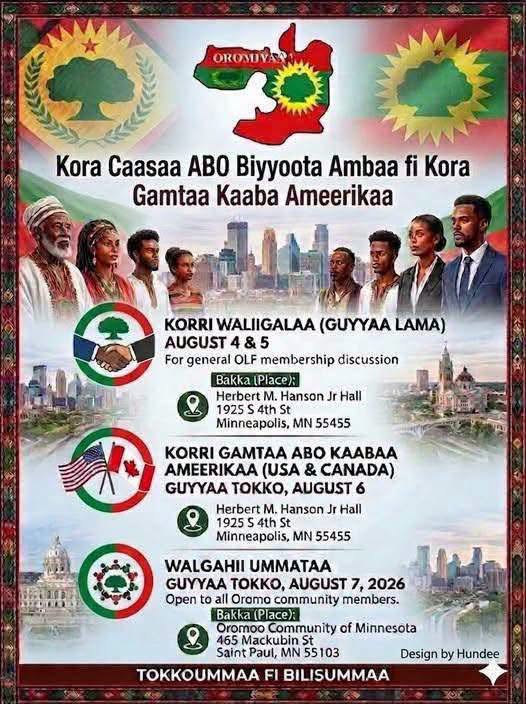
As the autumn leaves begin to turn across the American Midwest, a familiar and powerful rhythm stirs within the Oromo diaspora. In just a few weeks, Minnesota—often affectionately called “Little Oromia” for hosting one of the largest Oromo populations outside of East Africa—will become the epicenter of a movement that refuses to fade. The Oromo Liberation Front (OLF/ABO) is set to hold its annual dialogue, a cornerstone tradition that weaves together strategy, solidarity, and the unyielding pursuit of self-determination.
The announcement is more than a calendar entry; it is a declaration. The tradition continues.
A Gathering of Purpose
For decades, the Oromo people have carried the weight of marginalization, yet they have also carried the tools of resistance. The OLF/ABO has been at the forefront of this resistance, and its annual dialogue represents a critical moment of reckoning and renewal. Leaders, intellectuals, activists, and everyday community members will converge in Minnesota to take stock of the movement’s progress, confront pressing challenges in the homeland, and chart a course for the year ahead.
But what makes this year’s event particularly noteworthy is its inclusivity. Organizers have extended a rare and welcoming invitation: the final day of the dialogue will be open to all Oromo Community members. This decision transforms a closed-door political meeting into a celebration of collective identity. It is a recognition that the struggle for Oromia’s liberation is not confined to the political elite—it belongs to the farmer in the countryside, the mother in the diaspora, the student in the university, and the elder who remembers a homeland before displacement.
Why Minnesota?
The choice of Minnesota is no accident. Over the past three decades, the state has become a sanctuary and a springboard for Oromo activism. From the bustling neighborhoods of Minneapolis to the suburban cities of St. Paul, Oromo culture thrives—through language, music, faith, and political organization. Holding the annual dialogue here acknowledges the diaspora not as a distant bystander, but as a vital pillar of the liberation project.
In this space, the past meets the present. Elders who witnessed the early days of the OLF sit alongside youth born in the West, forging an intergenerational bond that strengthens the movement’s resilience. It is a living classroom where history is taught, grievances are voiced, and hope is rekindled.
Consistency and Determination: The Unshakeable Foundation
The flyer circulating among community groups carries a powerful mantra: “As always, consistency and determination remain the foundation of lasting progress and success.”
These words are not empty rhetoric. In the long and often brutal struggle for Oromo self-determination, fads and fleeting passions have no place. What sustains the movement is the dogged, day-in and day-out commitment of a people who refuse to be erased. The annual dialogue is the embodiment of this ethic. It is a ritual of endurance—a moment to recalibrate, to reaffirm, and to recommit.
Consistency means showing up, year after year, regardless of the political winds. Determination means turning setbacks into stepping stones. The OLF/ABO has weathered imprisonment, exile, and state-sponsored repression, yet here it stands, preparing to convene once again in the heart of America. That is the quiet power of persistence.
An Open Door to the Community
The decision to open the final day to all Oromo community members is a strategic and symbolic masterstroke. It breaks down barriers between leadership and the grassroots, ensuring that the dialogue is not an ivory tower but a public square. It invites critical feedback, fresh perspectives, and the energy of those who may not hold formal titles but carry the daily lived experience of Oromo identity.
Whether one is a long-time activist or a young professional attending for the first time, the final day promises to be a space of belonging. It is a chance to ask questions, share concerns, and witness firsthand the democratic spirit that the OLF/ABO champions. In a world where liberation movements often become opaque, this open-door policy is a beacon of transparency and trust.
The Cry That Echoes: IUOf! 

As the event draws near, social media feeds and community bulletin boards will fill with the colors of the Oromo flag—red, green, and red—a trinity of courage, hope, and sacrifice. And when the dialogue reaches its crescendo, the hall will undoubtedly erupt with the rallying cry: “IUOf!” Or Victory to Oromo people —a spirited abbreviation for the Oromo phrase that resonates across generations, declaring the unshakable belief in the Oromo nation’s future.
The red hearts speak to the blood shed for freedom. The green hearts speak to the fertile land of Oromia that awaits full restoration. Together, they form a visual prayer for justice.
A Tradition That Transcends Time
The annual dialogue is more than a political event; it is a cultural anchor. In a diaspora scattered across the globe, it provides a rare moment of physical convergence. It reminds the Oromo people that they are not isolated individuals but members of a vast, resilient family with a shared destiny.
As the final day opens its doors to all, the Oromo community in Minnesota and beyond will have the chance to witness history in the making. The tradition continues—not as a relic of the past, but as a dynamic, living force that charts the path toward a free and sovereign Oromia.
So mark the date, spread the word, and prepare to gather. The dialogue awaits. The struggle endures. And as always, it is consistency and determination that will carry the Oromo people across the finish line.
IUOf!




 Advocacy for Oromia