Reclaiming Oromo Identity: The First Step in the Struggle
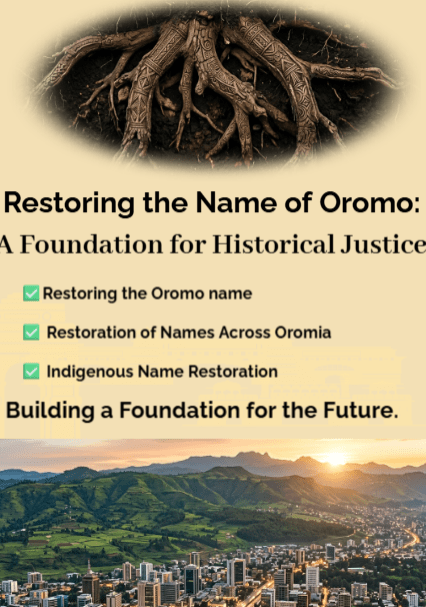
Restoring the Name of Oromo – A Foundation for Historical Justice
By Dhabessa Wakjira
The Oromo struggle for liberation, justice, and self-determination is multifaceted. It encompasses political rights, land rights, economic empowerment, and cultural preservation. But among all the objectives of the struggle, there is a first and foundational task—one that must be addressed before any other can be fully realized:
Restoring the Oromo name wherever it has been distorted, altered, or erased.
For centuries, the Oromo people have endured a systematic campaign of identity erasure. Their names—of people, places, and institutions—have been changed, distorted, and replaced. This is not a coincidence. It is a deliberate strategy of domination, designed to sever the Oromo people from their history, their heritage, and their sense of self.
The first step in the Oromo struggle, therefore, must be the restoration of the Oromo name. Without this, the history of the Oromo people cannot be told truthfully. Without this, the identity of the Oromo people cannot be fully reclaimed. Without this, the future of the Oromo people cannot be built on a foundation of truth.
The Significance of Names: More Than Words
In Oromo culture, names are not merely labels. They carry history, identity, meaning, and connection to the land. A name tells a story—of a person, a place, or a community. It embodies the values, the struggles, and the aspirations of those who bear it.
When names are changed or erased, something profound is lost. The connection to the past is broken. The continuity of culture is interrupted. The identity of a people is called into question.
For the Oromo people, the changing of names has been a tool of colonization and domination. Under successive regimes—from the expansion of the Ethiopian Empire under Menelik II to the Derg and beyond—Oromo names have been systematically replaced with Amharic or other names. This was not an innocent act. It was a deliberate strategy to erase Oromo identity and to impose a new, alien identity on the Oromo people.
Finfinne: A Case Study in Identity Erasure
Perhaps the most powerful example of this phenomenon is the city of Finfinne—the city known internationally as Addis Ababa.
The name “Finfinne” is Oromo. It means “place of hot springs.” This name reflects the history, geography, and culture of the area long before the establishment of the modern city. It is a name that connects the Oromo people to their ancestral land.
However, when Emperor Menelik II established the city in 1886, he gave it a new name: Addis Ababa, meaning “New Flower” in Amharic. This was not a neutral choice. It was a political act—an assertion of imperial power and a denial of Oromo identity.
The renaming of Finfinne to Addis Ababa was part of a broader campaign to erase Oromo presence and history. By changing the name, the empire sought to claim the city as its own and to sever the Oromo people’s connection to their ancestral homeland.
Today, the name “Finfinne” is increasingly being recognized alongside “Addis Ababa.” This is a positive development—a sign that the Oromo people’s historical connection to the city is being acknowledged. But it is not enough. The name “Finfinne” must be fully restored, and the history of the Oromo people in the city must be recognized.
The Broader Pattern: Changing Names Across Oromia
Finfinne is not the only example. Across Oromia, Oromo names have been changed, distorted, or replaced:
- Mountains, rivers, and valleys that once bore Oromo names have been renamed with Amharic or other names.
- Towns and villages have had their names changed to reflect the dominant culture.
- Historical sites have been given new names that obscure their Oromo heritage.
- Institutions and organizations have been named in ways that erase Oromo identity.
This pattern is not accidental. It is a deliberate strategy of cultural erasure—an attempt to make the Oromo people invisible in their own homeland. By changing names, the oppressor seeks to change history. By erasing names, the oppressor seeks to erase identity.
Why the Restoration of Names Matters
The restoration of Oromo names is not a symbolic gesture. It is a fundamental act of justice and a necessary step in the Oromo struggle.
1. Reclaiming History
History is told through names. When names are changed, history is distorted. To restore the Oromo name is to restore the Oromo narrative—to tell the story of the Oromo people in their own words, on their own terms.
2. Affirming Identity
Names are central to identity. To restore the Oromo name is to affirm that the Oromo people exist, that they have a history, and that they have a right to their identity. It is a declaration that the Oromo people will not be erased.
3. Healing Historical Wounds
The changing of Oromo names is a form of violence—a psychological and cultural assault on the Oromo people. Restoring these names is an act of healing. It acknowledges the harm that has been done and begins the process of repair.
4. Building a Foundation for the Future
The Oromo struggle is about building a future of justice, equality, and self-determination. But that future must be built on a foundation of truth. Restoring Oromo names is an essential part of that foundation.
5. Educating Future Generations
If the next generation of Oromo people does not know their own names—the names of their ancestors, their places, and their history—they will be disconnected from their heritage. Restoring names is a way of passing that heritage on.
The Global Context: Indigenous Name Restoration
The Oromo struggle to restore names is part of a global movement. Indigenous peoples around the world are reclaiming their names and their histories.
- In New Zealand, the Māori people have fought to restore Māori names to places that were renamed by European colonizers.
- In Australia, Aboriginal communities have worked to restore traditional names to landmarks and sites.
- In Canada, Indigenous peoples have successfully restored traditional names to places that were renamed during colonization.
- In the United States, Native American tribes have advocated for the restoration of Indigenous names for mountains, rivers, and other landmarks.
These movements are not about nostalgia. They are about justice. They are about recognition. They are about the fundamental right of a people to define themselves on their own terms.
The Oromo struggle for name restoration is part of this global movement. It is a demand for the same recognition and respect that other Indigenous peoples are seeking.
The Role of the Oromo Diaspora
The Oromo diaspora has a critical role to play in the restoration of Oromo names. In communities across the world—in the United States, Canada, Europe, Australia, and beyond—the Oromo diaspora can:
- Use Oromo names in their daily lives, businesses, and organizations.
- Advocate for the recognition of Oromo names in international forums.
- Educate others about the history and significance of Oromo names.
- Support efforts in Oromia to restore names and reclaim history.
- Build institutions that preserve and promote Oromo language and culture.
The diaspora is not separate from the struggle; it is an integral part of it. The restoration of Oromo names is a project that connects Oromo people across borders and generations.
The Challenge and the Hope
The restoration of Oromo names is not without challenges. There are forces that resist this change—those who benefit from the erasure of Oromo identity and who fear the power of a people reclaiming their history.
But there is also hope. The Oromo people are increasingly asserting their identity. The name “Finfinne” is being used alongside “Addis Ababa.” Oromo language and culture are being revitalized. And a new generation of Oromo youth is demanding recognition and justice.
The restoration of Oromo names is not just a demand—it is a movement. It is a declaration that the Oromo people are here, that they have a history, and that they will not be erased.
Conclusion: The First Step in the Struggle
The Oromo struggle is long and complex. It encompasses political, economic, social, and cultural dimensions. But among all these objectives, there is a first and foundational task:
To restore the Oromo name wherever it has been distorted, altered, or erased.
Without this, the Oromo people cannot fully reclaim their history. Without this, the Oromo people cannot fully affirm their identity. Without this, the Oromo people cannot fully build their future.
Finfinne must be called by its Oromo name.
Every place that has been renamed must have its Oromo name restored.
Every person who has been given a foreign name must have the right to reclaim their Oromo identity.
This is not just a cultural project—it is a political project. It is a declaration of self-determination. It is the first step in the struggle for justice.
Finfinne is Oromo.
Oromummaa is not negotiable.
The restoration of Oromo names is the foundation of the struggle.
Injifannoon Ummata Oromoo!
Maqaan Oromoo haa deebi’u!
Finfinne haa jabaattu!
This feature article is dedicated to all those who are working to restore Oromo names and reclaim Oromo history. The struggle continues, and the foundation is being laid.

Posted on August 11, 2026, in Aadaa, Afaan, Asylum Seekers, Biography, Bokkkuu, Diaspora, Election, Events, Face of Injustice, Finfinne, freedom, Information, Kindness, Language, Media, mental health, News, Oromia, Oromo truth telling. Bookmark the permalink. Leave a comment.




 Advocacy for Oromia
Leave a comment
Comments 0