A Cry for Justice: Oromo Diaspora in London Rises Against Oppression
By Maatii Sabaa
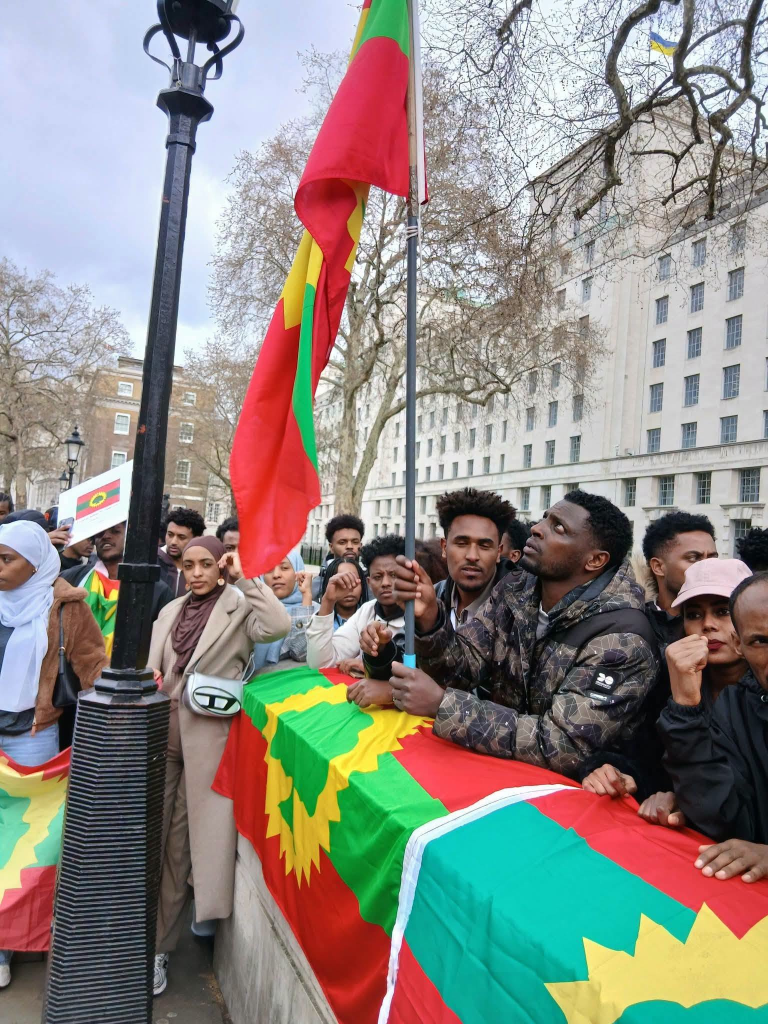
LONDON, UNITED KINGDOM — The streets of London echoed with the voices of the Oromo diaspora on 30 March 2026, as hundreds of protesters gathered to condemn the Ethiopian government and demand justice for the people of Oromia. The demonstration, held in the heart of the British capital, was a powerful display of solidarity, resilience, and unwavering commitment to the struggle for freedom, human rights, and self-determination.
A Movement Rooted in Pain and Hope
The protest brought together Oromo community members and supporters from across the United Kingdom, united by a shared sense of urgency and grief. Placards bearing the faces of fallen activists, images of destroyed villages, and slogans demanding accountability filled the streets. The air was thick with chants that resonated with decades of marginalisation, violence, and unfulfilled promises.
For the Oromo people, the struggle is not abstract. It is deeply personal. It is the memory of loved ones lost, homes destroyed, and futures stolen. It is the weight of a history marked by political repression, cultural erasure, and economic exploitation. But it is also a story of resilience—of a people who refuse to be silenced, who continue to rise, and who will not rest until justice is served.
The Demands: A Call for Accountability
The protesters’ chants were not random slogans; they were a clear and coherent set of demands that reflect the deep grievances of the Oromo people. Each chant carried the weight of a specific injustice, a cry for redress, and a vision for a better future.
1. Free All Political Prisoners in Ethiopia
The protesters demanded the immediate and unconditional release of all individuals detained for their political beliefs or activities. In Ethiopia, thousands of activists, journalists, and opposition figures have been arrested under the pretext of maintaining order, their voices silenced and their families left in anguish. The call for their release is a demand for the restoration of basic human rights and the rule of law.
2. Ethiopia’s Prime Minister Is a War Criminal
A direct and unequivocal accusation, this chant held Prime Minister Abiy Ahmed personally responsible for atrocities committed during the conflicts in Oromia and other regions. For the protesters, Abiy is not a reformer but a figure whose tenure has been marked by escalating violence, civilian deaths, and a systematic dismantling of democratic institutions. The chant was a demand for accountability at the highest levels of power.
3. Oromia Shall Be Free
This was not merely a slogan but a declaration of the Oromo people’s belief in their right to self-determination. For decades, the Oromo have been subjected to political, economic, and cultural marginalisation. Their land has been exploited, their resources plundered, and their identity suppressed. The demand for freedom is a demand for dignity, autonomy, and the right to chart their own destiny.
4. Oromia Is Not for Sale
A powerful rejection of any attempts to appropriate or commodify Oromo land and resources. This chant spoke to the systemic exploitation of Oromia’s vast natural wealth—agricultural land, minerals, and water resources—often without the consent or benefit of the local population. It was a demand for economic justice and the recognition of Oromo sovereignty over their ancestral lands.
5. Oromia Is a Country
An assertion of Oromo national identity and the right to statehood. For many in the diaspora, this chant reflects the belief that the Oromo people constitute a distinct nation with a shared history, language, and culture. It is both a statement of identity and a political demand for international recognition.
6. Finfinnee Belongs to Oromo and Oromia
A demand for the recognition of Addis Ababa (Finfinnee) as part of Oromia, disputing its status as a separate federal entity. The city, which lies at the heart of Oromia, has been a flashpoint of contention for decades. For the protesters, its status is not merely symbolic but a matter of historical and territorial justice.
7. Fano Is a Terrorist Group
A denunciation of the Fano militia, accused by protesters of committing atrocities against Oromo civilians. The chant reflects the widespread perception that Fano, a militia with roots in the Amhara region, has been responsible for widespread violence, displacement, and ethnic cleansing in Oromia. The protesters called for the group to be officially designated as a terrorist organisation.
8. Fano Out of Oromia
A demand for the immediate withdrawal of Fano forces from Oromo territories. For the protesters, the presence of Fano in Oromia is an occupation, a violation of Oromo sovereignty, and a source of ongoing violence and instability.
9. Justice for Bette Urgessa
A call for accountability in the case of Bette Urgessa, an Oromo activist whose death has become a symbol of state repression. Her story is one of many—ordinary people whose lives have been cut short by violence, whose families are left without answers, and whose deaths demand justice.
10. Justice for Haacaaluu Hundeessaa
A demand for justice for the murdered Oromo singer and activist, whose assassination in 2020 sparked widespread protests across Ethiopia. Haacaaluu was not just a musician; he was a voice for the voiceless, a symbol of resistance, and a source of hope for millions. His death was a turning point, galvanising a new generation of activists and intensifying the struggle for justice.
A Global Movement: From London to the World
Organisers emphasised that the London protest is part of an ongoing global campaign by the Oromo diaspora. Demonstrations have been held in cities across Europe, North America, Australia, and Africa, with activists calling for international intervention to address the crisis in Oromia.
The Oromo diaspora has become a formidable force for change, using their platforms to document human rights abuses, amplify the voices of those on the ground, and pressure governments and international bodies to act. Social media has been a powerful tool, enabling activists to share real-time updates, coordinate protests, and build a global network of solidarity.
The protesters submitted a formal petition to the UK Foreign Office, urging the British government to take a stronger stance against the Ethiopian government and to support efforts to end the violence and human rights abuses in Oromia. The petition included calls for economic sanctions, diplomatic pressure, and support for independent investigations into human rights violations.
The Road Ahead: An Unbroken Determination
The London protest of 30 March 2026 was not an isolated event. It was part of a sustained movement that continues to grow, driven by the Oromo diaspora’s determination to see justice done and a free and democratic Oromia established.
As the organisers declared: “Hiriirri kun biyyoota addunyaa guutuu irratti itti fufuudha qaba” — This struggle continues across all countries of the world.
The road ahead is long and fraught with challenges. The Ethiopian government has shown little willingness to engage in meaningful dialogue or address the grievances of the Oromo people. Repression continues. Violence persists. The international community, while increasingly vocal, has been slow to act.
But the protesters in London and across the diaspora remain undeterred. They are driven by a vision of a future where the Oromo people are free, where justice prevails, and where the voices of the oppressed are finally heard.
A Legacy of Resistance
The Oromo struggle is not new. It is a legacy of resistance that has been passed down through generations—from the warriors of the past to the activists of today. It is a struggle that has been waged in villages and cities, in exile and at home, in the face of overwhelming odds.
The London protest is a testament to the enduring spirit of the Oromo people. It is a reminder that no matter how far they are from their homeland, the Oromo diaspora remains deeply connected to the struggles of their people. It is a declaration that the fight for justice is not confined to Oromia but is a global struggle that demands global solidarity.
The Oromo diaspora in London and beyond remains committed to the struggle for justice, freedom, and human rights for the Oromo people. Their voices will not be silenced. Their demands will not be forgotten. And their determination will not waver.
#Oromo #Oromia #LondonProtest #JusticeForOromo #FreeOromia #HumanRights #GlobalSolidarity





 Advocacy for Oromia