Category Archives: gender

Irreechaa 2026: A Sacred Celebration Across Australia’s Oromo Communities
By Maatii Sabaa
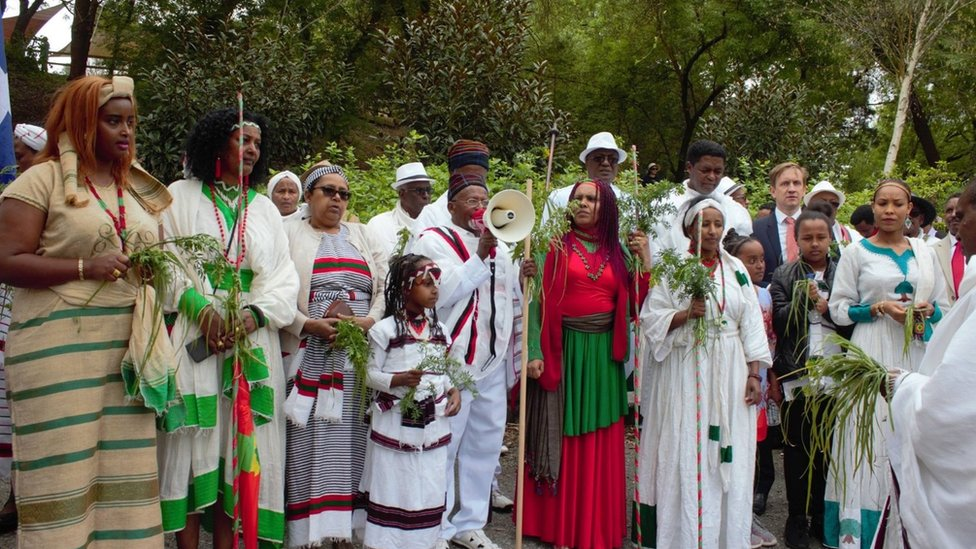
MELBOURNE, 27 September 2026 — For Australia’s Oromo diaspora, this Sunday is far more than a date on the calendar. Irreechaa — the ancient Oromo thanksgiving festival — is being celebrated across the country in a powerful display of culture, faith, and unity. From the banks of Melbourne’s waterways to gatherings in other cities, the tradition that has survived centuries of suppression now thrives on Australian soil.
A Festival of Gratitude and Renewal
Irreechaa marks the end of the rainy season (Ganna) and the beginning of spring (Birraa) — a time of harvest, hope, and renewal. Rooted in Waaqeffannaa, the traditional Oromo belief in one God (Waaqa), the festival predates Christianity and Islam and has been passed down through generations for thousands of years .
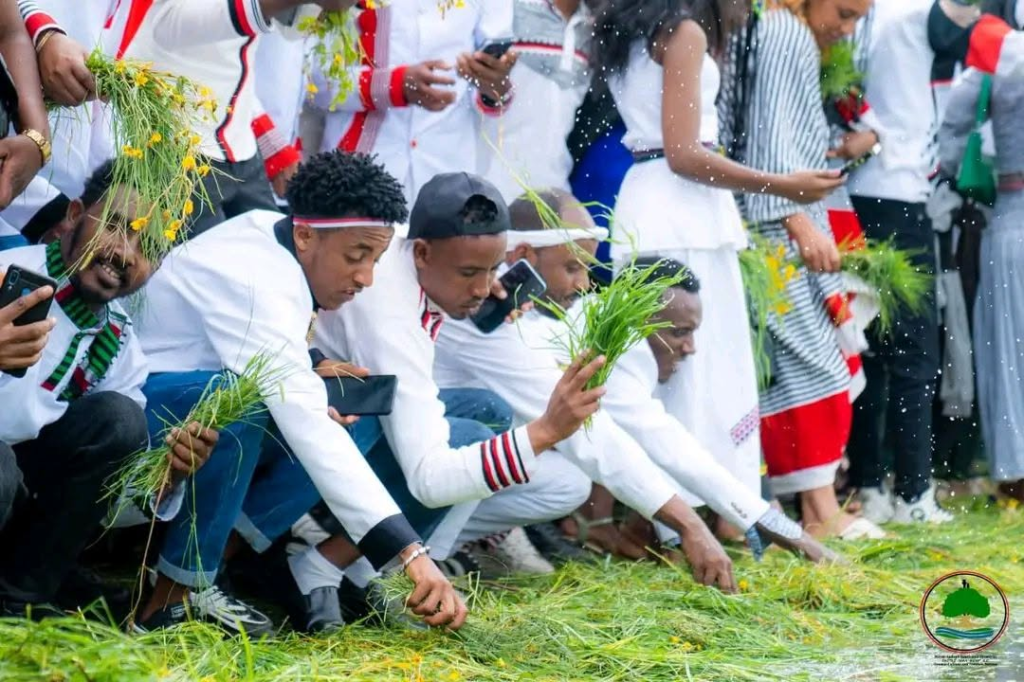
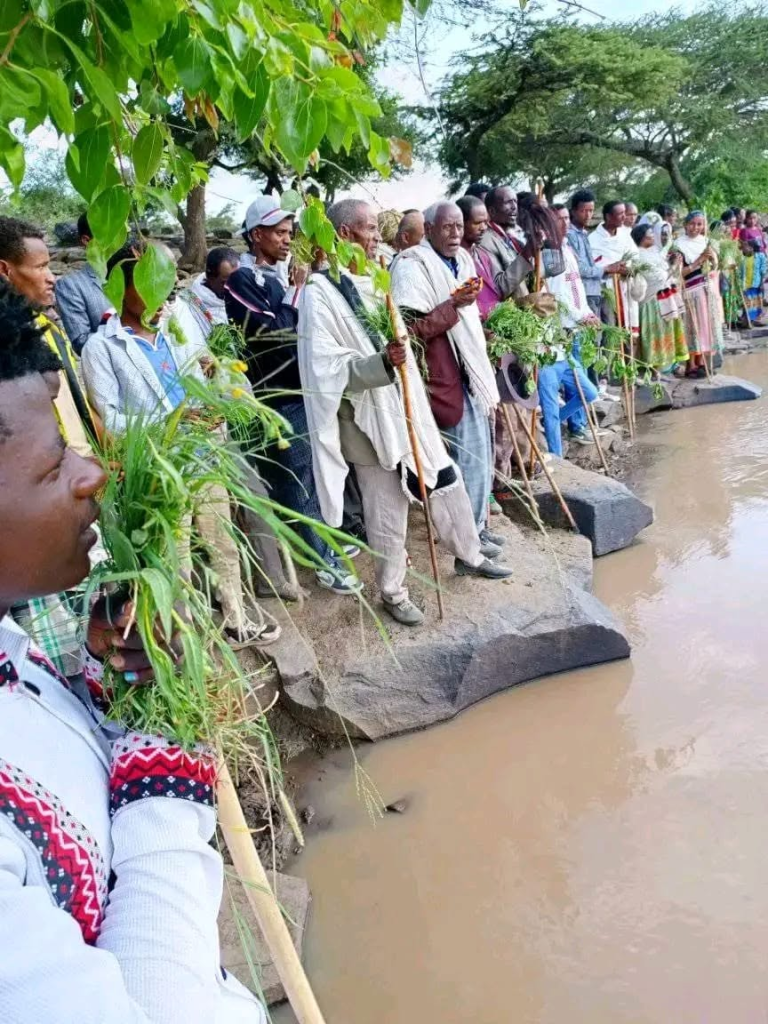
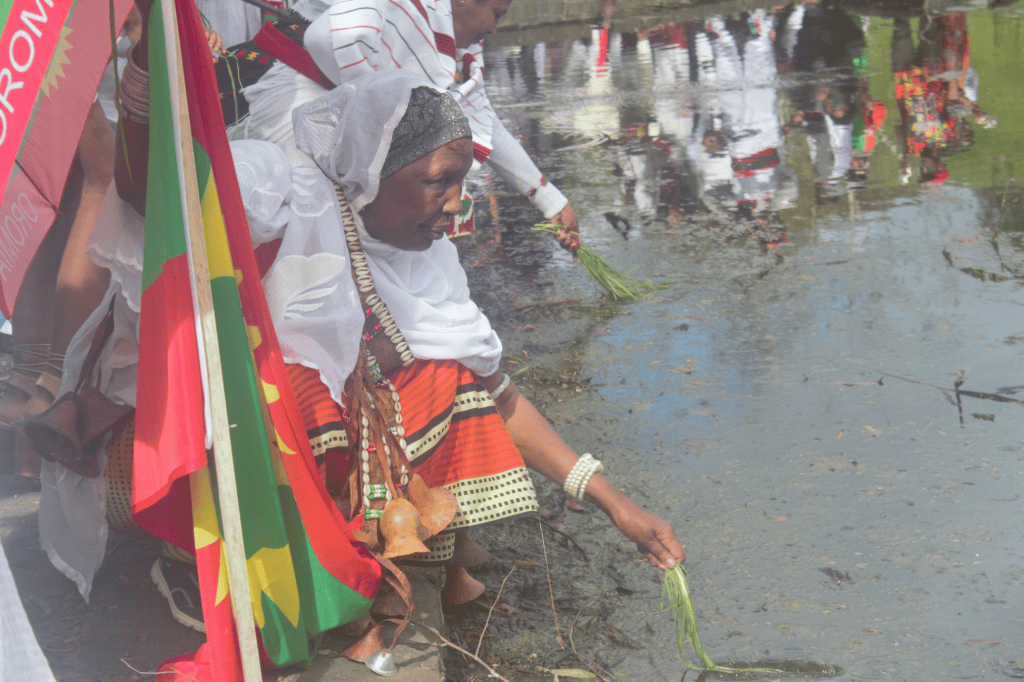
Participants carry fresh green grass and yellow daisies (daraaraa keelloo) to the water’s edge, dipping them into the water as an offering of gratitude. This act symbolizes purification, renewal, and the washing away of the past year’s hardships .
The festival is also a time of reconciliation — disputes are settled before participation, and communities come together in peace .
Melbourne: Irreechaa Malkaa at Wilson Botanic Park
The Melbourne Oromo community is celebrating Irreechaa Malkaa 2026 on Sunday, 27 September at Wilson Botanic Park in Berwick, with festivities beginning at 11:00 AM .
The celebration follows the traditional structure of Irreechaa:
- Blessing of Elders: The event opens with prayers led by community elders (Abbaa Gadaa, Hadhasiinqee) .
- The Procession: Participants walk together toward the water, with women traditionally walking in front — a practice rooted in the Siinqee institution symbolizing women as sacred and as agents of peace .
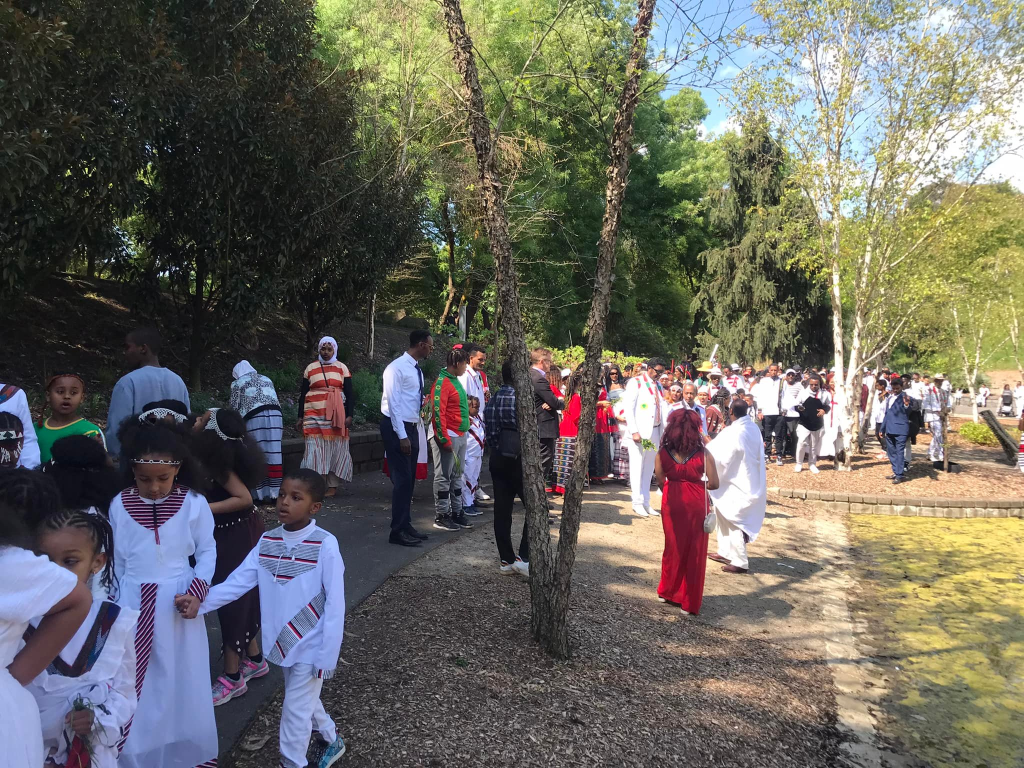
- Carrying Grass and Flowers: Attendees carry fresh green grass and yellow flowers to the water’s edge, symbols of life, fertility, and connection to the earth .
- Dipping and Sprinkling: The grass and flowers are dipped into the water, and participants sprinkle water on themselves and others as a blessing .
- Songs and Prayers: Traditional Oromo songs (faaruu) fill the air — songs of gratitude, hope, and blessing, including the Marewoo songs sung during the procession .
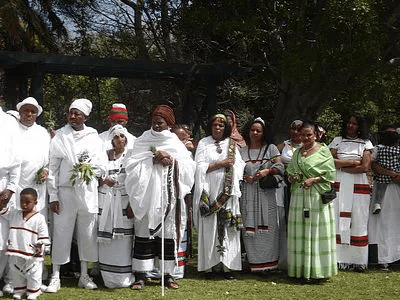
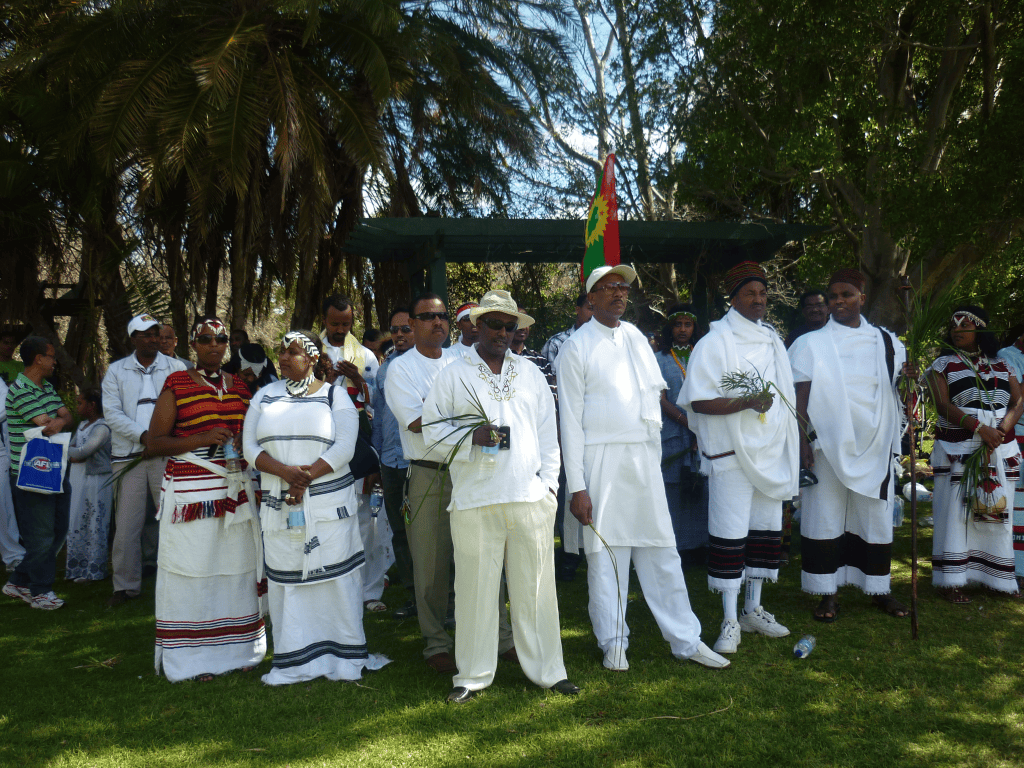
Community members are encouraged to wear traditional Oromo clothing, bringing water, flowers, and a spirit of gratitude .
Irreechaa Arfaasaa: The Spring Celebration
Earlier in 2026, the Melbourne community gathered for Irreechaa Arfaasaa on Sunday, 26 April at Dandenong Mountain (Tulluu Dandenong) .
Irreechaa Arfaasaa marks the end of the dry season and the beginning of the rainy season — a spring celebration where communities pray to Waaqa for rain and good spirit. It is celebrated at hilltops and mountains, with elders leading blessings and the community gathering in traditional attire .
Organizers emphasized the importance of environmental protection at this year’s Arfaasaa celebration, reminding participants to respect the natural surroundings of Dandenong Mountain and leave no waste behind .
Irrecha Australia: A Growing National Movement
What began as small community gatherings among Oromo families in Australia has blossomed into vibrant national festivals. At the heart of this movement is Irrecha Australia, a registered non-profit organization dedicated to honoring the Oromo people’s cherished thanksgiving tradition .
The organization places particular emphasis on empowering young people, equipping the next generation to carry traditions forward with pride and confidence. Its vision extends beyond the Oromo community itself — envisioning a nation where Oromo culture thrives as an integral part of Australia’s diverse identity .
“Through festivals, education, and community initiatives, we strengthen connections, honour our heritage, and celebrate a way of life rooted in gratitude, resilience, and unity,” the organization states .
Why Irreechaa Matters in Australia
For Oromos living far from their homeland, Irreechaa serves as a vital cultural anchor. It connects the diaspora to their ancestors, their language, and one another .
The festival is also a powerful statement of resilience. Irreechaa has been celebrated by the Oromo for generations, preserved through years of oppression and systemic subjugation. That it now thrives in Australia — thousands of kilometres from Oromia — is a testament to the community’s determination to keep its traditions alive .
As one Oromo community message beautifully expressed: “Irreecha is not a memory. It is a living prayer. And you are the ones who keep it alive” .
A Message for All
Irreechaa is more than a festival. It is an expression of identity, a bond of unity, and a living link between generations. For the Oromo community in Australia, this weekend’s celebrations are a sacred homecoming — a chance to give thanks, to reconnect, and to pass the flame of Oromummaa to the next generation.
Baga Irreechaan nagaan geesse! — May the Irreechaa have arrived in peace.
Irreechaa is celebrated annually at the banks of rivers and lakes across Oromia, and by Oromo communities around the world.

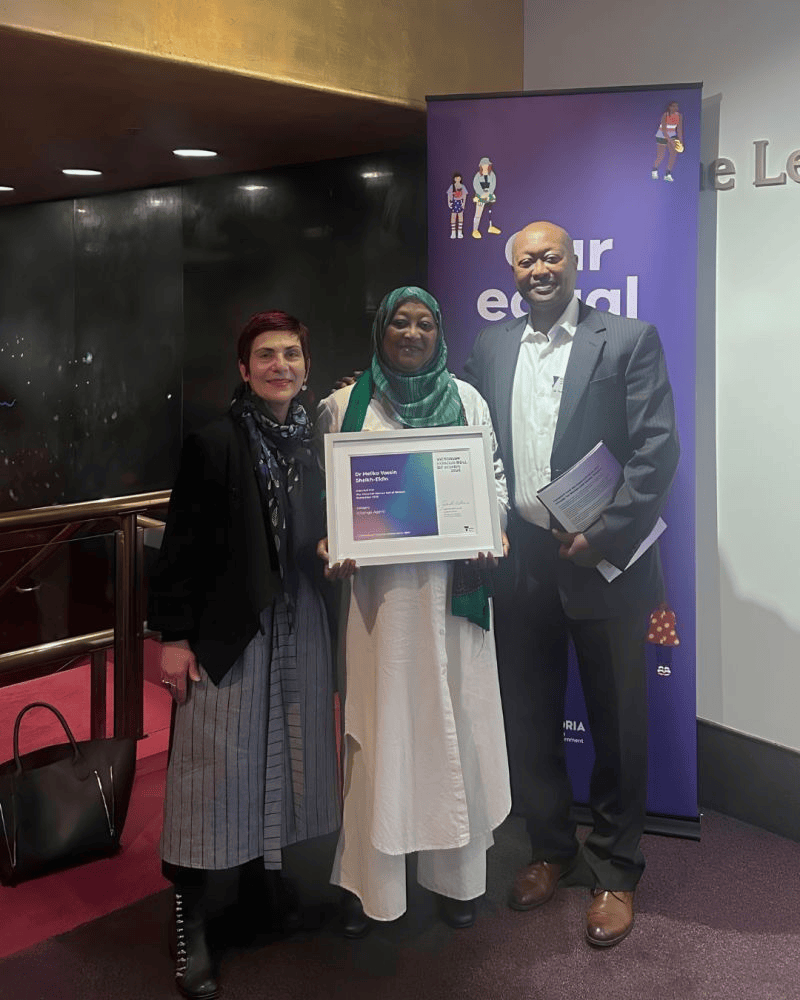
A Trailblazer Honoured: Dr Melika Sheikh-Eldin Inducted into the Victorian Honour Roll of Women
By Dhabessa Wakjira
In a moment that celebrates both personal achievement and the power of lived experience, Dr Melika Sheikh-Eldin — Manager of International and Community Development at AMES Australia — has been inducted into the Victorian Honour Roll of Women, one of the state’s most prestigious recognitions of women’s contributions to their communities and the nation.
The announcement was met with pride and joy across AMES Australia and the broader settlement sector, where Dr Melika has been a guiding force for more than two decades.
“Congratulations to Dr Melika Sheikh-Eldin, our Manager of International and Community Development, on being inducted into the Victorian Honour Roll of Women,” AMES Australia shared in a statement. “This well-deserved recognition celebrates Melika’s outstanding leadership and commitment to creating opportunities for multicultural communities.”
A Journey from Refugee to World-Leading Innovator
Dr Melika’s story is one of remarkable transformation — and of turning personal hardship into a force for systemic change. She fled war in Eritrea in the late 1970s, volunteering in Sudanese refugee camps and in Cairo for organisations including the United Nations High Commissioner for Refugees (UNHCR) , the Red Cross, and Save the Children. She resettled in Australia in 1992.
Since joining AMES Australia in 2001, she has dedicated her career to settlement, community development, capacity building, and advocacy. Her work has helped thousands of new arrivals settle successfully in Australia and has influenced settlement policy and practice both nationally and internationally.
At the Victorian Honour Roll of Women ceremony, it was recognised that Dr Melika Sheikh-Eldin has transformed her lived experience as a refugee into world-leading approaches to community integration and social cohesion.
Three World-Leading Models
Dr Melika’s impact at AMES Australia is perhaps best illustrated by the innovative programs she has led — programs that have become blueprints for others:
1. The Nhill Rural Settlement Project
In western Victoria, the small town of Nhill was facing economic decline. Dr Melika’s project settled Karen refugees in the community, revitalising the town’s economy and creating a model now considered a global blueprint for rural settlement.
2. The Werribee Park Gardening Program
Engaging isolated Karen women in gardening, this program addressed critical issues of isolation and mental wellbeing. Its success was so evident that the model has been adopted by other organisations.
3. The Community Guides Program
Perhaps her most influential innovation, the Community Guides Program recruits former refugees to use their lived experience to assist new arrivals. Dr Melika has travelled to Sweden, New Zealand, and Japan to help international organisations establish programs based on this model.
Challenging Stereotypes, Championing Two-Sided Education
Throughout her career, Dr Melika has disrupted gender stereotypes and challenged the public perception of what refugees can achieve. Central to her philosophy is the concept of “two-sided education” — the idea that both host communities and new arrivals must learn about one another for true integration to occur.
This mutual learning, she explains, helps mitigate the fear of the unknown — the anxiety that so often fuels resistance to newcomers. It is a simple but profound insight: integration is not something done to refugees, but something built with them, and with the communities that receive them.
A Scholar and a Mother
Dr Melika’s achievements are all the more remarkable given the circumstances in which she pursued them. While raising three children as a refugee in a small Australian town, she completed a PhD in aquatic science — a testament to her intellectual rigor and her refusal to be defined by the limitations others might have placed upon her.
Since 2007, she has also sat on the board of the Refugee Council of Australia and represented the nation as a “Refugee Voice” at annual UNHCR consultations in Geneva, advocating for policy shifts that recognise refugees as stakeholders rather than recipients of aid.
A Well-Deserved Recognition
The Victorian Honour Roll of Women celebrates women who have made exceptional contributions to Victoria and beyond. Inductees are recognised for their leadership, courage, and lasting impact on their communities.
Dr Melika’s induction places her among a distinguished group of women who have shaped the state’s social, cultural, and political landscape. For the Oromo community and for refugees and migrants across Australia, her recognition is a moment of immense pride.
“Congratulations, Melika. We are incredibly proud of you,” AMES Australia said. 💙
Learn More
To read Dr Melika Yassin Sheikh-Eldin’s full profile on the Victorian Honour Roll of Women, visit:
🔗 https://www.vic.gov.au/dr-melika-yassin-sheikh-eldin
#AMESAustralia #AMES #Award #VictorianHonourRoll

Preserving the Sacred: Why Irreechaa Needs Correction, Not Just Celebration
By Dhabessa Wakjira
Irreechaa is more than a festival. It is a sacred covenant between the Oromo people and Waaqa — a day of thanksgiving, reconciliation, and renewal that has survived centuries of suppression. But as the celebration grows in size and visibility, so too does the need to protect its spiritual integrity.
A recent community message, circulated among Oromo elders and youth, raises urgent concerns about practices that have crept into modern Irreechaa celebrations — practices that, while perhaps well-intentioned, risk distorting the festival’s deep cultural and spiritual meaning. The message is not an attack on the celebration. It is a call to return to the duudhaa — the sacred customs and traditions — that give Irreechaa its power.
The concerns can be grouped into four key areas that, according to the message, must be corrected.
1. The Time of Irreechaa Malkaa Must Not Be at Night
The first concern is about timing. According to Oromo tradition, Irreechaa Malkaa should not be performed at night. The Oromo people have their own natural sense of time, rooted in family life and community rhythms. A person rises, tends to their household, prepares coffee, and then proceeds to the water’s edge for Irreechaa — honoring the customs passed down through generations.
The tradition describes how participants should approach the water: carrying fresh grass and flowers, singing the sacred songs of Mareyoo, and moving with reverence. Elders sing “Araaroo yaa araari hoo / Ararsaa waaqatu jalaataa / Nuuf Ararami hoo” — calling for peace and blessing from Waaqa. The youth accompany the elders respectfully, and upon reaching the Malkaa, no one should make noise or ululate until the Irreechaa ceremony at the water is complete.
This is a call to restore the solemnity and order that should define the procession. Irreechaa is not a chaotic gathering; it is a structured, reverent spiritual journey.
2. The Water Ritual Must Follow Tradition
The second concern addresses how the water ritual is performed. According to the message, sprinkling water on oneself and others — or turning back before reaching the designated Irreechaa site — is not part of Oromo duudhaa. The practice of indiscriminately splashing water, the message warns, resembles a “cuubbaa” (baptismal) ritual rather than the traditional Oromo offering.
The Abbootii Gadaa (Gadaa leaders) are called upon to correct this. The water of Irreechaa is sacred — it is meant for purification and blessing in a specific, reverent manner, not for casual splashing. The distinction matters because Irreechaa is rooted in Waaqeffannaa, the traditional Oromo faith, and its rituals must remain true to that origin.
3. Vehicles Must Not Obstruct the Path to the Malkaa
The third concern is practical but deeply important: the overuse of vehicles on Irreechaa day is obstructing access to the Malkaa. While some vehicles are genuinely necessary — for security, emergency services, or for elderly and disabled participants — the message argues that too many cars are being used for entertainment and convenience, narrowing the roads and blocking the path for those who wish to walk.
The message specifically notes that artists and well-known figures should walk with the community rather than being driven, closing roads and causing hardship for ordinary participants. The image of last year’s Irreechaa, where celebrants struggled because roads were blocked by vehicles carrying notable figures, is still fresh in memory.
Irreechaa is a communal pilgrimage. Walking together — as one people, regardless of status — is part of what makes it sacred. Vehicles should be limited to genuine necessity, not convenience or display.
4. Respect for the Spiritual Boundaries of Irreechaa
The fourth concern is perhaps the most sensitive. The message observes that people of other faiths are attending Irreechaa and engaging in practices that contradict its spiritual purpose — including singing, preaching, and distributing religious materials at the Malkaa that promote beliefs other than Waaqeffannaa.
The message does not say that non-Waaqeffannaa participants are unwelcome. Irreechaa is a national and cultural celebration, and all Oromos are invited to share in it. But the Malkaa is a sacred space with its own spiritual rules. Those who come should respect the boundaries of the tradition they are joining. Proselytizing at the water’s edge — whatever the faith — is not part of Irreechaa and does not honor its purpose.
The message calls on those who engage in such practices to reflect on their actions, and on the Abbootii Gadaa to safeguard the spiritual integrity of the festival.
The Call to the Abbootii Gadaa
The message concludes with a direct appeal: the Abbootii Gadaa and community elders must take the lead in correcting these practices. Specifically, they are asked to address:
- Celebrations at 10 PM that should not be happening
- The sprinkling of water that departs from tradition
- The obstruction of roads by unnecessary vehicles
- The introduction of foreign religious practices at the Malkaa
These are not minor details. They are the difference between a festival that honors its ancestors and one that drifts into something unrecognizable.
Irreechaa Is Peace, Reconciliation, and Blessing
The message ends with a reminder of what Irreechaa truly is:
“Irreechi Nagaa, Araara, Milkii fi quufa. Baga geenye!”
“Irreechaa is Peace, Reconciliation, Blessing, and Abundance. Welcome!”
This is the heart of the matter. Irreechaa is not a party. It is not a parade. It is not a platform for personal recognition or religious outreach. It is a sacred act of gratitude to Waaqa, a communal reconciliation, and a prayer for peace and abundance in the year to come.
If the celebration is to remain meaningful for future generations, it must be practiced with the same reverence, order, and fidelity to tradition that has kept it alive for centuries — through persecution, suppression, and diaspora.
The message is a wake-up call. And it is one that deserves to be heard.

From Refugee to Trailblazer: How Dr Melika Yassin Sheikh-Eldin Is Reshaping Australia’s Approach to Settlement
By Dhabessa Wakjira
When Dr Melika Yassin Sheikh-Eldin fled war in Eritrea in the late 1970s, she could not have known that her journey would one day help shape how an entire nation welcomes its newest arrivals. But that is precisely what happened. Over four decades, Melika has transformed her lived experience as a refugee into world-leading models for community integration and social cohesion — models now studied and adopted far beyond Australia’s shores.
She has helped thousands of new arrivals settle successfully. She has disrupted gender stereotypes and challenged public perceptions of what refugees can achieve. And she has done so while raising three children, completing a PhD, and representing Australia on the global stage as a “Refugee Voice” at United Nations consultations in Geneva.
Her story is not simply one of personal triumph. It is a blueprint for what is possible when refugees are recognized not as recipients of aid, but as stakeholders, leaders, and architects of their own futures.
A Journey Forged in Service
Melika’s path to Australia was neither short nor simple. After fleeing Eritrea, she volunteered in Sudanese refugee camps and later in Cairo. Her dedication drew the attention of some of the world’s most respected humanitarian organizations. She volunteered for the United Nations High Commissioner for Refugees (UNHCR) , the Red Cross, and Save the Children — gaining frontline experience that would later inform her professional approach.
She resettled in Australia in 1992, bringing with her not only the scars of displacement but also an unshakeable commitment to service. That commitment found its home at AMES Australia, where she has been a pivotal leader since 2001 and has served as Manager of Settlement Support Services since 2006.
Since 2007, she has sat on the board of the Refugee Council of Australia and represented the nation as a “Refugee Voice” at annual UNHCR consultations in Geneva. In that role, she has advocated relentlessly for policy shifts that recognize refugees as stakeholders rather than passive recipients of aid — a principle that has guided every project she has led.
Three World-Leading Models
Melika’s work at AMES Australia has produced initiatives that are now considered global blueprints for settlement and integration. Three stand out in particular.
1. The Nhill Rural Settlement Project
In western Victoria, the small town of Nhill was facing economic decline. Melika’s project settled Karen refugees in the community — and the results were transformative. The town’s economy was revitalized, and the model is now regarded internationally as a global blueprint for rural settlement. It demonstrated that refugee settlement is not a burden but an opportunity — for the newcomers and for the host community alike.
2. The Werribee Park Gardening Program
Isolation and mental wellbeing are critical challenges facing many refugee women, particularly those who arrive without established community networks. Melika’s program engaged isolated Karen women in gardening at Werribee Park. The initiative directly addressed these challenges, and its success was so evident that the model has since been adopted by other organizations.
3. The Community Guides Program
Perhaps Melika’s most influential innovation is the Community Guides Program, which recruits former refugees to use their lived experience to assist new arrivals. The logic is elegant: those who have walked the path themselves are uniquely positioned to guide others along it. The program has proven so effective that Melika has traveled to Sweden, New Zealand, and Japan to help international organizations establish programs based on the AMES Community Guides model.
Challenging Stereotypes, Championing Two-Sided Education
Melika’s impact extends beyond program design. She has been a powerful voice in disrupting gender stereotypes and challenging the public perception of what refugees can achieve. At a time when refugee women are often portrayed as passive or dependent, Melika’s leadership — and the leadership she cultivates in others — tells a different story.
Central to her philosophy is the concept of “two-sided education.” Integration, she argues, is not a one-way process. Both host communities and new arrivals must learn about one another for true integration to occur. This mutual learning, she explains, helps mitigate the fear of the unknown — the anxiety that so often fuels resistance to newcomers.
It is a simple but profound insight: integration is not something done to refugees, but something built with them, and with the communities that receive them.
A Scholar and a Mother
Melika’s achievements are all the more remarkable given the circumstances in which she pursued them. While raising three children as a refugee in a small Australian town, she completed a PhD in aquatic science — a testament to her intellectual rigor and her refusal to be defined by the limitations others might have placed upon her.
Her academic background in science may seem distant from her work in settlement, but both reflect the same qualities: careful observation, systematic thinking, and a commitment to understanding complex systems — whether ecosystems or communities.
A Legacy Still Being Written
Dr Melika Yassin Sheikh-Eldin’s story is a reminder that refugee experiences are not only stories of loss. They are also stories of contribution, innovation, and leadership. Her work has reshaped how Australia approaches settlement, and her models continue to influence practice internationally.
But perhaps her most enduring legacy is the principle she has championed throughout her career: that refugees are not problems to be solved, but partners to be engaged. They are not merely recipients of aid, but stakeholders in their own futures — and, as Melika’s own life demonstrates, architects of the futures of others.
From a young woman fleeing war to a world-leading voice in settlement and integration, Melika’s journey is a testament to what becomes possible when refugees are given the opportunity — and the respect — to lead.
Dr Melika Yassin Sheikh-Eldin is the Manager of Settlement Support Services at AMES Australia and a board member of the Refugee Council of Australia.

Why is Irreechaa celebrated in Australia?
Irreechaa is celebrated in Australia because it serves as an essential cultural anchor and a vital tool for preserving Oromo identity for the diaspora community. For Oromos living far from their homeland, the festival bridges the physical distance, allowing them to maintain a profound connection to their heritage, land, and community.
🌏 Maintaining Connection to Homeland
For the Oromo diaspora in Australia, Irreechaa is not merely a tradition but a spiritual and cultural lifeline. As community members explain, the festival creates a “cultural ambiance that connects the people to Oromo land and the creator, Waaqa”. It serves as a powerful bridge, reinforcing the bond between those living abroad and their ancestral roots, ensuring that their connection to Oromia remains strong despite the geographical separation.
🎶 Preserving Identity Across Generations
The celebration plays a critical role in fostering Oromummaa (Oromo identity) in a new environment. By organizing these events, the community ensures that younger generations born or raised in Australia can learn about and embrace their heritage. The festival includes traditional blessings by elders, cultural performances like the Siiqqee and Gumii dances, and communal meals, all of which educate and immerse participants in Oromo traditions. This active practice is vital for intergenerational learning and instills a sense of pride in Oromo culture among the youth.
🤝 Building Community and Belonging
Irreechaa provides a crucial opportunity for the Oromo diaspora to unite and strengthen their communal bonds. In cities like Melbourne, the celebration brings together families and individuals to share in a collective expression of gratitude, peace, and solidarity. The festival has been held annually in Australia since 2009, growing steadily in participation. It serves as a platform to build a sense of belonging and mutual support within the community, creating a home away from home.
🌉 Bridging Cultures
The celebration also acts as a cultural bridge to the wider Australian society. Many Irreechaa events invite local government officials, multicultural organizations, and curious residents, encouraging mutual respect and intercultural exchange. By sharing their traditions openly, the Oromo community not only sustains its own cultural practices but also contributes to the vibrant multicultural fabric of Australia.
In essence, Irreechaa in Australia is a dynamic and necessary adaptation of a sacred tradition. It allows the Oromo diaspora to give thanks, celebrate their shared history, and ensure their culture continues to thrive and be recognized for generations to come.

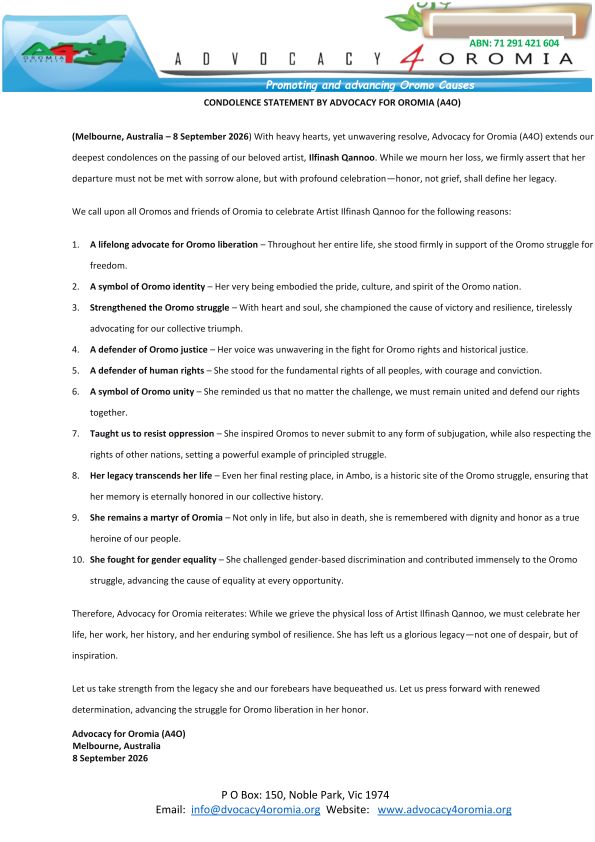
A Life Worth Celebrating—A4O Calls for Honor, Not Grief, for Artist Ilfinash Qannoo
By Our Correspondent
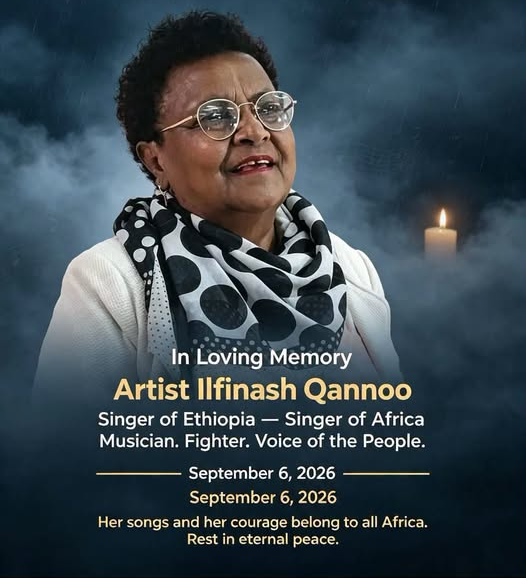
(Melbourne, Australia – 8 September 2026)-In a poignant and powerful statement released today, Advocacy for Oromia (A4O) has called on Oromos and friends of the struggle worldwide to transform mourning into celebration for the late artist and freedom fighter, Ilfinash Qannoo.
The Melbourne-based advocacy group, speaking from their Australian headquarters, emphasized that while the loss of the beloved artist is deeply felt, her life, legacy, and unwavering commitment to the Oromo cause demand a response of honor rather than sorrow.
A Life Dedicated to Liberation
Ilfinash Qannoo was no ordinary artist. According to A4O, she was a steadfast pillar of the Oromo liberation movement, dedicating her entire life to the struggle for Oromo self-determination. Her artistry was not merely entertainment—it was resistance. Her voice was not just melody—it was a clarion call for justice.
“Artist Ilfinash Qannoo spent her whole life supporting and advancing the Oromo struggle for freedom,” the statement reads, positioning her among the most committed cultural warriors of her generation.
More Than an Artist—A Symbol
A4O’s statement highlights ten compelling reasons why Ilfinash Qannoo’s legacy must be celebrated:
A Symbol of Oromo Identity: She embodied the pride, dignity, and cultural richness of the Oromo nation. Her very presence was a testament to Oromo resilience and identity.
Champion of Justice: She was a fearless defender of Oromo rights, human rights, and gender equality. She challenged oppression in all its forms and stood against discrimination, including gender-based injustice.
Unifier of the Oromo People: At a time when division threatens the struggle, Ilfinash Qannoo stood as a powerful symbol of Oromo unity, reminding her people that solidarity is the foundation of victory.
Teacher and Inspiration: Through her life and work, she taught Oromos to resist subjugation with dignity, while also respecting the rights of other nations—a rare and powerful example of principled advocacy.
Martyr for the Cause: Her final resting place in Ambo is now etched into the historical landscape of the Oromo struggle. Her grave, like her life, has become a site of memory and honor.
A Legacy That Transcends Death
Perhaps the most striking aspect of A4O’s tribute is the assertion that Ilfinash Qannoo’s impact extends far beyond her lifetime. She did not simply live for Oromia; she ensured that even in death, she would remain a rallying figure for the movement.
“She left us not with despair, but with a glorious legacy,” the statement declared. “We are called to take strength from what she and our forebears have left us, and to rededicate ourselves to the struggle with renewed vigor.”
A Call to Action, Not Lamentation
In what can be described as a clarion call to the Oromo diaspora and the wider movement, A4O urged supporters to channel their grief into action. The organization stressed that the most fitting tribute to Ilfinash Qannoo is not tears, but a renewed commitment to the goals she championed.
“We must celebrate her life, her work, her history, and her enduring symbol of resilience,” the statement emphasized. “Let us march forward in her honor, advancing the struggle for Oromo liberation with determination and unity.”
Global Reach of the Statement
Issued from Melbourne, Australia, on 8 September 2026, the statement reflects the global nature of the Oromo struggle and the far-reaching influence of cultural icons like Ilfinash Qannoo. A4O’s message transcends geographic boundaries, speaking directly to Oromos in the homeland and across the diaspora.
The advocacy group concluded with an unwavering declaration: “Victory to Oromia!” —a fitting epitaph for a woman whose life was dedicated to that very cause.
Historical Context
Ilfinash Qannoo’s passing marks the end of an era in Oromo cultural and political history. She was among a generation of artists who used their craft as a weapon of resistance, challenging the status quo and inspiring millions. Her death is not just a loss of talent, but the departure of a moral compass for a movement in constant pursuit of justice.
As Oromos around the world reflect on her legacy, A4O’s message is clear: Grieve, yes—but more importantly, celebrate. Honor her by carrying the torch she has passed on.
About Advocacy for Oromia (A4O): Based in Melbourne, Australia, A4O is a diaspora advocacy organization committed to advancing the rights, justice, and self-determination of the Oromo people through awareness, advocacy, and solidarity initiatives.
“We mourn her loss, but we celebrate her life—for in her, Oromia found a voice that will never be silenced.”

FEATURE NEWS: Funeral of Artist Ilfinash Qannoo to Be Held Tomorrow in Ambo
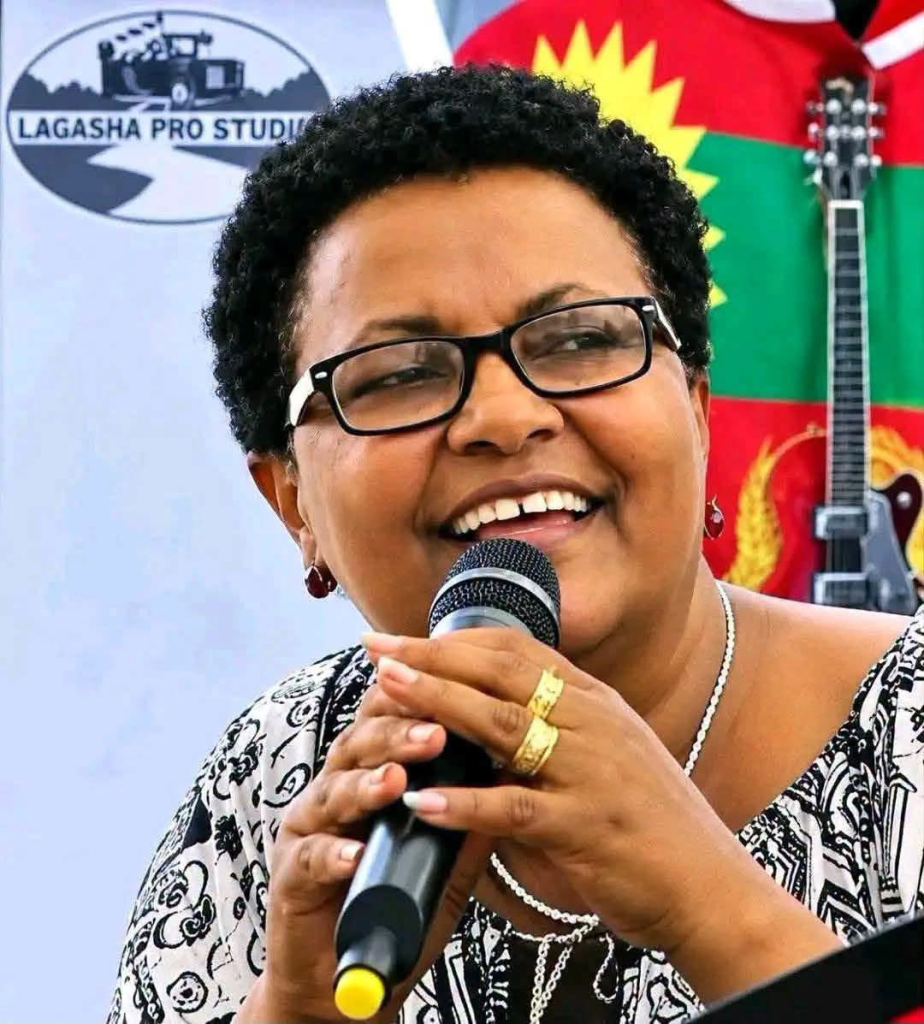
Organizing Committee Confirms Final Farewell for Oromo Cultural Icon
Finfinnee, Fulbaana 07, 2026 – The funeral service and burial ceremony for beloved Oromo artist and freedom fighter Ilfinash Qannoo will take place tomorrow, the organizing committee has confirmed. The final rites are scheduled to be held in the town of Ambo, following a series of commemorative events in Finfinnee.
A Day of Farewell: The Funeral Itinerary
According to Obbo Lammii Beenyaa, a member of the funeral organizing committee, the day’s proceedings will unfold as follows:
| Time in local time | Event |
|---|---|
| 11:00 – 12:00 | Departure of the body from Koriyaa Hospital in Finfinnee |
| 12:00 – 1:00 | Transfer to Finfinnee Stadium for public tribute |
| 1:00 – 3:00 | Formal commemoration and honoring ceremony at Finfinnee Stadium |
| 3:00 onwards | Procession carrying the body to Ambo |
| Upon arrival in Ambo | Funeral and burial ceremony to be conducted |
A Heroine Returns Home
The decision to hold the funeral in Ambo reflects the wishes of the family and the broader Oromo community to honor Ilfinash Qannoo in a location of deep cultural and historical significance. The journey from Finfinnee to Ambo will allow thousands of mourners to pay their final respects to the artist who dedicated her life to the Oromo struggle.
The public tribute at Finfinnee Stadium is expected to draw large crowds, as Ilfinash Qannoo was not only a celebrated musician but also a symbol of resilience and resistance for generations of Oromos. Her songs of unity, justice, and freedom resonated across the Oromo nation and the global diaspora.
Committee Calls for Orderly Participation
The organizing committee has urged all attendees to participate in the funeral proceedings with dignity and respect, maintaining the spirit of unity that Ilfinash Qannoo championed throughout her life. Security and logistical arrangements are being put in place to ensure a smooth and solemn farewell for the departed heroine.
As the Oromo nation prepares to lay its beloved artist to rest, the words of her final songs echo once more: a call for unity, a plea for justice, and a dream of freedom that will not die with her.
“Ilfinash duutus seenaan gootummaa ishii bara baraan dhaloota qaraa, leellifamaa jiraata.”
“Even in death, the legend of her heroism is praised across generations for ages to come.”
#IlfinashQannoo #Funeral #OromoUnity #Ambo #RestInPower #Oromia

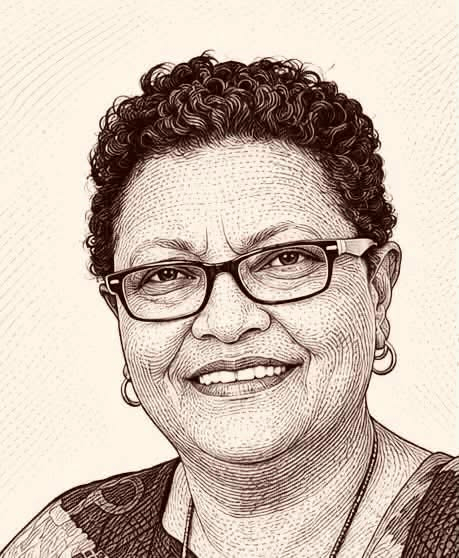
The Death That Refuses to Fade: Why Ilfinash Qannoo’s Legacy Demands Celebration, Not Mourning
By Dhabessa Wakjira
—
In the Oromo cultural cosmos, death is rarely a stranger. It is the great equalizer, the silent harvester that spares neither the peasant nor the prince. The proverb, “Duuti nama kamiifuu hin hafu” — “Death does not leave anyone behind” — is a sobering reminder of our shared mortal fate. Yet, every so often, a soul departs this earth in such a blaze of fire and principle that the grave cannot contain their echo. Ilfinash Qannoo is one such soul.
And here is our radical proposition: We should not weep. We should celebrate.
Not because her death is devoid of sorrow—far from it. The loss of a warrior, a mother, a symbol of unyielding resistance, carves a wound into the flesh of history. But to reduce Ilfinash to a tragedy is to misunderstand her life. To mourn her is to pity her; to pity her is to diminish her. Instead, we choose to honor her as the Oromo people have always honored their heroes: with poetry, with pride, and with the unshakable belief that her story is not an ending, but a beginning.
The Gootummaa (Heroism) That Defies Time
Ilfinash Qannoo was not merely a figure of her era. She was a force of nature sculpted into human form. In a world that demanded women be silent, she roared. In a system that demanded submission, she stood with her spine straight and her gaze fixed on the horizon of justice.
Her gootummaa—her heroism—was not carved from reckless anger, but from a profound love for her people. It was the kind of love that does not bow to colonialism, does not kneel to oppression, and does not whisper in the face of tyranny. It was the kind of love that marched, that fought, and that—when necessary—fell, so that others could stand taller on her shoulders.
This is why the proverb holds a second, hidden meaning. Yes, death takes everyone. But not everyone lives with the intensity of Ilfinash. For most, death is an erasure. For her, death was a megaphone. The louder the silence around her grave, the louder her deeds speak across generations.
Celebration as Resistance
Why celebrate? Because grief is passive; celebration is active. Mourning looks backward; celebration propels forward.
In many cultures, we are taught to dress in black, to lower our voices, to count the days of absence. But for a figure like Ilfinash Qannoo, such rituals are insufficient. They are, in fact, a betrayal of the fire she carried.
Imagine Ilfinash herself. Would she want a river of tears? Or would she demand a drumbeat of defiance? Would she desire bowed heads or raised fists? The answer is written in every chapter of her struggle. She lived for the flourishing of her people. Therefore, the greatest tribute we can pay is to flourish audaciously in her name.
To celebrate Ilfinash is to:
- Sing her praises in public gatherings, not whisper them in private corners.
- Teach her story in schools, not confine it to oral whispers.
- Emulate her courage in our daily battles, not relegate it to museum glass.
- Laugh with the joy she fought for, not weep with the sorrow she overcame.
Her death is a chapter. Her life is the entire book. And books are meant to be read aloud.
The Eternal Present of Her Legacy
Here is the miracle of Ilfinash Qannoo: she exists in the present tense. Yes, her heartbeat has ceased, but her rhythm continues in the pulse of every Oromo child taught to speak their language without shame. She lives in the defiant ink of every activist’s pen. She breathes in the lungs of every woman who refuses to be a footnote in someone else’s story.
The historians may write her dates—born, fought, fell. But the bards will sing her essence: She who bent the wind. She who taught the stones to speak.
Thus, we say: Do not mourn Ilfinash. Summon her.
Call her spirit into every courtroom where justice is demanded. Invoke her name in every village meeting where the future is debated. Let her be the ancestor who dances at our weddings, not the ghost who haunts our funerals.
A Final Call to the Living
Brothers and sisters, let us be clear. This is not callousness. This is not forgetting. This is the highest form of remembrance. We celebrate because we understand that Ilfinash Qannoo did not lose her life—she invested it. And the dividends of that investment compound with every generation that dares to dream freely.
So tonight, when the elders speak of her, do not lower your gaze. Lift a cup of water—the symbol of life—and toast to her name. Clap your hands. Stamp your feet. Let the earth feel the vibration of her memory.
For indeed, death does not leave anyone behind. But heroes like Ilfinash Qannoo leave something behind that death cannot touch: a legacy so fierce that it turns sorrow into a war cry.
Celebrate her. Live like her. And in living, you prove that she never truly died.
“Ilfinash duutus seenaan gootummaa ishii bara baraan dhaloota qaraa, leellifamaa jiraata.”
(Even in death, the legend of her heroism is praised across generations for ages to come.)
Let that praise be loud. Let it be joyful. Let it be eternal.
#IlfinashLives #CelebrateTheHero #OromoPride #LegacyOverMourning

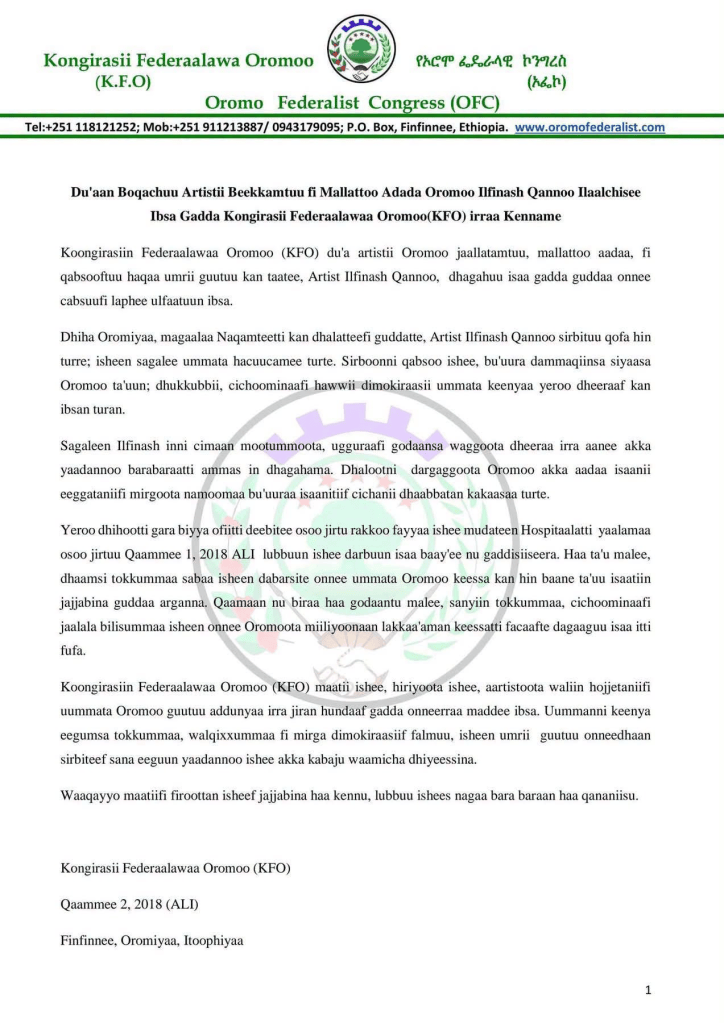
Oromo Federalist Congress (OFC) Mourns the Passing of Iconic Artist and Cultural Symbol Ilfinash Qannoo
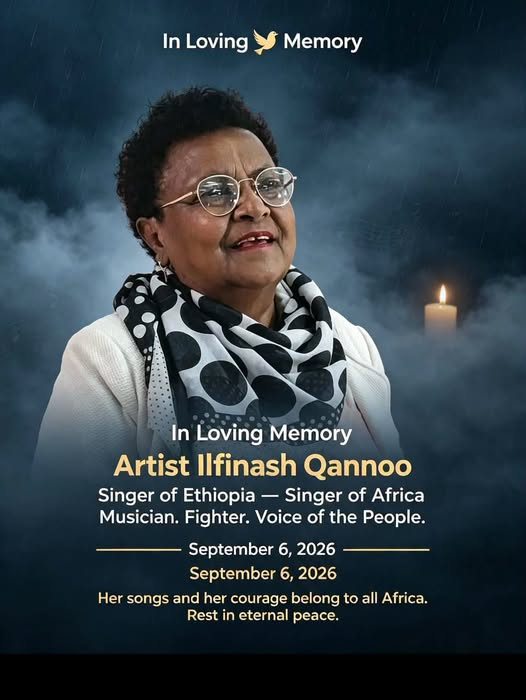
FEATURE CONDOLENCE NEWS
Oromo Federalist Congress (OFC) Mourns the Passing of Iconic Artist and Cultural Symbol Ilfinash Qannoo
A Nation in Mourning: The Voice of a Generation Falls Silent
Finfinnee, Oromia – Qaammee 2, 2018 (E.C.)
The Oromo Federalist Congress (OFC/KFO) has announced with profound sorrow, heartbreak, and overwhelming grief the passing of beloved Oromo artist, cultural icon, and lifelong justice advocate – Artist Ilfinash Qannoo.
Her departure marks the end of an era in Oromo music, culture, and political consciousness. She was not merely an entertainer; she was the musical embodiment of a people’s struggle – a woman whose voice became the anthem of the oppressed and whose lyrics carried the weight of a nation’s dreams.
From Naqamtee to National Icon: The Journey of a Heroine
Born and raised in the historic city of Naqamtee, Western Oromia, Ilfinash Qannoo emerged from humble beginnings to become one of the most recognizable and beloved figures in Oromo cultural history. Her early life in the heart of Oromia shaped her deep connection to her people, their traditions, and their aspirations.
But Ilfinash was never content to be merely a performer. She understood from a young age that art could be a weapon – a tool for awakening consciousness, exposing injustice, and mobilizing the masses. Her songs transcended entertainment; they became historical documents that chronicled decades of political repression, marginalization, and the enduring hope for democracy in Oromia.
The Power of Her Voice: Lyrics That Shook Empires
Throughout her illustrious career, Ilfinash Qannoo’s powerful voice challenged regimes, dictators, and prolonged systems of oppression. Her protest songs became the foundation of Oromo political awakening – each melody carrying the pain of a people, each lyric demanding accountability from those in power.
Her music captured:
- The suffering of generations under oppressive rule
- The resilience of the Oromo people in the face of adversity
- The dream of a democratic and just society
- The call for unity, equality, and fundamental human rights
Though she faced imprisonment, torture, and exile for her convictions, her voice never wavered. Even today, her songs echo across Oromia and the global Oromo diaspora – a testament to a legacy that death cannot silence.
The Final Chapter: Returning Home
In her final days, Ilfinash Qannoo had returned to her beloved homeland – a poignant homecoming that filled her with joy despite her failing health. She was receiving medical treatment at a hospital when, on Qaammee 1, 2018 (E.C.), she succumbed to illness and departed from this world.
Her passing has left an unfillable void in the hearts of millions. The Oromo nation has lost not only a cultural treasure but a moral compass – a woman who dedicated her entire life to the pursuit of justice, unity, and freedom for her people.
A Message of Unity That Endures
Yet, even in death, Ilfinash Qannoo continues to inspire. The message of national unity that she carried throughout her life remains etched in the hearts of the Oromo people. Her final gift to the nation was not sadness but strength – the knowledge that while her physical form may depart, the seeds of unity, resilience, and love for freedom she planted in the hearts of millions will continue to grow and flourish.
As the Oromo Federalist Congress (OFC) observed in its official statement:
“Qaamaan nu biraa haa godaantu malee, sanyiin tokkummaa, cichoomina fi jaalala bilisummaa isheen onnee Oromoota miiliyoonaan lakkaa’aman keessatti facaafte dagaaguu isaa itti fufa.”
(“Though her physical body may depart, the seeds of unity, resilience, and love for freedom that she scattered in the hearts of millions of Oromos will continue to grow.”)
OFC’s Official Condolence and Call to Action
The Oromo Federalist Congress (OFC) extends its deepest and most heartfelt condolences to:
- The family and relatives of Ilfinash Qannoo
- Her friends and close associates
- Her fellow artists and collaborators
- The entire Oromo community across Ethiopia and the global diaspora
In its statement, the OFC has issued a powerful call to the Oromo people: to honor Ilfinash Qannoo’s memory by upholding the very principles she championed throughout her lifetime – principles that include:
| Principle | Meaning in Action |
|---|---|
| Unity | Standing together as one nation, transcending divisions |
| Equality | Demanding justice and equal rights for all |
| Democracy | Continuing the struggle for fundamental freedoms |
| Cultural Pride | Preserving and celebrating Oromo identity and heritage |
The OFC emphasized that the greatest tribute the Oromo people can pay to this fallen heroine is to continue the struggle she so passionately sang about – ensuring that her sacrifice and the sacrifices of countless others are not in vain.
A Final Prayer
The Oromo Federalist Congress concludes its statement with a solemn prayer and tribute:
“Waaqayyo maatiifi firoottan isheef jajjabina haa kennu, lubbuu ishees nagaa bara baraan haa qananiisu.”
(“May the Almighty grant her family and loved ones strength, and may her soul rest in eternal peace.”)
Legacy That Transcends Death
Ilfinash Qannoo’s legacy is secure. She will be remembered not only as a gifted artist but as a courageous freedom fighter, a proud symbol of Oromo identity, and a voice that refused to be silenced. Her songs will continue to inspire future generations of Oromo youth to:
- Preserve their culture
- Stand firm in their identity
- Fight courageously for their rights
- Dream boldly of a free and just Oromia
About the Oromo Federalist Congress (OFC/KFO)
The Oromo Federalist Congress (Koongirasiin Federaalawaa Oromoo – KFO) is a political organization committed to advancing the rights, unity, and self-determination of the Oromo people within a federal democratic framework. The OFC mourns the loss of Ilfinash Qannoo as a profound tragedy for the entire Oromo nation and all who cherish justice and freedom.
Issued by:
Oromo Federalist Congress (OFC/KFO)
Qaammee 2, 2018 (E.C.)
Finfinnee, Oromia, Ethiopia
In Memoriam
| Name: | Artist Ilfinash Qannoo |
| Birthplace: | Naqamtee, Western Oromia |
| Legacy: | Cultural Icon, Freedom Fighter, Voice of the Oppressed |
| Contribution: | Over 10 albums, decades of resistance music |
| Cause: | Justice, Unity, Democracy, Oromo Liberation |
| Resting: | In the hearts of millions |
“Sirboonni ishee hin duune. Sagaleen ishee hin dadhabne. Hafuura ishee waliin Oromoo hunda wajjin deema.”
“Her songs shall not die. Her voice shall not fade. Her spirit walks with every Oromo.”
#IlfinashQannoo #OFC #KFO #OromoUnity #CulturalHero #JusticeForOromia #LegacyLives #RestInPower

On the Passing of Artist Ilfinash Qannoo – Beloved Cultural Icon and Symbol of Oromo Resistance

The official press release from the Oromo Federalist Congress (OFC/KFO) regarding the passing of Artist Ilfinash Qannoo:
OFFICIAL FEATURE STATEMENT
On the Passing of Artist Ilfinash Qannoo – Beloved Cultural Icon and Symbol of Oromo Resistance
Issued by the Oromo Federalist Congress (OFC/KFO)
Qaammee 2, 2018 (E.C.) | Finfinnee, Oromia, Ethiopia
A Profound Loss to the Oromo Nation
The Oromo Federalist Congress (OFC/KFO) received with deep sorrow, profound heartbreak, and heavy grief the news of the passing of the beloved Oromo artist, cultural emblem, and lifelong advocate for justice – Artist Ilfinash Qannoo.
Born and raised in Naqamtee, Western Oromia, Ilfinash Qannoo was never merely a performer. She was the voice of a silenced people. Her protest songs became the very foundation of Oromo political awakening – lyrics that for decades spoke unflinchingly of oppression, marginalization, and the long-cherished dream of democracy for our people.
A Voice That Would Not Be Silenced
The powerful voice of Ilfinash – which for years had challenged regimes, dictators, and prolonged systems of subjugation – still echoes as an eternal memory. She inspired generations of Oromo youth to preserve their culture, stand firm in their identity, and fight courageously for their fundamental human rights.
Her music was not entertainment; it was resistance set to melody. Her stage was not a platform; it was a pulpit for truth. Her audience was not merely fans; they were a movement in the making.
Her Final Days and Peaceful Departure
In her final days, she had recently returned to her homeland. While undergoing medical treatment at a hospital, she was overtaken by illness, and on Qaammee 1, 2018 (E.C.), she passed from this life – a departure that has left an unfillable void in the heart of the Oromo nation.
Yet, even in this loss, we draw immense strength from the message of unity she left behind – a message that will never fade from the hearts of the Oromo people. Though her physical form may depart, the seeds of unity, resilience, and love for freedom that she planted in the hearts of millions of Oromos will continue to grow and flourish across generations.
A Call to Honor Her Legacy
The Oromo Federalist Congress (OFC/KFO) extends its deepest condolences to her family, her friends, her fellow artists, and the entire Oromo community across the globe.
We call upon our people to honor her memory by upholding the very principles she sang for throughout her lifetime:
- Unity – standing together as one nation.
- Equality – demanding justice for all.
- Democracy – continuing the struggle for fundamental rights.
Let her music remain our anthem. Let her courage be our compass. Let her sacrifice fuel our determination.
Final Prayer and Tribute
We pray to the Almighty to grant her family and loved ones strength and patience during this time of immense loss, and to bestow upon her soul eternal peace and rest.
Her name shall not be forgotten. Her songs shall not fade. Her spirit shall walk with every Oromo who dares to dream of a free and just tomorrow.
Rest in Power, Ilfinash Qannoo.
Your voice was our weapon. Your legacy is our foundation.
Issued by:
Oromo Federalist Congress (OFC/KFO)
Finfinnee, Oromia, Ethiopia
Qaammee 2, 2018 (E.C.)
#IlfinashQannoo #OromoUnity #CulturalHero #JusticeForOromia #LegacyLives