Category Archives: gender

On the Departure of Beloved Artist and Freedom Fighter Ilfinash Qannoo

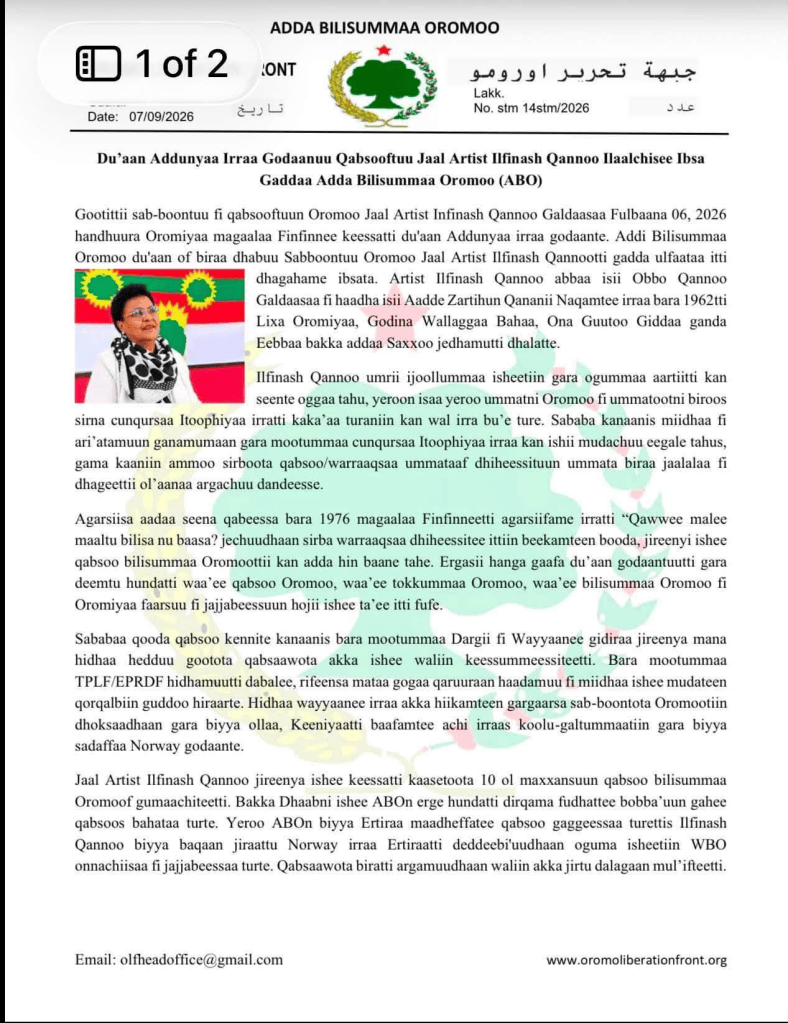
The official press release from the Oromo Liberation Front (OLF/ABO) regarding the passing of beloved artist and freedom fighter Ilfinash Qannoo:
OFFICIAL FEATURE STATEMENT
On the Departure of Beloved Artist and Freedom Fighter Ilfinash Qannoo
Issued by the Oromo Liberation Front (OLF/ABO)
Fulbaana 07, 2026 | Finfinnee, Oromia
A Great Heroine Has Fallen
The Oromo Liberation Front (OLF/ABO) announces with profound grief and a heavy heart the passing of the great Oromo heroine, patriot, and freedom fighter – Beloved Artist Ilfinash Qannoo – who departed from this world on Fulbaana 06, 2026, in the heart of Oromia, at Finfinnee.
Her loss is not merely the loss of an artist. It is the silencing of a voice that sang freedom for over six decades. It is the emptying of a heart that burned with love for Oromia. It is the falling of a flag that inspired millions to rise against oppression.
Roots of a Revolutionary
Artist Ilfinash Qannoo was born in 1962 to her father, Obbo Qannoo Galdaasaa, and her mother, Aadde Zartihun Qananii, in the town of Saxxoo, located in Eebbaa district, East Wallagga Zone, Western Oromia – a region that would later become the cradle of many liberation struggles.
From her childhood, she was drawn to the arts. But her coming of age coincided with a period of intense political awakening across Ethiopia – a time when the Oromo people and other nations rose against the oppressive system. It was this environment that shaped her destiny and transformed her from a simple performer into a voice of the voiceless.
The Song That Shook the Throne
Her path to fame – and to persecution – began in 1976 at a historic cultural performance in Finfinnee. There, she posed the revolutionary question that would become an anthem of resistance:
“Qawwee malee maaltu bilisa nu baasa?”
(“Without the gun, what will set us free?”)
From that moment onward, her life became inseparable from the struggle for Oromo liberation. She dedicated every song, every performance, and every breath to:
- Glorifying the Oromo struggle
- Preaching Oromo unity
- Dreaming of Oromo freedom
- Empowering the Oromo people
Her stage became a battlefield. Her microphone became a weapon. Her lyrics became a declaration of war against injustice.
The Price of Resistance
For her unwavering commitment to the Oromo cause, she paid a heavy price. Under both the Derg regime and the later Woyanne (TPLF/EPRDF) government, she endured long years of imprisonment alongside countless other freedom fighters.
Her suffering did not end there. During her incarceration under the Woyanne regime, she was subjected to brutal torture – including having her scalp forcibly shaved with broken glass – resulting in deep and lasting physical and psychological wounds.
Upon her release, with the help of Oromo patriots, she was secretly taken to neighboring Kenya, and later granted asylum in Norway, where she continued her work from exile.
A Lifetime of Contribution
Throughout her life, Artist Ilfinash Qannoo produced over 10 albums, each one a powerful contribution to the Oromo liberation movement. Wherever the OLF/ABO had a presence, she was there – answering the call, lending her voice, and rallying the people.
Even during the period when the OLF was hosted in Eritrea and waging its armed struggle, Ilfinash – though living in exile in Norway – traveled repeatedly to Eritrea to inspire and strengthen the fighters. Her presence among the combatants was proof of her unwavering dedication; she did not simply sing about the struggle – she lived it.
Her Final Days – Fire That Would Not Die
Her love for Oromia and her commitment to the cause never wavered. Her heart and spirit remained as strong as steel, untouched by compromise or despair. But the years of imprisonment, torture, and exile had taken a toll on her health. The physical and emotional wounds inflicted upon her in Ethiopian dungeons finally caught up with her.
In her final moments, even as her body weakened, her spirit burned bright. Her last words were not of regret, but of love:
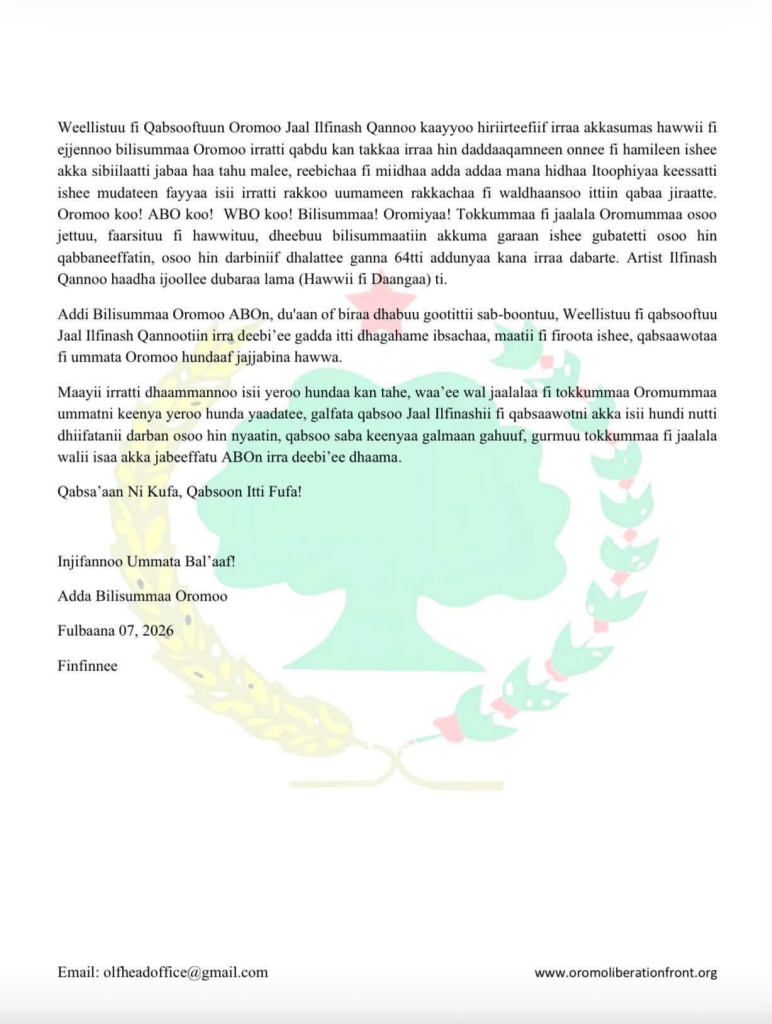
“Oromoo koo! ABO koo! WBO koo! Bilisummaa! Oromiyaa! Tokkummaa fi jaalala Oromummaa…”
(“My Oromo! My OLF! My Oromo Liberation Army! Freedom! Oromia! Unity and love of Oromummaa…”)
She passed at the age of 64, still singing, still hoping, still burning for freedom – until her very last breath.
Artist Ilfinash Qannoo leaves behind her two beloved daughters, Hawwii and Daangaa.
A Call to Honor Her Sacrifice
The Oromo Liberation Front (OLF/ABO) extends its deepest condolences to her family, her relatives, her fellow freedom fighters, and the entire Oromo nation.
We call upon our people to remember her message of unity and love – which was her eternal legacy. We urge all Oromos to carry forward the torch she lit, and to not let the sacrifice of Ilfinash and countless other heroes be in vain.
Let us strengthen our unity. Let us reinforce our love for one another. Let us complete the struggle they began – so that Oromia may be free.
Final Salute
Her memory will forever be etched in our hearts. Her songs will forever echo in our struggles. Her spirit will forever march beside us.
Rest in power, Beloved Ilfinash Qannoo.
You did not die – you were promoted to immortality.
“Qabsa’aan ni kufa, qabsoon itti fufa!”
(“The fighter may fall, but the struggle continues!”)
Glory to the Broad Victory of the People!
Issued by:
Oromo Liberation Front (OLF/ABO)
Fulbaana 07, 2026
Finfinnee, Oromia
#IlfinashQannoo #OLF #ABO #Oromia #Bilisummaa #HeroineNeverDies #StruggleContinues

The Voice That Refused to Be Silenced: Minnesota Oromo Community Mourns Iconic Artist Ilfinash Qannoo

A tribute to a pioneering artist whose music and courage shaped Oromo identity across generations and continents
MINNEAPOLIS, Minnesota – September 6, 2026
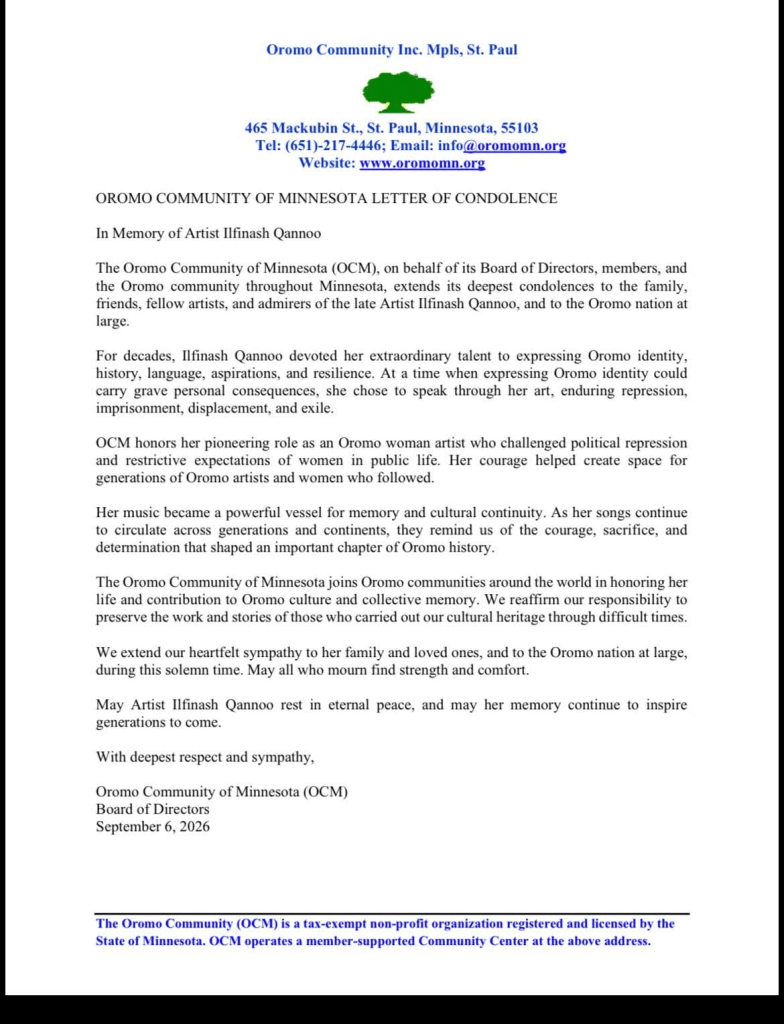
The Oromo Community of Minnesota (OCM), one of the largest Oromo diaspora organizations in the United States, has issued a formal letter of condolence honoring the life and legacy of Artist Ilfinash Qannoo, whose passing marks the end of an era for Oromo arts and cultural expression.
In a statement released today, the organization paid tribute to an artist who, for decades, transformed personal sacrifice into an enduring cultural treasure, becoming a symbol of resistance, resilience, and identity for Oromo people worldwide.
A Life Dedicated to Cultural Preservation
Ilfinash Qannoo was more than a musician or performer. She was a cultural archivist, a linguistic guardian, and a fearless voice who understood that art could carry the weight of an entire people’s history. Through her extraordinary talent, she devoted her life to expressing Oromo identity, history, language, aspirations, and resilience—often at great personal cost.
The OCM statement emphasized that during decades when openly expressing Oromo identity could carry grave personal consequences, Ilfinash chose to speak through her art. She endured repression, imprisonment, displacement, and exile, yet her creative spirit remained unbroken. Her music and performances became acts of quiet defiance in the face of political oppression, preserving the Oromo language and traditions at a time when they were systematically marginalized.
A Pioneer for Oromo Women in Public Life
Perhaps one of her most significant legacies was her role as a trailblazer for Oromo women. At a time when restrictive expectations limited women’s participation in public life, Ilfinash challenged both political repression and social conventions.
The OCM honored her as a “pioneering role as an Oromo woman artist who challenged political repression and restrictive expectations of women in public life.” Her courage helped create space for generations of Oromo artists and women who followed, proving that creative expression and political consciousness could go hand in hand.
“Her courage helped create space for generations of Oromo artists and women who followed,” the OCM board wrote, acknowledging that her influence extended far beyond music into the very fabric of Oromo social and political life.
Music as Memory and Resistance
Ilfinash’s music became a powerful vessel for memory and cultural continuity. Her songs, which continue to circulate across generations and continents, have served as an informal archive of Oromo history, preserving stories, struggles, and triumphs that might otherwise have been lost.
The OCM statement noted that her music “reminds us of the courage, sacrifice, and determination that shaped an important chapter of Oromo history.” For Oromo communities scattered across the globe—from the Horn of Africa to the diaspora centers of North America, Europe, and Australia—her voice became a thread connecting them to their homeland and heritage.
A Global Mourning
The Minnesota Oromo community, which numbers in the thousands, joins Oromo communities around the world in mourning this profound loss. The OCM pledged to continue preserving her work and the stories of those “who carried our cultural heritage through difficult times.”
“We reaffirm our responsibility to preserve the work and stories of those who carried our cultural heritage through difficult times,” the statement reads, acknowledging that the preservation of Oromo culture rests on the shoulders of those who, like Ilfinash, sacrificed their safety and comfort for the sake of collective memory.
Calls for Celebration Amid Grief
The OCM’s formal letter follows a growing chorus within the Oromo diaspora and homeland alike, urging that Ilfinash’s life be celebrated as much as her death is mourned. Many have echoed sentiments expressed in recent weeks that her legacy is one of joy, defiance, and triumph—not merely sorrow.
“May Artist Ilfinash Qannoo rest in eternal peace, and may her memory continue to inspire generations to come,” the OCM concluded in their letter, striking a tone of solemn respect mixed with hope for the future.
A Legacy That Endures
Ilfinash Qannoo’s death represents a significant loss for the Oromo cultural landscape. Yet her life’s work ensures that her voice will continue to resonate through the generations she inspired and the communities she helped to empower.
As the Oromo diaspora reflects on her contributions, her songs will undoubtedly continue to play in homes, community gatherings, and cultural events—each note carrying the defiance, resilience, and pride of a people whose identity she devoted her life to preserving.
The Oromo Community of Minnesota’s full letter of condolence can be accessed through the organization’s official channels. The Oromo community across Minnesota and beyond extends its deepest sympathy to her family, friends, fellow artists, admirers, and the Oromo nation at large.
With deepest respect and sympathy,
Oromo Community of Minnesota (OCM)
Board of Directors
September 6, 2026
#IlfinashQannoo #OromoArt #CulturalResilience #OromoDiaspora #MinnesotaOromo #LegacyOfResistance

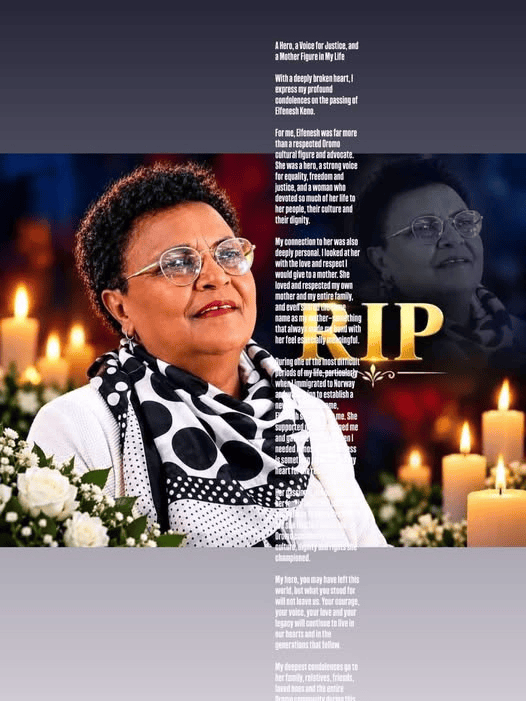
Eulogy: Ilfinesh Qannoo (1962-2026): A Voice That Has Nurtured Generations
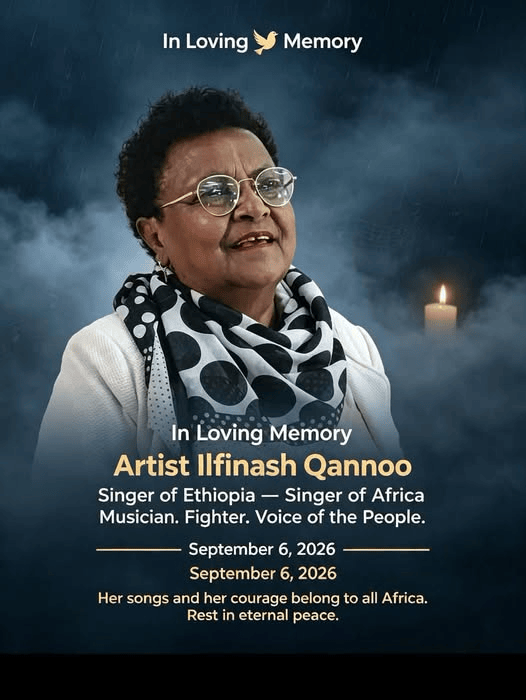
By Dhabessa Wakjira
We gather today with heavy hearts to mourn the passing of Ilfinash Qannoo, and yet, even in our grief, we find ourselves compelled to celebrate a life so extraordinary that mourning alone cannot contain it. Ilfinash Qannoo was not simply a singer. She was one of the most iconic, courageous, and influential Oromo women of her generation—a woman whose life was woven inseparably into the story of her people’s long struggle for dignity, identity, justice, and self-determination.
To speak of Ilfinash is to speak of commitment that never wavered, sacrifice that was never counted as loss, courage that never asked permission, and a devotion to the Oromo cause that outlasted every hardship placed before it. Hers was a life of artistic achievement, yes, but far more than that, it was a life offered, again and again, in service of something larger than herself.
The First Note of a Lifelong Song
From the moment she first stepped forward as a member of Wollega Kinet Guad, Ilfinash set out on a path from which she would never truly depart. That early beginning was not a stepping stone toward personal fame; it was the first note of a lifelong song dedicated to her people. From those early days until her final ones, her commitment to the Oromo cause never dimmed, never bent, and never went silent. Through her music, her voice, her courage, and the example of her own life, she awakened, inspired, and nurtured generation after generation of Oromo youth.
We must remember the times in which she sang. There were years when simply expressing Oromo identity, Oromo aspiration, Oromo pride required extraordinary courage—when a melody could be an act of defiance, and a lyric could carry the weight of a people’s unspoken longing. In those years, Ilfinash did not shrink from the risk. She took the gift she had been given—her voice—and turned it into an instrument of inspiration and resistance. She sang not because it was safe, but because it was necessary.
More Than an Artist
It would be a disservice to Ilfinash Qannoo’s memory to say only that she sang songs. She did something far greater: she gave voice to the hopes, the pain, the aspirations, the courage, and the unbending determination of an entire people. When her voice rose, it did not simply fill a room or a stage; it entered the hearts of Oromo youth across generations, and in doing so, it steadied them. It reminded them who they were. It gave them the strength to stand for their identity, their dignity, and their future, even when standing was costly.
In this way, she became something more than an artist. She became a symbol, a living demonstration that a single life, fully given, could serve a cause greater than itself. She poured out her talent, her energy, her courage, her voice, and ultimately her life for the Oromo people, one of the great nations of the Horn of Africa. In doing so, she showed us all that an artist can be far more than an entertainer. An artist can be a teacher. An artist can be an inspiration. An artist can become the guardian of a people’s collective struggle, and the voice through which a people’s aspirations are carried forward.
The Song That Echoes Through Generations
Among the many songs she gave to her people, one holds a place apart in the hearts of generations of Oromo people: “WBO Koo Maaloo Ree.” Its melody has traveled from parent to child, from one generation to the next, carrying memories of struggle, sacrifice, hope, and unshaken determination. It is no longer simply a song. It has become part of the emotional and historical memory of a people, woven into their story so deeply that it will continue to echo in the hearts of Oromo people yet to be born.
Unwavering Conviction
Perhaps the greatest lesson of Ilfinash Qannoo’s life was her firm and unwavering stand on the Oromo cause. She did not abandon her convictions when times grew difficult. She did not retreat when retreat would have been easier, safer, more comfortable. Her courage and her steadfastness stand today as an example for generations still to come, and they teach us something essential: that genuine commitment is not proven in moments of comfort, but in moments of difficulty and uncertainty. It is easy to declare loyalty when nothing is being asked of you. Ilfinash showed us what it means to hold to your convictions when everything is being asked of you.
A Bond Forged in Ambo
Ilfinash’s connection to Oromo youth was profound, and it was personal. She did not stand apart from them, observing from a distance; she stood among them, encouraged them, and shared directly in their hopes and in their struggles. Her time alongside Oromo youth in the forests and surrounding areas of Ambo forged a bond of deep mutual respect and affection, one that shaped the rest of her life. The love and the respect that the people of Ambo gave her in return were immense, and that relationship became one of the most meaningful of her entire life.
So deep was her attachment to Ambo and its people that she is remembered for a wish that reveals the depth of her heart: that if she should die, she wished to be laid to rest in Ambo, or, if that could not be, then even beneath the ice of Norway. These are not the words of someone who loved a place casually. They are the words of a woman whose experiences, whose memories, and whose sense of belonging were bound up entirely with the people who had walked beside her.
A Legacy That Will Never Die
Today, as we mourn Ilfinash Qannoo, we are also called to celebrate an extraordinary life fully lived. We mourn the loss of a great artist. But we remember, and will go on remembering, a woman whose legacy reaches far beyond music alone. We remember a courageous Oromo woman who used her voice when silence would have been easier. We remember a woman who remained committed when retreat was possible. We remember a woman who inspired generations, not only through the songs she sang, but through the example of the life she lived.
Her physical voice has now gone silent. But the voice she gave to her people—the voice of hope, of resistance, of identity, of belonging—will never disappear. Her songs will continue to be sung, in homes, at gatherings, in the quiet moments when a people needs reminding of who they are. Her courage will continue to inspire those who face their own difficult and uncertain times. Her commitment will continue to be remembered as a standard against which devotion to a cause is measured. And her name will remain written into the history and the collective memory of the Oromo people, for as long as that memory is kept.
—
Ilfinash Qannoo has departed from us. But her legacy remains.
She sang for her people. She stood with her people. She gave her voice to her people.
And her voice will live on with her people, from generation to generation.
Her voice will never die. Her legacy will never be forgotten.
Rest in peace, Ilfinash Qannoo.

Oromo Literacy Day: Celebrating the Power of Stories Held in Oromia
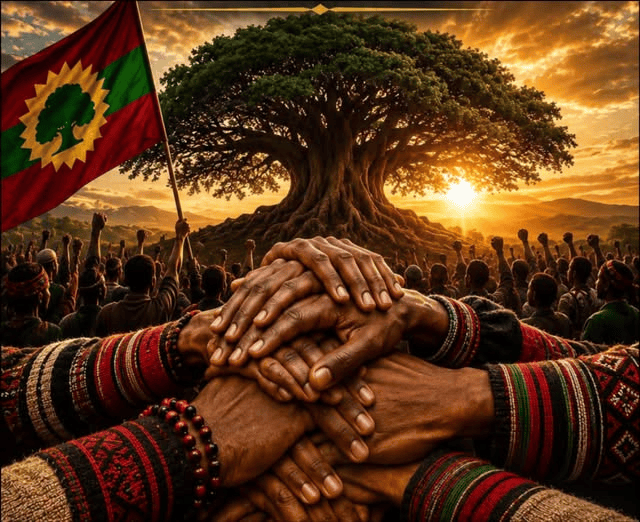
By Maatii Sabaa
—
Every year, Oromo Literacy Day is more than a date on a calendar—it’s a living tribute to the resilience of a people and their language. It celebrates Afaan Oromoo, a language that carries the weight of history, the songs of ancestors, and the dreams of a nation. But how did the Oromo people arrive at this moment, where their stories can finally be written, read, and shared with the world? The answer lies in a long and courageous journey toward literacy.
A Written History of Resistance and Revival
The story of Oromo literacy is one of relentless struggle. The Oromo people have long possessed a rich oral tradition, but for much of Ethiopia’s modern history, their language was marginalized. It was a household language—spoken, sung, and whispered—but rarely seen on paper . The first major push to change this came in the late 19th and early 20th centuries.
A pivotal figure was Onesimos Nasib, an Oromo freed from slavery who trained as a teacher in Sweden. Upon his return, he and his colleague Aster Ganno worked with an almost missionary zeal to promote literacy in Afaan Oromoo. Onesimos created the Oromo Reader, a book filled with stories that were “short and funny” and designed to be both accessible and engaging. His aim was not just religious instruction but to cultivate a love for reading itself . He would famously ask young people he met, “Can you read and write?” and persuade them of its immense value .
However, their work met fierce opposition from the imperial government. In the mid-1940s, the Haile Selassie regime placed a total ban on Oromo literature . The language was effectively erased from public life, becoming a symbol of defiance.
The Quest for the Perfect Script
The suppression only intensified the desire for a written Oromo. The question of how to write the language became a central point of debate. Early works, like those of Onesimos, used the Ge’ez alphabet. But many activists and intellectuals believed this script was inadequate for Oromo sounds, failing to represent vowel length and consonant gemination—features that change a word’s meaning .
In the 1960s, the movement for a new script gained momentum. At Addis Ababa University, Oromo students began printing the first newspaper in Afaan Oromoo, Kana Beektaa? (“Do you know this?”), in 1968. The paper was a bold act of cultural preservation, collecting “Oromo songs, proverbs, war and grievance chants, Oromo prophecies, nuptials, baby lullabies, and others” . This was more than journalism—it was a declaration of identity. The paper was short-lived, forced to cease publication in 1971 .
Simultaneously, Oromo students in Europe were rigorously debating the script question. In 1968, a study group led by figures like Haile Fidaa concluded that a modified Latin alphabet was the most practical and linguistically sound choice for Oromo . This decision was not just technical; it was a political act of resistance, rejecting a script associated with the establishment.
A New Dawn: The Adoption of Qubee
After years of struggle, the fall of the military Derg regime in 1991 brought a turning point. The new Ethiopian constitution granted greater autonomy to regional states. Oromo was finally made the official language of the Oromia Regional State .
The Latin-based alphabet, known as Qubee, was officially adopted for writing Oromo . This was a victory decades in the making. The script’s simplicity and adaptability to modern technology made it a practical choice for a language finally stepping into the digital age. As one study noted, Qubee “enabled the language to grow faster as the script can be learned easily” .
However, the adoption was not without controversy. For some, the Ethiopic script held deep cultural significance, and the switch to a Latin alphabet was seen as an emotional and political break . Yet for the majority, Qubee represented liberation.
The Stories That Endure
The adoption of Qubee unlocked a literary explosion. Oromo youth and intellectuals began producing “newspapers, magazines, novels, translations and plays that describe their nation and their state in Afaan Oromoo” . Stories once confined to memory were now printed, preserved, and shared.
The journey has also involved recovering alternative scripts. A fascinating chapter is the story of Sheek Bakrii Saphaloo, a scholar who created a unique indigenous Oromo script. He developed an abugida, a writing system where each base glyph has multiple vocalic components, making it distinct from both the Ge’ez and Latin alphabets . This script has been used for over 70 years and is now being considered for digital preservation and inclusion in Unicode, highlighting the deep connection between literacy and cultural identity .
Why Oromo Literacy Day Matters
Oromo Literacy Day is a celebration of this entire journey. It honors the tenacity of Onesimos Nasib, the courage of student activists, and the vision of scholars who fought to give their language a written form. It is a day to recognize that literacy is not just about reading and writing; it is about power, identity, and survival.
The stories held in Oromia are now written down for the world to see. This day celebrates their liberation and their enduring power.
—
“The stories, with the exception of a couple of martyr stories, are short and funny, and the subjects vary in order to attract.” — Onesimos Nasib on the Oromo Reader
—
 Maatii Sabaa is a writer and advocate of the Oromo stories.

The Name and the Narrative: Reclaiming Oromo Identity Beyond “Habesha”
In the complex tapestry of the Horn of Africa, few threads are as deeply woven—or as fiercely contested—as the question of identity. For centuries, labels have been applied, histories have been written, and narratives have been constructed, often by those in power. But what happens when a people rise to say, “That name is not ours”?
A powerful statement from within the Oromo community cuts to the very heart of this question: “Habashaan jecha eenyummaa Oromoo ibsuu miti. Oromoon Habashaa miti.” This translates to: “‘Habesha’ does not express Oromo identity. An Oromo is not Habesha.” This is not a simple rejection of a label; it is a profound declaration of a distinct historical narrative, a reclamation of selfhood, and a bold assertion of a people’s independent journey through time and across the land they call home.
The Power of a Name
The term “Habesha” has historically served as a broad, unifying identifier for the peoples of the Ethiopian highlands, often associated with the ancient Aksumite civilization, the Orthodox Christian faith, and Semitic languages. For many, it is a term of pride, symbolizing a shared, ancient heritage.
However, for the Oromo people—the largest ethnic group in Ethiopia—this label often feels foreign and exclusionary. The assertion “Oromoon Habashaa miti” directly challenges the notion that “Habesha” is an all-encompassing term for all Ethiopians. Instead, it argues that the term is culturally and historically specific to a particular group and that it has been inaccurately and unfairly imposed upon the Oromo nation.
This rejection is a vital act of self-affirmation. It is a declaration that Oromo identity, with its own ancient traditions, its own language (Afaan Oromo), and its own sophisticated governance system (the Gadaa system), is independent and deserving of recognition on its own terms. It is a way of saying, “We are not a footnote in someone else’s history; we have our own story to tell.”
A Shared Journey: Revisiting the Origins
The second part of the statement offers a specific historical perspective on this shared geography: “Habashaan jecha Yaman irraa warra Abyssinia ofiin jedhan waliin gara biyya Oromoo-Oromiyaatti dhufee dha.” (“Habesha came to the land of Oromo-Oromia from Yemen together with those who call themselves Abyssinian.”)
This presents a powerful and deliberate counternarrative to the dominant historical accounts of the region. By asserting that both the ancestors of the “Abyssinians” and the Oromo people migrated into the region from a shared origin, this perspective challenges the traditional narrative that often places one group as indigenous and the other as later arrivals.
This framing redefines the historical relationship between the two communities. It moves the Oromo from a position of being perceived as “others” or “newcomers” in their own homeland to being co-architects of the region’s history. It suggests a shared, albeit not necessarily harmonious, arrival and cohabitation, thereby establishing an equal and ancient claim to the land of Oromia. This is a crucial point, as it aims to dismantle historical hierarchies and assert that the Oromo are not intruders but are, in fact, foundational to the region’s story.
The Land of Oromia: More Than a Place
This assertion of identity is intrinsically tied to a specific territory: Oromia. This vast and diverse region, stretching from the highlands to the lowlands, is the historic and ancestral homeland of the Oromo people. By connecting the narrative of arrival directly to “the land of Oromo-Oromia,” the statement anchors Oromo identity in a tangible, sacred geography.
It is a powerful reminder that identity is not an abstract concept; it is rooted in the mountains, rivers, and plains where a people’s history was lived and written. For the Oromo, the struggle for identity is inseparable from the struggle for their cultural, political, and territorial rights within Oromia. Declaring that the “Habesha” came to their land, and not the other way around, is a profound reclamation of both history and territory.
A Continuing Dialogue
The statement provided is a potent contribution to an ongoing and essential conversation about identity, history, and power in the Horn of Africa. It challenges the monolithic narratives that have often dominated the national discourse and demands a more inclusive, accurate, and multi-vocal understanding of the past.
For the Oromo people, the declaration “Oromoon Habashaa miti” is not an act of division, but one of definition. It is a call to be seen, understood, and respected on their own terms. It opens a vital dialogue about how history is written, who gets to write it, and how we can build a future that honors the full and complex story of all the peoples in the region. The debate over identity is far from settled, but it is a debate that is crucial for any nation seeking to forge a just and inclusive future.

A Cry for Justice: The Unfolding Crisis in Oromia
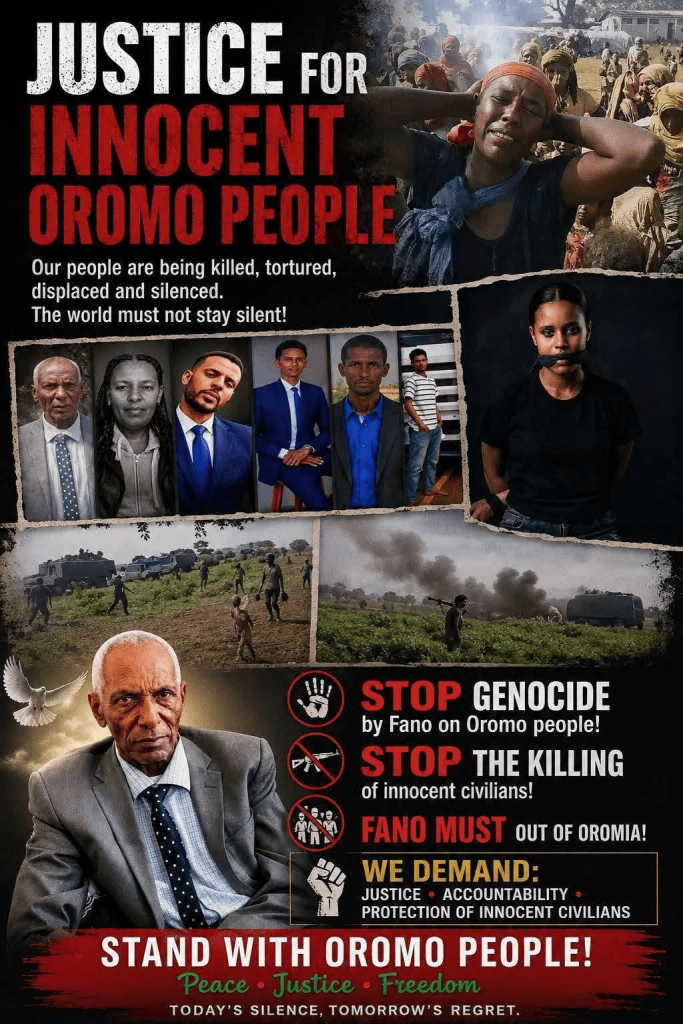
As violence escalates in Ethiopia’s most populous region, a growing chorus of voices is demanding accountability, protection, and peace for the Oromo people.
The plea is urgent and uncompromising: “Stop the killing of Oromo civilians! Stop violence against the Oromo people! Fano must leave Oromia!” These calls reflect a deep-seated crisis that has gripped the Oromia region, where civilians find themselves caught in the crossfire of multiple armed conflicts.
The Human Toll of Conflict
Recent reports paint a harrowing picture of the violence unfolding across Oromia. The Ethiopian Human Rights Commission (EHRC) has documented atrocities including killings, bodily injuries, abductions, displacement, and destruction of property in the Arsi Zone of Oromia . The violence is not isolated—it reflects a broader pattern of human rights abuses across multiple regions, including Amhara and Tigray .
In one particularly devastating incident, armed men killed more than 20 civilians in Oromia. Local civil servants reported that Fano militants attacked civilians “with swords and guns” in the Nono district, approximately 110 kilometers southwest of Addis Ababa, resulting in 25 deaths including women and children, with four more later dying in hospital . A regional security official confirmed that Fano militants had been active in the region for four years, “taking advantage of opportunist moments to launch attacks against civilians and loot property”.
The Humanitarian Crisis
The violence has created a severe humanitarian crisis. The United Nations reports that 3.2 million children are out of school due to the conflict . Hospitals and clinics have been attacked—in 2023, the International Committee of the Red Cross reported that “almost all” of 42 health posts in Oromia’s Beji area had been looted or destroyed . Aid organizations have struggled to distribute supplies, leading to severe malnutrition .
Civilians describe a terrifying reality. One woman from Oromia’s Shewa region told of her family facing constant harassment and extortion from armed groups, with her uncle detained until a 100,000 Ethiopian birr ransom was paid . A coffee farmer from Wollega has been unable to return home for three years due to the security situation, with his harvest stolen by armed fighters .
A Call for Justice and Peace
The demands for justice and protection are clear. As one civil servant noted, the situation “has worsened in recent years” . The Red Cross has warned that the current clashes have “devastating consequences” for civilians, particularly in remote areas, noting that “Oromia doesn’t make the headlines, yet civilians continue to be deeply affected by violence” .
The call for Fano to leave Oromia reflects the reality that multiple armed groups are active in the region, each contributing to the suffering of civilians. For the Oromo people, the demand is simple but profound: protection, justice, and accountability for those who have committed atrocities.
Without decisive action, the cycle of impunity and violence will continue to erode Ethiopia’s stability and legitimacy . The international community, regional bodies, and Ethiopian authorities face a critical choice: allow the violence to continue, or take meaningful steps to protect civilians and bring perpetrators to justice.

The Founding Edition Is Now Live: From Migrant to Movement Builder

Discover the Vision Behind Australia’s First Empowerment-Focused Pageant Movement
By Dhabessa Wakjira
The Founding Edition of The Multicultural Magazine™ is now live, and it features a story that is as inspiring as it is transformative. In a world where women are often searching for confidence, connection, and purpose, one woman’s journey from migrant to movement builder is lighting the way for countless others.
Lee Plowman, the founder of Miss Multicultural NT and creator of the C.R.O.W.N. Method™, is redefining what a pageant can be.
A Vision Born from Personal Experience
When women migrate to a new country, they often leave behind more than family and friends. Many experience a profound loss of identity, confidence, and certainty about who they are becoming. Lee Plowman understands that journey personally. After migrating from the Philippines to Australia, she faced the challenges of rebuilding her identity in a new land.
Through years of advocacy and community leadership, including her work with the Australian Red Cross Connected Women program, Lee met countless women who shared similar struggles. She recognised a critical gap: many women were not lacking potential; they were lacking a pathway.
That insight became the foundation of Miss Multicultural Australia™ —a movement designed to help women reconnect with who they are while providing clarity, structure, and direction for who they are becoming.
The C.R.O.W.N. Method™: A Framework for Empowerment
At the heart of the movement is the proprietary C.R.O.W.N. Method™, a structured empowerment framework developed by Lee Plowman. The method guides women through a journey of self-awareness, confidence-building, leadership development, and purposeful action.
Every workshop, training session, and community activity within the movement is intentionally curated to create impact from the inside out. As Lee explains: “Miss Multicultural Australia™ was never created to be just another pageant. It was created as a movement for empowerment. We believe women deserve more than a title. They deserve opportunities to develop confidence, leadership skills, cultural pride, and the belief that their voice matters.”
Building Social Cohesion Through Pageantry
Australia is one of the most culturally diverse nations on earth, yet migrants often report feeling invisible or stereotyped. Lee Plowman is turning that legacy on its head. Her pageant actively encourages women to showcase their cultural heritage through traditional dress, food, music, and storytelling, educating audiences and building bridges between communities.
Community engagement is a core requirement for participants. Each woman undertakes a community service project that addresses a need in her local area—from multicultural food drives to mentoring programs for newly arrived refugee women. By pairing personal development with community action, the pageant creates a ripple effect that extends far beyond the individual contestant.
Lee Plowman has also been recognised by the Women Economic Forum Australia as an Empowerment Coach, and her work aligns with the forum’s mission to empower women economically and socially, particularly those from marginalised backgrounds.
A National Vision with Local Roots
Although still in its early stages, the momentum is building. Lee Plowman plans to expand the pageant to other states and territories, creating a network of regional pageants that feed into a national event. Each regional pageant will be tailored to the specific cultural demographics and community needs of that area.
The first Miss Multicultural NT 2025 titleholder, Sarah Madinah, an Indonesian-Australian woman, represents the beginning of this vision in action. Her crowning marked the start of a movement dedicated to empowering women from all cultural backgrounds to embrace their identity, strengthen their confidence, and become active contributors within their communities.
How You Can Be Part of the Movement
For women who feel the pull to step into their own power, Miss Multicultural Australia offers a structured, supportive pathway. There are no height or weight requirements, and the age limit for this empowerment pageant is 18 to 45 years old. The program is designed for Australian residents who identify with a multicultural background and are committed to personal development and community impact.
Applications for Miss Multicultural NT 2026 are now open, with another opportunity in early 2027.
Because Every Story Deserves to Be Seen
The Multicultural Magazine™ celebrates culture, confidence, community, leadership, and impact through stories that inspire. The Founding Edition is now available to read at www.multiculturalmagazine.com/founders-edition-2026.
✨ Applications are also open for future features—for Women of Influence, Community Leaders, Cultural Ambassadors, Business Founders, Titleholders, and Changemakers.
📩 Interested in being featured? We’d love to hear your story. Because every story deserves to be seen.
Read the full feature now:
👉 www.multiculturalmagazine.com/founders-edition-2026
This feature article is part of The Multicultural Magazine’s coverage of inspiring stories that strengthen belonging, connection, and social cohesion.

Arsi University Updates Logo, Puts Afaan Oromo First
A Historic Step for Linguistic Recognition in Higher Education
By Daandii Ragabaa
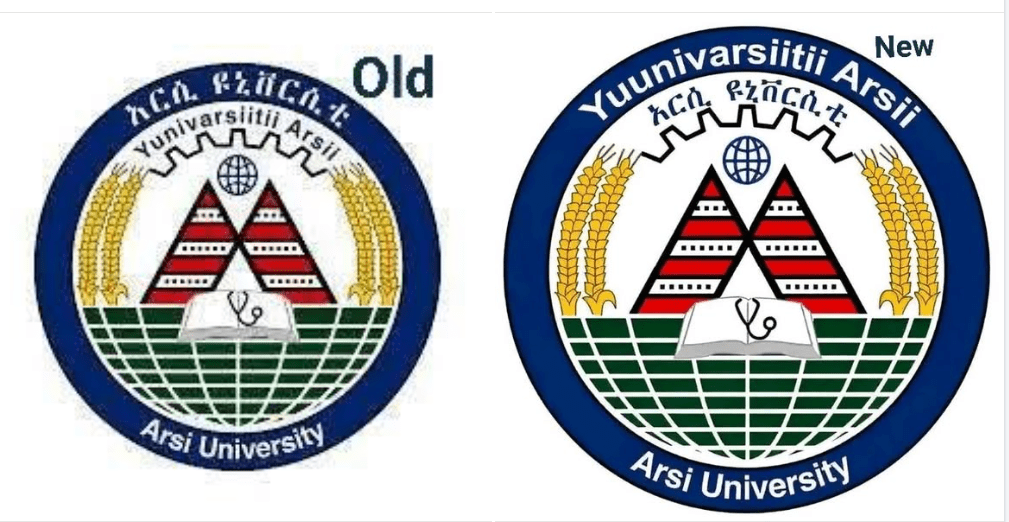
In a significant move for linguistic inclusivity and cultural recognition, Arsi University has announced an update to its institutional logo, placing Afaan Oromo first in the order of languages displayed on the emblem. The announcement, made on 23 August, marks an important milestone in the recognition of the Oromo language within Ethiopia’s higher education system.
The New Design
The university has made what it describes as “slight modifications” to its former logo, with the revised design featuring a new language order: Afaan Oromo first, Amharic second, and English third.
The university has also corrected the Afaan Oromo inscription from “Yunivarsitii Arsii” to “Yuunivarsitii Arsii,” ensuring linguistic accuracy in the representation of the language .
The announcement instructed all stakeholders to “recognize and use the new logo in accordance with the captions order stated above.”
A Growing Movement for Afaan Oromo Recognition
The decision by Arsi University aligns with a broader movement within Oromia to promote and preserve the Afaan Oromo language in academic and public life. The University has previously demonstrated its commitment to Afaan Oromo through collaborative initiatives, including a Memorandum of Understanding with Wachemo University aimed at preserving and digitising the rich cultural heritage of the Afaan Oromo language .
This latest move represents a tangible step toward normalising the use of Afaan Oromo in official and institutional contexts, affirming the language’s status as a medium of higher education and institutional identity.
The Role of Language in Cultural Identity
For the Oromo people, Afaan Oromo is more than a means of communication—it is a vessel of history, culture, and identity. The prioritisation of Afaan Oromo on an institutional logo is a symbolic but powerful recognition of the Oromo people’s right to see their language reflected in spaces of knowledge and governance.
The decision also carries practical implications for students and staff who use Afaan Oromo as their primary language. It signals that their linguistic identity is valued and respected within the institution. This is particularly significant given the historical marginalisation of Afaan Oromo in education and public life.
The efforts to preserve and digitise Afaan Oromo language resources, including through university partnerships, have helped strengthen its role in academic and public life .
The University’s Visual Identity
The updated emblem retains the university’s core visual elements, including the agricultural sheaves, gears, triangular structure, globe and open book. These elements symbolise the university’s commitment to education, innovation, and community development, while the new language placement underscores its commitment to linguistic inclusivity.
Located in Assela, the capital of the Arsi Zone in the Oromia Regional State, Arsi University serves students from across the region. The university also operates extended campuses in different parts of the zone, further expanding its reach and impact.
A Broader Conversation
The update follows the growing importance of Afaan Oromo in academic and official contexts . Research has highlighted the significance of mother-tongue instruction in educational settings, noting that students benefit from learning in their first language. The perception of mother-tongue use in educational contexts has been shown to positively influence learning outcomes .
Arsi University’s logo update joins a broader conversation about language recognition in Ethiopia, where the federal constitution recognises the equality of all languages but where Amharic has historically dominated official and educational contexts. Other institutions and public bodies may follow suit, reflecting the changing linguistic landscape of the country. While the logo change is primarily symbolic, it represents a tangible step towards normalising the use of Afaan Oromo in institutional settings.
Conclusion
Arsi University’s decision to place Afaan Oromo first on its logo is a significant step for the recognition of the Oromo language. It affirms the identity of Oromo students and staff, sets a precedent for other institutions, and demonstrates the ongoing vitality of Afaan Oromo in higher education.

Slaughter in the Shadows: The Unfolding Horror in East Wollega
As the world looks elsewhere, Ethiopian civilians are being burned alive, and a desperate plea for help rises from the ashes.
In the quiet villages of Ethiopia’s Oromia region, a summer of horror is drawing to a close. While global attention remains fixed on other crises, the International Oromo Women’s Organization (IOWO) has released a desperate appeal documenting an escalating campaign of violence that has turned the East Wollega Zone into a graveyard of professional promise and a testament to human cruelty .
The reports paint a picture of systematic terror allegedly perpetrated by Amhara Fano armed groups. Beginning in July and intensifying throughout August 2026, the violence has centered on the Gida Ayana Woreda—including the communities of Andode Dichoo, Angar Gute, and Tullu Lenca—as well as Kiramu and Horro Guduru. The testimonies describe not merely a conflict, but a targeted attempt to dismantle the very fabric of civilian life.
A Targeting of Hope
What distinguishes these atrocities is the chilling precision of the attacks. Among the dead are not just anonymous civilians, but the very pillars of the community. On August 19, the violence claimed Mr. Lamessa Mangistu, the branch manager of Awash Bank in Gida Ayana, and Mr. Mamush Maru, a banker at the Oromia Cooperative Bank. Their crime? Providing essential financial services to their community .
In Angar Gute, armed men reportedly burned Sister Liktu Amanu, a midwifery and nursing professional, while she was carrying out emergency duties. Just days earlier, 65-year-old Amanu Hirpha Bidu was reportedly burned alive inside an active ambulance during a patient transfer—a blatant violation of the fundamental protections afforded to medical transport under international humanitarian law . The attack on Mr. Olika Sagni, a local teacher, represents another devastating blow, stripping the community of its educators and the promise of future generations.
“We as mothers and sisters, cannot stand the endless brutal actions against civilian human beings,” writes Dinknesh D. Kitila, IOWO’s Board Director, in the appeal . Their plea is directed at the UN Security Council, the Human Rights Council, the U.S. Secretary of State, the EU, and governments worldwide: act before more innocent lives are extinguished.
Scorched Earth and Silence
The destruction is not limited to lives. The IOWO report details widespread arson targeting public offices, private homes, and transport vehicles, displacing families and paralyzing local economies. The group has released harrowing images of vehicles and property consumed by flames, emphasizing that the campaign is as much about erasing community infrastructure as it is about inflicting casualties. The targeted destruction of the Angar Gute area, including a special attack on Tullu Lenca, points to an attempt to force a demographic change or to punish communities for their identity .
This violence is part of a broader pattern of instability in Ethiopia. Travel advisories from various embassies currently designate East Wollega as a “red” or “extremely high-risk” area, warning citizens to avoid the region due to the presence of armed groups and the risk of attacks on civilians . The international community, while aware, has often been slow to act as the crisis deepens.
The World’s Response
The IOWO appeal calls for two immediate actions: emergency civilian protection for vulnerable populations in the affected woredas, and accountability for the perpetrators of these unlawful killings.
As the appeal letter was signed on August 24, the silence from the international community remains deafening. The documented cases of targeted killings of professionals, the use of ambulances as instruments of death, and the burning of entire communities demand more than a passing glance.
The mothers and sisters of East Wollega are not asking for charity; they are demanding the basic right to live. The charred remains of a midwife’s ambulance and the empty desks of murdered teachers are a stain on the conscience of humanity, a stark reminder that the cost of inaction is always counted in lives.

The World Looks Away: Western Oromia’s Cry for Justice

As violence escalates in Western Oromia, a leading advocacy group warns that silence is complicity and calls for urgent international intervention.
—
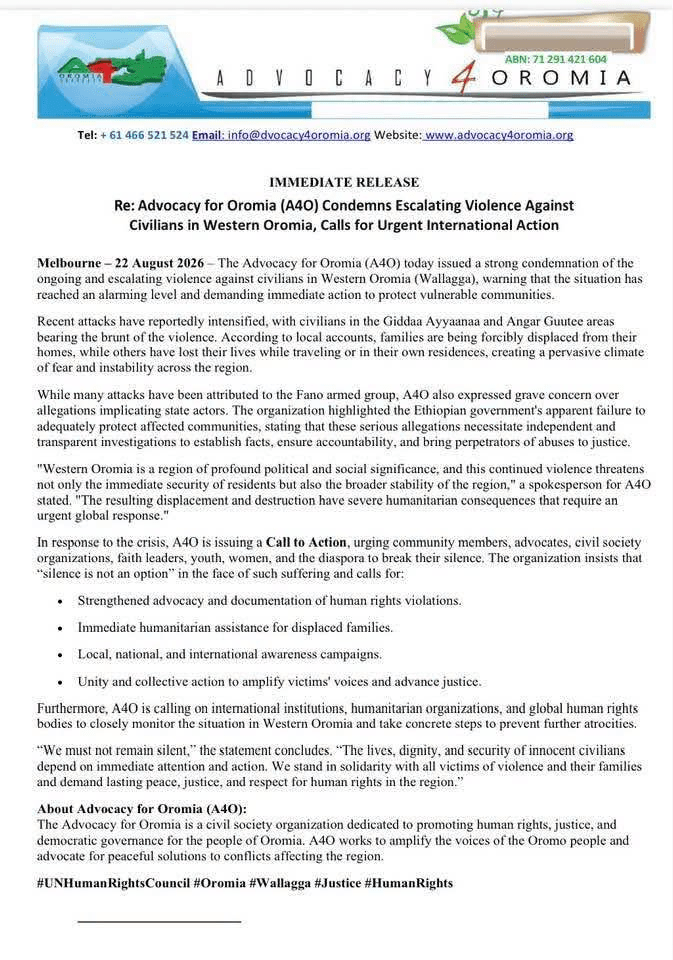
Melbourne – August 22, 2026 – The Advocacy for Oromia (A4O) has issued a stark warning that the escalating violence against civilians in Western Oromia (Wallagga) has reached an alarming level, demanding immediate action to protect vulnerable communities. In a powerful statement released today, the organization condemned the intensifying attacks that have reportedly displaced families, claimed lives, and created a pervasive climate of fear across the region.
The violence, concentrated in the Giddaa Ayyaanaa and Angar Guutee areas, has targeted civilians in their homes and while traveling, according to local accounts. Families are being forcibly displaced, their lives upended by a campaign of terror that shows no sign of abating.
A Crisis of Complicity
While many attacks have been attributed to the Fano armed group, A4O has expressed grave concern over allegations implicating state actors. The organization has accused the Ethiopian government of failing to adequately protect affected communities, a failure that demands independent and transparent investigations.
“Western Oromia is a region of profound political and social significance, and this continued violence threatens not only the immediate security of residents but also the broader stability of the region,” an A4O spokesperson stated. “The resulting displacement and destruction have severe humanitarian consequences that require an urgent global response.”
The government’s apparent inaction raises difficult questions about accountability and the protection of civilians. A4O insists that these serious allegations necessitate thorough investigations to establish facts, ensure accountability, and bring perpetrators of abuses to justice.
A Call to Break the Silence
In response to the unfolding crisis, A4O has issued a Call to Action, urging community members, advocates, civil society organizations, faith leaders, youth, women, and the diaspora to break their silence. The organization insists that “silence is not an option” in the face of such suffering.
The call outlines several key priorities:
· Strengthened advocacy and documentation of human rights violations to ensure that the world bears witness to the atrocities.
· Immediate humanitarian assistance for displaced families, whose basic needs remain unmet.
· Local, national, and international awareness campaigns to shine a spotlight on the crisis.
· Unity and collective action to amplify victims’ voices and advance justice.
A4O is also calling on international institutions, humanitarian organizations, and global human rights bodies to closely monitor the situation in Western Oromia and take concrete steps to prevent further atrocities.
The Cost of Inaction
The human toll of the violence is immeasurable. Families torn apart, communities shattered, and lives cut short—all while the international community remains largely silent. The displacement and destruction have severe humanitarian consequences, yet the global response has been insufficient.
A4O’s statement is a desperate plea to the world: “We must not remain silent. The lives, dignity, and security of innocent civilians depend on immediate attention and action. We stand in solidarity with all victims of violence and their families and demand lasting peace, justice, and respect for human rights in the region.”
A Call to Remember
As the violence continues to escalate, the world faces a choice: to act or to look away. A4O’s message is clear—silence is complicity, and inaction is a choice to abandon innocent lives.
The organization’s commitment to amplifying the voices of the Oromo people and advocating for peaceful solutions is a reminder that even in the darkest times, hope persists. But hope alone is not enough. It requires action, solidarity, and a collective demand for justice.
The people of Western Oromia are not merely statistics; they are mothers, fathers, children, and communities whose lives hang in the balance. Their cries for help must not go unanswered.
—
For more information, contact Advocacy for Oromia (A4O), a civil society organization dedicated to promoting human rights, justice, and democratic governance for the people of Oromia.
#UNHumanRightsCouncil#Oromia#Wallagga#Justice#HumanRights