Daily Archives: July 19, 2026

The Wonders of Creation: A Reflection on the Divine Order and Human Understanding

Exploring the mysteries of the universe and the pursuit of wisdom through the story of Daaniyaa.
There are moments in life when we are called to pause—to step back from the noise of our daily existence and contemplate the grandeur of creation. These moments of reflection are not merely intellectual exercises; they are acts of spiritual and psychological renewal that nourish the soul and expand the mind.
“Yeroo tokko tokko waan Uumaa-uumamaa xiinxaluu fi abuuruun fayyaa fi qalbii keenyaaf gaarii dha.”
Sometimes, contemplating the wonders of creation and being amazed by them is good for our health and our hearts. This simple truth carries profound wisdom. In a world that constantly demands our attention, our energy, and our productivity, we are rarely encouraged simply to wonder—to gaze at the stars, to marvel at the complexity of life, to ponder the mystery of existence itself.
The Wisdom of Contemplation
“Uumaan akkamitti akka uumama uumee fi akka jiraatu godhe, akkasumas akkamitti akka itti fufsiisaa jiru qorachuun beekumsaa fi hayyummaa olaanaa namaaf dabala.”
Studying how the Creator has created creation, how He has made it exist, and how He continues to sustain it adds to a person’s knowledge and elevates their wisdom.
This is a profound insight into the nature of wisdom itself. Wisdom is not merely the accumulation of facts; it is the ability to see the connections between things, to understand the patterns that underlie reality, and to recognize the hand of the Creator in all that exists.
When we study creation, we are not just learning about the world—we are learning about the Creator. We are glimpsing the divine wisdom that has ordered the universe.
The natural world is a book of signs, a revelation of divine artistry. The cycles of the seasons, the complexity of the human body, the vastness of the cosmos—all speak of a Creator whose wisdom and power are beyond human comprehension.
The Quest for Knowledge
“Raajii fi dinqii kana beekuuf tattaaffii gochuunis qalbii namaa haaromsa.”
Striving to know these prophecies and wonders renews the human spirit. The pursuit of knowledge is not a dry, academic exercise—it is a spiritual journey that enriches the soul and refreshes the mind.
This is why humanity has always been drawn to the mysteries of existence. From the earliest philosophers to the greatest scientists, the quest to understand the nature of reality has been a driving force of human civilization.
When we seek to understand the wonders of creation, we are engaging in an act of worship. We are using the minds that the Creator has given us to appreciate the beauty and complexity of what He has made.
Daaniyaa: A Model of Wisdom and Knowledge
“Daaniyaan beekumsaa fi hayyummaa jabaa ofkeessaa qaba.”
Daaniyaa possesses strong knowledge and wisdom. The figure of Daaniyaa, known from ancient scripture and tradition, stands as a model of the integration of wisdom and faith.
Daaniyaa was a man who, despite being taken into exile in a foreign land, maintained his faith in the Creator. He was known for his wisdom, his integrity, and his ability to interpret visions and dreams. He was a man of prayer who sought understanding from God.
Daaniyaan beekumsaa fi hayyummaa jabaa ofkeessaa qaba. Daaniyaa embodies the kind of wisdom that comes not merely from human learning but from divine revelation. He was a man who understood the mysteries of creation because he was in relationship with the Creator.
The Questions and Answers
“Waa’ee Daaniyaa beekuuf gaaffii fi deebii kana daaw’achuun mishaa dha.”
To know about Daaniyaa, watching this question and answer is excellent. The story of Daaniyaa offers us a model of what it means to pursue wisdom in a world that often values power over understanding.
Daaniyaa’s wisdom was not a secret he kept to himself; it was a gift he used to serve others. He interpreted dreams for kings, provided counsel to rulers, and gave glory to God for the wisdom he had received.
The questions we ask about Daaniyaa are really questions about ourselves. How can we cultivate wisdom in our own lives? How can we maintain our faith in the midst of challenges? How can we use our knowledge to serve others?
The Call to Wonder
In a world that often values certainty over curiosity, the call to wonder is a radical act. It is an acknowledgment that there is always more to learn, always more to discover, always more to understand.
The pursuit of wisdom is a lifelong journey. It requires humility, curiosity, and a willingness to be amazed. It requires us to recognize that we are not the center of the universe but are part of a larger creation that points beyond itself to its Creator.
Conclusion
“Yeroo tokko tokko waan Uumaa-uumamaa xiinxaluu fi abuuruun fayyaa fi qalbii keenyaaf gaarii dha.”
Sometimes, contemplating the wonders of creation and being amazed by them is good for our health and our hearts.
As we contemplate the wonders of creation, as we study the works of the Creator, and as we strive to understand the mysteries of existence, we grow in wisdom and in health. We are renewed in spirit and refreshed in mind.
Let us never lose the capacity for wonder. Let us always seek to understand. Let us follow the example of Daaniyaa, who combined strong knowledge and wisdom with unwavering faith.
—
The wonders of creation are all around us, waiting to be discovered. May we have the eyes to see them, the hearts to be amazed by them, and the minds to understand them.

WHEN DREAMS TAKE ROOT: Why an Oromia Freedom Struggle Dream Can Grow Better

A story of constitutional promise, cultural resurgence, and the long arc toward justice
—
For generations, the Oromo freedom struggle has been defined by its resilience. Through decades of marginalization, forced displacement, and systemic exclusion, the dream has endured—not as a fading memory, but as a living force that refuses to be extinguished.
Today, that dream stands at a crossroads. The path forward is neither simple nor guaranteed. But beneath the surface of conflict and political turbulence, there are reasons to believe that the Oromo freedom struggle dream can grow better—not despite the challenges, but because of the lessons learned, the institutions built, and the constitutional foundations that remain, however imperfectly, in place.
This is the story of why that dream can flourish.
THE CONSTITUTIONAL FOUNDATION: A PROMISE WAITING TO BE KEPT
Every great struggle requires a legal and moral framework. For the Oromo people, that framework exists in Ethiopia’s 1995 Constitution—a document that, on paper, offers something remarkable.
Article 39 of the Constitution affirms that every “nation, nationality, and people” has the unconditional right to self-determination, including the right to secession. The Constitution established Ethiopia as a multinational federal state, granting autonomy to minorities based on territorial boundaries and empowering self-rule and regional control. Afaan Oromo is now used in Oromia’s courts, schools, and bureaucracy, reversing decades of marginalization.
Yet scholars describe a persistent gap between constitutional promise and political reality. Federal practice has remained markedly centralized. The question of Oromia’s special interests in Finfinne (Addis Ababa) remains largely unresolved.
This gap is not a reason for despair—it is a reason for hope. The Constitution exists. The legal framework is in place. The struggle ahead is not to create new rights, but to enforce existing ones. When constitutional guarantees are ignored, public trust erodes; but when they are finally implemented, the foundation for lasting peace is laid.
POLITICAL EVOLUTION: FROM ARMED STRUGGLE TO POLITICAL ENGAGEMENT
The Oromo Liberation Front (OLF), established in 1973 as a political organization advocating for the self-determination of the Oromo people, has undergone a remarkable transformation. In 2018, the Ethiopian government removed the OLF from its terrorist list, allowing its leaders to return from exile. In June 2025, the OLF officially regained access to its headquarters in Finfinne (Addis Ababa), which it had been unable to use since August 2020.
This is not merely symbolic. It represents a shift from armed resistance to political engagement—a recognition that sustainable change requires participation in the democratic process, however constrained that process may be.
The OLF has participated in elections, fielding 163 candidates for both the federal parliament and the regional council in the 2026 elections. Though it did not win a single seat, the party has used the narrow political space available to communicate its objectives and principles to the public.
Professor Merera Gudina, chairman of the Oromo Federalist Congress (OFC), has long championed a “stem and branches” philosophy: the belief that Oromia is the indispensable heart of Ethiopia, and that its people must secure self-rule and shared-rule within a unified, democratic state. His perspective, tempered by over five decades of activism, argues that Ethiopia still lacks the genuine political will required for deep-seated dialogue.
But political will can be built. Institutions can be strengthened. The very fact that opposition parties continue to organize, to contest elections, and to demand accountability is evidence that the dream is alive and evolving.
CULTURAL RESURGENCE: THE REBIRTH OF IDENTITY
A freedom struggle is not only about politics—it is about identity, memory, and the right to be seen.
Irreechaa, the annual festival of the Oromo people, has undergone a remarkable transformation, evolving from a banned event to a recognized element of national cultural heritage and an attraction for international tourism. The 2025 theme, “Irreecha: For National Renewal,” embodies the spirit that sustainable progress must be grounded in cultural harmony and shared values.
Afaan Oromo, once reduced to minority status, is now experiencing revitalization efforts. Though implementation remains uneven, the language of wider communication in Ethiopia and neighboring countries is reclaiming its place. The Gadaa system has gained global recognition as a model of democracy and environmental stewardship.
Cultural revival is not a distraction from the struggle—it is the struggle’s soul. When a people remember who they are, they remember what they deserve.
ECONOMIC DEVELOPMENT: BUILDING THE MATERIAL FOUNDATION
Justice cannot be built on empty stomachs. Economic development in Oromia provides the material foundation upon which political dreams can be realized.
Development projects like the Welmel River Irrigation and the Sof Omer Luxury Lodge, alongside ongoing agricultural modernization and tourism efforts in Bale Zone, are pillars of economic transformation. The new Yabello airport is expected to significantly enhance regional trade, tourism, and investment while strengthening people-to-people ties.
The Oromia regional government has prioritized the expansion of domestic air travel to drive rapid development. Investment projects are expected to create employment opportunities for more than 284,174 individuals across various sectors, particularly in agriculture, manufacturing, and services.
When economic opportunities expand, political participation becomes more meaningful. When communities have a stake in the future, they are more willing to invest in the struggle for that future.
THE CHALLENGES THAT MUST BE OVERCOME
No honest assessment of the Oromo freedom struggle can ignore the profound challenges that remain.
The Oromo Liberation Army (OLA) has been fighting the Ethiopian government for more autonomy since 2018. The conflict has taken a devastating toll. In January 2025, the U.N. reported that 3.2 million children were not in school because of the fighting. Human rights conditions remain precarious, with documented arbitrary deprivations of life and liberty amid clashes in Oromia.
Political space has shrunk. Opposition leaders have been imprisoned. Electoral competition alone is no longer viewed as sufficient to address Oromia’s political challenges. The OLF has raised concerns that “Tsimdoo” (allied) forces have attempted attacks that caused harm to local residents.
These challenges are real. They are painful. They are not insurmountable.
THE PATH FORWARD: WHY THE DREAM CAN GROW BETTER
The Oromo freedom struggle dream can grow better because the conditions for its growth are being laid—not by outside forces, but by the Oromo people themselves.
First, constitutional tools exist. The 1995 Constitution provides a framework for self-determination that, however imperfectly implemented, remains a powerful legal weapon. The gap between promise and reality is not permanent—it can be closed through sustained political pressure and legal advocacy.
Second, political engagement is deepening. The OLF’s return from exile, its participation in elections, and its calls for inclusive dialogue represent a maturation of the struggle. The OLF has urged the government to demonstrate genuine political will in resolving ongoing grievances through justice, truth, and reconciliation.
Third, cultural identity is strengthening. The revival of Irreechaa, the resurgence of Afaan Oromo, and the global recognition of the Gadaa system provide a cultural foundation that no political repression can destroy.
Fourth, economic development is creating new possibilities. As Oromia’s economy grows, so does the capacity of its people to organize, to advocate, and to demand their rights.
Fifth, the international community is watching. Human rights reporting, U.N. documentation, and global advocacy create pressure for accountability. The Oromo cause is no longer invisible.
CONCLUSION: THE LONG ARC
The Oromo freedom struggle has been long. It has been costly. It has been marked by betrayal, violence, and heartbreak. But it has also been marked by resilience, courage, and an unshakeable commitment to justice.
The dream can grow better because it has already survived the worst that history could throw at it. It has endured because it is rooted in truth—not propaganda, not false narratives, but the lived reality of a people who know what they have lost and what they deserve.
As the OLF has stated, the situation in Oromia and across Ethiopia cannot be resolved merely by declaring an election victory. It requires “an inclusive, genuine, and transparent dialogue”. It requires the courage to acknowledge historical realities, the wisdom to respect differing perspectives, and the commitment to uphold the principles of constitutional democracy and the rule of law.
The Oromo freedom struggle dream can grow better because the Oromo people have never stopped dreaming. And dreams, when nurtured by truth, justice, and unwavering commitment, have a way of becoming reality.
—
This feature is based on reporting from Addis Standard, The Reporter Ethiopia, OROMIA TODAY, the Associated Press, the Oversight Board, and other sources documenting the Oromo freedom struggle, political developments, and cultural resurgence in Ethiopia.
The Sacred Gathering: Ya’a Gadaa of Arsii Sikkoo Mandoo at Baldhaa
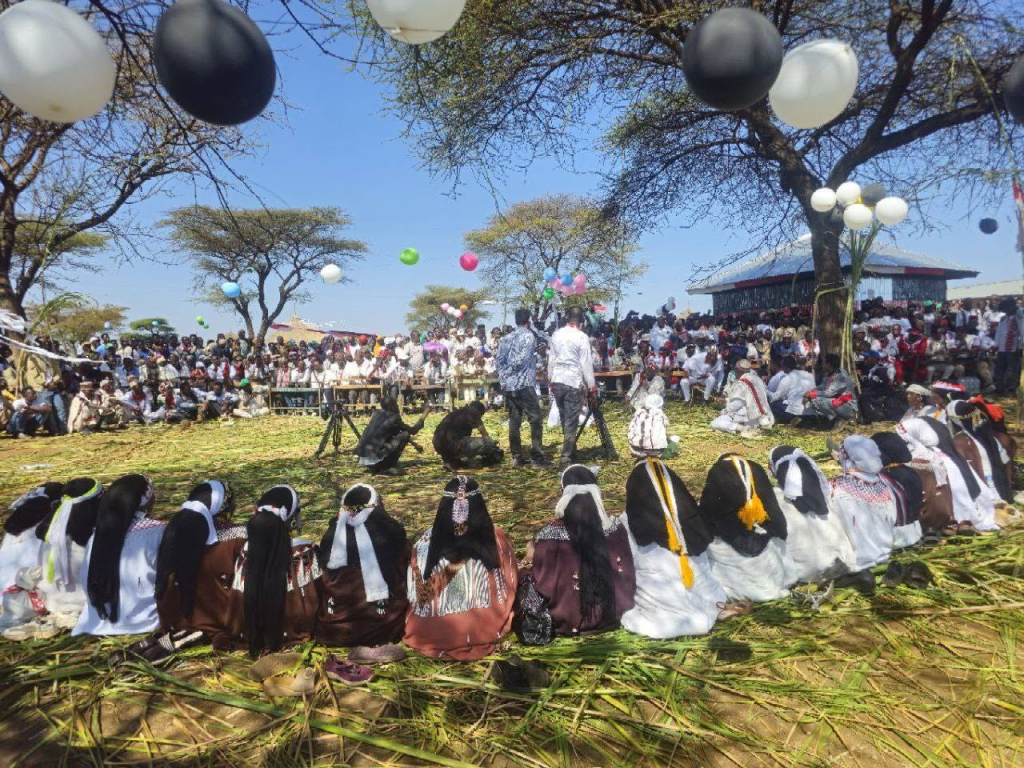
Thousands of Oromo from Arsii converge at the ancient grounds of Dhaddacha Baldhaa to honour the Gadaa system and restore the sacred traditions of their forefathers
BALEE ZONE, OROMIYA — The ancient grounds of Dhaddacha Baldhaa are alive with purpose. From July 12th to 14th, tens of thousands of Oromo from Arsii have descended upon the sacred site in the Rayitu district of Bale Zone, responding to a call that echoes through generations. They have come not merely to gather, but to restore, to honour, and to preserve the sacred traditions of the Gadaa system.
“Ya’a Gadaa Arsii Sikkoo Mandoo Dhaddacha Baldhaa!”
The Ya’a Gadaa (Gadaa Assembly) of Arsii Sikkoo Mandoo at Dhaddacha Baldhaa has been called. This is a moment of profound significance for the Oromo people—a moment when the ancient traditions of governance, justice, and community are reaffirmed in the face of historical challenges.
The Call to Gather
“Dhaaddachoota sirna gadaa Oromoo Arsii Sikkoo Mandoo caffee gadaa Odaa Roobaa jala jiran keessaa Dhaddacha Baldhaa deebisani dhaabuu Oromoon Arsii July 12-14 walitti dhufee ya’a Gadaa kabajuuf gara godina Baalee Bahaa Aanaa Raayituu magaalaa Dhaddacha Baldhaatti imalaa jiru.”
The elders of the Gadaa system of Arsii Sikkoo Mandoo, who reside under the shade of the Odaa Roobaa Gadaa assembly, are journeying to the town of Dhaddacha Baldhaa in Rayitu district of East Bale Zone. They gather from Adoolessa 12th to 14th to restore the Ya’a Gadaa and honour its sacred traditions.
The Odaa Roobaa is a sacred site—a place where the Gadaa assembly has traditionally met under the shade of the sycamore tree. It is a symbol of justice, community, and continuity. The elders who gather there carry the wisdom of generations and the responsibility of preserving the Oromo way of life.
The Purpose of the Gathering
“Dhaddachi Bal’aan dhaaddachoota wiirtuu gadaa Sikkoo Mandoo Caffee Gadaa Odaa Roobaa jalatti argaman keessaa Dhaddacha Saddeetaa kan Abbaa duulaa ykn kan waraanaa ittisa daangaa waan taheef Ya’a gadaa kanaan dudhaa ganamaa bakkatti deebisuu fi dhaloota safuu fi safeeffanaa ijaaruu, ittiin bulmaata Oromoo kalleessaa calaqqee eenyummaa Oromoo tahe waan barattaniif akka irraatti argamtan waamicha Gumiin Abbootii gadaa Sikkoo Mandoo dabarsee hojirra oolchuun gaafa Adoolessa 12-14’tti Aanaa Raayituu Magaalaa Dhaddacha Baldhaatti akka argamtan jenna.”
The Baldhaa Assembly has issued a formal call to all Gadaa elders of the Sikkoo Mandoo council, who gather at the Odaa Roobaa Gadaa seat, to restore the sacred tradition of the “Dhaddacha Saddeetaa”—the eight-fold assembly. This assembly, which serves as a defence council (Abbaa duulaa) and border protection council, is being reconvened to restore morning prayers and establish a legacy of cultural preservation for future generations.
The elders have learned the importance of preserving Oromo identity from the past. They understand that without the Gadaa system, the Oromo people would lose their governance, their justice, and their identity. This gathering is a direct response to that understanding—a determination to pass on the cultural heritage to the next generation.
The Significance of the Gadaa System
The Gadaa system is one of the most sophisticated indigenous governance structures in the world. It is a system that has guided the Oromo people for centuries—organising their society, managing their resources, resolving their conflicts, and preserving their culture.
“Ya’iin kun kan hunda keenyyaa waan ta’eef ilmaan Oromoo hunduu keessattuu abbaan sirnichaa Ilmaan Arsii Sikkoo Mandoo, ya’a kanarratti argamuun dudhaa sirna gadaa isa ganamaa bakkatti akka deeffannu waamicha waliif dabarsina.”
This gathering belongs to all of us. Therefore, all Oromo people, especially the sons of Arsii Sikkoo Mandoo, are encouraged to attend this assembly to restore the ancient morning traditions of the Gadaa system. Let us spread the word to one another.
The Gadaa system is built on a foundation of values:
- Respect for Elders: The wisdom of the elders is recognized and honoured. They are the keepers of tradition, the guides for the community.
- Community Solidarity: The well-being of the individual is inseparable from the well-being of the community. Everyone has a role to play, and everyone is valued.
- Cultural Continuity: The traditions of the ancestors are preserved and passed on to the next generation. The past is not forgotten but honoured.
- Spiritual Connection: The relationship with the Creator is central to the Gadaa system. Rituals and ceremonies are expressions of gratitude and petitions for blessing.
- Justice and Equality: The Gadaa system is a democratic system that values fairness, justice, and the participation of all members of the community.
The Restoration of Tradition
The gathering at Dhaddacha Baldhaa is not merely a commemoration—it is an act of restoration. The Gadaa system has faced significant challenges over the years, from colonial suppression to modern pressures. Yet the Oromo people have refused to let their traditions die.
The restoration of the Gadaa system is a declaration of cultural survival. It is a statement that the Oromo people will not be erased, their culture will not be forgotten, and their identity will not be denied.
The “Dhaddacha Saddeetaa” (eight-fold assembly) is being reconvened to restore the sacred rituals of the Gadaa system—the morning prayers, the governance structures, the justice systems, and the traditions that have guided the Oromo people for centuries.
A Call to All Oromo
“Odaa Robaa, Odduun Roobaaf Nagaya!”
Odaa Roobaa, Oduu Roobaaf Nagaya! (May the Odaa Roobaa be blessed! May the news of Roobaa bring peace!)
The message is clear: all Oromo are invited to participate in this historic gathering. It is not limited to the elders of Sikkoo Mandoo; it is open to all who wish to honour and preserve the Gadaa traditions.
The preservation of Oromo culture is the responsibility of all Oromo people. It is not the task of a few elders or a single community—it is the duty of every Oromo, wherever they may be.
The Way Forward
As the sun sets over the ancient grounds of Dhaddacha Baldhaa and the fires of the Gadaa assembly burn bright, the Oromo people are reaffirming their commitment to their traditions. They are declaring that the Gadaa system is not a relic of the past but a living, breathing system of governance that continues to guide them.
“Odaa Robaa, Odduun Roobaaf Nagaya!”
The gathering at Dhaddacha Baldhaa is a testament to the resilience of the Oromo people. It is a reminder that cultures do not die when they are actively practised, when they are passed on to the next generation, and when they are honoured in the face of all challenges.
May the Gadaa system continue to guide the Oromo people for generations to come. May the Odaa Roobaa continue to provide shade for the elders who gather beneath it. And may the Oromo people never forget the traditions that make them who they are.
The Gadaa Calendar: Understanding the Time
The gathering at Dhaddacha Baldhaa follows the traditional Oromo calendar, which is a lunar calendar based on the cycles of the moon. Adoolessa is one of the months in this ancient calendar system, and the 12th to 14th days of Adoolessa hold particular significance for the Gadaa assembly.
The traditional Oromo calendar is a living link to the ancestors, a reminder that time itself is cyclical and sacred.
A Gathering of Unity
The Ya’a Gadaa at Dhaddacha Baldhaa is not just a political gathering—it is a spiritual and cultural gathering. It is a time for prayer, for community, for celebration, and for the transmission of wisdom from one generation to the next.
“Ya’iin kun kan hunda keenyyaa waan ta’eef ilmaan Oromoo hunduu keessattuu abbaan sirnichaa Ilmaan Arsii Sikkoo Mandoo, ya’a kanarratti argamuun dudhaa sirna gadaa isa ganamaa bakkatti akka deeffannu waamicha waliif dabarsina.”
This gathering belongs to all of us. Therefore, all Oromo people, especially the sons of Arsii Sikkoo Mandoo, are encouraged to attend this assembly to restore the ancient morning traditions of the Gadaa system. Let us spread the word to one another.
Conclusion
“Odaa Robaa, Odduun Roobaaf Nagaya!”
May the Odaa Roobaa be blessed! May the news of Roobaa bring peace!
The Ya’a Gadaa of Arsii Sikkoo Mandoo at Dhaddacha Baldhaa is a historic gathering—a reaffirmation of Oromo identity, a restoration of sacred traditions, and a declaration of cultural survival. Thousands have gathered, and the message is clear: the Gadaa system lives, the Oromo people endure, and the traditions of the ancestors will never be forgotten.
As the elders gather under the sacred sycamore tree, they are not just remembering the past—they are building the future.
“Odaa Robaa, Odduun Roobaaf Nagaya!”
May the Odaa Roobaa be blessed! May the news of Roobaa bring peace!

BEYOND THE BANNER: KOSTE ABDIISAA’S BLEAK PROGNOSIS FOR TSIMDO AND THE PERILS OF RECYCLED STRATEGIES

A feature analysis of a blunt political intervention that exposes the fault lines in Oromo political strategy
In the fractious arena of Ethiopian and Oromo politics, where alliances shift like desert sands and rhetoric often outpaces reality, few voices cut through the noise with the surgical precision of Koste Abdiisaa. In a recent, characteristically unvarnished reflection, Abdiisaa has delivered a damning indictment of TSIMDO—an indictment that warrants serious analysis not merely as a partisan jab, but as a profound commentary on the trajectory of political struggle itself.
Abdiisaa’s core thesis is stark: “Milka’ina TSIMDOf jecha olollii ABO irratti ta’u hin milka’u!” — TSIMDO’s success cannot be built upon a struggle against ABO (a reference to the Oromo Liberation Front). He doubles down with the declarative English postscript: “TSIMDO will never succeed! A new alliance, but with the same old and failed strategy.”
To understand the gravity of this critique, one must dissect its layered components.
The Strategic Miscalculation: Misplacing the Target
Abdiisaa’s primary contention is that TSIMDO has fundamentally misdiagnosed the battlefield. By framing its struggle primarily as an adversarial contest against the federal seat of power in Addis Ababa/Finfinne, the movement traps itself in a zero-sum paradigm.
Historically, Oromo political movements have oscillated between integrationist and confrontational postures. Abdiisaa suggests that TSIMDO, despite its new branding, has fallen into the latter trap—defining itself more by what it opposes than by what it offers. To orient a struggle for Oromo rights purely against the administrative mechanisms of the capital is to confuse the symptom with the structure. The federal system, with all its constitutional complexities, cannot be stormed through oppositional posturing alone. True leverage, he implies, lies in constitutional fidelity, not rhetorical siege warfare.
The Moral Calculus: Truth Over Propaganda
Perhaps the most philosophically resonant line in Abdiisaa’s reflection is: “Sobni dhugaa/haqa mo’ee hin beeku!” — Deception does not know how to defeat truth and justice.
This is a pointed accusation that TSIMDO may be relying on distorted historical narratives, emotional sloganeering, or selective outrage to galvanize support. In an era where propaganda proliferates on digital platforms, Abdiisaa issues a warning: mobilizing a people through manipulated grievances is a short-term anesthetic, not a long-term cure.
Justice (haqa) possesses an inherent, almost gravitational, historical momentum. When a movement builds its foundation on factual instability, it risks catastrophic collapse when reality reasserts itself. Abdiisaa insists that TSIMDO’s leadership must confront historical and constitutional truths—particularly regarding the complexities of Finfinne’s status—rather than simplifying them into digestible but deceptive soundbites.
The Resilience of Righteous Struggle
Counter-intuitively, Abdiisaa does not dismiss struggle itself. He validates the necessity of resistance: “Ololli qabsoo haqaa irratti ta’us qabsichi fi qabsa’ota daran ni jabeesssa, ni xiiqessa malee of duubatti hin deebisu!” — A struggle grounded in justice, even if it faces intense pressure, strengthens the fighters and never retreats.
This is a critical nuance often lost in political polemics. Abdiisaa is not a pacifist; he is a strategist. He argues that when the cause is just, adversity functions as a crucible—it hardens resolve and clarifies purpose. However, he implies that TSIMDO’s current methodology lacks this foundational justice. If their cause were truly righteous, state pressure would only fortify them. Instead, he observes a tendency toward capitulation, hypocrisy, or confusion. The problem, therefore, is not external opposition but internal moral bankruptcy and tactical incoherence.
The Sharp Irony of Hypocrisy
Abdiisaa’s most scathing critique is reserved for the conduct of TSIMDO’s protagonists: “Namoonni dharaan maqaa nama xureessuf yoo akkas xaaran, namoonni maqaan xura’u ammo hagam akka hojjetan tilmaamuun salphaa dha!” — If those known for having a clean reputation engage in such dirty tactics to defame others, one can easily imagine how those with historically tarnished reputations will operate.
This is a devastating rhetorical thrust. It accuses TSIMDO’s leadership—or their allies—of engaging in character assassination, smear campaigns, and divisive intra-communal attacks. The irony is palpable: if the “righteous” are acting immorally, what restraint can be expected from the unprincipled?
Abdiisaa exposes a dangerous trend in Oromo political activism: the weaponization of identity politics to silence dissent within the community. By attacking other Oromo figures or factions rather than building ideological consensus, TSIMDO risks cannibalizing its own base. This reflects a broader crisis of leadership where personal ego and factional loyalty supersede collective emancipation.
The New Alliance, The Old Failure
Ultimately, Abdiisaa’s verdict is delivered in plain English for universal clarity: “A new alliance, but with the same old and failed strategy.”
This is the crux of the analysis. TSIMDO may present itself as a fresh vanguard, a revitalized coalition, or a break from the past. But Abdiisaa argues that beneath the veneer of novelty lies the fossilized remains of past political failures—an over-reliance on populist agitation, a neglect of constitutional legalism, and an inability to forge durable alliances beyond narrow ethnic or geographic confines.
The “old strategy” is one of perpetual confrontation without governance, of protest without program, of demands without democratic legitimacy. It is a strategy that has historically left the Oromo people politically empowered but structurally disenfranchised—winning the rhetoric but losing the constitutional reality.
Conclusion: A Call for Strategic Sobriety
Koste Abdiisaa’s reflection is more than a critique of a single movement; it is a mirror held up to the Oromo political project at large. He challenges activists to move beyond performative opposition and engage with the arduous labor of constitutional implementation, cross-community dialogue, and principled truth-telling.
For TSIMDO to prove its critic wrong, it must demonstrate a departure from the old playbook. It must anchor its struggle not in the negation of Addis Ababa’s federal role, but in the affirmative realization of Oromia’s constitutional rights within that framework. It must replace smear campaigns with substantive policy proposals.
As Ethiopia’s national dialogue looms, Abdiisaa’s words serve as a stark warning: political movements that refuse to evolve, that cling to outdated antagonisms and inflated rhetoric, are destined for the dustbin of history—regardless of how shiny their new banners appear.
—
This analysis is based on the public reflections of Koste Abdiisaa and aims to provide a strategic and ideological interpretation of his critique of TSIMDO and contemporary Oromo political strategy.






