Author Archives: advocacy4oromia
Irreecha: Oromo’s Largest African Festival Celebrated by Millions at Hora Arsadi, Bishoftu
On Sunday October 5, 2014 an estimated 4 million people attended the annual Irreecha Festival at Hora Arasdi (lake) in Bishotu town, located 47.9 kilometers southeast of the Oromo nation’s capital Finfinne (aka Addis Ababa).
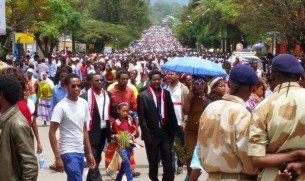 Although not conceptually, historically and purposively equivalent, people sometimes superficially use the word from the American holiday “Thanksgiving” to describe Irreecha Festival to expatriates. Oromo and friends of Oromo from across all religions and backgrounds converged to celebrate the transition from a gloomy (dukkana) rainy season to a bright (booqaa) birraa (fall season).
The rainy season that runs for 3 months–June to August– is considered a harsh winter and is associated with darkness and separation from friends and families because of rivers swelling, (and also because of the lack of electricity). In contrast, Fall is considered a more pleasant season of festivity. Honestly the tropical rainy season is not as a harsh a season as Winter as we know it in the northern hemisphere if you have the skills to swim and walk in and on waters.
https://www.youtube.com/watch?v=gn8MzduVUE4
To say that Irreecha is a celebration of escaping a bad season, would be a gross oversimplification given the long and complex history of the Oromo indigenous African holiday practiced for thousands of years before the arrival of Abrahamic faiths in Oromia, Ethiopia and the Horn of Africa. Some people try to desecularize the holiday, but elders relate to us that Irreecha is quintessentially about uplinking with God and thanking God at natural and beautiful sites that he created for allowing people to withstand harsh weather conditions and natural disasters.
A bouquet of flowers arranged with wet grasses is presented to God (Waaqaa/Creator/Uumaa) as a gift on outdoor natural sites such as rivers, lakes and hilltops. People dip the grasses, coqorsa, in water and sprinkle the water over their foreheads sometimes as a way of receiving blessings.
Then they leave the gifts on the side of a lake for Waaqaa to see and enjoy the sight. This shows the deep Oromo connection with nature and creatures. Irreecha is about thanking God, it’s about preserving the environment, keeping nature intact and green and about maintaining harmony between human and non-human beings in the universe. Hence the prayer for araaraa-reconciliation with God and nature.
The concepts of celebrating the link between uumaa and uumamaa(Creator and Creation) is at the core of Irreecha. It’s also about freedom music, having fun, expressing social grievances and the need for liberation, meeting people, recovering and re-asserting the marginalized and lost Oromo way of life–culture and identity.
According to the description of Irreecha obtained from the website of Waldaa Waaqeffattoota Addunyaa (Council of World Worshippers of the Oromo God), a body with authority to comment on the subjectmatter of Irreecha, Irreecha is celebrated for the following main reasons in outdoor natural settings:
- to thank Waaqaa (God) for blessings and mercies we have received throughout the past year at the sacred ground of Hora Arsadi, Bishotu, Oromia;
- to welcome the new season of plentiful harvests after the dark and rainy winter season associated with disruption of social life; and
- to mark the end of rainy season (winter) and the beginning of Birraa (Fall);
Irreecha has been celebrated for the last 6400 years in Oromia and the Horn of Africa, according to the source above.
With this many million visiting the town of Bishoftu near the Irreecha site, the economic and tourism benefits of Irreecha is obviously tremendous. Pilgrims from other Oromia areas pay for public transportation and stay in hotels and some go to opening and closing concerts and other sub-events contributing to the economic growth of the state. Millions buy cultural clothes as well, which is a huge economic boost for Oromo and other traders.
Seemingly caving to popular demand for the holiday to be registered as a world heritage by UNESCO, Oromia State’s administrators and Ethiopia’s Ministry of Culture and Tourism allege that they are teaming up in an effort to register Irreecha with UNESCO and report that 80% of the work needed for the registration has already been completed. While seeking international recognition is right, ironically Ethiopia doesn’t have the holiday on its list of national holidays. If it materializes (it is a big IF), this can be an important development as many Ethiopian regimes have long suppressed every element of Oromo culture as alien even internally, let alone seeking international recognition for them.
The Abbaa Gadaas who did the blessings praising the Ethiopian government did so under duress and they may not mean it anyway. The EPRDF government deployed an an entire Central Command part of its army in full gear, making the festival tense and occupied by TPLF soldiers. Yet, Qeerroo Oromiyaa kept singing freedom songs and didn’t budge at this huge display of force.
Source: http://oromopress.blogspot.com.au/2014/10/irreecha-oromos-largest-african.html
————–
Notes: Italicized words are from Afan Oromo, a language spoken by the Oromo people, making up nearly half of Ethiopia’s population, single largest and one of the most repressed ethno-national groups in Oromia and Ethiopia.
“Holiday” and “Holyday” can be used interchangeably in this text depending on why you are clebrating Irreecha.
Gadaa.com’s Irreecha “Central” is recommended if you want to view further photos and videos of the event in Oromia, Ethiopia and worldwide.
Hon. Anthony Byrne, Member of the Australian Parliament, attends the Irreechaa held in Melbourne
(A4), 5 October 2014) Hon. Anthony Byrne, Member of the Australian Parliament, attends the Irreecha (Oromo Thanksgiving) held in Melbourne, Australia, on October 5, 2014.
He reflects on his Facebook as follows:
“Wonderful to attend the Oromo Community’s Irreechaa or Thanksgiving ritual yesterday. As part of Irreechaa it is in Oromo tradition to gather at the river banks and lakes shores to give thanks to the almighty Waaqaa for all the blessings throughout past years and ask for Araaraa (Reconciliation), Nagaa (Peace), Walooma (Harmony) and Finnaa (Holistic Development) for the past, the present and the future. #ThisIsAustralia ”

Oromo community in Uganda celebrate Irreecha festival
The Oromo community in Uganda celebrate Ireecha which is a thanksgiving festival.
The Oromo community in Uganda celebrated Irreecha, a festival of thanksgiving, on Sunday. The Oromo people are Ethiopia’s largest ethnic group.
Oromo communities spread out across the world on this day perform rituals around water sources to thank God for enduring the rainy season and ushering in the spring season. The Oromo Community in Uganda have held their celebrations at the Kabaka’s Lake in Lubaga.
– See more at: http://www.ntv.co.ug/news/local/06/oct/2014/ethiopias-oromo-community-uganda-celebrate-irreecha-festival#sthash.JZjOIcMT.dpuf
Irrecha: From Thanksgiving Ritual to Strong Symbol of Oromo Identity
By Asebe Regassa, PhD Candidate, Bayreuth University | August 24, 2013
 It has become evident since recently that the Oromo across religious, political and geographical boundaries have converged together in celebrating an annual ritual/festival called irrecha. Historically, irrecha has been understood and practiced within the context Oromo religion, Waaqeffannaa – a belief in one supernatural power called Waaqa (God). However, as I will discuss shortly in this piece, irrecha has undergone some transformations in accommodating non-religious aspects of Oromo culture and thus has played significant role in building Oromo identity and sense of unity. In the contemporary context where the ritual brings Oromo across different walks of life, irrecha should be understood more as an arena where Oromo identity is articulated, reconstructed, built and practiced, rather than as a religious-oriented or a mere thanksgiving celebration. Before delving into some historical trajectories that shaped irrecha to be the way it is practiced today, I will briefly clarify on some conceptual understandings of the ritual itself.
Traditionally, the Oromo practiced irrecha ritual as a thanksgiving celebration twice a year (in autumn and spring) to praise Waaqa (God) for peace, health, fertility and abundance they were given with regards to the people, livestock, harvest and the entire Oromo land. Irrecha is celebrated as a sign of reciprocating Waaqa in the form of providing praise for what they got in the past, and is also a forum of prayer for the future. In such rituals, the Oromo gather in places with symbolic meanings such as hilltops, river side and shades of big sacred trees. Here, I would like to make clear that Oromo people never worship any of these physical landscapes though some outsiders and detractors of Oromo culture and religion represent it as such. Rather, these physical landscapes are chosen for their representations in Oromo worldviews, for example, green is symbolized with fertility, peace, abundance and rain.
In Oromia, the core center of irrecha celebration has been around Hora Arsadi in Bishoftu town, some 25kms to the south of Finfinne, the capital city. Annually, particularly during the Irrecha birraa (the Autumn Irrecha) in September or October, the Oromo from different parts of the country come together and celebrate the ritual. In the past few decades, irrecha celebrations have been expanded both in content as well as geographical and demographic representations. This short commentary deals with such historical trajectories by contextualizing the changes within political discourses in Ethiopia vis-à-vis Oromo nationalism.
Irrecha in Pre-1991 PeriodsAny analysis of the rights of Oromo people to exercise its culture, religion, economy, governance, language and identity within the Ethiopian state should be positioned within the historical trajectories that brought the birth of the modern Ethiopian state and the subsequent political, economic and cultural dominations unfolded upon the subjugated peoples of the South in which the Oromo people was a part. Following the military conquest of the different hitherto autonomous states of the South by the army of Menelik II in the late 19th century, the Amhara ruling group imposed its culture, language, religion and political dominance over the subjugated nations and nationalities. Menelik’s soldiers dispossessed the land of the conquered people and reduced them to the status of tenancy. In areas of religion, Orthodox Christianity was installed as the only legitimate religion while other religious practices were denigrated, discouraged and at times banned. For instance, Orthodox priests took the place of Oromo Abba Qaalluu and other religious leaders. Oromo religious and cultural practices became targets of state repression during those times. Irrecha rituals were very restricted and were portrayed by state backed Orthodox Christian church as a practice of devilish worship.
The military regime that overthrew the imperial regime in 1974 initially seemed to have tolerated traditional cultural practices, language diversity and religion but its communist orientation and ‘modernist’ discourse had placed the regime at odds with these fundamental rights of the peoples of the country – the right to cultural and religious practices. While it outlawed ‘religion’ – though Orthodox Christianity did not face state persecution as other religious sects – it labeled traditional cultural practices such as irrecha as ‘backward’ and obstacles to development and revolutionary ethos of the regime. As a result, irrecha and other Oromo religious and cultural practices were banned by the government.
It is imperative to mention two fundamental motives behind state suppression of irrecha (as common to other Oromo cultural practices) during those eras. First, successive Ethiopian regimes had subtle and overt policies of establishing culturally, linguistically and religiously ‘homogenized’ Ethiopia in their quest to build Ethiopian nationalism as a replica of Amhara and to some extent Tigrayan identities. Secondly, the Ethiopian state was built on a cultural and political identity that depicted Amhara/Tigrayan cultural/political superiorities. The myth of ‘great tradition’ that portrays the North as cradle of ‘civilization’ and conversely demotes the South to the opposite was in the center of Ethiopian state identity. This myth has been used to legitimize exclusionary policies of the state against the people in the conquered region in the process of political, economic and cultural representations. In the process, denigrating the culture or religion of the ‘Others’ as ‘backward’ was used as strong instrument to place one’s own on the privileged position.
The Revitalization of Irrecha in post-1991 PeriodIn 1991, Ethiopia underwent remarkable political reconfiguration following the overthrow of the military regime. The analysis of the political ideologies of the new regime is not the objective and scope of this piece. Rather, it suffices to mention that the new political arrangement along ethnic federalism fundamentally deconstructed the old illusion of nation building along one dominant cultural path. Ethnic groups (nations and nationalities) were for the first time given a constitutional right to exercise, preserve and promote their religion, culture, language and history. Although the translation of these constitutional rights into practice has faced inconsistencies and flaws all through the last twenty years, it was a breakthrough in providing a political space for cultural revitalization.
Under the initiative and organizational leadership of Macha-Tulama Association, irrecha celebrations were started in Hora Arsadi in mid 1990s. As the period was the heyday of Oromo nationalism and self-conscious, irrecha became not only a religious practice as in the past; rather it served as an arena where Oromo people across religious boundaries could meet and share their common identity. However, it maintained its fundamental element of Oromo’s connection to Waaqa (God). The thanksgiving ceremonies, prayers and blessings by elders have put Waaqa in the center of the ritual while songs and material culture the youth decorated themselves with brought into the scene political and emerging Oromo national identity. In both cases however, two fundamental principles of the ritual were consistent across different time spans. Firstly, irrecha served and still serves as a medium or symbol of connection between Oromo and Waaqa through thanksgivings, prayers and blessings. Secondly, irrecha rituals reflect how emotional, cultural, psychological, spiritual and identity issues are embedded and embodied within the Oromo and thus one cannot dissociate one of these elements from another.
Another major feature of the post-1991 irrecha celebration was that it attracted more of the youth and the educated class than before. This should be contextualized within the broader Oromo consciousness and the rise in Oromo nationalism. University students, government civil servants, businessmen/women and people in different professions were highly involved in the celebrations. It became at times an arena where people could meet, discuss and demonstrate their common issues – political and cultural to a larger extent.
However, it soon became a contested space between different actors, mainly between political parties (the ruling party and opposition political parties and movements). The ruling party was confronted by two ambivalent developments on its side with regard to irrecha and other Oromo cultural revitalization movements. Firstly, the constitutional provisions its enacted grants, in theory, the right of nations and nationalities to exercise their culture, religion, language and history. On the other hand, people’s exercise of such rights – like the case of irrecha, music, language, etc. – would inevitably raise the level of self-consciousness of the people that would in the long run challenge the status qou. For example, using the constitutional right as a legal protection, many participants on irrecha used to ecorate themselves with material culture and costumes that reflect the flags of the Oromo Liberation Front (OLF) rather than that of Oromo People’s Democratic Organization (OPDO). Around the year 2003/04, the government of Ethiopia heavily scrutinized irrecha festival and tried to manipulate it for its own advantage. Since then, irrecha in Oromia fell under full control of the government. While such intervention gave irrecha more publicity on the one hand, as the celebration was at times given huge coverage on state media, it has added a political dimension on the other hand. It should be noted, however, that the contestability of this cultural field still persists despite strong state intervention.
Irrecha in ExileIrrecha is not only practiced among the Oromo in Oromia. As hundreds of the Oromo are in exile for different reasons, their culture, religion, language and identity also exiled with them. Because irrecha has a cultural ambiance in connecting the people to Oromo land and the creator, Waaqa, it still remained as strong element of connection between the Oromo in diaspora and home – Oromia. In the past ten years or so, the Oromo across different parts of the world (from Toronto to Melborne and Bergen to Johannesburg) have come together and celebrated irrecha as a common icon of their identity. If anything could be mentioned in bridging the differences (political and religious) within Oromo in the diaspora, irrecha has become the major binding force not as a mere cultural or religious practice but for its conjoint constitution of culture and identity. Currently, irrecha has got publicity among the non-Oromos (Ethiopians and non-Ethiopians alike) to the extent that city administrations in different countries recognized the celebration and granted the Oromo with the spaces for the ritual.
To sum up, irrecha as one of the Oromo cultural practices has responded to different forms of internal and external influences but persisted across history in binding the Oromo across religious, political and geographical boundaries together. Today, it is considered as the major unifying emblem of Oromo identity. Despite relentless attempts by different actors (interest groups) to appropriate irrecha for their interests or to demote it altogether, it continued to be a marker of Oromo’s embedded cultural identity. Among the diaspora in particular, where political rift is more apparent, irrecha is believed to converge differences and in the future investing on how Oromo common markers of identity would contribute to common visions of the people should be the core agenda of all the Oromo.
IOYA shines spotlight on child rights abuses in Ethiopia
In July 2006, about 60 Oromo youth met in Minneapolis, Minnesota for what was initially planned as a leadership conference. At the end of the three-day gathering, which featured, among other activities, leadership exercises, social activities and speeches by invited guests, the attendees formed the International Oromo Youth Association (IOYA).
It was meant to serve as an umbrella organization for Oromo youth groups around the world (in part because most of the delegates at that conference came representing their local youth associations).

*Photo credit Amy Bergquist via IOYA’s Facebook page: https://www.facebook.com/IOYANetwork
After years of lethargy, IOYA is showing signs of rejuvenation, and deserves all our support. On September 26, IOYA leaders co-presented a report on the rights of children in Ethiopia along with the Minnesota-based Advocates for Human Rights at the United Nations Committee on the Rights of the Child in Geneva, Switzerland. During the weeklong engagement, IOYA representatives participated in several meetings discussing human rights issues related to Oromo, spoke at a side event looking at diaspora engagement on human rights (with Ethiopia as a case study) and met with the U.N. Committee in a 2.5 hour, closed-door session.
There are several reasons for IOYA’s resurgence. Two of them are worth mentioning here. First, most of the organization’s earliest protagonists have moved on. This created an opportunity for younger leaders to calibrate the organization’s mission and vision in the context of the current state of Oromo affairs.
“Seeing its decline was particularly devastating to me,” Amane Badhasso, the current IOYA president, told OPride during a recent interview. “That is why we dedicated several months to formulating strategies to revive IOYA. We are determined to strengthen IOYA’s capacity as an international organization and build global networks not only to advance our goals but also to ensure the organization’s sustainability.”

*Photo credit Amy Bergquist via IOYA’s Facebook page: https://www.facebook.com/IOYANetwork
Badhasso and her executive board members seem to be doing a phenomenal job in that regard. In 2011, IOYA appeared on the brink of dissolution because no one was willing to step up and take over the reins from the then-outgoing board. Despite this, however, even through years of ups and downs — which in all fairness is not unique to IOYA — its leaders continued to hold annual meetings and partner with Oromo community organizations on human rights causes.
The 2012 executive board faced a unique challenge: guiding IOYA through a year of transition and rethinking its mission. They set in motion the changes that enabled the current board to revive the organization’s advocacy arm in few months. The new vision emphasized leadership training, cross generational dialogue, networking and the creation of “a space to address issues pertaining to Oromo communities in the diaspora.” In some sense, this was a slight departure from the organization’s initial goal and proved key to the current turnaround.
In 2006, there was a palpable sense of urgency to define the place of youth in Oromo struggle and for the youth to take leadership roles within their diaspora communities. The enthusiasm and sense of Oromummaa at the conference was overwhelming — so much so that everyone cried at the farewell gathering. The sense of shared passion and dreams made saying goodbye that much harder. Over the years, many had told this writer that it was “the best summer and event” of their lives. A handful of the attendees, including some who met for the first time, have built long term personal relationships and friendships.
But in restrospect there was also a clear lack of strategy on that which the group set out to do. For the first few years, IOYA organized well-attended human rights rallies in Minnesota and Washington, D.C. It issued press releases reacting to human rights violations in Ethiopia, including a government crackdown on their peers at home.
But it’s fair to say that IOYA fell far short of becoming a formidable umbrella organization for Oromo youth around the world. It faced many hurdles, including lack of clarity around membership, dues, etc. Its main problem has always been leadership and inability to translate the overly broad mission and vision into actionable advocacy.
The new leaders have now taken IOYA through the corridors of the United Nations. No small feat. Much of IOYA’s success seems to be a result of collaboration with others and changes in leadership.

*Photo credit Amy Bergquist via IOYA’s Facebook page: https://www.facebook.com/IOYANetwork
In June, IOYA launched a three-day social media campaign to demand the release of Oromo students arbitrarily rounded up by Ethiopian security forces during #OromoProtests. The initiative generated a lot of awareness and media coverage. But it also afforded the group an opportunity to partner with The Advocates. On July 1, 2014, IOYA and The Advocates submitted a detailed report to the United Nations Pre-Sessional Working Group of the Committee on the Rights of the Child.
The report, which focused on the government crackdown on Oromo students, identified numerous violations of the rights of children in Ethiopia. It concluded that children of certain ethnic groups, particularly ethnic Oromos, face severe discrimination and rights violations. Other issues pertaining to liberty, security, privacy, freedom of expression and association, family, basic health and welfare, education and leisure and cultural activities were also included in the report. The high-level advocacy at the U.N. is a result of that ongoing collaboration with The Advocates.
The second reason for IOYA’s comeback has to do with the makeup of its leadership. Unlike previous years, the last two IOYA boards were largely made up of women. This sounds hasty and simplistic, but it is important in the context not only of IOYA’s remarkable achievements but also the makeup of Oromo political and civic leadership. To the writer’s knowledge, no other Oromo organization, anywhere, has more women in the position of leadership than IOYA. In fact, it’s been said that to some extent the paralysis in Oromo struggle can be attributed to the lack of Oromo women’s participation. This is not to say Oromo women did not contribute to Oromo struggle or activism. They do. But rarely are they given leadership roles. Their contribution to the struggle, arts, academia and other areas of Oromo life is seldom acknowledged.
Two years ago, OPride put out a banner with a photo of about a dozen Oromo martyrs during the annual memorial. Readers immediately noted the absence of a single woman martyr on that poster. The Internet is awash with photos of Oromo leaders, past and present. But one would be hard pressed to find an image of Oromo heroine along with her male counterparts. This need to change. More girls and women need to be recognized and encouraged to take leadership roles in our communities and youth organizations. IOYA offers the clearest example of efficiency and effectiveness when women take leadership roles.
Source:http://www.opride.com/oromsis/news/3775-ioya-shines-spotlight-on-child-right-abuses-in-ethiopia
Oromo refugee and elite runner has plans for new life in Brisbane
By Jennifer King

PHOTO: Lamaa Kuruu is building a new life for himself and his family in Brisbane. (ABC: Jennifer King) MAP: Brisbane 4000
Have you ever been on a crowded train with your face wedged into someone’s shoulder, or complained to friends about the lack of legroom on your flight to wherever you are travelling?
Spare a thought for Lamaa Kuruu and his fellow refugees, jammed into a vehicle, one person lying on top of another, for days on end with no food and little water.
This is what Lamaa endured to seek a new life for himself.
Now he has arrived in Brisbane on a humanitarian refugee visa and is grappling with learning English and trying to build a future for himself and his wife, Ayantu Daba.
Finding his feet
Lamaa is an elite runner. Prior to fleeing Ethiopia four years ago, he lived in a house with 60 other runners and two coaches, training twice a day on the track and in the forest.
Last weekend he entered his first Australian road running event, the Twilight Bay Run. He was confident of winning the 5km event but was nervous about deciphering the route.
His English is limited, and as a track runner road running is a novelty, especially in a new country.
Taking advice from well-meaning fellow runners, he followed the lead bike. But no-one realised the bike would stop before the runners went into the final finish chute.
So Lamaa stopped too, not understanding that the finish line was still 500 metres away.

PHOTO: Lamaa narrowly missed a win at the Twilight Bay 5km race. (ABC: Jennifer King)
It was not until the second runner and eventual winner, Patrick Hagan, yelled “keep going” as he ran past that Lamaa realised his mistake.
With a finish time of 16:53, he lost by just five seconds and was devastated. If he had finished as he hoped, he would have begun to lay down the foundations for a new running career in Queensland.
Lamaa is competitive and he wants to win.
“I love Australia. I want to win for Australia,” he said in halting English.
Escape from beatings
Pulling up his shirtsleeve, Lamaa reveals scars he says he received from the random beatings by government forces in Ethiopia which he says would occur at any time for any reason.
Eventually worn down by oppression, Lamaa says he joined a group of about 30 other refugees who had each paid a man $1,300 to be led out of the country.
In recounting the story, Lamaa refers to this person as “the manager” and says that once underway, he demanded more money but Lamaa had none to give. He had left with just the clothes he wore and one small bag.
Lamaa and the other refugees then walked to Sudan.
Communication with Lamaa is difficult. His English is extremely basic. He speaks two African languages – Oromo and Amharic – and is undertaking regular English lessons at TAFE.
Yet he is adamant they walked more than 1,000km from Addis Ababa to Sudan where they stayed for two months.
“Yes. We walked. It was very hot. Very hot. Very difficult. And no water. No food,” he said.
From Sudan the group travelled to their final destination, Egypt. They travelled there by foot and by vehicle.
Bodies stacked one on top of the other
Again, it is difficult to ascertain what kind of vehicle but Lamaa said it was not a bus. He tells of being forced to lie in the vehicle with bodies stacked one on top of the other so that 30 people would be packed in.
He says people died on the journey. There was no light or food and very little water. When not in the vehicle, the group walked until they reached Egypt, all the time avoiding capture.
In Egypt, Lamaa met his wife, also an Ethiopian refugee. They lived in Cairo in a house with others from the Oromo community.
The pair were assessed by the UNHCR, referred to the Australian Government and granted permanent refugee status.
The couple flew to Australia, arriving in Brisbane in July 2013. They have Medicare cards, receive a Centrelink payment and attend regular English classes at South Bank TAFE.
Their transition has been made a little smoother by the Multicultural Development Association which provided a case manager for their first six months here, helping them adjust to their new lives.
Lamaa is very keen to improve his English and find work, but most of all, he wants to run and win races.
In a gesture representing a positive running future for Lamaa, the organisers of the Twilight Running Festival have donated a pair of running shoes to him.
Source: http://www.abc.net.au/news/2014-09-26/ethiopian-refugee-runing-to-new-life/5760800




 Advocacy for Oromia