Category Archives: Seenaa

A Life Worth Celebrating—A4O Calls for Honor, Not Grief, for Artist Ilfinash Qannoo
By Our Correspondent
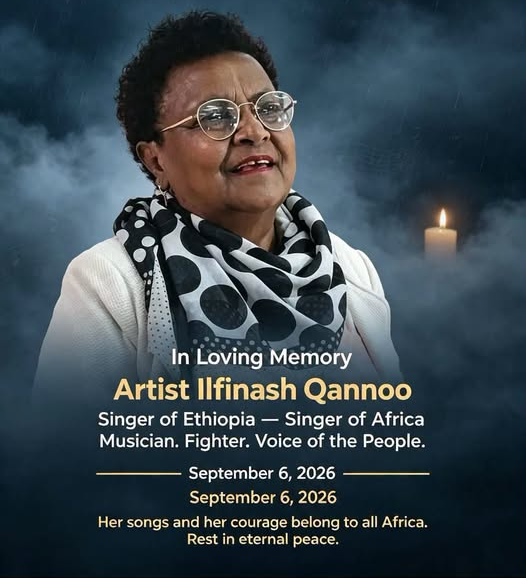
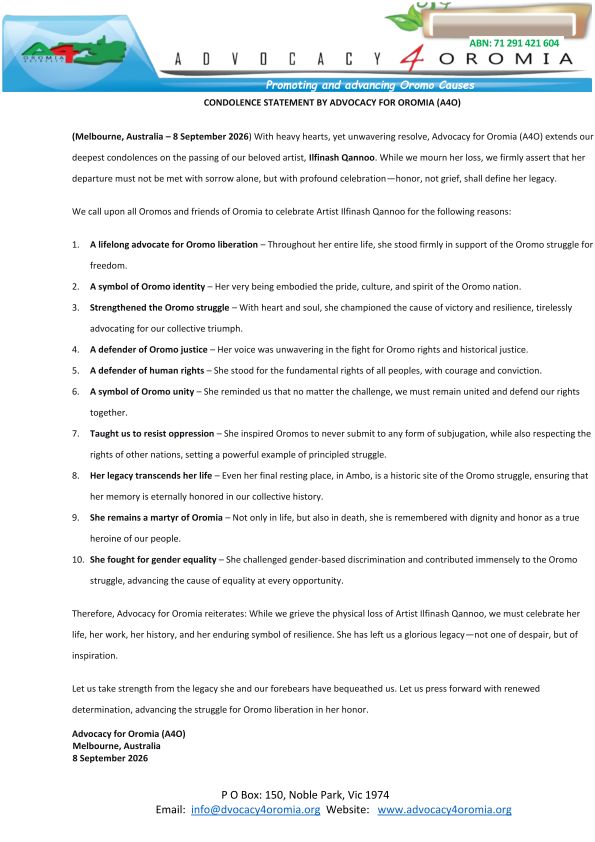
(Melbourne, Australia – 8 September 2026)-In a poignant and powerful statement released today, Advocacy for Oromia (A4O) has called on Oromos and friends of the struggle worldwide to transform mourning into celebration for the late artist and freedom fighter, Ilfinash Qannoo.
The Melbourne-based advocacy group, speaking from their Australian headquarters, emphasized that while the loss of the beloved artist is deeply felt, her life, legacy, and unwavering commitment to the Oromo cause demand a response of honor rather than sorrow.
A Life Dedicated to Liberation
Ilfinash Qannoo was no ordinary artist. According to A4O, she was a steadfast pillar of the Oromo liberation movement, dedicating her entire life to the struggle for Oromo self-determination. Her artistry was not merely entertainment—it was resistance. Her voice was not just melody—it was a clarion call for justice.
“Artist Ilfinash Qannoo spent her whole life supporting and advancing the Oromo struggle for freedom,” the statement reads, positioning her among the most committed cultural warriors of her generation.
More Than an Artist—A Symbol
A4O’s statement highlights ten compelling reasons why Ilfinash Qannoo’s legacy must be celebrated:
A Symbol of Oromo Identity: She embodied the pride, dignity, and cultural richness of the Oromo nation. Her very presence was a testament to Oromo resilience and identity.
Champion of Justice: She was a fearless defender of Oromo rights, human rights, and gender equality. She challenged oppression in all its forms and stood against discrimination, including gender-based injustice.
Unifier of the Oromo People: At a time when division threatens the struggle, Ilfinash Qannoo stood as a powerful symbol of Oromo unity, reminding her people that solidarity is the foundation of victory.
Teacher and Inspiration: Through her life and work, she taught Oromos to resist subjugation with dignity, while also respecting the rights of other nations—a rare and powerful example of principled advocacy.
Martyr for the Cause: Her final resting place in Ambo is now etched into the historical landscape of the Oromo struggle. Her grave, like her life, has become a site of memory and honor.
A Legacy That Transcends Death
Perhaps the most striking aspect of A4O’s tribute is the assertion that Ilfinash Qannoo’s impact extends far beyond her lifetime. She did not simply live for Oromia; she ensured that even in death, she would remain a rallying figure for the movement.
“She left us not with despair, but with a glorious legacy,” the statement declared. “We are called to take strength from what she and our forebears have left us, and to rededicate ourselves to the struggle with renewed vigor.”
A Call to Action, Not Lamentation
In what can be described as a clarion call to the Oromo diaspora and the wider movement, A4O urged supporters to channel their grief into action. The organization stressed that the most fitting tribute to Ilfinash Qannoo is not tears, but a renewed commitment to the goals she championed.
“We must celebrate her life, her work, her history, and her enduring symbol of resilience,” the statement emphasized. “Let us march forward in her honor, advancing the struggle for Oromo liberation with determination and unity.”
Global Reach of the Statement
Issued from Melbourne, Australia, on 8 September 2026, the statement reflects the global nature of the Oromo struggle and the far-reaching influence of cultural icons like Ilfinash Qannoo. A4O’s message transcends geographic boundaries, speaking directly to Oromos in the homeland and across the diaspora.
The advocacy group concluded with an unwavering declaration: “Victory to Oromia!” —a fitting epitaph for a woman whose life was dedicated to that very cause.
Historical Context
Ilfinash Qannoo’s passing marks the end of an era in Oromo cultural and political history. She was among a generation of artists who used their craft as a weapon of resistance, challenging the status quo and inspiring millions. Her death is not just a loss of talent, but the departure of a moral compass for a movement in constant pursuit of justice.
As Oromos around the world reflect on her legacy, A4O’s message is clear: Grieve, yes—but more importantly, celebrate. Honor her by carrying the torch she has passed on.
About Advocacy for Oromia (A4O): Based in Melbourne, Australia, A4O is a diaspora advocacy organization committed to advancing the rights, justice, and self-determination of the Oromo people through awareness, advocacy, and solidarity initiatives.
“We mourn her loss, but we celebrate her life—for in her, Oromia found a voice that will never be silenced.”

A Nation Mourns: The Passing of a Giant—Adde Ilfinesh Qannoo (1962-2026)
A Voice of Freedom Falls Silent, But Her Legacy Echoes Eternally
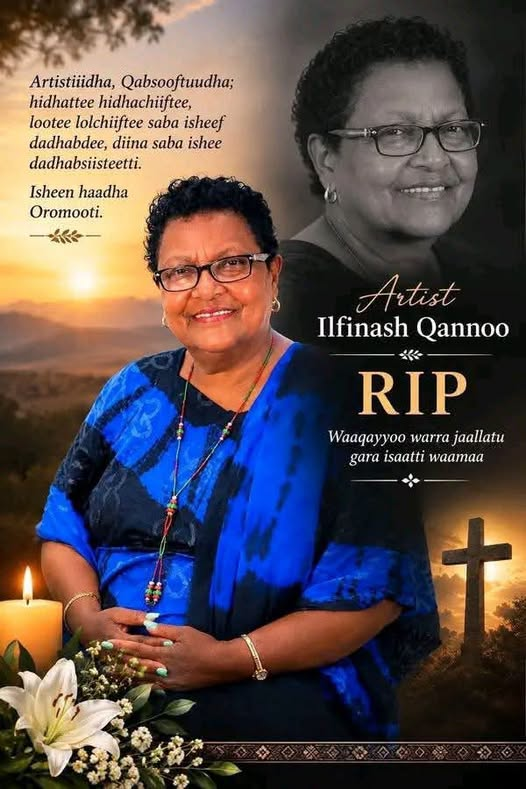
Finfinne, Oromia — Our nation lost a giant today. Adde Ilfinesh Qannoo, the renowned artist whose voice became the heartbeat of a people’s struggle, has passed from this world, leaving behind a legacy etched in the soul of the Oromo nation. Her departure marks the end of an era, but her spirit, her music, and her unyielding commitment to the Qabsoo Bilisummaa Oromoo (Oromo Liberation Struggle) will resonate for generations to come.
An Indelible Mark on History
Ilfinesh Qannoo was more than an artist; she was a monument to resilience, a symbol of identity, and a mother to a movement. Through her music, she gave voice to the joys, sorrows, and aspirations of her people, becoming a living archive of their history. Her songs, imbued with the deep cultural motifs of the Oromo, served as both a comfort and a call to action, reminding her listeners of their dignity, their heritage, and their unalienable right to freedom.
Her contributions to the Qabsoo Bilisummaa Oromoo were not merely artistic but deeply personal and sacrificial. She understood that the struggle for liberation was fought not only in the forests and on the battlefields but also in the hearts and minds of the people. Through her music, she fortified the spirit of the movement, offering hope in moments of despair and courage in the face of oppression.
A Faithful and Loyal Contributor
Throughout her life, Ilfinesh Qannoo remained steadfast in her dedication to the Oromo cause. She was a loyal contributor to the liberation struggle, using her platform to amplify the voices of the marginalized and to challenge the systems of injustice that sought to silence her people. Her courage in the face of censorship, persecution, and hardship stands as a testament to her character and her unwavering commitment to justice.
Even when her body grew frail and her steps grew slow, her spirit remained an unyielding force. Her presence at gatherings of the Oromo Liberation Front (OLF) and other movement events was a source of inspiration and moral clarity. She was the living embodiment of the Oromo proverb “Ilkaan socho’e buqqa’uun isaa hin oolamu”—a seed that moves does not rot. She was that moving seed, ensuring that the dream of liberation never decayed.
A Legacy That Lives Forever
Though her physical journey has ended, the essence of Ilfinesh Qannoo—her music, her symbolism, her love—is a permanent inheritance for the Oromo people. Her life continues to resonate, to inspire, and to fortify those who hold her memory dear. She may have left this world, but her voice remains, echoing in the songs that will be sung, the stories that will be told, and the hearts that will never forget.
Her legacy exists at a powerful intersection: the intimate space of a family mourning a beloved matriarch, and the public sphere honoring an artist who channeled a people’s soul. As flowers are laid and her songs are played anew, the Oromo nation is not just saying goodbye. They are affirming that the struggle she gave voice to continues, the identity she symbolized remains unbroken, and the love she embodied is eternal.
A Message of Condolence from Advocacy for Oromia (A4O)
The Advocacy for Oromia (A4O) joins the global Oromo community in mourning this profound loss. In a statement released today, the organization extended its heartfelt condolences to Ilfinesh Qannoo’s family and the entire Oromo nation:
“Our nation lost a giant today. Adde Ilfineesh Qannoo, a renowned artist and loyal contributor to the Qabsoo Bilisummaa Oromoo, has left an indelible mark on our people and our history. Her legacy will live on forever. The Advocacy for Oromia (A4O) extends its sincere condolences to her family and the entire Oromo nation. May she rest in peace, and may her memory continue to inspire us all.”
An Eternal Prayer
And so, we offer our unending prayer: that Adde Ilfinesh Qannoo’s soul finds the eternal comfort and peace it so deeply deserves. May her spirit rest gently, knowing that her life was a masterpiece of love, labor, and liberation. For her family, her friends, and her people, we wish the warmth of her memory, the strength of her example, and the profound solace that comes from knowing her legacy is in the most capable hands: the hands of a people who will never forget.
Rest in peace, Adde Ilfinesh Qannoo. Your struggle is over, but your victory is assured in the hearts of those you loved and who loved you in return.
—
“A name is above the grave, and your name, Ilfinesh Qannoo, is etched in gold in the annals of Oromo history.”
—
This tribute is offered by Advocacy for Oromia (A4O) and the global Oromo community in loving memory of Adde Ilfinesh Qannoo.

The Unshakable Pillar: Why One Foundational Aspiration Will Outlast Every Attempt to Destroy It
By Dhabessa Wakjira
—
In the quiet corners of history, in the roar of revolutions, and in the whispered hopes of ordinary homes, one truth has endured: human beings are born with an innate longing for equality, freedom of thought, and dignity.
This is not a modern invention. It is not a Western import, nor an Eastern myth. It is the quiet fire that lit every abolition movement, every suffrage march, every student protest, and every parent’s prayer for a better future. And in our own community—ummata keenya—this aspiration has been planted like a deep-rooted tree.
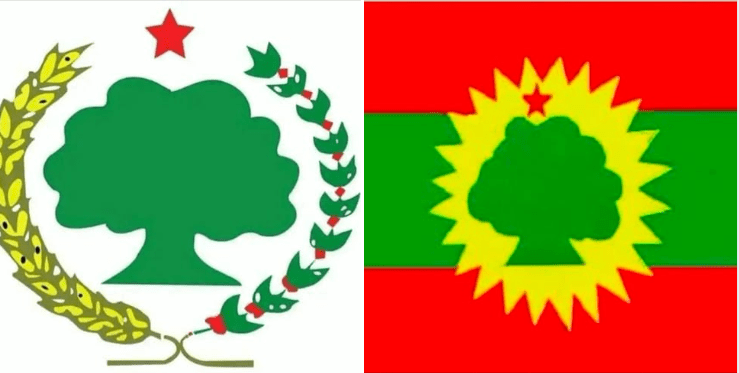
That tree is OLF—not as a slogan, but as a living, breathing promise: that no person is above another; that no mind should be chained; that every voice carries the weight of sacred worth.
—
The Aspiration That Refuses to Die
The original text reminds us: “ABOn waan bu’uraa tokko ummata keessa kaahee jira.”
There is, among the people, one foundational principle. It is not written in stone alone—it is written in conscience. It says:
· Equality is not a privilege; it is a birthright.
· Freedom of thought is not a concession; it is the soil where truth grows.
· Dignity is not a reward; it is the oxygen of human existence.
This aspiration, the text insists, cannot be stopped or erased in any form. Not by armies. Not by laws. Not by propaganda. Not by time.
Why? Because it is not borrowed from a constitution or a king. It is discovered—in the cry of a child, in the sweat of a labourer, in the silent grief of a mother, in the bold question of a teenager. It is experiential before it is philosophical.
—
The Many Faces of Opposition
History is littered with attempts to suffocate this aspiration.
· Tyrants have banned books.
· Dictators have jailed thinkers.
· Empires have rewritten histories.
· Corporations have commodified attention.
· Algorithms have tried to herd our thoughts into safe, sellable boxes.
Yet every time, the aspiration returns—not in the same shape, but in a stronger one.
Why? Because suppression is reactive; aspiration is generative.
· Suppression says: “You must not think this way.”
· Aspiration replies: “Then I will think deeper.”
· Suppression says: “You are unequal by nature.”
· Aspiration answers: “Then I will build communities that prove you wrong.”
This is why the text declares: “Kun dhugaa bara baraan dhaloota walqixxummaa fi bilisummaa barbaadan kamiyyuu keessa kan jiraatuu dha.”
It is the permanent inheritance of every generation that dares to seek equality and liberty. Not a relic of the past—but a living torch passed from hand to hand, across fire and flood.
—
What Does This Mean for Us Today?
In our own time—fractured by misinformation, polarized by identity, exhausted by performative justice—this foundational aspiration calls us back to simplicity and courage.
It asks us:
· Do we treat the stranger at our gate as our equal, or as a threat?
· Do we listen to an idea we hate with the same patience as one we love?
· Do we defend dignity for the powerless, even when it costs us comfort?
If the aspiration is truly unkillable, then our job is not to protect it—but to practice it. Because an aspiration that lives only in speeches is a ghost. An aspiration that lives in schoolrooms, marketplaces, courtrooms, and dinner tables—that is a revolution.
—
The Final Word: A Promise, Not a Puzzle
Some will try to redefine this aspiration. They will twist it into a weapon, a commodity, or a vague slogan. But the core remains indestructible:
Every person holds the right to be free, to think boldly, and to stand equal before their fellow human.
No empire, no algorithm, no crisis can undo that truth—because it is not built on fragile institutions. It is built on the fragile, fierce, unbreakable human heart.
And as long as one parent teaches a child to question, one writer speaks truth to power, one citizen refuses to kneel—that aspiration lives.
It has survived every storm before us.
It will survive every storm ahead.
Not because we are lucky.
But because we are human.
—
“ABOn waan bu’uraa tokko ummata keessa kaahee jira.”
May we never forget it. May we never betray it. May we live it—until it needs no defense.

The Legend of Waacoo Dabaloo: A Hero Who Defied an Empire
Remembering the Oromo Warrior Who Chose Resistance Over Submission
By Malkaamuu Taarikuu Amoosaa
(Asosa, August 11/2026)-In the oral traditions of western Oromia, few names command the reverence of Waacoo Dabaloo—a warrior whose defiance against the expansion of the Ethiopian Empire has become the stuff of legend. While his story remains largely unrecorded in formal histories, it lives on in the songs, proverbs, and collective memory of the Oromo people, particularly in the Jaarsoo district of East Wallagga.
A Lineage Rooted in Resistance
Waacoo Dabaloo was born in what is now the Jaarsoo district of East Wallagga Zone, a region known historically as “Citaa Akkumaa.” Today, the area lies approximately 525 kilometres west of Finfinne (Addis Ababa) and 103 kilometres west of Gimbi, the zonal capital. The district is bordered by Najjoo to the east, Baabboo Gaambel to the west, Gullisoo to the south, and Lataa Sibu to the north, covering an area of 491.6 square kilometres.
Waacoo Dabaloo belonged to the Sibuu clan of the Oromo people—a lineage that traces its origins to the Maccaa branch of the Oromo nation. The Sibuu are one of the seven sons of Daallee (or Daadhii), who was himself a descendant of the Oboo clan. This deep-rooted lineage gave Waacoo a profound connection to the land and people he would later defend.
The Context of Conflict
Waacoo Dabaloo came of age during the latter half of the 19th century, a period when Emperor Menelik II’s expansionist campaigns were sweeping through southern and western Oromia. This era was marked by brutal subjugation, land dispossession, and the systematic erasure of Oromo identity. While some local leaders chose to submit to the advancing forces, Waacoo Dabaloo stood firm.
The historical record suggests that Waacoo formed alliances with other prominent Oromo resistance figures, most notably Abiishee Garbaa of the Horro Guduru region. Together, they coordinated efforts to resist the encroaching empire, exchanging messengers and supporting each other during times of attack.
The Art of Guerrilla Warfare
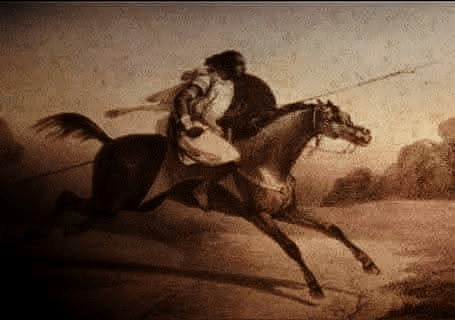
What makes Waacoo Dabaloo’s resistance remarkable is that he fought without modern weaponry. Armed only with the traditional spear and shield, he employed guerrilla tactics—using his intimate knowledge of the forests and terrain of Jaarsoo and surrounding areas to launch ambushes and disappear before the enemy could retaliate.
Songs composed in his honour still echo in the region:
“Waacoon daggala galee,
Daggallikoo hin qabiniin.
Inni farda koomfatee,
Mootichi hin dhabamiin!”“Waacoo entered the forest,
He does not lack forest.
He led his horse forward,
The emperor will not find him!”
Another song praises his mount, a horse named Biichee:
“Mee fardaan dhufe jedhaa,
Biicheen Waacoo Dabaloo.
Gootni eeboo luqqisee,
Diinaaf laatu gadoo!”“They say he came on horseback,
Biichee, the horse of Waacoo Dabaloo.
The hero brandished his spear,
Brought death to the enemy!”
A Difference in Strategy
While some Oromo leaders, including a figure named Kuumsaa, chose to negotiate with Menelik’s forces—accepting titles and positions in exchange for submission—Waacoo Dabaloo refused. He saw such compromises as a form of enslavement.
“Paying tribute to the northern empire is servitude,” he is said to have declared. “We must not give away our ancestors’ land to anyone.”
His refusal to submit ultimately led to his capture through betrayal rather than defeat on the battlefield. Like many Oromo heroes, Waacoo Dabaloo was not conquered by force but brought down through deception—a pattern that echoes throughout Oromo history.
A Legacy Etched in the Land
Today, the memory of Waacoo Dabaloo is kept alive not only in song but also in the landscape. A hotel in Jaarsoo town, built by his descendants, bears his name as a testament to his enduring legacy. For the Oromo people, Waacoo Dabaloo represents the spirit of defiance—the refusal to submit to oppression, even at the cost of one’s life.
His story is part of a broader tapestry of Oromo resistance that includes figures like Waaqoo Guutuu, Aliyii Cirrii, and Bakar Waaree. Like them, Waacoo Dabaloo’s sacrifice reminds the current generation that freedom and dignity are worth fighting for.
Injifannoon Ummata Oromoo!
Gootummaa Waacoo Dabaloo haa jabaattu!
This feature article is based on oral histories and the reflections of Malkaamuu Taarikuu Amoosaa, dedicated to preserving the legacy of Oromo heroes.





 Advocacy for Oromia