Daily Archives: September 9, 2026

The Unbroken Ode: Elfinesh Keno’s Life of Resistance and the Legacy She Left in Ambo
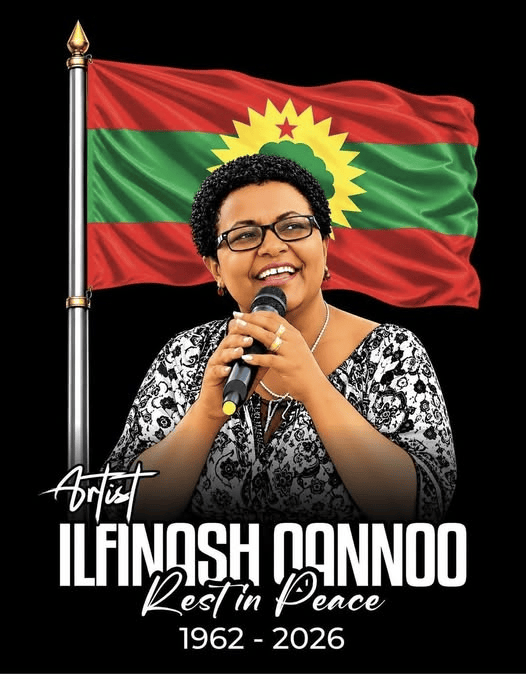
By Daandii Ragabaa
In a world where countless souls bend, break, or sell their dignity for comfort or personal gain, Elfinesh Keno walked through fire and emerged with her value intact. Even in death, her respect stands untouched—a monument to a life lived not for fame, but for freedom. Her art was never mere entertainment; it was resistance. It was a shield. It was a call to conscience.
She was an Oromo singer and cultural icon whose voice rose not for applause but for the rights, equality, and dignity of her people.
The Child of a Legacy
Born into the shadows of a struggle far larger than herself, Elfinesh Keno—known to many as Ilfinash Qannoo—was the daughter of Daraaraa Kafanii. Her lineage traced directly to Obboo Argaw Dinqaa, a towering Oromo patriot, lawyer, and founding father of cultural and political organizations such as Jibatii, Maccaa, and the Waldaa Walgargaarsaa Maccaafi Tuulamaa (WMT). Obboo Argaw was no ordinary man. Imprisoned for his opposition to the H/S government, he emerged from confinement to organize the Grand Oromo Cultural Festival of 1977 in Finfinne. He used culture as a weapon to resurrect Oromo identity and unity.
It was on that stage that young Elfinesh Keno first stepped into the light of history, performing alongside artists like Obboo Tasammaa Nagarii and Aaddee Kuulanii Guddinaa. Her art was a product of that great cultural renaissance—a movement that toured towns such as Asallaa, Waliso, and Naqamtee, where elders like Jaal Nadhii Gammadaa and Jaal Magarsaa Barii worked alongside Obboo Argaw to reinstate the sacred Gadaa system through performance.
A Heroine Forged in the Crucible of Conflict
But the road was never easy. When the Oromo liberation movement intensified, the Derg regime came for its leaders. Obboo Argaw was arrested on October 19, 1978, and later executed. Yet the flame he lit was passed to the next generation—to artists like Daraaraa Kafanii and his daughter, Elfinesh.
In the turbulent years that followed, Elfinesh found herself on the frontline. During a ferocious battle in Burree, Jalduu, in July 1992, between W3O fighters and the Wayyaanee (EPRDF) regime, she and fellow artist Zaruhuun Wadaajoo were captured. They were imprisoned in Ambo’s Karchallee detention center. There, Elfinesh faced the possibility of execution.
Her story at that point offers a stunning glimpse into her character. When the Wayyaanee regime’s OPDO operatives debated executing her, she was saved—not by bending her principles, but by her unwavering association with the Oromo people. Some of those who held her file, knowing the depth of her devotion, feared the wrath of the people so much that they altered her records to avoid carrying out the sentence.
Meanwhile, the people of Ambo acted. They pooled their money and bribed the prison commander, ensuring Elfinesh would not be killed behind bars. When she was finally released, the community welcomed her like a returning queen—taking her to the Daraaraa Kafanii Hotel, where she reunited with elders and fellow fighters. Even in the face of death, she did not run. She chose duty.
Ambo’s Daughter by Choice
One of the most defining moments of Elfinesh Keno’s life came near the end. When she could have chosen to return to her birthplace, to the comfort and familiarity of her early years, she did not. Instead, she chose Ambo—the city whose people once chose to face bullets for her.
Ambo’s masses had refused to let her die. They had stood by her during her darkest hour, chanting for her survival and promising to keep the fight for true freedom alive. In return, Elfinesh honored their bravery with her final resting place. That decision alone speaks volumes about her character.
Her choice reminds us that heroism is not loud; it is consistent. It is not boastful; it is principled. And it is not convenient; it is costly. But Elfinesh Keno paid that cost willingly.
A Lesson for the Wavering
Elfinesh Keno’s life offers a powerful lesson to all who waver, compromise, or forget the weight of responsibility. While many ran for safety, she ran toward duty. While others hid, she stood in the field. While some betrayed their own, she remained truthful to her core.
Her integrity was so complete that she could recognize goodness even in those standing on the opposite side of history—a mark of a true heroine. She taught the cowards and the “gantuus” that she would rather be covered with the flag of resistance, a symbol of freedom, than to live under the shadow of betrayal.
The Eternal Thread
Elfinesh Keno’s story is not an isolated one. It is a thread in a larger tapestry of Oromo resistance and cultural preservation. In her, we see the face of Obboo Argaw Dinqaa. Through her, we hear the voices of Jaal Nadhii Gammadaa, Jaal Magarsaa Barii, Jaal Abboomaa Mitikkuu, and countless unnamed heroes who gave their lives for Oromummaa.
Her passing is a heartbreak—”Bool’akee bookni haa guutu,” as the Oromo poet wrote. Yet she did not die in vain. She passed away with her value intact, her respect untouched, and her legacy eternal.
May her memory continue to guide her people.
May her courage continue to inspire future generations.
May her integrity remain a mirror for all who claim to serve the truth.
Stand for Something
Elfinesh Keno’s final chapter reflects her deepest values: the pursuit of truth, the protection of dignity, and the unwavering commitment to her people. In the end, she was not just an artist or a performer—she was a symbol of what it means to live with purpose and die with honor.
Her voice may be silent now, but the melody of her resistance will echo forever.
Stand for something.
Live truthfully.
Protect your dignity.
Let your final chapter reflect your deepest values.
Elfinesh Keno—Ilfinash Qannoo—passed away with her value intact.
Her respect untouched.
Her legacy eternal.






