Category Archives: Information

The Oromo of Eastern Africa: Ali Mazrui’s Perspective

Exactly 10 years ago at the annual meeting of the Oromo Studies Association in Minneapolis, Minnesota, the late Kenyan philosopher Ali Mazrui (1933-2014) gave the keynote address in which he spoke, with his characteristic flamboyance, about what he called the largest ethnic nation in Eastern Africa, the Oromo. His perspective was originally comparative and international.

The Oromos are in the news lately in connection with their growing demand for self-determination. When he gave the keynote speech Mazrui was regarded as one of the top 100 public intellectuals in the world. So, what did Mazrui, the public intellectual, have to say about the Oromo? What are the implications of the Oromo question for Ethiopia and the Horn of Africa? I believe this is the right time to understand some of the relevant issues more fully from a historical perspective. In this vein, I am presenting below an adaptation of Mazrui’s keynote speech—mostly in his own words.

One of the exceptional things about Eastern Africa is the historic cultural symbiosis between the Oromo and the Amhara across the centuries. If the Amhara are like the English in the United Kingdom, are the Oromo as historically abused by the Amhara as the Irish were by the English, or are the Oromo as historically respected by the Amhara as the Scots were by the English?

Two processes have fluctuated in relations between the Oromo and the Amhara across the centuries. The two processes are homogenization (trend towards becoming homogeneous) and hegemonization (trend towards becoming dominant or hegemonic). This has created the special exceptionalism of the Oromo people.

With regard to cultural homogenization between the Oromo and the Amhara, earlier centuries left the rivalry unsettled. From the 17th century sedentary Oromo started integrating with their Amharic-speaking neighbors. Some Oromo chiefs acquired some political power in the wider Ethiopian monarchy. Emperor Iyasu II (1730-55) was half Oromo and promoted a network of Oromo allies. Indeed, this was the period when the Oromo language became the language of the court at Gonder. Homogenization in this era favored the spread of Oromo culture.

In late 18th century the central government of Ethiopia weakened considerably. Local princes and governors carved out greater power and asserted autonomy for themselves. This period was known as the Zemene Mesafint, and was characterized by dis-homogenization, in the sense of decentralization of power. The Oromo dynasty of Yejju Chiefs produced a string of warlords who exercised disproportionate influence on the weakened titular emperors of Ethiopia. Some Oromo Chieftains became virtual Regents of the Empire.

Power transfer through marriage was another method of hegemonization. Ras Ali of Yejju ascended to pre-eminence in 1779. As the Emperor of Ethiopia lost hegemony during Zemene Mesafint, the Yejju Oromo became de facto custodians of the Empire.

In 1855 Ras Ali II of Yejju was defeated by Kassa Hailu. Almost out of the blue Kassa Hailu became Emperor Tewoderos II. From then on the Oromo not only declined politically; they also became gradually marginalized culturally. The Oromo language was even banned from official institutions very much like the Kurdish language was later discouraged in the Republic of Turkey under the legacy of Mustapha Kemal Ataturk. The Amharaization of the urban Oromo elites accelerated the process of cultural homogenization from the nineteenth century onwards. The treatment of the Oromo by the Amhara was almost a dress rehearsal of the treatment of the Kurds by the Turks a century later.
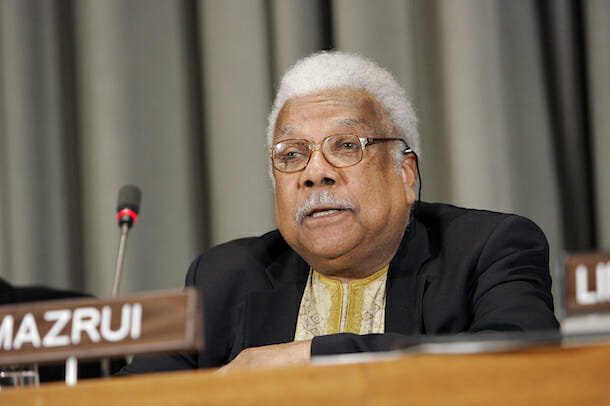
Ali Mazrui in 2007. (Ryan Brown)

The major subprocesses of the Amharaization of the Oromo were linguistic (the spread of Amharic among the Oromo), religious (the Christianization of the Oromo, especially via Orthodox Christianity), bureaucratization (the cooptation of the Oromo into the civil service and the armed forces of the Empire), and intermarriage (cross-ethnic matrimony and raising children of mixed ethnicity).

Lady Menen of Wollo became Empress in the nineteenth century; Ras Muhammad of Wollo became Ras Mikael and subsequently Negus of Siyon. He fathered Emperor Iyasu V. In the twentieth century Lady Menen of Ambassel became Empress Consort of Haile Selassie I. These were forms of homogenization in more than one sense. They were the mixing of biological genes, as well as the erosion of cultural differences (heterogeneity).

Was there counterpenetration of Amhara culture by the Oromo? In reality Oromo counterpenetration into Amhara society did not include language. The Amharic language was bound to absorb some words and phrases from the Oromo linguistic heritage, but very few Ethiopians of Amhara descent embraced the Oromo language instead of Amharic. A lot more Oromo adopted Amharic instead of the Oromo tongue [Oromiffa or Afaan Oromoo].

In the transmission of religion there was some exchange. Millions of Oromo were Christianized as a result of contact with the Amhara. Emperor Yohannes IV even forced Christianity upon large numbers of the Oromo in the late 1800s on pain of the Oromo losing their properties. These were trends towards religious homogenization.

While the indigenous Gadaa system of governance of the Oromos did not influence the imperial monarchical system, the indigenous warrior tradition of the Oromo did result in a disproportionate military role for the Oromo within the Empire. Menelik II allied with Ras Gobena’s militia to expand Menelik’s empire eastward and southward. Haile Selassie’s father, Governor of Harar, was a top-general in the Battle of Adwa when Melelik’s forces defeated the Italians. Emperor Haile Selassie I was in part of Oromo descent, as well as of Amhara ancestry. Haile Selassie symbolized Oromo counter-penetration of the Amhara at the highest political level. But he was in denial about his Oromo genes. Haile Selassie was the de jure Emperor of Ethiopia from 1930 to 1974. Iyasu V, another Oromo-Amhara, had been the de facto but uncrowned ruler of the Empire in the nineteenth century.

The exceptionalism of the role of the Oromo in Ethiopia has continued to be this symbiotic interplay between hegemonization (as the Oromo have ascended to ultimate power-sharing) and homogenization (as the Oromo have shared culture and mixed blood with the Amhara).
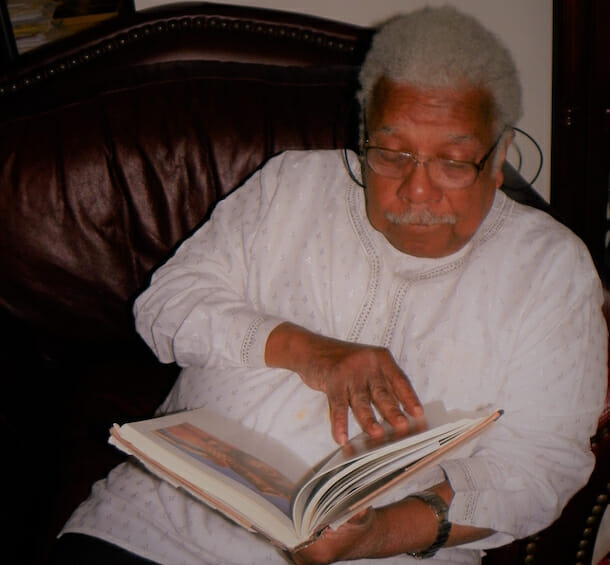
Ali Mazrui. (Seifudein Adem)

Have the Oromo been an internalized colony of the Amhara? Yes, but there are degrees of colonial status. A closer look at another imperial power would clarify these degrees of subordination. Before Great Britain became a global empire, it consisted of internal colonization. The English people were the equivalent of the Amhara.

Linguistically the whole of the United Kingdom was homogenized and became English-speaking. But the status of the component parts varied. The most deeply colonized and dominated was Ireland. Indeed, for centuries, the Irish were treated by the English as an inferior “race” right into the earlier years of the twentieth century. Next in status within the United Kingdom was Wales, which was also treated as an inferior partner to the English for centuries, but was not as humiliated as the Irish.

The most respected partner in the United Kingdom to the English was Scotland. Its union with England under the Scottish Stuart Kings in the seventeenth century (James I and Charles I and their post-Cromwellian successors) was voluntary. The union put a Scottish King in the throne of England. Scotland developed its own Church of Scotland (partially distinct from the Church of England) and retained its own parallel currency into the twenty-first century. In spite of the rise of the Scottish nationalist movement in the second half of the twentieth century, the Scots were essentially almost the equals of the English for most of the time since the formal union of England and Scotland under the Stuarts in the 1600s.

The big comparative question is whether the Oromo in the history of Ethiopia were more like the Irish in the history of the United Kingdom – totally dominated and despised by the English for centuries? Or were the Oromo more like the Scots – not quite the equals of the English, but often sharing power, and at times even occupying the English throne?

There were times in Ethiopian history when the Oromo elite and the Amhara elite were more like the English aristocracy alongside the Scottish aristocracy – not quite equal, but retaining substantial mutual respect. There have been other periods of Ethiopian history when the Amhara treated the Oromo in the way the English once treated the Irish – as a lower breed of people, and an internalized colony.

But what about the Oromia of the future? Will it be more like Scotland – autonomous and dignified but not totally equal to England politically? Or will it be more like Ireland before the first half of the twentieth century – a de facto colony in subjection to the English? Or is there a chance that Oromia would one day become the equivalent of the Irish Republic – sovereign, free and increasingly prosperous? If the whole of Ethiopia had been governed in terms of so-called “one man, one vote,” the Oromo would have had an edge. Out of the total population of 105 million, most independent estimates place the Oromo at about 34% of the population, while the Amhara may be just about 27%, with Tigrayans coming third, with about 6%.

Systems of governance in Eastern Africa have included monarchies which endured for centuries among the Amhara and simpler pastoralist traditions among the Somali. Governance among the Oromo was intermediate between the monarchical centrism of the Amharas and the statelessness of the Somali. The Oromo transitional principle of eight years as a generational unit of allegiance (Gadaa), has been increasingly adopted as a term limit for two terms of presidential incumbency in the United States. More and more countries in the world, influenced by the American example, have opted for two maximum terms of presidential incumbency, adding up to eight years (or an outer limit of ten years).

The reasons which made the Oromo choose the unit of eight years as a guiding ancestral principle of democracy were entirely distinct from what made the United States after World War II opt for a maximum of eight years for all future presidents after Franklin D. Roosevelt and Harry S. Truman. Nevertheless, the term limit of eight years for presidential power is gaining ascendancy in modern democracies centuries after the ancient Oromo founding fathers were guided by the mystique of eight years as a generational unit.

If you’re interested in writing for International Policy Digest – please send us an email via submissions@intpolicydigest.org
Human Rights Abuses:163 extra-judicial killings and the arbitrary detention of at least 933 people in Ethiopia

(Oromia Support Group Report) The extra-judicial killing and arbitrary arrest of OLF supporters since December 2018 has created a situation in Oromia very similar to that in 1991-2 when thousands of OLF supporters were killed and scores of thousands detained and tortured.

The good will and support for Ethiopia from the international community helped to maintain the abusive regime of Meles Zenawi, then in power. The current silence about killings and widespread imprisonment is eerily reminiscent of that time.

Many reports have been sent to OSG since December 2018 and this report is a summary of the information received.

This report includes information about 163 extra-judicial killings and the arbitrary detention of at least 933 all due to their suspected support for the Oromo Liberation Front, which officially returned to Ethiopia in September 2018.

Oromia Support Group Australia – Summary Report on Human Right Abuses in Ethiopia

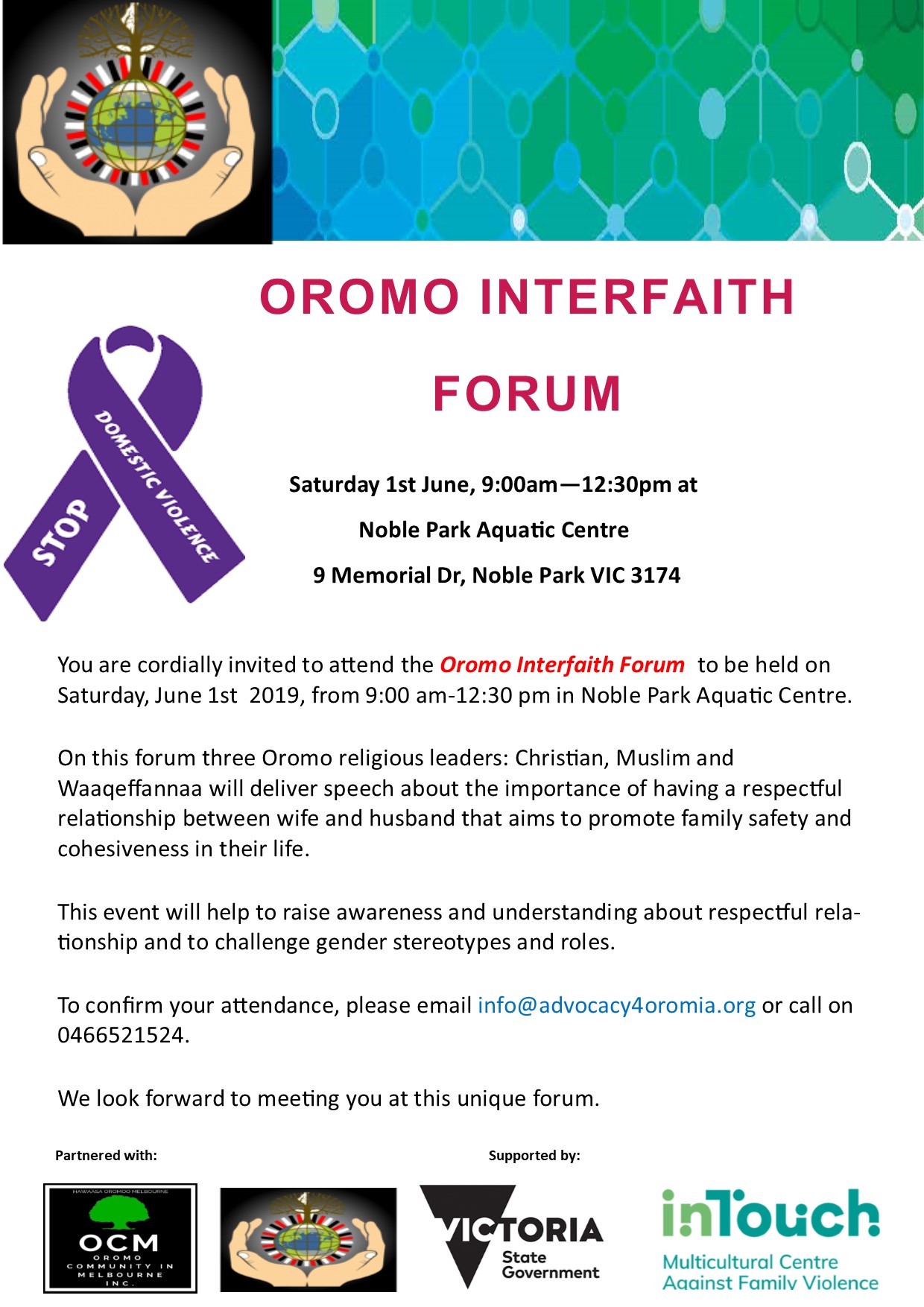
OROMO INTERFAITH FORUM

Requesting urgent intervention to uphold the rights of Benshangul Gumuz civilians

(A4O, 8 May 2019, Press Release) We have confirmed that Benshangul Gumuz civilians are increasingly targeted and executed by the highly armed and well-trained Amhara militia. They were trained, radicalized and fully armed with modern machine guns by a National Movement for Amhara (NAMA).


According to the eye witnesses, over 500 Shinasha people in Benshangul-Gumuz Region, Jawi Woreda, were suddenly executed; tens of thousands of civilians were also made to flee their own villages for their lives between May 1 and 2, 2019. The main victims were civilians including children, women and elderly. Homes were also torched in that outbreak of violence.
We have also observed that the civilians are getting killed for no apparent reasons by a highly armed Amhara regional special force in Benshangul Gumuz regional state. This armed group is not only targeting solely indigenous and legitimate owners of the land; but also, hundreds of children and elderly are getting summarily executed for a simple reason of being different from their killers in the aspect of their culture, skin colour and political beliefs.
The Ethiopian Government neither condemn the killings of civilians nor asked for apology for failing to safeguard them. Although some authorities claim the restoration of the order, this is far from the truth as the Government hasn’t so far take any justifiable action against the killers and forces behind these tragic executions.

Background information
Recently, the Amhara Special force further threatened the Oromo people in relation to the ownership claims of Finfinnee (Addis Ababa). These group further vowed to repeat their success in Benshangul in Wallo and other parts of Amhara-Oromia borders.
In 2003, for instance, between 430 and 500 unarmed civilians were massacred by those who colonised their land for a simple reason of silencing them whilst expropriating their resources and land in Gambella region. The same massacre is now unfolding in Shaka zone on a Shakacho people by the same highlanders. Tens of thousands of Oromo, Ogaden Somali and Sidama civilians were executed in the last 27 years alone.
Call of Action
Advocacy for Oromia, a non-profit advocacy organisation working to ensure that the people’s rights and wishes are respected, has deeply admired much of the work done by both regional and federal government to restore peace and stability in the region.
In fact, political differences may divide some of the regional states in the country. But upholding human rights is in the interest of every state. Peoples of these regions also seek a common agenda: rights, peace, security, justice, freedom, and sustainable development.
We firmly believe that human rights are a powerful medicine, which heals wounds and develops resilience. Thus, we show our consistent and unrestricted solidarity until justice is served on their behalf by bringing those who have killed and maimed their sons and daughters to an independent justice.
Advocacy for Oromia, therefore, unanimously condemn with the strongest possible terms such barbaric actions toward the unarmed civilians, children, women and elderly of Benshangul Gumuz.

Furthermore,
1. We urge the Amhara’s regional state to exercise utmost restraint and lawfully handle its anarchically behaving special forces that has been primarily trained to maintain law and order. There won’t be any peace and security as long as some groups are fighting to dominate and dehumanise fellow mankind.
2. We demand the federal government to immediately intervene and stop the on-going execution of powerless civilians whose lives are put at the mercy of their barbaric assailants.
3. We urge the federal government to immediately investigate and bring those responsible for such horrific and inhumane actions to civilians to justice.
4. We advise the international human rights group and western countries politicians to earnestly bring this unsettling massacre of civilians to the attentions of obliviously sleeping Ethiopian authorities by urging them to take meaningful and corrective measures as a matter of urgency.
5. We call up on all Ethiopian peoples to unconditionally condemn such barbarism and demand the Amhara regional state to stop its inhumane actions to the unarmed civilians.
We will always continuously work for and speaks up for the voiceless people.
Press Release by Advocacy for Oromia,
May 8, 2019.

For PDF format:Press Release 8 May 2019

Grave Human rights violation in the Guji area of Oromia Regional State, Ethiopia

‘Why is it so brutal, immoral, inhuman, and so atrocious.’

Oromia Support Group Australia
Issue 2, April 2019

Oromia Support Group Australia (OSGA) grievously worries about the severe human rights violation in Guji area, State of Oromia. The Ethiopian military forces, regional and zonal administrations are, in collaboration, committing a grave violation of human rights that include mass killing, incineration of people alive, mass detention, burning of villages, and confiscation of properties, torture and starvation of villagers. The action of brutality has been carrying out only in the name of stamping out OLF (Oromo Liberation Front) forces from the area.

Since December 2018 right after the deployment of Ethiopian military to the area, there have been many atrocities committed by the army and the zonal administration forces in the area. For instance:

1. 28 December 2018, thirteen innocent civilian from Finchawa town, Dugda Dawa district and six civilians from a village called ‘Maxxaarrii’ in Galana Abaya districts were brutally killed. The same day, around 10 pm local time many people were injured some of which died later due to their injuries. What made the killing so horrendous was that it happened at a time when the village was peaceful, and the residents of the town were on their regular daily routine. The residents in the area unsuspicious as to what was going to happen even to take a cover to avoid the spontaneous raining bullets and heavy machine guns that burned everything it hits (vehicle, motorbike, house, tree) including human being.

As a human being, no one thinks would enjoy the sight of tarred corpus and can easily imagine what the family and society would feel seeing their beloved torched in broad daylight without his or her sin.

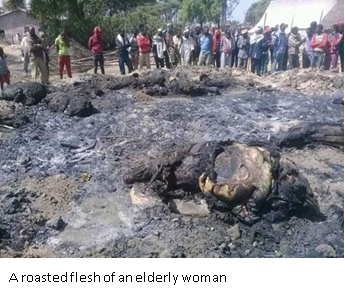
2. Similarly, on 15 January 2019, an elderly woman who was sitting in her hut was incinerated after the door of the shelter she was living in was locked from behind and torched while she was alive. What made this killing too shockingly inhuman was the brutality of the soldiers that waited to make sure the elderly that was burning to ashes was completed and fled the scene pinching their noses due to the roasting flesh that smoked the area. This brutal killing has happened after the soldiers had indiscriminately killed at least ten and injured many in and around Karcha town and killed many unaccounted along their way including an elderly man who was riding a horse 100 meters away from the house they torched with the elderly woman.

Besides these significant incidents, without any late up, the killing rampage of two, three, five, ten, here and there across the area has continued to date including burning of villages, displacement of villagers, confiscation of properties and killing of anyone who rides a motorbike without any impunity.

3. On 19 February 2019, for instance, an indiscriminate shooting on artisanal gold miners in the Dakara village in Arero district killed six civilians on the spot and injured many who run into the thorny bush and ragged rocks that further harmed women and children.

4. Gujii area is totally under siege. Motorbike, the only means of transportation for remote villagers, is prohibited. Much of it is confiscated as such people have to walk a day or so on foot to access markets. In some areas, even those markets are restricted. The amount of food one carries is limited to less than five kilos yet if one has to have a family of ten or more which is common in Gujii area.
5. Night curfew is imposed in the rural and urban areas. One can’t walk in the night to reach the village, and he or she has to walk in the scorching sun to avoid the killing and detention that comes due to the breach of the night curfew. No one can complain about why someone is arrested and why someone is shot. The number of people who moved to the concentration camp has increased by the day. At the time of this report conducted more than two hundred and fifty people from Bule Hora, ninety-four from Qarcha, fifty-five from Malkaa Soda and many more from various areas of Gujii are on course to be transported in addition to thousands who have already been transported to some undisclosed harsh concentration camp. People have to run to bushes with their children to avoid capture. It is so hostile beyond human imagination.

6. Just recently as if all the atrocities committed by the military are not enough they have trained local militias whose task is to burn properties of families of suspected sympathisers of the rebel groups as such many suspects’ properties in many places in the area are burned to ashes. Those who objected to the tactic are taken to concentration camps. While that is one thing what is worrying is the identity of those who are burning properties. As stated these militias are locals and they are known, people. At the same time, those of who whose properties are destroyed are locals. They know who is doing this. Guji community is known for its cooperation along its lineage. If the family or sub-clans of those whose properties are destroyed respond to the action of the local militias and the families or sub-clans of the local militias counter, it is not hard to imagine what would happen in the area.

Oromia Support Group Australia urges all the concerning bodies to pay immediate attention to these grave human rights violations and instantly call for the cessation of these brutal collective punishments. All the breadwinners of their family should be released from concentration camps. Peace and stability need to be restored in the area through civilised negotiation instead of resolving the differences through military means. Those who have committed grave crimes should be brought to justice for the accountability of the evil they have committed.

For more information:OSGA April 2019 Statement on Grave Human Right Violations in Guji – State of Oromia

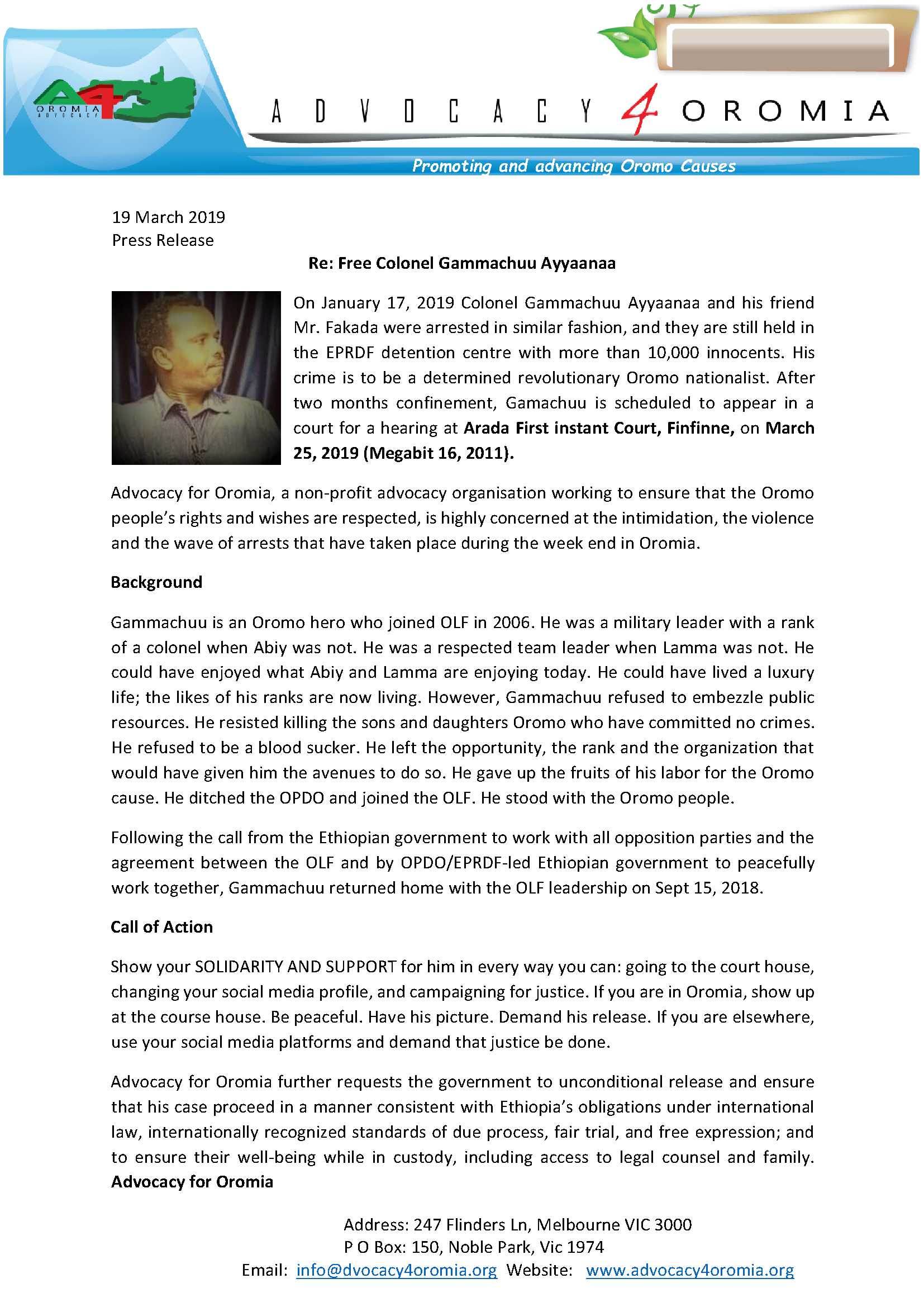
Call of Action: Free Colonel Gammachuu Ayyaanaa

(A4O, Press Release 19 March 2019) Advocacy for Oromia, a non-profit advocacy organisation working to ensure that the Oromo people’s rights and wishes are respected, requests SOLIDARITY AND SUPPORT for Colonel Gammachuu Ayyaanaa in every way you can: going to the court house, changing your social media profile, campaigning for justice, and doing everything that is orderly and peaceful.

The organisation says in today’s press release, more than 10,000 Oromo individuals are imprisoned because of their bold stand against in justice in Oromia.

Event: Gamachuu is scheduled to appear in a court for a hearing. Show your SOLIDARITY AND SUPPORT for him in every way you can: going to the court house, changing your social media profile, campaigning for justice, and doing everything that is orderly and peaceful.

When: March 25, 2019 (Megabit 16, 2011)

Where : Arada Court, Finfinne.

For full press release:Press Release 19 March 2019

Oromia: Requesting urgent intervention to uphold the rights of Oromos in Oromia

(A4O, Press Release 12 March 2019) Advocacy for Oromia, a non-profit advocacy organisation working to ensure that the Oromo people’s rights and wishes are respected, is highly concerned at the intimidation, the violence and the wave of arrests that have taken place during the week end in Oromia.

Advocacy for Oromia understands the security concerns of the regional and the Federal Government and the steps taken to protect the people who live in the country. The Ethiopian military established a buffer zone in Western Oromia (four zones of Wollega) and Southern Oromia (Borana, Goji Zones) and deployed huge number of military forces in Oromia.

Over the last three months, more than 200 Oromo people have reportedly been detained in Xoolay and Sanqallee detention camps. Furthermore, the door to door operation has involved breaking the houses and beating them up cold-heartedly and treating them in heartless manner and robbing their properties. However, none of the government bodies have initiated any inquiry into the matter which continues to violate human rights.

For detail information: Press Letter 12 March 2019

Oromoonni Melbourne Australia keessa jiraatan waa’ee Irreechaa Melbourne 2018 dhaamsa qabu.

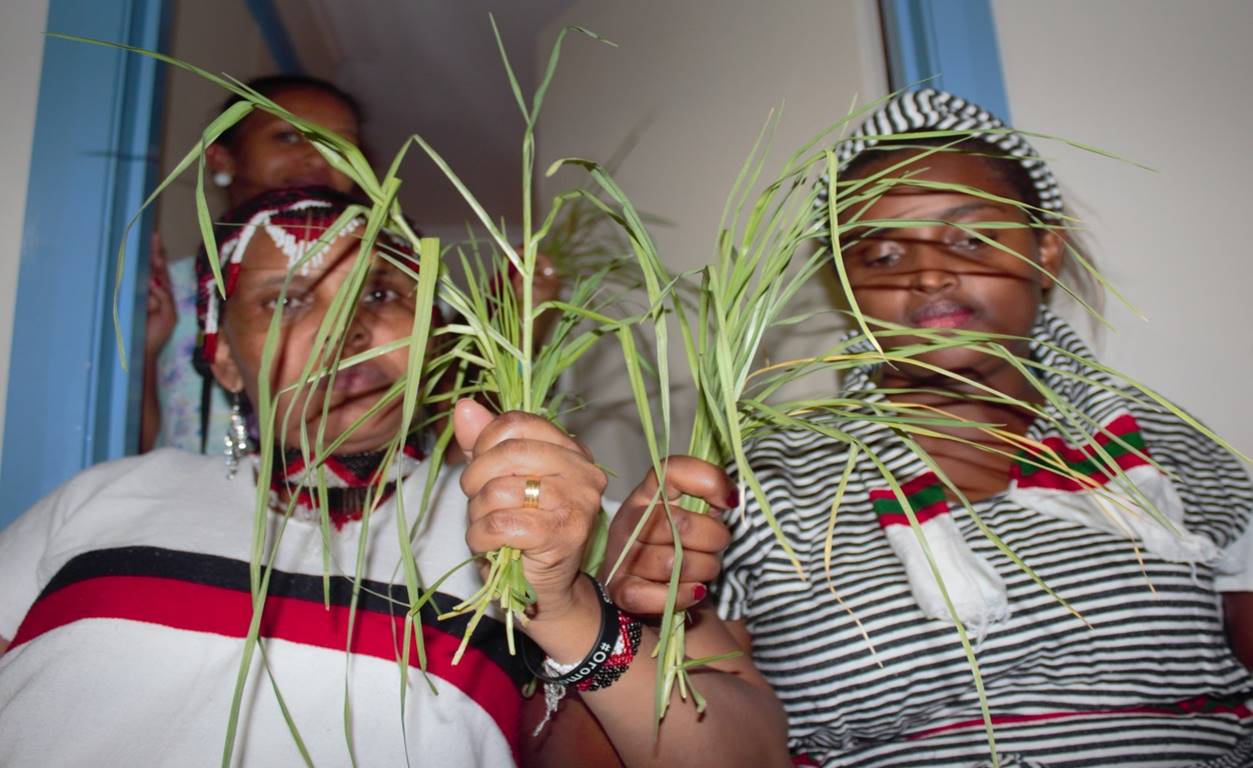
(A4O, 5 Onkoloolessa 2018) Irreechaa 2018 gaafa Onkoloolessa 7, bara 2018 biyya Australia kutaa Victoria keessatti kabajama.

The culture: go forward with “Ilaa fi Ilaamee” (dialogue) for resolutions

Oromo, at home and abroad please get organized; let those claiming to have been organized also get stronger. For how long will you live grumbling or kneel and beg to be noticed? Get up on your knees, raise your head and assert your rights as you did four years ago. This time has been called transitional but where it transits it is not clear. All oppressors’ tricks seem to be exhausted but no one knows this time with what they might come out to save the empire? Heating up war of words is heard between Amaaraa and Tigree.

From speeches of leaders, it seems the empire’s administration is inclining towards Amaaraa. Because Oromo entered the palace power did not go for Oromiyaa but for Ethiopia. Persons who are in power in Ethiopia and Oromiyaa are members of EPRDF. For that reason, they are fanning Ethiopianism; that means Oromiyaa colonial status is still in their minds. When they say Ethiopia, Ethiopia it is as if they lost and found. Oromiyaa’s independence has been forgotten as dead. In order for past dangers not to occur again we have to remind about it to those who are wavering. And point out directions as to what to do next, for untimely and misplaced criticisms against each other or the enemy alone cannot be a solution. If whatever we say to each other or others has no concrete benefit why would we badmouth and humiliate ourselves? When a beast can no more devour after its strong canine teeth had fallen and strong new one comes and improves on its methods and gnaw not only the flesh but also the bones, what is their difference? If not, the size it chomps at, being eaten means being eaten? Unless we see similarities of what Habashaa of Ankobar and that of Adwa did to us, we could make a mistake of looking for a different panacea.

It is good to develop the stamina to say for all, “Stop your domination and plundering just now”. Tigree and Amaaraa had lived waging power struggle among themselves at least from the time they destroyed Aksum. Occupying us together reconciled them, for a part starting to lose us made them to quarrel. Of what concern is it for an Oromo person to interfere in their wars before he/she stands on own feet and build strong rear? How can one choose between masters when one can liberate oneself? Had our crooks not helped them in the past they could not have been able to devour us alone. Bragging by changes brought by Oromoo Qeerroo and Qeerrantii they still are warming up to destroy Tigree and reoccupy Oromiyaa with Oromo blood. Oromo is withdrawing after opening for them Minilik’s palace which the Tigree closed on them. Because they did that they were branded as “Zaranyaa” (racist?) What made them to be called Zaranyaa is their asserting that what is ours is ours and what is yours is yours, let us know that and respect for each other.

Oromo in their history had ever discriminated others for their blood line for they think as human beings. It is not only in today’s history that those they trusted turned their backs on Oromo. The gratitude for what Qeerroo /Qeerrantii contributed is denial of rescuing when they were slain in Cinaaksan, Mooyaalee, Areeroo, Wanbara, Goobba, Baatii etc.

Freedom cannot be achieved without organizing oneself. It was because you were not organized that Nafxanyaa remnants stomped on you at DC. You were not noticed though present. Minnesota made history because they were organized. Little Oromiyaa exposed what great Oromiyaa looks like. So far Oromo survived destruction by Ethiopian governments by their relentless struggle. There is no doubt in the minds of the revolutionary that they will again survive by their own efforts and regain their sovereign right. If possible, Oromo will go forward with “Ilaa fi Ilaamee” (dialogue) for resolutions; that is their culture. If that fails, to fend off the enemy with any means available is a birth right. Get organized; unless organized you will remain lamenting.

Oromiyaan haa jiraattu!

Ibsa Guutama

WAL’AANSA MATAA

Mataan keenya fayyaa ta’uun karaa hedduu gaarii dha. Yeroo hedduu garuu, dhimmi mataa yoo dagatamu mul’ata. Hawaasa keenya keessattis, dhimmi kun akka gaariitti hubatamaa hin jiru..

Haata’uutii, waa’een fayyaa mataa waa hundaaf murteessaa dha. Namni mataan isaa fayyaa hin qabne, fayyaa guutuu hin qabaatu. Mataan keenya waan hojjannu mara qajeelcha. Kana waan ta’eef, yoo yeroo kamiyyuu mataa keenyaaf xiyyeeffannoo kennuun barbaachisaa dha.

Ribuu Magariisa: Mallattoo Hubannoo Fayyaa Mataa ti.

Addunyaa irratti dhimmi Fayyaa Mataa akkaan hubannoo argachaa jira. Keessayyuu, dhimmi Dhibee Mataa waan hedduun waan walqabatuuf yeroon wal’aansa argachuun barbaachisaa dha. Kun bakka hedduutti himamaa fi beeksifamaa jira. Addunyaa irratti mallattoon hubannoo dhibee mataa ittiin dhaadgessan “Ribuu Magariisa”.

Ribuun Magariisaa Maal?

Ribuun Magariisaa dhimma fayyaa mataa hawaasa ittiin bariisuuf uumame. Bara durriitti mallattoon “Magariisaa” kun biyyoota garii keessatti akka mallattoo maraatummaatti fudhatama ture. Bara ammaa garuu mallattoon kun waa’ee fayyaa mataa ibsuuf oolaa jira. Mallattoon kunis bakka halletti kan ibsaa jiru, barbaachisummaa xiyyeeffannoo waa’ee fayyaa mataa ti. Kanuma waliin, namoota dhibee fayyaa mataa tajaajiluu fi ofitti qabuun akka barbaachisu barsiisa. Nama mataan dhukkubu, ofirraa fageessuun yookaan hawaasa keessaa baasuun dhibee san darna itti hammeessa. Gochaan akkasii immoo safuu namummaa miti.

Hawaasa akka Oromoo rakkoolee hedduu walxaxaa keessa jiraniif dhimmi Fayyaa Mataa kun immoo daran jabaa dha. Ummanni keenya rakkoo gabrummaa, waraana, hidhaa, shorokaa, hiyyummaa fi gadaddoo keessatti argama. Rakkooleen kunneen fayyaa waliigalaa irratti dhiibbaa guddaa qabaatu; mataan keenyas akak fayyaa hina rganne godhu. Kanaaf, dhimma Fayyaa Mataa irratti beekumsa, hubannoo fi muuxannoo jiru waliif qooduun hedduu barbaachisaa ta’a. Dhimmi Fayyaa Mataa kan callisamee bira darbamuu miti. Yeroo kamiyyuu kan iddoon gudda akennnamuufii qabuu dha.

Mataa keenay fayyaa gochuuf, hojiin nu eeggatu hedduu dha. Kan duraa garuu, mataan keenya akka wal’aansa barbaadu hubannoo qabaachuu dha. Yeroo kamiyyuu waanti wal’aansa hina rganne, dhibamaa adeema. Dhibeen gaafa hube immoo fayyisuun rakkisaa dha. Kanaaf, waa hunda dura, Mataa keenya wal’aanuu aadeffachuun barbaachisaa dha.

Wal’aansa Mataa

Dura akak beeknutti nama cabe yookaan miidhame qofaa wal’aanu. Garuu, kan hin cabnes, kan hin dhibamnes wal’aanuun, akka dhibeef hin saaxilamne godha.

Mataa keenyas akka addaddaatti wal’aanuu dandeenya. Inni duraa mataan keenya akka wal’aansa barbaadu hubachuu dha.Qabxiileena rmaan gadii kun mala ittiin mataa keenya wal’aanuu dandeenyuu dha.

  1. Hirriba gaarii argachuu
  2. Nyaata gaarii nyaachuu
  3. Sochii qaamaa gochuu
  4. Waan nu gammachiisu hojjachuu fi gochuu
  5. Namoota nagaa fi gaarumama nuuf kennan waliin hariiroo qabaachuu
  6. Ogeessa fayyaa keenya bira deemnee waa’ee fayyaa mataa keenyaa ilaalamuu
  7. Waan nu yaaddeessu nama nu gargagarutti dhihaannee waliin maryachuun hedduu nu gargaara.

Mataa keenya wal’aanuun wana guyyaa tokko jalqabamee dhiifamuu miti; yeroo mara aadeffatamuu qaba. Yeroo dhibamne qofaa wal’aansa fayyaa deemuu hin qabnu; yeroo fayyaa qabnus, mataa keenya kunuunsuuf dhibaahuu hin qabnu. Waa’ee fayyaa mataa irratti hubannoo qabnu guddifachuun barbaachisaa dha; akkuma jiruu fi jireenya keenya biroof tattaffannu fayyaa mataa keenyaafis xiyyeeffannoo kennuun barbaachisaa dha.

Fayyaan Mataa Murteessaa dha!!