Ethiopia Closes Embassy in Asmara, Expels Ten Eritrean Diplomats in Escalating Diplomatic Rupture

By Daandii Ragabaa
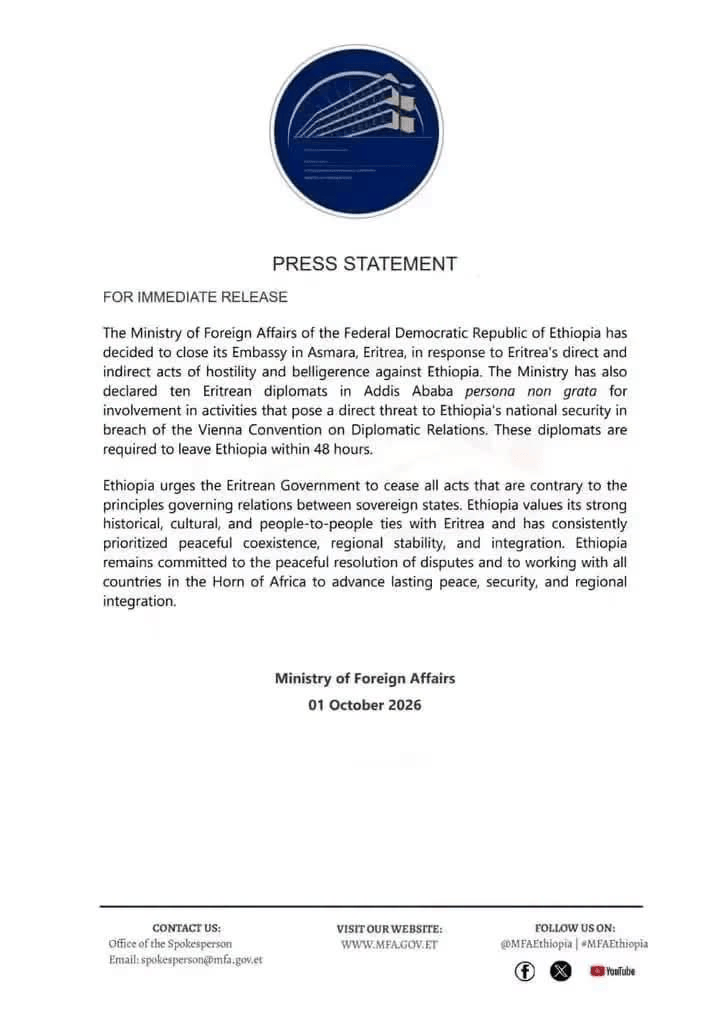
ADDIS ABABA — In a dramatic escalation of diplomatic tensions in the Horn of Africa, the Ethiopian Ministry of Foreign Affairs announced on October 1, 2026, that it has decided to close its Embassy in Asmara, Eritrea, and has declared ten Eritrean diplomats in Addis Ababa persona non grata.
The sweeping move, detailed in an official press statement released for immediate distribution, marks a severe deterioration in relations between the two neighboring states—a relationship already fraught with historical complexity and recent political friction.
A Direct Response to “Hostility and Belligerence”
The Ministry’s statement was unambiguous in its justification. The closure of the Ethiopian Embassy in Asmara comes “in response to Eritrea’s direct and indirect acts of hostility and belligerence against Ethiopia.”
This language signals a significant shift from previous diplomatic posturing to concrete, punitive action. The expulsion of ten Eritrean diplomats—accused of involvement in activities that “pose a direct threat to Ethiopia’s national security”—adds a sharp edge to the announcement.
Citing the Vienna Convention on Diplomatic Relations, the Ministry declared the diplomats persona non grata, a formal designation under international law that renders them unwelcome in the host country. They have been given a strict 48-hour ultimatum to leave Ethiopia.
A Breach of Diplomatic Norms
The reference to the Vienna Convention is significant. By invoking this foundational treaty governing diplomatic relations, Ethiopia is framing Eritrea’s alleged activities not merely as unfriendly, but as violations of established international norms.
The expulsion of diplomats is among the most serious actions a state can take short of severing relations entirely. It signals that Ethiopia believes Eritrean diplomatic personnel were using their official positions to undermine Ethiopian security—an accusation that, if substantiated, represents a profound breach of trust between nations.
Ethiopia’s Message: Strength and Restraint
Despite the severity of the measures, the statement struck a dual tone: firm in action, yet measured in rhetoric.
Ethiopia urged the Eritrean government to “cease all acts that are contrary to the principles governing relations between sovereign states.” This appeal to international principles positions Ethiopia as the party seeking adherence to established norms, even as it takes decisive action.
The Ministry further emphasized Ethiopia’s “strong historical, cultural, and people-to-people ties with Eritrea”—a deliberate acknowledgment of the deep bonds that transcend political disputes. It reaffirmed Ethiopia’s consistent prioritization of “peaceful coexistence, regional stability, and integration.”
Notably, the statement concluded with a commitment to “peaceful resolution of disputes and to working with all countries in the Horn of Africa to advance lasting peace, security, and regional integration.” This olive branch, extended alongside the punitive measures, suggests Ethiopia is leaving the door open for de-escalation—should Eritrea alter its course.
Regional Implications: A Horn in Flux
The Horn of Africa has long been a region where diplomatic ruptures carry outsized consequences. Ethiopia and Eritrea share a deeply intertwined history—one marked by both fraternal solidarity and devastating conflict.
The closure of an embassy is not merely a bureaucratic decision; it severs a primary channel of communication between governments. In a region already grappling with multiple armed conflicts, political instability, and humanitarian crises, the loss of this diplomatic lifeline raises serious questions about the trajectory of bilateral relations.
For Eritrea, the expulsion of ten diplomats represents a significant blow to its diplomatic presence in Ethiopia. For Ethiopia, the closure of its embassy in Asmara removes its ability to directly engage with Eritrean authorities on the ground—a decision that signals Addis Ababa’s assessment that such engagement has become either futile or dangerous.
What Comes Next?
The 48-hour ultimatum for the expelled diplomats adds a ticking clock to the crisis. How Eritrea responds in the coming days will determine whether this remains a serious but contained diplomatic incident or escalates into a broader rupture.
Ethiopia’s statement leaves room for both possibilities. Its firm action, coupled with its expressed commitment to peace and regional integration, suggests a strategy of calibrated pressure—demonstrating seriousness of purpose while maintaining the moral high ground.
For now, the Horn of Africa watches and waits. The closure of an embassy is a loud statement. The question is whether anyone in Asmara is listening.
Ministry of Foreign Affairs
Federal Democratic Republic of Ethiopia
October 1, 2026
For more updates and in-depth coverage of Horn of Africa affairs, follow: https://t.me/addisreporter2
Contact Information:
Office of the Spokesperson
Email: spokesperson@mfa.gov.et
Website: WWW.MFA.GOV.ET
Follow: @MFAEthiopia | #MFAEthiopia

Posted on October 1, 2026, in Aadaa, Afaan, Information, Language, Media, News, Press Release, Promotion. Bookmark the permalink. Leave a comment.






Leave a comment
Comments 0