Irreechaa: The Regeneration of Humanity
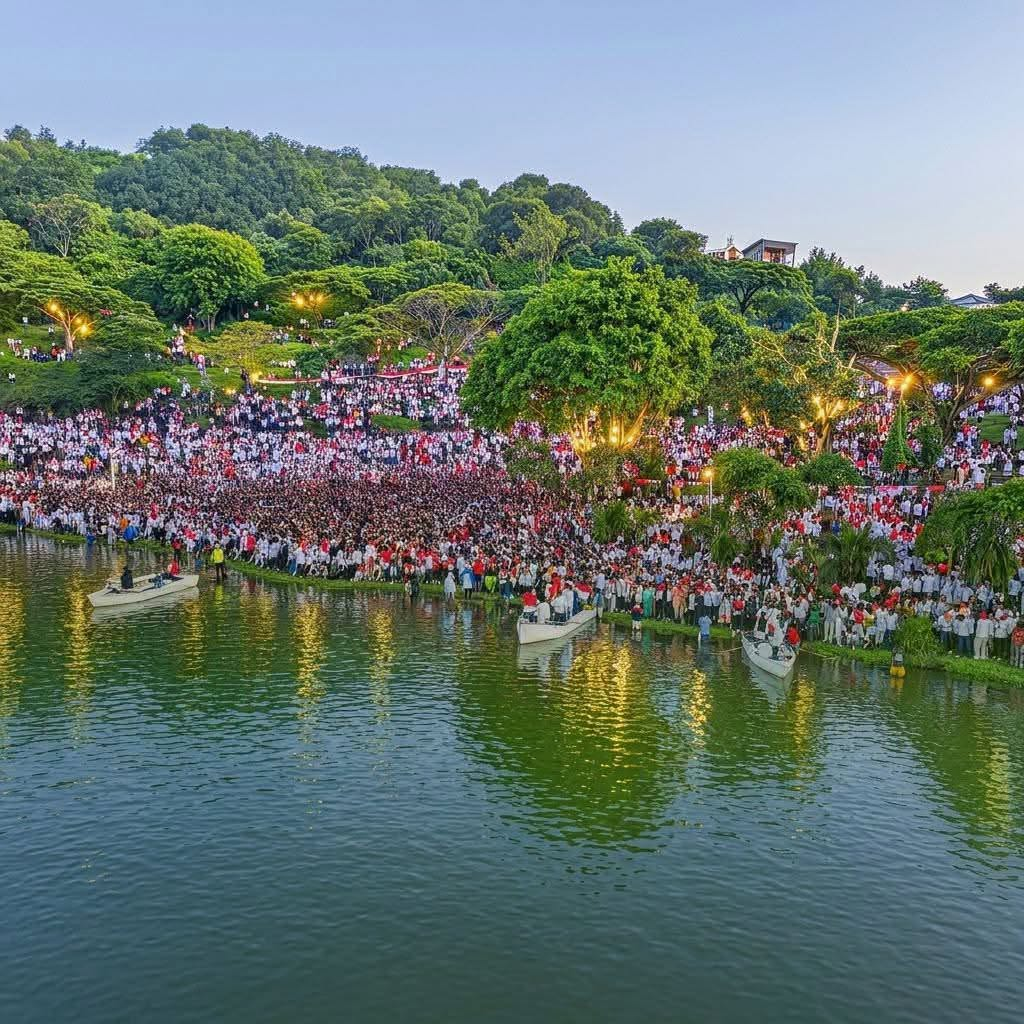
Beneath the sacred sycamores at Hora Arsadi, millions gather not merely to give thanks, but to become something new. In a world fractured by grievance and division, the Oromo thanksgiving festival offers a radical proposition: you cannot thank God while holding a grudge.
BISHOFTU, Ethiopia — The waters of Hora Arsadi do not discriminate.
They receive the freshly cut grass from the hands of a university student in her first traditional dress. They receive the prayers of an elder whose grandfather was forbidden from approaching this shore. They receive the flowers from a mother who buried a son in last year‘s conflict. And they receive the sprinkled droplets — Kormoomsaa, the blessing of the young men — upon the heads of strangers who arrived here as enemies and will leave as something else entirely.
This is Irreechaa. And to understand why it is the regeneration of humanity, you must first understand what the Oromo people have always known: that the human spirit, like the earth itself, needs a season to renew.
The Rejection of Resentment
There is a rule at Irreechaa that might strike the modern observer as impossibly naive. According to tradition, a person cannot participate unless they have resolved their disputes with others. Holding onto resentment is not permitted. You cannot come to the water carrying a grudge.
In an era where grievance has become identity, where political and social media economies thrive on division, where forgiveness is often mocked as weakness, this ancient requirement lands like a thunderclap.
“Before attending the festival, participants reconcile with themselves and others, setting aside grudges, anger, or resentment,” writes Girma Mirgisa of the Ethiopian News Agency. “This cleansing of the spirit gives the festival its essence as the festival of peace and reconciliation, where forgiveness, unity, and brotherhood take center stage”.
The Oromo word for this is araara — reconciliation. It is not merely a suggestion. It is the prerequisite. The water will not accept your thanks if your heart is still at war.
This is not a festival that asks you to feel grateful while ignoring pain. It asks you to set the pain down first — deliberately, consciously, as a spiritual discipline — and then approach the sacred.
Water as Origin, Water as Renewal
The Oromo philosophy of water is not ornamental. It is cosmological.
“The ancient Oromo philosophy regarding water views it as the source of purity and the foundation of creation and life,” Prime Minister Abiy Ahmed noted in his Irreechaa message this year. Water is where life begins. It is where life returns. It is the medium through which gratitude flows.
The Oromo proverb says it plainly: “A people without Melka — a river, a water source — is like a people without a head”.
At Irreechaa Melka, celebrated at the close of the rainy season (Ganna) as Ethiopia enters spring (Birraa), participants carry green grass and daisies to the water‘s edge. They dip the grass into the lake or river. They sprinkle the water upon themselves and one another. They lift their hands in prayer.
The grass is not a symbol in the shallow sense. It is the thing itself: fertility, life, renewal, the stubborn persistence of green in a world that so often tends toward brown. The water is not just water. It is the medium of regeneration.
“The sown seed dies and is resurrected to bear fruit,” Abiy said, describing the Oromo understanding of harvest and divine providence. This is not a metaphor for the religious. It is the pattern of the cosmos. Death and resurrection. Rain and spring. Grief and gratitude. You cannot have one without the other.
The Dark Season and the Return of the Sun
To understand Irreechaa, you must understand Ganna.
The rainy season in Oromia is not a gentle drizzle. It is months of heavy downpour, swollen rivers, destroyed crops, impassable roads, isolation. Families cannot visit one another. Communities are physically separated by water that has become dangerous rather than life-giving.
The Oromo do not detest rain. But they recognize Ganna as a demanding season — a time of endurance, of waiting, of trusting that the sun will return.
“As the winter darkness clears, the Oromo people gather in unity at the river for traditional thanksgiving rituals,” Abiy said this year, drawing an explicit parallel between the natural season and Ethiopia’s long struggles with “economic, political, and administrative challenges”.
The Prime Minister’s comparison is worth noting, but it is the deeper spiritual parallel that matters. Irreechaa is the celebration after the suffering. It is the moment when the community pauses at the water‘s edge and says: we made it through. We survived. We are still here.
“The heavy rain brings with it lots of things like swelling rivers and floods that can destroy lives, cattle, crop, and homes,” notes the Ethiopian Herald. “The Oromo celebrate Irreechaa not only to thank Waaqa but also to welcome the new season of plentiful harvests following the dark and rainy winter season”.
This is regeneration: not the erasure of hardship, but the transformation of hardship into gratitude.
A Festival Older Than Empires
Irreechaa’s roots run deeper than any institution that currently exists on the African continent. Estimates place its origins at over 6,000 years, connected to the ancient Cushitic civilizations that predate the rise of modern empires and religions. Some accounts suggest the tradition has been celebrated in this part of Africa for 12,000 years.
The festival is intimately connected to the Gadaa system, the traditional Oromo governance structure recognized by UNESCO as an Intangible Cultural Heritage of Humanity. The Gadaa system organizes society by age grades, each with defined responsibilities and transition periods. Irreechaa is woven into this system — a spiritual punctuation mark in the rhythm of community life.
“When Europe is still in the Dark Ages, Africans were conducting a colorful, passionate, and heartfelt thanksgiving celebration,” writes Solomon Dibaba of the Ethiopian News Agency, “spiritually outsmarting the ‘civilizing’ mission of the European colonizers”.
This is not merely historical pride. It is the living proof that African civilizations developed sophisticated spiritual and philosophical systems long before colonial encounter — systems that understood gratitude, reconciliation, and renewal as the foundational architecture of human community.
The Reclamation of Space
For decades, Irreechaa was banned.
Under successive regimes, the Oromo people were denied the right to celebrate at their own sacred sites. Public gatherings were suppressed. The geography of the capital — the very place whose name Finfinne derives from the sacred lake around which it was built — was overwritten by imperial and colonial logics.
The revival of Irreechaa at Hora Finfinne, in the heart of Addis Ababa, is therefore not just a cultural event. It is an act of reclamation.
“Celebrating Irreechaa here is not just a cultural act,” writes Advocacy for Oromia. “It is a powerful reclamation of space, identity, and dignity”.
Prime Minister Abiy’s message this year acknowledged this directly: “The restoration and institutionalization of Hora Finfinnee Irreecha to its river site and the grand gatherings at Hora Harsadi in Bishoftu” are proof that “long-standing cultural questions regarding language and heritage have been fully answered”.
For the Oromo people, space is not abstract. The water is not interchangeable. Hora Arsadi is not simply a convenient lake. It is a specific, sacred geography where generations have come to pour out their gratitude and their grief. To ban Irreechaa is to sever the people from their own spiritual lungs.
To restore it is to allow them to breathe again.
The White Sea and the Dissolution of Difference
On the day of Irreechaa at Hora Arsadi, millions of people dress in white.
The image is overwhelming. A sea of white garments, traditional habesha kemis and gorro, moving toward the water. White turbans. White shawls. The white of purity, of peace, of renewal.
But the white does not erase difference. It holds it.
Women wear the caaccuu, beads of different colors. They carry the siiqqee, the stick traditionally held by Oromo women, a symbol of their agency and their role in preserving moral order. Men carry the haroresa, a traditional stick designated by the Gadaa system. The Abba Gadaas — fathers of the Gadaa system — lead prayers. The Haadha Sinqees — women entrusted with justice and peace — lift their siiqqee sticks, representing balance and protection.
There are Muslims here. There are Christians. There are practitioners of the old faith, the belief in Waaqa, the one God who created the heavens and the earth. They come together not because their differences have disappeared, but because something larger than difference calls them to the water.
“Irreechaa is not exclusively an Oromo festival,” says Yusus Omar Bocha, a Kenyan attendee. “Many Africans, Asians, and individuals from various nationalities also partake”.
Claire, a visitor from Belfast, Northern Ireland, described her experience to the BBC: “It is amazing. Everybody wants to say hello, everyone wants to give you a kiss and say welcome”.
This is regeneration: the ability to recognize oneself in the stranger, to offer blessing to those who do not share your language or your history, to become, for a moment, something larger than your own small identity.
Gratitude as Resistance
There is a tendency in modern discourse to treat gratitude as passive. To give thanks is to accept one’s circumstances. To express contentment is to abandon the struggle for change.
Irreechaa rejects this dichotomy.
The festival is, at its core, a profound act of seeing — of recognizing that despite the floods, despite the oppression, despite the losses, there is still something worth gathering by the water for. The harvest came. The rains ended. The sun returned. The community survived.
“We believe that a country without a sea outlet is a country without life,” Abiy said this year, connecting the Oromo philosophy of water to Ethiopia’s national quest for maritime access. The analogy is instructive: water is not just spiritual in Oromo cosmology. It is strategic. It is the foundation of prosperity. To be without it is to be incomplete.
But the deeper lesson of Irreechaa is that gratitude does not mean complacency. It means grounding. It means remembering what you have, what you have survived, what you have been given — and then moving forward from that foundation.
The 2025 Irreechaa theme, “Irreecha: For National Renewal,” captured this perfectly. The festival is not a retreat from the future. It is a ritual that prepares the community to build it.
The Regeneration of Humanity
To say that Irreechaa is the regeneration of humanity is not to claim that the festival makes humans biologically new. It is to claim something more radical: that the practices embedded in this ancient celebration — reconciliation, gratitude, purification, community, forgiveness — are the very mechanisms by which human beings become capable of living together again after fracture.
Every year, millions of people gather at the water. Every year, they are asked to set down their grudges. Every year, they dip the grass, sprinkle the water, lift their hands, and sing the songs their ancestors sang.
And something happens.
“Irreechaa has the potential to contribute significantly to national dialogue and national consensus,” writes the Ethiopian Herald. “It brings people from various ethnic backgrounds together. This inclusivity creates a space where diverse voices can be heard, perspectives can be shared, and different communities can engage in meaningful dialogue”.
This is regeneration: the slow, annual, ritual work of becoming a people again. Not a people defined by ethnicity or politics or grievance, but a people defined by their willingness to stand at the water‘s edge together and say: we give thanks.
The Oromo have a greeting for this festival: Baga Irreechaa nagaan geessan — May the Irreechaa have arrived in peace.
It is not a wish. It is an instruction. Peace is not something that happens to you. It is something you arrive at, together, at the water, with your hands open and your grudges surrendered.
That is the regeneration. That is Irreechaa.

Posted on October 2, 2026, in Aadaa, Afaan, Events, Finfinne, freedom, gadaa, Information, Irreechaa, Language, Media, News, Oromia, Press Release, Promotion. Bookmark the permalink. Leave a comment.






Leave a comment
Comments 0