Celebrating Muhuba: A Story of Kindness in Crisis
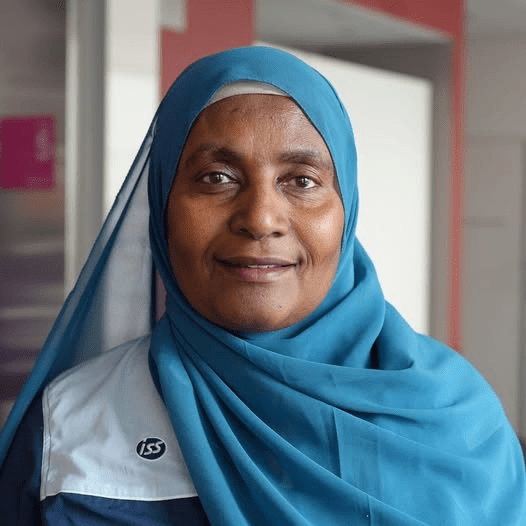
When a labouring patient arrived alone, unable to speak English, ISS placemaker Muhuba didn’t hesitate. She was on her way home from a cleaning shift at The Royal Women’s Hospital when she got a call—and she turned around without a second thought.
It was the end of a long shift. Muhuba had spent her day cleaning at The Royal Women’s Hospital in Melbourne—ensuring that rooms were sanitised, surfaces were spotless, and the environment was safe for patients, families, and staff. She was tired. She was heading home.
Then her phone rang.
On the other end was a voice from the hospital, asking if she could help. A labouring patient had arrived alone. She was scared. She couldn’t speak English. And staff had just discovered that Muhuba spoke her language.
Muhuba didn’t hesitate. She turned around and came straight back.
“I just wanted to help,” she said.
A Labour of Love
What happened next would change a woman’s birth experience—and inspire people around the world.
Muhuba was quickly thrown a pair of scrubs and rushed into the operating theatre. For the next five hours, she stayed by the patient’s side. She held her hand. She spoke to her in her own language. She calmed her fears.
She was not a midwife, a nurse, or a doctor. She was a placemaker—a cleaner. But in that moment, she was the only person who could truly communicate with a terrified mother about to bring a new life into the world.
The woman gave birth safely, comforted by the presence of someone who spoke her words, understood her heart, and gave her the dignity of being heard.
The Kind of Care That Transcends Job Titles
At The Royal Women’s Hospital, patient safety and comfort are paramount. But sometimes, the most profound care comes from unexpected places. Muhuba’s story is a testament to the fact that compassion does not require a clinical degree—it requires a human heart.
In her five hours in the theatre, Muhuba was not just translating words. She was translating trust. She was bridging the gap between a foreign medical system and a terrified mother. She was giving that woman the single most powerful gift a caregiver can offer: the feeling that she was not alone.
When the award nomination was announced, those who know Muhuba were not surprised. Her act was not a one-time gesture—it is a reflection of who she is. Every day, staff at the Women’s see the quiet dignity and dedication of workers like Muhuba, who clean rooms, deliver meals, and ensure the hospital runs smoothly, often without recognition.
Recognition Across the World
Muhuba’s extraordinary kindness did not go unnoticed.
Last year, she was recognised with a state-wide award from ISS—the global facility services company that employs her. Her act of going above and beyond stood out as an example of the power of compassion in healthcare.
This year, she has been named one of four international finalists in a global awards program. In May, ISS will fly her to Denmark for the awards ceremony, where she will represent The Royal Women’s Hospital—and Australia—on the international stage.
It is a remarkable journey for a woman who was simply heading home after a shift and answered a call for help.
The Placemaker’s Role: More Than Cleaning
ISS describes its role as “placemaking”—creating environments where people thrive. Muhuba’s story exemplifies this mission. In a hospital setting, the role of cleaning staff is often invisible, taken for granted. Yet without them, the hospital could not function. They are the quiet guardians of hygiene, the unseen hands that ensure safety, and, as Muhuba proved, sometimes the most compassionate voices in a time of crisis.
Muhuba’s willingness to drop everything and stay for five hours speaks to a deeper philosophy: care is not confined to job descriptions. It is a human duty, a moral impulse, and a gift that can be given by anyone, regardless of their title.
A Hospital Community That Cheers Her On
The Royal Women’s Hospital has expressed profound pride in Muhuba’s recognition. In a social media post celebrating her achievement, they wrote:
“We are incredibly proud of Muhuba and the compassion she brings to our hospital community. Join us in cheering her on as she represents the Women’s on the international stage.”
The post resonated widely—drawing thousands of reactions, comments, and shares. People from around the world responded with admiration. They saw in Muhuba’s story something universal: the power of one person to make a difference when it matters most.
One commenter wrote: “This is what true compassion looks like. Thank you, Muhuba, for showing the world that kindness has no boundaries.”
Another said: “She may not have a clinical degree, but she has a degree in humanity. This is the kind of care we all need.”
The Language of Kindness
Muhuba’s act of kindness also highlights a broader issue in healthcare: the importance of language access and culturally safe care.
Australia is one of the most multicultural nations in the world, yet language remains a significant barrier to equitable healthcare. Patients who cannot speak English are often at risk of miscommunication, misdiagnosis, and poor health outcomes. They may feel isolated, frightened, and unable to advocate for themselves.
Muhuba’s presence in that theatre was more than comfort—it was clinical necessity. She ensured that a mother could understand what was happening, could express her fears, and could consent to her care with full understanding. In doing so, she helped deliver not just a baby, but a safer, more dignified birth experience.
Her story reminds us that health systems must invest in language services, translation support, and cultural safety training—and that sometimes, the most effective support is the person who simply speaks your language and holds your hand.
From Melbourne to Denmark
In May, when Muhuba boards a plane for Denmark, she will carry with her the hopes of her colleagues, her community, and the thousands of people who have been moved by her story.
She will stand on an international stage, not as a doctor or a nurse, but as a placemaker—a cleaner—who proved that compassion is the highest qualification of all.
Her recognition is not just personal. It is a tribute to all the invisible workers in hospitals around the world: the cleaners, the porters, the kitchen staff, the administrative workers—everyone who contributes to healing without wearing a white coat.
They are the backbone of healthcare. And Muhuba has shown the world just how powerful their contribution can be.
A Message to Us All
Muhuba’s story is a challenge—and an invitation.
It challenges us to recognise that kindness is always possible, even when we are tired, even when we are heading home, even when it is not “our job.”
It invites us to see the humanity in everyone, to reach out when someone is in need, and to understand that the smallest gestures—a held hand, a spoken word, a calm presence—can change a person’s entire experience.
As one commenter wrote: “Not all heroes wear capes. Some wear scrubs and hold hands.”
Muhuba is one of those heroes. And soon, the world will have a chance to celebrate her.
Join Us in Cheering Her On
The Royal Women’s Hospital is inviting everyone to join in celebrating Muhuba’s international recognition.
“We couldn’t be prouder of Muhuba,” the hospital said. “She represents the very best of who we are—people who care, who go above and beyond, and who make a difference when it matters most.”
When Muhuba heads to Denmark in May, she will be carrying more than her own story. She will be carrying the stories of countless patients who have been comforted by someone like her—someone who chose compassion over convenience, kindness over exhaustion.
She is an inspiration to the entire hospital community. And now, she is inspiring the world.
Muhuba, we are so proud of you. Your kindness has already changed lives—and it will continue to do so as your story travels around the world. Congratulations on this well-deserved recognition, and thank you for showing us all the power of a compassionate heart.
The Royal Women’s Hospital is Australia’s largest specialist women’s hospital, providing care for women and newborns across Victoria and beyond. Founded in 1856, the hospital is committed to excellence in clinical care, research, and advocacy for women’s health.

Posted on July 1, 2026, in Aadaa, Afaan, Biography, Bokkkuu, Diaspora, Events, Finfinne, gadaa, gender, Grief Support, Information, Kindness, Language, Media, News, Obituary, Oromia, Press Release, Promotion, Sirna Oromo. Bookmark the permalink. Leave a comment.






Leave a comment
Comments 0