Category Archives: Media

The Unfinished Project: Language, Liberation, and the Oromo Struggle for Epistemic Freedom
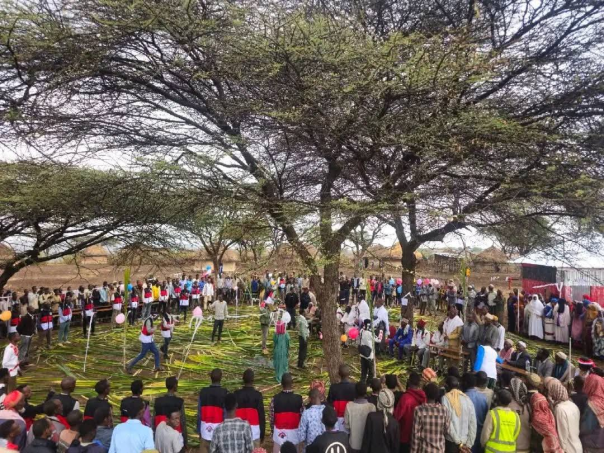
By Dhabessa Wakjira
Introduction: Language, Power, and the Unfinished Multilingual Project
Language is not merely a tool for communication. It is the backbone of identity, the engine of governance, and the very medium through which a citizen accesses justice, opportunity, and dignity. In multilingual nations, language policy determines not only how people speak to their government but also who receives power, who finds justice, and who is consigned to the margins.
Ethiopia, one of the world’s most linguistically diverse nations, enshrines equality for all languages in Article 5 of its constitution. On paper, it is a model of multicultural federalism. But between the constitutional promise and the lived reality lies a vast chasm—a gap where Amharic has continued to enjoy structural dominance at the expense of other languages, most notably Afaan Oromo, the most widely spoken language in the country.
This feature story explores how Amharic supremacy was forged during imperial expansion (which many scholars directly term colonization), how it has been perpetuated through institutional mechanisms, and the profound political, social, and economic consequences for the Oromo people. More critically, it examines this struggle through the lens of decoloniality—the understanding that true liberation requires not merely political independence but the dismantling of colonial power structures that persist in knowledge production, governance, and identity.
For the Oromo people, whose lands were incorporated into the Ethiopian Empire through military conquest in the late 19th century, the struggle against Amharic dominance is not a request for administrative convenience. It is an act of decolonial resistance.
The Historical Foundations of Amharic Supremacy: The Colonization of Oromia
The dominance of Amharic was forged in the crucible of empire. During the late 19th and early 20th centuries, the expanding Ethiopian Empire absorbed Oromia through military conquest. Amharic was imposed as the language of administration, military command, taxation, and the courts.
This was not a neutral or practical choice. It was a political weapon—a tool for centralizing power, assimilating cultures, and controlling subjugated populations. The policy was explicit. In 1933, Education Minister Sahle Tsedalu called for the suppression of so-called “pagan languages.” In 1968, the renowned British anthropologist Paul Baxter documented that in Arsi, the speaking of Afaan Oromo was actively suppressed. Publishing, preaching, teaching, or broadcasting in Afaan Oromo was forbidden.
While Amharic was institutionally elevated, Afaan Oromo was relegated to the informal sphere—the home, the oral tradition, the market. This historical process established a linguistic hierarchy that persisted through the Imperial era, the socialist Derg, and even into the current federal system. After Ethiopia adopted ethnic federalism in 1991, the structural advantages of Amharic remained largely untouched. The constitution embraced diversity, but the daily machinery of the state continued to reflect older, colonial norms.
For the Oromo people, this history is not abstract. The Gadaa system—an indigenous democratic governance structure and knowledge system—was suppressed. The language was erased from public life. Stripped of meaningful representation and denied the ability to govern their own social existence, the Oromo were subjected to what scholars Asafa Jalata and Mohammed Hassen have described as a condition of landlessness, rightlessness, and systematic exploitation on their own soil.
As decolonial theory teaches, colonialism does not end with a change in political structure. It continues in the organization of knowledge, in education, and in the daily interactions between state and citizen. The continued dominance of Amharic is a living scar—proof that the colonization of the Oromo has never been fully undone.
Institutional Mechanisms of Linguistic Hierarchy: Coloniality in Practice
Decolonial thinkers, including Anibal Quijano, argue that colonialism created a global system of power organized around three interconnected hierarchies: the coloniality of power (racial/ethnic ranking), the coloniality of knowledge (the suppression of indigenous ways of knowing), and the coloniality of being (the imposition of foreign values of humanity). In Ethiopia, these hierarchies are embodied in the dominance of Amharic over Afaan Oromo.
The Civil Service and Employment Structures
The most glaring evidence of linguistic inequality lies in federal employment. A study cited by Bulto shows that while Afaan Oromo speakers constitute approximately 34.5 percent of the population, they hold only 7.9 percent of federal civil service positions. In stark contrast, Amharic speakers, representing 29 percent of the population, occupy 68.5 percent of these jobs.
This is not an accident. Civil service examinations are administered in Amharic. Hiring processes require Amharic proficiency. Internal communications—including policy documents and performance evaluations—are conducted in Amharic. Career advancement is contingent upon navigating a bureaucratic environment that assumes Amharic fluency. The language requirement has become a systematic filter that disadvantages Afaan Oromo speakers and restricts their access to state power.
Access to Justice and Legal Communication
The right to justice is fundamental, yet language barriers have systematically excluded Afaan Oromo speakers from equitable participation in Ethiopia’s legal system. Laws, regulations, and the official legal gazette (Negarit Gazeta) are published primarily in Amharic alone. For citizens whose primary language is Afaan Oromo, understanding the law, participating in legal proceedings, and defending their rights presents an overwhelming obstacle.
The absence of a consistent multilingual legal framework undermines the principles of fairness and equal protection under the law. This is a manifestation of what decolonial theory terms epistemicide—the systematic destruction of other knowledge and communication systems by rendering them invisible before the law.
Symbolic and Ceremonial Dominance
Beyond formal institutions, language carries symbolic power. Amharic has long been associated with state authority, national identity, and political legitimacy. Major national ceremonies, government announcements, and presidential addresses are predominantly conducted in Amharic. This symbolic supremacy reinforces the perception that “serious” national affairs belong to Amharic speakers, while other languages—and their speakers—are secondary.
For the Oromo, these symbolic structures are daily reminders of their colonial subjugation. They are not abstract grievances; they are concrete triggers that reinforce feelings of exclusion and second-class citizenship.
Educational Structures and Language Hierarchy: The Coloniality of Knowledge
The education system plays a central role in reproducing linguistic inequality. While mother-tongue education expanded under the federal system, higher education and professional advancement remain tightly linked to Amharic and, to a lesser extent, English. Students who fail English proficiency exams cannot enter university regardless of their knowledge in other subjects.
Students educated primarily in Afaan Oromo face a sudden barrier when transitioning to Amharic-dominated systems, limiting their competitiveness and access to opportunity. The language hierarchy is thus reproduced in educational outcomes and professional trajectories.
This echoes the critique of Kenyan writer Ngũgĩ wa Thiong’o, who argued that the colonial education model ensures that a child sees himself not through his own culture but through the lens of London and New York. In the Oromo context, a child is taught to see the state through Amharic—to internalize the colonizer’s language as natural and their own as inferior.
Decolonial “epistemic liberation” requires rejecting these internalized narratives and reclaiming an identity shattered by colonial structures. A genuine educational policy would allow students first to study their own community’s culture and environment, then to relate it to others. In Ethiopia, however, Oromo students are rarely afforded that equal foundation.
The Wider Consequences of Linguistic Inequality
Barriers to a Shared Civic Identity
A shared civic identity depends on inclusive communication. When major national debates occur primarily in Amharic, large segments of the Oromo population are forced to participate indirectly—through translation or second-hand interpretation. This asymmetry diminishes democratic engagement and prevents the emergence of a truly inclusive national conversation.
Social Mobility and Economic Opportunity
Language competence profoundly affects individual life chances. Oromo citizens who do not speak Amharic face additional barriers when seeking federal employment or pursuing higher education. Professional networks among lawyers, doctors, engineers, and civil servants are constrained by language differences, limiting inter-regional mobility and integration.
Tensions Between Regional and Federal Authorities
Regional governments like Oromia have developed administrative systems based on Afaan Oromo, yet they must interact with federal institutions that operate primarily in Amharic. This creates an unequal burden: regional officials must be bilingual, while their federal counterparts operate monolingually. Such asymmetry contributes to tensions between regional self-governance and federal centralism—tensions that a properly functioning federal system should have resolved by requiring federal officials to speak at least two languages.
The Mind in the Structure
Even within Oromia’s cities and bureaucracy, Amharic retains its dominance. No language in the world can develop its full capacity if confined to rural areas alone. Worse, in Finfinnee (Addis Ababa)—a city Oromia claims as its “capital”—Afaan Oromo is not even the working language. Ethiopia remains the only country in the world where the most widely spoken language is neither the federal working language nor a recognized national language.
If there exists anywhere in the world a city where the language of the majority of its inhabitants is spoken only as a foreign tongue, an island of alien speech, that city is Finfinnee. This reality exposes the failure within Oromia itself: Afaan Oromo has not achieved the institutional status and development it requires, even within the region’s own boundaries.
This failure is partly due to a leadership shaped by colonial mentality—leadership that has continued to maintain Amharic dominance through both policy and inaction—and partly due to colonial structures that were never dismantled. As Ngũgĩ argued, “decolonizing the mind” is a personal and collective project of rejecting the colonizer’s language, values, and internalized narratives. For the Oromo, this begins with their own institutions and leadership.
Emancipation vs. Liberation: A Critical Distinction
To properly address the Oromo condition, one must understand the difference between emancipation and liberation.
Emancipation means achieving reforms within an existing oppressive system—securing a few more government jobs, amending a few laws, while the overall colonial structure remains intact. Liberation, by contrast, demands radical political and economic freedom, including epistemic freedom.
Post-1994 South Africa serves as a cautionary tale. The liberation movement transformed into an emancipation project, embracing liberal democracy rather than genuine decolonization. The Black majority remains mired in poverty, and the colonial economy continues unchanged. Similarly, Ethiopia’s post-1991 ethnic federalism was emancipation, not liberation. It granted limited cultural recognition but left intact the Amharic-based federal power structure.
Indigenous elites—the adbarayoch—regardless of their ethnic identity, remain captives of colonial modernity. They learned Amharic systematically, internalized colonial administrative logic, and seek not to transform the system but merely to replace the old elite. For the Oromo people, genuine liberation means breaking free from the coloniality of power entirely—rejecting the assumption that federal affairs must be conducted in Amharic, making Afaan Oromo a full language of education, research, law, and administration as a matter of right, not a favor.
Decolonial theory demands “peripheral thinking”—producing knowledge from the colonized context. Oromo scholars, teachers, and citizens must not translate their concepts into Amharic or Western frameworks. They must stand on their own validity.
Consider a simple metaphor: A bird in a cage is not free. Opening the cage and removing the bird is emancipation—a concrete act that ends captivity. But when the bird flies through the sky, going wherever it chooses, that is liberation—the result of that act. The Oromo people will be truly liberated only when they secure self-determination through free popular participation.
Toward a Decolonial Language Policy
Breaking free from Amharic dominance requires more than symbolic recognition. It demands structural transformation grounded in decolonial principles. Ethiopia—and particularly Oromia—needs a comprehensive language policy that includes the following elements:
First, institutionalizing multilingualism. Federal institutions must accommodate multiple working languages in daily operations, provide translation and interpretation services, and ensure that internal communications are accessible in Afaan Oromo and other major languages.
Second, civil service reform. Hiring and promotion processes should treat multilingual competence as a valuable asset, eliminate unnecessary language barriers, and ensure that the civil service reflects Ethiopia’s actual linguistic diversity.
Third, expanding multilingual public services. Health facilities, legal aid, administrative services, and commercial transactions must be accessible in Afaan Oromo and other major languages.
Fourth, legal and judicial reform. Laws must be published in Afaan Oromo. Court proceedings must guarantee interpretation services.
Fifth, educational transformation. Mother-tongue education must be strengthened at all levels—including higher education—ensuring that Afaan Oromo becomes a language of research and professional service.
Sixth, building multilingual public platforms. Media, civic education, and political debates must not only be conducted in multiple languages but must also ensure proportional representation based on population size and economic contribution. Given the number of Afaan Oromo speakers and the Oromo people’s critical role in the national economy, Afaan Oromo deserves proportional attention and space in media, education, and political discourse.
The Unfinished Multilingual Project
Ethiopia’s constitution dreams of a multilingual federal system built on language equality. But in practice, the state remains trapped within a historical colonial framework that privileges Amharic. This linguistic gap is not a mere operational issue. It reflects a deep tension between federal aspirations and the persistence of colonial inheritance.
Decolonial theory teaches that colonialism does not end—it updates itself, changing form but not substance. In the Oromo context, decolonization means questioning the very foundations of the Ethiopian state: its linguistic hierarchy, its health service accessibility, its commercial and religious languages, its education system, its access to justice, and the very meaning of citizenship.
It means actively building new structures—schools, courts, media, and bureaucracies—grounded in Oromo perspectives and practices. It is a project of “living again” for a people told they had no right to exist on their own terms.
A reimagined language policy—rooted in equity, inclusivity, and the practical realities of decolonial thought—can transform language from a source of division into a foundation for cooperation. For Oromia and for Ethiopia as a whole, the path forward lies not in replacing one dominance with another but in building a system where all languages and their speakers can participate equally in the nation’s comprehensive life.
This is the unfinished multilingual project. This is the call to liberation. And this struggle continues—in the schools, in the courts, in the civil service offices, and in the daily conversations of millions who dare to dream not merely of dreaming, but of changing the world.
Language is not only a cultural expression. It is economic power. It is diplomacy. It is technology. It is global influence. And for the Oromo people, it is the final frontier of freedom.
The unfinished project calls. The struggle continues. And liberation, once chosen, cannot be undone.
*Author’s Note on Attribution: The above feature story is based on a social media post written by Jaal Daawwiit Abdataa Hundeessaa. Dhabessa Wakjira engaged with that post as a commentator, and the present reflection draws substantially from the ideas, analysis, and historical framing originally articulated by Jaal Daawwiit Abdataa Hundeessaa. This feature story is offered as a synthesis and expansion of that shared conversation, with full acknowledgment of the original source.

The Role of Media in the Oromo Freedom Struggle
From Clandestine Radio to Digital Resistance – How Communication Became a Weapon
By: Dhabessa Wakjira
PROLOGUE: The Unseen Battlefield
The Oromo freedom struggle has been fought on many fronts: in the forests with weapons, in the streets with protests, in the prisons with endurance, and in the hearts with hope. But there is another battlefield – invisible, yet essential. It is the battlefield of information.
Media – whether printed on paper, broadcast through radio waves, or shared across digital networks – has been the oxygen of the Oromo national movement. Without it, the struggle would have been fragmented, silenced, and easily erased. With it, the Oromo people have informed, organized, and inspired generations of resistance.
This feature examines the role of media in the Oromo freedom struggle – from the early print experiments of the Derg era, to the iconic radio broadcasts of the OLF, to the digital mobilization of the Qeerroo generation, and to the challenges that remain.
PART ONE: The Printed Word – Bariisaa and the Battle for Language
Afaan Oromo as a Site of Resistance
Before the internet, before satellite radio, before social media, there was the newspaper. And for the Oromo struggle, one newspaper stands out: Bariisaa.
Published between 1975 and 1991 under the Derg regime, Bariisaa was an Afaan Oromo newspaper that became, according to scholarly research, “the main forum for issues of social justice, including linguistic rights, economic and cultural values as well as political representation” .
The newspaper was published in a context of extreme repression. The Derg regime, like the Imperial regime before it, had systematically marginalized Afaan Oromo. The language of tens of millions was excluded from education, from government, from official communication. To write in Oromo was itself an act of defiance.
Bariisaa provided a space – however constrained – for Oromo intellectuals, poets, and activists to exchange ideas. The newspaper published arguments about how to deal with the disrespect for Oromo national identity, and about the sabotage made to paralyze the Oromo press .
Crucially, Bariisaa also became a forum for one of the most sensitive issues in Oromo identity politics: orthography. What script should be used to write Afaan Oromo? The government attempted to impose the Geez script, which was ill-suited to represent Oromo sounds. Oromo writers and intellectuals debated alternatives, seeking a writing system that could faithfully represent their language and, by extension, their identity .
The regime knew the power of what they were censoring. According to historical research, Bariisaa‘s contents were “strictly censored and systematic efforts were made to limit the number of copies and centres of distributions” . The government did not merely tolerate the newspaper; they feared it.
Yet Bariisaa survived. And it served as “important sources of information for the contemporary radio broadcasts in Afaan Oromo” . The printed word laid the foundation for the spoken word – broadcast across borders, beyond the reach of Ethiopian censors.
PART TWO: The Voice That Could Not Be Silenced – Sagalee Bilisummaa Oromoo
A Radio Station That Became a Movement
On June 15, 1988, a new voice entered the airwaves of the Horn of Africa. It was not the voice of the Derg, which controlled all media inside Ethiopia. It was the voice of the Oromo Liberation Front (OLF) , broadcasting from outside the country’s borders. Its name was Sagalee Bilisummaa Oromoo (SBO) – the Voice of Oromo Liberation .
For the Oromo people, who had been denied any media in their own language for decades, hearing Afaan Oromo on the radio was not merely informative. It was transformative. It was a confirmation that they existed, that their language was real, that their struggle was heard.
The OLF’s statement, marking the 35th anniversary of SBO in 2023, captured the radio’s significance:
*”Launched on June 15th 1988, SBO/VOL has been contributing a lot in the long journey of Oromo struggle for freedom, despite several relentless attempts of the enemy to quit the media. This quarter-a-century contribution of SBO in informing, organizing and [inspiring] the Oromo nation for the struggle to self-determination”* enabled the OLF media organ to be the first Oromo media launched to serve the Oromo cause .
SBO was not a neutral news source. It was a weapon of the struggle. It reported on Oromo grievances that Ethiopian state media ignored. It called for resistance. It organized the diaspora. It inspired young Oromo to join the liberation front.
The Ethiopian government, of course, tried to stop it. Jamming, threats, diplomatic pressure – all were deployed. But SBO remained on air. And it remains on air today, still broadcasting, still informing, still organizing, still inspiring .
The radio’s contribution is incalculable. For Oromo refugees in camps in Somalia and Kenya, SBO was a connection to home. For Oromo students in Ethiopian universities, it was a secret education in their own history. For Oromo farmers in the countryside, it was proof that someone, somewhere, was fighting for them.
PART THREE: The Predecessors – Early Oromo Broadcasting in Exile
Mogadishu, Nairobi, and the Birth of Oromo Airwaves
While SBO is the most famous Oromo radio, it was not the first. The history of Oromo broadcasting goes back much further – to 1962, to a small radio station in Mogadishu, Somalia .
According to historical research, “Afaan Oromoo broadcasting for which only five minutes allowed was begun by a few exiled Oromoo at Mogadishu in 1962” . Five minutes. That was all. But those five minutes were revolutionary.
The exiled Oromo broadcasters had a clear mission: “to reveal the Oromoo grievances and their rejection, and to call on the Oromoo masses in Ethiopia to rise up against the severe oppression they were subjected to” .
The Somali government, engaged in a border dispute with Ethiopia, soon increased the broadcasting time to one hour daily. They had their own political motives, but the result was the same: Oromo voices were finally being heard internationally.
The Kenyan government, facing its own Oromo-related conflicts in the northern region during the Shifta War, launched its own Afaan Oromo broadcast in 1963, allocating four hours daily . This created a peculiar situation: the Oromo language, which had been suppressed inside Ethiopia, was being broadcast from both Somalia and Kenya.
It was this external pressure that forced the Ethiopian government to act. In 1972, the Imperial regime launched its first radio broadcast in Afaan Oromo from Harar – not out of a sudden commitment to Oromo rights, but to “impress on the large Oromoo masses in Ethiopia” and to counter the propaganda from Mogadishu .
Through this process, Afaan Oromo became “the contested language in the identity politics of the Horn of Africa” . The linguistic politics of radio broadcasting “not only brought Afaan Oromoo to become the language of radio broadcastings but also contributed to the consolidation of Oromoo Nationalism” .
The stage was set for SBO. And SBO took that foundation and built a movement upon it.
PART FOUR: The Digital Revolution – Qeerroo and Social Media
From Radio Waves to Hashtags
If the 1960s through the 1990s were the era of radio, the 2010s became the era of digital media. And the Oromo struggle adapted once again.
The Qeerroo (Oromo youth movement) that emerged in the 2010s was not a traditional political party or armed front. It was a decentralized, digitally native movement – and social media was its nervous system.
The academic literature describes how the Qeerroo movement, which launched mass protests in 2014, exploited “unpopular political decisions and a weakened federal government” and employed “an ethnic discourse, university campuses, and social media to mobilize mass protests” .
The 2015 Oromo protests, in particular, have been studied as a case of “the use of the Internet as an alternative communication platform and a site of political resistance” . When the Ethiopian government blocked websites, shut down internet access, and arrested journalists, the Qeerroo found ways around the censorship.
The protests were not only urban. One of the remarkable features of the Oromo digital mobilization was its ability to create “a shared vision between the urban-digital activists and the rural-offline protesters” . This bridge – between those with smartphones and those without – was crucial to the movement’s success.
Social media platforms like Facebook, Twitter, and Telegram became: bulletin boards for protest coordination, archives of government violence (shared globally), sites of Oromo cultural affirmation, and spaces for diaspora Oromo to contribute financially and politically.
The Qeerroo movement, as the Wikipedia entry notes, “is a movement of the Oromo youth in Ethiopia seeking political changes” . Within traditional Oromo culture, the term means “bachelor” or “unmarried youth,” but within the movement, it symbolizes “the struggle of the Oromo for greater political freedom, greater ethnic representation in the government and the recovery of Ethiopia under the government of the Qeerroo” .
The movement was instrumental in the political changes that led to the resignation of Prime Minister Hailemariam Desalegn in 2018 and the coming to power of Prime Minister Abiy Ahmed . While the ultimate outcomes of those changes remain contested, the power of Oromo digital mobilization had been proven beyond doubt.
PART FIVE: The Diaspora Mediascape – Amplifying the Struggle Abroad
When the World Becomes a Studio
The Oromo media landscape is not confined to Ethiopia. It is global. The diaspora – Oromo communities in the United States, Canada, Europe, Australia, and elsewhere – have created their own mediascape.
Scholarship on Oromo media cultures describes “the translocal dimensions of media and cultural flows among the Oromo” and focuses on “the important interlocutory roles of artists, media and cultural workers in diaspora contexts” . Oromo people, the research indicates, “performatively conjoin with and chaotically produce their own mediascapes – at the various sites called the loci of affirmation – in the process of imagining themselves to be members of a global diaspora” .
This diaspora media includes: satellite television channels broadcasting in Afaan Oromo, online radio stations, YouTube channels dedicated to Oromo history and culture, social media influencers who blend entertainment with political commentary, and digital archives preserving Oromo oral traditions.
Consecutive Ethiopian regimes have tried to curb the influence of these diaspora mediascapes, but with limited success . The internet does not respect borders. And Oromo voices, once silenced, have found global amplification.
PART SIX: The Challenge of State Media – Representation and Distortion
The Ethiopian Broadcasting Corporation and the Politics of Erasure
Not all media has served the Oromo struggle. In fact, state media has historically been a tool of suppression rather than liberation.
A recent study published in the Journal of African Media Studies examined how the Ethiopian Broadcasting Corporation (EBC) represented the Oromo and Amhara protests. The findings are sobering: “despite the existence of foundational national instruments and laws for freedom of the media, the EBC’s representations of political, economic, cultural and social inquiries of the Oromos and Amharas remain largely determined by the Tigre People’s Liberation Front/Ethiopian People’s Revolutionary Democratic Front authorities instead of the media professionals” .
In other words, state media did not report on the Oromo protests objectively. Instead, “media professionals in the EBC were forced to marginalize, ignore and distort the voices of the protesters instead of advancing freedom of expression” .
This is not a minor footnote. It is central to understanding why the Oromo struggle needed its own media. When the state controls the narrative, the oppressed must create alternative platforms. SBO, Bariisaa, and the Qeerroo’s social media networks were not luxuries. They were necessities – the only way for the Oromo story to be told at all.
PART SEVEN: Language as the Core of the Struggle
Why Afaan Oromo Media Is Not Just Communication – It Is Resistance
Underlying all of this – the newspapers, the radio broadcasts, the social media posts – is a single, fundamental issue: language.
The suppression of Afaan Oromo has been a consistent policy of Ethiopian regimes for over a century. As one scholarly article notes, “the suppression of ethnic identities in order to create homogeneous nation-states is an old strategy used by rulers of multi-ethnic and multilingual states. Perceived as salient markers of ethnic identities and as obstacles to the cultivation of the feeling of belonging and loyalty to the state by the policy makers, minority languages become the objects of suppression and replacement by the languages of the dominant groups” .
The Oromo have resisted this suppression. And media has been their primary tool of resistance. Writing in Afaan Oromo, broadcasting in Afaan Oromo, posting in Afaan Oromo – these are not merely technical choices. They are political acts. They assert that Oromo identity matters, that Oromo voices deserve to be heard, that Oromo culture will not be erased.
The same research notes that “ethnic opposition to linguistic homogenization is triggered by objective as well as subjective existential concerns” . The Oromo are not fighting for a privilege. They are fighting for survival. And media is a weapon of survival.
CONCLUSION: The Battle Continues
The role of media in the Oromo freedom struggle has evolved over six decades, but its function has remained constant: to inform, to organize, and to inspire.
- In the 1960s, a few exiled Oromo fought for five minutes of radio time from Mogadishu.
- In the 1970s and 1980s, Bariisaa newspaper provided a forum for Oromo intellectuals to debate their identity under the nose of the Derg.
- In 1988, Sagalee Bilisummaa Oromoo began broadcasting, becoming the voice of the Oromo liberation movement for over three decades.
- In the 2010s, the Qeerroo movement turned social media into a battlefield, organizing mass protests that changed Ethiopian politics.
- And today, diaspora Oromo continue to build a global mediascape that amplifies their struggle beyond the reach of any censor.
Each era has had its own technology. But the purpose has never changed: to ensure that the Oromo story is told, that Oromo suffering is witnessed, that Oromo aspirations are known, and that Oromo heroes are remembered.
The Ethiopian state has tried, repeatedly, to control the narrative. It has censored newspapers, jammed radio signals, shut down the internet, and arrested journalists. But the Oromo have always found a way to speak.
Because the alternative – silence – is death.
EPILOGUE: A Call to Remember and to Continue
As we remember the role of media in the Oromo struggle, we must also recognize that the battle is not over. State media in Ethiopia still distorts Oromo voices. International media still often ignores Oromo issues. And the digital divide means that many Oromo – especially in rural areas – are still cut off from the information they need.
But the foundation has been laid. The infrastructure of Oromo media – from print to radio to digital – exists. It is fragile, often underfunded, and constantly under threat. But it exists.
And as long as it exists, the Oromo struggle will not be silenced.
“Sagalee Bilisummaa Oromoo – the Voice of Oromo Liberation – will remain on air.”
Nagaatti to all the journalists, broadcasters, writers, poets, and social media activists who have risked everything to tell the Oromo story. You are warriors. And your words are weapons.
SIDEBAR: Timeline of Oromo Media in the Struggle

Oromo Diaspora in the UK Protests Against Human Rights Abuses in Oromia
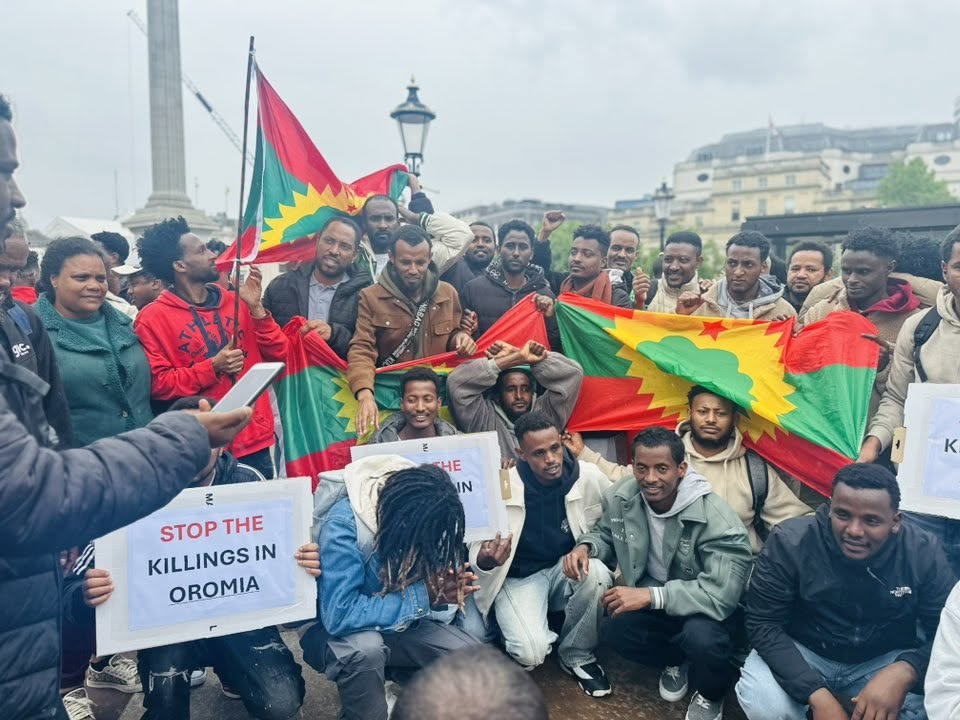
Thousands gather in London to denounce the Prosperity Party government’s actions and demand international intervention
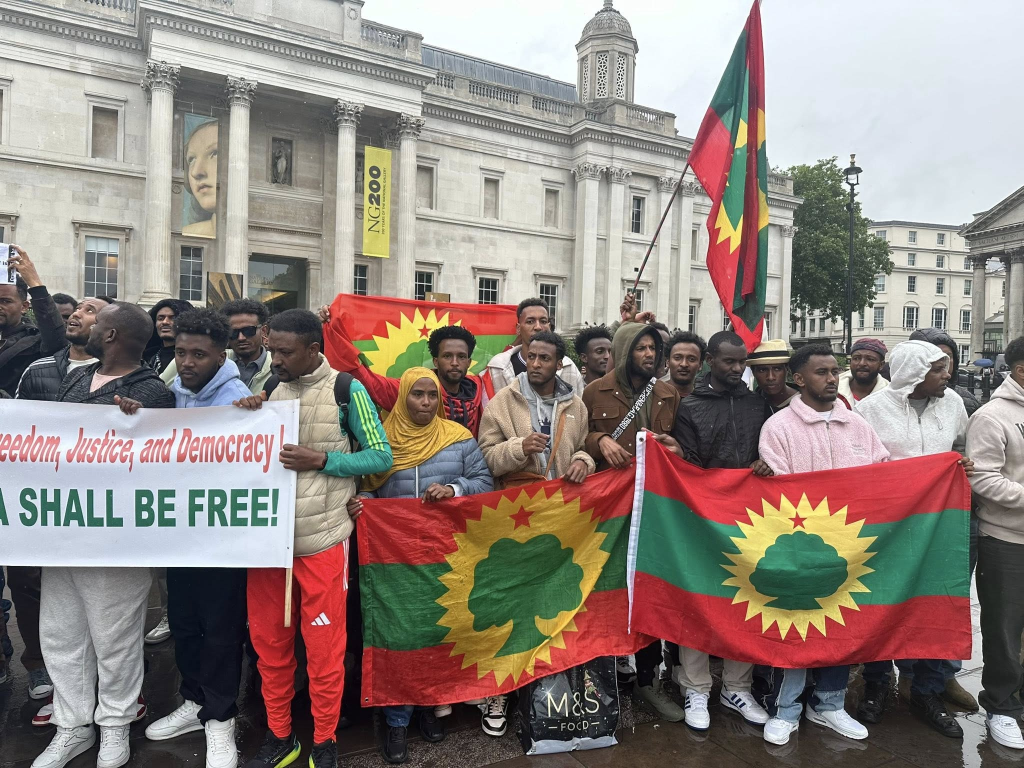
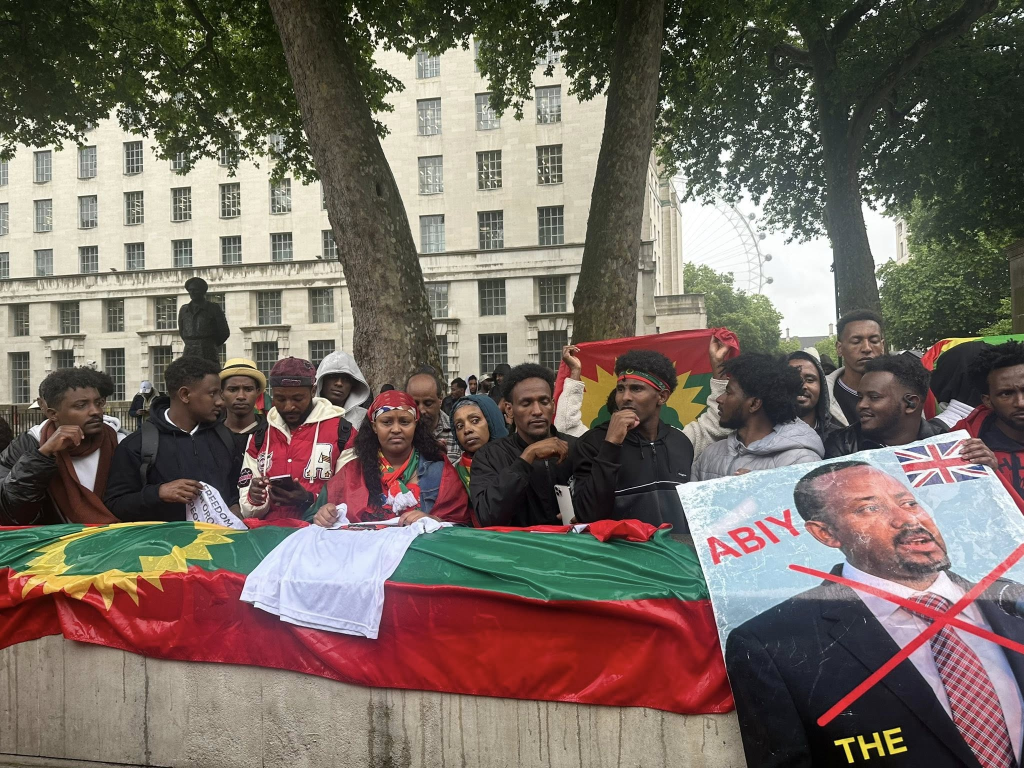
LONDON, UNITED KINGDOM — The Oromo diaspora community in the United Kingdom took to the streets of London on May 27, 2025, in a powerful demonstration against what they described as escalating human rights violations and systematic oppression in Oromia under the Prosperity Party government led by Prime Minister Abiy Ahmed .
Organizers described the protest as an urgent response to conditions in Oromia that have reached a critical threshold, drawing participants from across the UK. The rally demanded immediate international action to halt the violence and protect Oromo civilians.
A Crisis at the Breaking Point
Protest leaders emphasized that human rights abuses in Oromia and across Ethiopia have surpassed acceptable boundaries. They warned that the situation has become so alarming that it can no longer be ignored or dismissed.
The Oromo people, who constitute approximately 35 percent of Ethiopia’s population, have long voiced grievances over political marginalization, economic exploitation, and cultural suppression. The recent escalation of military operations in Oromia has deepened these concerns, with protesters pointing to a deliberate campaign of displacement and violence.
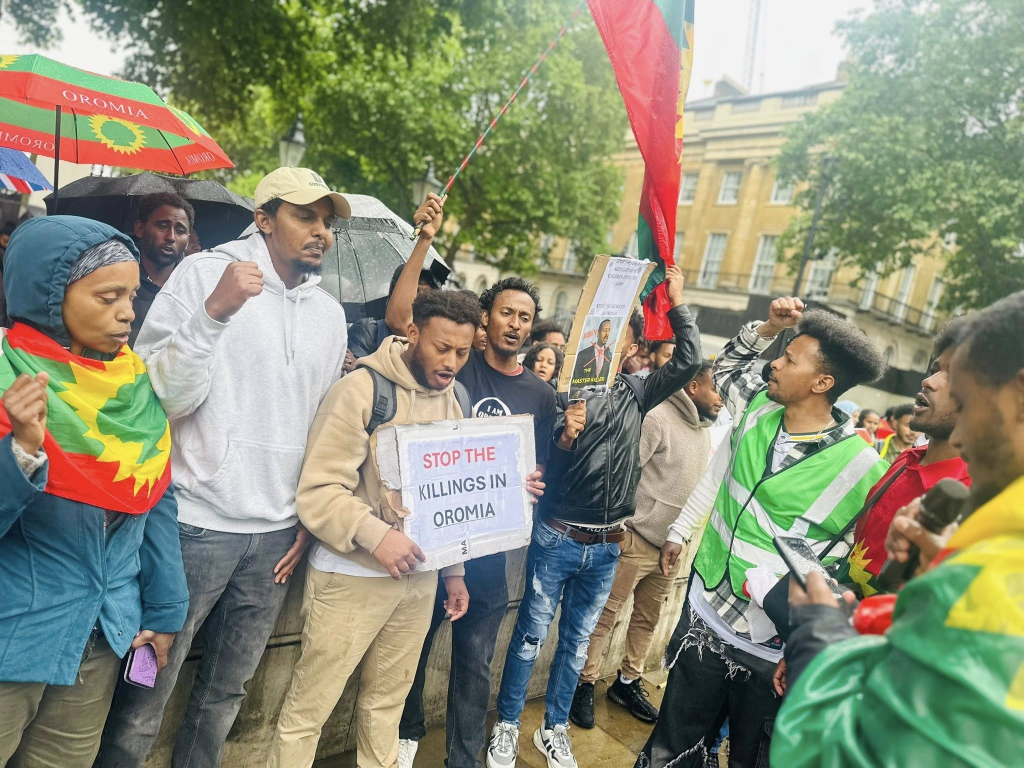
Echoes of the Derg Era
Demonstrators drew stark parallels between the current Prosperity Party government and the Derg regime of Mengistu Hailemariam (1974-1991). They accused the current administration of employing similar tactics: forcibly conscripting youth into the military, deploying them to war zones, and using them as cannon fodder in conflicts across the country .
The comparison resonated deeply with participants, many of whom have personal or family memories of the Derg’s brutal crackdown on Oromo communities. The Red Terror period, which saw systematic killings and disappearances of political opponents, remains seared into the collective memory of the Oromo people.
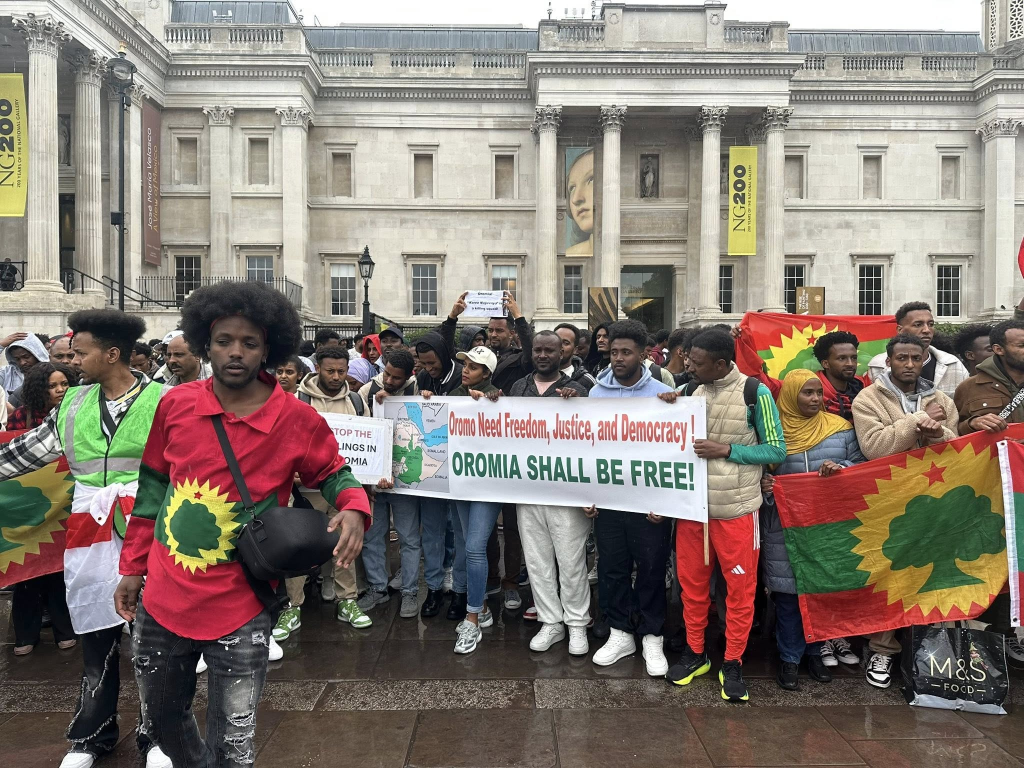
The Human Toll
Demonstrators painted a stark picture of life under the current government: the Oromo people have no peace and live each day like leaves falling to the ground. The constant state of insecurity has made movement between places “almost impossible” .
Reports from human rights organizations have documented extrajudicial killings, torture, abductions, and rape committed by both government forces and the Oromo Liberation Army (OLA). A joint investigation by Reuters uncovered the operations of a clandestine Security Committee in Oromia that has allegedly ordered extra-judicial killings and illegal detentions .
The impact on civilians has been devastating: over 3.2 million children are reportedly out of school due to the fighting, and aid groups have struggled to distribute supplies, contributing to high malnutrition rates.
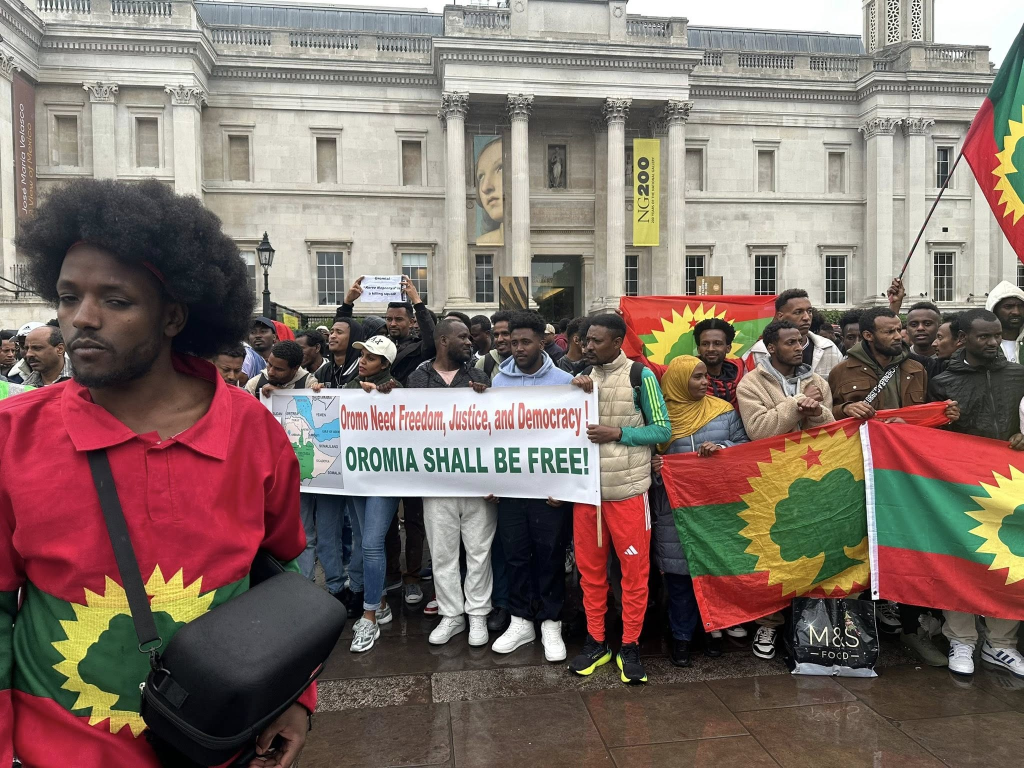
A Call to Action
The protesters presented a series of demands to both the Ethiopian government and the international community :
- An immediate halt to what they described as genocide and military operations across Ethiopia
- The cessation of forced conscription of children into the military
- The withdrawal of all forces from Oromia
- An end to the unlawful seizure of Oromo land and property
- The unconditional release of all political prisoners
- Justice for murdered artists and activists, including Haacaaluu Hundeessaa and Battee Urgeessaa
The demonstrators specifically called on the UK government and international financial institutions to suspend all financial and diplomatic support to the Ethiopian government. A formal petition detailing these grievances was submitted to the UK Foreign Office.
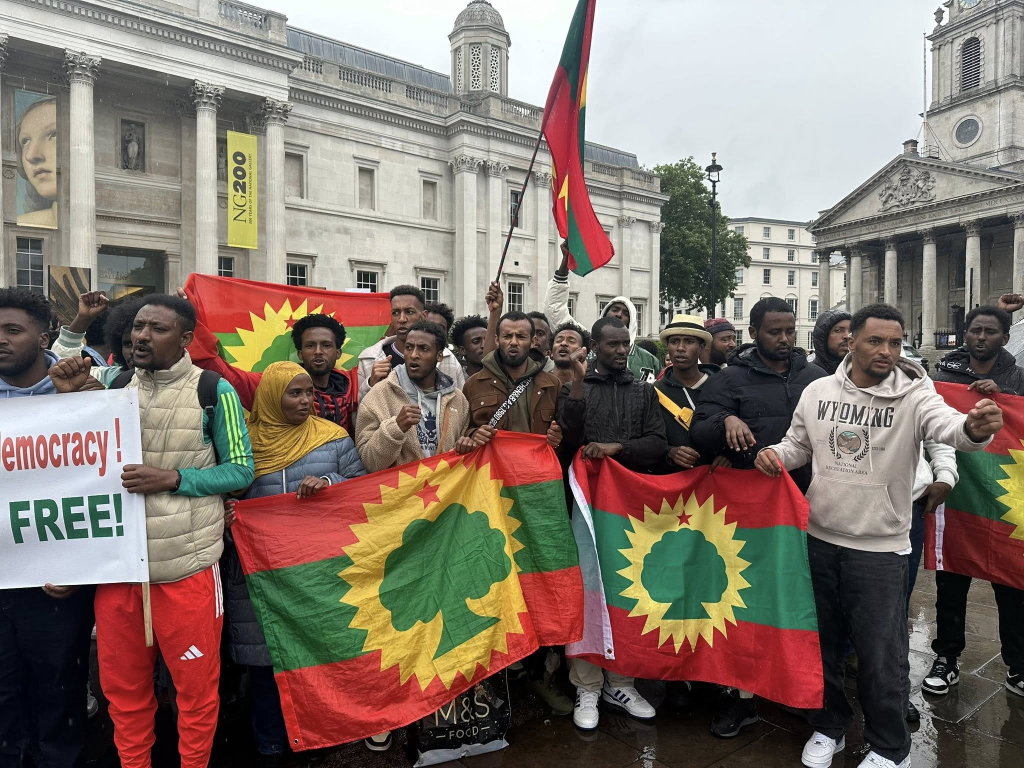
The Role of the International Community
Protest leaders emphasized that international actors have a moral and legal obligation to intervene. The Ethiopian government, they argued, has repeatedly failed to protect its citizens and has weaponized state institutions against the Oromo people .
The call for the UK government to exert “necessary pressure” on the Prosperity Party reflects growing frustration among the Oromo diaspora with the international community’s perceived inaction. Despite widespread documentation of human rights abuses, Ethiopia has continued to receive diplomatic and financial support from Western nations.
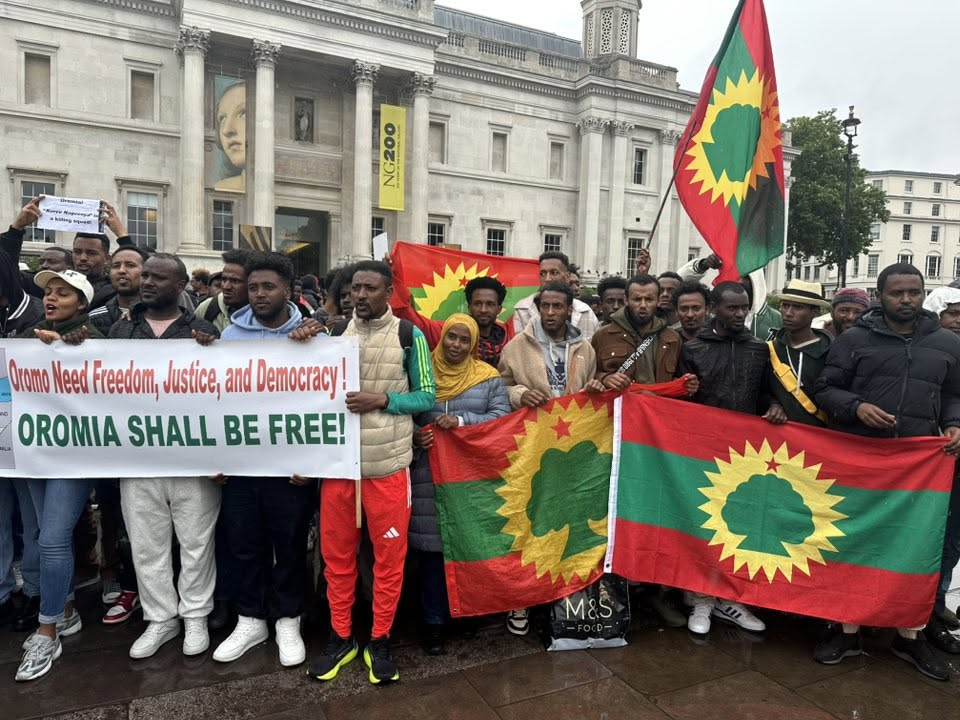
The London protest on May 27, 2025, was part of an ongoing global campaign by the Oromo diaspora to bring attention to systematic human rights abuses in their homeland . The demonstrators’ demands reflect a deep sense of urgency: they have called for an end to the killings, the withdrawal of forces, and international intervention .
The Oromo people continue to live without peace, and the situation in Oromia remains deeply insecure. The international community faces a critical test: whether it will respond with concrete action or allow another chapter of suffering to unfold largely unseen.

The Oromian Story: Preserving Voices, Empowering Communities, and Celebrating Culture

Through the voices of elders and the vitality of community, the Oromian Story program ensures that Oromo culture remains a living, breathing force for generations to come
FINFINNE, OROMIA — In the heart of every culture lies a story—a narrative passed down through generations, carried in the voices of elders, and woven into the fabric of daily life. For the Oromo people, this story is not merely a record of the past; it is a dynamic, living force that shapes identity, builds community, and points toward the future.
The Oromian Story program stands as a testament to this truth. By centering the voices of Oromo elders and engaging communities at the grassroots level, the program ensures that Oromo culture remains vibrant, resilient, and relevant in a rapidly changing world.
“The Oromian elders’ voices is a dynamic part of Oromian culture and identity.”
This recognition lies at the heart of the Oromian Story program. Elders are not simply repositories of ancient wisdom—they are active participants in the ongoing creation of culture. Their voices, their memories, and their insights are essential to understanding who the Oromo people are and who they are becoming.
The Power of Elders’ Voices
In Oromo society, elders occupy a position of profound respect and responsibility. They are the keepers of history, the guardians of tradition, and the guides for the younger generation. The Gadaa system, which has governed Oromo society for centuries, is built on a foundation of elder wisdom and intergenerational transmission.
The Oromian Story program recognizes that the preservation of culture depends on the active engagement of elders. When elders share their stories, they are not merely recounting the past—they are shaping the future. They are teaching younger generations about their identity, their values, and their responsibilities.
Maintaining Culture Through Community Involvement
“The Oromian story program presents the maintenance and continued development of Oromo culture at the community level.”
Culture is not something that can be preserved in museums or archives alone. It lives in the daily practices, rituals, and relationships of communities. The Oromian Story program understands this, focusing on community-level activities that keep culture alive and dynamic.
Through community gatherings, storytelling sessions, and cultural events, the program ensures that Oromo culture is not a relic of the past but a living presence in the present. It engages people of all ages in the ongoing work of cultural preservation and innovation.
Supporting New Forms of Cultural Expression
The program supports activities that support new forms of Oromo cultural expression.
Culture is not static—it evolves, adapts, and grows. The Oromian Story program recognizes this, supporting new forms of cultural expression that reflect the creativity and dynamism of the Oromo people.
This might include:
– Contemporary art and music that draws on traditional themes
– Digital storytelling that reaches new audiences
– Literary works that explore Oromo identity in new ways
– Cultural festivals that bring together diverse communities
– Intergenerational projects that bridge the gap between elders and youth
By supporting new forms of cultural expression, the program ensures that Oromo culture remains relevant and vibrant in the modern world.
Increasing Public Awareness of Oromo Culture
The program supports activities that increase public awareness of Oromo culture, including through the presentation and exchange of culture.
One of the greatest challenges facing Oromo culture is the lack of public awareness—both within Ethiopia and internationally. The Oromian Story program addresses this challenge by promoting the presentation and exchange of culture.
Through public events, cultural exchanges, and educational initiatives, the program helps to:
– Educate the broader public about Oromo culture and history
– Foster cross-cultural understanding and dialogue
– Challenge stereotypes and misconceptions
– Celebrate the richness and diversity of Oromo traditions
– Build bridges between Oromo communities and others
Sustainable Development of Community Organisations
The program supports the sustainable development of community organisations involved in cultural activities.
Cultural preservation cannot be achieved without strong, sustainable community organisations. The Oromian Story program invests in the capacity of these organisations, helping them to:
– Develop effective governance and management structures
– Build financial sustainability
– Train staff and volunteers
– Expand their reach and impact
– Collaborate with other organisations and institutions
The Broader Impact
“The program promotes activities that encourage culturally vibrant communities and contribute to the cultural wellbeing of Oromia.”
The impact of the Oromian Story program extends far beyond the preservation of culture. By strengthening cultural identity and community cohesion, the program contributes to:
Social Cohesion: When communities share a strong cultural identity, they are more resilient, more united, and better able to address common challenges.
Youth Engagement: By involving young people in cultural activities, the program helps to build their sense of identity and purpose.
Community Pride: Cultural activities foster a sense of pride and belonging, strengthening communities from within.
Economic Development: Cultural tourism, arts, and crafts can contribute to local economic development.
Peacebuilding: Cultural exchange and dialogue can help to build trust and understanding between communities.
A Vision for the Future
“The Oromian Story program presents the maintenance and continued development of Oromo culture at the community level.”
The vision of the Oromian Story program is a future in which Oromo culture is not merely preserved but is a vibrant, dynamic force in the lives of Oromo people. It is a future in which elders are honored and their wisdom is valued; in which young people are engaged and empowered; in which communities are united and resilient; and in which Oromo culture is celebrated and shared with the world.
Conclusion
The Oromian Story program is a vital initiative for the preservation and development of Oromo culture. By centering the voices of elders, engaging communities, supporting new forms of cultural expression, and investing in community organisations, the program ensures that Oromo culture remains a living, breathing force for generations to come.
“The Oromian elders’ voices is a dynamic part of Oromian culture and identity.”
As the Oromo people continue their journey of cultural revival and self-determination, programs like the Oromian Story will play an essential role in ensuring that the voices of elders are heard, the stories of the past are remembered, and the culture of the Oromo people continues to thrive.
—
In the voices of Oromo elders lies the story of a people—a story of resilience, resistance, and hope. Through the Oromian Story program, that story will continue to be told.





 Advocacy for Oromia