Under the Odaa Tree: The Living Legacy of the Ituu Oromo
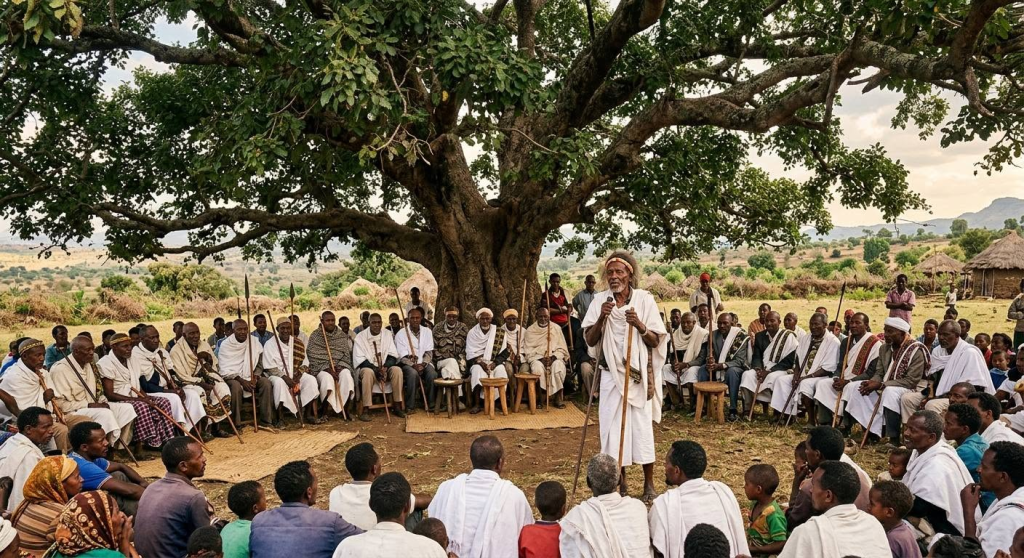
In the highlands of eastern Oromia, the roots of the Odaa tree (sycamore fig) stretch deep into the earth, just as the traditions of the Oromo people extend into the fabric of history. Among the most storied branches of the Oromo nation is the Ituu, a community whose identity is woven from the threads of ancient lineage, a sophisticated socio-political system, and a resilient spirit of justice. To understand the Ituu is to journey into the heart of the Oromo civilization, where the past is not merely remembered but lived.
The Ancestral Tree: From Murawwaa to Ituu
The Ituu are not a people without a past; they are a clear and significant branch on the vast Oromo genealogical tree. According to both oral tradition and contemporary scholarship, the lineage flows from Oromoo to Bareentuu (or Bareentuma), then to Murawwaa, and from Murawwaa springs the Ituu. A 2026 study by Jimma University confirms this ancestral link, placing Ituu firmly within the Murawwaa Barentuu family.
The Ituu themselves are divided into two primary clans, forming the backbone of their social structure:
- Galaan, with sub-clans such as Baabboo, Gaadullaa, and Elelle.
- Kurraa (Kuraa), with sub-clans such as Baayee, Addaayyo, Arroojjii, and Waayyee.
This is just one layer of a complex organizational system. Under the Gulantaa Odaa or Tumaa Heeraa (customary law), the Ituu are further organized into two major houses: Mana-Ituu (the House of Ituu) and Mana-Baabboo (the House of Baabboo). This dual structure underscores that for the Ituu, identity is a multi-faceted concept, governed by both bloodline and law.
Gadaa: The Soul of Oromo Governance
For the Ituu, as for all Oromo, the Gadaa system is the lifeblood of their society. It is far more than a political structure; it is a comprehensive philosophy that governs every aspect of life. It provides a framework for:
- Political Leadership: A system of elected officials with fixed terms, ensuring a democratic transfer of power.
- Justice (Heera): A legal system that predates modern courts, offering a way to resolve disputes and maintain order.
- Peace (Araara): A defined process for reconciliation and conflict resolution.
- Social Organization: A structure that defines the roles and responsibilities of individuals within the community.
- Spiritual Life: A connection to the divine and the natural world through rituals.
Odaa Bultum: The Parliament of the People
Central to the Ituu and wider Barentuu Oromo history is Odaa Bultum. This site in Hararghe served as a colossal Gadaa assembly center, a place where the community would gather to make laws, elect leaders, and settle disputes. It was the “parliament” under the shade of the Odaa tree, where the echoes of debate and the spirit of democracy were cultivated for generations.
Here, the voices of the people were heard through the Caffee (assembly), and the foundation of their society—Heera (law)—was debated and set. It was a place where the spiritual and the political converged to build a cohesive society.
Gumaa: A Path from Bloodshed to Brotherhood
Perhaps the most profound expression of Ituu culture is the institution of Gumaa. Often translated simply as “blood compensation,” Gumaa is actually a complex, restorative justice system. A 2026 Jimma University study highlights its true purpose: it is not solely about retribution but about reconciliation.
Gumaa is a process that transforms conflict, seeking to stop the cycle of violence and reintegrate offenders back into the community. It is a testament to the Ituu belief that even in the face of grave wrongs, the ultimate goal is peace and social harmony. The system includes specific legal frameworks such as Heera Diinoo, Heera Amboo, and Heera Danuu.
The Rituals and the Voices of the People
The cultural life of the Ituu is rich with ceremony. The Korbeessaa–Goromtii ritual, for instance, involved the sacrifice of goats to invoke peace, seek victory in conflict, and predict social and natural outcomes. It was a way of seeking divine guidance for the community’s journey.
Importantly, the Ituu social structure also features a powerful institution for women: Siiqqee. This is not merely a tradition but a social force that gave women a formal voice in matters of justice, peace, and reconciliation. It stands as a powerful testament to the Oromo society’s recognition of the vital role of women in maintaining social order and integrity.
A Living Tradition
Today, the Ituu Oromo stand at a crossroads of history. Their traditional systems—the Gadaa, the Heera, and the Gumaa—are not relics of a bygone era. They are living institutions that continue to provide a framework for justice and identity in a rapidly changing world. The genealogy from Murawwaa to Ituu is not just a list of names but a testament to a civilization that built a sophisticated society rooted in democracy, justice, and a profound respect for community.
The story of the Ituu is a story of resilience—a reminder that the roots of the Odaa tree, and the culture it represents, are deep and enduring.
Sources:
- Boru Musa Burka & Jira Mekonnen Choroke, “Gumaa beyond Compensation,” Gadaa Journal, 2026.
- Boru Musa Burqa & Dejene Gemechu Chala, “Korbeessaa-Goromtii Ritual,” Gadaa Journal, 2022.
- Admasu Feleke & Deressa Debu, “Oromo Historical Heritage: Historical Significance of Odaa Bultum Gadaa Assembly,” Jimma University.

Posted on September 1, 2026, in Aadaa, Afaan, Bokkkuu, Election, Events, Finfinne, freedom, gadaa, Gumaa, Information, Kindness, Language, Media, News, Oromia, Oromo diaspora, Oromo truth telling, Press Release, Promotion. Bookmark the permalink. Leave a comment.






Leave a comment
Comments 0