The Pillar of Borana: A Tribute to Abbaa Gadaa Liiban Jaldeessaa (1967-2026)
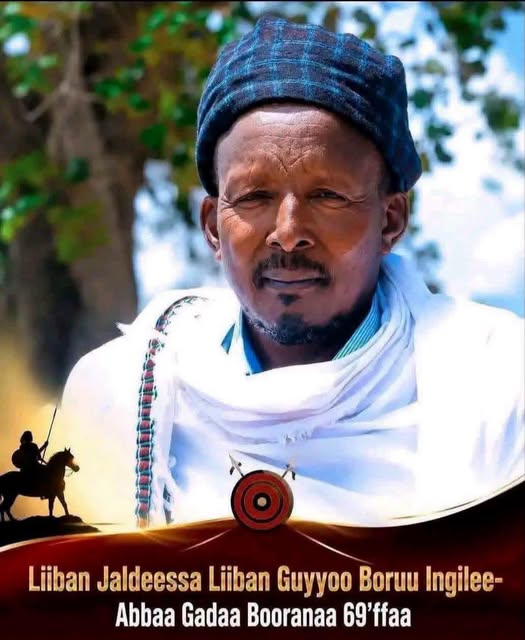
In the vast, sun-scorched plains of Borana, where the acacia trees stand as silent witnesses to centuries of tradition, a giant once walked among the people. He was not a king in the Western sense, nor a politician in the modern mold. He was an Abbaa Gadaa—a father, a judge, a living constitution for the Oromo people. His name was Liiban Jaldeessaa, and his life, from 1968 to 2026, was a testament to the enduring power of indigenous governance.
His story is not merely a biography; it is the history of a people’s resilience, a chronicle of justice, and a powerful reminder that true leadership is often found not in grand palaces, but in the dusty meeting grounds and under the shade of sacred trees.
A Son of the Soil: The Early Years
Born in 1967 to Jaldeessa Liiban and Tarrii Jaldeessa, in the Bur Busa area of Dheeda Booranaa, Liiban was a child of the Gadaa system from his first breath. He was the eldest of six siblings and would grow to be the father of fifty children—a patriarch in every sense of the word. Even in his youth, he was marked by a profound sense of duty. He was a “Tikaa,” a guardian of the cattle camps, learning the sacred responsibility of protecting the community’s lifeblood. He immersed himself in the traditions of his people, taking part in every rite of passage: from the Gammee (councils) to the Kuusa-Raabaa (age-grade gatherings), proving his dedication and worth at every step.
As a young man, Liiban distinguished himself through his unwavering commitment. He excelled in the crucial, often overlooked tasks of community life—the “hard work” that keeps society functioning. He was a man who understood the ancient ways, taking part in night-long vigils and traditional song and dance ceremonies (Olka Sirbuu) held at sacred sites like Dambii Dhedheertuu, Afuuraa, Areeroo, and Haroo Diimtuu. He earned a reputation for being tireless and principled, famously ensuring a great water reservoir (Gooroo) was properly filled, demonstrating his devotion to the community’s well-being even before he took on the highest office.
The Gauntlet of Leadership: A Gadaa in Action
In 1991, at a critical juncture for the Borana people, Liiban Jaldeessaa received the ultimate call to leadership. He took the Gooroo Gadoomaa—the sacred ceremonial staff—from the 68th Abbaa Gadaa, Boruu Madhaa. This was not a time of peace, but a time demanding strength, wisdom, and a firm hand.
His tenure as Abbaa Gadaa was defined by decisive action and a tireless defense of tradition and justice:
· Restoring Tradition: The great Gumii assembly of the Oromo, a cornerstone of democratic governance, had weakened and fractured. Liiban, understanding its vital importance, re-established the Gumii Dibbee Eldalloo, breathing new life into the ancient institution and ensuring the voice of the people could once again be heard.
· Uncompromising Justice: When elders attempted to use their authority to pass a decree without consulting the people, Liiban stood firm. His principle was clear: “An Abbaa Gadaa has no power to create a law by himself; the law is made by the Gumii.” He scrupulously upheld the rule of law, ensuring that power was accountable to the community.
· Protecting the Land: He was a fierce and unyielding defender of Oromo territory. At a time of great fear and uncertainty, he famously declared: “Fear should not cause the heartland of Oromo to be lost; fear should not cause the land of Oromo to be diminished.” He led land border expeditions (Lallaba) to assert territorial claims, confronting regional and federal authorities to protect the integrity of his people’s ancestral lands.
· The Ethiopian Renaissance Dam: When the issue of the Grand Ethiopian Renaissance Dam (GERD) arose, Gadaa Liiban gave a striking directive on how the Borana people should contribute to the national project. He proclaimed, “We will not support it with money from our pockets, but we will contribute with our hands and our labor,” reflecting a pragmatic and dignified approach to national duty.
· Diplomacy and Peacebuilding: He was a bridge-builder, working tirelessly with the Kenyan and Somali governments, and numerous NGOs to maintain peace and security in the volatile borderlands. He believed in the unity of all people, transcending clan, religion, and nation.
The Enduring Legacy: The “Dhaamsa” of a Great Man
On August 29, 2026, at the age of 59, Abbaa Gadaa Liiban Jaldeessaa passed away while receiving treatment in a Korean hospital. His death was a profound loss, a “Rifuu” (sorrow) felt from the savannahs of Ethiopia to the grasslands of Kenya.
But an Abbaa Gadaa does not simply die; he leaves a legacy—a Dhaamsa. This is not just a will, but a final message, a solemn charge to his people.
His legacy is twofold:
1. The Rifuu (The Sorrow and the Shield): He left behind a legacy of protection and strength. His memory is a shield, a “Jabaa Fulaa” (strong face) and a “Waardiyaa” (shield) that guards the community against its enemies and against division. The sorrow for his loss is immense, but it is a sorrow that binds the people together.
2. The Dhaamsa (The Final Charge): His final message is a call to action. It is a warning that the path he paved, the justice he upheld, and the unity he fostered must not be abandoned. His “Dhaamsa” is a reminder that the work of the Gadaa is never finished. It is a call to the community to remain steadfast, to support one another, and to continue the struggle for their rights and identity.
A Star That Still Guides
Abbaa Gadaa Liiban Jaldeessaa was more than a leader; he was the embodiment of the Gadaa system’s greatest ideals: justice, resilience, and unwavering dedication to the people. He was a “Fiixee Seeraa” (the pinnacle of the law), a “Tissaa Gooroo Gadaa” (the guardian of the Gadaa’s sacred staff), a man whose name will forever be etched in the annals of Borana history.
He passed into the next world, but for the Oromo people, he remains a star. His life is a lesson that the most profound leadership is born not of ambition, but of service. His legacy is a testament that a people’s strength lies not in their weapons, but in their traditions, their unity, and their unwavering commitment to justice.
As the Oromo people honor his memory, they are called to embody his final message: to be strong, to be united, and to ensure that the spirit of Gadaa Liiban Jaldeessaa lives on in every generation. He was a son of the soil, a pillar of his community, and a beacon of hope for all who believe in the power of indigenous wisdom.

Posted on September 1, 2026, in Biography, Grief Support, health, Information, Kindness, Language, Media, News, Obituary, Oromia. Bookmark the permalink. Leave a comment.






Leave a comment
Comments 0