Category Archives: Election

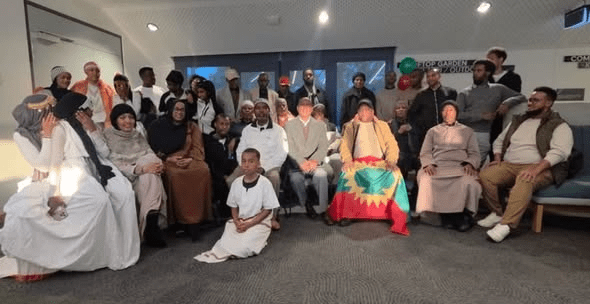
Honouring Our Roots: AOCV Launches Elders Voice Program at Flemington Hub
By Dhabessa Wakjira
—
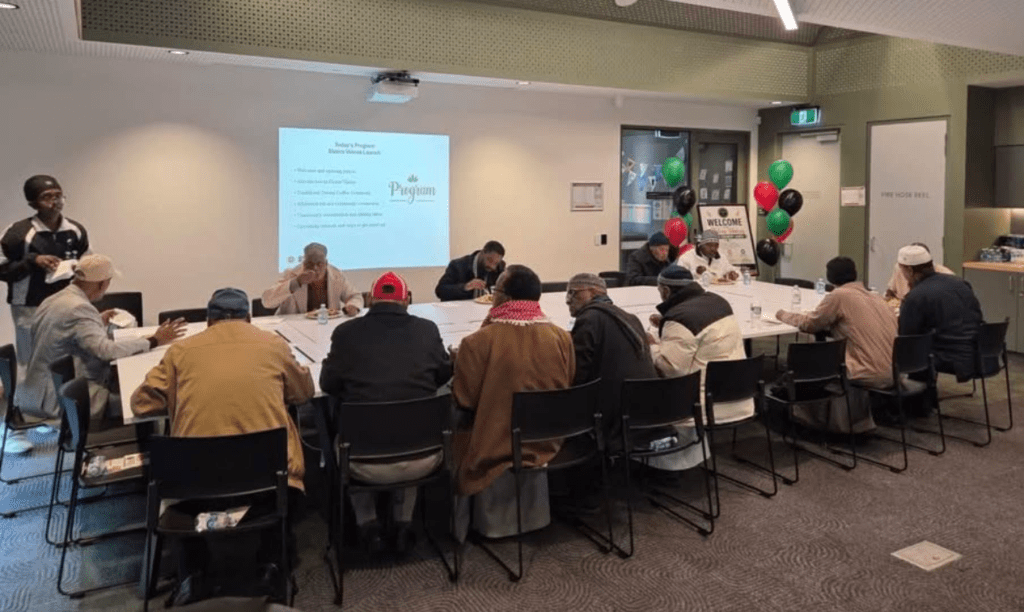
On Sunday, 16th August 2026, the air at Flemington Hub was thick with anticipation, respect, and the warm hum of community. It was a day of celebration, reflection, and a profound commitment to the future—a day when the Australian Oromo Community Victoria (AOCV) officially launched its much-anticipated Elders Voice Program (Sagantaa Sagalee Maanguddootaa) .
The event marked more than just a ceremonial opening; it was a declaration that the voices of our elders matter. That their stories are not merely echoes of the past but living threads that weave the fabric of our identity. As the program unfolds, it promises to become a cornerstone of cultural preservation, intergenerational connection, and community healing.
—
A Program Rooted in Reverence
The Elders Voice Program will be delivered on the first week of every month, offering a regular, dedicated space for elders to share their wisdom, experiences, and cultural knowledge with younger generations. It is a structured yet heartfelt initiative designed to ensure that the rich tapestry of Oromo heritage—its history, traditions, language, and values—is not only remembered but actively lived and passed on.
“Maanguddoonni keenya kuusaa seenaa, aadaa fi duudhaa keenyaati,” the AOCV team reminded attendees during the launch. “Isaan seenaa, barnoota, muuxannoo fi yaadannoo dhaloota walitti hidhu baatanii jiru.”
Translation: “Our elders are the keepers of our history, culture and traditions—carrying stories, lessons and memories that connect us to where we come from and remind us of who we are.”
These words resonated deeply with the crowd, a mix of young and old, Oromo-born and Australian-raised, all united by a shared desire to honour the past while building a resilient future.
—
Why This Program Matters Now
In an age of rapid globalisation and digital distraction, the risk of cultural erosion is real. For diaspora communities, the challenge is even greater. Languages fade, customs evolve, and the intimate oral traditions that once bound generations together can easily slip through the cracks of busy modern lives.
The Elders Voice Program stands as a deliberate counterforce to this trend. By creating a regular forum where elders are not just listened to but celebrated, AOCV is ensuring that:
· History is preserved: Oral histories, migration stories, and ancestral knowledge are documented and shared.
· Wisdom is transferred: Life lessons, problem-solving approaches, and traditional skills are passed to younger hands.
· Identity is strengthened: Young people gain a clearer sense of who they are and where they come from, building pride and resilience.
· Community is unified: Intergenerational dialogue fosters mutual understanding, respect, and deeper social bonds.
—
A Launch to Remember
The Flemington Hub was alive with energy on launch day. Elders were seated in places of honour, their faces beaming with pride and emotion. Young community members performed traditional songs and poetry, weaving the old with the new. There were moments of laughter, tears, and powerful silence—the kind that speaks louder than words.
One elder, reflecting on the initiative, shared: “Yeroo dheeraaf sagaleen keenya hin dhageeffamne ture. Amma garuu, ijoolleen keenya dhaga’uu barbaada. Kun ijoollee keenyaaf, nuufis, eebba guddaadha.”
“For too long, our voices were not heard. But now, our children want to listen. This is a blessing for them and for us.”
The launch concluded with a community feast and the formal announcement of the program’s monthly schedule, with the first official session set to take place in the first week of September 2026.
—
Looking Ahead
The Elders Voice Program is more than a series of meetings—it is a movement. It is a promise that the stories of those who came before us will not be forgotten. It is an invitation for every community member, young and old, to participate in the sacred act of remembering and retelling.
As AOCV continues to build bridges between the Oromo diaspora and broader Australian society, initiatives like this remind us all of a universal truth: every culture is carried forward by its elders, and every community is enriched when it pauses to listen to them.
“Sagalee maanguddootaa keenyaa haa dhageenyu, seenaa isaanii haa galmeessinu, ogummaa isaanii dhalootaaf haa dabarsinu.”
“Let us hear the voices of our elders, document their stories, and pass on their wisdom to the generations to come.”
—
Get Involved
The Elders Voice Program invites all community members to attend, contribute, and learn. For more information on upcoming sessions, volunteer opportunities, or to share an elder’s story, contact AOCV at [insert contact details] .
Together, we honour the past. Together, we build the future.
—
#EldersVoice#AOCV#OromoCommunity#CulturalPreservation#FlemingtonHub#GenerationsUnited

Arsi University Updates Logo, Puts Afaan Oromo First
A Historic Step for Linguistic Recognition in Higher Education
By Daandii Ragabaa
In a significant move for linguistic inclusivity and cultural recognition, Arsi University has announced an update to its institutional logo, placing Afaan Oromo first in the order of languages displayed on the emblem. The announcement, made on 23 August, marks an important milestone in the recognition of the Oromo language within Ethiopia’s higher education system.
The New Design
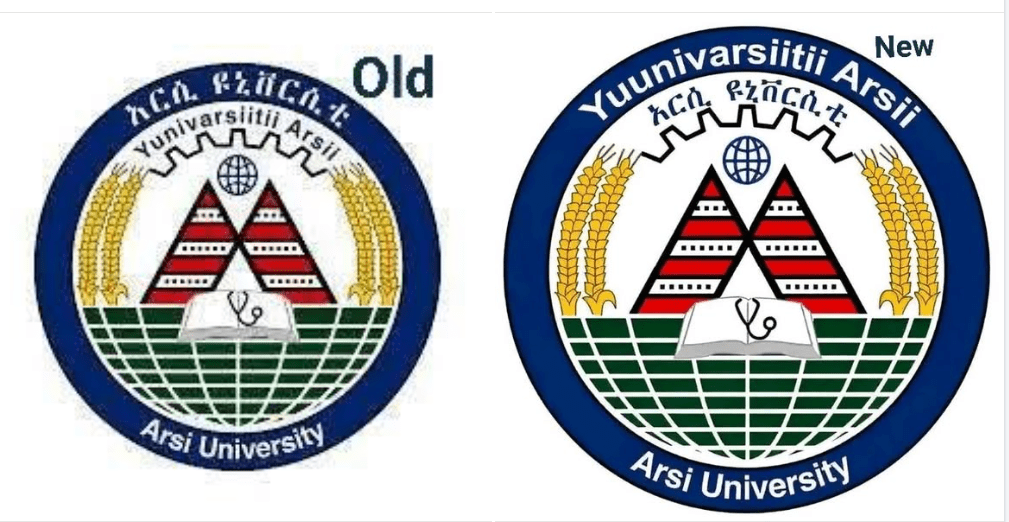
The university has made what it describes as “slight modifications” to its former logo, with the revised design featuring a new language order: Afaan Oromo first, Amharic second, and English third.
The university has also corrected the Afaan Oromo inscription from “Yunivarsitii Arsii” to “Yuunivarsitii Arsii,” ensuring linguistic accuracy in the representation of the language .
The announcement instructed all stakeholders to “recognize and use the new logo in accordance with the captions order stated above.”
A Growing Movement for Afaan Oromo Recognition
The decision by Arsi University aligns with a broader movement within Oromia to promote and preserve the Afaan Oromo language in academic and public life. The University has previously demonstrated its commitment to Afaan Oromo through collaborative initiatives, including a Memorandum of Understanding with Wachemo University aimed at preserving and digitising the rich cultural heritage of the Afaan Oromo language .
This latest move represents a tangible step toward normalising the use of Afaan Oromo in official and institutional contexts, affirming the language’s status as a medium of higher education and institutional identity.
The Role of Language in Cultural Identity
For the Oromo people, Afaan Oromo is more than a means of communication—it is a vessel of history, culture, and identity. The prioritisation of Afaan Oromo on an institutional logo is a symbolic but powerful recognition of the Oromo people’s right to see their language reflected in spaces of knowledge and governance.
The decision also carries practical implications for students and staff who use Afaan Oromo as their primary language. It signals that their linguistic identity is valued and respected within the institution. This is particularly significant given the historical marginalisation of Afaan Oromo in education and public life.
The efforts to preserve and digitise Afaan Oromo language resources, including through university partnerships, have helped strengthen its role in academic and public life .
The University’s Visual Identity
The updated emblem retains the university’s core visual elements, including the agricultural sheaves, gears, triangular structure, globe and open book. These elements symbolise the university’s commitment to education, innovation, and community development, while the new language placement underscores its commitment to linguistic inclusivity.
Located in Assela, the capital of the Arsi Zone in the Oromia Regional State, Arsi University serves students from across the region. The university also operates extended campuses in different parts of the zone, further expanding its reach and impact.
A Broader Conversation
The update follows the growing importance of Afaan Oromo in academic and official contexts . Research has highlighted the significance of mother-tongue instruction in educational settings, noting that students benefit from learning in their first language. The perception of mother-tongue use in educational contexts has been shown to positively influence learning outcomes .
Arsi University’s logo update joins a broader conversation about language recognition in Ethiopia, where the federal constitution recognises the equality of all languages but where Amharic has historically dominated official and educational contexts. Other institutions and public bodies may follow suit, reflecting the changing linguistic landscape of the country. While the logo change is primarily symbolic, it represents a tangible step towards normalising the use of Afaan Oromo in institutional settings.
Conclusion
Arsi University’s decision to place Afaan Oromo first on its logo is a significant step for the recognition of the Oromo language. It affirms the identity of Oromo students and staff, sets a precedent for other institutions, and demonstrates the ongoing vitality of Afaan Oromo in higher education.

Slaughter in the Shadows: The Unfolding Horror in East Wollega
As the world looks elsewhere, Ethiopian civilians are being burned alive, and a desperate plea for help rises from the ashes.
In the quiet villages of Ethiopia’s Oromia region, a summer of horror is drawing to a close. While global attention remains fixed on other crises, the International Oromo Women’s Organization (IOWO) has released a desperate appeal documenting an escalating campaign of violence that has turned the East Wollega Zone into a graveyard of professional promise and a testament to human cruelty .
The reports paint a picture of systematic terror allegedly perpetrated by Amhara Fano armed groups. Beginning in July and intensifying throughout August 2026, the violence has centered on the Gida Ayana Woreda—including the communities of Andode Dichoo, Angar Gute, and Tullu Lenca—as well as Kiramu and Horro Guduru. The testimonies describe not merely a conflict, but a targeted attempt to dismantle the very fabric of civilian life.
A Targeting of Hope
What distinguishes these atrocities is the chilling precision of the attacks. Among the dead are not just anonymous civilians, but the very pillars of the community. On August 19, the violence claimed Mr. Lamessa Mangistu, the branch manager of Awash Bank in Gida Ayana, and Mr. Mamush Maru, a banker at the Oromia Cooperative Bank. Their crime? Providing essential financial services to their community .
In Angar Gute, armed men reportedly burned Sister Liktu Amanu, a midwifery and nursing professional, while she was carrying out emergency duties. Just days earlier, 65-year-old Amanu Hirpha Bidu was reportedly burned alive inside an active ambulance during a patient transfer—a blatant violation of the fundamental protections afforded to medical transport under international humanitarian law . The attack on Mr. Olika Sagni, a local teacher, represents another devastating blow, stripping the community of its educators and the promise of future generations.
“We as mothers and sisters, cannot stand the endless brutal actions against civilian human beings,” writes Dinknesh D. Kitila, IOWO’s Board Director, in the appeal . Their plea is directed at the UN Security Council, the Human Rights Council, the U.S. Secretary of State, the EU, and governments worldwide: act before more innocent lives are extinguished.
Scorched Earth and Silence
The destruction is not limited to lives. The IOWO report details widespread arson targeting public offices, private homes, and transport vehicles, displacing families and paralyzing local economies. The group has released harrowing images of vehicles and property consumed by flames, emphasizing that the campaign is as much about erasing community infrastructure as it is about inflicting casualties. The targeted destruction of the Angar Gute area, including a special attack on Tullu Lenca, points to an attempt to force a demographic change or to punish communities for their identity .
This violence is part of a broader pattern of instability in Ethiopia. Travel advisories from various embassies currently designate East Wollega as a “red” or “extremely high-risk” area, warning citizens to avoid the region due to the presence of armed groups and the risk of attacks on civilians . The international community, while aware, has often been slow to act as the crisis deepens.
The World’s Response
The IOWO appeal calls for two immediate actions: emergency civilian protection for vulnerable populations in the affected woredas, and accountability for the perpetrators of these unlawful killings.
As the appeal letter was signed on August 24, the silence from the international community remains deafening. The documented cases of targeted killings of professionals, the use of ambulances as instruments of death, and the burning of entire communities demand more than a passing glance.
The mothers and sisters of East Wollega are not asking for charity; they are demanding the basic right to live. The charred remains of a midwife’s ambulance and the empty desks of murdered teachers are a stain on the conscience of humanity, a stark reminder that the cost of inaction is always counted in lives.

The World Looks Away: Western Oromia’s Cry for Justice

As violence escalates in Western Oromia, a leading advocacy group warns that silence is complicity and calls for urgent international intervention.
—
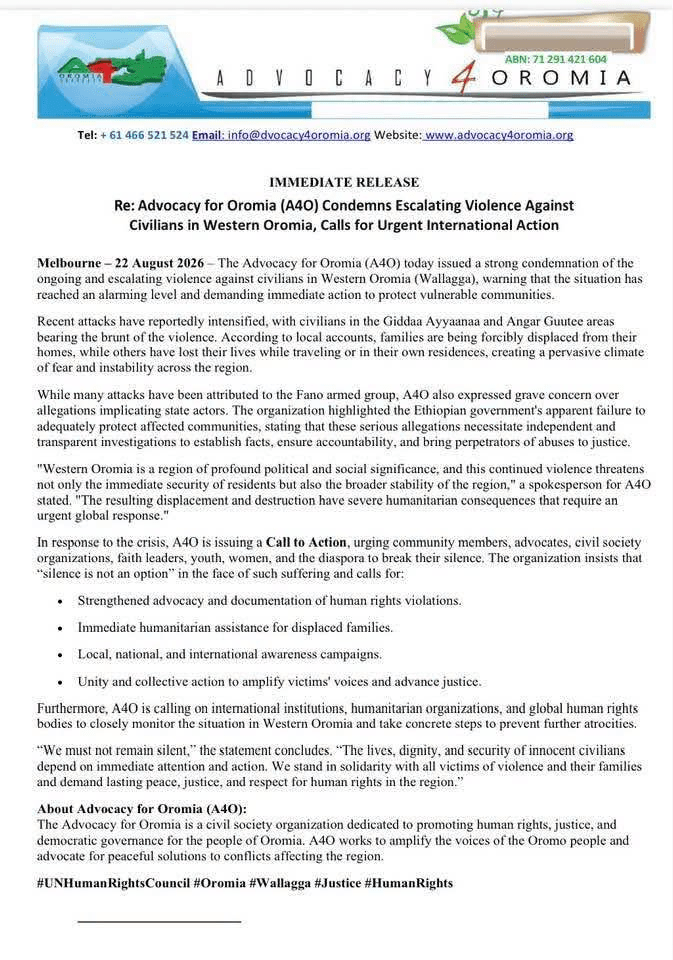
Melbourne – August 22, 2026 – The Advocacy for Oromia (A4O) has issued a stark warning that the escalating violence against civilians in Western Oromia (Wallagga) has reached an alarming level, demanding immediate action to protect vulnerable communities. In a powerful statement released today, the organization condemned the intensifying attacks that have reportedly displaced families, claimed lives, and created a pervasive climate of fear across the region.
The violence, concentrated in the Giddaa Ayyaanaa and Angar Guutee areas, has targeted civilians in their homes and while traveling, according to local accounts. Families are being forcibly displaced, their lives upended by a campaign of terror that shows no sign of abating.
A Crisis of Complicity
While many attacks have been attributed to the Fano armed group, A4O has expressed grave concern over allegations implicating state actors. The organization has accused the Ethiopian government of failing to adequately protect affected communities, a failure that demands independent and transparent investigations.
“Western Oromia is a region of profound political and social significance, and this continued violence threatens not only the immediate security of residents but also the broader stability of the region,” an A4O spokesperson stated. “The resulting displacement and destruction have severe humanitarian consequences that require an urgent global response.”
The government’s apparent inaction raises difficult questions about accountability and the protection of civilians. A4O insists that these serious allegations necessitate thorough investigations to establish facts, ensure accountability, and bring perpetrators of abuses to justice.
A Call to Break the Silence
In response to the unfolding crisis, A4O has issued a Call to Action, urging community members, advocates, civil society organizations, faith leaders, youth, women, and the diaspora to break their silence. The organization insists that “silence is not an option” in the face of such suffering.
The call outlines several key priorities:
· Strengthened advocacy and documentation of human rights violations to ensure that the world bears witness to the atrocities.
· Immediate humanitarian assistance for displaced families, whose basic needs remain unmet.
· Local, national, and international awareness campaigns to shine a spotlight on the crisis.
· Unity and collective action to amplify victims’ voices and advance justice.
A4O is also calling on international institutions, humanitarian organizations, and global human rights bodies to closely monitor the situation in Western Oromia and take concrete steps to prevent further atrocities.
The Cost of Inaction
The human toll of the violence is immeasurable. Families torn apart, communities shattered, and lives cut short—all while the international community remains largely silent. The displacement and destruction have severe humanitarian consequences, yet the global response has been insufficient.
A4O’s statement is a desperate plea to the world: “We must not remain silent. The lives, dignity, and security of innocent civilians depend on immediate attention and action. We stand in solidarity with all victims of violence and their families and demand lasting peace, justice, and respect for human rights in the region.”
A Call to Remember
As the violence continues to escalate, the world faces a choice: to act or to look away. A4O’s message is clear—silence is complicity, and inaction is a choice to abandon innocent lives.
The organization’s commitment to amplifying the voices of the Oromo people and advocating for peaceful solutions is a reminder that even in the darkest times, hope persists. But hope alone is not enough. It requires action, solidarity, and a collective demand for justice.
The people of Western Oromia are not merely statistics; they are mothers, fathers, children, and communities whose lives hang in the balance. Their cries for help must not go unanswered.
—
For more information, contact Advocacy for Oromia (A4O), a civil society organization dedicated to promoting human rights, justice, and democratic governance for the people of Oromia.
#UNHumanRightsCouncil#Oromia#Wallagga#Justice#HumanRights

We Must Not Remain Silent: The Unfolding Horror in Western Oromia

As violence escalates and thousands are displaced, the Oromo Sisterhood Institute issues a desperate plea: silence is complicity, and action cannot wait.
—
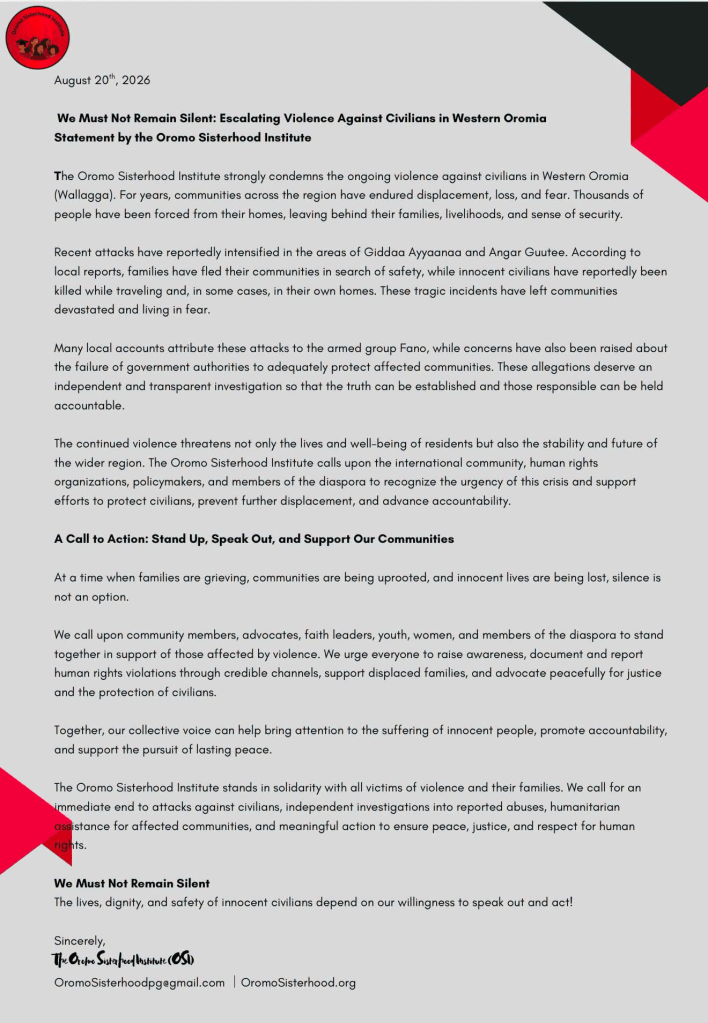
In the quiet villages of Western Oromia, a crisis of staggering proportions has been unfolding for years. But in recent weeks, the violence has reached a terrifying crescendo. The Oromo Sisterhood Institute (OSI) has issued an urgent condemnation of the escalating attacks against civilians in the Wallagga region—a humanitarian catastrophe that has displaced thousands, claimed countless lives, and left communities living in a state of paralyzing fear.
The areas of Giddaa Ayyaanaa and Angar Guutee have borne the brunt of the violence. According to local reports, families have been forced to flee their homes, leaving behind everything they have ever known. Civilians have reportedly been killed while simply traveling, while others have been murdered in their own homes—a brutal reminder that no place is safe.
The Oromo Sisterhood Institute, a leading voice for women’s rights and community protection, is sounding the alarm: the international community cannot afford to look away.
A Crisis of Accountability
While many attacks have been attributed to the Fano armed group, serious concerns have also been raised regarding the role of state actors and the Ethiopian government’s failure to adequately protect affected communities. The government’s apparent inaction raises deeply troubling questions about the protection of civilians and the rule of law.
OSI insists that these serious allegations warrant independent investigations to establish the facts, ensure accountability, and bring those responsible for abuses against civilians to justice.
“Western Oromia is widely recognized as an area of significant political and social importance,” the Institute states. “The continued violence threatens not only the security and well-being of local residents but also the stability of the broader region.”
The ongoing displacement of civilians and destruction of communities have both immediate and long-term humanitarian consequences. Families are being torn apart, children are being denied their futures, and an entire region is being pushed to the brink.
A Call to Action: Silence Is Not an Option
In the face of such unimaginable suffering, the Oromo Sisterhood Institute is issuing a powerful call to action. The message is clear and uncompromising: silence is not an option.
“We urge community members, advocates, civil society organizations, faith leaders, youth, women, and members of the diaspora to stand up for civilian protection, speak out against human rights violations, and support affected families and communities.”
The Institute is calling for:
· Strengthened advocacy and documentation of human rights violations through credible channels.
· Immediate humanitarian assistance for displaced families, whose basic needs remain unmet.
· Local, national, and international awareness campaigns to shine a spotlight on this unfolding tragedy.
· Unity and collective action to amplify the voices of victims, advance accountability, and contribute to the pursuit of justice and lasting peace.
Every Community Deserves Safety
The Oromo Sisterhood Institute’s message is rooted in a fundamental belief: every community has the right to live in safety, dignity, and freedom from violence. This is not a partisan issue; it is a human issue.
The Institute is calling upon international institutions, humanitarian organizations, and global human rights bodies to closely monitor the situation in Western Oromia and take meaningful action to ensure the protection of civilians and the prevention of further atrocities.
“We stand in solidarity with all victims of violence and their families,” OSI declares. “We call for an immediate end to attacks against civilians, independent and transparent investigations into reported abuses, humanitarian assistance for affected communities, and concrete measures to ensure lasting peace, justice, accountability, and respect for human rights in the region.”
The Cost of Inaction
As the violence continues to escalate, the world faces a choice: to act or to remain silent. The Oromo Sisterhood Institute has made its position unequivocally clear.
“We must not remain silent,” the statement concludes. “The lives, dignity, and security of innocent civilians depend on immediate attention and action.”
The people of Western Oromia are not just statistics; they are mothers, fathers, children, and communities whose lives hang in the balance. Their cries for help must not go unanswered. The time for action is now—before more lives are lost, more families are displaced, and more communities are destroyed.
The Oromo Sisterhood Institute calls upon the international community, human rights organizations, policymakers, and members of the diaspora to recognize the seriousness of the situation and to support efforts aimed at protecting civilians, preventing further displacement, and promoting accountability for human rights violations.
The world must not remain silent. The time to act is now.
—
The Oromo Sisterhood Institute (OSI) is a civil society organization dedicated to promoting the rights, dignity, and well-being of Oromo women and communities. Through advocacy, awareness, and collective action, OSI works to amplify the voices of the marginalized and advance justice and lasting peace.
#UNHumanRightsCouncil#Oromia#Wallagga#Justice#HumanRights

Ukee: An Oromo Tradition of Nurturing the Next Generation
Celebrating Childhood and Cultural Continuity in Walisoo
By Daandii Ragabaa
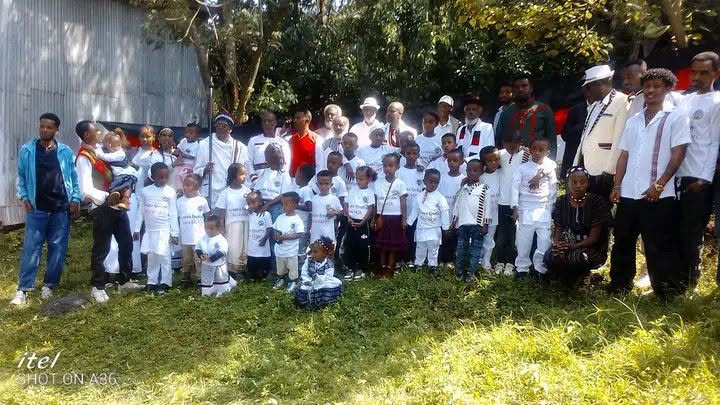
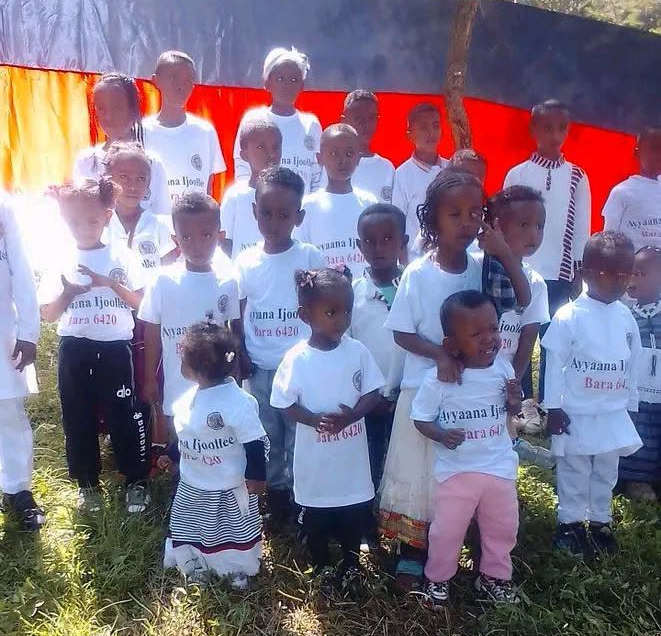
Today, in the historic town of Walisoo, the Galma Amantaa Waaqeffannaa Duudhaa Ganamaa Walisoo Liiban was filled with the joyous sounds of children’s laughter and celebration. The occasion was the annual Ukee festival—a sacred Oromo tradition dedicated to honouring children and ensuring the continuity of culture from one generation to the next.
What Is Ukee?
Ukee, also known as Taabooree in some regions, is a traditional Oromo children’s festival celebrated during the month of Hagayya (July-August). It is a time when the community comes together to honour its youngest members—the inheritors of the culture, the carriers of the language, and the hope of the future.
The festival reflects the deep value that Oromo culture places on children. In a society where oral tradition is the foundation of cultural transmission, children are not merely the future—they are the living connection to ancestors and the continuity of identity.
A Celebration of Childhood and Community
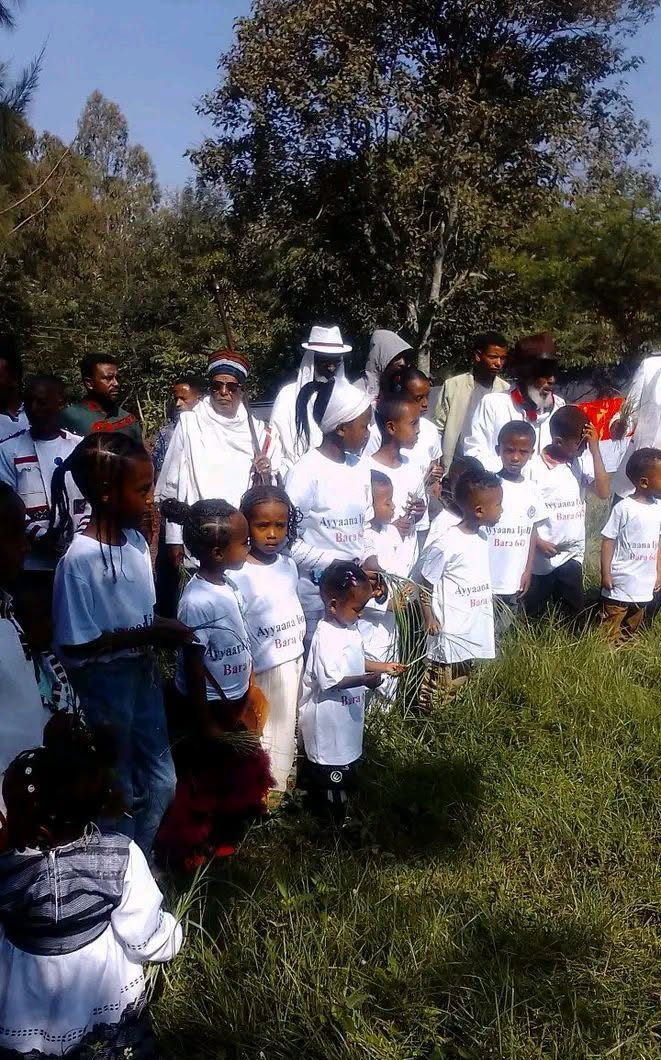
The Ukee festival is a vibrant celebration filled with traditional songs, games, and communal gatherings. Children are the centre of attention, dressed in their finest traditional attire, participating in activities that have been passed down through generations.
The festival is also a time for intergenerational connection. Elders share stories, teach traditional values, and impart the wisdom of the Gadaa system to the younger generation. Through these interactions, children learn about their history, their culture, and their responsibilities to their community.
The Significance of Ukee
For the Oromo people, the Ukee festival is not merely a children’s holiday—it is a profound expression of the community’s commitment to its future. By celebrating and nurturing children, the community ensures that its culture, language, and values will endure for generations to come.
The festival also reinforces the bonds of community. Families come together, neighbours share meals, and the entire community participates in the celebration of its youngest members. This collective affirmation of the value of children strengthens the social fabric and builds a foundation for future prosperity.
A Living Tradition
In a rapidly changing world, traditions like Ukee serve as anchors of identity and continuity. The celebration at the Galma Amantaa Waaqeffannaa in Walisoo is a testament to the resilience of Oromo culture and the commitment of the community to preserving its heritage.
As the children of Walisoo gather to sing, dance, and celebrate, they are not only enjoying a moment of joy—they are participating in a ritual that has sustained the Oromo people for centuries. They are learning who they are and who they can become.
Conclusion
The Ukee festival is a beautiful reminder that the strength of a community lies in its children. By honouring them, we honour our ancestors. By celebrating them, we celebrate our future. By teaching them, we ensure that the flame of our culture will never be extinguished.
This feature article is dedicated to the children of Oromia and all those who work to ensure that Oromo culture thrives for generations to come.

Goobee and Shinooyyee: A Dual Model of Prevention and Intervention for Social Problems

How Ancient Oromo Festivals Build Peace, Unity, and Social Cohesion
By Dhabessa Gemelal
In an era of deepening social divisions, political polarisation, and youth disengagement, the Oromo people possess a powerful and ancient resource: their own cultural traditions. The festivals of Goobee and Shinooyyee—celebrations marking the transition from the rainy season to spring—are not merely expressions of cultural identity. They are sophisticated mechanisms for social cohesion, conflict prevention, and youth engagement that offer a model for addressing some of the most pressing social challenges of our time.
Understanding Goobee and Shinooyyee
Goobee: A Festival of Light and Freedom for Young Men
Goobee is a festival where young men welcome the light of Spring with joy, hope, and good wishes. It represents “the bliss of spring, the joy of the dawn of the earth”—a light that sprouts for youth with green hope and courage . It is a time when young men declare their freedom and independence, marking their transition toward adulthood.
Shinooyyee: A Festival of Freedom and Identity for Young Women
Shinooyyee is a unique festival celebrated by young unmarried girls . During this festival, girls “plait their hair in fantastic styles and dress up and decorate with ornaments of their choice. They chant, sing, and dance with friends and peers for up to 3 weeks” . They collect fragrant grass and give it to neighbours as a symbol of abundance and blessing, receiving food and butter in return. It provides “young girls with absolute freedom to enjoy outside of their family’s home” .
Both festivals are celebrated in the weeks leading up to Irreechaa, the grand Oromo thanksgiving festival, and are part of the wider Gadaa system recognised by UNESCO as an Intangible Cultural Heritage of Humanity .
Prevention: Addressing Root Causes of Social Problems
1. Preventing Conflict Through Reconciliation
The Gadaa system, of which Goobee and Shinooyyee are a part, is built on a fundamental principle: “as much as possible, conflict should be prevented from occurring” . Should conflict occur, “everything should be done to prevent it from escalating and all institutions should work together to manage the conflict” .
This preventive philosophy is embedded in the festivals. Irreechaa, the culminating festival, requires participants to resolve conflicts before attending. As one Abba Gadaa explained, “if anyone who attends the festival has a conflict even with a close person, he should first reconcile with himself or with the other persons” . This principle of pre-festival reconciliation prevents conflicts from festering and escalating.
2. Preventing Youth Disengagement Through Meaningful Participation
Shinooyyee and Goobee provide structured, meaningful activities that engage youth during a critical transition period. The festivals offer young people “absolute freedom” to express themselves, build social bonds, and develop confidence . This engagement prevents the alienation and disconnection that often lead to social problems.
Social Anthropologist Daniel Deressa noted that the festivals “promote love and unity to uphold peaceful coexistence in the society” . By providing positive outlets for youth energy and creativity, Goobee and Shinooyyee prevent the frustration and disengagement that can fuel social unrest.
3. Preventing Cultural Erosion Through Intergenerational Transmission
Goobee and Shinooyyee serve as mechanisms for transmitting cultural knowledge, values, and ethics from elders to youth. The festivals ensure that young people learn “the culture and morals of the people and teaching them the truth” . This intergenerational transmission prevents the loss of cultural identity that can leave communities vulnerable to social breakdown.
Intervention: Addressing Existing Social Problems
1. Healing Divisions Through Reconciliation
For those already in conflict, Goobee and Shinooyyee provide a structured pathway to reconciliation. The festivals are described as “a time for reconciliation,” where “hatred and revenge are removed and solidarity is strengthened” . The requirement of pre-festival reconciliation serves as a direct intervention for existing conflicts.
The festivals create an environment where “peace is preached and love is praised; disagreement, grievance and discontent are condemned” . This public affirmation of peace values directly counters the narratives that fuel conflict.
2. Building Social Bonds Across Communities
Goobee and Shinooyyee bring together young people from different communities, strengthening “their love and unity” . The festivals are not exclusive—they are inclusive gatherings that promote understanding and solidarity across diverse groups.
Irreechaa, the culminating festival, has become “an important ritual festival that attracts visitors” and “has been becoming a cultural nationalism not only for the people of Oromo but also the nations and nationalities of the country” . This inclusivity makes the festivals a direct intervention against ethnic division.
3. Strengthening Community Resilience
The festivals contribute to community resilience by reinforcing social bonds and shared values. As scholars have noted, “Irreechaa brings people closer to each other and strengthen social bonds” . This strengthening of social cohesion makes communities more resilient to the stresses that can lead to social problems.
The Dual Model in Action
Goobee and Shinooyyee operate through a dual model of prevention and intervention:
Prevention:
- Engaging youth through meaningful participation
- Transmitting cultural values and ethics
- Resolving conflicts before they escalate
- Building social cohesion through inclusive participation
Intervention:
- Healing existing conflicts through reconciliation rituals
- Strengthening social bonds across communities
- Reinforcing shared values of peace and unity
Conclusion: A Model for Our Times
In a world facing deepening social divisions, youth alienation, and conflict, Goobee and Shinooyyee offer a powerful model. They demonstrate that cultural traditions are not merely nostalgic artifacts—they are living resources for building peace, strengthening communities, and engaging youth.
By preserving and promoting these festivals, the Oromo people are not only celebrating their heritage—they are investing in a more peaceful, cohesive, and resilient society. As one young participant noted, Goobee and Shinooyyee are “a festival of success, history, restoration of lost culture and expression of the Oromo people” .
In a fractured world, this ancient tradition offers a blueprint for healing.
This feature article is dedicated to the youth of Oromia who carry these traditions forward, and to all communities seeking models of peace and unity.


Ifaanoo: A Sacred Oromo celebration of light and renewal of Faith and Unity
An Ancient Ritual of Illumination and Reaffirmation of Faith
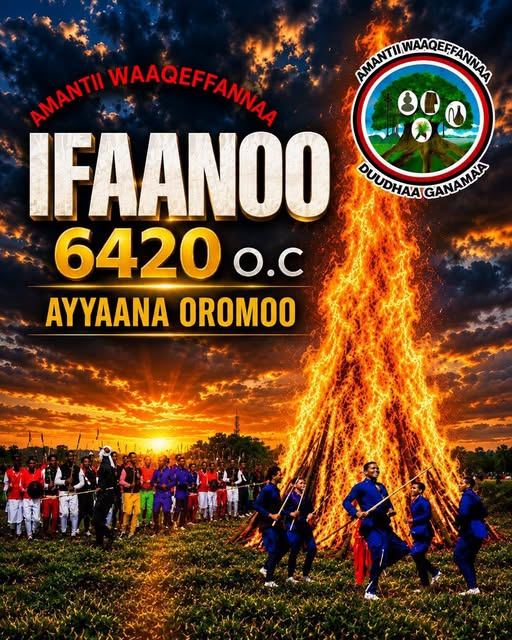
In the rich tapestry of Oromo cultural and religious traditions, few ceremonies carry the luminous symbolism of Ifaanoo—a sacred celebration of light, spiritual renewal, and the reaffirmation of community bonds. Rooted in the ancient Waaqeffannaa faith system, this profound ritual embodies the Oromo people’s deep connection to creation, their Creator, and one another.
The Symbolism of Light in Oromo Spirituality
The term Ifaanoo derives from ifaa, meaning “light” in Afaan Oromoo. In the traditional Oromo worldview, light represents not only physical illumination but also spiritual clarity, moral purity, and the presence of divine blessing. Just as light dispels darkness, the Ifaanoo ceremony symbolises the dispelling of ignorance, conflict, and spiritual obscurity from the community.
The concept of light appears throughout Oromo religious practice. The rituals of Ulaa bahuu, Ifa bahuu, and Dhugaa bahuu are among the major components of ceremonies undertaken in the indigenous religion, where the entire family of followers is required to visit the shrine centre to receive blessing, good fortune, and reconciliation with Waaqaa (God) . These “emergence” rituals are deeply connected to the symbolism of coming into the light—emerging from darkness into divine presence.
The Ifaanoo Ceremony
Ifaanoo is closely tied to the Oromo calendar and the Gadaa system—the democratic social and political institution that organised Oromo life for centuries and is recognised by UNESCO as an Intangible Cultural Heritage of Humanity . The festival is fundamentally a ritual of gratitude to Waaqa (God) for life, health, and the bounty of the land .
In the Waaqeffannaa faith, followers celebrate various Ayyannota (ceremonies) to offer thanksgiving . Scholars have noted that the indigenous practices of the Oromo are believed to have been intact for centuries, involving the blessing and reconciliation of entire families . While the specific rituals of Ifaanoo vary by region, they share common elements:
- Gathering at sacred sites — often at shrines or natural locations deemed spiritually significant
- Light rituals — the symbolic use of fire, candles, or the rising sun to represent divine presence
- Blessings by elders — led by the Abba Gadaa or spiritual leaders who offer prayers for the coming season
- Communal singing and dancing — traditional songs and ululations that express joy and gratitude
- Offerings to Waaqa — gifts of dadhii (honey beer), dufo (bread), and other symbolic items
- Reconciliation — resolving conflicts before participating, reinforcing that one cannot give thanks while holding a grudge
A Social Bond Across Communities
The ceremony is profoundly social. Irreechaa—a related celebration—has been described as “a social bond within Oromo people that brings them closer to each other” . Ifaanoo similarly serves as a gathering point, bringing Oromo people from different areas together regardless of their religious background .
In diaspora communities, ceremonies like Ifaanoo and Irreechaa take on added significance. In Bergen, Norway, the festival has been celebrated as the only place in Europe where the event takes place, with participants travelling from across European countries, emphasising how religious celebrations offer opportunities for families and friends to reaffirm relations through face-to-face interaction .
Renewal of Faith and Unity
At its core, Ifaanoo is a reaffirmation of faith in Waaqa and a renewal of the community’s covenant with the divine. It embodies the principle that light represents not only spiritual clarity but also the ongoing presence of Waaqa in the lives of the faithful.
The blessing, which is a central part of Waaqeffannaa ceremonies, is described as a time when “the entire family members of followers of the religion and all their living animals are required to visit the shrine center to have blessing, good fortune and reconciliation with Waaqaa (God)” . This is a holistic act, covering all aspects of life—from the spiritual to the physical to the economic.
Ifaanoo also embodies the values of unity. Like Irreechaa, which “is now observed by the majority of Oromos, regardless of their religion” , Ifaanoo brings together followers of Waaqeffannaa, Muslims, and Christians who come together and celebrate with joy . It is a symbol of cultural identity and social cohesion.
A Living Tradition
Ifaanoo remains a living tradition, celebrated in Oromia and diaspora communities worldwide. It is a powerful expression of Oromo identity and resilience—a declaration that the light of tradition continues to shine brightly despite the challenges of modernity.
As the Oromo people continue to preserve and celebrate their heritage, ceremonies like Ifaanoo ensure that the light of their culture, faith, and unity will illuminate the path for future generations.

The Oromo Calendar and the Year 6420: A Legacy of Ancient Timekeeping

Understanding the Origins of One of Africa’s Oldest Calendrical Systems
By Maatii Sabaa
In March 2026, when most of the world marked the beginning of a new year according to the Gregorian calendar, the Oromo people—across Oromia and the global diaspora—celebrated the arrival of a different milestone: the Oromo New Year, 6420. For many outside the Oromo community, this number raises a fundamental question: Where does the year 6420 come from?
The Oromo Calendar: A 2,300-Year-Old Legacy
The Oromo calendar is one of Africa’s oldest indigenous calendrical systems. It is believed to have been developed by the Oromo people around 300 BC . This places its origins at approximately 2,300 years ago—a period when the Oromo were already sophisticated observers of the cosmos.
Known as the Borana calendar or the Dhaha/Henni calendar, it is a lunar-stellar calendar system. This means it relies on astronomical observations—specifically, the phases of the moon in conjunction with the rising and setting of seven particular stars or constellations.
The calendar’s sophistication lies in its integration of astronomy with daily life. It consists of 12 months and 354 days in a year, based on the lunar cycle. It has no weeks, but rather a name for each day of the month. The first day of the Oromo year begins in the month of Bitootessaa (March), when the constellation Triangulum is in conjunction with the new moon.
The Significance of the Number 6420
The year 6420 is reached by counting forward from the calendar’s inception around 300 BC. While the exact starting point is a subject of ongoing scholarly discussion, the calendar’s antiquity is well-established.
For the Oromo people, the calendar is more than just a way to count time—it is a cornerstone of their identity and cultural continuity. As one elder explained at the Walisoo Liiban celebration of the 6420 New Year:
“Observing Birboo at our Galma is not just about marking a calendar. It is about remembering who we are. It is about connecting our past to our future, grounding ourselves in the values of balance, respect for all creation, and community that Waaqeffannaa teaches” .
The calendar is tied to the traditional Oromo religion, Waaqeffannaa, and is used to schedule the Gadaa system of elections and power transfer. The Gadaa system, recognised by UNESCO as an Intangible Cultural Heritage of Humanity, is itself deeply connected to the calendar.
Archaeological and Astronomical Evidence
The Oromo calendar’s origins are not merely a matter of oral tradition. The Namoratunga archaeological site near Lake Turkana, Kenya, has been central to understanding its antiquity. Some scholars have argued that the site, dating to around 300 BC, contains evidence of an early Cushitic calendar that shares astronomical alignments with the Oromo calendar. The site’s basalt pillars are aligned with seven star groups that correspond to the Borana star groups still used in the Oromo calendar today.
However, it should be noted that the relationship between Namoratunga and the Oromo calendar has been debated. Astronomer and archaeologist Clive Ruggles, after re-examining the site, concluded there is no direct relationship. Nevertheless, the broader scholarly consensus acknowledges the calendar’s ancient roots and its continuity into the present day.
A Living Calendar in the Modern World
Today, the Oromo calendar remains a living tradition. In January 2026, Waaqeffannaa faithful gathered at the Galma Amantaa (House of Worship) in Walisoo Liiban, Oromia, to observe the Oromo New Year, Birboo, marking the year 6420. The celebration, which included prayers for peace (nagaa), love (jaalala), and unity (tokkummaa), was described as “a powerful reaffirmation of an ancient identity” and “a community’s declaration of continuity”.
The calendar’s months and day names, with their astronomical origins, are still used by Oromo communities in both Ethiopia and Kenya. The Ayyaantu—Oromo time-experts with knowledge about stars—continue to track time astronomically, preserving a tradition that has survived for millennia.
Conclusion: A Calendar of Identity and Continuity
The Oromo calendar, with its year 6420, is a testament to the ancient astronomical knowledge of the Oromo people and their enduring cultural identity. Its development around 300 BC and its continued use today represent one of the longest continuous calendrical traditions in the world. For the Oromo people, the calendar is not just a way to count years—it is a declaration of continuity, a connection to ancestors, and a guide for the future.
As the Oromo New Year 6420 was celebrated, the message was clear: “May this New Year bring you peace, love, and unity” .
This feature article is dedicated to the custodians of the Oromo calendar and to all those working to preserve and promote Oromo cultural heritage.

The Historical Evidence: Uncovering the Truth About Finfinne’s Origins
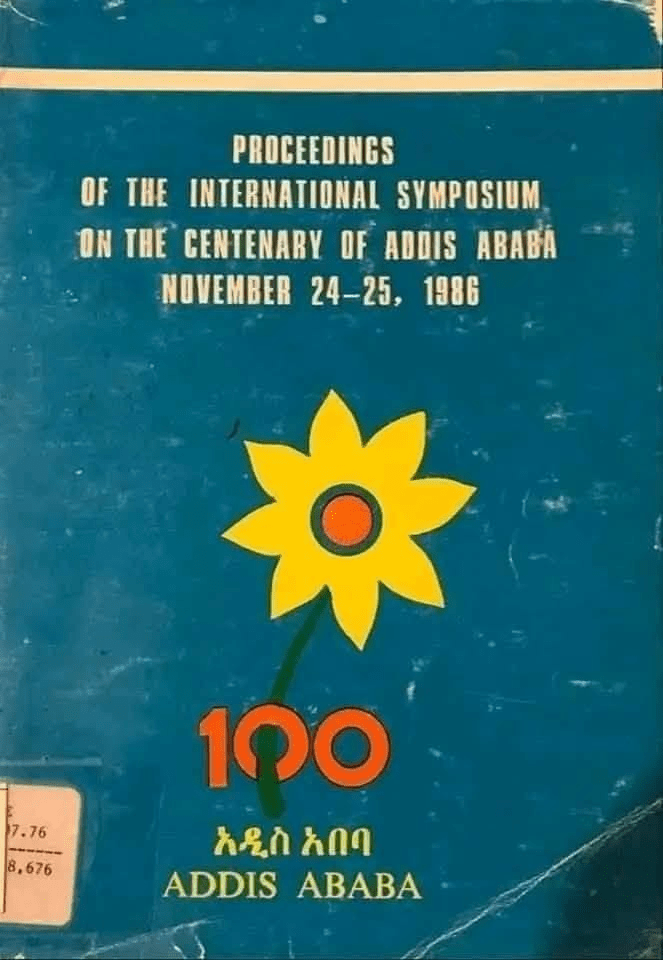
Proceedings of the International Symposium on the Centenary of Addis Ababa (November 24-25, 1986)
By Negash Qemant
In 1986, under the Derg regime, an international symposium was held to mark the centenary of Addis Ababa. The proceedings, published in a historical volume, brought together scholars from various disciplines to examine the history of the city. Among the contributions was a groundbreaking research paper that sheds light on the true origins of Finfinne—the city now known as Addis Ababa.
This paper, presented by scholars of the time, documented the historical reality that the area now occupied by St. George’s Church and the statue of Menelik was once known as Birbirsa. The research paper opens with a striking question:
“Who would imagine that the place where one can see today’s Saint George’s Church and the statue of Menelik was known as Birbirsa?”
The paper continues:
“This paper is about Birbirsa, a place located in Finfinne which later on came to be called Addis Ababa.”
The Name “Finfinne”
The symposium proceedings confirm what Oromo oral tradition has always maintained: the area was originally known as Finfinne—a name derived from the hot mineral springs (finfina) that bubble up from the earth in the area. The proceedings note that the name “Finfinne” was the original designation, and the name “Addis Ababa” was a later imposition.
The research paper documents that the area now known as Piassa, Arat Kilo, and the surroundings of St. George’s Church were once called Birbirsa Goro—an Oromo name. The paper also confirms that the area around the present-day St. George’s Cathedral was known as Birbirsa, an Oromo name that predates the arrival of Menelik and his forces.
The proceedings document that the area was known by Oromo names: Gafarsa, Hurufa Boombii, Tulluu Daalattii, and others. These names were systematically replaced with new names after the establishment of the city under Menelik.
The Dream of Sahle Selassie
The symposium proceedings also address the well-known story of King Sahle Selassie’s “prophecy” about the site where his descendants would build a city. The proceedings treat this story as a genuine prophecy, which was used to legitimise the establishment of the city.
As the proceedings note, the story goes that King Sahle Selassie, while camping in the area, had a vision that his descendants would build a city on that spot. This “prophecy” was used to create an aura of divine legitimacy around Menelik’s decision to establish the capital.
However, as Blatten Geta Hiruy Wolde Selassie notes in his book The History of Ethiopia from the Queen of Sheba to the Victory of Adwa (p. 87):
“This land, which today is called Addis Ababa and is the capital of Ethiopia, was known as Finfinne at that time. King Sahle Selassie, while on a campaign, pitched his tent at the spot where the palace now stands and is said to have prophesied that his descendants would build a city there.”
The Role of Empress Taytu
The symposium proceedings and other historical sources confirm that it was Empress Taytu who gave the city its new name, Addis Ababa (“New Flower”). According to the account of Dr. Dejazmach Zewde Gebre Selassie, Empress Taytu wrote to Emperor Menelik:
“I have found the place we were looking for, and I have named it Addis Ababa.”
She sent this message to Menelik, who was at a different location at the time. The empress and the emperor, along with their armies, later pitched their tents on the hill known as Tulluu Finfinnee (the hill of Finfinne), where the hot springs (Hora Finfinnee) are located. After this, the emperor ordered that all official correspondence should bear the new name “Addis Ababa.”
However, the symposium proceedings also note that the area was already known as Finfinne and that the local population had long used this name. The renaming was an act of imperial assertion, not a neutral decision.
The Birbirsa Connection: Catholic Missionaries and the Oromo College
The symposium proceedings and Catholic missionary records confirm that Birbirsa Goro was the site of a Catholic mission and an Oromo college established by missionaries. The missionaries had introduced various species of flowers from Europe to the area, planting them in the college compound and surrounding areas. These flowers—not indigenous to the region—impressed Empress Taytu, who saw them when she visited the area.
The Catholic mission records also confirm that after the college was closed, the site was later chosen for the construction of St. George’s Church, which now stands in the heart of the city.
The Erasure of Oromo History
What emerges from these historical documents is a clear pattern: the systematic erasure of Oromo history and identity. The Oromo names—Finfinne, Birbirsa, Gafarsa, Hurufa Boombii, Tulluu Daalattii—were replaced with Amharic names. The story of Sahle Selassie’s “prophecy” was used to create a legitimising narrative that obscured the reality of Oromo dispossession.
The symposium proceedings, while an important historical document, were also a tool of propaganda. The Derg regime, like the imperial regime before it, sought to construct a narrative that legitimised the empire’s expansion. The “prophecy” of Sahle Selassie was treated as a genuine prediction, while the history of the Oromo people in the area was suppressed.
The Oromo Contribution to the City
The historical evidence also confirms that the Oromo people made significant contributions to the establishment and development of the city. The symposium proceedings document the role of Oromo labour in building the city, the supply of food and water by Oromo communities, and the presence of Oromo settlements in the area before the establishment of the capital.
The city’s name—Finfinne—is itself a testament to Oromo presence. The hot springs (finfina) that gave the city its name continue to flow, a reminder of the land’s original identity.
Conclusion: A History That Must Be Reclaimed
The proceedings of the 1986 symposium provide valuable historical evidence that confirms what Oromo oral tradition has always maintained: that Finfinne was originally Oromo land, and that the city was established through dispossession and conquest.
The evidence from the symposium proceedings, combined with the accounts of Blatten Geta Hiruy Wolde Selassie and Dr. Dejazmach Zewde Gebre Selassie, paints a clear picture:
- The area was originally known as Finfinne and Birbirsa.
- The Oromo people were the original inhabitants of the area.
- The city was renamed and its history was systematically rewritten.
- The narrative of Sahle Selassie’s “prophecy” was used to legitimise the dispossession.
As the Oromo people continue to demand recognition and justice, this historical evidence serves as a powerful reminder that the truth cannot be erased. The documents exist. The names remain in the landscape. The history is there for those who seek it.
The land remembers. The history endures. Finfinne is Oromo.
This feature article is based on the proceedings of the International Symposium on the Centenary of Addis Ababa (1986) and the historical accounts cited above. It is dedicated to all those who seek the truth about Oromo history and the origins of Finfinne.





 Advocacy for Oromia