The Historical Evidence: Uncovering the Truth About Finfinne’s Origins
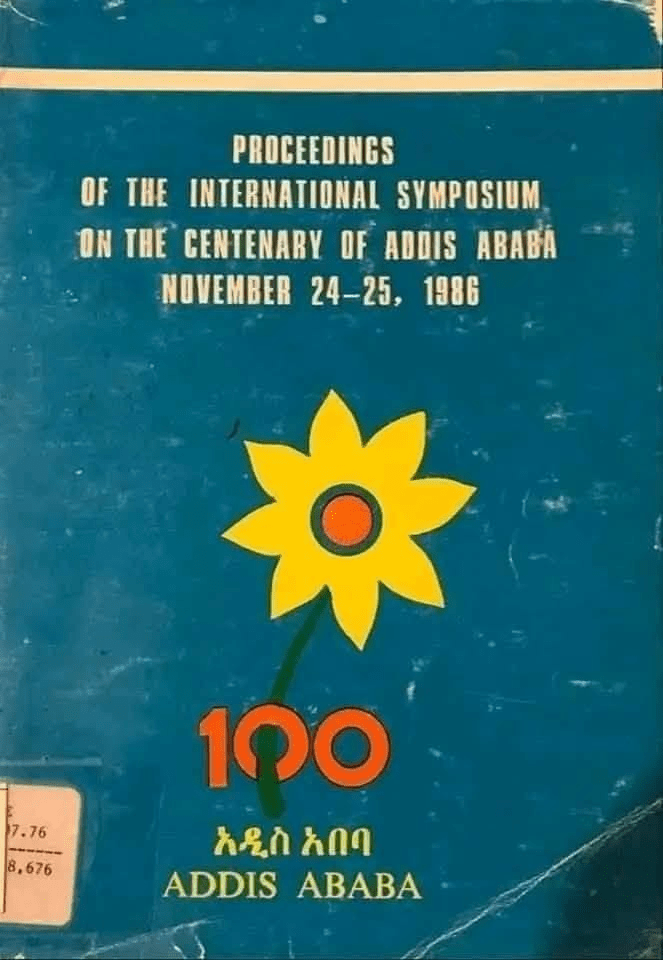
Proceedings of the International Symposium on the Centenary of Addis Ababa (November 24-25, 1986)
By Negash Qemant
In 1986, under the Derg regime, an international symposium was held to mark the centenary of Addis Ababa. The proceedings, published in a historical volume, brought together scholars from various disciplines to examine the history of the city. Among the contributions was a groundbreaking research paper that sheds light on the true origins of Finfinne—the city now known as Addis Ababa.
This paper, presented by scholars of the time, documented the historical reality that the area now occupied by St. George’s Church and the statue of Menelik was once known as Birbirsa. The research paper opens with a striking question:
“Who would imagine that the place where one can see today’s Saint George’s Church and the statue of Menelik was known as Birbirsa?”
The paper continues:
“This paper is about Birbirsa, a place located in Finfinne which later on came to be called Addis Ababa.”
The Name “Finfinne”
The symposium proceedings confirm what Oromo oral tradition has always maintained: the area was originally known as Finfinne—a name derived from the hot mineral springs (finfina) that bubble up from the earth in the area. The proceedings note that the name “Finfinne” was the original designation, and the name “Addis Ababa” was a later imposition.
The research paper documents that the area now known as Piassa, Arat Kilo, and the surroundings of St. George’s Church were once called Birbirsa Goro—an Oromo name. The paper also confirms that the area around the present-day St. George’s Cathedral was known as Birbirsa, an Oromo name that predates the arrival of Menelik and his forces.
The proceedings document that the area was known by Oromo names: Gafarsa, Hurufa Boombii, Tulluu Daalattii, and others. These names were systematically replaced with new names after the establishment of the city under Menelik.
The Dream of Sahle Selassie
The symposium proceedings also address the well-known story of King Sahle Selassie’s “prophecy” about the site where his descendants would build a city. The proceedings treat this story as a genuine prophecy, which was used to legitimise the establishment of the city.
As the proceedings note, the story goes that King Sahle Selassie, while camping in the area, had a vision that his descendants would build a city on that spot. This “prophecy” was used to create an aura of divine legitimacy around Menelik’s decision to establish the capital.
However, as Blatten Geta Hiruy Wolde Selassie notes in his book The History of Ethiopia from the Queen of Sheba to the Victory of Adwa (p. 87):
“This land, which today is called Addis Ababa and is the capital of Ethiopia, was known as Finfinne at that time. King Sahle Selassie, while on a campaign, pitched his tent at the spot where the palace now stands and is said to have prophesied that his descendants would build a city there.”
The Role of Empress Taytu
The symposium proceedings and other historical sources confirm that it was Empress Taytu who gave the city its new name, Addis Ababa (“New Flower”). According to the account of Dr. Dejazmach Zewde Gebre Selassie, Empress Taytu wrote to Emperor Menelik:
“I have found the place we were looking for, and I have named it Addis Ababa.”
She sent this message to Menelik, who was at a different location at the time. The empress and the emperor, along with their armies, later pitched their tents on the hill known as Tulluu Finfinnee (the hill of Finfinne), where the hot springs (Hora Finfinnee) are located. After this, the emperor ordered that all official correspondence should bear the new name “Addis Ababa.”
However, the symposium proceedings also note that the area was already known as Finfinne and that the local population had long used this name. The renaming was an act of imperial assertion, not a neutral decision.
The Birbirsa Connection: Catholic Missionaries and the Oromo College
The symposium proceedings and Catholic missionary records confirm that Birbirsa Goro was the site of a Catholic mission and an Oromo college established by missionaries. The missionaries had introduced various species of flowers from Europe to the area, planting them in the college compound and surrounding areas. These flowers—not indigenous to the region—impressed Empress Taytu, who saw them when she visited the area.
The Catholic mission records also confirm that after the college was closed, the site was later chosen for the construction of St. George’s Church, which now stands in the heart of the city.
The Erasure of Oromo History
What emerges from these historical documents is a clear pattern: the systematic erasure of Oromo history and identity. The Oromo names—Finfinne, Birbirsa, Gafarsa, Hurufa Boombii, Tulluu Daalattii—were replaced with Amharic names. The story of Sahle Selassie’s “prophecy” was used to create a legitimising narrative that obscured the reality of Oromo dispossession.
The symposium proceedings, while an important historical document, were also a tool of propaganda. The Derg regime, like the imperial regime before it, sought to construct a narrative that legitimised the empire’s expansion. The “prophecy” of Sahle Selassie was treated as a genuine prediction, while the history of the Oromo people in the area was suppressed.
The Oromo Contribution to the City
The historical evidence also confirms that the Oromo people made significant contributions to the establishment and development of the city. The symposium proceedings document the role of Oromo labour in building the city, the supply of food and water by Oromo communities, and the presence of Oromo settlements in the area before the establishment of the capital.
The city’s name—Finfinne—is itself a testament to Oromo presence. The hot springs (finfina) that gave the city its name continue to flow, a reminder of the land’s original identity.
Conclusion: A History That Must Be Reclaimed
The proceedings of the 1986 symposium provide valuable historical evidence that confirms what Oromo oral tradition has always maintained: that Finfinne was originally Oromo land, and that the city was established through dispossession and conquest.
The evidence from the symposium proceedings, combined with the accounts of Blatten Geta Hiruy Wolde Selassie and Dr. Dejazmach Zewde Gebre Selassie, paints a clear picture:
- The area was originally known as Finfinne and Birbirsa.
- The Oromo people were the original inhabitants of the area.
- The city was renamed and its history was systematically rewritten.
- The narrative of Sahle Selassie’s “prophecy” was used to legitimise the dispossession.
As the Oromo people continue to demand recognition and justice, this historical evidence serves as a powerful reminder that the truth cannot be erased. The documents exist. The names remain in the landscape. The history is there for those who seek it.
The land remembers. The history endures. Finfinne is Oromo.
This feature article is based on the proceedings of the International Symposium on the Centenary of Addis Ababa (1986) and the historical accounts cited above. It is dedicated to all those who seek the truth about Oromo history and the origins of Finfinne.

Posted on August 16, 2026, in Aadaa, Afaan, Election, Events, Finfinne, freedom, Information, Language, Media, News, Oromia, Press Release, Promotion. Bookmark the permalink. 1 Comment.






FINFINNEE! The narrative that national capitals belong to no one in the name of abstract citizenship conveniently ignores how those capitals were created.
The historical record shows that Finfinnee was not established on empty, neutral land, nor did it grow through peaceful, organic settlement.
To understand why the narrative of a neutral capital falls apart, one must look directly at the primary historical documentation written at the very moment Entoto was fortified and Finfinnee was seized. European travelers, diplomats, and military observers who visited Menelik II’s royal court in the late nineteenth century recorded clear eye-witness testimony of a military occupation rather than a peaceful urban expansion.
The French explorer Jules Borelli, who traveled extensively through Shewa and Oromo territories between 1885 and 1888, documented the systematic destruction of the indigenous Oromo social order. Borelli recorded in his journals how the central plateau of Finfinnee, inhabited by the Tulama Oromo clans of Gullallee, Galaan, and Ekkaa, was transformed from a flourishing agricultural and pastoral hub into a military outpost.
He explicitly described how Oromo farmsteads were set ablaze, their cattle seized by the tens of thousands, and their people subjected to forced labor to construct the royal garrisons at Entoto and later at the mineral hot springs of Finfinnee below. Similarly, the British diplomat Gerald Portal, visiting the imperial court, and the French envoy Jean-Baptiste Piolet documented the reality of the neftenya-gabbar system. Their records confirm that the Oromo people were not recognized as citizens or property owners. Instead, whole Oromo families were assigned directly to northern soldiers and feudal chiefs as hereditary serfs.
The land was confiscated by imperial decree, and the indigenous population was legally compelled to yield up to three-quarters of their agricultural produce to new landlords while providing unpaid labor for municipal building projects. Russian military officer Alexander Bulatovich, who observed Menelik’s campaigns in the late 1890s, wrote extensively about the scale of the conquest and land alienation. Bulatovich acknowledged that the Oromo possessed an organized, highly productive agricultural society governed by their own institutions prior to their subjugation.
He detailed how the state apparatus dismantled these indigenous governance structures, declared all ancestral lands to be state property, and forcibly relocated entire communities to secure the perimeter of the new capital. The argument that historical injustice can be dismissed in favor of an abstract, colorblind citizenship is a flawed premise that serves to freeze unjust historical gains in place. In legal and moral philosophy worldwide, true reconciliation cannot happen without acknowledging title, restoring historical rights, and providing full, direct compensation for lands illegally expropriated.
The administrative expansion of Addis Ababa over recent decades highlights this ongoing issue. Official municipal proclamations show that the city’s footprint exploded from 127 square kilometers in 1991 to over 1,500 square kilometers in recent years—an increase of more than 1,100 percent. This rapid expansion occurred almost entirely at the expense of surrounding Oromo farming communities, who faced dispossession, displacement, and economic destruction without fair compensation or political consent.
A practical solution for long-term stability is the full incorporation of Finfinnee as an integral, geographical, and administrative entity within Oromia’s broader Sheger and regional state framework, while continuing to serve as the seat of the federal government. This model is well established globally. In Switzerland, Bern functions as the federal capital while remaining an integrated, constituent city within the Canton of Bern. In Canada, Ottawa operates as the national capital while remaining fully inside the provincial jurisdiction of Ontario.
In South Africa, Pretoria serves as the executive seat of the national government while fully situated within the Gauteng province. In Europe, Brussels serves as the capital of the European Union, the national capital of Belgium, and a regional hub, balancing multiple tiers of identity and governance seamlessly. Incorporating Finfinnee into Oromia provides clear advantages for every Ethiopian citizen. It eliminates the legal ambiguity surrounding regional boundaries and establishes clear, long-term legal and political stability.
Furthermore, unified regional planning between Finfinnee and the surrounding Sheger area creates cohesive infrastructure, reliable water management, efficient public transportation, and synchronized agricultural supply chains that lower food prices for all urban residents. Guaranteeing Oromia’s territorial integrity rectifies historical grievances, fostering genuine national trust, security, and shared economic prosperity rather than endless cycles of administrative conflict.
True unity cannot be achieved by erasing history or telling dispossessed communities that their loss was simply the price of nation-building. Lasting peace requires institutional justice, formal recognition of ancestral land rights, full economic compensation for affected families, and the integration of Finfinnee into its natural regional home.