Catholic Missionary Records from 1868 Confirm the Oromo Identity of Finfinne and Birbirsa
By Negash Qemant
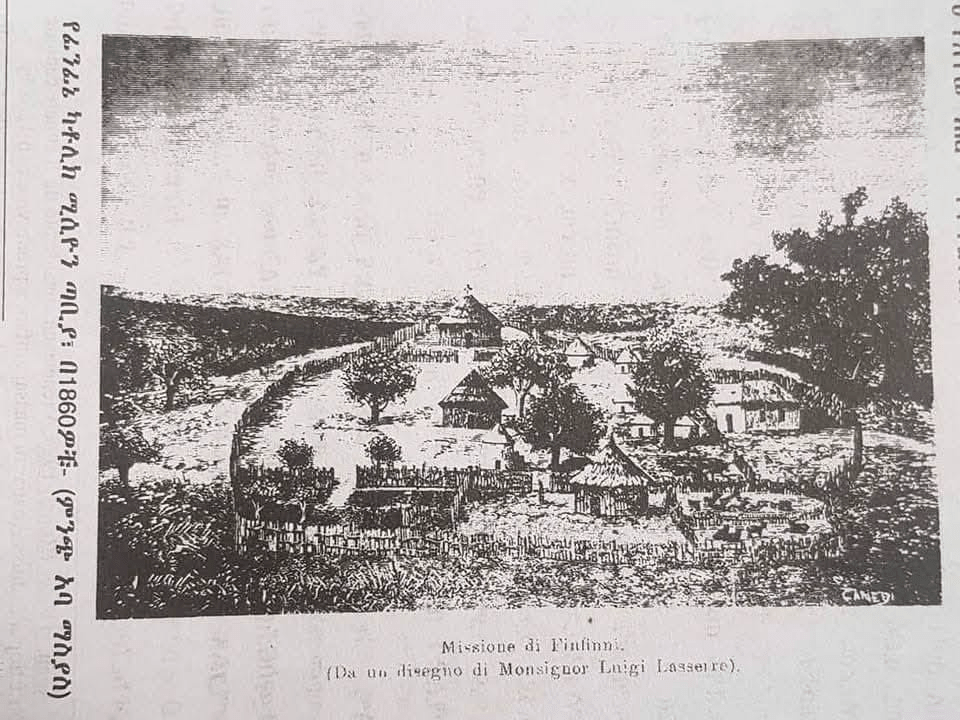
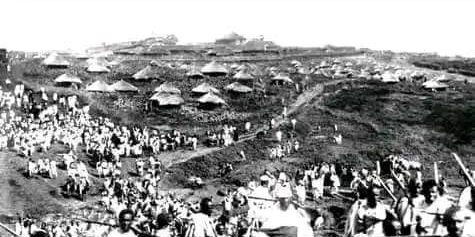
In the archives of Catholic missionary history lies a remarkable document that provides irrefutable evidence of Oromo presence in what is now Addis Ababa. The “Missione di Finfinni” —a drawing and written account by Monsignor Luigi Lasserre from 1868—offers a vivid snapshot of the area known as Finfinne and Birbirsa (the present-day Piassa and St. George’s area) long before the establishment of the imperial capital.
This historical record, preserved by Dr. Abba Antonios Alberto, OFM Cap, in his writings (pages 110-111), confirms that the area was not an empty wilderness awaiting colonisation, but a vibrant Oromo landscape with established communities, trade routes, and cultural significance.
The Foundation of Finfinni and Birbirsa (1868)
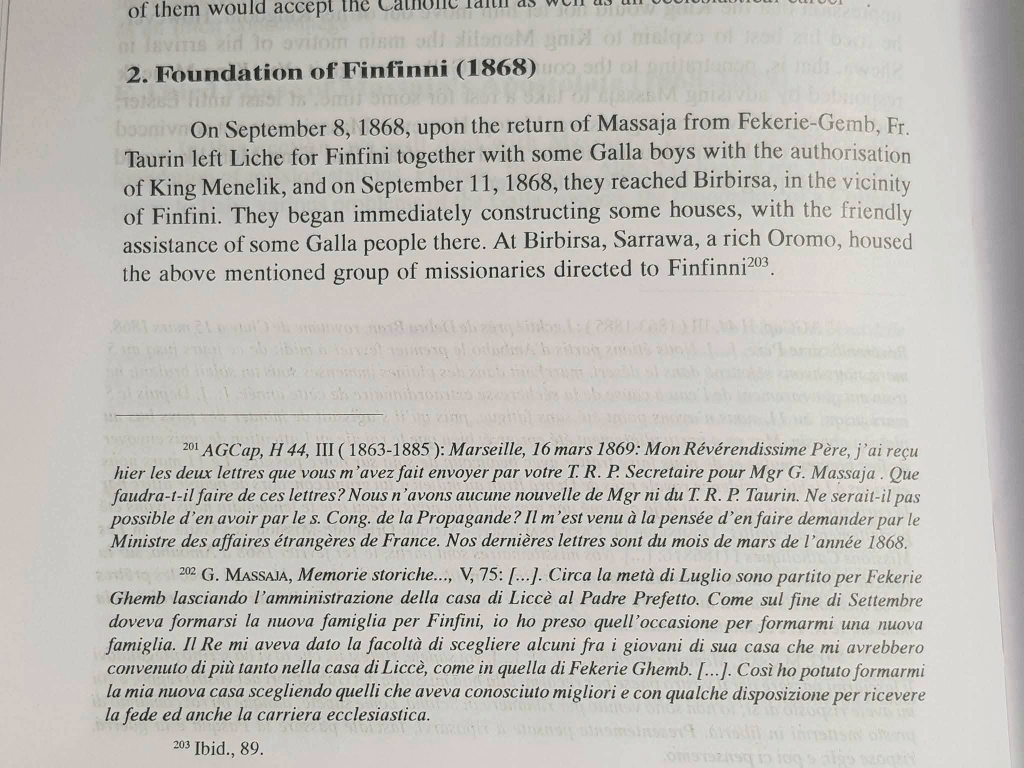
According to the missionary records, the Catholic mission at Finfinne was established in September 1868. The account states:
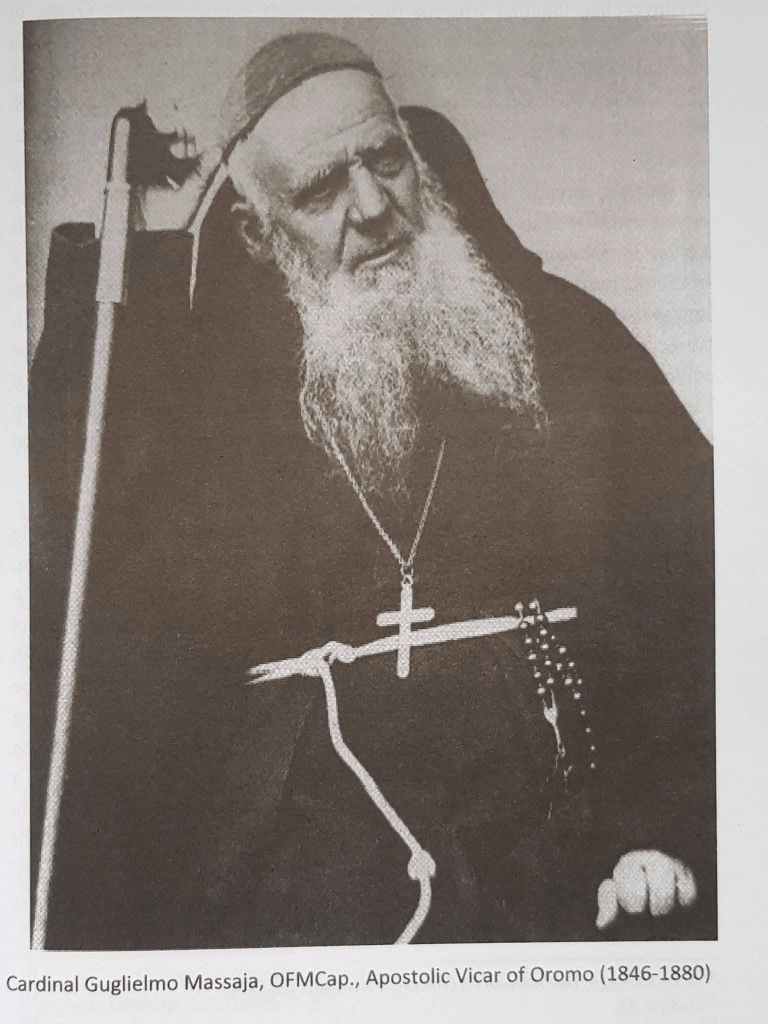
“On September 8, 1868, upon the return of Massaja from Fekerie Gemb, Francisco Taurin left Liche for Finfinne together with some Oromo boys with the authorisation of King Menelik. On September 11, 1868, they reached Birbirsa, in the vicinity of Finfini. They began immediately constructing some houses with the friendly assistance of some Oromo people there.”
This passage is significant for several reasons:
The Name “Finfinni”: The missionaries used the name “Finfinni” (Finfinne) to refer to the area. This confirms that the Oromo name was in common use and was recognised by outsiders.
The Name “Birbirsa”: The area now known as Piassa and St. George’s was specifically identified as “Birbirsa.” This Oromo name predates the establishment of Addis Ababa.
Oromo Presence: The missionaries were assisted by “some Oromo people” who helped them construct their buildings. This demonstrates that the area was inhabited by Oromo communities who were active participants in the life of the region.
King Menelik’s Authorisation: The missionaries received authorisation from King Menelik to establish their mission. This indicates that Menelik, at this time, was not yet the undisputed ruler of the area but was engaging with the existing landscape.
The Sarrawa Family: Oromo Hospitality
The missionary records also document the role of an Oromo family in hosting the missionaries:
“At Birbirsa, Sarrawa, a rich Oromo, housed the above-mentioned group of missionaries directed to Finfinni.”
This is a remarkable detail. A wealthy Oromo individual named Sarrawa provided shelter and support to the Catholic missionaries. This act of hospitality is a testament to the generosity and openness of the Oromo people, even towards strangers from distant lands.
The presence of a “rich Oromo” in the area also challenges the narrative that the Oromo people were impoverished nomads. Sarrawa was a person of means who could offer accommodation and support to a group of foreign missionaries. This indicates a level of economic activity and social organisation that contradicts the stereotypes used to justify dispossession.
Finfinne: “At the Center of the Country of Oromo”
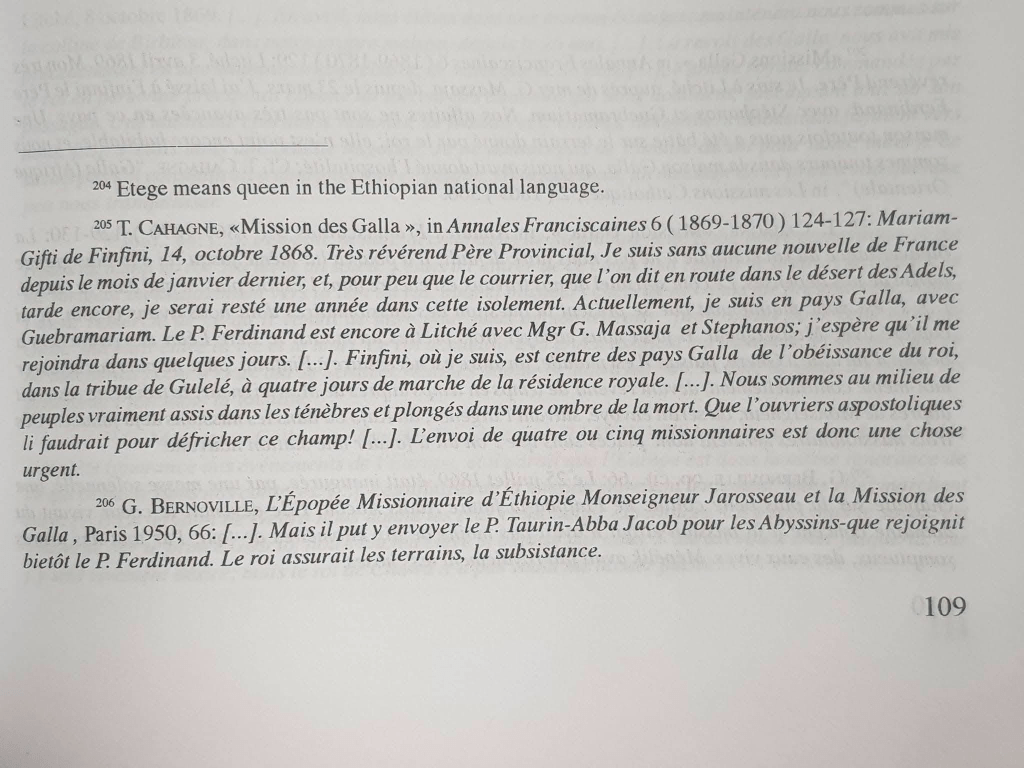
Perhaps the most significant passage in the missionary records is a letter dated October 14, 1868, written by Fr. Taurin from Finfinne. In this letter, addressed to the provisional minister, Fr. Taurin states:
“He was with a certain Gebremariam at Finfinni situated at the center of the country of Oromo with the tribe of Gulele.”
This is a powerful statement. The missionary explicitly identifies Finfinne as being located at the “center of the country of Oromo.” This is not a vague reference—it is a precise geographical and ethnographic observation.
The phrase “center of the country of Oromo” confirms that Finfinne was understood by outsiders as being in the heart of Oromo territory. The mention of the “tribe of Gulele” (the Gulele Oromo) further locates the area within a specific Oromo community.
This evidence is consistent with Oromo oral tradition, which has always maintained that Finfinne is the heart of Oromia—a place of cultural, spiritual, and historical significance to the Oromo people.
The Missionaries and the Oromo Landscape
The missionary accounts also provide insights into the Oromo landscape of the time. The records describe:
Oromo settlements: The area was not empty but inhabited by Oromo communities.
Oromo agriculture: The presence of “rich” Oromo individuals indicates economic activity.
Oromo hospitality: The missionaries received assistance and accommodation from the local Oromo population.
Oromo social organisation: The mention of specific tribes (like Gulele) indicates a structured society.
The missionaries were not arriving in an empty wilderness—they were entering a well-established Oromo landscape with its own social, economic, and political systems.
Implications for the History of Finfinne
The missionary records from 1868 provide crucial historical evidence that challenges the dominant narrative of Finfinne’s origins. They demonstrate that:
The Oromo People Were the Inhabitants: The area was inhabited by Oromo communities, including the Gulele tribe, before the establishment of the imperial capital.
The Land Was Oromo: The missionaries identified Finfinne as being at the “center of the country of Oromo.”
The Oromo Names Were Original: The names “Finfinne” and “Birbirsa” were in use before the area was renamed Addis Ababa.
The Oromo People Were Active Participants: The Oromo people assisted the missionaries, hosted them, and engaged with them as equals.
Oromo Society Was Structured: The presence of “rich” Oromo individuals like Sarrawa indicates economic stratification and social organisation.
Conclusion: A Historical Record That Cannot Be Erased
The Catholic missionary records from 1868 are a powerful testament to the Oromo presence in Finfinne. They provide irrefutable evidence that the area was not an empty wilderness but a vibrant Oromo landscape with established communities, economic activity, and social organisation.
These records confirm what Oromo oral tradition has always maintained: that Finfinne is Oromo land, and that the Oromo people were the original inhabitants of the area now known as Addis Ababa.
As the Oromo people continue to demand recognition and justice, these historical records serve as a powerful reminder that the truth cannot be erased. The documents exist. The names remain in the landscape. The history is there for those who seek it.
The land remembers. The history endures. Finfinne is Oromo.
This feature article is based on the missionary records of Dr. Abba Antonios Alberto, OFM Cap (pages 110-111) and the original documents from the Missione di Finfinni (1868). It is dedicated to all those who seek the truth about Oromo history and the origins of Finfinne.
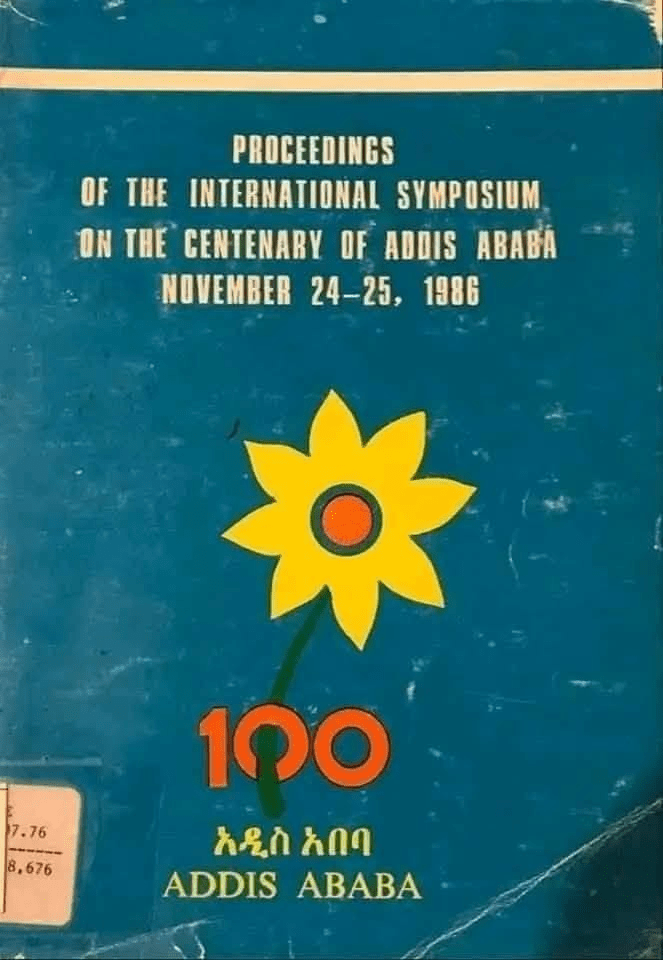
Proceedings of the International Symposium on the Centenary of Addis Ababa (November 24-25, 1986)
By Negash Qemant
In 1986, under the Derg regime, an international symposium was held to mark the centenary of Addis Ababa. The proceedings, published in a historical volume, brought together scholars from various disciplines to examine the history of the city. Among the contributions was a groundbreaking research paper that sheds light on the true origins of Finfinne—the city now known as Addis Ababa.
This paper, presented by scholars of the time, documented the historical reality that the area now occupied by St. George’s Church and the statue of Menelik was once known as Birbirsa. The research paper opens with a striking question:
“Who would imagine that the place where one can see today’s Saint George’s Church and the statue of Menelik was known as Birbirsa?”
The paper continues:
“This paper is about Birbirsa, a place located in Finfinne which later on came to be called Addis Ababa.”
The Name “Finfinne”
The symposium proceedings confirm what Oromo oral tradition has always maintained: the area was originally known as Finfinne—a name derived from the hot mineral springs (finfina) that bubble up from the earth in the area. The proceedings note that the name “Finfinne” was the original designation, and the name “Addis Ababa” was a later imposition.
The research paper documents that the area now known as Piassa, Arat Kilo, and the surroundings of St. George’s Church were once called Birbirsa Goro—an Oromo name. The paper also confirms that the area around the present-day St. George’s Cathedral was known as Birbirsa, an Oromo name that predates the arrival of Menelik and his forces.
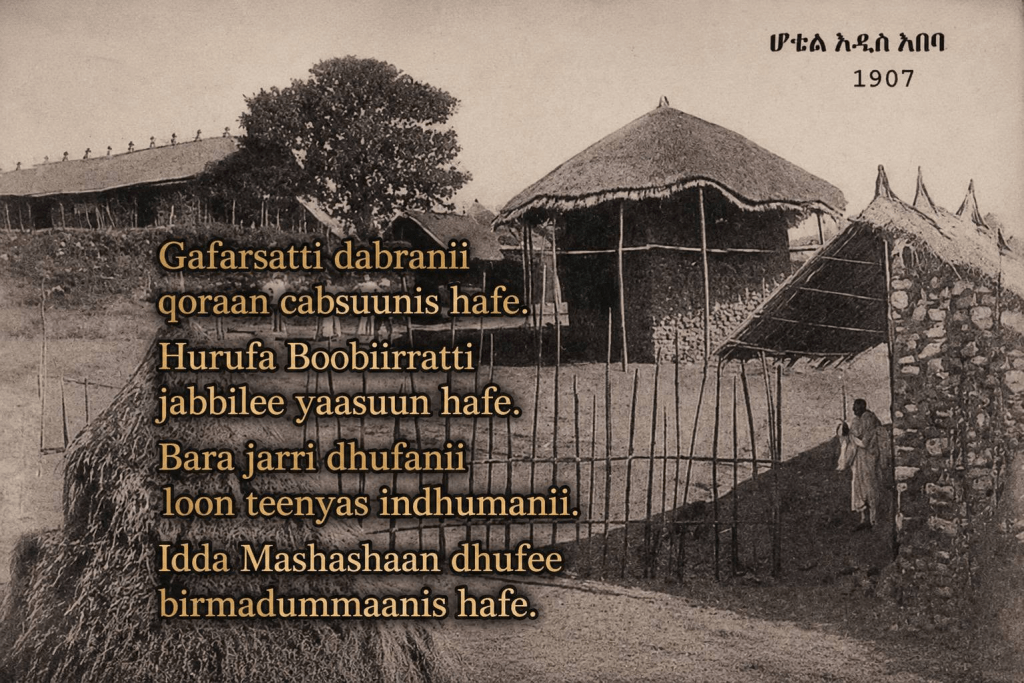
The proceedings document that the area was known by Oromo names: Gafarsa, Hurufa Boombii, Tulluu Daalattii, and others. These names were systematically replaced with new names after the establishment of the city under Menelik.
The Dream of Sahle Selassie
The symposium proceedings also address the well-known story of King Sahle Selassie’s “prophecy” about the site where his descendants would build a city. The proceedings treat this story as a genuine prophecy, which was used to legitimise the establishment of the city.
As the proceedings note, the story goes that King Sahle Selassie, while camping in the area, had a vision that his descendants would build a city on that spot. This “prophecy” was used to create an aura of divine legitimacy around Menelik’s decision to establish the capital.
However, as Blatten Geta Hiruy Wolde Selassie notes in his book The History of Ethiopia from the Queen of Sheba to the Victory of Adwa (p. 87):
“This land, which today is called Addis Ababa and is the capital of Ethiopia, was known as Finfinne at that time. King Sahle Selassie, while on a campaign, pitched his tent at the spot where the palace now stands and is said to have prophesied that his descendants would build a city there.”
The Role of Empress Taytu
The symposium proceedings and other historical sources confirm that it was Empress Taytu who gave the city its new name, Addis Ababa (“New Flower”). According to the account of Dr. Dejazmach Zewde Gebre Selassie, Empress Taytu wrote to Emperor Menelik:
“I have found the place we were looking for, and I have named it Addis Ababa.”
She sent this message to Menelik, who was at a different location at the time. The empress and the emperor, along with their armies, later pitched their tents on the hill known as Tulluu Finfinnee (the hill of Finfinne), where the hot springs (Hora Finfinnee) are located. After this, the emperor ordered that all official correspondence should bear the new name “Addis Ababa.”
However, the symposium proceedings also note that the area was already known as Finfinne and that the local population had long used this name. The renaming was an act of imperial assertion, not a neutral decision.
The Birbirsa Connection: Catholic Missionaries and the Oromo College
The symposium proceedings and Catholic missionary records confirm that Birbirsa Goro was the site of a Catholic mission and an Oromo college established by missionaries. The missionaries had introduced various species of flowers from Europe to the area, planting them in the college compound and surrounding areas. These flowers—not indigenous to the region—impressed Empress Taytu, who saw them when she visited the area.
The Catholic mission records also confirm that after the college was closed, the site was later chosen for the construction of St. George’s Church, which now stands in the heart of the city.
The Erasure of Oromo History
What emerges from these historical documents is a clear pattern: the systematic erasure of Oromo history and identity. The Oromo names—Finfinne, Birbirsa, Gafarsa, Hurufa Boombii, Tulluu Daalattii—were replaced with Amharic names. The story of Sahle Selassie’s “prophecy” was used to create a legitimising narrative that obscured the reality of Oromo dispossession.
The symposium proceedings, while an important historical document, were also a tool of propaganda. The Derg regime, like the imperial regime before it, sought to construct a narrative that legitimised the empire’s expansion. The “prophecy” of Sahle Selassie was treated as a genuine prediction, while the history of the Oromo people in the area was suppressed.
The Oromo Contribution to the City
The historical evidence also confirms that the Oromo people made significant contributions to the establishment and development of the city. The symposium proceedings document the role of Oromo labour in building the city, the supply of food and water by Oromo communities, and the presence of Oromo settlements in the area before the establishment of the capital.
The city’s name—Finfinne—is itself a testament to Oromo presence. The hot springs (finfina) that gave the city its name continue to flow, a reminder of the land’s original identity.
Conclusion: A History That Must Be Reclaimed
The proceedings of the 1986 symposium provide valuable historical evidence that confirms what Oromo oral tradition has always maintained: that Finfinne was originally Oromo land, and that the city was established through dispossession and conquest.
The evidence from the symposium proceedings, combined with the accounts of Blatten Geta Hiruy Wolde Selassie and Dr. Dejazmach Zewde Gebre Selassie, paints a clear picture:
The area was originally known as Finfinne and Birbirsa.
The Oromo people were the original inhabitants of the area.
The city was renamed and its history was systematically rewritten.
The narrative of Sahle Selassie’s “prophecy” was used to legitimise the dispossession.
As the Oromo people continue to demand recognition and justice, this historical evidence serves as a powerful reminder that the truth cannot be erased. The documents exist. The names remain in the landscape. The history is there for those who seek it.
The land remembers. The history endures. Finfinne is Oromo.
This feature article is based on the proceedings of the International Symposium on the Centenary of Addis Ababa (1986) and the historical accounts cited above. It is dedicated to all those who seek the truth about Oromo history and the origins of Finfinne.
A Story of Dispossession, Resilience, and the Unbroken Spirit of Gullallee
By Abdi Milkessa
The history of the Oromo people of Finfinne—the city known internationally as Addis Ababa—is a history of profound sorrow and indomitable resistance. It is a story that moves the heart to tears, sets the teeth on edge, and stirs the soul to action. It is a history that calls upon the Oromo people to reclaim their land, their identity, and their dignity.
As the wise saying goes: “The history of the Oromo Gullallee, like the history of other Oromo communities, grieves you, makes you weep, grinds your teeth in frustration, stirs your heart to action, and makes you proud.”
The Land and Its People
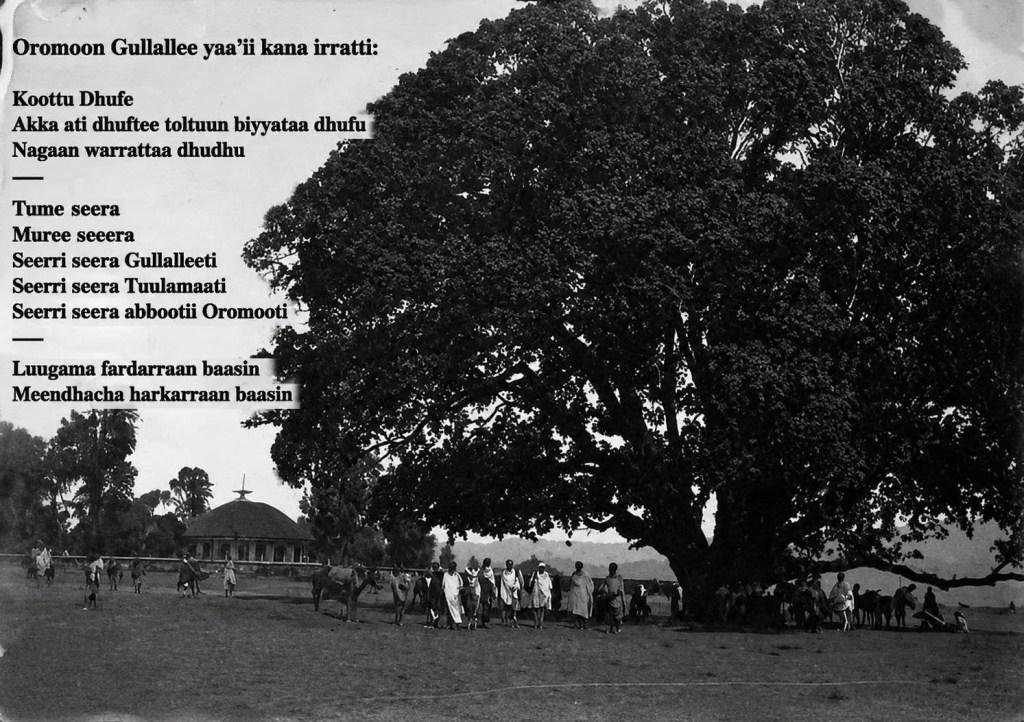
Finfinne was not built on empty land. It was built on the bones and blood of the Oromo people. The area now known as Addis Ababa was once the heartland of the Gullallee Oromo, one of the clans of the greater Tulama Oromo nation. Alongside the Gullallee, other Oromo clans—Eekkaa, Galaan, Meettaa Aabbuu, and Sululta—inhabited the region that surrounded what is now the capital.
The name Finfinne itself is Oromo, derived from the hot mineral springs (finfina) that bubble up from the earth in the area. For centuries, these springs were a source of healing and sustenance for the Oromo people and their cattle.
The land was rich and fertile, a land of pastures, rivers, and hills where the Oromo people lived according to the Gadaa system—a democratic governance structure that regulated every aspect of their lives.
The Arrival of the Colonizers
The arrival of Emperor Menelik II and his armies in the late 19th century marked the beginning of a dark chapter. Menelik, armed with modern European weapons, launched a campaign of conquest against the Oromo, Sidama, Gurage, and other peoples of the south. This was not a peaceful integration—it was colonisation.
The Oromo people of Gullallee were among the first to resist. They stood firm against Menelik’s forces, using their knowledge of the land and guerrilla tactics to defend their homeland. But the disparity in weaponry was overwhelming. The Oromo warriors, armed only with spears and shields, faced muskets and cannons.
One Oromo elder lamented the arrival of the colonisers in a poem:
“No more standing on Intotto, to look down at the pasture below, No more taking cattle to Finfinnee, to water at the mineral spring. No more gathering on Tulluu Daalattii, where the Gullallee assembly used to meet. Since Mashasha came, freedom has vanished.”
The Uprising of 1878
The Gullallee Oromo rose in a major uprising in 1878. They had endured years of oppression—land dispossession, cattle raids, and the subjugation of their women. The final straw came when Menelik’s soldiers began taking Oromo women by force.
According to oral tradition, the Oromo women of Gullallee, tired of being violated by the colonisers, gathered together and devised a plan. They told their husbands:
“We are being forced to sleep with the enemy. If you do not act, we will take matters into our own hands.”
The men, shamed into action, organised a rebellion. The Gullallee warriors launched a coordinated attack against the colonisers, using the cover of darkness and their intimate knowledge of the terrain.
But they were outmatched. Menelik sent a massive army under his nephew, Dajjaach Mashashaa Seifu, to crush the rebellion. The Gullallee were defeated. Thousands were killed, and the survivors were scattered.
The Dispossession Continues
The defeat of the Gullallee uprising was followed by a systematic campaign of ethnic cleansing. The Oromo were driven from the heart of Finfinne—from areas now known as Arat Kilo, Siddist Kilo, Piassa, Mercato, and beyond.
The land was given to Menelik’s generals and loyalists. Oromo farms were confiscated. Oromo cattle were taken. Oromo children were forced into servitude.
The Gullallee were scattered to the winds. Some fled to neighbouring Oromo areas—to Meettaa, Sooddo, Bacho, Ada’a Bargaa, Waliso, and Kuttaaye. Others remained in Finfinne, but their numbers dwindled as they were steadily pushed to the margins.
Even today, the dispossession continues. In the areas of Bole, Garji, Bulbula, Laaftoo, Makkannisa, Kaarra Qoree, Buraayyuu, Askoo, Shoogalee, and Qaallittii, Oromo families are being displaced to make way for new developments.
The Resilience of the Oromo Gullallee
Despite the centuries of oppression, the Oromo Gullallee have not been broken. They have preserved their culture, their language, and their identity against all odds.
Their resilience is captured in the songs they still sing:
“Bole was once a field of wheat and barley, Now it is covered with villas. The cattle that once grazed there are gone, The land has been taken by strangers.”
Another song laments the loss of the land while affirming the unbroken spirit of the people:
“Bole, O water of Bole, The villas have covered the field. Tomorrow we will go to Jimma, This evil time will pass. Stand firm, stand firm, do not give up!”
The Struggle Continues
The history of the Oromo Gullallee is not just a story of the past—it is a story of the present. The Oromo people of Finfinne and its surrounding areas continue to face displacement, marginalisation, and the erasure of their identity.
The current government, under the Prosperity Party, has continued the policies of its predecessors. The Oromo Special Zone surrounding Finfinne has been systematically dismantled. Oromo farmers in areas like Buraayyuu, Garjii, Bole, and Laaftoo have been displaced to make way for the expansion of the capital.
But the Oromo people have not given up. They continue to resist, to organise, and to demand justice.
A Call to Action
The history of the Oromo Gullallee is a call to action for all Oromo people. It is a reminder that the struggle for Finfinne is not just about land—it is about identity, dignity, and justice.
As the late Dr. Makuraa Bulchaa wrote:
“We have been lamenting for too long. Let us leave that behind and move forward—both at home and abroad. Let us organise our people, let us build our institutions, let us strengthen our unity, and let us fight for our freedom.”
The path to liberation is clear: unity, organisation, and determination. The Oromo people must overcome their divisions, strengthen their institutions, and build a coordinated struggle that will leave the colonisers with no option but to retreat.
Conclusion
The history of the Oromo people of Finfinne is a history of suffering, but it is also a history of resilience. From the heroes of Gullallee to the Qeerroo of today, the Oromo people have never ceased to resist.
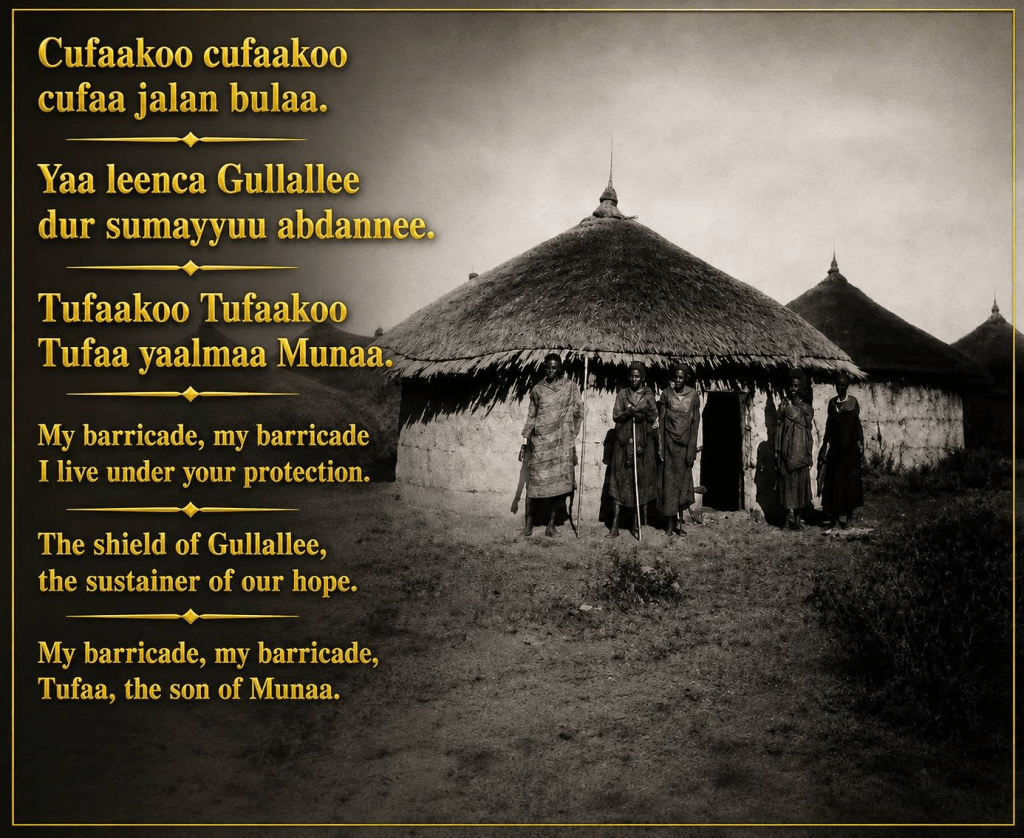
The memory of Tufaa Munaa, Hasanuu Wadaay, and countless other heroes reminds us that the struggle for freedom is a sacred duty. Their sacrifice calls us to action.
Finfinne is not just a city—it is the heart of Oromia. And as long as the Oromo people remember their history, they will never give up the fight to reclaim it.
This feature article is dedicated to the Oromo Gullallee and all the Oromo people who have endured displacement and oppression, and who continue to resist for a free and just Oromia.
Advocacy for Oromia was established in 2010 with the purpose of enabling and empowering Oromo people by providing accurate and timely information that will help to make better choices to create the kind of future in which they wish to live.
It also provides information focus on the major issues facing us in the 21st century and it is going to try and bring a balanced approach with factual information that is positive and solution based.
The website has been in operation for the last nine years with the mission of promoting and advancing causes of Oromo people through advocacy, community education, information service, capacity building, awareness raising and promotion.
The website is also the official site of Advocacy for Oromia Association in Victoria Australia Inc., a non-profit organisation, registered under the Associations Incorporation Reform Act 2012 in Victoria as April 2014.
Our team already had considerable community development experience and expertise. Our various projects helped to develop our confidence and the capacity of our agency. Our team used every gained knowledge, skills and experiences as an opportunity to design and develop new approaches, to documenting progress, supporting positive employment outcomes, liaising with community stakeholders, and conduct evaluation.
Advocacy for Oromia is devoted to establishing Advocacy for Oromia organisation to close the gaps where we can stand for people who are disadvantaged and speaking out on their behalf in a way that represents the best interests of them. We are committed to supporting positive settlement and employment outcomes for Victoria’s Oromo community.
Advocacy for Oromia Office
Addresses:
39 Clow St,
Dandenong VIC 3175
=====================
247-251 Flinders Lane
Melbourne VIC 3000
Activities Address
Springvale Neighbourhood House Inc
Address: 46-50 Queens Ave, Springvale VIC 3171
Postal Address:
P. O. Box 150
Noble Park, Vic 3174
With your support, we can continue to help community build a better future.
Advocacy for Oromia Mental Health Program
The aim of the program is to improving the mental health and well-being of Oromo community in Victoria. It aims to assist those experiencing, mental ill-health, their families and carers of all ages within this community to address the social determinants of mental health for Oromo community. It helps:
Identify and build protective factors,
Reduce stigma and discrimination
Build capacity for self-determination
Better understand mental wellbeing, mental ill-health and the impacts of trauma
The goal of the project is to increase mental health literacy of Oromo community that aims:
To assist people with mental health issues
To increase the capacity of mental health worker
To better understand mental wellbeing
To provide mental health education and information
To address the social and cultural causes of mental health issues
Advocacy for Oromia will organise information session, women performance, radio programs, culturally adopted conversations on Oromo Coffee Drinking ceremony, providing training for mental health guides and forum and producing educational materials on the selected groups and geographical area.
Human Rights Education Program
The Human Rights Education Program is a community based human rights program designed to develop an understanding of everyone’s common responsibility to make human rights a reality in each community.
Human rights can only be achieved through an informed and continued demand by people for their protection. Human rights education promotes values, beliefs and attitudes that encourage all individuals to uphold their own rights and those of others.
The aim of the program is to build an understanding and appreciation for human rights through learning about rights and learning through rights. We aimed at building a universal culture of human rights. Thus, we aimed:
To build an understanding and appreciation for human rights through learning about rights and learning through rights.
To build capacities and sharing good practice in the area of human rights education and training
To develop human rights education and training materials and resources
The goal of the project is to increase human rights literacy of Oromo community that aims:
To better understand human rights
To increase the capacity of human rights worker
To analyse situations in human rights terms
To provide human rights education and information
To develop solidarity
To strategize and implement appropriate responses to injustice.
The ultimate goal of education for human rights is empowerment, giving people the knowledge and skills to take control of their own lives and the decisions that affect them.
Human rights education constitutes an essential contribution to the long-term prevention of human rights abuses and represents an important investment in the endeavour to achieve a just society in which all human rights of all persons are valued and respected.
Advocacy for Oromia will organise information session, performance, radio programs, culturally adopted conversations on Oromo Coffee Drinking ceremony, providing training for Human Rights guides and forum and producing educational materials on the selected groups and geographical area.
Community Safety Program
The program aims to strengthen existing collaborations and identify opportunities for the development of partnerships aimed at community safety and crime prevention activities. This approach seeks to improve the individual and collective quality of life by addressing concerns regarding the wider physical and social environment. Importantly, community safety means addressing fear of crime and perceptions of safety as without this any actions to address the occurrence of crime and anti-social behaviour are of less value.