Daily Archives: August 21, 2026

Ifaanoo: A Sacred Oromo celebration of light and renewal of Faith and Unity
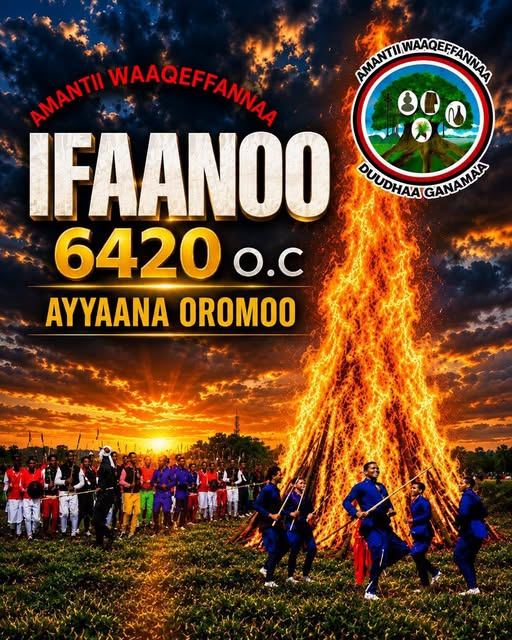
An Ancient Ritual of Illumination and Reaffirmation of Faith
In the rich tapestry of Oromo cultural and religious traditions, few ceremonies carry the luminous symbolism of Ifaanoo—a sacred celebration of light, spiritual renewal, and the reaffirmation of community bonds. Rooted in the ancient Waaqeffannaa faith system, this profound ritual embodies the Oromo people’s deep connection to creation, their Creator, and one another.
The Symbolism of Light in Oromo Spirituality
The term Ifaanoo derives from ifaa, meaning “light” in Afaan Oromoo. In the traditional Oromo worldview, light represents not only physical illumination but also spiritual clarity, moral purity, and the presence of divine blessing. Just as light dispels darkness, the Ifaanoo ceremony symbolises the dispelling of ignorance, conflict, and spiritual obscurity from the community.
The concept of light appears throughout Oromo religious practice. The rituals of Ulaa bahuu, Ifa bahuu, and Dhugaa bahuu are among the major components of ceremonies undertaken in the indigenous religion, where the entire family of followers is required to visit the shrine centre to receive blessing, good fortune, and reconciliation with Waaqaa (God) . These “emergence” rituals are deeply connected to the symbolism of coming into the light—emerging from darkness into divine presence.
The Ifaanoo Ceremony
Ifaanoo is closely tied to the Oromo calendar and the Gadaa system—the democratic social and political institution that organised Oromo life for centuries and is recognised by UNESCO as an Intangible Cultural Heritage of Humanity . The festival is fundamentally a ritual of gratitude to Waaqa (God) for life, health, and the bounty of the land .
In the Waaqeffannaa faith, followers celebrate various Ayyannota (ceremonies) to offer thanksgiving . Scholars have noted that the indigenous practices of the Oromo are believed to have been intact for centuries, involving the blessing and reconciliation of entire families . While the specific rituals of Ifaanoo vary by region, they share common elements:
- Gathering at sacred sites — often at shrines or natural locations deemed spiritually significant
- Light rituals — the symbolic use of fire, candles, or the rising sun to represent divine presence
- Blessings by elders — led by the Abba Gadaa or spiritual leaders who offer prayers for the coming season
- Communal singing and dancing — traditional songs and ululations that express joy and gratitude
- Offerings to Waaqa — gifts of dadhii (honey beer), dufo (bread), and other symbolic items
- Reconciliation — resolving conflicts before participating, reinforcing that one cannot give thanks while holding a grudge
A Social Bond Across Communities
The ceremony is profoundly social. Irreechaa—a related celebration—has been described as “a social bond within Oromo people that brings them closer to each other” . Ifaanoo similarly serves as a gathering point, bringing Oromo people from different areas together regardless of their religious background .
In diaspora communities, ceremonies like Ifaanoo and Irreechaa take on added significance. In Bergen, Norway, the festival has been celebrated as the only place in Europe where the event takes place, with participants travelling from across European countries, emphasising how religious celebrations offer opportunities for families and friends to reaffirm relations through face-to-face interaction .
Renewal of Faith and Unity
At its core, Ifaanoo is a reaffirmation of faith in Waaqa and a renewal of the community’s covenant with the divine. It embodies the principle that light represents not only spiritual clarity but also the ongoing presence of Waaqa in the lives of the faithful.
The blessing, which is a central part of Waaqeffannaa ceremonies, is described as a time when “the entire family members of followers of the religion and all their living animals are required to visit the shrine center to have blessing, good fortune and reconciliation with Waaqaa (God)” . This is a holistic act, covering all aspects of life—from the spiritual to the physical to the economic.
Ifaanoo also embodies the values of unity. Like Irreechaa, which “is now observed by the majority of Oromos, regardless of their religion” , Ifaanoo brings together followers of Waaqeffannaa, Muslims, and Christians who come together and celebrate with joy . It is a symbol of cultural identity and social cohesion.
A Living Tradition
Ifaanoo remains a living tradition, celebrated in Oromia and diaspora communities worldwide. It is a powerful expression of Oromo identity and resilience—a declaration that the light of tradition continues to shine brightly despite the challenges of modernity.
As the Oromo people continue to preserve and celebrate their heritage, ceremonies like Ifaanoo ensure that the light of their culture, faith, and unity will illuminate the path for future generations.

The Oromo Calendar and the Year 6420: A Legacy of Ancient Timekeeping
Understanding the Origins of One of Africa’s Oldest Calendrical Systems
By Maatii Sabaa
In March 2026, when most of the world marked the beginning of a new year according to the Gregorian calendar, the Oromo people—across Oromia and the global diaspora—celebrated the arrival of a different milestone: the Oromo New Year, 6420. For many outside the Oromo community, this number raises a fundamental question: Where does the year 6420 come from?
The Oromo Calendar: A 2,300-Year-Old Legacy
The Oromo calendar is one of Africa’s oldest indigenous calendrical systems. It is believed to have been developed by the Oromo people around 300 BC . This places its origins at approximately 2,300 years ago—a period when the Oromo were already sophisticated observers of the cosmos.
Known as the Borana calendar or the Dhaha/Henni calendar, it is a lunar-stellar calendar system. This means it relies on astronomical observations—specifically, the phases of the moon in conjunction with the rising and setting of seven particular stars or constellations.
The calendar’s sophistication lies in its integration of astronomy with daily life. It consists of 12 months and 354 days in a year, based on the lunar cycle. It has no weeks, but rather a name for each day of the month. The first day of the Oromo year begins in the month of Bitootessaa (March), when the constellation Triangulum is in conjunction with the new moon.
The Significance of the Number 6420
The year 6420 is reached by counting forward from the calendar’s inception around 300 BC. While the exact starting point is a subject of ongoing scholarly discussion, the calendar’s antiquity is well-established.
For the Oromo people, the calendar is more than just a way to count time—it is a cornerstone of their identity and cultural continuity. As one elder explained at the Walisoo Liiban celebration of the 6420 New Year:
“Observing Birboo at our Galma is not just about marking a calendar. It is about remembering who we are. It is about connecting our past to our future, grounding ourselves in the values of balance, respect for all creation, and community that Waaqeffannaa teaches” .
The calendar is tied to the traditional Oromo religion, Waaqeffannaa, and is used to schedule the Gadaa system of elections and power transfer. The Gadaa system, recognised by UNESCO as an Intangible Cultural Heritage of Humanity, is itself deeply connected to the calendar.
Archaeological and Astronomical Evidence
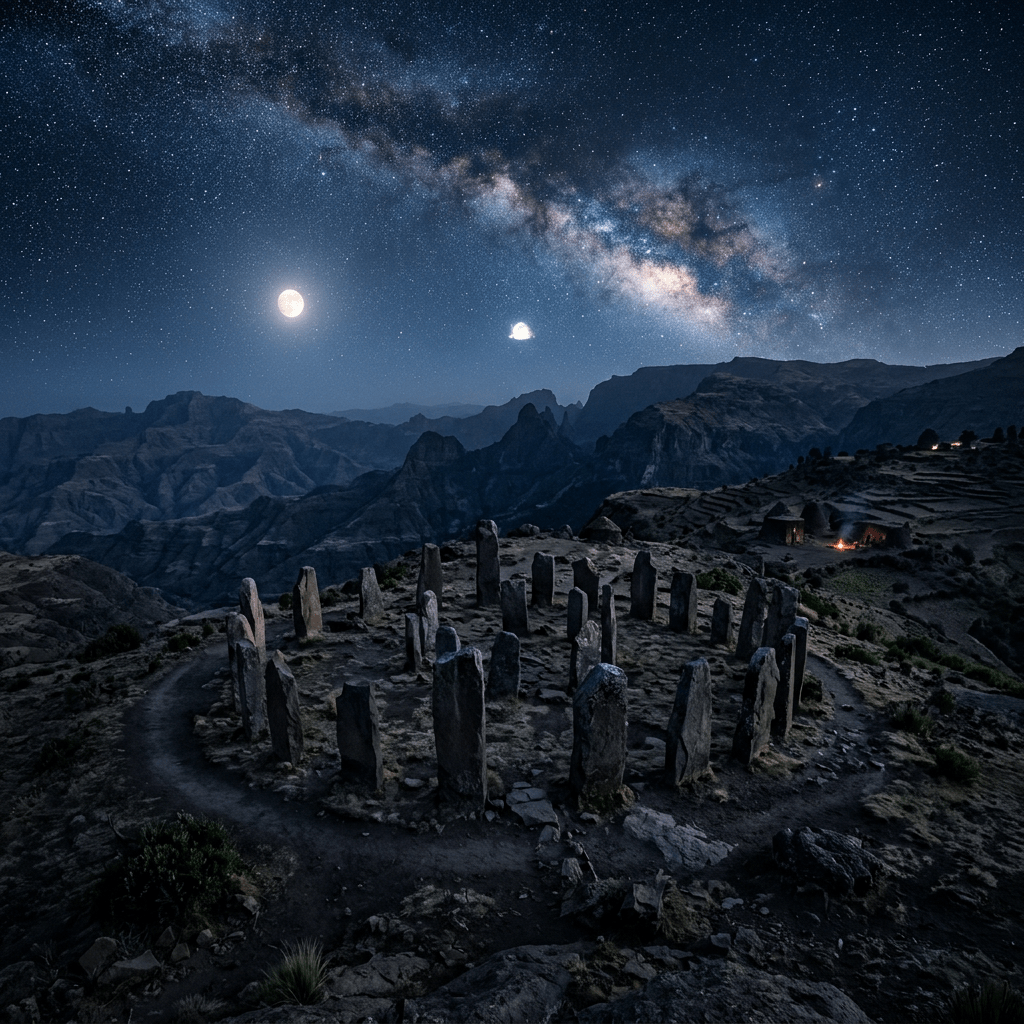
The Oromo calendar’s origins are not merely a matter of oral tradition. The Namoratunga archaeological site near Lake Turkana, Kenya, has been central to understanding its antiquity. Some scholars have argued that the site, dating to around 300 BC, contains evidence of an early Cushitic calendar that shares astronomical alignments with the Oromo calendar. The site’s basalt pillars are aligned with seven star groups that correspond to the Borana star groups still used in the Oromo calendar today.
However, it should be noted that the relationship between Namoratunga and the Oromo calendar has been debated. Astronomer and archaeologist Clive Ruggles, after re-examining the site, concluded there is no direct relationship. Nevertheless, the broader scholarly consensus acknowledges the calendar’s ancient roots and its continuity into the present day.
A Living Calendar in the Modern World
Today, the Oromo calendar remains a living tradition. In January 2026, Waaqeffannaa faithful gathered at the Galma Amantaa (House of Worship) in Walisoo Liiban, Oromia, to observe the Oromo New Year, Birboo, marking the year 6420. The celebration, which included prayers for peace (nagaa), love (jaalala), and unity (tokkummaa), was described as “a powerful reaffirmation of an ancient identity” and “a community’s declaration of continuity”.
The calendar’s months and day names, with their astronomical origins, are still used by Oromo communities in both Ethiopia and Kenya. The Ayyaantu—Oromo time-experts with knowledge about stars—continue to track time astronomically, preserving a tradition that has survived for millennia.
Conclusion: A Calendar of Identity and Continuity
The Oromo calendar, with its year 6420, is a testament to the ancient astronomical knowledge of the Oromo people and their enduring cultural identity. Its development around 300 BC and its continued use today represent one of the longest continuous calendrical traditions in the world. For the Oromo people, the calendar is not just a way to count years—it is a declaration of continuity, a connection to ancestors, and a guide for the future.
As the Oromo New Year 6420 was celebrated, the message was clear: “May this New Year bring you peace, love, and unity” .
This feature article is dedicated to the custodians of the Oromo calendar and to all those working to preserve and promote Oromo cultural heritage.






