The Power of One Voice: Ambassador Dagifee Bulaa on Ethiopia’s Electoral Responsibility
By Bariisaa Newspaper
May 23, 2018
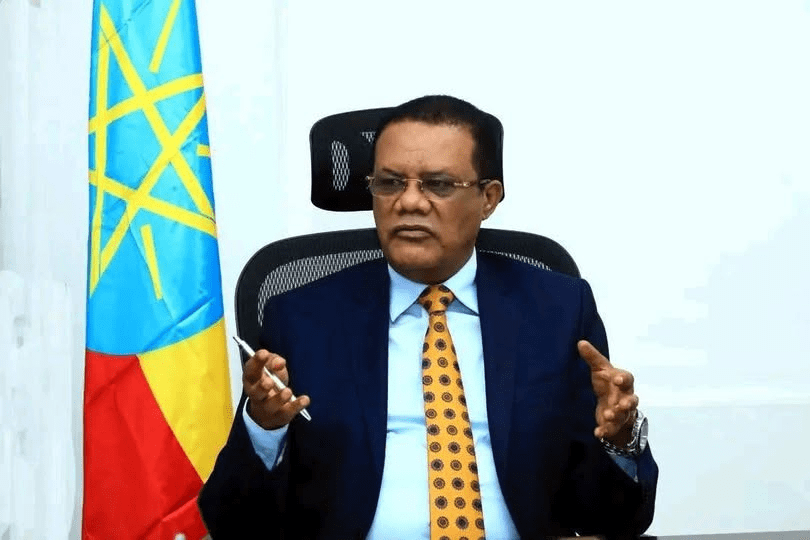
In the quiet corridors of the Federal Institute of Law and Justice, Ambassador Dagifee Bulaa speaks with the measured precision of a man who has spent decades navigating the complex intersections of justice, diplomacy, and national transformation. As the current Director of Ethiopia’s Federal Institute of Law and Justice, his voice carries the weight of experience—from serving as ambassador to Uganda, Rwanda, Burundi, and the Democratic Republic of Congo to leading the Ethiopian Football Federation and media oversight.
But today, on the eve of Ethiopia’s seventh national election, his message is both urgent and timeless: “In an election, the people must understand that every single vote is decisive, and they must participate.”
Building Justice from the Ground Up
The Federal Institute of Law and Justice, under Ambassador Dagifee’s leadership, operates on four fundamental pillars: conducting research on justice sector issues, providing training to legal professionals, collecting evidence from various jurisdictions, and spearheading comprehensive reform efforts.
“We don’t just conduct research and leave it on a shelf,” Ambassador Dagifee explains from his office in the Ayat area of Addis Ababa. “Our research has directly contributed to reforming legal procedures, including the long-overdue revision of the Criminal Procedure Law that served for over sixty years.”
What sets the Institute apart is its three-tiered training approach—a comprehensive system designed to transform theoretical legal education into practical, applied justice. Newly appointed judges and legal professionals undergo nine months of intensive training before ever hearing a case. Sitting judges receive five-to-ten-day refresher courses. And practicing lawyers must complete five days of paid continuing education annually to maintain their licenses.
Perhaps most striking is the Institute’s embrace of technology. “We have now implemented E-learning platforms,” Ambassador Dagifee notes. “Judges and legal professionals can complete their assignments from wherever they are, receiving their certifications without disrupting their court schedules.”
A Dictionary for Justice
One of the Institute’s most ambitious projects has been the creation of the first-ever comprehensive Oromo language law dictionary—the “Walabu Law Dictionary”—alongside an updated Amharic version completed two years ago.
This was no academic exercise. Ambassador Dagifee recounts the urgent need: “For too long, legal terminology has been interpreted inconsistently across different regions. A term that works in Shawa might cause confusion in Wallagga, Boorana, Gujii, Arsi, or Hararge. When a judge’s decision affects someone’s property and very life, precise understanding of legal terms is not optional—it is essential.”
The dictionary took two and a half years to complete, bringing together legal scholars, linguists, and practitioners from across Oromia. “This is unprecedented in Ethiopia,” he says with pride. “Not just in quality, but in scope. And it is available in both print and soft copy, ensuring accessibility for judges, lawyers, police, and anyone working in the justice system who works in Oromo.”
The Justice Sector’s Electoral Duty
As Ethiopia prepares for its seventh national election, Ambassador Dagifee emphasizes the critical role of justice sector institutions in ensuring the process is democratic, fair, peaceful, and free.
The Institute recently convened a symposium for judges and legal professionals specifically focused on their electoral responsibilities. “The role of four key institutions—NEBE, police, prosecutors, and courts—is paramount,” he explains.
The electoral board creates the enabling environment. Police ensure security around polling stations. Prosecutors investigate and refer any electoral disputes to the courts. And the courts adjudicate based on electoral law.
“The election has proceeded peacefully so far,” Ambassador Dagifee observes. “Both parties and individuals have been given the opportunity to compete wherever they wish. Even those who have stepped back, perhaps doubting their chances of victory, must remain engaged.”
On Federalism and National Unity
Some political parties have argued that Ethiopia’s federal system divides rather than builds. Ambassador Dagifee disagrees—but with an important qualification.
“Twenty-eight countries worldwide, including the United States, Canada, Germany, and Nigeria, operate under federal systems. There is nothing unique about Ethiopia’s federalism that makes it inappropriate for our context.”
He continues: “Properly implemented, federalism allows regions to govern themselves while uniting under a national framework. The problem has never been federalism itself, but how it has been implemented. We have not adequately focused on what binds us as one nation.”
A Final Appeal
As our interview concludes, Ambassador Dagifee returns to the eve of the election with a final message to every Ethiopian holding a voter card.
“The election belongs to all the people of this country. Every citizen who holds a voter card must cast their vote. Our hope is that tomorrow’s election will be peaceful, democratic, fair, and free for every Ethiopian.”
His words echo through the Institute’s modern facility—a 10,000 square meter campus built with 3.5 million Euros of European Union support, complete with training halls, dormitories, cafeteria, library, E-learning studio, and a 40 million Ethiopian birr borehole.
But the most important resource, Ambassador Dagifee would argue, is not in the buildings or the technology or even the new law dictionary. It is in the hands of millions of Ethiopian voters, each holding a single vote, each deciding to make their voice heard.
=======
This feature story was developed from an interview conducted by Bariisaa Newspaper’s Natsaannat Taaddasa on May 23, 2018

Posted on June 2, 2026, in Aadaa, Events, Finfinne, gender, Information, Media, News, Oromia, Press Release, Promotion. Bookmark the permalink. Leave a comment.






Leave a comment
Comments 0